AI Order Processing: The Smarter Way to Manage Orders at Scale
Orders are the lifeblood of any business. But managing them is a whole different ball game.
A customer submits a purchase order by email. Another person places an order through a portal. Someone else calls your customer service team with a request. Soon, your operations team is juggling information from many sources. They have to put this together and ensure that every order is fulfilled properly and on time.
As orders multiply, so does complexity. Teams spend countless hours scraping data, confirming details, updating systems, and dealing with exceptions.
As a result of this chaos, many companies continue to struggle with manual work, lag times, and expensive mistakes, even with regular automation.
This is where AI order processing is changing the game.
AI Agents differ from traditional automation. They can understand context, make decisions, coordinate actions, and learn from business processes over time. They don’t just automate tasks — they orchestrate workflows.
For companies focusing on improving operations and customer experiences, AI agents are the cornerstone of next-generation order management.
A Look at – What Is AI Order Processing?
AI order processing uses smart AI agents to automate and improve the whole order cycle. This begins with getting customer requests. Then, it continues to validate order details and update OMS systems.
AI agents differ from traditional automation. While traditional systems follow set rules and workflows, AI agents can understand context. It is also able to process unstructured data, decide, and act in real-time. They can process emails, chats, voice calls, portals, and more. This happens without needing manual work for each step.
Imagine AI order processing as a team of digital workers working together in the background. One agent captures incoming order information. Another extracts key details. A third validates the data. Others coordinate workflows, validate business rules, and update OMS and TMS systems. How does this benefit your business? It brings speed, accuracy, and the ability to scale faster. Here’s a more detailed look at how AI agents improve order processing.
Manual Order Processing Is Costing You More Than You Think
How are AI Agents Used in Order Processing?
AI agents enhance order processing by moving beyond traditional automation rules. We are talking about actual reasoning, using memory, and real-time feedback loops, to name a few. Here’s a closer look.
1. Intelligent Order Capture and Validation
One of the biggest challenges in order management is dealing with unstructured information.
Customers don’t always submit orders in a standardized format. Some people send emails. Others attach spreadsheets. Many include key details hidden in long conversations.
Traditionally, employees must review and interpret this information manually. AI agents eliminate that burden by reading, understanding, and extracting relevant data automatically.
They can spot missing fields, flag inconsistencies, and check information before it enters business systems. This greatly cuts down on processing errors.
2. Autonomous Workflow Coordination
Order processing rarely involves a single department.
Sales, inventory, finance, logistics, and customer service often work together. They have to coordinate before fulfilling an order.
AI agents serve as intelligent orchestrators across these functions. They shuttle information between systems, request approvals, and make sure every stakeholder has access to the right data.
This removes bottlenecks and ensures orders flow seamlessly through the pipeline.
3. Real-Time Exception Handling
Even the best of processes run into exceptions.
Stockouts, pricing errors, incomplete customer information, and delivery-related problems interfere with the process flow.
Instead of letting these problems sit unnoticed in someone’s inbox, AI agents flag them. They can take care of simple problems themselves. The complex ones get passed on to the right person.
This means quicker resolution and fewer hold-ups.
4. Faster Order Processing and Customer Response
Customers expect fast responses.
When they place an order, they want to be sure it has been received. They also want to confirm it’s moving through the fulfillment process.
With AI order processing, organizations can handle orders in seconds. Customers can count on faster confirmations, speedier updates, and more dependable service.
The result is enhanced trust and customer satisfaction.
5. Continuous Process Optimization
Conventional automation follows the same instructions over and over. However, the AI agents are trained based on real-world data and previous outcomes. They start to spot repetitive patterns over time, detect inefficiencies, and suggest improvements.
This capability enables the process to be continuously evolved without human intervention.
The Top Benefits of Using AI Agents in Order Management?
1. Scale Operations Without Increasing Headcount
As order volumes increase, companies are often faced with a tough decision — hire more people, or risk overwhelming the teams they already have. AI agents help eliminate that trade-off. Automating order capture, validation, data entry, and workflow coordination helps reduce the workload. This means less need for extra staff. This allows organizations to scale operations without proportionally increasing headcount.
2. Faster Order Processing
Manual processing of orders can take 10 to 15 minutes per order. Teams have to read emails, extract information, verify details, and then update multiple systems. AI agents can perform many of these tasks in 1–2 minutes—or even seconds, in some cases. Order confirmation processing gets faster, order fulfillment cycles get shorter, and customers become happier.
3. Lower Operational Costs
Every manual touchpoint adds time and cost to the order management process. When workers spend hours doing the same administrative tasks over and over, operational costs start adding up. AI agents reduce the need for manual intervention, allowing teams to concentrate on higher-value activities while lowering the overall cost of processing each order.
4. Eliminate Costly Errors
A small mistake in product quantities, pricing, customer info, or shipping can lead to expensive losses. Frequent returns, lost revenue, and unhappy customers can badly affect the brand value. AI agents verify information, looking up to knowledge bases including business rules, inventory records, customer agreements, and past data before they process orders. This significantly reduces human error and helps organizations avoid expensive downstream corrections.
The result is a quicker, more accurate, and scalable order management system. It boosts efficiency and helps the business grow.
Industry Use Cases
1. Manufacturing
Challenge: Manufacturers often deal with large volumes of complex B2B orders. An order can have multiple product configurations, special pricing arrangements, lead times, and production requirements. Manually processing these orders for production may delay workflow and cause errors.
Solution: AI agents support manufacturers by extracting details of orders from emails and messages from customers. They cross-reference this data with production schedules, verify stock availability, and update OMS/TMS systems automatically.
Benefits:
- Accelerates quote-to-order conversion
- Reduce costly rework and scrap due to manual entry errors
- Reduce manufacturing wastes
- Prioritizes high-value or time-sensitive orders
- Tracks customer-specific compliance, quality
- Identifies orders that may impact production line efficiency
2. Retail and eCommerce
Challenge: Retail and ecommerce now operate on websites, marketplaces, mobile apps, social commerce channels, and in-store. It’s not always easy to sync inventory and order fulfillment across these channels.
Solution: AI agents enable the retailer to efficiently fulfill omnichannel customer orders by capturing orders in real time, validating details, and orchestrating the order processing operations. When there is more demand in seasonal sales, AI agents will contribute to these operations efficiently.
Benefits:
- Consolidates orders from multiple sales channels into a single processing workflow.
- Detects duplicate orders submitted across different channels.
- Prevents overselling by validating stock availability.
- Routes orders faster to the nearest fulfillment center.
- Improves order accuracy for products with multiple variants.
- Minimizes cart-to-fulfillment delays, especially during peak seasons.
3. Distribution and Logistics
Challenge: Speed and visibility are paramount for distributors and logistics providers. The orders can include a combination of different warehouses, shipping partners, and delivery dates. Disruptions can change what customers expect and what it takes to run day-to-day operations.
Solution: AI agents can improve shipment coordination, keep transport systems informed with the right data, monitor order status, and detect potential problems. This creates a more resilient and responsive logistics operation.
Benefits:
- Validates delivery locations, service zones, and transportation constraints.
- Reduces manual order entry errors that can lead to shipment delays.
- Prioritizes urgent, time-sensitive, and high-value shipments.
- Help route orders to the most suitable warehouse or distribution centers.
- Reduces order backlogs during seasonal peaks.
- Enables 24/7 order intake and processing.
4. Healthcare and Medical Supply
Challenge: Healthcare providers rely on the correct purchasing and delivery of essential supplies. A missing item or a shipment delay can lead to serious consequences.
Solution: AI agents make procurement easier. They help suppliers validate requests faster based on inventory availability, coordinate approvals, and update systems in real-time to eliminate medical procurement delays. Healthcare providers can be reassured that vital supplies will arrive where and when they are needed most.
Benefits:
- Validates orders against approved product catalogs.
- Prioritizes urgent orders for critical care and emergency departments.
- Prevents ordering errors for regulated, high-value products.
- Ensures compliance with healthcare procurement policies.
- Helps prevent stockouts of life-critical supplies with 24/7 order processing.
- Supports multi-location healthcare networks.
FAQs
1. Can AI agents integrate with ERP systems for order processing?
A. Yes. AI agents can connect to your ERP, OMS, and TMS systems using APIs and connectors. This allows for smooth data synchronization, automated refreshes, and full workflow orchestration.
2. Are AI agents better than traditional order processing automation?
A. Traditional automation is effective for repetitive, rule-based tasks. AI agents take it further. AI agents enhance order management by combining smart order capture, automated checks, workflow coordination, real-time issue handling, and ongoing improvement. This makes the process smarter and self-enhancing.
3. Can AI agents process orders from emails, chats, and voice calls?
A. Absolutely. Modern AI agents can gather information from different channels. They extract important details and start workflows automatically. This happens no matter how the order was received.
4. How do AI agents reduce order processing errors?
A. AI agents validate information against business rules, inventory records, pricing agreements, and customer data before processing orders. This significantly reduces the risk of manual data entry mistakes and operational errors.
Introducing OrderFlow AI Agent Powered by Fingent
OrderFlow AI Agent is Fingent’s smart AI Agent-powered solution for efficient order processing. The AI Agent can be custom-integrated with your existing TMS and OMS systems to act as a digital worker and automate your entire order processing workflow. It uses a multi-agent architecture. Specialized AI agents team up to handle requests, validate information, and act in real time without much human intervention. Here’s a closer look at how the system works.
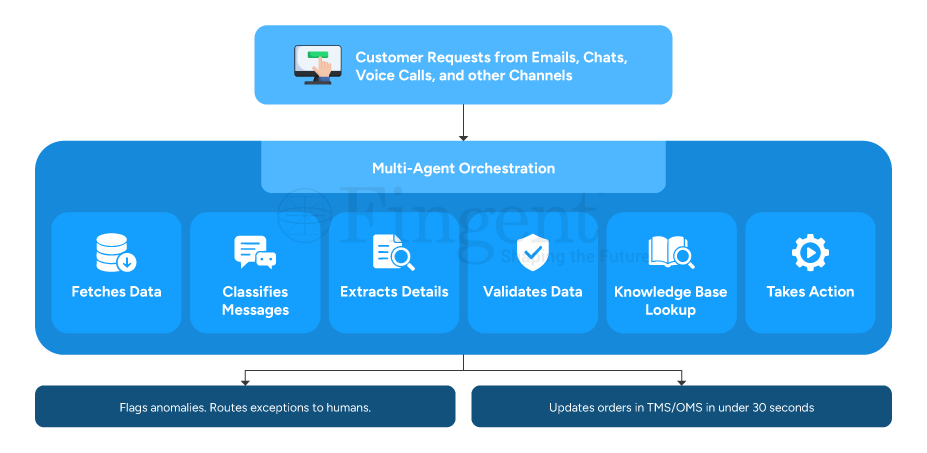
1. Captures Orders from Any Channel: The system automatically identifies and captures relevant order information from emails, chats, voice calls, portals, and more, as soon as it arrives.
2. Understands and Classifies Requests: The OrderFlow AI Agent intelligently classifies each interaction and routes it through the appropriate workflow, whether it is order modification requests, cancellations, inquiries, or support queries.
3. Extracts Critical Order Details: The system automatically gathers key information like product details, quantity, pricing, delivery needs, customer info, or special instructions without manual intervention.
4. Validates Information Against Business Rules: Before processing an order, the system validates its accuracy and compliance by comparing it against specified business rules.
5. Leverages Enterprise Knowledge: The system can access internal knowledge bases, contracts, historical transactions, policies, and documentation to make informed decisions and support complex order-processing scenarios.
6. Executes Actions Automatically: The OrderFlow AI Agent takes action in real-time. It updates the OMS/TMS systems with accurate order details and customer data. If exceptions are found, they’re sent to the right team for review. This ensures that human-in-the-loop for enhanced safety.
The Outcome:
- Zero-touch order entry
- Faster order processing and fulfilment
- Human-in-the-loop exception management
- Seamless OMS and TMS integration
- Reduced manual effort and operational costs
- Continuous process optimization
- Enhanced safety with robust AI guardrails and security policies
Don’t Let Traditional Order Processing Methods Sloth Your Business Leverage AI Agents and Scale Without Limits
Conclusion
Order processing is not just about moving information from one system to another. It’s a key business function that directly impacts customer satisfaction, operational efficiency, and business expansion.
Organizations must ensure efficiency and speed at the core of the order processing workflow.
AI order processing addresses this with seamless understanding of context, making decisions, handling exceptions, and adapting to changing business needs. That’s exactly what businesses need today.
It’s time to reshape and redefine with the latest technologies and find a competitive edge in the market.
Stay up to date on what's new

About the Author

Recommended Posts

17 Sep 2026 B2B
Agentic AI Governance: A Practical Framework for CXOs and IT Leaders
AI pilots are easy to approve. However, production says a different story. Once an AI agent starts making decisions, calling business systems, handling customer interactions, or triggering actions without waiting……

03 Sep 2026 B2B
How AI Agents Are Simplifying the Adoption of AI in Logistics
AI in logistics is changing the game for businesses, from forecasting and order processing to lead generation and customer service. Yet, many logistics leaders struggle to move from experimentation to……

19 Aug 2026 B2B
Agentic AI vs RPA: Where Automation Hits a Ceiling
Most enterprises treat automation as one. That's the first mistake. Some keep funding RPA for problems it was never built to solve. Others replace working RPA bots with agentic AI……

07 Aug 2026 B2B
Agentic AI for Business: 8 Operational Signs You’re Ready
Most CTOs and CIOs have already sat through several agentic AI pitches this quarter, each one promising transformation with a slightly different slide template. Awareness was never really the problem.……
Featured Blogs







Stay up to date on
what's new



Talk To Our Experts