Most CTOs and CIOs have already sat through several agentic AI pitches this quarter, each one promising transformation with a slightly different slide template. Awareness was never really the problem. What’s missing is a practical way to check if agentic AI fits with current operations. This needs to consider the systems and processes already in place.
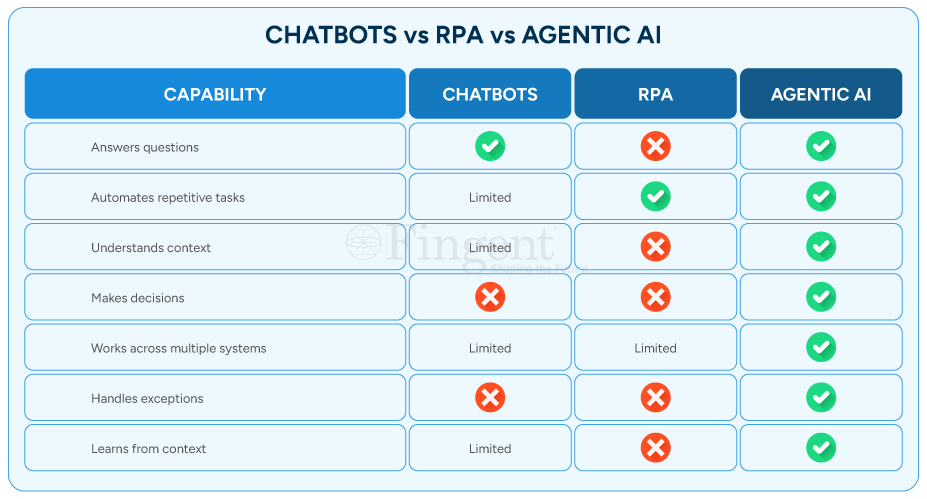
Chatbots and RPA automate individual tasks. But an agentic AI runs the whole workflow. It is a judgment-based, multi-step model that involves reading context, coordinating across systems, and taking action without someone approving every stage. One executes instructions, the other exercises judgment. That’s the actual dividing line.
Research indicates that software development projects are shifting from tools built for people to systems built for autonomous agents. That scale of projected investment says something. Agentic AI for business is becoming standard enterprise infrastructure, not a passing trend.
Not every business will see itself in the patterns below, and that’s fine. It usually just means agentic AI isn’t a priority yet. But for businesses already wondering whether they’re ready. The eight signs below are a faster way to find out than sitting through another vendor call. Often, several of these signs show up together. But they all trace back to the same ceiling. How much manual effort a business can absorb before growth stalls.
Discover How Agentic AI Can Transform Your Operations
Explore Now!
The 8 Signs That Indicate Your Business Is Ready for Agentic AI
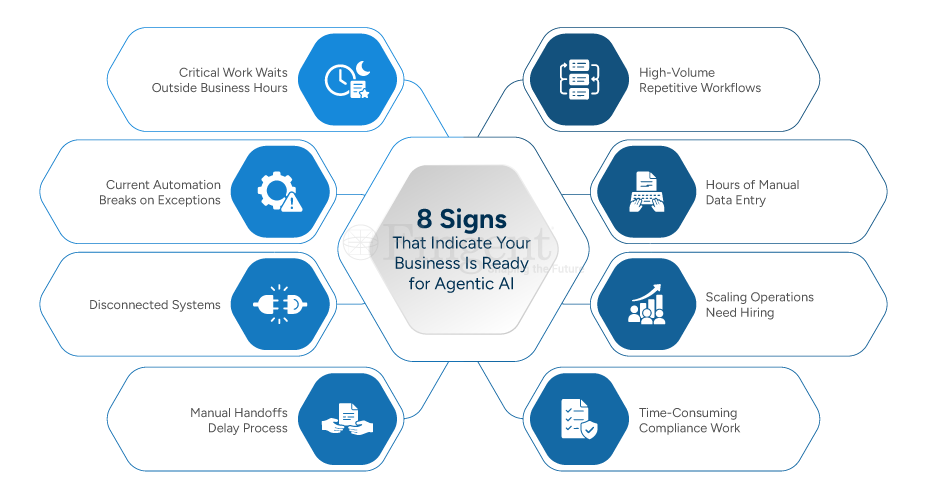
You don’t need another strategy workshop to answer this question. Start by looking at where work slows down. Look at where manual effort keeps creeping up, and where your best people are stuck doing repetitive tasks instead of the work they were hired for. The more of these signs that sound familiar, the stronger the case for exploring an agentic AI solution.
1. The same multi-step process runs thousands of times a month
Tasks like loan applications, identity verification, refund requests, and customer onboarding follow a near-identical sequence every time. If employees must monitor every stage or manually resolve routine exceptions, the volume itself reveals the underlying constraint. The limit is not complexity, but manual execution.
2. Your staff’s time gets swallowed by reading, extracting, and re-entering data
KYC reviews, insurance claims, purchase order validation, regulatory forms all of it involves moving information from one place to another. When your most experienced people spend more hours transferring data than actually analyzing it, you’re burning expertise on work a system could handle.
3. Costs keep climbing because of manual processing, not because of growth
When workloads increase, plenty of organizations just hire more people rather than fixing the underlying process. Compliance teams expand every time regulations shift; support teams grow alongside the business. Over time, that pattern doesn’t just add headcount; rather, it adds errors, rework, and a ceiling on how far you can scale. This isn’t about eliminating the people doing this work today. It’s about moving them off transcription and into judgment calls the system can’t make. The teams that adopt early usually redeploy, not downsize.
4. Compliance documentation eats a disproportionate share of your operations
In industries governed by AML, GDPR, HIPAA, or SOX, huge amounts of time go into documentation, reporting, and recordkeeping. Because it’s scattered across departments, leaders often don’t realize just how much of the day gets absorbed by the same compliance work, repeated endlessly.
5. Manual handoffs are quietly slowing everything down
Beyond staffing costs, manual work slows decision-making. Requests sit in approval queues. Routine cases take longer than they should. Customers wait because someone has to physically move a case from one stage to the next. In logistics, this often looks like shipments stuck behind manual exception-handling rather than any real capacity problem. Here the process is the bottleneck, not the volume.
6. Fragmented tools are forcing your team to do the integrating
CRM here, ERP there, and a compliance tool that doesn’t link to either, and the employees end up copying data between platforms by hand. That’s when delays, duplication, and errors happen. Agentic AI doesn’t need you to replace what you’ve invested in. It can manage work across those separate systems instead.
7. Your automation falls apart the moment something unusual happens
RPA and rule-based bots only work inside the exact conditions they were built for. An unusual claim, a mismatched document, an incomplete form, or anything outside the rules, and the system stops and hands it back to a person. If your team spends more time rescuing automation than benefiting from it, the workflow needs judgment. More rules won’t fix that.
8. Work sits untouched overnight because it needs a decision, not a lookup
Claims, tickets, approval requests that arrive after hours often just wait until someone’s back at their desk. It’s rarely about task difficulty; it’s that the next step needs a judgment call the current system can’t make on its own. When timing becomes as much of a bottleneck as volume, you likely need something that can decide, not just queue.