Intelligence Integration: Making AI Work Inside the Enterprise

Artificial Intelligence is no longer a buzzword. It has grown into a board-level priority across industries. AI adoption is also growing rapidly, beating analyst estimates and industry expectations. 

According to McKinsey’s 2024 State of AI report, more than 72 percent of companies have implemented at least one AI use case, and nearly half are already experimenting with generative AI. 

All these hints that AI is no longer a future initiative but a present-day operational expectation.

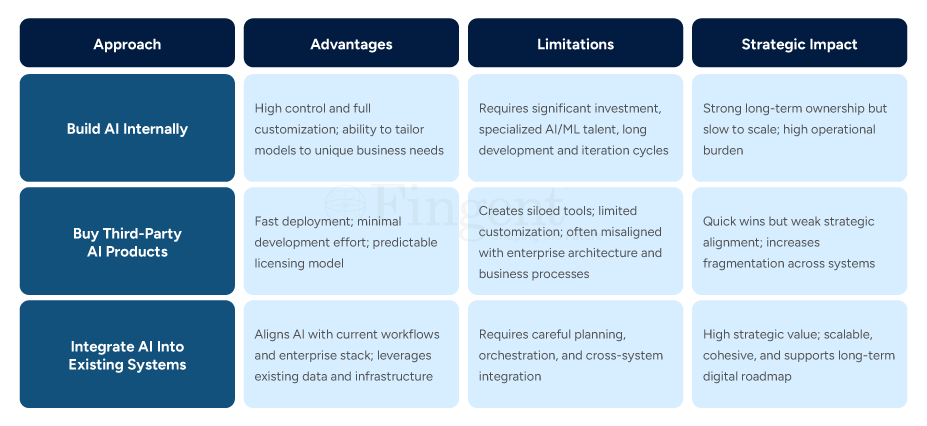
As adoption grows, leaders are debating whether they should build AI solutions internally or buy third-party AI products, or integrate an AI layer into their existing systems.

This dilemma is caused by trade-offs that each build-buy-integrate approach has.

Here is a table that summarizes the trade-offs.

 
Intelligence-integration-Infographics-3.png

This tension between multiple approaches drives business leaders to make fragmented decisions. The result is rushed AI adoption without a unified approach and the subsequent waste of well-funded AI initiatives.

Why do most AI initiatives fail to connect with long-term digital strategy?

  • AI is treated as a standalone initiative rather than a capability to be integrated into existing operations
  • Teams adopt multiple AI tools with disjointed workflows, compounding efforts and undermining efficiency
  • Data models are implemented without proper alignment with data strategy, governance, guardrails, or enterprise architecture
  • Technology decisions prioritize features instead of long-term scalability, maintainability, and interoperability
  • Organizations underestimate the effort required to integrate intelligence into legacy systems, leading to partial or stalled initiatives

In other words, while businesses are racing to adopt AI, the misalignment of investment with broader digital transformation goals leads to budget and effort wastage. Intelligence Integration offers a strategic middle path that resolves the mismatch by embedding intelligence directly into legacy systems and processes that the business already relies on.

How Intelligence Integration Works

Intelligence integration is not about adding yet another system into an already complex technology stack. It is about connecting intelligence to existing systems, data, and workflows that are already driving the business. 

If executed correctly, intelligence integration can act as an embedded capability that enhances decision-making, automates actions, and improves outcomes without disrupting ongoing operations.

Connecting Data Sources, Applications, and AI Model

Most enterprises already generate a large volume and variety of data at a great velocity. Such data is usually located in scattered locations such as ERPs, CRMs, document repositories, data warehouses, and legacy applications. Intelligence Integration works by unifying access to this data.

  • Data pipelines connect source systems to AI models in real time or near real time.
  • AI models consume enterprise data to generate predictions, recommendations, or classifications.
  • Outputs are written back into operational systems, ensuring insights are immediately actionable.

Instead of extracting data into standalone AI tools, intelligence integration keeps the data within the enterprise ecosystem, helping preserve data integrity, security, and governance.

Leveraging APIs, Middleware, and Orchestration Layers

AI cannot operate in isolation. It must interact with multiple applications, services, and users. APIs and middleware play a crucial role in connecting them together and giving AI a connected data pipeline.

API, Middleware, and orchestration layers each work in their own way.

APIs enable seamless communication between AI models and enterprise applications. Middleware acts as a bridge between legacy systems and modern AI services, minimizing friction and operational disruption. Orchestration layers manage workflows and decision logic across systems.

Real-world examples of Intelligence Integration

Key Types of Intelligence Integration

Depending on business objective, scale of organization, tech stack, and existing systems, AI integration can take many forms.

The most common and high-impact Intelligence Integration types across industries include:

  • Predictive analytics
  • AI workflow automation
  • Conversational AI or agent
  • Computer vision in existing apps
  • Generative AI inside enterprise portals or apps
  • Document intelligence and extraction

Predictive Analytics

Predictive analytics enables businesses to go from reactive decisions to proactive planning. Integrating intelligence into predictive analytics will help analyze historical and real-time data from enterprise systems to forecast outcomes and identify trends.

When integrated into platforms such as ERP, CRM, or supply chain systems, predictive insights become part of everyday workflows. Teams can anticipate demand changes, predict customer churn, and optimize inventory. They can also identify potential operational risks without switching tools or exporting data. The result is faster, data-driven decisions grounded in existing enterprise data.

AI Workflow Automation

AI workflow automation expands on traditional automation by introducing intelligence into business processes. Instead of following rigid, rule-based logic, AI-enabled workflows adapt based on data patterns and context.

Integrated into workflow engines, BPM tools, or custom applications, AI can:

  • Route tasks dynamically based on priority or risk
  • Trigger actions based on predictions or classifications
  • Reduce manual intervention in complex processes

Intelligent Document Processing

Intelligent Document Processing (IDP) allows businesses to extract textual information, images, and documents of varying formats and structures. By integrating IDP into operational applications, businesses can easily analyze documents, summarize information from them, and automate approval workflows. 

Such an IDP system can provide several benefit,s including:

  • Eliminating manual data entry
  • Reducing processing time and errors
  • Maintaining compliance and audit trails

Why Integrate Intelligence Instead of Buying an AI Product or Building from Scratch

There are two default paths that enterprises resort to when they are evaluating AI: purchasing ready-made AI products or investing in custom-built AI applications.

There is no denying that both approaches have their own merits. However, they could fall short of enterprise expectations compared to the time and effort that it demands.

Intelligence Integration, on the other hand, offers a more pragmatic and strategic alternative. It aligns intelligence with business context, legacy systems, and the long-term digital transformation goals.

Off-the-Shelf AI Doesn’t Fit Your Digital Strategy

Pre-built AI solutions are usually meant for broad applicability across uniform use cases. This generalization is restrictive in enterprise environments where data, processes, and compliance requirements are specific.

Additionally, these AI solutions could be designed on generalized datasets, which limits their usefulness for the enterprise’s use case. This would typically impact industries like manufacturing, healthcare, or financial services.

Further, since these AI tools operate outside the core platform, the business would be forced to switch systems or create fragmented workflows that further complicate the tech stack.

Building AI Products from Scratch Is Expensive and Slow

Building custom AI products may offer the promise of full control; however, it comes at a hefty cost – both financially and in terms of time. The major spending will revolve around acquiring AI talent, building infrastructure, and acquiring datasets for LLM model training.

Furthermore, extensive development efforts will be required to invest in model development, testing, deployment, and validation, all of which can span months or longer.

Intelligence Integration: A Practical Approach to Achieving AI Maturity

We can deduce from the above challenges that intelligence delivers value only when it fits naturally into the enterprise ecosystem.

Intelligence integration addresses these challenges directly by embedding intelligence into existing systems, data flows, and governance frameworks.

Instead of disrupting existing operations, it creates an efficient, scalable, and sustainable way to leverage AI for enterprise operations.

Below are the core ways intelligence integration transforms challenges into tangible business advantages.

Protects and Extends Existing Technology Investments

Intelligence integration does not lay to waste current investments in the tech stack. Instead if replacing your current ERP, CRM, HRMS, EHR, EMR, and operational platforms, a layer of intelligence is added onto them. The result is maximized return on investment while avoiding the cost, risk, and disruption of large-scale replatforming efforts.

Enables Unified Data and Actionable Insights

Intelligence integration eliminates data silos. Data that existed in fragmented systems and stored in silos is not brought together to create a unified intelligence layer. Such an intelligence layer can draw insights from multiple sources and flow back into operational workflows. The result is a single, consistent view of the business that supports faster, more informed decision-making.

Strengthens Compliance, Security, and Governance

Intelligence integrates plays within the borders of established security frameworks and compliance controls. Sensitive data remains within the system without sharing access to third-party tools. Governance is maintained, and proper guardrails can be put in place to avoid data biases, prejudices, and hallucinations.

Delivers Faster and More Sustainable Time to Value

Intelligence integration supports incremental adoption, which allows enterprises to start with handpicked use cases, test their performance, and gradually expand over time. It causes no disruptions to existing operations. Also, since intelligence integration enhances operations instead of replacing them, adoption tends to be faster, and change management is easier.

How Fingent Helps Businesses Integrate Intelligence the Right Way

Integrating intelligence requires more than just technical expertise. A thorough understanding of the business, its objectives, existing systems, and long-term digital transformation goals are essential prerequisites.

Fingent’s AI Integration Philosophy

Fingent approaches Intelligence Integration as a strategic enabler. Our AI expertise ensures that intelligence enhances operations, supports decision-making, and scales with the enterprise.

Business-First, Not Model-First

Fingent begins every intelligence integration initiative by understanding the business problem and not selecting a model or technology. We focus on the desired outcome, such as efficiency, accuracy, cost effectiveness, etc., and determine how intelligence integration can support these objectives

Intelligence Aligned with Digital Transformation Goals

Intelligence Integration at Fingent is designed to complement and accelerate the broader digital transformation efforts. We embed intelligence into existing platforms, workflows, and architectures so AI initiatives can reinforce enterprise digital roadmaps instead of operating in isolation.

Interoperability, Scalability, and Usability by Design

Fingent prioritizes seamless integration across legacy and modern systems. Our solutions are built to scale across departments and geographies while remaining easy for users to adopt. By focusing on interoperability and usability, we ensure AI fits naturally into enterprise environments and evolves as business needs change.

Technologies and Platforms We Work With

  • Languages
    Python, TypeScript (Node.js)
  • Frameworks (Agent/RAG)
    Semantic Kernel, Azure AI Studio, Amazon Bedrock
  • Frameworks (Training)
    PyTorch, TensorFlow, Hugging Face, AWS Rekognition, AWS Sagemaker
  • Models
    All Open AI GPT Models, AntropicClaude Sonnet Models,Meta Llama Models, Gemini Models,
  • Models (Fine-tuning)
    Faster R-CNN, Mask R-CNN, SSD ResNet
  • Vector DBs (Memory)
    Pinecone, Weaviate, ChromaDB, Qdrant, pgvector, FAISS,
  • Platforms (Dev/Deploy)
    Amazon Bedrock, AWS Sagemaker, AWS Rekognition,Azure AI Studio,Azure Foundary Tools, Azure AI Services ( Vision, Language , Speech etc )
  • Low-Code/Automation
    Microsoft Copilot Studio, n8n, Flowise

Integrate Intelligence into your enterprise Make AI Work Within Your Enterprise. Not Around It

Consult an AI Integration Expert

Stay up to date on what's new

    About the Author

    ...
    Tony Joseph

    Tony believes in building technology around processes, rather than building processes around technology. He specializes in custom software development, especially in analyzing processes, refining it and then building technology around it.He works with clients on a daily basis to understand and analyze their operational structure, discover (and not invent) key improvement areas and come up with technology solutions to deliver an efficient process.
    Talk To Our Experts

      ×