Tag: Artifical Intelligence
Stay up to date on what's new

About the Author

Featured Blogs







Stay up to date on
what's new



Talk To Our Experts
Intelligent integration architecture – it’s more valuable than you think. Yes, your enterprise already has AI, the forecasting models, recommendation engines, and automation workflows.
Now here’s the hard question: Are these systems creating value together or quietly cancelling each other out?
Most organizations don’t notice the gap until something breaks. A demand signal triggers procurement. Procurement optimizes for cost. Logistics is constrained by capacity and then delivery slips.
Each system performs correctly on its own. The failure happens between them, showing up not as errors but as missed revenue, delayed responses, and silent inefficiency.
These raise uncomfortable questions:
- Who decides when multiple AI systems disagree?
- Where is alignment enforced before execution begins?
- How much revenue leakage hides inside “correct” but conflicting decisions?
This is where Intelligent integration architecture becomes critical. It defines how intelligence flows, aligns, and executes across enterprise systems.
What Is an Intelligent Integration Architecture?
Intelligent integration architecture is the structural design that enables AI systems, services, and agents to operate as a coordinated network rather than isolated components.
Traditional integration connects systems, while intelligent integration ensures they act together, not in conflict. In practical terms, this shifts integration from data exchange to decision alignment.
At its core, it defines:
- How AI systems communicate
- How decisions are prioritized
- How actions are executed across systems
- How feedback loops refine outcomes
This layer functions above microservices and APIs. It frequently uses event-driven architecture (EDA), orchestration engines, and shared context layers to align decisions throughout distributed systems.
In modern Enterprise AI architecture, integration must handle:
- Real-time decision flows
- Cross-system dependencies
- Dynamic workloads
- Continuous learning cycles
Without this structure, enterprises don’t just face system fragmentation. They face decision fragmentation at scale.
The Core Components of Intelligent Integration
To understand how this architecture works, we need to break it into execution layers that mirror real-world systems.
1. MCP Servers: The Coordination Backbone
MCP servers can be understood as coordination hubs within the control plane, similar in role to orchestration engines or API gateways, but focused on maintaining decision context across systems.
Think of them as control points. Not passive connectors. Their responsibilities include:
- Routing tasks between systems
- Managing execution context
- Handling state across workflows
- Enforcing communication protocols
In practice, this function is often implemented using workflow orchestration platforms (such as Temporal or Camunda) combined with event streaming systems like Kafka to maintain state and sequencing.
In the context of MCP servers in enterprise AI, they ensure that interactions between agents and systems remain structured and traceable.
Without it, integration becomes fragile, costly, and doesn’t scale.
2. Agent Frameworks: The Execution Layer
Agent frameworks define how autonomous or semi-autonomous AI agents operate. Agents are not just models. They are decision-makers with defined roles, combining models, rules, tools, and memory within controlled autonomy.
Agent frameworks provide:
- Lifecycle management
- Task orchestration logic
- Inter-agent communication protocols
In real-world implementations, frameworks such as LangChain or AutoGen enable agents to interact with APIs, tools, and other agents in structured workflows.
In Agent frameworks for enterprise AI, the goal is not autonomy for its own sake. It is controlled autonomy aligned with business outcomes.
Because unmanaged autonomy does not scale. It multiplies risk.
3. Orchestration Layer: The Control Mechanism
This is where coordination becomes execution.
An AI orchestration framework ensures that multiple agents and systems work together without conflict.
It defines:
- Task sequencing
- Dependency resolution
- Conflict management
- Priority handling
Technically, this layer integrates workflow engines, rule engines, and event-driven pipelines to enforce coordination across distributed systems.
This is where AI system orchestration becomes visible. Without it, systems compete; with it, they align. The real challenge begins when speed clashes with cost, multiple agents are right, and coordination slows decisions.
The orchestration layer resolves this in real time by balancing speed, cost, and accuracy.
What Is Intelligent Integration & What Does It Promise For Enterprises in 2026?
How Intelligence Is Coordinated Across Systems
Most enterprises treat coordination as a setup task. It is not. Every new data signal, agent decision, or system update has the potential to create misalignment downstream.
Coordination has to run continuously, not occasionally. In a well-designed Enterprise AI integration framework, this happens through a structured flow that keeps every system in sync as conditions change:
- Input Aggregation: Data flows in from ERP, CRM, and operational systems.
- Context Formation: MCP-like coordination layers establish shared context using event streams and state management systems.
- Agent Activation: Relevant agents are triggered.
- Decision Coordination: The orchestration layer aligns outputs before execution.
- Execution Across Systems: Actions are executed across platforms.
- Feedback Loop: Outcomes are captured and refined.
The critical insight! Failures rarely occur at execution. They occur before execution, when context is misaligned.
This is how Coordinating AI across enterprise systems becomes structured rather than reactive.
Architecture in Practice
In an Enterprise AI architecture, consider a supply chain scenario:
A demand forecasting agent predicts a surge, then a procurement agent evaluates suppliers, and then a logistics agent plans distribution.
Now consider the reality. Procurement saves money, logistics saves time, and finance protects budgets. Yet no one saves the outcome.
With AI agents orchestration architecture:
- MCP servers establish shared context
- Agents exchange insights
- The orchestration layer resolves trade-offs
- Execution follows a unified plan
The result is fewer conflicting decisions, faster alignment, and measurable operational efficiency.
Extend this further: in customer experience systems, pricing engines, recommendation engines, and churn prediction models often act independently. Without coordination, they optimize different outcomes. With integration, they align toward a single customer strategy.
This is the difference between automation and intelligence.
Key Design Principles
Good architecture is not just about performance. It is about accountability. When something goes wrong, you should be able to trace what happened and why. Without that clarity, small issues turn into expensive problems. These principles ensure that visibility is never lost.
Principles for an Intelligent System Architecture
- Context Awareness
- Controlled Autonomy
- Real-Time Coordination
- Scalable AI integration layer architecture
- Observability and Governance
Challenges in Implementation
Designing architecture is one part, but implementation is where most failures occur. In most enterprises, these failures appear in a few recurring patterns:
1. Legacy System Constraints
Legacy systems were built for batch processing, not real-time integration. When AI agents need immediate data, these systems quickly become bottlenecks.
Solution: Implement abstraction layers and APIs between legacy systems and the integration layer. Event-driven connectors enable legacy systems to react almost in real time without requiring a complete overhaul.
Trade-off: You incur increased latency and initial integration expenses. This is still significantly less expensive than dismantling core systems.
2. Fragmented Data Sources
AI is only as good as its data. When that data is inconsistent or siloed, agents start making decisions no one can trust.
Solution: Unify data models and uphold governance. Employ data agreements, uniform formats, and verification prior to data entering decision processes.
Trade-off: Substantial initial engineering work. Bypassing it means you’ll face the consequences later through poor choices and expensive repairs.
3. Agent Conflict and Overlap
Several agents collaborating on the same signals might appear to be effective. In truth, it results in clashes, redundancy, and disruption.
Solution: Establish distinct responsibilities for every agent. Allow the orchestration layer to serve as the ultimate decision-maker in cases of conflict.
Trade-off: Reduced independence for each agent. However, unchecked autonomy at scale produces greater risk than benefit.
4. Scalability Issues
What succeeds with a small number of agents fails quickly when scaled up. Latency increases, conflicts proliferate, and visibility decreases
Solution: Create with a modular approach from the start. Each component must be deployable and replaceable on its own.
Trade-off: Increased preparation and greater initial effort. However, expanding a well-organized system is much simpler than repairing a delicate one afterwards.
Still Wondering If You Need Intelligent Integrations?We Can Help You Seamlessly Embed AI into Your Processes to Enable Faster Results.
FAQs
Q. In what way do AI agents collaborate within enterprise systems?
A. AI agents operate within well-defined roles and interact via structured protocols. A coordination layer, similar to an MCP server, maintains shared context. This helps every agent to know what others are doing. The orchestration layer subsequently coordinates its outputs before execution. Doing so ensures they aim for a single outcome rather than moving in different directions.
Q. What is AI orchestration, and why does it matter?
A. AI orchestration manages decisions and actions among agents and systems. It arranges tasks, addresses dependencies, and manages conflicts when results collide. In its absence, every system seeks its own optimization. That can lead to a negative impact on the overall business results, despite the good performance of individual components.
Q. What function do MCP servers serve in AI integration?
A. MCP servers acts as central coordination points. They direct tasks, uphold execution context, and ensure organized communication among agents. In the absence of this layer, interactions turn unstructured, difficult to track, and unstable when scaled.
Q. In what ways are agent frameworks utilized in enterprise AI?
A. Agent frameworks outline the construction, deployment, and regulation of agents. They oversee the lifecycle, regulate the transformation of inputs into actions, and standardize interactions with systems and tools. Frameworks such as LangChain and AutoGen facilitate transparent, verifiable workflows rather than unclear, black-box actions.
Q. How do organizations align intelligence across different systems?
A. Structure gives rise to alignment. Orchestration layers arrange decisions in sequence, coordination centers uphold a common understanding, and agent frameworks dictate actions. Collectively, they guarantee that various systems function as a unified whole instead of rival units pursuing different objectives.
Q. What is the difference between AI architecture and AI integration architecture?
A. AI integration architecture is about making sure those systems work together. One focuses on creating capable models and the infrastructure behind them. The other focuses on what happens when multiple capable systems are running at the same time.
Q. Is intelligent integration architecture suitable for legacy systems?
A.Yes. Legacy systems were never built for real-time coordination. Replacing them is not the only option, though. APIs and abstraction layers act as bridges. Thus, allowing older systems to connect with modern components without a full rebuild. Event-driven connectors go a step further by allowing responses to real-time signals rather than depending on batch cycles.
Enable Enterprise AI Architecture for Your Business
Enterprises no longer struggle to build AI. They struggle to align it. It is from isolated intelligence to coordinated execution. Intelligent integration architecture defines how that coordination happens.
The real question is, are your systems thinking together or competing silently at scale?
This is where the right partner becomes critical.
At Fingent, the focus goes beyond building AI solutions to enabling Enterprise AI architecture that aligns intelligence across the business. With expertise in AI integration architecture and orchestration, Fingent helps organizations move from fragmented adoption to coordinated execution.
From designing AI orchestration framework layers to implementing Agent frameworks for enterprise AI and Coordinating AI across enterprise systems, the objective is simple: one unified business outcome.
Competitive advantage doesn’t come from more AI. It comes from AI that works as one.
Stay up to date on what's new
About the Author
Featured Blogs
Stay up to date on
what's new
Talk To Our Experts
Most AI initiatives do not fail because they never reach the core of the business. They might stay in pilots, generate insights, and impress in presentations. But they do not impact decision-making.
The real question for enterprises in 2026 is: How to enable Intelligent Integration with AI?
If AI is separate from operational systems, it stays in the experimental phase. No one wants that. If it is embedded inside workflows, data flows, and decision points, it becomes structural. That shift is called intelligent integration. It is not about adding tools. It’s about upgrading the brains of the systems already running your business so they do more than process. They learn, reason, and act.
That distinction is what separates short-lived experimentation from lasting enterprise impact.
What Is Intelligent Integration in AI and Why Does It Matter Now?
The urgency is not ambiguous. Did you know that in three years, over 40% of agentic AI projects will be discontinued? Why so? Unclear business values, insufficient governance, and rising costs.
In plain terms, excitement is high, strategic planning is low. The technology is sprinting ahead. The strategy behind it is limping. And in this race, speed without direction is just expensive noise.
That is precisely why intelligent integration matters. When intelligence lives inside revenue and risk systems, value is measurable. Governance gets real.
Discover Ways To Maximize Business Impact With AI Let Us Help You Start Small and Scale Smart
How Is Intelligent Integration Different from AI Automation?
The key difference between the two is this. Automation rule-driven and great at repeatable work. Think batch invoice processing – reliable and predictable. Intelligent integration is different. It turns systems from task runners into decision makers. Add context and feedback, and they stop repeating work. They start getting smarter.
Today, leaders are moving beyond task automation toward decision augmentation and operationalized generative and agentic AI. But here’s the catch. Where there is no governance, there are no gains.
If AI actions are not tied to business KPIs, you are not scaling intelligence. You are scaling guesswork.
How Agentic AI and AI Agents Enable Intelligent Integration
Agentic AI and AI agents are a pattern for modular intelligence. Think of agentic AI as a set of specialist workers embedded across systems. Each agent has a bounded remit, clear inputs/outputs, and a governance envelope:
- CRM lead-qualification agent — scores and routes leads inside the CRM.
- Support triage agent — classifies tickets and suggests fixes inside the ticketing system.
- Procurement forecasting agent — adjusts reorder triggers inside the ERP.
This multi-agent approach lets enterprises add intelligence without rebuilding core systems. Gartner and Forrester reports indicate enterprises are increasingly piloting and embedding such agentic patterns, but warn that many projects will fail unless value and risk are clearly defined.
What Are Examples of Intelligent Integration in Enterprises?
The following examples aren’t “AI on the side” add-ons. They are intelligence built into the system fabric where value gets tracked, decisions speed up, and existing platforms stay intact.
1. AI-powered operational assistant in marketing opsAn award-
winning experiential marketing firm in the US embedded an AI assistant into their existing CRM, project management, and inventory systems to enable unified data management. This powers the sales operators during client calls with quick access to relevant customer data.
The solution reduces the routine information lookup workload by 70%. The time taken to analyze project data is reduced by 75%. Sales productivity is improved by 3–5% and Report generation time fell by 40%.
2. Conversational AI for real-time marketing insight
A diversified media organization serving millions of customers online implemented a conversational AI agent to extract meaningful insights from their customer calls. It analyzes 9,400 daily call interactions in real time. It improves intelligence gathering, enhances clarity on changing trends and customer behavior, and accelerates campaign development by 3 weeks.
The team can now enhance customer engagement and brand value with customer-specific marketing campaigns and product enhancements.
3. AI lead response automation
A leading IT firm in the US was losing 30-40% of potential leads due to a slow and manual lead management process. They embedded AI Agents into their sales workflow to identify, qualify, and route leads automatically.
The solution helps reduce response time from 4–24+ hours to one hour. It enables 100% accuracy in sales manager assignment. Classification accuracy reached 96%. No opportunities are lost due to delays.
4. AI-powered ticketing in support workflows
A global technology and electronic company had their skilled agents spend more time on administrative triage than real problem resolution. Manual email triage and ticketing led to time-consuming and error-prone processes.
A custom AI ticketing system was embedded into the existing support platform. It auto-triages emails and routes tickets intelligently. Manual bottlenecks were reduced. Resolution consistency improved. Throughput increased without replacing the core system. Manual handling time was reduced by 80%. Agent productivity boosted by 40%.
Organizational Capabilities You Must Build (Not Buy)
Technology alone won’t deliver outcomes. Organizations must develop:
- MLOps and governance: The foundational support for AI operations. This encompasses model oversight, performance evaluation, retraining processes, audit records, and compliance measures to mitigate drift and unmanaged risk.
- Quantifiable KPIs and use cases: Domain product owners are business leaders who establish quantifiable KPIs, prioritize use cases, and hold themselves responsible for results. They make certain that AI projects address genuine operational issues rather than just theoretical ones.
- Human involvement in the process: Established oversight systems in which critical or risky choices necessitate human confirmation. This safeguards against automation mistakes and maintains responsibility.
- Preparing for the change: Organized adoption initiatives that synchronize process reworking, education, and communication. AI is effective when it enhances results without causing unnecessary workflow interruptions
A Practical Enterprise Rollout Roadmap (Six Steps)
This incremental approach reduces the risk and increases the odds of sustained value capture.
- Diagnose & prioritize – Audit workflows for decision friction.
- Define value metrics – Replace vague goals with measurable targets.
- Architect with a containment strategy – Choose an integration pattern. Ensure fallback and human override.
- Build an agent MVP – One bounded agent integrated into a single workflow. Measure business impact against your chosen metrics.
- Operationalize (MLOps + monitoring) – Build model serving, feature stores, drift detection and operational dashboards. Measure both model health and business impact.
- Scale by function – Expand agents into adjacent workflows and maintain interoperability via shared services and feature stores.
The Economics: Value First, Cost Disciplined
Remember, organizations that focus on scaling and building organizational capability realize substantially greater value from AI investments. Here’s what you can do:
1) Cost model
Intelligent integration often wins on total cost of ownership versus replatforming, because it:
- Leverages existing licensing and processes
- Delivers faster ROI via targeted KPIs
- Avoids the one-time capital shock
Ensure to make cost-vs-value explicit in the pilot business case and tie future funding to measured outcomes.
2. Risk and controls: governance checklist
Embed governance into the integration lifecycle:
- Decision audit trails — every agent action must be traceable back to inputs, model version, and human sign-off.
- Role-based permissions — limit which agents can act automatically vs. recommend only.
- Safety boundaries — agents that touch financials, safety, or legal workflows should be recommendation-only until proven.
- Testing & staging parity — production-like data in staging reduces surprises.
- Drift and fairness monitoring — monitor performance across cohorts to catch regressions.
Failure to control agent scope is a leading cause of project cancellation and reputational risk. Put governance first.
3. Security and Compliance Considerations
Enterprise AI integration must account for data residency and access control. Include third-party model risk.
Organizations implementing intelligent integration must ensure:
- Strict role-based access controls for AI agents
- Encryption of data in transit and at rest
- Clear audit logs for regulatory traceability
- Prompt injection and model abuse safeguards
- Vendor risk assessments for external LLM providers
Security cannot be layered after integration; it must be architected alongside it.
4. Integration checklist for legacy systems
Is intelligent integration for legacy enterprise systems possible? Absolutely — but expect work.
Actionable checklist:
- Inventory available APIs and integration points.
- Add a middleware/API layer if direct integration is risky.
- Use event adapters to capture business events.
- Build read-only views first to assess risk, then move to writeback.
- Prioritize non-critical workflows for early agents.
5. Success Metrics
CFOs and CROs care about impact, not model ROC curves. Example metrics:
- Revenue uplift (conversion, cross-sell rate)
- Cycle time reductions (lead response, procurement)
- Support TTR reduction and CSAT lift
- Cost per transaction reduction
- Model uptime and incident frequency (ops metrics)
Measure both model performance and business impact — one without the other won’t justify scale.
Leverage AI for Your Business With the Right Expertise
Common FAQs
Q. Is intelligent integration suitable for legacy systems?
A. Yes. Intelligent integration is suitable for legacy systems. Use APIs, middleware, or event-driven adapters to attach intelligence. Read-only pilots reduce risk before writeback is permitted.
However, system interoperability and data quality must be assessed early. Enterprises with fragmented or undocumented legacy systems may require preliminary modernization before safe integration.
Q. What is the first step to intelligent integration?
A. The initial step involves conducting a systematic workflow evaluation. Determine areas where decision-making is sluggish, manual, prone to errors, or has financial implications within your current systems, like ERP, CRM, or support platforms.
Next, establish a quantifiable business metric linked to that friction point, like minimizing lead response time, enhancing forecast precision, or decreasing processing mistakes. Smart integration should start in areas where AI can produce tangible operational effects, rather than where it merely appears cutting-edge.
Q. Why do enterprises struggle with AI integration?
A. Enterprises commonly struggle with AI integration due to the lack of strategic planning. For a successful AI integration, businesses must first identify core areas of improvement, where AI integration can matter the most. Planning for ‘Quick Wins’ or easily measurable results can demonstrate more success. Tech partnership also determines the success of AI projects for business. Partnership with reliable and experienced AI solution providers can add to the success.
How Fingent Helps Enterprises Scale Intelligently
AI is not the challenge. Making it work inside your systems is.
Intelligent integration requires a structured architecture. Plus, it also demands organized data and governance that maintains scalability. Fingent can help integrate AI agents into existing CRM, ERP, marketing, and support platforms via secure, API-driven integration with inherent supervision. No rip and replace. No innovation theater.
The result is intelligence working inside the systems that already run your business. Practical, measurable, and ready to scale.
Stay up to date on what's new
About the Author
Featured Blogs
Stay up to date on
what's new
Talk To Our Experts
For years, enterprise software has been following the same basic pattern. One system, one workflow, and one decision engine. That model worked when problems were linear and environments were stable. However, it struggles today.
Enterprises now operate across fragmented systems, dynamic markets, and continuous change. Decisions are no longer isolated. They are interconnected, parallel, and time sensitive. That’s why most leaders are asking: How to design systems that can reason, act, and adapt at scale. The answer is one– multi-agent systems.
The goal of a multi-agent system is not to increase the complexity of AI. It involves dissecting intelligence into more manageable, functional units that can operate autonomously, coordinate when necessary, and continue even when components malfunction.
This model appeals to businesses for three reasons: Scalability, resilience, and autonomy.
The challenge is not understanding why multi-agent systems are attractive. It is understanding how to build a multi-agent system that works.
Build Multi-Agent Systems That Work! Take The Right Steps Towards Multi-Agent AI With Experts On Your Side
How to Create Multi-Agent AI?
Many multi-agent initiatives fail for a simple reason. They start with agents before they start with problems. A practical blueprint begins elsewhere. Here is a look:
1. Define the Problem
Before thinking about agents, architectures, or frameworks, step back and think. What problem are you trying to solve? Not in abstract terms but in operational terms.
Is it coordinating supply chain decisions across regions? Is it managing customer support workflows across channels? Is it monitoring risk signals across finance, compliance, and operations?
Multi-agent systems work best when workflows are inherently distributed. Once the workflow is clear, break it down. Identify decision points. Identify handoffs and where delays or inconsistencies occur.
Now assign clear responsibilities.
Each agent should own a specific task or decision. No overlap or no ambiguity. Clarity determines whether the system works together or breaks down. This step is foundational to building a multi-agent system that scales.
2.Design the Multi-Agent Architecture
Architecture is where intent becomes structure. Start by defining agent types.
Some agents observe — continuously monitoring data streams and identifying meaningful signals. Some agents reason — analyzing context, connecting insights, and recommending the right course of action. Some agents act — triggering workflows, executing updates, and sending timely notifications.
Not every agent needs the same level of intelligence. Overengineering agents is a common mistake.
Next comes communication.
How do agents share information? Do they communicate directly? Do they publish to a shared context, or do they rely on an orchestrator? Considering these leads to an important design decision.
Orchestration: central versus decentralized.
Governance is made easier by centralized orchestration. One brain handles conflict resolution and task routing. Although it is simpler to manage, it may become a bottleneck.
Resilience is enhanced by decentralized orchestration. Peer-to-peer coordination is done by agents. Although it requires more rigorous design discipline, it scales better.
Many businesses begin as centralized and, as confidence grows, gradually decentralize.
When learning how to develop a multi-agent system for enterprise use, it is essential to comprehend this tradeoff.
3. Enable Tools
Agents are only as useful as the tools they can access.
In enterprise environments, this means integration. Agents must connect to APIs, enterprise systems, and data sources. Also, to ERP systems, CRM platforms, data lakes, and ticketing tools.
Tool access should be explicit and scoped. An agent that can do everything will eventually do the wrong thing. This is where many proofs of concept fail. Tools are added casually. Permissions are loose. Governance is an afterthought.
In production systems, tool integration must mirror enterprise access policies. If a human cannot act, an agent should not either.
4.Orchestration and Governance
This is where skeptical leaders should lean in. Multi-agent systems without governance are unpredictable. Predictability is non-negotiable in enterprises.
Orchestration defines how tasks flow between agents. Who decides what happens next? What happens when agents disagree?
Conflict resolution logic must be explicit. If two agents recommend different actions, which one wins? Or does a third agent decide? Fallback logic matters even more. What happens when an agent fails? What happens when data is incomplete or when confidence is low?
Having a human in the loop is not a weakness. It is a control mechanism. Security and policy controls must be embedded. Not layered on later.
The real test is simple. If regulators asked you to explain an AI-driven decision, could you? If the answer is no, governance is insufficient. This moment defines how to build a multi-agent system reliably.
5. Testing, Monitoring, and Making the System Better Over Time
Traditional testing assumes predictable flows. Multi-agent systems are dynamic by design.
Testing must cover not just individual agents, but interactions. Testing should focus on how agents respond to load, data shifts, and unexpected behaviour from other agents
Monitoring is equally important. You must observe agent decisions, communication patterns, and outcomes. Drift is real. Behaviour changes over time.
Optimisation is continuous. Agents learn, and workflows evolve. Business priorities shift. Remember, a multi-agent system is never done; rather, it is managed.
6.Scaling From Pilot to Production
Most enterprises face difficulties transitioning from pilot to production. Pilots run in controlled settings with clean data and a narrow scope. Production is different. Data is messy, workflows collide, and edge cases surface fast.
This is where understanding how to build multi-agent systems becomes critical. Scaling demands discipline. Agent interfaces must be standardised, governance formalised, and Integrations hardened. Teams must work with the system, not around it.
And the system must be tied to clear business metrics. If impact cannot be measured, confidence fades.
Read More: what are multi agent systems
FAQ
Q. What are the best 5 frameworks to build multi-agent AI applications?
A. Several frameworks are commonly used to build Multi-Agent AI applications, depending on maturity and needs. The best five frameworks are:
- LangGraph supports agent workflows and stateful coordination.
- AutoGen enables conversational multi-agent collaboration.
- CrewAI focuses on role-based agent teams.
- Ray provides scalable distributed execution.
- JADE is a classic framework for agent-based systems.
Frameworks matter less than design discipline. Tools cannot compensate for poor architecture.
Q. What is an example of a multi-agent AI system?
A. common example of a Multi-Agent AI System is intelligent customer support.
One agent classifies intent. Another retrieves customer context. A third proposes responses. A fourth monitors compliance. A fifth escalates when confidence is low.
Each agent has a role. Together, they deliver faster, more consistent outcomes. This pattern appears across finance, supply chain, and IT operations.
Q. How much does multi agent ai system cost?
A. Multi-Agent AI System may costs vary widely.
Factors include infrastructure, model usage, integration complexity, and governance overhead. Small pilots may cost tens of thousands. Enterprise-scale systems can reach millions over time.
The better question is this. What is the cost of not scaling intelligence where decisions matter?
Q. How do you test and monitor multi-agent systems?
A. Simulation, scenario testing, and stress testing of agent interactions are all part of testing. Telemetry across decisions, communications, and results is necessary for monitoring. Dashboards ought to highlight behavior rather than just performance.
Note that if you cannot explain why an outcome occurred, monitoring is incomplete.
What Are Multi-Agent Systems Architecture?
Turning Blueprint Into Business Value
Knowing how to build a multi-agent system is only half the journey. The other half is execution. Execution requires process. It requires iteration and restraint.
This is where Fingent focuses. We help enterprises move from concept to capability by applying discipline where it matters most.
- A streamlined process
We cut through complexity early. Use cases are prioritised by impact. Agent roles are sharply defined. Dependencies are addressed upfront. This prevents drift and keeps momentum visible. - An agile methodology
Multi-agent systems evolve. That’s how we make them. Agents are gradually added, tested in actual workflows, and continuously improved. Hence, the risk stays controlled. Learning stays fast. - A continuous innovation approach
Deployment is not the finish line. We monitor behaviour, optimise performance, and extend capability as the business changes. Intelligence compounds instead of stagnating.
The outcome is not experimentation. It is execution.
Multi-agent systems reward organisations that act deliberately and consistently. The blueprint shows intent. Fingent helps turn that intent into durable business value.
The leaders must consider: Will your organisation adopt them deliberately, or react to them later?
Stay up to date on what's new
About the Author
Featured Blogs
Stay up to date on
what's new
Talk To Our Experts
Enterprises are drowning in data, but still starve for clarity. Not because the data is missing. Because insight does not emerge automatically from systems, even very good ones.
This is the real context in which Generative AI with SAP matters. Not as a trend. Not as a promise. But as a way to finally close the gap between enterprise data and executive decision making.
The question leaders should ask is not whether AI is powerful. That is already settled. The real question is this. Can AI reason with enterprise data in a way leaders can trust?
What Is Generative AI in SAP?
Why Generative AI matters in the SAP ecosystem?
SAP systems run the most sensitive and consequential processes in the enterprise. Finance, procurement, supply chain, compliance, and human capital. These are not experimental domains. They are where risk lives.
For decades, SAP has captured transactions, enforced controls, and produced reports. But reports describe the past.
Your SAP system knows your business. So why does getting answers still feel like an interrogation?
This is where Generative AI with SAP changes the dynamic. It shifts SAP from being a system you query into a system that can explain, summarize, and suggest. Not autonomously but responsibly.
This matters because intelligence that sits outside the ERP rarely scales. Intelligence that lives inside core systems can.
Leverage the Power of Generative AI with SAP Unlock Unique Possibilities for Your Business
What Are the Potential Applications of Generative AI Within SAP?
There is considerable buzz surrounding generative AI. Most of it is not relevant to enterprise leaders.
In the SAP context, generative AI is not about creative output. It is about cognitive support. It reads enterprise data, understands business context, and helps humans interpret complexity.
Say, your SAP system already knows what happened. Generative AI helps you understand the reasons for it. It also helps in evaluating possible future results, based on real data.
This is the reason Generative AI with SAP distinctly differs from independent AI tools. It does not live on the edges of the business. It works inside enterprise governance, authorization, and process logic.
The same controls leaders already trust. The same systems that run finance, supply chains, and people operations. That difference matters.
Does that mean it replaces judgment? No! It sharpens judgment by removing friction.
How Does SAP Integrate Enterprise Data With Generative AI?
Enterprise leaders are right to worry about hallucinations, data leakage, and compliance risk. Open AI models trained on the internet are not designed for regulated enterprise environments.
SAP takes a different approach. Generative AI is grounded in enterprise data. It is not free floating. It does not guess. It reasons within defined boundaries.
SAP integrates generative AI through controlled access to structured business data, metadata, and process context. Responses are traceable. Permissions are enforced. Auditability remains intact.
Here is the logical test leaders should apply. If AI cannot explain where an insight comes from, should it influence a decision? With Generative AI with SAP, that traceability is built into the design.
Where Generative AI Fits in SAP Landscapes?
Enterprise architecture is not forgiving. One poorly integrated capability can introduce risk far beyond its value.
So, where does generative AI belong? The answer is simple. It belongs where decisions already happen. Let’s look at a few key factors that explain this:
1. SAP S/4HANA and Core Business Processes
SAP S/4HANA is the digital core of the enterprise. It handles financial close, inventory valuation, order fulfilment, and production planning.
These processes already generate immense data. What they lack is interpretation at speed.
Imagine a CFO during close week. The numbers are finalising and the variances appear. The question is not what changed. The question is why.
With Generative AI with SAP, the CFO does not need to pull multiple reports. The system can summarise drivers, highlight anomalies, and explain trends using actual ledger data.
2. What Role Does SAP BTP Play in SAP’s AI Strategy?
SAP Business Technology Platform is the quiet enabler behind most enterprise innovation.
It connects systems. It governs data. It allows extensions without destabilizing the core.
For generative AI, BTP is critical. It provides the layer where AI services can interact with SAP and non-SAP data securely. It is also where enterprises control how and where intelligence is applied.
Without this layer, Generative AI with SAP would remain a series of disconnected experiments. With it, AI becomes part of enterprise architecture.
3. What Are SAP AI Core, SAP AI Launchpad, and Joule?
These components exist for a reason. Enterprises do not just need AI. They need AI that can be managed.
SAP AI Core handles the operational side. It deploys and runs AI models in a controlled way. SAP AI Launchpad gives visibility. It allows teams to monitor, govern, and refine AI use cases.
Joule is where leaders and users feel the impact. It is the conversational layer that allows natural interaction with enterprise data.
4. Integration With Enterprise Data and Workflows
Adoption fails when intelligence feels foreign.
Generative AI works best when it feels native. Embedded in approvals. Embedded in analysis and embedded in daily work.
When insight arrives on the same screen where action is taken, friction disappears. This is not convenient. It is operational leverage.
Enterprise Benefits of Generative AI with SAP
Enterprises adopting generative AI inside SAP environments are not chasing novelty. They are solving pressure points.
Decision cycles shorten because insight arrives faster. Manual analysis decreases because summarization is automated. Risk exposure reduces because anomalies surface earlier.
But there is a deeper benefit: Confidence. Leaders act faster when they trust the reasoning behind the numbers. Generative AI with SAP does not replace reports. It explains them.
That explanation is what turns data into leadership action.
Is Generative AI in SAP Secure for Enterprise Use?
Security concerns are not a fear. They are responsible.
SAP approaches generative AI with the same discipline it applies to financial data. Access is role-based. Data usage is governed. Models do not train on customer data by default.
This matters because AI that cannot be governed will not be adopted, especially not at scale.
The real question is this: Can Artificial Intelligence be introduced without increasing risk? With Generative AI with SAP, the answer is yes, when implemented correctly.
Enterprise Use Cases of Generative AI with SAP
Enterprises that treat generative AI as a novelty will see novelty results. Enterprises that treat it as an extension of enterprise reasoning will see real transformation. Generative AI with SAP is not about replacing systems or people. It is about helping leaders think better, faster, and with greater confidence.
- Intelligent Finance
Finance teams spend an enormous amount of time explaining results. Not just reporting them.
Generative AI can summarise financial performance, explain variances, and support scenario exploration using actual SAP data.
Instead of digging through spreadsheets, finance leaders ask focused questions. The system responds with context, not guesses.
That changes the rhythm of finance.
- Procurement Processes
Procurement (which includes contracts, suppliers, compliance, and pricing) is complex by design. Generative AI simplifies that intricacy. It aids teams in quickly reviewing contracts, uncovering hidden risks, and assessing supplier behavior instantly with reduced manual work. Improved choices, enhanced oversight. It doesn’t replace negotiation. It elevates it.
In procurement, speed without insight is a risk multiplier. Insight without speed is useless. Generative AI with SAP balances both.
- Document Processing
Invoices, contracts, regulatory documents. Enterprises are buried in them.
Classification, extraction, summarization—Generative AI compresses hours of work into minutes. Errors reduce. Visibility improves. This is not glamour, but rather an operational relief.
Achieve 99.99% Scalable Operational Accuracy with AI-Driven Document Processing!
Why Strategic Partnership Matters?
Technology rarely fails because it does not work. It fails because it is misapplied.
Generative AI requires discipline. Use case selection matters. Governance and integration matters.
Without experience, enterprises either overreach or underdeliver. A strategic partner helps avoid both.
How Fingent Can Help!
Fingent approaches Generative AI with SAP from a business-first perspective.
We help leaders identify where intelligence will create measurable value. We design architectures that respect enterprise constraints. We embed AI into workflows that already matter.
Our focus is not experimentation. It is outcomes.
Stay up to date on what's new
About the Author
Featured Blogs
Stay up to date on
what's new
Talk To Our Experts
Traditional automation excels at repetition. RPA follows scripts. GenAI generates insights.
But when conditions change mid-process, suppliers miss dates, forecasts shift, or approvals stall – these tools stop short. They alert. They suggest. Then they wait.
Enterprises don’t need more notifications. They need systems that take ownership of outcomes. That’s where agentic AI development enters the picture.
Why Agentic AI, Why Now?
When systems detect problems but cannot resolve them, teams become the glue.
In finance, forecasts trigger alerts but require manual adjustment. In IT ops, cloud overspend is flagged after the bill arrives. In sales ops, leads are scored but still sit untouched. The pattern is the same: insight without execution.
Agentic AI development closes that gap. It identifies issues, evaluates options, executes decisions within policy, and learns from outcomes. All without waiting on handoffs.
We’re seeing enterprises drive meaningful operational costs this way. With the agentic AI market projected to grow to USD 154.84 billion by 2033, the question is no longer if enterprises adopt, but who gains the lead.
Integrate AI Into Your Existing Systems The Smart Way. Reduce Friction. Maximize Results.
What Agentic AI Means for Your Operations
Agentic AI development builds systems that act independently. They sense issues, plan responses, execute fixes, and learn over time, all with minimal supervision. Forget rigid scripts. These systems handle surprises the way experienced operators do.
Picture your invoice disputes. An agent pulls contract data, cross-checks deliveries, flags errors, issues credits, and updates ledgers automatically. No more weekend escalations.
We mix perception (spotting anomalies), reasoning (weighing options), tools (accessing ERP systems), memory (past deals), and decisions (approving changes under limits). That’s agentic AI development in action, transforming chaos into smooth flows.
Expand this to tail-spend. Those 3,000+ low-value purchases eating your time? The agent aggregates them, benchmarks prices, bundles into bulk deals, and executes, freeing your team for strategic sourcing.
Why It’s Not Like Chatbots or Basic Bots
Generative AI spits out reports on supplier risks but stops there; now, you act. Virtual assistants book a meeting but can’t renegotiate contracts.
Agentic AI development goes further. It is platform agnostic, integrating with your existing enterprise systems, executing actions, tracking outcomes, and adapting over time.
In IT operations, this means more than dashboards. An agent detects abnormal cloud usage, reallocates resources, enforces budgets, and documents actions automatically. No ticket queues. No late surprises.
Key Benefits of Agentic AI for Enterprises
Agentic AI drives cost reduction and speed through autonomous, end-to-end execution. Let’s dig deeper:
1. Cut Costs and Speed Wins in Procurement
Procurement slows down when decisions wait on people, and systems don’t talk to each other. Agentic AI fixes this by orchestrating sourcing workflows end to end. Autonomous agents monitor pricing, flag cost gaps, recommend renegotiation paths, and route sourcing actions without manual handoffs. Teams stay focused on exceptions, while routine work moves faster with tighter control.
2. Faster, Smarter Decisions Daily
Markets shift fast—agentic AI processes signals instantly, beating human speed. In finance, it flags risky loans early; in procurement, it predicts shortages.
Finance teams love this for cash flow: The agent forecasts spend patterns from invoices and POs, flags variances, auto-adjusts forecasts, and suggests accruals, keeping your books tight.
Procurement leaders report improved supplier quality, too. Agents evaluate risks like financial stability or ESG compliance continuously, dropping underperformers proactively.
3. Personalize at Enterprise Scale
Personalization breaks when scale increases. Agentic AI fixes that by adapting actions, not just messages. AI agent development companies craft agents that adapt emails, terms, and follow-ups based on your data.
A B2B firm scored leads, personalized outreach, timed calls, and tweaked pricing. Result: more conversions, shorter cycles, bigger deals. Apply this to RFPs, you win more bids.
For enterprise architects, think spend categorization: Agents parse unstructured invoices, classify by GL codes, and flag maverick spend, ensuring compliance without manual reviews.
Enterprise Use Cases
Agentic AI automates enterprise workflows end to end, reducing risk, controlling spend, and keeping operations on track. Here’s how this shows up across enterprise functions:
1. Procurement and Supply Chain Wins
Disruptions keep you up at night. Multi-agent systems monitor everything: performance, forecasts, compliance.
One retailer used autonomous agent solutions to track inventory. When delays hit, agents negotiated premiums, sourced alternates, and adjusted forecasts, avoiding stockouts.
Dive deeper: Autonomous supplier discovery. Agents scan markets 24/7 for vendors matching your criteria, be it cost, location, or certifications. They score them, run background checks, and suggest switches, cutting cycle times 70%.
Dynamic contract negotiation takes it further. The agent drafts terms, simulates counteroffers, identifies risks (e.g., penalty clauses), and finalizes compliant deals, reducing review time.
2. Finance and Risk Scenarios
Banks run agentic AI development for portfolios. It scans borrowers, adjusts terms, ensures regs, all proactive.
During downturns, it flags risks and retains clients. Stable times? It optimizes profits.
In procurement, predictive spend analytics shines. Agents blend historical data, market trends, and real-time signals to forecast category spends, spot savings, and execute optimizations.
3. Infrastructure and Ops Examples
Cloud teams use agentic AI to predict demand and adjust resources automatically, improving cost efficiency and maintaining high availability without constant manual intervention. Procurement intake is simplified, without adding friction for IT teams
4. Sales and Threat Protection
Sales agents qualify leads, nurture them, and hand off hots. Cybersecurity agents spot insider threats, isolate systems, and log evidence. This stops breaches.
For finance, threat detection means spotting unusual PO patterns like duplicate invoices or off-contract buys and blocking fraud instantly.
Rollout Steps That Work
Agentic AI succeeds when enterprises start small, secure data early, keep humans in control, and track ROI rigorously. These steps show how to deploy autonomous AI agents safely, scale fast, and avoid costly missteps.
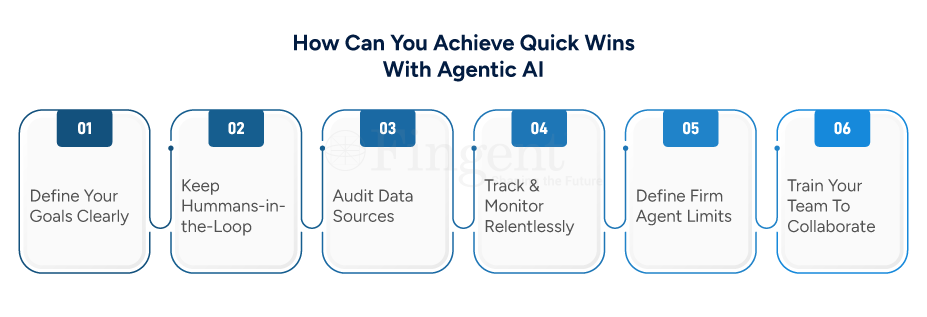
1. Define Goals First
Pick one pain point. Invoice matching or supplier onboarding. Define what “fixed” means and start where the risk is low.
Start narrow: Prove agentic workflows on routine tasks, then grow.
2. Keep Humans in Key Spots
Max autonomy tempts, but loop in people for big spends or contracts. It builds trust, catches drifts.
Two patterns work well in practice:
- Centralized for control (simple approvals)
- Hierarchical scale in multi-agent systems (complex chains)
3. Fix Data Upfront
Audit data sources early because bad data will derail agents. Set standards, loop feedback for better decisions.
In procurement, unify S2P data: Centralize spend, contracts, and suppliers for accurate agent reasoning.
4. Track Relentlessly
Monitor resolutions, accuracy, costs, and compliance. Refine based on real runs. Track ROI: Did negotiations yield expected savings?
5. Security from Jump
Apply zero-trust access, audits, and RBAC. Define firm agent limits and require review for high-value contracts.
6. Build Team Skills
Train on collaborating with agents. Learn from wins/losses together. Procurement teams need sessions on overriding agents safely.
Pitfalls We’ve Seen
Vague goals derail projects. Spell out success criteria, limits, and escalations. Define risky suppliers clearly.
Fix data gaps before agentic AI development. Start with clean vendor master data. Build security in from day one. Add explainability for audits. Avoid black-box agents. Add alerts and rollback controls.
Vendor lock? Pick open APIs. Accountability? Map chains now, like “agent proposes, human approves.”
Your 4-Phase Start
Phase 1: Target repetitive procurement task with data access, like invoice automation. Test with AI agent development company—learn feasibility.
Phase 2: Quantify: Autonomy rate? Cost drop? Tweak for 70% auto-handle. Add features like risk scoring.
Phase 3: Add cases (e.g., contracts), boost autonomy. Train teams, set governance. Roll to adjacent: Spend analytics next.
Phase 4: Deploy widely, monitor drifts. Key: Sponsorship, cross-teams (IT/procure/finance), change prep. Aim for 50% task automation by year-end.
Drive AI Success Faster! Start Small with the Right Expertise. Gain Quick Wins.
Fingent as Your Partner
Need help with agentic AI development? As one of the best agentic AI development companies for enterprise procurement, we tailor our solutions to your stack. We pilot fast, integrate seamlessly, govern safely, and train your team. No lock-in: We build your skills.
From multi-agent designs (one for discovery, one for negotiation) to monitoring (drift alerts), we shorten your path and reduce both cost and risk. We’ve delivered significantly better ROI in tail spend for manufacturers. Now it’s your turn.
Act Now
Agentic AI development is already reshaping enterprise workflows. The advantage goes to teams that start small and learn fast.
Pick one workflow. Run one pilot. Measure outcomes.
Invoice disputes. Forecast adjustments. RFP evaluation.
Start there. We’ll help you map it.
Stay up to date on what's new
About the Author
Featured Blogs
Stay up to date on
what's new
Talk To Our Experts
Your company spent two million dollars on an AI project. The pilot looked strong. The demo worked. Then the results flatlined. You are not alone!
Most companies face AI adoption challenges. They see very little or almost no measurable return from their AI adoptions. Failure to reach scale leads to money down the drain.
The problem is not the model. The problem is people, process, and strategy. Although these issues are fixable. Let’s see how!
Why AI Adoption Is Essential
AI drives speed, accuracy, and better decisions. It removes repetitive work and frees your teams to focus on high-value tasks. Most companies adopting AI see a significant change in operational efficiency.
However, when companies make large shifts rapidly, they face AI adoption challenges. Pilot projects work, but scaling fails. Teams push back, and the systems block progress. Skills fall short. Data is unreliable to say the least. These and many such reasons are why companies struggle with AI adoption. Here’s more on the common challenges in AI adoption for businesses.
Barriers To Enterprise AI Implementation
1.Workforce Readiness
What is the role of workforce preparedness in AI adoption? Most teams do not have the skills to run AI at scale. Half of all businesses cite a lack of skilled talent as their top blocker. According to Statista, in 2025, the biggest barriers to AI adoption were the lack of skilled professionals, cited by 50% of businesses, a lack of vision among managers and leaders, cited by 43%, followed by the high costs of AI products and services at 29%.
Skills shortages show up in three ways:
- You try to hire: The talent pool is small and expensive.
- You try to upskill: Training takes time.
- You rely on a few experts: If they leave, your project fails.
The fix is simple. Build a blended model. Hire where needed. When training your teams, create a culture of learning. Spread knowledge across teams.
2. ROI Uncertainty
Leadership wants clear returns. Few companies define them well. Many teams track with no clear outcome. They guess at goals, and they use vague metrics. Some AI projects take time to show impact. Early benefits are small and indirect. Many leaders expect fast results and lose interest before the project matures.
To improve results, companies must define one primary outcome, set clear timelines, and track progress with simple metrics.
3. AI Adoption Issues in Legacy Systems
How do legacy systems impact AI implementation? Many companies face integration issues. Old systems store data in incompatible formats. Since data lives in silos, infrastructure is slow. APIs fail to support real-time data. Integration becomes expensive. Your team struggles to connect modern tools with outdated systems.
The fix is a staged approach —modernize in small steps, consolidate data, and clean your core systems before scaling AI.
4.Lack of Clear Objectives
Many leaders approve AI projects without a clear goal. Teams pick use cases that sound interesting but solve no real business problem. Without clear objectives, the project drifts. No one knows what success means. Results are hard to measure.
The better way—start with one business problem, slow response times. Set a specific goal and develop around it.
5. Concerns Around Data Security
Executives worry about data exposure. These concerns are valid. Poor data governance creates risk. Companies often do not know where data lives or who uses it. Data quality issues cost the US economy over three trillion dollars a year.
Regulated industries face higher standards. One mistake creates legal and financial risk.
The fix— address security early. Set rules. Clean your data. Ensure to safeguard confidential data.
6. Absence of Trustworthy Partners
Many companies try to build AI alone. Others hire partners with no real experience. Both paths fail. AI requires skill, time, and structure. Most teams lack the bandwidth. Vendors with weak industry knowledge add more risk. The result is predictable. Wrong use cases. Wrong tech stack. Poor rollout. Projects that never scale.
Work with partners who know your industry and have delivered real outcomes. Ask for evidence. Look for teams that focus on people and process, not only tools.
Break The Barriers to AI Adoption Harness AI With Expert Guidance & Clear Roadmaps
How Leaders Move Forward: Your AI Adoption Playbook
What is the best strategy for successful AI adoption? Most leaders ask this question after stalled pilots and unclear results. An MIT report shows that 95% of generative AI pilots fail. Only five percent deliver fast revenue growth. The problems are known. The blockers are clear. What matters now is a plan you can act on. The next steps give you a simple path to stable adoption, clear value, and long-term progress. Each strategy focuses on one goal. Reduce friction and improve accuracy. Strengthen trust. Create a system your teams trust and use with confidence.
Strategy 1: Use the 30 Percent Rule and Keep Control
AI should take the repetitive work, but your people should make the decisions that matter. A simple split works. AI handles most repetitive activities. Humans handle the strategic parts that drive value. Examples include support, finance, and legal review. AI processes the bulk of the work. Humans own edge cases, decisions, and context.
This model improves trust. Companies achieve greater consumer trust percentages when they implement responsible AI along with human supervision.
What the 30 Percent Rule Tells You
AI handles repetitive work well. Humans handle judgment and strategy. In legal work, AI reviews most clauses. Lawyers focus on the few that matter. In finance, AI handles routine analysis. Humans handle portfolio decisions and client strategy. Automating the wrong tasks destroys value. Protect the human layer. It creates the critical insight your business needs.
Strategy 2: Always Keep a Human in the Loop
AI needs continuous human guidance. During training, humans label data and adjust outputs.
Before launch, experts test the system and fix errors. After launch, teams monitor decisions and report issues. This reduces bias and mistakes. It also builds internal confidence.
Strategy 3: Build a Clear Roadmap
Do not start with advanced use cases. Start small.
Phase 1. Minimize operational barriers and streamline routine activities. Utilize RPA, chatbots, and document handling. These quick wins build momentum.
Phase 2. Predict future outcomes. Use forecasting, segmentation, and recommendation models. These projects offer long term value.
Phase 3. Scale what works. Integrate with core systems. Build new business models.
Each phase supports the next. Set clear metrics for each phase and track them without excuses.
Strategy 4: Bring in AI experts who know what they are doing
Strong partners shorten your learning curve. Choose partners who know your industry. Ask for real case studies. Confirm they understand organizational change. Check their ability to work with your existing systems. A good partner brings a clear method. They guide you from assessment to deployment and support scaling.
Start Small and Focus On Quick Wins!
How Fingent Can Help You Adopt AI
Fingent guides companies from confusion to clarity. Their model is simple and proven.
Stage 1. Reduce Friction
Fingent identifies repetitive processes. We deploy RPA, document processing, and chatbots. This frees your team to focus on high value tasks.
Stage 2. Predict Outcomes
Fingent builds predictive analytics, recommendation engines, and segmentation models. Our experts help you improve forecasting and customer insights. We strengthen your governance and data discipline.
Stage 3. Scale and Advance
Fingent expands successful use cases. We integrate with core systems. Additionally, we support long-term transformation and new business value.
CASE STUDY: The Sapra & Navarra Success Story
AI/ML Claims Management Solution
Industry – Legal/Finance
Key Metrics:
- Case Settlement Time: Reduced from years to 1-2 days
- Settlement Cost Reduction: Over 50% reduction
- Business Impact: Enabled expansion into new insurance domains
Solution: A light-touch workers’ compensation solution powered by AI and ML
Key Success Factors:
- Clear problem identification (reduced settlement time)
- AI augmenting human expertise (not replacing lawyers)
- Human-in-the-loop approach for strategic decisions
- Decrease in average total claim costs and claim cycle time
What Sets Fingent Apart?
We provide human oversight as a standard. We run validation loops and follow strong governance. We fix data issues with clear mapping, cleanup, and security.
We start small, but ensure big results. We focus on modernizing legacy systems and integrating AI without disrupting operations. And that’s not where we stop. Fingent supports cultural change and upskilling to help businesses build confidence in leveraging new-age technologies to their maximum benefit.
Discuss your ideas with us and hear our expert solutions tailored to your unique needs.
Stay up to date on what's new
About the Author
Featured Blogs
Stay up to date on
what's new
Talk To Our Experts
Step into a clinic in 2025, and you’ll see something very different from the clinics of old. The clipboard? Gone. That waiting room magazine from 2019? History.
Instead, an AI system analyzed your symptoms before you arrived. It cross-referenced your genetic profile with millions of patient records. It flagged potential concerns. It suggested personalized treatment options. All this before you said a word.
AI in healthcare isn’t coming. It’s here. And it’s transforming everything.
AI in healthcare is no longer optional. It’s essential. For patients. For providers. For everyone who wants better, faster, cheaper medicine.
Through this blog, we aim to help you grasp exactly how AI in healthcare transforms medicine from reactive to predictive, and you’ll have a clear roadmap to implementation.
Top Applications of AI in Healthcare: Where It Actually Makes a Difference
How is AI transforming healthcare today? The global AI healthcare market is projected to explode from USD 19.27 billion in 2023 to an astounding USD 613.81 billion by 2034, growing at a CAGR of 36.83%. That’s not incremental growth. That’s a fundamental shift in how medicine works. Where can you see this the most?
In the three forces reshaping healthcare: Personalization, Diagnostics and Automation.
Think of diagnostics so fast they catch diseases before you even feel off. According to a Nature meta-analysis, AI in digital pathology achieves a mean sensitivity of 96.3% and a mean specificity of 93.3%. That’s expert-level performance, available 24/7.
Think of what it can do with admin tasks. Now, your hospital runs on paperwork. AI changes that. Doctors drown in electronic health records. Nurses waste hours on administrative tasks. Treatment is delayed. Mistakes happen. Costs explode. AI in healthcare solves these problems at their roots.
Here’s a look at what is possible:
Streamlining Administrative Tasks
Administrative work takes up to 30% of healthcare costs. Scheduling. Billing. Coding. Insurance claims. These tasks don’t heal patients. They drain resources.
AI in healthcare simplifies operational complexities:
- Identifies no-shows in advance and adjusts schedules effortlessly.
- It streamlines medical coding with high accuracy, ensuring claims are accurate and minimizing rejections
- Billing automation catches errors before submission, accelerating payments
- Insurance verification is completed in seconds instead of hours
Personalization: One Size Fits None
Every patient is different. Their genetics. Their lifestyle. Their environment.
AI in healthcare makes medicine personal:
- Tailored treatment plans
- Adjusted medication dosages
- Customized care pathways
- Personalized risk assessments
The result: better outcomes, fewer side effects, happier patients.
Improved and Quick Diagnosis: Speed Saves Lives
Diagnostic errors kill. A missed tumour. A misread scan. A delayed treatment. Human doctors are excellent but fallible. They get tired. They miss patterns. They have bad days.
AI in healthcare never sleeps. It analyzes millions of images, lab results, and patient histories in seconds. It spots patterns humans can’t see.
Another study shows diagnostic error rates dropped from 22% to 12%—a 45% reduction—when AI-assisted clinicians. For pulmonary conditions, AI detection accuracy reached 92% versus 78% for manual interpretation.
How Does AI Help in Disease Diagnosis and Early Detection?
Let’s dive into the real clinical punch of AI—how it sifts through massive datasets in seconds, spots diseases before symptoms whisper, chops medical errors nearly in half, and builds treatment plans that feel tailor-made instead of template-driven. It’s not just smart; it’s economical too, cutting hospital readmissions by 30% while pushing care quality up and costs down.
Cancer doesn’t wait. Neither does AI.
The biggest impact of AI in healthcare happens at the bedside. In the lab. In the diagnostic suite. Where seconds matter, and mistakes cost lives.
Analyzing Large Data Faster: From Weeks to Seconds
Pathologists’ examinations and radiologists’ studies take time. Both are limited by human capacity. AI in healthcare processes thousands of images simultaneously. It identifies cancer cells in pathology slides. It spots tumours in radiology scans.
What is the result? Diagnostic accuracy matches or exceeds human experts, delivered in seconds instead of weeks.
Diagnosing Diseases at the Early Stage: Catching What Humans Miss
Detecting issues early can save lives. Late detection ends them. The difference between stage 1 and stage 4 cancer is often a matter of months.
AI in healthcare identifies diseases before symptoms appear. It analyzes patterns in:
- Genetic data predicting cancer risk
- Imaging data detecting microscopic changes
- Lab results flagging abnormal trends
- data monitoring vital signs continuously
Did you know? AI flags 8% of patients for potential rare diseases. 75% of those flags are right.
Minimize Medical Errors
Medical errors kill more people than many diseases. Wrong diagnoses. Wrong medications. Wrong treatments. AI reduces these errors systematically. It double-checks prescriptions. It verifies treatment plans. It alerts clinicians to potential mistakes.
One study estimates that broader AI adoption could save the U.S. healthcare system roughly 200–360 billion USD per year.
Enabling Personalized Patient Care and Treatments
Every patient is their own chemistry experiment. One treatment works magic for one and falls flat for the next. Traditional medicine uses trial and error. It’s slow. It’s expensive. It’s often wrong.
AI in healthcare predicts treatment response. It analyzes:
- Genetic markers indicating drug metabolism
- Medical history showing past responses
- Lifestyle factors affecting treatment efficacy
- Population data identifying successful patterns
The result? Outcomes rise. Side effects fall. That’s the AI advantage.
Reducing Complications and Hospital Readmissions
Hospital readmissions cost billions. They indicate treatment failure. They harm patients.
AI predicts which patients are likely to be readmitted. It identifies risk factors. It suggests interventions. It monitors recovery remotely.
Raising Care Quality While Driving Costs Down
When healthcare costs increase, patients feel the weight first. Quality keeps declining. Access keeps shrinking. It’s time for a smarter system that delivers better care without bleeding budgets.
AI in healthcare reverses this trend. It improves quality while reducing costs.
- Early detection prevents costly late-stage trauma
- Predictive prevention stops disease progression
- Administrative automation slashes operational overhead
The result: high-quality care at lower costs. Accessible. Affordable. Effective.
AI in Healthcare: Concerns Around Data and Cybersecurity
AI doesn’t just open doors—it creates entire highways for attackers. Interconnected devices become hop-on points. Cloud storage turns into a “please steal me” jackpot.
Your medical data is your most valuable asset. It’s also your most vulnerable. Every AI system runs on data. Patient records. Genetic information. Medical images. Treatment histories. This data is sensitive. It’s personal. It’s protected by law.
But AI creates massive attack surfaces. Hospitals store petabytes of data. Wearables transmit information continuously. Cloud systems connect thousands of devices. Each connection is a potential vulnerability.
Use Case: AI Predictive Analytics for Disease Prevention
What Are the Biggest Challenges of AI Adoption in Healthcare?
Weaknesses in AI in healthcare systems include:
- Interconnected devices — Every connected medical device is a potential entry point for hackers
- Cloud storage — Centralized data repositories create high-value targets
- Human error — Staff click phishing links. They share passwords. They accidentally expose data
According to the Department of Health and Human Services, AI could help detect up to $200 billion in fraudulent healthcare claims yearly. But the same AI systems creating this value can be compromised.
The World Economic Forum warns: AI in healthcare risks could exclude 5 billion people if not implemented equitably, with proper data governance and security frameworks.
But data breaches are predictable. The question is damage control.
Approaches to Handling Vulnerabilities: Building Fortresses, Not Sandcastles
Healthcare organizations must implement robust cybersecurity:
- Continuous monitoring
- Regular penetration testing
- Staff training
- Incident response plans
- Vendor security assessments
AI in healthcare must be designed with privacy by default. Anonymization. Data minimization. Secure multi-party computation. Federated learning. In other words: the model learns, the data stays home.
FAQs on AI in Healthcare
Q: Will AI soon take over the duties of healthcare providers?
A: Most certainly not. It energizes them immensely.
AI handles the grunt work. That includes admin work, pattern-spotting, and data crunching. This helps clinicians focus on what actually saves lives: judgment, empathy, and complex care.
Q: How do we ensure AI is accurate and safe?
A: Test it. Monitor it. Control it. Models need diverse data, rigorous clinical testing, and nonstop drift checks. And human oversight? Non-negotiable. Think of AI as the copilot—it advises fast, and clinicians decide wisely. That’s how you get speed without sacrificing safety.
Q: How do we secure AI in healthcare from the start?
A: Lock it down from day one. Build security into the foundation. Privacy is the spine holding everything upright. Encrypt everything. Keep data anonymized by default. Use strict access controls. When you do all this well, AI doesn’t become a liability — it becomes armor.
Q: How long does implementation take?
A: Pilots land in 3–6 months. Full deployment takes 12–24.
Here’s the typical runway:
- Months 1–2: Define the problem, prep the data
- Months 3–4: Build and test the model
- Months 5–6: Pilot and validate
- Months 7–12: Roll out, refine, optimize
Short runway. Big payoff.
AI in healthcare is iterative. You don’t “finish.” You mature—step by step—toward higher automation and better outcomes.
Q: What if our staff resists AI?
A: Bring them in early. Show the value. Train for confidence.
Resistance isn’t a roadblock—it’s a flare. Pay attention. Reduce the tasks, not the staff. Place tools in their hands, not fear in their minds. Acknowledge minor achievements. Elevate the early adopters. AI doesn’t win by replacing people—it wins when it makes people feel stronger, sharper, and more in control.
Power Your Operations With Seamless AI Adoption Harness AI With Expert Guidace at Each Step
How Fingent Helps You Navigate AI Adoption
You’ve seen the potential. Now you need a partner who can turn potential into progress. Fingent cuts through the hype, draws a clear blueprint, and helps your teams adopt AI without the chaos or confusion. Practical guidance. Real-world execution. Tangible wins. That’s the difference.
Fingent helps healthcare organizations implement AI in healthcare successfully. Not as a vendor. As a partner.
Why Fingent Succeeds Where Others Fail:
- We understand medicine, not just technology
- Successful implementations across healthcare organizations
- We manage the entire journey, from strategy to optimization
- We ensure your teams adopt and embrace AI
- We build systems that meet HIPAA, FDA, and other requirements
- We don’t disappear after deployment; we optimize continuously
AI in healthcare is complex. Fingent makes it simple. And effective.
Your patients are waiting. Your clinicians are ready. The time is now.
Stay up to date on what's new
About the Author
Featured Blogs
Stay up to date on
what's new
Talk To Our Experts
Your ticket updates itself. Your hotel knows your name. Even your suitcase can tell you where it is. The transformation that we see today in travel is impressive and massive.
Did you catch this news about travel industry trends? The travel and tourism market is on fire.
This isn’t just about convenience. It’s also getting smarter, faster, and greener. Travellers of the future take trips that have been customized for them based on intelligent systems and data.
Evolution of Travel Industry Trends — From Railways to Real-Time Algorithms
AI in tourism is expected to rise from USD 2.95 billion in 2024 to USD 13.38 billion by 2030. That would be a 28.7% compound annual growth. How did we get here?
Travel wasn’t always this effortless. From Thomas Cook’s first railway excursion in 1841 to AI-curated itineraries today, the journey of travel itself has evolved. For decades, traditional agencies held the reins. They had the data, the deals, the power. Then came the internet — and it rewrote everything.
Online Travel Agencies handed control to the traveler. Price comparisons. Reviews. Instant bookings. Travelers value transparency more than anything else.
The global OTA market size was USD 830 million in 2019, is expected to reach an awesome USD 1.3 billion by 2026. What does this prove? That the power shifted from agencies to individuals.
Well, the revolution continued. The rise of smartphones transformed each traveler into their personal concierge. Need a flight? Tap. A hotel? Tap. Dinner by the ocean? Tap again. Get everything you want — exactly when you want it.
The travel tech market mirrors that momentum — growing. Behind that surge lies one truth: people crave instant, personal, friction-free experiences.
No waiting. No middlemen. Just movement.
What began with paper tickets has evolved into predictive algorithms that know your next move before you do.
Travel isn’t just from one place to another anymore — it’s from analog to intelligent.
Power Your Travel Business with the Right TechnologiesOur Experts Can Help You Assess, Identify & Implement Solution That Drive Success
Technology: The Powerhouse For Future Tourism Trends
Technology is not only supporting the industry, but it’s powering travel industry trends in 2025 and beyond. From the beginning of the journey to the moment a traveller comes home, tech drives every touchpoint. It’s faster. Smarter. And deeply personal. Here’s how travel industry trends are rewriting modern travel.
1) AI and Automation: The Invisible Travel Companion
AI isn’t about chatbots anymore — it’s the unseen brain of the travel world.
- 40% of travellers are already using AI.
- Six in ten won’t plan a trip without technology doing the legwork.
The takeaway? Travel stopped being about booking the moment AI learned to think ahead. It crafts experiences that feel surprisingly human. Platforms like Booking.com and Skyscanner are your personal travel scouts. They find the best deals before you even think to look. And those chatbots? They now handle most of the customer chats. They are managing everything from flight delays to refunds, minus the waiting music torture.
Machine learning ups the ante. Airlines use predictive models trained on booking data and holidays to adjust pricing dynamically. Every seat, every second optimized.
2) Biometric Technology: Your Face Is Your Passport
No paper. No queues. Just a glance. Faster identification. Smoother movement. More personal travel.
Airports like Changi and Dubai International are redefining efficiency. Hotels are joining the movement. Guests check in, unlock rooms, and get personalized greetings — all via facial recognition. Tech investments in biometrics are also pumped up.
3) Internet of Things (IoT): Interconnected Encounters
Connection means more than Wi-Fi — it means intelligence.
Intelligent sensors now keep traffic flowing, trace suitcases, and stem delays. Hotels are becoming living ecosystems. With IoT-connected rooms, guests operate everything — lights, temperature, TV surfing — from their phone. Hilton’s Connected Room allows guests to personalize and control things as soon as they arrive.
IoT quietly makes travel more human — connected, calm, and in control.
4) Virtual and Augmented Reality: Try Before You Fly
Seeing is believing. Now, it’s booking.
- You can use VR to preview a hotel, an attraction, or a site before booking.
- Passengers can preview flight cabins and destinations in 360 degrees.
Nothing in a pamphlet can really compare to having already been there when you have. Technology is transforming the reason we travel, not simply the way we do it.
The point isn’t to travel from point A to point B. It’s about constantly feeling motivated, seen, and understood.
It’s about always feeling motivated, seen, and understood. Travel is becoming a metamorphosis rather than a transaction.
5) Experiential and Personalized Travel
In 2026, travel will mirror the traveler. Experiences will be built around identity, emotion, and imagination — not just geography. Journeys are becoming extensions of personal expression: travelers want to live stories, not itineraries.
- 71% want to visit destinations inspired by fantasy or “romantasy” worlds.
- 53% are open to immersive role-play retreats modeled after books, films, or games.
- 78% are curious about AI-powered travel suggestions that match fictional aesthetics or film locations.
6) Hotels as Destinations
Hotels are becoming the experience itself.
- Most travelers choose destinations because of the hotels and the stay.
- Architecture, design, and ambiance now define the journey as much as the location.
- That’s why hotels are turning to technology to provide personalized experiences.
- Mobile booking, self-check-in, and automated room services are all enhancing customer experiences.
A stunning space isn’t just a place to stay. It’s a reason to travel.
7) Global Mobility Programs
Governments are racing to woo the new nomad class.
- Many countries (from Italy to South Korea ) now offer digital nomad visas.
- Programs like Jamaica’s “Work From Jamaica” and Barbados’s “Welcome Stamp” turn long stays into a breeze.
8) A Broader Demographic
Digital nomadism is diversifying fast:
- 53% do not own a home.
- 48% relocate every 1–3 weeks.
More women and Gen Z professionals are joining the movement, driven by online entrepreneurship and flexible careers.
The future of work and travel is merging into one borderless rhythm — mobile, creative, and global.
9) Voice-Activated and Mobile-First Booking
The booking experience is becoming conversational — fast, natural, and intuitive.
Voice AI has turned into a clever companion for every traveler. It recalls your choices, analyzes costs, and reserves instantly.
- Hotels now use voice devices for room controls, service requests, and local tips.
- Travel agencies report faster responses and happier customers with AI voice systems.
No need to type anymore—just say, “Find me a pet-friendly hotel in Chicago under $200,” and it’s done.
10) The Rise of Mobile-First Travel
Mobile apps are now central to the travel experience. Some platforms that have over 10 million downloads allow users to manage every stage of a trip — from booking flights to finding cabs and holiday packages.
Mobile platforms now serve as the traveler’s digital command center, delivering:
- Real-time flight and gate updates
- Local weather alerts
- Destination guides and event notifications
Voice, mobile, and AI are combining to make travel simpler than ever. No clicks. No confusion. Just seamless motion.
Travel in 2026 will be intelligent, empathetic, and truly focused. It is a defining shift in travel industry trends that’s shaping the future of the travel industry and setting the tone for future tourism trends beyond 2025. Because it’s not so much where we go anymore. It is about how mindfully, inventively, and seamlessly we arrive.
Discover How AI in Travel Can Enable Smarter Operations
How Fingent Helps Travel Companies Evolve
The travel industry’s digital shift demands partners who understand both technology and traveler behavior. Fingent—an ISO 27001-certified, award-winning software company with 20+ years of experience—builds intelligent, future-ready solutions for travel businesses.
We deliver personalized mobile and cloud based solutions, OTA compliant booking systems, loyalty programs, and travel portals. In 2026, travelers will seek experiences that are seamless, ethical, and highly customized — where a face serves as identification, a voice takes the place of payments, and individual values steer each decision. The future of travel is not arriving. It has arrived.
Prepared to guide the upcoming phase of travel innovation? Collaborate with Fingent and convert current technology trends into a future advantage in the market.
Stay up to date on what's new
About the Author
Featured Blogs
Stay up to date on
what's new
Talk To Our Experts
Are you stuck in AI pilot purgatory?
Many businesses get a great start on AI. They have promising AI pilots. Then, they are stuck in a particularly painful purgatory, never able to breathe real life into their projects. This means they often fail to deliver measurable value.
In this article, we’ll discuss why scaling AI is important. We’ll look at how you could get trapped in AI pilot purgatory. Then, we’ll provide a practical guide for companies to move from testing to actual use through a strong AI for enterprise.
Drive Maximum Business Impact With AI. Our Experts Can Help You Adopt AI with Clear,Stress-free, Quick-Win Strategies.
Why AI Scaling Matters
Launching a single AI model is easy. The real challenge is using it in various departments or locations. It also needs to meet client needs.
For companies, AI for enterprise is not a passing fad. It is an operating strategy that helps your enterprise make better decisions, cuts down on costs, and increases your competitiveness in the market. In its proper deployment, AI in the enterprise transforms all functions. It mechanizes routine tasks, foresees customer behavior, and discovers new sources of revenue.
But few AI initiatives ever get into production. In fact, Gartner estimates that over 40% of AI projects will be discarded by 2027. Most of these projects end up discarded because they can’t deliver ROI or retain stakeholder confidence.
When you get a project underway as soon as you can, it saves you effort, money, and time. Yet why is scalability so important?
- Enterprises need to move from experimentation to impact, fast. Pilots test feasibility, and scaling proves the value of the project. AI insights help businesses make smarter marketing and logistics choices. This intelligence spreads across the organization.
- Scaled AI systems learn continuously, which improves performance outcomes over time rather than staying as a one-off experiment. This provides ROI sustainability.
That’s why AI scaling from pilot to production separates visionary firms from those just experimenting with innovation.
Understanding the AI Pilot Purgatory Challenge
Many organizations are eager to begin new initiatives. Pilot projects are a great choice because they show potential. But somewhere between understanding the concept and production, the excitement fades. We call this stage the AI Pilot Purgatory, a place where great ideas stall. So, what keeps enterprises stuck here?
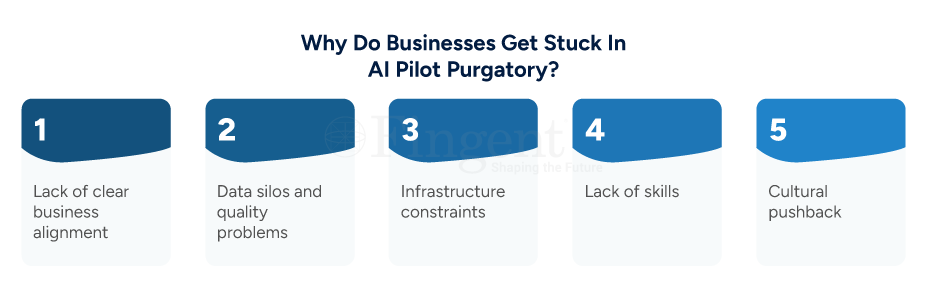
- Lack of clear business alignment: Many pilots show off new tech but fail to prove their value. Without measurable business outcomes, a pilot struggles to secure leadership support.
- Data silos and quality problems: AI hungers for good data. If data is disparate across departments, it can end up being inconsistent. This will hinder scaling.
- Infrastructure constraints: AI needs top-notch cloud infrastructure, data pipelines, and MLOps platforms to scale, but most companies ignore that.
- Lack of skills: To scale, data scientists won’t be enough. You require a team consisting of engineers, domain specialists, and a manager. They will keep an eye on the progress.
- Cultural pushback: Employees will push back against AI because they don’t believe in its decision, or they are afraid of being completely automated.
Eventually resulting in adoption barriers. To help your pilot escape purgatory, you need a complete enterprise AI strategy. This strategy should blend technology, governance, and cultural readiness.
Strategizing a Blueprint from Pilot to Production for AI Success
When you transition from pilot to production, the process isn’t done overnight. It is a structured journey that follows a blueprint. Here’s a blueprint to help your business scale AI from pilot to production.
1. Start with Business Value, Not Technology
Before coding for your project, determine high-impact business challenges that can be addressed with the help of AI. You can inquire:
- What are the most important processes in my company that can use automation? Are there any areas that can implement prediction to ease workflows?
- How should the project’s success be measured (KPIs, ROI, or time saved)?
This makes your AI for enterprise investment business-focused, not an experimental lab.
2. Build a Scalable Data Foundation
When your data is ready, AI success starts there. Construct central data lakes and maintain clean, labeled, and easily available data for departments. Invest in data governance frameworks such that data is of good quality and compliant.
3. Plan Scalability in Advance
Use reusable and modular blocks in building AI models on a strong foundation. Enforce MLOps practices that help integration, version control, and auto-deployment. This makes your AI a repeatable and scalable system rather than a one-time project.
4. Establish a Cross-Functional AI Taskforce
Scaling AI is an enterprise project, not an IT one. It involves more than one entity to make it work. So, you can bring in business leaders, data scientists, engineers, and compliance teams. Join forces towards a single purpose.
5. Use Ethical and Secure AI Practices
Enterprises need to focus on fairness and data privacy. To safeguard important data, establish an AI ethics board that looks carefully into policies that protect information. You can show accountability and regulatory compliance with XAI models.
6. Measure and Learn
Every successful enterprise AI strategy has ongoing feedback loops. Continuously track model performance, user adoption, and business results. Subsequently, retrain and improve models to keep pace with changing business objectives.
Strategize a Successful AI Journey for Your Enterprise. Assess AI Readiness, Spot Opportunities, and Integrate AI into Your Workflows.
Real-World Examples: Industry-Wise AI Scaling
Let’s explore how different industries are scaling AI in the enterprise effectively.
1. Banking and Financial Services
Banks lead with AI for enterprise when they use predictive analytics to detect fraud. They also use it to assess credit risk and personalize customer experiences.
Example: JPMorgan Chase’s COiN platform checks legal documents in seconds. This cuts down on spending for manual work and lowers operational costs.
Value: They experience all-round risk management and wiser decision-making.
2. Retail
AI for enterprise enables retailers to build buying experiences that are unique to their customers. It also streamlines supply chains.
Example: AI is employed by Walmart to predict customers’ demand. If their demand is altered, they modify stocks in real time.
Value: They get reduced wastage of products and improved customer service
3. Healthcare
Healthcare organizations gain from using AI in the enterprise. It helps with the before–diagnostics and predictive care. It also makes a notable difference to patient engagement.
Example: Diagnostic systems powered by deep learning can help analyze patient data and medical imaging in real time. The AI solution can be integrated with Electronic Health Records (EHRs) and lab databases. It also keeps HIPAA compliance and ethical transparency with enterprise AI strategy frameworks.
Value: Improved diagnostic accuracy, faster report turnaround time, and enhanced collaboration between clinicians and AI systems.
4. Manufacturing
AI in the enterprise changes manufacturing. It helps with predictive maintenance and quality control.
Example: Top players are using AI sensors that monitor machinery and prevent any breakdown.
Value: With this, they saved money, cut downtime, and achieved improved product consistency.
5. Nonprofits and the Public Sector
Non-profit organizations have greatly benefited from scaling AI implementations in enterprises for their workflows. It helps them to enhance engagement with donors and optimizes the way resources are utilized.
Example: UNICEF employs AI-driven data analytics to understand which regions require emergency aid.
Value: AI helped enhance their response time and effectively use their resources.
Common FAQs
Q. What is enterprise AI, and how is it different from general AI?
A. Enterprise AI is the use of artificial intelligence within large business settings. Enterprise AI is different from general AI. While general AI is used for consumer, as opposed to business, purposes and research, enterprise AI is designed to reinvent core business processes. Decision-making, prediction, automation, and customer interaction are just a few of them. It is about structured frameworks, governance models, and scalable infrastructure designed to enable the enterprise environment. Consider it as AI designed to deliver performance, compliance, and influence at scale.
Q. What is the timeline to deploy AI in a firm?
A.The timeline for implementing AI in the enterprise within a business relies on three key considerations: scope of business, data maturity, and complexity. A pilot would take 3–6 months, and a scaled deployment would take 12 to 24 months. Data-driven organizations with an adaptable culture can reduce the adoption time. Scaling is needed to plan extensively. That involves using AI to enhance processes and employee retraining. It can also establish MLOps for continuous improvement.
Q. Can small or medium enterprises scale AI successfully?
A. Yes! A size 500 fortune is not necessary to do business using AI for an enterprise. When an AI application is cloud-based, it allows SMEs to apply scalable analytics and automation. Begin small. Begin with one that has a high impact, such as sales forecasting or customer support automation. Pilot first, then roll it out incrementally. Strategic use of AI for enterprise has nothing to do with size but with clarity, intent, and action.
Q. How secure are enterprise AI implementations?
A. Enterprise AI rollouts put security at the top of the agenda. All serious AI systems abide by data protection legislation, like GDPR, and follow industry best practices. Security best practices include:
- Encryption of data in motion and rest
- Role-based access control implementation
- Conducting regular model audits
- Explainable AI (XAI) brings a whole new level of transparency
When done right, yes, enterprise AI can be secure. As secure as the systems it runs on. In fact, it can be even more secure because of its built-in anomaly detection and predictive monitoring.
How Can Fingent Help
At Fingent, we help businesses with their enterprise AI strategy. We guide them from ideas to full-scale implementation. We focus on finding real business value. We build data-driven roadmaps and facilitate responsible adoption across the enterprise. We help organizations:
- Move from pilot to production confidently
- Implement scalable and secure AI structures
- Make all transactions transparent and compliant
- Return quantifiable ROI with intelligent automation and analytics
Start your AI journey or move past pilot purgatory with Fingent. We can help you speed up transformation using AI for enterprise solutions that really work.
Think, Transform, and Evolve with AI
Scaling AI is not just about technology — it’s about transforming the way enterprises think, work, and evolve. Companies can avoid pilot purgatory by embracing an AI-based strategy that is robust and more powerful. Scalable infrastructure and an innovative culture are required. This can unlock the full potential of AI. The companies that succeed today will be leaders tomorrow.
Stay up to date on what's new
About the Author
Featured Blogs
Stay up to date on
what's new

