Tag: AI
Orders are the lifeblood of any business. But managing them is a whole different ball game.
A customer submits a purchase order by email. Another person places an order through a portal. Someone else calls your customer service team with a request. Soon, your operations team is juggling information from many sources. They have to put this together and ensure that every order is fulfilled properly and on time.
As orders multiply, so does complexity. Teams spend countless hours scraping data, confirming details, updating systems, and dealing with exceptions.
As a result of this chaos, many companies continue to struggle with manual work, lag times, and expensive mistakes, even with regular automation.
This is where AI order processing is changing the game.
AI Agents differ from traditional automation. They can understand context, make decisions, coordinate actions, and learn from business processes over time. They don’t just automate tasks — they orchestrate workflows.
For companies focusing on improving operations and customer experiences, AI agents are the cornerstone of next-generation order management.
A Look at – What Is AI Order Processing?
AI order processing uses smart AI agents to automate and improve the whole order cycle. This begins with getting customer requests. Then, it continues to validate order details and update OMS systems.
AI agents differ from traditional automation. While traditional systems follow set rules and workflows, AI agents can understand context. It is also able to process unstructured data, decide, and act in real-time. They can process emails, chats, voice calls, portals, and more. This happens without needing manual work for each step.
Imagine AI order processing as a team of digital workers working together in the background. One agent captures incoming order information. Another extracts key details. A third validates the data. Others coordinate workflows, validate business rules, and update OMS and TMS systems. How does this benefit your business? It brings speed, accuracy, and the ability to scale faster. Here’s a more detailed look at how AI agents improve order processing.
Manual Order Processing Is Costing You More Than You Think
How are AI Agents Used in Order Processing?
AI agents enhance order processing by moving beyond traditional automation rules. We are talking about actual reasoning, using memory, and real-time feedback loops, to name a few. Here’s a closer look.
1. Intelligent Order Capture and Validation
One of the biggest challenges in order management is dealing with unstructured information.
Customers don’t always submit orders in a standardized format. Some people send emails. Others attach spreadsheets. Many include key details hidden in long conversations.
Traditionally, employees must review and interpret this information manually. AI agents eliminate that burden by reading, understanding, and extracting relevant data automatically.
They can spot missing fields, flag inconsistencies, and check information before it enters business systems. This greatly cuts down on processing errors.
2. Autonomous Workflow Coordination
Order processing rarely involves a single department.
Sales, inventory, finance, logistics, and customer service often work together. They have to coordinate before fulfilling an order.
AI agents serve as intelligent orchestrators across these functions. They shuttle information between systems, request approvals, and make sure every stakeholder has access to the right data.
This removes bottlenecks and ensures orders flow seamlessly through the pipeline.
3. Real-Time Exception Handling
Even the best of processes run into exceptions.
Stockouts, pricing errors, incomplete customer information, and delivery-related problems interfere with the process flow.
Instead of letting these problems sit unnoticed in someone’s inbox, AI agents flag them. They can take care of simple problems themselves. The complex ones get passed on to the right person.
This means quicker resolution and fewer hold-ups.
4. Faster Order Processing and Customer Response
Customers expect fast responses.
When they place an order, they want to be sure it has been received. They also want to confirm it’s moving through the fulfillment process.
With AI order processing, organizations can handle orders in seconds. Customers can count on faster confirmations, speedier updates, and more dependable service.
The result is enhanced trust and customer satisfaction.
5. Continuous Process Optimization
Conventional automation follows the same instructions over and over. However, the AI agents are trained based on real-world data and previous outcomes. They start to spot repetitive patterns over time, detect inefficiencies, and suggest improvements.
This capability enables the process to be continuously evolved without human intervention.
The Top Benefits of Using AI Agents in Order Management?
1. Scale Operations Without Increasing Headcount
As order volumes increase, companies are often faced with a tough decision — hire more people, or risk overwhelming the teams they already have. AI agents help eliminate that trade-off. Automating order capture, validation, data entry, and workflow coordination helps reduce the workload. This means less need for extra staff. This allows organizations to scale operations without proportionally increasing headcount.
2. Faster Order Processing
Manual processing of orders can take 10 to 15 minutes per order. Teams have to read emails, extract information, verify details, and then update multiple systems. AI agents can perform many of these tasks in 1–2 minutes—or even seconds, in some cases. Order confirmation processing gets faster, order fulfillment cycles get shorter, and customers become happier.
3. Lower Operational Costs
Every manual touchpoint adds time and cost to the order management process. When workers spend hours doing the same administrative tasks over and over, operational costs start adding up. AI agents reduce the need for manual intervention, allowing teams to concentrate on higher-value activities while lowering the overall cost of processing each order.
4. Eliminate Costly Errors
A small mistake in product quantities, pricing, customer info, or shipping can lead to expensive losses. Frequent returns, lost revenue, and unhappy customers can badly affect the brand value. AI agents verify information, looking up to knowledge bases including business rules, inventory records, customer agreements, and past data before they process orders. This significantly reduces human error and helps organizations avoid expensive downstream corrections.
The result is a quicker, more accurate, and scalable order management system. It boosts efficiency and helps the business grow.
Industry Use Cases
1. Manufacturing
Challenge: Manufacturers often deal with large volumes of complex B2B orders. An order can have multiple product configurations, special pricing arrangements, lead times, and production requirements. Manually processing these orders for production may delay workflow and cause errors.
Solution: AI agents support manufacturers by extracting details of orders from emails and messages from customers. They cross-reference this data with production schedules, verify stock availability, and update OMS/TMS systems automatically.
Benefits:
- Accelerates quote-to-order conversion
- Reduce costly rework and scrap due to manual entry errors
- Reduce manufacturing wastes
- Prioritizes high-value or time-sensitive orders
- Tracks customer-specific compliance, quality
- Identifies orders that may impact production line efficiency
2. Retail and eCommerce
Challenge: Retail and ecommerce now operate on websites, marketplaces, mobile apps, social commerce channels, and in-store. It’s not always easy to sync inventory and order fulfillment across these channels.
Solution: AI agents enable the retailer to efficiently fulfill omnichannel customer orders by capturing orders in real time, validating details, and orchestrating the order processing operations. When there is more demand in seasonal sales, AI agents will contribute to these operations efficiently.
Benefits:
- Consolidates orders from multiple sales channels into a single processing workflow.
- Detects duplicate orders submitted across different channels.
- Prevents overselling by validating stock availability.
- Routes orders faster to the nearest fulfillment center.
- Improves order accuracy for products with multiple variants.
- Minimizes cart-to-fulfillment delays, especially during peak seasons.
3. Distribution and Logistics
Challenge: Speed and visibility are paramount for distributors and logistics providers. The orders can include a combination of different warehouses, shipping partners, and delivery dates. Disruptions can change what customers expect and what it takes to run day-to-day operations.
Solution: AI agents can improve shipment coordination, keep transport systems informed with the right data, monitor order status, and detect potential problems. This creates a more resilient and responsive logistics operation.
Benefits:
- Validates delivery locations, service zones, and transportation constraints.
- Reduces manual order entry errors that can lead to shipment delays.
- Prioritizes urgent, time-sensitive, and high-value shipments.
- Help route orders to the most suitable warehouse or distribution centers.
- Reduces order backlogs during seasonal peaks.
- Enables 24/7 order intake and processing.
4. Healthcare and Medical Supply
Challenge: Healthcare providers rely on the correct purchasing and delivery of essential supplies. A missing item or a shipment delay can lead to serious consequences.
Solution: AI agents make procurement easier. They help suppliers validate requests faster based on inventory availability, coordinate approvals, and update systems in real-time to eliminate medical procurement delays. Healthcare providers can be reassured that vital supplies will arrive where and when they are needed most.
Benefits:
- Validates orders against approved product catalogs.
- Prioritizes urgent orders for critical care and emergency departments.
- Prevents ordering errors for regulated, high-value products.
- Ensures compliance with healthcare procurement policies.
- Helps prevent stockouts of life-critical supplies with 24/7 order processing.
- Supports multi-location healthcare networks.
FAQs
1. Can AI agents integrate with ERP systems for order processing?
A. Yes. AI agents can connect to your ERP, OMS, and TMS systems using APIs and connectors. This allows for smooth data synchronization, automated refreshes, and full workflow orchestration.
2. Are AI agents better than traditional order processing automation?
A. Traditional automation is effective for repetitive, rule-based tasks. AI agents take it further. AI agents enhance order management by combining smart order capture, automated checks, workflow coordination, real-time issue handling, and ongoing improvement. This makes the process smarter and self-enhancing.
3. Can AI agents process orders from emails, chats, and voice calls?
A. Absolutely. Modern AI agents can gather information from different channels. They extract important details and start workflows automatically. This happens no matter how the order was received.
4. How do AI agents reduce order processing errors?
A. AI agents validate information against business rules, inventory records, pricing agreements, and customer data before processing orders. This significantly reduces the risk of manual data entry mistakes and operational errors.
Introducing OrderFlow AI Agent Powered by Fingent
OrderFlow AI Agent is Fingent’s smart AI Agent-powered solution for efficient order processing. The AI Agent can be custom-integrated with your existing TMS and OMS systems to act as a digital worker and automate your entire order processing workflow. It uses a multi-agent architecture. Specialized AI agents team up to handle requests, validate information, and act in real time without much human intervention. Here’s a closer look at how the system works.
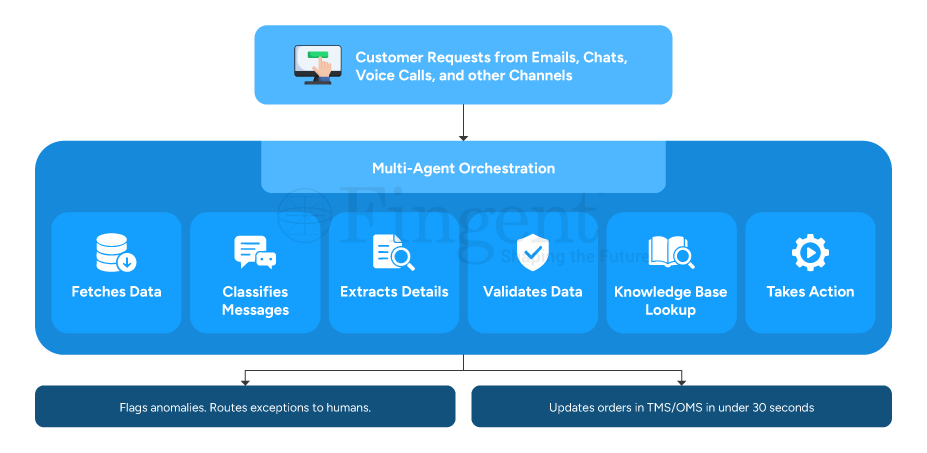
1. Captures Orders from Any Channel: The system automatically identifies and captures relevant order information from emails, chats, voice calls, portals, and more, as soon as it arrives.
2. Understands and Classifies Requests: The OrderFlow AI Agent intelligently classifies each interaction and routes it through the appropriate workflow, whether it is order modification requests, cancellations, inquiries, or support queries.
3. Extracts Critical Order Details: The system automatically gathers key information like product details, quantity, pricing, delivery needs, customer info, or special instructions without manual intervention.
4. Validates Information Against Business Rules: Before processing an order, the system validates its accuracy and compliance by comparing it against specified business rules.
5. Leverages Enterprise Knowledge: The system can access internal knowledge bases, contracts, historical transactions, policies, and documentation to make informed decisions and support complex order-processing scenarios.
6. Executes Actions Automatically: The OrderFlow AI Agent takes action in real-time. It updates the OMS/TMS systems with accurate order details and customer data. If exceptions are found, they’re sent to the right team for review. This ensures that human-in-the-loop for enhanced safety.
The Outcome:
- Zero-touch order entry
- Faster order processing and fulfilment
- Human-in-the-loop exception management
- Seamless OMS and TMS integration
- Reduced manual effort and operational costs
- Continuous process optimization
- Enhanced safety with robust AI guardrails and security policies
Don’t Let Traditional Order Processing Methods Sloth Your Business Leverage AI Agents and Scale Without Limits
Conclusion
Order processing is not just about moving information from one system to another. It’s a key business function that directly impacts customer satisfaction, operational efficiency, and business expansion.
Organizations must ensure efficiency and speed at the core of the order processing workflow.
AI order processing addresses this with seamless understanding of context, making decisions, handling exceptions, and adapting to changing business needs. That’s exactly what businesses need today.
It’s time to reshape and redefine with the latest technologies and find a competitive edge in the market.
Stay up to date on what's new

About the Author

Featured Blogs







Stay up to date on
what's new



Talk To Our Experts
Nobody builds a broken order process on purpose.
It starts with good intentions. A spreadsheet that works. An email thread that keeps everyone in the loop. A team skilled enough to work around the gaps. And for a while, it holds together just fine.
Then volume grows. Customer expectations shift. And the workflow that once felt manageable starts quietly bleeding money from every direction, in ways no single report will ever fully capture.
That’s the thing about manual order processing. It doesn’t fail dramatically. It fails slowly. Can order processing automation solve this burning challenge? Let’s find out!
The Hidden Operational Costs
Did you know it is with errors that the damage begins? Start there.
When orders arrive across multiple channels, someone has to read each one. Interpret it, and re-enter it into a system. That process introduces mistakes. Not because the people doing it are careless, but because humans doing repetitive data entry under volume pressure make errors.
And each error sets off a chain reaction. Wrong item shipped > Return raised > Credit note issued > Customer complaint logged >Re-processed from scratch. What looked like a small mistake at intake turns into a disproportionately expensive problem three steps downstream.
Then there’s visibility, or the complete lack of it. When your ERP lives in one place, your CRM in another, and order status is buried in someone’s inbox, nobody has the full picture. Exceptions go undetected. A shipment stalls or a customer waits. By then, the relationship is already damaged.
Approval workflows sitting inside email threads are their own problem. They add hours to every order that needs a second set of eyes. Sometimes days. In industries like logistics and freight, where speed is essentially the product, that delay isn’t a minor inconvenience. It’s a competitive disadvantage dressed up as normal.
Manual workflows create fragile operations. One absence, one volume spike, or one experienced employee walking out the door can throw the whole system into chaos.
The Business Impact
The cost of manual order processing doesn’t come from one catastrophic failure. It accumulates from thousands of small ones.
1. Reduced productivity
The small errors matter – the re-entered data, the overtime during peak periods, the customer credits issued to smooth over mistakes that should never have happened. Over time, that adds up to a significant and measurable drag on productivity and profitability.
2. Difficulty scaling operations
Scaling makes it worse, not better. Manual processes don’t grow gracefully. When volume spikes, whether from a seasonal rush, a new client, or genuine market growth, the only lever you have is headcount. You hire more people to do the same work at higher volume. Error rates climb because teams are under pressure. Good people burn out doing work that machines should be doing.
Think about what that means when you look at manual order processing vs automated order processing side by side. One scales with volume. The other scales with people. One gets more accurate over time. The other gets more expensive. One gives you real-time visibility across systems. The other gives you a Monday morning status meeting and a backlog nobody is happy about.
3. Lost revenue opportunities
The revenue impact is the part that stings most. Slow fulfillment drives customers toward faster, more reliable competitors. Errors erode trust that took years to build. In logistics, freight, and ecommerce, where the difference between retaining an account and losing it often comes down to speed and accuracy, a process that can’t keep up isn’t just inefficient. It’s a liability.
How AI Agents Can Transform Order Processing
This is where the conversation changes. How do you automate order processing?
Most businesses think they have a people problem – too many delays, too many errors, too much rework. Actually, more often than not, they have a process problem wearing a people costume.
Understanding how to automate order processing starts with understanding what an AI agent actually does. And no, it is not a chatbot sitting in a corner answering polite little questions all day.
An AI agent acts. That is the difference.
It reads incoming orders from emails, PDFs, portals, EDI systems, and spreadsheets. It pulls out the right data, checks it against inventory and business rules, routes the order through approvals, updates connected systems, and flags exceptions before they snowball into expensive problems. No copy-paste marathons. No inbox archaeology. No employee squinting at line items at 7:43 PM, wondering why SKU codes suddenly look like hieroglyphics.
Fingent’s AI Agent connects with your existing systems, automates clean orders, routes exceptions intelligently, and keeps operations moving without the usual inbox chaos. It’s fast, accurate and scalable.
For logistics and freight teams, that means processing orders from messy email chains and PDF attachments in minutes instead of hours. For ecommerce businesses, it means surviving peak season without throwing more exhausted humans at the problem every December. And for operations teams processing hundreds of orders a day, it means fewer mistakes, faster fulfillment, and a workday that no longer revolves around repetitive admin work disguised as productivity.
But the real shift goes deeper than efficiency.
When your order process runs cleanly at scale, your business changes shape. Teams stop reacting and start planning. And in industries where speed and reliability decide who keeps the account and who loses it, that advantage matters.
Dive Into The World of AI Agents Enable More Faster and Efficient Order Processing
Frequently Asked Questions
1. What is order processing automation?
A. Order processing automation replaces manual order handling with software and AI-driven workflows.
Your team does not need to bounce between inboxes, PDFs, spreadsheets, and ERP screens. Instead, AI agents capture the data automatically. They validate it against business rules, and move orders through the right workflows in real time.
2. How can businesses reduce order processing errors?
A. Businesses reduce order processing errors by reducing manual data entry.
One wrong digit turns into the wrong shipment. This can frustrate a customer. The support team then has to scramble to clean up a mess that should never have existed in the first place. AI agents catch those problems early. Before the warehouse does. Before the customer does. Before finance starts issuing credits as apologies.
3. How does order processing automation improve efficiency?
A. Order processing automation improves efficiency by removing repetitive work and workflow bottlenecks.
Teams stop wasting half the day entering the same information over and over. AI agents handle those tasks in minutes. Orders move faster. Teams breathe easier. This allows skilled employees to finally spend time solving problems instead of babysitting spreadsheets.
4. When should a business automate order processing?
A. A business should automate order processing the moment manual work starts slowing growth.
If your team is staying late just to clear order backlogs, if mistakes trigger constant rework, or if peak season feels less like growth and more like surviving a natural disaster, then the process already costs too much. Manual operations scale with stress. Automated operations scale with demand. That’s a big difference.
Conclusion
Manual order processing doesn’t announce when it becomes a problem. It just costs more every month. Quietly – in errors, in rework, in staff hours, and in customers who don’t come back.
Order processing automation, powered by AI agents that read, validate, route, and fulfill orders without human intervention, is how modern logistics, freight, and ecommerce businesses stop paying that cost. Not by replacing their teams. By giving those teams work that’s actually worth their time.
Fingent’s AI Agent for order processing integrates with what you already have and is built to deliver from day one. If your order operations are ready for a better way, we’d like to show you what that looks like.
Stay up to date on what's new
About the Author

Tony Joseph

Tony believes in building technology around processes, rather than building processes around technology. At Fingent, he specializes in custom software development, especially in analyzing processes, refining them, and then building technology around it. He works with clients on a daily basis to understand and analyze their operational structure, discover (and not invent) key improvement areas, and come up with technology solutions to deliver an efficient process. You can reach him at [email protected], Skype: tony_fingent
Featured Blogs
Stay up to date on
what's new
Talk To Our Experts
Stay up to date on what's new
About the Author
Tony Joseph
Tony believes in building technology around processes, rather than building processes around technology. At Fingent, he specializes in custom software development, especially in analyzing processes, refining them, and then building technology around it. He works with clients on a daily basis to understand and analyze their operational structure, discover (and not invent) key improvement areas, and come up with technology solutions to deliver an efficient process. You can reach him at [email protected], Skype: tony_fingent
Featured Blogs
Stay up to date on
what's new
Talk To Our Experts
Intelligent integration architecture – it’s more valuable than you think. Yes, your enterprise already has AI, the forecasting models, recommendation engines, and automation workflows.
Now here’s the hard question: Are these systems creating value together or quietly cancelling each other out?
Most organizations don’t notice the gap until something breaks. A demand signal triggers procurement. Procurement optimizes for cost. Logistics is constrained by capacity and then delivery slips.
Each system performs correctly on its own. The failure happens between them, showing up not as errors but as missed revenue, delayed responses, and silent inefficiency.
These raise uncomfortable questions:
- Who decides when multiple AI systems disagree?
- Where is alignment enforced before execution begins?
- How much revenue leakage hides inside “correct” but conflicting decisions?
This is where Intelligent integration architecture becomes critical. It defines how intelligence flows, aligns, and executes across enterprise systems.
What Is an Intelligent Integration Architecture?
Intelligent integration architecture is the structural design that enables AI systems, services, and agents to operate as a coordinated network rather than isolated components.
Traditional integration connects systems, while intelligent integration ensures they act together, not in conflict. In practical terms, this shifts integration from data exchange to decision alignment.
At its core, it defines:
- How AI systems communicate
- How decisions are prioritized
- How actions are executed across systems
- How feedback loops refine outcomes
This layer functions above microservices and APIs. It frequently uses event-driven architecture (EDA), orchestration engines, and shared context layers to align decisions throughout distributed systems.
In modern Enterprise AI architecture, integration must handle:
- Real-time decision flows
- Cross-system dependencies
- Dynamic workloads
- Continuous learning cycles
Without this structure, enterprises don’t just face system fragmentation. They face decision fragmentation at scale.
The Core Components of Intelligent Integration
To understand how this architecture works, we need to break it into execution layers that mirror real-world systems.
1. MCP Servers: The Coordination Backbone
MCP servers can be understood as coordination hubs within the control plane, similar in role to orchestration engines or API gateways, but focused on maintaining decision context across systems.
Think of them as control points. Not passive connectors. Their responsibilities include:
- Routing tasks between systems
- Managing execution context
- Handling state across workflows
- Enforcing communication protocols
In practice, this function is often implemented using workflow orchestration platforms (such as Temporal or Camunda) combined with event streaming systems like Kafka to maintain state and sequencing.
In the context of MCP servers in enterprise AI, they ensure that interactions between agents and systems remain structured and traceable.
Without it, integration becomes fragile, costly, and doesn’t scale.
2. Agent Frameworks: The Execution Layer
Agent frameworks define how autonomous or semi-autonomous AI agents operate. Agents are not just models. They are decision-makers with defined roles, combining models, rules, tools, and memory within controlled autonomy.
Agent frameworks provide:
- Lifecycle management
- Task orchestration logic
- Inter-agent communication protocols
In real-world implementations, frameworks such as LangChain or AutoGen enable agents to interact with APIs, tools, and other agents in structured workflows.
In Agent frameworks for enterprise AI, the goal is not autonomy for its own sake. It is controlled autonomy aligned with business outcomes.
Because unmanaged autonomy does not scale. It multiplies risk.
3. Orchestration Layer: The Control Mechanism
This is where coordination becomes execution.
An AI orchestration framework ensures that multiple agents and systems work together without conflict.
It defines:
- Task sequencing
- Dependency resolution
- Conflict management
- Priority handling
Technically, this layer integrates workflow engines, rule engines, and event-driven pipelines to enforce coordination across distributed systems.
This is where AI system orchestration becomes visible. Without it, systems compete; with it, they align. The real challenge begins when speed clashes with cost, multiple agents are right, and coordination slows decisions.
The orchestration layer resolves this in real time by balancing speed, cost, and accuracy.
What Is Intelligent Integration & What Does It Promise For Enterprises in 2026?
How Intelligence Is Coordinated Across Systems
Most enterprises treat coordination as a setup task. It is not. Every new data signal, agent decision, or system update has the potential to create misalignment downstream.
Coordination has to run continuously, not occasionally. In a well-designed Enterprise AI integration framework, this happens through a structured flow that keeps every system in sync as conditions change:
- Input Aggregation: Data flows in from ERP, CRM, and operational systems.
- Context Formation: MCP-like coordination layers establish shared context using event streams and state management systems.
- Agent Activation: Relevant agents are triggered.
- Decision Coordination: The orchestration layer aligns outputs before execution.
- Execution Across Systems: Actions are executed across platforms.
- Feedback Loop: Outcomes are captured and refined.
The critical insight! Failures rarely occur at execution. They occur before execution, when context is misaligned.
This is how Coordinating AI across enterprise systems becomes structured rather than reactive.
Architecture in Practice
In an Enterprise AI architecture, consider a supply chain scenario:
A demand forecasting agent predicts a surge, then a procurement agent evaluates suppliers, and then a logistics agent plans distribution.
Now consider the reality. Procurement saves money, logistics saves time, and finance protects budgets. Yet no one saves the outcome.
With AI agents orchestration architecture:
- MCP servers establish shared context
- Agents exchange insights
- The orchestration layer resolves trade-offs
- Execution follows a unified plan
The result is fewer conflicting decisions, faster alignment, and measurable operational efficiency.
Extend this further: in customer experience systems, pricing engines, recommendation engines, and churn prediction models often act independently. Without coordination, they optimize different outcomes. With integration, they align toward a single customer strategy.
This is the difference between automation and intelligence.
Key Design Principles
Good architecture is not just about performance. It is about accountability. When something goes wrong, you should be able to trace what happened and why. Without that clarity, small issues turn into expensive problems. These principles ensure that visibility is never lost.
Principles for an Intelligent System Architecture
- Context Awareness
- Controlled Autonomy
- Real-Time Coordination
- Scalable AI integration layer architecture
- Observability and Governance
Challenges in Implementation
Designing architecture is one part, but implementation is where most failures occur. In most enterprises, these failures appear in a few recurring patterns:
1. Legacy System Constraints
Legacy systems were built for batch processing, not real-time integration. When AI agents need immediate data, these systems quickly become bottlenecks.
Solution: Implement abstraction layers and APIs between legacy systems and the integration layer. Event-driven connectors enable legacy systems to react almost in real time without requiring a complete overhaul.
Trade-off: You incur increased latency and initial integration expenses. This is still significantly less expensive than dismantling core systems.
2. Fragmented Data Sources
AI is only as good as its data. When that data is inconsistent or siloed, agents start making decisions no one can trust.
Solution: Unify data models and uphold governance. Employ data agreements, uniform formats, and verification prior to data entering decision processes.
Trade-off: Substantial initial engineering work. Bypassing it means you’ll face the consequences later through poor choices and expensive repairs.
3. Agent Conflict and Overlap
Several agents collaborating on the same signals might appear to be effective. In truth, it results in clashes, redundancy, and disruption.
Solution: Establish distinct responsibilities for every agent. Allow the orchestration layer to serve as the ultimate decision-maker in cases of conflict.
Trade-off: Reduced independence for each agent. However, unchecked autonomy at scale produces greater risk than benefit.
4. Scalability Issues
What succeeds with a small number of agents fails quickly when scaled up. Latency increases, conflicts proliferate, and visibility decreases
Solution: Create with a modular approach from the start. Each component must be deployable and replaceable on its own.
Trade-off: Increased preparation and greater initial effort. However, expanding a well-organized system is much simpler than repairing a delicate one afterwards.
Still Wondering If You Need Intelligent Integrations?We Can Help You Seamlessly Embed AI into Your Processes to Enable Faster Results.
FAQs
Q. In what way do AI agents collaborate within enterprise systems?
A. AI agents operate within well-defined roles and interact via structured protocols. A coordination layer, similar to an MCP server, maintains shared context. This helps every agent to know what others are doing. The orchestration layer subsequently coordinates its outputs before execution. Doing so ensures they aim for a single outcome rather than moving in different directions.
Q. What is AI orchestration, and why does it matter?
A. AI orchestration manages decisions and actions among agents and systems. It arranges tasks, addresses dependencies, and manages conflicts when results collide. In its absence, every system seeks its own optimization. That can lead to a negative impact on the overall business results, despite the good performance of individual components.
Q. What function do MCP servers serve in AI integration?
A. MCP servers acts as central coordination points. They direct tasks, uphold execution context, and ensure organized communication among agents. In the absence of this layer, interactions turn unstructured, difficult to track, and unstable when scaled.
Q. In what ways are agent frameworks utilized in enterprise AI?
A. Agent frameworks outline the construction, deployment, and regulation of agents. They oversee the lifecycle, regulate the transformation of inputs into actions, and standardize interactions with systems and tools. Frameworks such as LangChain and AutoGen facilitate transparent, verifiable workflows rather than unclear, black-box actions.
Q. How do organizations align intelligence across different systems?
A. Structure gives rise to alignment. Orchestration layers arrange decisions in sequence, coordination centers uphold a common understanding, and agent frameworks dictate actions. Collectively, they guarantee that various systems function as a unified whole instead of rival units pursuing different objectives.
Q. What is the difference between AI architecture and AI integration architecture?
A. AI integration architecture is about making sure those systems work together. One focuses on creating capable models and the infrastructure behind them. The other focuses on what happens when multiple capable systems are running at the same time.
Q. Is intelligent integration architecture suitable for legacy systems?
A.Yes. Legacy systems were never built for real-time coordination. Replacing them is not the only option, though. APIs and abstraction layers act as bridges. Thus, allowing older systems to connect with modern components without a full rebuild. Event-driven connectors go a step further by allowing responses to real-time signals rather than depending on batch cycles.
Enable Enterprise AI Architecture for Your Business
Enterprises no longer struggle to build AI. They struggle to align it. It is from isolated intelligence to coordinated execution. Intelligent integration architecture defines how that coordination happens.
The real question is, are your systems thinking together or competing silently at scale?
This is where the right partner becomes critical.
At Fingent, the focus goes beyond building AI solutions to enabling Enterprise AI architecture that aligns intelligence across the business. With expertise in AI integration architecture and orchestration, Fingent helps organizations move from fragmented adoption to coordinated execution.
From designing AI orchestration framework layers to implementing Agent frameworks for enterprise AI and Coordinating AI across enterprise systems, the objective is simple: one unified business outcome.
Competitive advantage doesn’t come from more AI. It comes from AI that works as one.
Stay up to date on what's new
About the Author
Tony Joseph
Tony believes in building technology around processes, rather than building processes around technology. At Fingent, he specializes in custom software development, especially in analyzing processes, refining them, and then building technology around it. He works with clients on a daily basis to understand and analyze their operational structure, discover (and not invent) key improvement areas, and come up with technology solutions to deliver an efficient process. You can reach him at [email protected], Skype: tony_fingent
Featured Blogs
Stay up to date on
what's new
Talk To Our Experts
This is the reality of many enterprises today: A request is created. Someone sends an email. Another person updates a spreadsheet. Someone copies the data into a CRM. Then the cycle repeats.
Nothing appears broken. Yet the process stays slow and fragile. Relying on someone to process the next step can stall the workflow.
That is why custom enterprise workflow automation software is becoming essential for modern organizations. Automation keeps routine work moving without human nudges. Workflows are hassle-free, services are on time, and customers are easier to retain. Here’s more on enterprise workflow automation, what it is, how it works, and why modern businesses must consider it!
What are the Benefits of Enterprise Workflow Automation?
Manual processes look harmless on the surface. Yet they quietly create operational drag across an organization. Emails pile up, approvals stall. Data gets duplicated while small errors continue to multiply. These inefficiencies become expensive.
Well-designed custom enterprise workflow automation software addresses these problems in practical ways.
1. Faster Process Execution
Manual workflows slow down decision-making. Every step depends on someone noticing an email or remembering a task.
Automation removes that delay. A purchase request is automatically directed to the appropriate approver depending on department, budget, or spending restrictions. If approval is postponed, it triggers immediate alerts and reminders. This saves time.
2. Consistency and Precision
We humans, are capable, but we are not perfect data processors. Manual workflows often involve copying information between systems. This introduces mistakes. A wrong number in an invoice. An incorrect customer status. A missed compliance step.
Automation keeps the process consistent every time. The rules are built into the workflow, reducing the risk of human error.
3. Real-Time Process Visibility
Figuring out where the task is stuck is the top priority for managers.
Visibility is one of the superpowers of custom enterprise workflow automation software. Every step is visible through dashboards and logs. No guesswork. You know who approved, who hasn’t responded, and what stage the process is in.
4. Scalability Without Operational Chaos
As businesses grow, transaction volume increases. More invoices, more customer requests, more approvals. Manual systems rarely scale well. Teams respond by hiring more staff just to manage operational tasks.
Automation changes that equation. Processes handle higher volumes without proportional increases in manpower. This allows companies to grow while maintaining operational control.
Step Out of Tedious Time-Consuming Manual Efforts Elevate Your Operations With Enterprise Workflow Automation
Enterprise Automation Use Cases
Automation becomes easier to understand when we look at real operational scenarios. Many industries are already applying these systems to solve practical problems.
Let’s look at some real-world enterprise automation use cases.
1. Intelligent Document Automation
Businesses handle thousands of documents daily. AI-driven automation eliminates the trouble of manually reviewing documents, compiling data, and entering it. Through OCR and machine learning, documents are analyzed, data is gathered, verified, directed, and refreshed automatically.
The impact is immediate. Manual effort drops by up to 99.99%, shifting teams from data entry to real analysis and decision-making.
Such capabilities are particularly useful to industries handling large sets of data, like legal, insurance, and logistics. Document intelligence can help identify errors and fraud faster, recognize human writing, and process invoices faster.
In custom enterprise workflow automation, this is not an add-on. It is the workflow, with documents moving from intake to approval and storage with minimal human touch.
2. Operational Assistance in Experiential Marketing
Experiential marketing campaigns involve dozens of moving parts – venue coordination, vendor approvals, event staffing, and customer engagement tracking.
Without automation, campaign teams drown in coordination tasks. Operational AI assistants change this dynamic.
They act as digital coordinators that:
• Track campaign progress
• Assign operational tasks
• Monitor event logistics
• Alert teams when actions are required
With custom enterprise workflow automation software, these assistants connect seamlessly with CRM systems, marketing platforms, and analytics tools.
The result? Better coordinated campaigns, faster decisions. And a more consistent customer experience.
3. Automating Lead Response
In sales, timing matters most. However, most businesses continue to reply to leads several hours or days late, losing the significant increase in conversions that results from responding within minutes.
Automation solves this instantly. When a lead arrives:
- The system evaluates the lead
- Assigns it to the right salesperson
- Sends personalized responses
- Schedules follow-ups
- Updates CRM records
No missed opportunities. This is one of the fastest-return investments companies make when adopting Custom enterprise workflow Automation software.
4. Conversational AI for Marketing Intelligence
Marketing teams collect massive amounts of data. Such as:
- Campaign metrics.
- Customer engagement.
- Channel performance.
The challenge is interpreting that data quickly. Conversational AI changes the experience.
AI gets the data, looks at it, and gives you a clear answer in a few seconds. This is possible because custom enterprise workflow automation is already linking systems and running the right analysis in the background.
No need to chase reports or piece things together manually. The answers are ready when they are needed.
Why Choose to Build a Custom Enterprise Workflow Automation Software
Why not just buy an off-the-shelf tool? Because enterprise workflows are rarely generic.
They are shaped by:
- Internal policies
- Compliance requirements
- Legacy systems
- Industry-specific processes
Pre-built tools often force companies to adapt their processes to the software. Custom automation flips the equation. The software adapts to the business. That is the real advantage of custom enterprise workflow automation software.
It integrates with existing systems, mirrors real operational processes, and scales as the business evolves.
Best Practices for Successful Workflow Automation Software Development
Automation works only when it solves real operational problems. Effective workflow automation software development starts with understanding how work currently flows before building anything.
Here are a few principles experienced teams follow:
1. Start With High-Impact Workflows
Many organizations make the same mistake. They try to automate everything at once.
But ask a simple question first. Where does work slow down the most? Start there.
Look at the workflows employees complain about every week. These are usually the pressure points where delays pile up. Automate these first, and the payoff is immediate. Teams feel the relief. Leadership sees the numbers move.
2. Prioritize User-Friendly Design
Automation is intended to simplify work, not complicate it.
If workers require a guide to authorize a request or monitor progress, does the system truly assist?
Individuals ought to have the capability to authorize requests, monitor workflow progress, and advance tasks without searching through perplexing interfaces. When tools seem intuitive, acceptance occurs quickly.
This is the reason numerous organizations opt for tailored enterprise workflow automation software. Rather than compelling teams to conform to inflexible tools, the software adjusts to the actual workflow of the team.
3. Ensure Scalability and Security
Enterprise systems must support growth. A workflow platform handling hundreds of transactions today may face thousands tomorrow. Scalability keeps performance steady as demand grows.
Security is just as critical. The best custom enterprise workflow automation platforms integrate securely with enterprise systems while keeping access tightly controlled. The doors stay connected, but firmly locked.
4. Continuous Optimization After Deployment
Automation is not a singular occurrence. Process flows need to adjust as tasks evolve.
Teams can consistently enhance processes. They can remove bottlenecks as they emerge. This way, the organization evolves with a tailored, seamless workflow.
Power Your Workflows With Intelligence Integration
Frequently Asked Questions
Q. What is custom enterprise workflow automation software?
A. Custom enterprise workflow automation software is a tailored system that automates internal business processes. It routes tasks, triggers approvals, connects enterprise systems, and moves work forward automatically.
Instead of employees coordinating each step, the workflow manages the process.
Q. How long does enterprise workflow automation implementation take?
A. Timelines vary depending on workflow complexity and system integrations.
A focused automation initiative targeting key processes may take only a few months. Larger enterprise programs are usually implemented in phases to deliver early results. All the while expanding automation gradually.
Q. How much does it cost to make software for businesses?
A. The cost to build enterprise software depends on several factors:
Workflow complexity
Number of systems that must integrate
Security requirements
Advanced capabilities such as AI-driven automation
Most companies start small. They automate a few high-impact processes first, then expand as the value becomes clear.
Q. Can automation integrate with existing enterprise systems?
A. Yes. Modern automation platforms connect with CRM systems, ERP platforms, analytics applications, and marketing software via secure APIs.
This enables workflows to function smoothly throughout the organization without eliminating current systems.
How Fingent Can Help
Most businesses do not struggle due to a deficiency of ideas. They face challenges because of the friction throughout the workflow.
This is where Fingent creates real impact.
Fingent assists businesses in creating and deploying personalized enterprise workflow automation software. Our teams analyze current workflows and pinpoint bottlenecks. Doing so will help us create solutions that integrate smoothly with your enterprise systems.
The outcome extends beyond mere automation. It is operational clarity. Work moves faster. Teams spend less time coordinating and more time executing. And leadership gains the visibility needed to scale operations with confidence.
Stay up to date on what's new
About the Author
Tony Joseph
Tony believes in building technology around processes, rather than building processes around technology. At Fingent, he specializes in custom software development, especially in analyzing processes, refining them, and then building technology around it. He works with clients on a daily basis to understand and analyze their operational structure, discover (and not invent) key improvement areas, and come up with technology solutions to deliver an efficient process. You can reach him at [email protected], Skype: tony_fingent
Featured Blogs
Stay up to date on
what's new
Talk To Our Experts
Most enterprise leaders have experienced this—the initial excitement of AI giving way to a high-stakes question: When will I see the returns? This state of “pilot purgatory”, high investment with no measurable bottom-line impact, forces many to blame it on the maturity of AI models. The actual culprit, however, is the underlying infrastructure that lacks connectivity.
Gartner forecasts that through 2026, up to 60% of AI projects will be abandoned due to inadequate integration and low-quality data. To achieve enterprise-wide value, leaders must shift their focus from the model itself to the intelligent integration architecture that empowers it to act. Read on!
Structural Bottlenecks Hindering Your AI’s Success
AI initiatives are often considered as standalone trials rather than core business functions. Here’s where the AI project begins to fail. By dropping a high-powered AI model on top of disconnected data and fragmented legacy systems, you don’t get innovation but friction. Before scaling your next pilot, evaluate if these common architectural barriers are draining your budget:
- Fragmented and Siloed Data: AI can support strategic decisions only if it is able to see your operations end-to-end. Your models remain “data-deprived” in the absence of a unified architecture for intelligent integration. This results in the generation of irrelevant or inaccurate outputs.
- Rigidity of Legacy Systems: Traditional ERPs and databases weren’t designed for real-time AI interaction. How AI systems are integrated in enterprises determines whether your AI acts as a fast-moving engine or a stalled project that cannot access the records it needs to function.
- The Orchestration Gap: A lack of an AI agent orchestration architecture means your automated agents cannot communicate. This creates “agent silos” where only individual tasks are automated, but end-to-end business processes remain broken because the agents cannot “hand off” tasks to one another.
- Manual Middleware Debt: Relying on custom-coded connections for every new use case is unscalable. Many companies face a kind of “AI ROI Paradox” where they increase investment but struggle with returns because they spend more on “fixing the plumbing” than on actual innovation.
Afraid to Step Into the World of AI? Let Us Help You Design a Strategic Roadmap to AI Success
How to Secure Your Organization’s AI Investment and Drive Measurable Growth?
If your customer information, supply chain data, and financial records exist in three isolated systems, your AI is essentially operating with one eye closed. You can fix this by shifting to an intelligent integration architecture. More than connecting App A to App B, this architecture allows you to set up a unified ecosystem where AI can automatically access, interpret, and act on enterprise-wide data in real-time.
To protect your investment and achieve tangible growth, your IT strategy must prioritize a “digital core” that facilitates autonomous action across the board:
- Deploy an AI Integration Layer Architecture: Create a centralized hub that allows AI to securely access and interpret data from every department in real-time. This layer ensures that intelligence is consistent across the front and back office.
- Standardize with Agent Frameworks for Enterprise AI: By moving away from disconnected ad-hoc tools to a unified framework, you can ensure that every autonomous agent deployed follows your corporate governance norms, security protocols, and operational logic.
- Leverage MCP Servers in Enterprise AI: Model Context Protocol (MCP) enables your AI models to interact with local data and specialized tools securely. Utilizing this protocol helps you bypass the need for expensive, manual workarounds whenever you onboard a new department.
- Focus on Coordinating AI Across Enterprise Systems: Ensure your roadmap emphasizes “ecosystem thinking.” A robust architecture for intelligent integration enables automation that improves operational speed and efficiency and eliminates manual error.
- Future-Proof with Intelligent Integration Architecture: By implementing a scalable integration architecture, your infrastructure becomes equipped to keep pace with the evolving AI models, without the need for rebuilding your entire data pipeline.
A CIO’s Checklist for Running an AI Integration Audit
An integration audit is a critical next step for any leader looking to move from pilot testing to enterprise-scale AI deployment. Here is a 5-point checklist designed to give you, or your CIO/ CTO, a clear view of your current architectural health.
- Map Your Data Accessibility: Does your current setup allow AI models to query cross-departmental data in real-time, or is the AI restricted to isolated data lakes?
- Evaluate Legacy Connectivity: Can your existing ERP and CRM systems talk to AI agents via APIs and modern protocols, or are you relying on manual data exports?
- Audit Orchestration Readiness: Do you have a centralized AI integration layer architecture in place to manage how different AI agents interact with your business logic, or is orchestration currently handled by fragmented, hard-coded scripts?
- Assess Governance & Security Standards: Are your AI agent frameworks standardized to ensure that autonomous actions across the business remain compliant with internal security and data-privacy policies?
- Measure Latency in Decision Cycles: Are you able to quantify how long it takes for a data point to move from a source system to an AI decision output? A high-latency cycle is a clear sign that your intelligent integration architecture needs optimization.
Start Scaling Your AI ROI Through Intelligent Integration Architecture
AI is not a plug-and-play miracle. It is a sophisticated capability that is only as powerful as the data it can access and the integrated systems it can control or connect with. Companies winning the AI race aren’t necessarily the ones with the biggest budgets; they are the ones that have mastered the modern integration architecture.
The goal is no longer just to “have AI”—it is to have a connected, intelligent enterprise that can act at the speed of the market. Stop building isolated AI experiments and start building a foundation for scalable, autonomous growth that delivers a clear bottom-line impact.
Ready to Scale? Let’s optimize your integration architecture for maximum AI ROI today.
Frequently Asked Questions
Q. What is an intelligent integration architecture?
A. It is a strategic and structured framework that connects AI models with your core business data and legacy systems. By acting as a “digital nervous system”, an architecture for intelligent integration ensures the AI functions as a core functional part of your operational ecosystem rather than a disparate, ad-hoc tool.
Q. How do AI agents work together across enterprise systems?
A. Agents exchange data and perform interconnected workflows by employing an AI agents orchestration architecture. This architecture helps coordinate the actions of front-office and back-office agents in real-time, allowing businesses to prevent operational frictions and silos.
Q. What is AI orchestration, and why is it important?
A. AI orchestration helps coordinate AI across your enterprise systems to ensure every task follows business logic. It is crucial because it prevents conflicting AI actions and ensures consistent decision-making across the entire organization.
Q. What role do MCP servers play in AI integration?
A.MCP servers in enterprise AI act as secure connectors that allow models to instantly access local data and specific tools. These servers eliminate the need for maintaining custom codes for every new integration point.
Q. How are agent frameworks utilized in enterprise AI?
A. Agent frameworks for enterprise AI provide a standardized environment for developing and administering autonomous agents. These frameworks ensure that every agent sticks to the corporate security standards while performing complex, cross-functional tasks
Q. How do enterprises coordinate intelligence across systems?
A. Enterprises utilize a dedicated AI integration layer architecture to synchronize data and logic across various platforms. This layer acts as the “nervous system” that facilitates intelligence to flow seamlessly from front-end interfaces to back-end databases.
Q. What differentiates AI architecture from AI integration architecture?
A. AI architecture focuses on how models are built, whereas an intelligent integration architecture centers on how these models interact with your business. The latter is what actually enables how AI systems are integrated in enterprises for maximum ROI.
Q. Is intelligent integration architecture suitable for legacy systems?
A. Yes, an architecture for intelligent integration is specifically designed to bridge the gap between modern AI and rigid legacy infrastructure. It allows you to extract value from older data systems without requiring a complete, high-cost “rip and replace” overhaul.
Stay up to date on what's new
About the Author
Tony Joseph
Tony believes in building technology around processes, rather than building processes around technology. At Fingent, he specializes in custom software development, especially in analyzing processes, refining them, and then building technology around it. He works with clients on a daily basis to understand and analyze their operational structure, discover (and not invent) key improvement areas, and come up with technology solutions to deliver an efficient process. You can reach him at [email protected], Skype: tony_fingent
Featured Blogs
Stay up to date on
what's new
Talk To Our Experts
Legacy systems do not just support the enterprise. They run it. They move money, manage care, track inventory, and process millions of transactions with precision. The issue is not reliability. It is agility.
That is why AI integration for legacy systems has become a strategic priority. Leaders are not looking for disruption. They are looking for intelligence layered into what already works.
The real question is straightforward: how do you enable AI without replacing core systems that already carry operational risk and regulatory weight?
The answer lies in a disciplined AI overlay for enterprise systems—adding decision intelligence through APIs, event streams, and orchestration frameworks instead of rewriting transactional foundations. The result is foresight, self-sufficient processes, and quicker decisions without altering the core.
How Can Enterprises Modernize Legacy Systems Using AI?
Legacy systems such as COBOL mainframes, SAP R/3, and custom monoliths remain reliable but struggle with fragmented data, manual interventions, and limited visibility. AI applied to defined workflows reduces decision latency and exception friction.
Layered intelligence operates within existing boundaries, enabling evolutionary modernization. In procurement, monitoring agents assess supplier performance and trigger exceptions without altering core transactions.
This AI overlay for enterprise systems extends systematically across sectors. For non-AI native businesses operating entrenched infrastructures, this methodology provides accessible entry points. Initial deployments start with observational agents mining existing data exhaust. As governance strengthens, actuation follows. Cross-functional steering keeps the push aligned to measurable business outcomes, not experiments.
Discover Quick Wins with AI
Concrete Patterns to Apply AI Based On Platform Type
AI integration patterns stay grounded in proven architectural paradigms. The priority is modularity, enabled by frameworks like LangChain for tool orchestration, CrewAI for coordinated multi-agent execution, and AutoGen for dynamic delegation.
1. ERP Platform Modernization
In ERP estates such as SAP ECC, SAP S/4HANA, Oracle E-Business Suite, and Infor, AI runs on event-driven orchestration. OData and RESTful endpoints surface transactional data. Apache Kafka ensures durable, scalable streams.
Then execution scales. Orchestrator agents decompose goals like “resolve supply disruption” into parallel forecasting, negotiation, and logistics tasks, consolidating results for API-driven action.
Observe, orchestrate, execute.
SAP Ariba deployments illustrate maturity in this domain. Intelligence layers extract source-to-pay document flows, correlate against S/4HANA master data, and surface contractual compliance exposures through embedded reasoning pipelines.
Fingent’s legal sector implementations demonstrate practical sophistication—specialized agents augmented claims adjudication workflows, transitioning from comprehensive manual review cycles to surgically prioritized analysis. All this while preserving foundational ERP transactional sovereignty.
Advanced configurations introduce hierarchical delegation where parent agents maintain strategic context, dynamically instantiating child agents for domain-specific execution. Global supply chain operations benefit particularly, as distributed agent clusters process regional variances while synchronizing through centralized governance protocols.
2. CRM Platform Intelligence Augmentation (Salesforce, Microsoft Dynamics, Siebel)
CRM modernization prioritizes conversational and behavioral intelligence. AI integration patterns for enterprises use webhook synchronization to route emails, call transcripts, and support tickets into stateful NLP agents. These agents retain context, score propensity, flag churn risk, and recommend sequenced actions.
Under the hood, the engineering is deliberate. Services like Azure Cognitive Services or CrewAI powered agents maintain multi-turn conversational memory and enforce configurable confidence thresholds to control escalation boundaries. This is context retained, risk flagged, and action prescribed.
Container orchestration with Kubernetes keeps models elastic. Test in parallel. Roll back in seconds. Meanwhile, marketing agents cluster live behaviors on the fly, turning raw interaction streams into real-time customer typologies. Event-driven models enable near real-time segmentation updates.
3. ECM Semantic Intelligence Frameworks (SharePoint, Alfresco, OpenText, Documentum)
Enterprise content systems play a critical role in AI integration for legacy systems, especially where unstructured data slows visibility and decisions. The goal is simple: extract contextual intelligence from existing repositories while preserving governance, access controls, and core system stability.
- Vector database overlays such as Pinecone or Weaviate index unstructured repositories and power retrieval-augmented generation pipelines for precise query resolution.
- Fine-tuned extraction models traverse document hierarchies to surface compliance gaps and regulatory risks.
- Agents navigate ECM access controls to isolate critical clauses and validate them against policy templates.
- Workflow intelligence triggers on lifecycle events such as approvals or expirations, syncing context to ERP and CRM systems.
- ERP integrations prioritize event durability through Kafka and coordinated multi-agent orchestration.
- CRM architectures rely on webhook responsiveness and stateful NLP agents.
- HR and DevOps integrations use MCP bridges to federate data access with strict authorization controls.
4. Architectural Navigation of Persistent Integration Challenges
AI integration for legacy systems confronts structural impediments, each addressable through established countermeasures.
Data fragmentation across proprietary formats undermines unified visibility. Apache NiFi ingestion pipelines reconcile disparate streams into canonical schemas, applying data mesh ownership models to establish domain accountability. Agents consume cohesive logical interfaces oblivious to origination heterogeneity.
Governance deficiencies compromise regulated deployments. Immutable logging frameworks—LangSmith equivalents—capture exhaustive reasoning traces encompassing tool invocations, inference paths, and resolution rationales. Model Context Protocol implementations enforce granular privilege segregation across agent lifecycles.
Security architectures demand vigilant boundary enforcement. Zero-trust API gateways validate cross-boundary interactions; pre-validated integration frameworks like Fingent’s MUSA DevOps query surfaces minimize bespoke vulnerability exposure.
Organizational capacity constraints amplify execution risks. Strategic partnerships deliver operationalized pilots alongside comprehensive knowledge transition programs.
5. Executable Modernization Roadmap Framework
AI modernization strategy execution follows disciplined phase gates, ensuring progressive value realization:
Discovery phases inventory endpoint surfaces, trace data provenance through Collibra lineage tooling, and prioritize intervention targets by operational leverage—procurement friction consistently emerges preeminent.
Proof validations concentrate single high-impact surfaces like CRM lead adjudication. Thus effectively deploying containerized intelligence with precision instrumented performance surfaces encompassing latency profiles, precision thresholds, and adoption velocities.
Domain consolidation orchestrates interconnected agent collectives across three-to-five functional surfaces. This validates bidirectional handoff protocols spanning CRM-to-ERP execution paths.
Perpetual refinement cycles incorporate operational feedback, methodically expanding agent populations across contiguous opportunity domains on quarterly cadences.
This framework particularly empowers AI for non-AI native businesses, cultivating demonstrable successes that catalyze enterprise-wide commitment.
Industry Applications of AI Integration for Legacy Systems
AI integration for legacy systems is no longer a slide-deck concept. It’s operational. Regulated and high-volume industries are layering intelligence onto existing platforms to move faster, decide smarter, and stay compliant, without ripping out the systems that already run the business.
Healthcare: To ensure that patients who are most urgent are seen first, triage agents use EHR systems to match symptoms to available space.
Financial Services: Transactions are tracked and risk is identified before it materializes through real-time anomaly detection.
Retail: Behavioral models use past purchases, not conjecture, to optimize assortments and promotions.
Industrial Supply Chains: Predictive agents keep inventory under control and foresee problems before they become serious.
Public Sector: Semantic extraction speeds archival searches and policy responses across fragmented records.
Fingent’s implementation portfolio encompasses B2B lead adjudication revolutions, media quality assurance overhauls, and legal process acceleration. All executed through principled legacy augmentation methodologies.
What Are Common Challenges In AI Integration For Legacy Platforms?
Integrating AI into legacy systems often comes with a unique set of hurdles. Many older platforms rely on siloed architectures, making it difficult to access and unify data for AI models. Limited scalability and outdated infrastructure can also restrict the performance of modern AI capabilities. Here’s a list of the common challenges businesses might face with AI integration for legacy platforms and how to tackle them.
- Data silos: Disconnected systems limit access to unified data. Industries can tackle it by implementing data integration layers or centralized data platforms.
- Compatibility issues: Lack of API support and real-time capabilities can restrict AI integration in legacy platforms. Use middleware or API wrappers to enable smooth communication between systems.
- Scalability constraints: Infrastructure may not support AI workloads. Leverage cloud-based or hybrid architectures to scale on demand.
- Poor data quality: Inconsistent or unstructured data affects accuracy. Invest in data cleansing, normalization, and governance frameworks.
- Security & compliance risks: Sensitive data handling during integration. Apply robust encryption, access controls, and compliance protocols.
- Change resistance: Teams struggle to adopt AI-driven workflows. Drive adoption through training, clear communication, and phased implementation.
Intelligent Integrations: Making AI Work for Enterprises
FAQs
Q Can AI be integrated into legacy systems without replacing them?
A.Yes. AI can be integrated into legacy systems without replacing them. API wrappers expose data and functions externally. Agents operate as independent reasoning layers reading inputs, generating decisions, and executing through callbacks. The resulting system ensures that core transactional logic remains intact.
Q. What are the best ways to add AI to ERP and CRM systems?
A. ERP integrates through event APIs, feeding forecasting and exception agents with callback execution. CRM employs webhook streams driving NLP scorers and autonomous routers orchestrated via LangChain or CrewAI.
Q. How does AI integration work with existing enterprise data?
A. Integrating AI without replacing core systems would translate to an AI overlay for enterprise systems that sits on top of existing enterprise data. Many things work in tandem to connect and analyze existing data and integrate it with the new and improved AI-powered system. Standardized APIs surface live transactional streams. Ingestion pipelines normalize and enrich payloads. Vector stores enable semantic retrieval. Agents maintain contextual state through secure update cycles.
Q. What role do APIs and agents play in legacy system integration?
A.APIs establish read-write contracts bridging legacy surfaces. Agents provide reasoning, memory, and tool-chaining capabilities enabling autonomous multi-step execution. The combination delivers composable augmentation.
Q. Is AI integration for legacy systems cost-effective?
A. Yes. AI integration for legacy systems can be cost-effective. Focused pilots incur fractional costs relative to comprehensive rewrites. As validated surfaces scale organization-wide with iterative expansion, returns naturally compound.
Q. How long does it take to integrate AI into legacy enterprise systems?
A. Pilots typically require 6–10 weeks, depending on integration scope and governance review. Domain consolidation spans 3-6 months, including validation and change alignment. Enterprise-wide orchestration often extends 6–12 months, particularly in regulated environments.
Fingent: Precision Partner for Legacy Intelligence Augmentation
The question is not whether intelligence can be integrated. It is whether it can be embedded without destabilizing control surfaces.
Successful businesses view AI as a tool for enhancement rather than a substitute, ensuring it is controlled, transparent, and reversible. Companies that implement with that rigor, from limited trials to full-scale deployment, will define the forthcoming decade of advancement. Fingent operates in that execution layer, embedding intelligence while protecting transactional control. So the answer to “how to add AI to legacy systems” is Fingent.
Read More: Artificial Intelligence
Modernization, done surgically, compounds. Modernization, done recklessly, fractures.
The difference is architectural maturity.
Stay up to date on what's new
About the Author
Tony Joseph
Tony believes in building technology around processes, rather than building processes around technology. At Fingent, he specializes in custom software development, especially in analyzing processes, refining them, and then building technology around it. He works with clients on a daily basis to understand and analyze their operational structure, discover (and not invent) key improvement areas, and come up with technology solutions to deliver an efficient process. You can reach him at [email protected], Skype: tony_fingent
Featured Blogs
Stay up to date on
what's new
Talk To Our Experts
Most AI initiatives do not fail because they never reach the core of the business. They might stay in pilots, generate insights, and impress in presentations. But they do not impact decision-making.
The real question for enterprises in 2026 is: How to enable Intelligent Integration with AI?
If AI is separate from operational systems, it stays in the experimental phase. No one wants that. If it is embedded inside workflows, data flows, and decision points, it becomes structural. That shift is called intelligent integration. It is not about adding tools. It’s about upgrading the brains of the systems already running your business so they do more than process. They learn, reason, and act.
That distinction is what separates short-lived experimentation from lasting enterprise impact.
What Is Intelligent Integration in AI and Why Does It Matter Now?
The urgency is not ambiguous. Did you know that in three years, over 40% of agentic AI projects will be discontinued? Why so? Unclear business values, insufficient governance, and rising costs.
In plain terms, excitement is high, strategic planning is low. The technology is sprinting ahead. The strategy behind it is limping. And in this race, speed without direction is just expensive noise.
That is precisely why intelligent integration matters. When intelligence lives inside revenue and risk systems, value is measurable. Governance gets real.
Discover Ways To Maximize Business Impact With AI Let Us Help You Start Small and Scale Smart
How Is Intelligent Integration Different from AI Automation?
The key difference between the two is this. Automation rule-driven and great at repeatable work. Think batch invoice processing – reliable and predictable. Intelligent integration is different. It turns systems from task runners into decision makers. Add context and feedback, and they stop repeating work. They start getting smarter.
Today, leaders are moving beyond task automation toward decision augmentation and operationalized generative and agentic AI. But here’s the catch. Where there is no governance, there are no gains.
If AI actions are not tied to business KPIs, you are not scaling intelligence. You are scaling guesswork.
How Agentic AI and AI Agents Enable Intelligent Integration
Agentic AI and AI agents are a pattern for modular intelligence. Think of agentic AI as a set of specialist workers embedded across systems. Each agent has a bounded remit, clear inputs/outputs, and a governance envelope:
- CRM lead-qualification agent — scores and routes leads inside the CRM.
- Support triage agent — classifies tickets and suggests fixes inside the ticketing system.
- Procurement forecasting agent — adjusts reorder triggers inside the ERP.
This multi-agent approach lets enterprises add intelligence without rebuilding core systems. Gartner and Forrester reports indicate enterprises are increasingly piloting and embedding such agentic patterns, but warn that many projects will fail unless value and risk are clearly defined.
What Are Examples of Intelligent Integration in Enterprises?
The following examples aren’t “AI on the side” add-ons. They are intelligence built into the system fabric where value gets tracked, decisions speed up, and existing platforms stay intact.
1. AI-powered operational assistant in marketing opsAn award-
winning experiential marketing firm in the US embedded an AI assistant into their existing CRM, project management, and inventory systems to enable unified data management. This powers the sales operators during client calls with quick access to relevant customer data.
The solution reduces the routine information lookup workload by 70%. The time taken to analyze project data is reduced by 75%. Sales productivity is improved by 3–5% and Report generation time fell by 40%.
2. Conversational AI for real-time marketing insight
A diversified media organization serving millions of customers online implemented a conversational AI agent to extract meaningful insights from their customer calls. It analyzes 9,400 daily call interactions in real time. It improves intelligence gathering, enhances clarity on changing trends and customer behavior, and accelerates campaign development by 3 weeks.
The team can now enhance customer engagement and brand value with customer-specific marketing campaigns and product enhancements.
3. AI lead response automation
A leading IT firm in the US was losing 30-40% of potential leads due to a slow and manual lead management process. They embedded AI Agents into their sales workflow to identify, qualify, and route leads automatically.
The solution helps reduce response time from 4–24+ hours to one hour. It enables 100% accuracy in sales manager assignment. Classification accuracy reached 96%. No opportunities are lost due to delays.
4. AI-powered ticketing in support workflows
A global technology and electronic company had their skilled agents spend more time on administrative triage than real problem resolution. Manual email triage and ticketing led to time-consuming and error-prone processes.
A custom AI ticketing system was embedded into the existing support platform. It auto-triages emails and routes tickets intelligently. Manual bottlenecks were reduced. Resolution consistency improved. Throughput increased without replacing the core system. Manual handling time was reduced by 80%. Agent productivity boosted by 40%.
Organizational Capabilities You Must Build (Not Buy)
Technology alone won’t deliver outcomes. Organizations must develop:
- MLOps and governance: The foundational support for AI operations. This encompasses model oversight, performance evaluation, retraining processes, audit records, and compliance measures to mitigate drift and unmanaged risk.
- Quantifiable KPIs and use cases: Domain product owners are business leaders who establish quantifiable KPIs, prioritize use cases, and hold themselves responsible for results. They make certain that AI projects address genuine operational issues rather than just theoretical ones.
- Human involvement in the process: Established oversight systems in which critical or risky choices necessitate human confirmation. This safeguards against automation mistakes and maintains responsibility.
- Preparing for the change: Organized adoption initiatives that synchronize process reworking, education, and communication. AI is effective when it enhances results without causing unnecessary workflow interruptions
A Practical Enterprise Rollout Roadmap (Six Steps)
This incremental approach reduces the risk and increases the odds of sustained value capture.
- Diagnose & prioritize – Audit workflows for decision friction.
- Define value metrics – Replace vague goals with measurable targets.
- Architect with a containment strategy – Choose an integration pattern. Ensure fallback and human override.
- Build an agent MVP – One bounded agent integrated into a single workflow. Measure business impact against your chosen metrics.
- Operationalize (MLOps + monitoring) – Build model serving, feature stores, drift detection and operational dashboards. Measure both model health and business impact.
- Scale by function – Expand agents into adjacent workflows and maintain interoperability via shared services and feature stores.
The Economics: Value First, Cost Disciplined
Remember, organizations that focus on scaling and building organizational capability realize substantially greater value from AI investments. Here’s what you can do:
1) Cost model
Intelligent integration often wins on total cost of ownership versus replatforming, because it:
- Leverages existing licensing and processes
- Delivers faster ROI via targeted KPIs
- Avoids the one-time capital shock
Ensure to make cost-vs-value explicit in the pilot business case and tie future funding to measured outcomes.
2. Risk and controls: governance checklist
Embed governance into the integration lifecycle:
- Decision audit trails — every agent action must be traceable back to inputs, model version, and human sign-off.
- Role-based permissions — limit which agents can act automatically vs. recommend only.
- Safety boundaries — agents that touch financials, safety, or legal workflows should be recommendation-only until proven.
- Testing & staging parity — production-like data in staging reduces surprises.
- Drift and fairness monitoring — monitor performance across cohorts to catch regressions.
Failure to control agent scope is a leading cause of project cancellation and reputational risk. Put governance first.
3. Security and Compliance Considerations
Enterprise AI integration must account for data residency and access control. Include third-party model risk.
Organizations implementing intelligent integration must ensure:
- Strict role-based access controls for AI agents
- Encryption of data in transit and at rest
- Clear audit logs for regulatory traceability
- Prompt injection and model abuse safeguards
- Vendor risk assessments for external LLM providers
Security cannot be layered after integration; it must be architected alongside it.
4. Integration checklist for legacy systems
Is intelligent integration for legacy enterprise systems possible? Absolutely — but expect work.
Actionable checklist:
- Inventory available APIs and integration points.
- Add a middleware/API layer if direct integration is risky.
- Use event adapters to capture business events.
- Build read-only views first to assess risk, then move to writeback.
- Prioritize non-critical workflows for early agents.
5. Success Metrics
CFOs and CROs care about impact, not model ROC curves. Example metrics:
- Revenue uplift (conversion, cross-sell rate)
- Cycle time reductions (lead response, procurement)
- Support TTR reduction and CSAT lift
- Cost per transaction reduction
- Model uptime and incident frequency (ops metrics)
Measure both model performance and business impact — one without the other won’t justify scale.
Leverage AI for Your Business With the Right Expertise
Common FAQs
Q. Is intelligent integration suitable for legacy systems?
A. Yes. Intelligent integration is suitable for legacy systems. Use APIs, middleware, or event-driven adapters to attach intelligence. Read-only pilots reduce risk before writeback is permitted.
However, system interoperability and data quality must be assessed early. Enterprises with fragmented or undocumented legacy systems may require preliminary modernization before safe integration.
Q. What is the first step to intelligent integration?
A. The initial step involves conducting a systematic workflow evaluation. Determine areas where decision-making is sluggish, manual, prone to errors, or has financial implications within your current systems, like ERP, CRM, or support platforms.
Next, establish a quantifiable business metric linked to that friction point, like minimizing lead response time, enhancing forecast precision, or decreasing processing mistakes. Smart integration should start in areas where AI can produce tangible operational effects, rather than where it merely appears cutting-edge.
Q. Why do enterprises struggle with AI integration?
A. Enterprises commonly struggle with AI integration due to the lack of strategic planning. For a successful AI integration, businesses must first identify core areas of improvement, where AI integration can matter the most. Planning for ‘Quick Wins’ or easily measurable results can demonstrate more success. Tech partnership also determines the success of AI projects for business. Partnership with reliable and experienced AI solution providers can add to the success.
How Fingent Helps Enterprises Scale Intelligently
AI is not the challenge. Making it work inside your systems is.
Intelligent integration requires a structured architecture. Plus, it also demands organized data and governance that maintains scalability. Fingent can help integrate AI agents into existing CRM, ERP, marketing, and support platforms via secure, API-driven integration with inherent supervision. No rip and replace. No innovation theater.
The result is intelligence working inside the systems that already run your business. Practical, measurable, and ready to scale.
Stay up to date on what's new
About the Author
Tony Joseph
Tony believes in building technology around processes, rather than building processes around technology. At Fingent, he specializes in custom software development, especially in analyzing processes, refining them, and then building technology around it. He works with clients on a daily basis to understand and analyze their operational structure, discover (and not invent) key improvement areas, and come up with technology solutions to deliver an efficient process. You can reach him at [email protected], Skype: tony_fingent
Featured Blogs
Stay up to date on
what's new
Talk To Our Experts
Stay up to date on what's new
About the Author
Tony Joseph
Tony believes in building technology around processes, rather than building processes around technology. At Fingent, he specializes in custom software development, especially in analyzing processes, refining them, and then building technology around it. He works with clients on a daily basis to understand and analyze their operational structure, discover (and not invent) key improvement areas, and come up with technology solutions to deliver an efficient process. You can reach him at [email protected], Skype: tony_fingent
Featured Blogs
Stay up to date on
what's new
Talk To Our Experts
Stay up to date on what's new
About the Author
Tony Joseph
Tony believes in building technology around processes, rather than building processes around technology. At Fingent, he specializes in custom software development, especially in analyzing processes, refining them, and then building technology around it. He works with clients on a daily basis to understand and analyze their operational structure, discover (and not invent) key improvement areas, and come up with technology solutions to deliver an efficient process. You can reach him at [email protected], Skype: tony_fingent
Featured Blogs
Stay up to date on
what's new

