Category: Custom software
Key Features And Benefits Of An Artificially Intelligent Ecosystem For App Development
Artificial Intelligence is omnipresent in this digital era. Artificial Intelligence and human intelligence work together to deliver numerous solutions at the technological forefront. The global artificial intelligence market size is expected to reach $169,411.8 million in 2025. The leading application development trendsetters such as IBM, Microsoft, and many more global leaders have adopted Artificial Intelligence as an inevitable part of their advancements in bringing up the intelligent app ecosystem.
Artificial Intelligence has its key segments in the market based on Technology and they are Machine Learning, Speech Recognition, Image Processing, and Natural Language Processing along with various other industry verticals.
What is an AI application?
Putting it in simple words, AI is the reason why your smartphone when connected to your car’s Bluetooth gives a beep with a message about the traffic conditions and in what time you are likely to reach your destination you often travel to. Artificial Intelligence makes this possible via its pattern recognition skills which it formulates over a period of time, known as machine learning!
For instance, Microsoft has developed a productivity AI application known as ‘Office Graph and Delve’ of Microsoft Office 365. It collects data and shows only relevant content to users according to their priority. Other examples include:
- Voice recognition apps with GPS.
- Search engine applications.
- Chatbots or AI-enabled assistants.
- Personalized shopping applications that make use of Google Analytics.
- Financial applications that are both accurate and efficient in calculations and providing results, such as automated advisors, powered by AI.
- Autonomous vehicles, drones.
- Transport apps powered by AI, Google Maps, etc.
- Social Media applications.
- Smart home devices that make use of data science like smart voice assistants.
- Creative arts such as Watson Beat, yet another powerful AI implemented the app.
- Security apps that implement Facial Recognition and image processing technologies.
Making Mobile Apps Intelligent With AI
The first quarter of 2019 witnessed over 2.1 million apps available in Google’s Play store for Android users. Apple’s Appstore was the second largest to have over 1.8 million apps ready for download.
Related Reading: Read on to learn how voice app can enhance your business.
With such intense competition, app developers are looking for ways to create personalized applications. The solution to this is AI implementation. The role of AI in an intelligent app ecosystem is to make the applications learn the intention of users. Machine learning and Data analysis features form the Intelligent Ecosystem for these applications.
The AI ecosystem increases the efficiency of programs and machines and also allows users to predict user intentions online like their purchasing trends and other social behaviors when they are online. The following are some of the roles played by Artificial Intelligence in an intelligent app ecosystem:
- Multi-faceted technology that incorporates machine learning algorithms and deep learning.
- Implements Big Data, Neural Networks in its programming.
- Predicts user communication and intention online in real-time.
- Automates functions.
- Can make informed decisions for specific users.
- Can create analytics from a history of searches.
- Interprets tasks using preassigned commands.
- Provides personalization.
- Accurate Insights
- Perfection In App Development Features
- Efficient Ways to Complete Redundant Tasks
- Enhanced User Satisfaction
- Notifies Important Details making operations easier
AI integrated applications help in improving success rates and also increase app performance. Along with helping machines to mimic humans and its problem-solving capacity, AI has become an inevitable part of app development with its ability to learn, perceive and manipulate data.
AI protects an application user’s data. It performs an analysis of the data for identifying user patterns and behavior online in real-time. This data can be used to provide better customer experience and for user engagement.
Role of Artificial Intelligence is also in aiming at generating revenue through efficient user interfaces.
Related Reading: Are you planning on enhancing your business with AI? Here is a guide just right for you.
The Intelligent App Ecosystem: How It Functions
Applications are becoming more intelligent each day. Staying ahead of the game is crucial for app developers with users wanting a personalized experience and much-improved experiences. The following are the latest trends in AI intelligent app ecosystem:
- Wider use of machine learning techniques.
- Wider adoption of microservices for app development.
- A rapid increase of numerous platforms to develop applications.
- A rise in the adoption of various machine learning models.
Various layers of technology are involved in the development of artificially intelligent applications. Artificial Intelligence plays a major role in modeling the market dynamics of businesses to a large extent. In addition to creating new opportunities, be it for startups or even for large industrial giants, artificial intelligence provides numerous implications on the development side including the following key features:
1. Customer Experience with machine learning defines an intelligent app ecosystem
Every business needs high-quality data that will suit their specific application needs. So the machine learning models are required by user data specific companies. For instance, for Google, it was the ‘search’ function, ‘entertainment’ was defined by Netflix, Facebook for the ‘social’ amenities and many more such specific intelligent applications.
Many more categories include healthcare, personal assistants, retail, agriculture, sales, security, automation and many more industry verticals. Machine learning along with user critical data have formed the basis of these applications on the artificial intelligence vertical.
Related Reading: Here’s how you can redefine your business with AI chatbots.
2. Cross-platform services With The Intervention of New Platforms
There are many cross-platform mobile applications developed on cross-platforms such as hybrid and native platforms. Consider Facebook Messenger and Amazon’s Alexa. The added features make it more user-friendly and even beneficial on the sales front. This also becomes simpler for industries to perform when they can deliver their products/ services across such platforms as it is all about adding a new layer of API that connects with the entire existing microservices for authentication and other critical functions. These interfaces, thus revamp the existing applications into macro-services.
3. Machine Learning Models And Intermediate Services For Business-Specific Platforms
Pre-trained machine learning models can be used as plug-and-play for performing functions such as natural language processing, image processing, etc. These are the intermediate services. On the other hand, there are raw intelligence providers that form the building blocks. These two are the major 2 types of industries that provide value to the intelligent app ecosystem.
4. The Big Data Technology Analysis And The Intelligent App Ecosystem
Do you know what Hadoop has contributed to enabling an artificially intelligent ecosystem of app development? The hardware companies that store large chunks of IoT data and other transactional data perform? Well! Big Data Analysis is how businesses keep up with the intelligent app ecosystem.
According to the latest IDC forecast, 75% of the commercial enterprise applications will make use of AI by 2021. This shows that deploying AI for app development will lead your business to have an intense advantage over your competitors in the near future. To learn more about how you can capitalize AI for your business benefits, get in touch with our experts today!
Stay up to date on what's new

About the Author

Featured Blogs







Stay up to date on
what's new



Talk To Our Experts
How Face Recognition Apps Are Defining The Future Of Competitive Industries?
There has been a lot of talk about Face Recognition Apps recently. It has received accolades for its use in enhancing security as well as flak over privacy concerns. Speculations aside, there is no denying that face recognition software has revolutionized the way we perceive technology. It is no longer a faraway concept as it finds a place in our pockets through mobile technology.
In this blog, we will look at the technology behind face recognition software, what makes it tick and how it has found application across industries.
What Is A Face Recognition App?
Face recognition is a biometric technology that creates a face print of an individual by mapping out his or her facial features mathematically. This face print is stored and used to compare a digital image of a person verifying their identity.
This mapping is done by identifying 80 nodal points on a human face. These nodal points are used to measure different variables of the face. The width of the forehead, the length of the nose, the shape of the eyes – these measurements are captured on a digital image of the person’s face and stored as a face print. Deep learning algorithms are then used to identify a person in comparison with the face print.
This technology has been used in various ways from automatic photo tagging by apps like Facebook for authentication and identification by Apple’s iPhone X. The way in which Apple has used this technology is interesting. Face ID technology, which allows users to unlock their phones using the stored face print, is designed with 3-D modeling. The software compares over 30,000 variables to fine-tune recognition capabilities. This face print or Face ID can be used as authentication for purchases done with Apple Pay and other Apple stores. Amazon Rekognition, Google Cloud Vision API and other image analysis APIs can be now used to add facial recognition capabilities to other applications.
The inclusion of technologies like augmented reality, mixed reality and more have made face recognition software a powerful force. At Fingent, we developed a mixed reality application using Microsoft Hololens. This application helps in the identification of a person and also links the face print to the biodata of the person. It will also be able to capture images and compute similarities between the captured image and all the other images in a secure database.
Read More: The future of communication and security using augmented reality.
The Role of Face Recognition Apps in Safety and Protection
According to a Javelin Strategy and Research study, identity fraud hit a record high with 15.4 million U.S. Victims in 2016 and an increase of 16 percent from previous years. In a connected world where such vulnerabilities exist, face recognition software is proving to be an invaluable asset. The software is helping law enforcement and corporate to put a name to the faces of criminals who have been playing havoc with stolen identities. Some applications of face recognition software in ensuring safety are:
- Identity validation at ATMs and prevention of identity theft with photo IDs.
- Face recognition surveillance systems in schools to protect students from expelled students or parents who have been flagged as dangerous.
- Equipping law enforcement personnel with identification of criminals and contextual data to warn them of dangerous persons before they approach offenders.
- Automated facial recognition (known as AFR) helps in forensic investigations by identifying individuals on surveillance cameras and videos, as well as in recognition of dead/unconscious individuals at crime scenes.
- Protecting retailers from shoplifters by warning security personnel of known criminals with a record. It also helps them avoid potential violence in the store by warning them when dangerous criminals or disgruntled former employees enter.
How Various Industries Can Benefit from Face Recognition Apps
Apart from ensuring safety and prevention of identity theft, face recognition software has many commercial applications as well. Many organizations across industries are recognizing the vast potential of face recognition apps and exploring different ways to capitalize on its features. Let us look at the Healthcare and Retail industries as an example.
Healthcare
Healthcare is constantly making giant strides with technology and facial recognition is contributing in unexpected ways. Researchers from the National Human Genome Research Institute (NHGRI) in the United States have come up with a face recognition system, which can diagnose a rare genetic disease called DiGeorge syndrome. People with this syndrome exhibit particular facial anomalies, which give them characteristic expressions that can be detected by facial recognition software. Despite the many challenges associated with effective detection, the team has developed software with an accuracy of 96.6%.
Another example of face detection software being used in healthcare is the facial recognition app developed by Listerine. This app enables a blind person to detect when somebody is smiling at them, by setting off vibrations when the face recognition app detects a smile. This helps the blind respond better in social situations, thus contributing to their quality of life.
Speaking about the further possibilities that technology can bring to healthcare, Christoffer Nellaker, of the Medical Research Foundation’s Functional Genomics Unit at Oxford says: “A doctor should in the future, anywhere in the world, be able to take a smartphone picture of a patient and run the computer analysis to quickly find out which genetic disorder the person might have”. This is already coming true with the help of face recognition.
Related Reading: Check out how modern healthcare is revolutionizing with automation.
Retail
Retailers have been using augmented reality to improve the customer experience for a while now. The retail giant Sephora has gone one step further and added a live 3D facial recognition feature to its Virtual Artist application. This enables a more accurate facial tracking and rendering, allowing users to virtually try on Sephora’s various products while they are moving in real time. Parham Aarabi, CEO of ModiFace, which is the developer of this function for Sephora says: “We believe the ability to see yourself with products can impact sales online … and thus the integration on Sephora will, based on our expectation, result in increased conversions and user engagement.” The goal with this move is to enable customers to try on their products in a fun and more interactive way. The accuracy enabled by this technology will go a long way in enhancing the customer’s experience and boosting sales.
By using face recognition software in making educated guesses about a potential customer’s gender, age, etc., big retail giants are optimizing their ad campaigns to specific target audiences. Such advertisements are more effective as they help deliver a targeted message that has a powerful effect on consumers. An example is the “Because I’m a Girl” campaign rolled out by children’s charity Plan the UK. The charity created bus billboards, which would scan the viewer’s face and display an ad depending on the viewer’s gender. This was done to highlight the plight of women who are denied rights based on their sex. Brands like Virgin Mobile, Nike and others have also used face recognition software to create a more immersive ad experience for their customers.
Related Reading: Find top ways to leverage smart IT solutions for your retail business.
Implementing Face Recognition Technology
Face recognition software is closer to home than we think, and it is apt to look at ways in which your company can capitalize on its capabilities. Talk to us and let’s discuss how.
Stay up to date on what's new
About the Author

Featured Blogs
Stay up to date on
what's new
Talk To Our Experts
Before I give a definite yes or no to this question, let’s understand the concept of User Interface or UI.
Remember back in the days when owning a Gameboy was as good as an Xbox now, when 30 minutes of Super Mario Land was as intense as a game of graphically dense Far Cry 5 today? Or how uber cool it was to hit your favorite music on a Sony Walkman while you browsed through your myspace account?
Fast forward to 2019, where software is more intelligent and much better looking, even the older millennials cannot ditch their Xboxes to go back to the Nintendo DS nor can they return to myspace from Instagram. Did they love their Nintendos? Yes. Did they enjoy using it even though it wasn’t as graphically demanding? Yes. Then what changed?

All thanks to better UI designers.
Related Read: The Power of UX and UI in Delivering Successful Digital Assets
What Is UI?
UI or User Interface is simply the link between your customer and your product. Whatever elements your customer can see, touch or feel to navigate through your product can contribute to the User Interface. Be it the mobile phone we use, the smartwatch we wear, the car we ride or the websites we use. Everything has a User Interface.
Talking about software, do customers really care what your software looks like or do they just want any platform to get their work done quickly?
The answer is Yes. Customers do care about the interface you provide. Are they aware of it? Probably not.
Psychologically, most users aren’t consciously aware of the interface they use to navigate through the software. It is through their experience on your website that they decide whether to stay or leave. This is where the importance of User Experience or UX comes to play. A well thought of User Interface can subsequently lead to good user experience and can undoubtedly help you retain your users.

Here are a few points that you need to keep in mind when you design your next product to help you retain your customers/users.
1. Take Time to Research
This is one of the most underrated steps in the software design process. Many product teams focus on having the requirements in place and getting work started without “wasting” time. Little do we realize that spending those extra hours in user research and understanding the end user, can do wonders for your product.
Nowadays companies even consult with independent UX research companies that conduct user interviews, focus groups, personas, etc. for them. According to Forrester Research, a good user-centric design has proven to boost ROI and bring up conversion rates by up to 400%.
Moreover, in a study by the Design Management Institute, “design-centric” companies outperformed the S&P 500 by 211%.
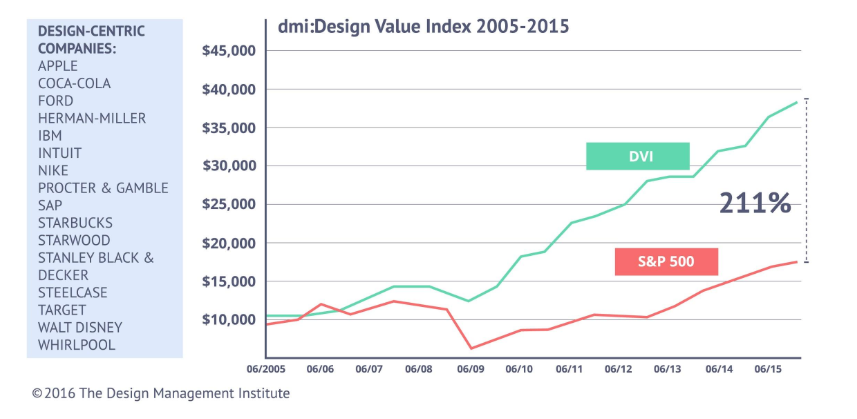
Source – The Design Management Institute
It is imperative that the product that is being delivered to users cater to their needs, accommodate their goals and reflect their behavior in order to make them use your product. A design that does not take into account what the customer wants will only prompt them to move away from your product.
2. Make Educated Decisions
Needless to say, it is absolutely crucial that design teams are aware of the latest trends in software design and are up to date with the current design principles. As a designer, you simply cannot afford to offer a dated solution to your user. So make sure your product team takes that extra step to study what solution your competitors are offering for the same problem and try to come up with a better solution.
This does not mean you need to go over the top with new ideas and designs. For example, a trash can icon is synonymous to “Delete” in the digital world and replacing that with any other fancy icon would only confuse your user.
Some very well thought UI creations that come to my mind are
- Charlie AI
- Samsung SDS Flow
- Airbnb
- Bellroy
- ESPN Sports Programming
3. Use a Style of Communication that Suits Your Audience
Understand your user base and use a communication style that best suits their age and interests. Say for a children’s website or a fashion e-commerce application, a dull downbeat communication style might not sit well with your younger audience and could force your customers to move on to an application they can relate to emotionally.
On the other hand, a professional network like LinkedIn will require a precise and formal tone as the larger audience on it are strictly there for professional reasons.
Using a tone that makes sense to your audience is very important to capture their attention and build trust with them. Users like to know the “people” behind the software and the tone of your website does just that.
4. Consistency is Key
Like we talked about setting a communication style for your website, it is just as important that this style is maintained throughout the website. The importance of being consistent cannot be stressed enough when it comes to optimal user experience. Users tend to use applications that are consistent in their elements, color scheme, typefaces, and interactions.
Say, if your application displays notifications on a side panel, maintain all notifications on the side panel throughout the site. Believe it or not “Your users don’t like surprises”.
5. Include a Knowledge Base
Let’s explain this with an example. Patrick wants to use your application. He loves the concept and the UI design. He can’t wait to start using your app as he has heard it is perfect for his needs. But Patrick has no idea HOW to use your product. He searches for a guide to help him, but found none. Disappointed, he had to move to another application that had a detailed manual.
Now, losing a customer like Patrick is such a shame. Had you spent that extra effort to create a beautifully crafted knowledge base that explains every functionality and feature of your app, you would have retained millions of users like Patrick.
Understand what your users are looking for. If you don’t want to maintain a separate knowledge pile for this, you can add all the information you want to show the user in the UI, by making it seem less like a knowledge base but more like an intuitive design. You could even integrate an AI bot to answer popular queries for you instantly.

When customers are able to find answers to their questions easily and without having to Google/Quora for answers, the overall customer satisfaction increases and also increases user engagement on your website.
Related Read: CTOs Guide – How Robotics and AI Can Improve Customer Experience
6. Less is More Vs More is More
Minimalism isn’t just a fancy word for lazy design. A minimalist design is a visual concept that seeks to embrace simplicity in design, in order to rope in users only towards what is most important.
When catering to a mature target audience, minimalism can be more attractive than a page full of creative design elements, sliding panels, glittering headlines, and modish popups. If your aim is to urge your customers to focus on a particular set of products, minimalist design is the path to choose.
However, it is crucial to understand your customers here. A minimalist design may not work as well for software designed for children, like an educational game. Younger audiences probably would not understand the aesthetic that you are trying to create and may move away to a more attractive website.
7. Improvise and Adapt – The Secret Sauce of Software Design
This is probably THE most important point that businesses need to keep in mind in order to retain their user base for years.
According to a survey by Skype, Adobe, Norton, and TomTom, less than half of the technology users do not like to upgrade software when they should. The simple reason is that people are comfortable with the way things work and do not want to risk getting an update until it’s proven to work for someone else.
On the contrary, users are attracted to new features and functionality as well.
So how do we ensure our software stays on top of its game to an audience that are hesitant to upgrade but wants new stuff too?
Let’s look at the case study of a simple messaging software.
Starting with a messaging platform to simply connect with friends and family via text messages, the team introduced push notifications on mobiles to ensure messages are received even when the application is not running in the foreground. Once the application garnered a few users, more features like photo and video sharing were added and while they were at it, some edit and filter features were included too. Once the application turned out to be an indispensable communication tool for its users, they added voice and video call features.
At this point, users were receptive to all these subtle changes because they hadn’t realized that the application as it was in the beginning, had completely transformed into something much bigger. As far as the customers knew, their experience on the application was flawless. Once the users were comfortable with the current working, the team added group conferencing and even payment integration. Finally, what started as a simple one-on-one messaging app had the potential to replace at least 4-5 apps that were needed every day.
This is the story of how the messaging giant “WhatsApp” increased its user base from a humble 250,000 users to more than 1.5 billion active users standing right next to Facebook and YouTube.
Takeaway – Start by building trust with your customers. Be attentive to your customer’s needs and incorporate improvements without overwhelming the users.
Some popular applications that have evolved into tech giants over time are
- Google Suite
- Adobe Photoshop
- Amazon
- Windows
- Android
- SAP
- iOS
Knowing how to improvise and adapt is the reason these intelligent businesses remain relevant in the market for years.
Related Read: How AI is Redefining the Future of Customer Service
Summing Up
Coming back to the beginning of this article, we asked you why millennials are unable to switch back to older technologies even though they enjoyed the UI at that time. Gameboys for one, were well researched, were consistent, came with a detailed manual and had a great design given the technological limitations of that age. Where they failed to deliver was improvisation. Users are always looking for the next big technological breakthrough.
To stay on top of your game, you must be open to enhance your product for improvements and cater to the continuous cycle of changing customer demands. Product teams should focus on providing users with a flawless experience, be it through the user interface, functionality or customer service. A user-friendly UI is a catalyst for building good relationships with your customers. Retaining your users become easy when you have earned their trust by consistently meeting your customer’s expectations.
By building sustainable software that sees well into the future, we at Fingent, believe our partners deserve the best that technology can offer. Feel free to contact our consultants to get an insight into how we work to deliver your dreams.
Stay up to date on what's new
About the Author

Featured Blogs
Stay up to date on
what's new
Talk To Our Experts
Customer Experience or CX may be the single most important factor that could make or break a business in today’s customer-centric market. A good product, a great marketing team, and competitive pricing can all amount to nothing if the customer experience isn’t up to the mark. As more and more businesses head towards brand transformation, it is vital that they keep the customer experience at the center of things.
In this blog, we will discuss why a memorable Customer Experience is key for brand transformation and how you can achieve it for your business.
How Important is Customer Experience?
Before we get into the importance of customer experience, let’s have a look at what that term really means.
Gartner defines customer experience as “the customer’s perceptions and related feelings caused by the one-off and cumulative effect of interactions with a supplier’s employees, systems, channels or products.”
A take on the definition of what a customer has come to mean today was brought out in this interesting article: “In a connected business reality, everyone in the ecosystem of your business is a customer: from employees and investors to partners, buyers and their networks, including the various players in the value chain from manufacturer to end consumer and back. In other words: all stakeholders.”
Customer Experience then is much more than achieving customer satisfaction. Everything a brand does play a part in forming the customer experience. A study by the Temkin group brought out that CX is made up of three components – success, effort, and emotion. The study showed that out of all the three, emotion played the most significant part. Affecting the emotions of customers through a concerted effort by the brand is what customer experience management is all about. Does it pay off? Definitely. As the study goes on to show, “companies that earn $1 billion annually can expect to earn, on average, an additional $700 million within 3 years of investing in customer experience.”
The benefits of Customer Experience extend to much more than revenue, though that is a pretty great factor in itself! A Walker study found that customer experience will overtake price and product as the key brand differentiator by the year 2020. This is of prime importance in brand transformation as the key goal of this transformation is to differentiate a business from its competitors and get ahead of them.
Related Reading: Find how Robotics and AI can help improve the customer experience
Ways to Enhance the Customer Experience
Ensuring that Customer Experience is the best it can get is a complete discipline in itself. Customer experience management (CEM or CXM) is the function that works towards streamlining every interaction between an organization and its customers. The goal is to foster brand loyalty in customers by ensuring that every touch point in the customer’s journey with the brand is satisfactory. The Customer Experience must be memorable and for the right reasons.
The most important factor in creating a good CX is to have a 360-degree view of customers. Starting from there, the customer’s journey is optimized at every point to ensure a consistently positive experience. Consumer research, a thorough knowledge of market conditions, and an organization’s culture, vision and mission are some factors to keep in mind when designing a customer experience strategy for your business. This will ensure that the strategy takes into account all departments in the organization and not just those in customer-facing roles.
Customer Strategist Journal lists six key areas of the digital customer experience:
-
Reachability
-
Service convenience
-
Purchase convenience
-
Personalization
-
Simplicity and ease of use
-
Channel flexibility
If you notice, many of these key areas are linked to the channels used by customers. The Genesys State of Customer Experience research brings out that 83% of consumers say the ability to move from one assisted channel to another, such as moving from web chat to a live conversation, is desirable. However, only 50% of businesses support such cross-channel interactions. This is definitely something to be considered. Let’s look into this in detail.
Unlike a few years ago where customers would communicate with brands either through email, telephone or directly visiting the company, today’s connected customer has various channels at their disposal. Websites, Facebook, Twitter, Whatsapp, and public forums are being used to contact and interact with brands. They expect customer service to be available and top notch in all these channels. This makes the brand transformation complicated, as delivering flawless customer service through every one of these platforms is challenging to say the least. If you fail, you know they are going to switch brands, which are available at the next click.
Channel Switching is another related challenge. For example, a customer could raise an issue through email and then request for escalation through a call and leave negative feedback on social media. The customer would expect the brand to be aware of his/her different interactions, respond and resolve the issue satisfactorily.
This challenge can be addressed with a few measures:
-
Centralization of interactions and data
This gives all customer-facing executives the necessary information to deal with issue no matter which platform is used.
-
A unified stand
The goal is to make the customer feel that it is one conversation, even if they are talking to different teams. This requires all teams to be equipped with the resources, information, and vision to show a unified stand and represent the brand consistently.
-
Engage with customers on their terms
Customers prefer using different channels according to their convenience. They will not appreciate being directed to the channel that is convenient for the brand. This makes it important to identify and respond to them in their own terms.
Related Reading: Check out other blogs to know how a streamlined workflow can improve customer service.
Apart from addressing Channel Switching, there are a few important measures that brands need to keep in mind if they want to deliver a seamless and satisfactory Customer Experience. Here’s listing a few of them.
-
Go Mobile
The Genesys report showed that “when interacting with a business for service and support, 78% of consumers surveyed use a mobile device. And that number jumps to 90% when working with millennials.” This makes it extremely important for brands to provide mobile-optimized solutions including apps, which focus on ease of access and interaction with the brand.
-
Weave CX into your entire structure
The goal of Customer Experience must be all pervasive throughout the organization. A customer experience strategy must be designed and weaved into the core of your business. Your vision and mission must include this commitment. An example is Dell Computer. Their mission is “to be the most successful computer company in the world at delivering the best customer experience in the markets we serve.” Employees have this on their ID cards and every bulletin board in every office has a sign that reads “The Customer Experience: Own It.”
-
Know your customers
Understand your customer completely. Use technology to its fullest to derive insights into customer behavior and demographics. Getting detailed and actionable insights will help you plan your customer experience strategy effectively.
Personalize! Personalize!
The most important aspect of getting your Customer Experience strategy right is personalization. Hyper-personalization is what the customer demands, and it is vital for brands to adopt measures to ensure this. At Fingent, we help brands build custom applications and solutions to achieve this for their customers. Let’s talk.
Stay up to date on what's new
About the Author

Featured Blogs
Stay up to date on
what's new
Talk To Our Experts
Do manufacturers need custom software solutions?
When Fingent started operations nearly two decades ago, we had the vision of helping organizations solve business challenges using technology. As we have helped numerous clients in the manufacturing as well as other industries, we have seen one thing – there isn’t a one-solution-fits-all software in the world that fits the needs of every organization. Each organization is unique.
While this is the most obvious benefit of custom software development, there are many other benefits that it brings to your organization. Let’s have a look at them in this blog.
How Custom Software Helps Manufacturers
Technology and software have become integral to the manufacturing industry. Irrespective of what the product is, manufacturers have recognized the role of good software in every aspect of their business. Right from design to implementation, production to shipping, employee management, to invoicing, and client relationship management (CRM) to predicting customer demand – there is no function that can run effectively without the help of good software. This makes software perhaps the most important element in your business. It stands to reason therefore that we consider in detail on which software suits your business best.
In that vein, let’s discuss the 5 benefits of custom software in manufacturing:
1. Better Production Planning and Control (or PPC)
In today’s competitive environment, lead times are getting shorter and price pressure is getting tougher. In addition, today’s consumers demand make-to-order manufacturing and hyper-personalized products. This is a tall order and requires highly optimized production processes, which focus on effectively allocating the internal resources of the company. This includes manpower, materials, and machines. Custom software will help you optimize processes more effectively than out-of-the-box software. This is because the software will be customized to include the right mix of resources and production needs, which are unique to your business.
2. Effective Monitoring of Machinery and Processes
Each manufacturer and product require precise process workflows and specifically calibrated machinery. Any change, however small, in the process or machinery can cause huge setbacks in production and eat away at your profits. A good custom software, which is specifically designed for your process flow and machinery, will help you track and monitor even slight changes. This will help you detect and rectify issues before they snowball into a major problem.
3. Insightful Business Intelligence
With AI, IoT and machine learning adding exceptional capabilities to software, it has become possible to collect and process data to derive precise actionable insights. Business intelligence software helps managers have their finger on the pulse of every function in the organization and obtain an insight into the workings of the organization as a whole. These insights can be used to fine-tune inventory management, employee management, and other functions. Unique organization-specific data can be analyzed in real-time, allowing business leaders to make sound decisions without having to pour through lengthy and complex reports. Data mining, automated reporting, benchmarking and predictive analytics capabilities are features of Business Intelligence software, which are invaluable to manufacturers in achieving cost and time efficiencies as well as meet customer demand effectively.
4. Customer Relationship Management and Customer Service
With a custom CRM software for your manufacturing business, you can achieve better client relationship handling, faster responsiveness to customer demand and queries, and reduced customer dissatisfaction. Accurate Demand Forecasting helps manufacturers detect trends and cut the time from the concept phase to market delivery. This will ensure that you are keeping up with the competition and giving your customers exactly what they need. A custom CRM solution also helps figure process errors in real-time and ensure that the products are high-quality. It helps in creating an intelligent supply chain through insights into operations, order processing, inventory management, warehousing, and distribution chains. A CRM will also keep track of warranties, scheduled service calls, etc. to help serve customers better and maintain good customer relationships.
Related Reading: Find how custom software can benefit your business more.
Why Custom Software Is Better Than Off-The-Shelf Software
Although “custom” is often synonymous with “expensive,” this isn’t the case when it comes to custom software for your manufacturing business. The scalability, ease of integration and other benefits that come with custom software far outweigh the costs of initial investment. Some of the pros of custom software are:
1. Competitive Advantage
In today’s age when technology can be one of the most important competitive advantages, it is important to stand out from the crowd in this area. Using a mass-produced software gives you the same or lesser functionalities as your competitors.
2. Scalability
While off-the-shelf software might work for your start-up phase, these aren’t easily scalable, and the technology used could become obsolete with time. Custom software, on the other hand, can be designed to provide the scalability required for your individual business. This will help you have a solution that is perfect for your business while avoiding costs associated with major software overhauls every time a technology becomes obsolete.
3. Performance
Since off-the-shelf software aren’t customized for your business, they have many redundant features that you may never use for your business. This unnecessarily increases the amount of space required and load times, thereby decreasing performance. Custom software is sleek and only has the functionalities that your business requires. This makes it faster with improved performance.
Related Reading: Find how to make the right choice between off-shelf and custom software development.
Get Custom Software for Your Manufacturing Business
Despite knowing the benefits of custom software development, many manufacturers shy away from investing time and resources on this. They feel it is a daunting task considering the effort and resources needed to implement a custom solution. It need not be a difficult task at all however if you have the right help.
With decades of experience in custom software development, Fingent can help dismiss these fears. We help simplify the process for you, giving you the peace of mind to concentrate on your core business while we take care of the complete development and implementation. Get in touch with us to discuss more.
Video: Custom Software Vs Off The Shelf – Dileep Jacob (Head of Operations, Fingent Corporation)
Stay up to date on what's new
About the Author
Featured Blogs
Stay up to date on
what's new
Talk To Our Experts
Why should businesses invest in custom software development?
The need to transform digitally has created a scenario where enterprises are constantly investing in new digital solutions to either make life easier for operations or help them explore new revenue streams in the digital space. However, there are a lot of misconceptions that prevail in the market with regards to digital solutions. As soon as a business announces that it is ready to invest in digital, they get bombarded with ready-to-deploy and off the shelf digital tools that are provided by several players in the tech industry.
But is investing in readily available solutions the best way to gain a foothold in digital adoption? Not always is what industry experts say. It is important for enterprises to invest in custom software development to empower their business growth with a more personalized digital arsenal. Several executives may argue that custom software development is a costly affair, but buying commercial off the shelf software could do more harm than good in the long run if it is not tailored to your objectives.
Here are 5 reasons why investing in custom software development is important for your enterprise.
1. Complexities in Systems Integration
Different areas of your business operations may find tools from different vendors to be useful. However, these tools may each have their own technology infrastructure requirements, architectural differences, different development methodologies and varying levels of implementation support. As an organization, your technology ecosystem needs to work as a streamlined single unit, capable of delivering value across your business.
For integrating systems from multiple vendors, a considerable effort is needed and this could outweigh the advantages offered by individual systems. Such a scenario calls for creating a suite of operational enterprise applications, custom made to fit the objectives of your business. Every custom software, thus built would follow common standards in development and execution, thereby creating a flexible and interoperable enterprise technology stack.
2. Scalability restrictions
Ready to deploy enterprise solutions are often advertised to be scalable for large workloads. But when unique requirements of your organization require flexibility beyond the scope defined by the software development company, then you are left with expensive software that cannot scale up with your business demand. This is another area where tailored and custom software development can be the game changer in your technology landscape.
Components of such software can be built keeping in mind the objectives specific to your business areas and not just a standard industry requirement. Hence, when scalability requirements arise, a custom built enterprise software will be able to accommodate your unique business and process workflows accordingly without creating new challenges for the teams handling your enterprise applications. This is vital for SMB’s as their growth ambitions would definitely require a scalable technology backend to support a critical business process.
3. Future proof innovations
Innovation is at the heart of every competitive business environment today. The more you innovate, the greater will be your chances of satisfying diverse consumer interests. When enterprises buy expensive and ready to deploy software from reputed vendors, they often limit their own dimensions of innovation. Such businesses are often forced to either wait till the software vendor comes up with the desired innovation or they may have to again purchase a new software if their existing application vendor is not in a position to add the new feature anytime soon.
Having your own custom software built will enable you to experiment and bring on board innovative concepts faster and without depending on other technology vendors to do it for you. This can help in greater market competence as your brand would be recognized as a forerunner rather than a late adopter for innovations that consumer’s desire.
4. Existing technology support
Many times, businesses invest in new digital solutions by blindly following trends in the market. It could be possible that the technology that they already have may just need a few tweaks and upgrades to provide the exact same or even better features that a totally new commercial off the shelf software can provide. Bringing a new digital solution from a vendor into your existing technology ecosystem can cause challenges not just in systems integration as mentioned above, but may also create instances where large effort is needed to maintain existing software that serves other core business processes.
When businesses go for custom software development, they have the liberty to build new capability on top of existing enterprise applications and hence saving considerable effort in development as well as reducing cost escalations. Having a team to customize existing software is a better alternative than engaging one to implement a third-party solution from scratch and then follow it up with expensive customizations to further suit your business requirements and objectives.
5. Compliance with standards and processes
Even the best of digital solutions from world-class vendors may have compliance issues with the standard rules and processes adopted within a business. The makers of such software may have included recommendations from industry recognized standards, but very often a business may have to think out of the box while running their daily operations. This leads to their core processes and standards being subjected to deviations from what the industry follows.
When third-party digital solutions are directly brought into such deviation prone business scenarios, there will be issues with compliance policies and standards. This is yet another scope for custom software development to take center stage and empower businesses with the flexibility to meet their unique compliance requirements. This is also true when government and other geopolitical influences require custom standard or compliance implementation rules to be followed by enterprise applications. Areas such as data privacy and consent management would be under multiple legal and judicial networks. A region and a third-party digital solution may not be flexible to handle such variances.
Any technology implementation done today should be closely linked to business objectives, and enterprises need to have a clear idea on the business use cases that a particular technology could solve. With custom software development, it is possible to have a clear picture of the quantifiable value every investment in enterprise application development is made.
This will prove to deliver more ROI than a fully-fledged third-party digital solution implementation where your business may often be at the mercy of the vendor’s technology prowess. If technology is not your core forte, then you need to have the right advisory and consulting partner to help drive the most value out of your custom software development initiatives.
With years of empowering some of the world’s best businesses with custom software development, Fingent can be the right partner to help you build the technology backbone of your business. Get in touch with us to know more.
Stay up to date on what's new
About the Author

Featured Blogs
Stay up to date on
what's new
Talk To Our Experts
Imagine you are a salesman and you have logged into your system with the dashboard pulled up in front of you. Viewing the dashboard with a horde of information on it can turn out to be a very overwhelming experience. Bar charts, pies, metrics, numbers, arrows, percentages, ratios and what not go swimming in front of your eyes. Do they make any sense or do they end up confusing you? Does it include an intuitive interface allowing seamless navigation or is it cluttered and poorly organized? Well, it all depends on how well the sales dashboard is designed.
Recently, Fingent was approached by a client to develop a sales dashboard for their customers who are real estate agents and brokers. The requirement was to develop a portal for the agents and brokers to log into and a dashboard which gives a snapshot of their business performance. With this real estate platform, realtors should be able to access third-party applications to help them with the various stages of their business process.
Related Read: The Tech Disruptors in the Real Estate Space: What to Implement First?
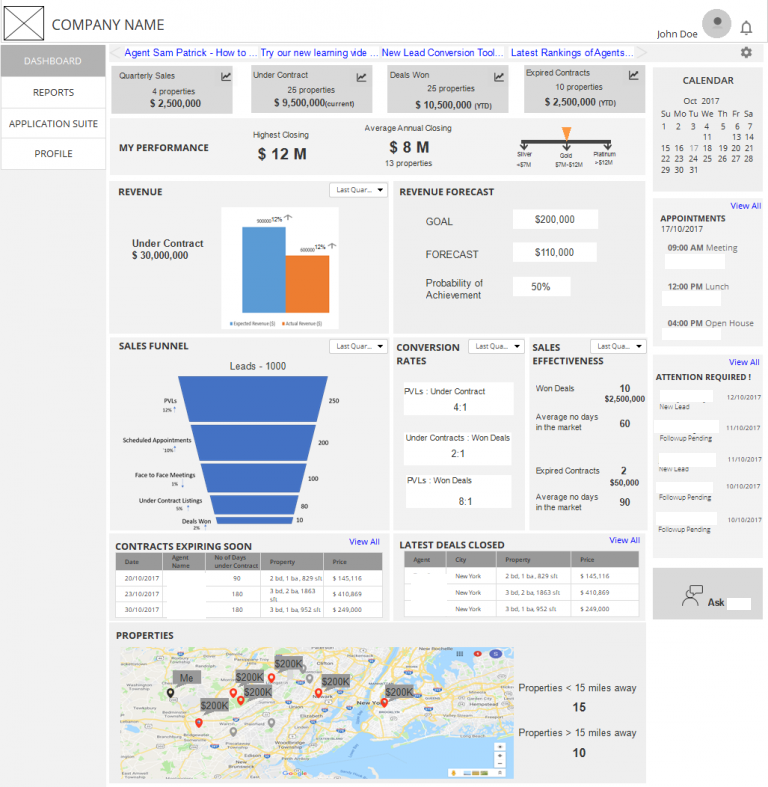
Fig 1. Wireframe of Dashboard Designed for a Real Estate Agent
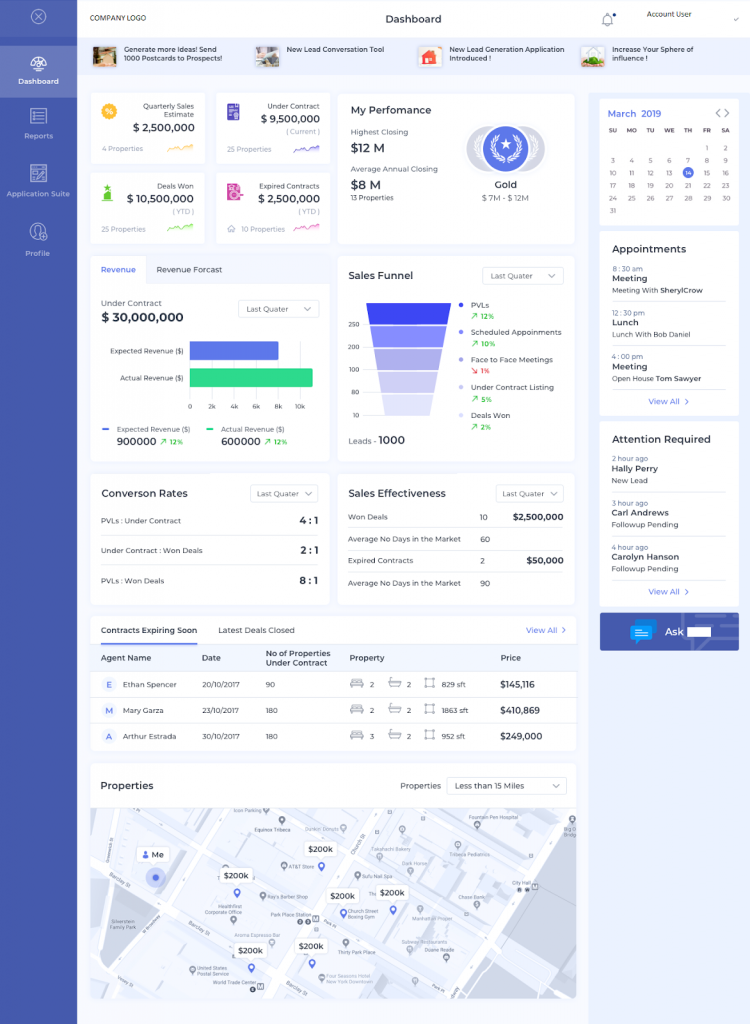
Fig 2. Sample Mockup Designed for a Real Estate Agent
In the real estate industry, data is often unstructured and unaccounted. This platform allows agents to prospect leads, manage and follow up on them, view the status, close on them and ultimately account for the costs and commissions.
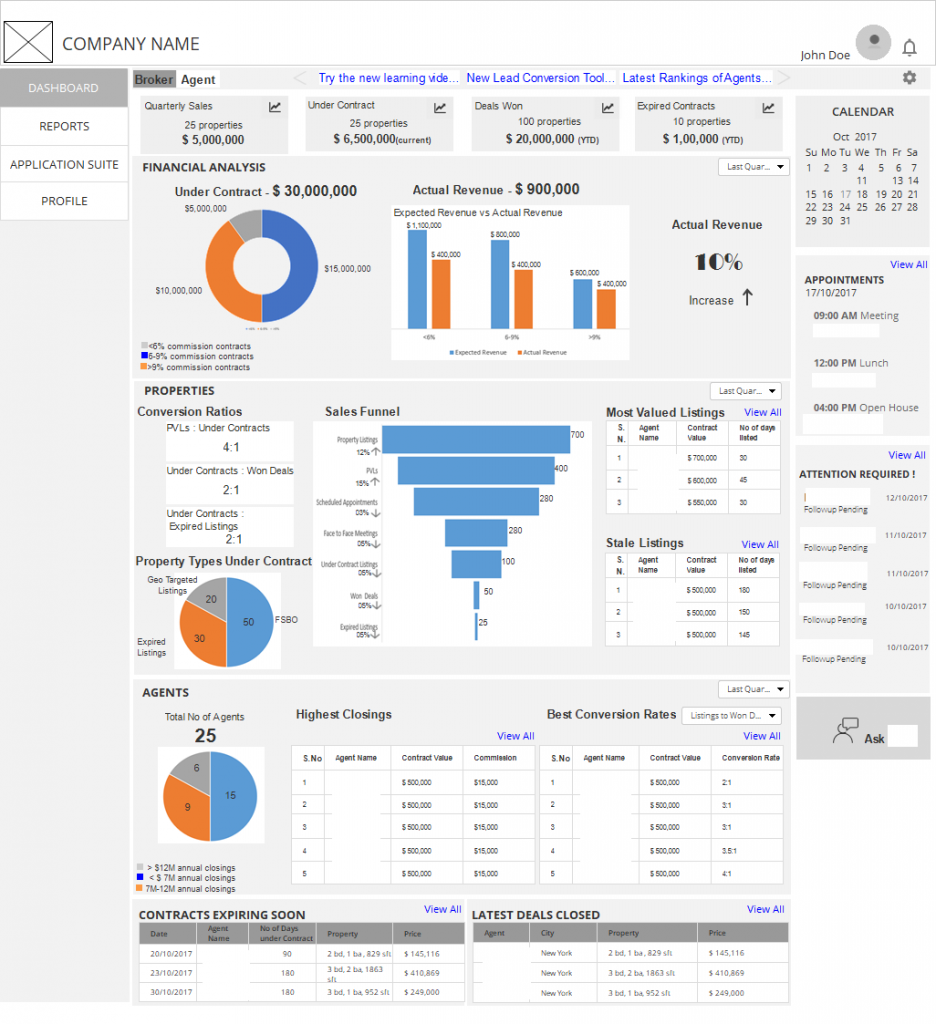
Fig 3. Wireframe of Dashboard Designed for a Real Estate Broker
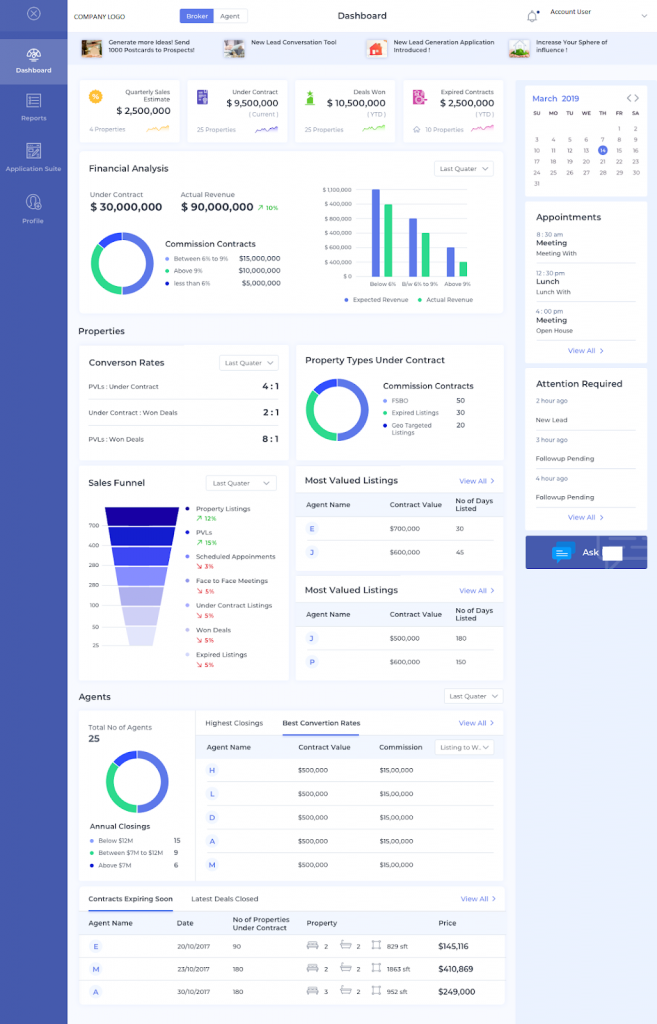
Fig 4. Mockup Template Created for a Real Estate Broker
Expectations from a Good Sales Dashboard
A well-designed sales dashboard is like a good storyteller. It tells you a story complete with the setting, the characters, the main plot, the conflicts, and a conclusion. This should all flow in a seamless, logical way as the eyes of the user move from the top of the dashboard to the bottom; gauging information, which is crucial to making accurate decisions.
Salespeople usually juggle with a lot of numbers. They have numbers related to revenue, sales pipeline, products and services, customer base, forecasts, financial data etc. These numbers help them analyze and make critical decisions on the next move to steer their business forward to success. If these numbers are all scattered around, a salesperson may end up spending precious time gathering data and in the process slip on making important decisions.
Now, imagine if all these numbers come across as a story. Accordingly, the salesperson is able to quickly view the Key Performance Indicators (KPIs) of their business, make a conclusion and plan for the next moves. That is what a good sales dashboard aims to achieve.
A good sales dashboard gives an unbiased true picture of the day to day workings of one’s business. It provides an illustrated view of KPIs and other information crucial in the sales process.
Related Read: Ok Seriously, How Important Is Data Visualization?
Besides, a well-designed sales dashboard should also offer access to real-time data. With this real-time data, salespeople can continually monitor the sales pipeline and activities for making crucial decisions.
The design is yet another leading factor in ensuring better user experience. The logical arrangement of the metrics and other information contribute to effortless navigation all the while ensuring that the most important information is accessed first.
Designing a Sales Dashboard
Now, on the other hand, designing a sales dashboard is an equally daunting task. How do we represent all those numbers in a visually pleasing and logical manner? Furthermore, which numbers to choose from the many, that would ultimately matter the most to the client.
Keeping in mind the following tips will help you design an effective sales dashboard.
1. Getting Your Story Right
A good understanding of the client’s business and its KPIs will help you build the story. Identifying the pulse of the business by tapping on which will give you a correct understanding of the business’s lifeline is the key. Following are some metrics that are generally used in sales –
-
Revenue
This is the key indicator denoting how well the business is doing. Revenue is compared over time (monthly, quarterly, yearly) or with the projected versus actual revenue. It can also be compared to the costs and expressed as a return on investment (ROI). Another way of representing it is to show profits after all the costs are deducted from the revenue. Finding out from your clients which figure would best be useful to them will help you in the design.
-
Forecast
The client can integrate a system to predict their future sales and revenue based on their past backlog, current pipeline, employee performances, market conditions etc. Showing this data on the dashboard will help them see the direction their business is taking.
-
Sales in Numbers and Value
From where is all the revenue coming? Is it from just one product or are all the departments making enough sales? These questions can be answered by displaying the sales in numbers and value. This will give more clarity on the inner workings of the client’s business.
-
Sales Pipeline
The sales pipeline reflects the number of deals in each stage of the sales process. The stages can be open leads, qualified leads, face to face meetings, proposal stage, and closed deals. The number of deals in each stage will help the salesman asses whether they have enough incoming leads to sustain their business, and also whether they have an appropriate distribution of deals to meet their sales targets. It also helps in forecasting revenue in the near future.
-
Lost Deals or Backlog
Negative metrics such as the number of lost deals or the backlog from the previous financial cycle, on the dashboard help in critical decision making. It can tell the salesman where their business is lacking and what it is that they need to focus on.
-
Conversion Ratios
Conversion ratios tell the efficiency of the various stages in the sales process. Numbers such as these – the ratio of open leads to qualified leads, the ratio of qualified leads to closed deals, the ratio of open leads to closed deals etc. help in understanding where the work is getting piled and identifying the bottlenecks faced in the business.
-
Attention Required/Overdue items
Salespeople would appreciate if they can get hold of a list of items on the dashboard, which needs their immediate attention. Overdue tasks is another area which needs to be highlighted in the day to day functioning of the business.
-
Performance
A metric that reflects the sales effectiveness or achievements of a salesperson in line with the company strategy and targets would summarize their performance and also act as a motivating factor to push them towards achieving more.
2. Making Data Comparisons for Deriving Insights
One can gather meaningful insights from data when a comparison is made. Therefore, the way these metrics get compared side by side to derive a logical conclusion is downright important.
Should the metrics be compared with respect to each other? For example actual revenue against forecasted, lost deals versus won deals, sales backlog against the pipeline etc.
Or should it be compared with respect to time? Daily, weekly, quarterly, year on year, year to date etc. Making a comparison should ultimately help the salesperson answer the right questions.
3. Building your Story on Actual Data
Getting real-time data is really helpful in determining the best way of representing it. If it is fictional data, then one must stick to keeping the proportions right. Each chart has a specific type of data that it represents. For example, a pie is used to represent parts of a whole, a funnel represents a progression and a line displays variation over time of different series.
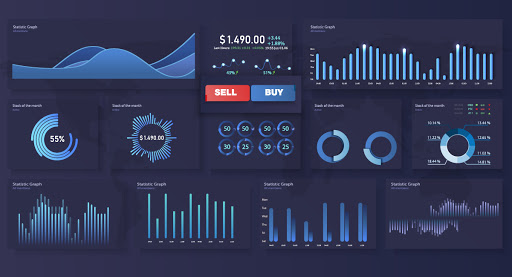
When you use actual data, you tend to realize that some charts do not look as good as you expected and maybe you should think about representing it in some other way. Or, that some numbers are better off shown as numbers itself and not compared to other figures as part of a chart, because it might end up skewing the chart in one direction.
4. Following General UI/UX Principles
Following the general UI/UX principles of good design makes the dashboard visually pleasing and easily navigable. Since most people read from left to right and top to bottom, aligning the widgets on the dashboard in the same order as the story progresses, helps in seamless navigation. The top left space on the dashboard is where the eye falls first. Placing the most important piece of information there ensures high visibility.
Leaving enough white spaces and keeping the dashboard uncluttered will help the user assimilate the information better. A sales dashboard should be concise with just the right amount of information for the salesperson to make an assessment of their business.
5. Keep Reinventing
Nobody gets it right the first time. Redesigning the dashboard a couple of times gives you a better perspective each time and helps you discover the one which will ultimately win your client’s heart.
Related Read: Make Your Data Visualization go Viral: 10 Quick Tips
Wrapping Up
Bringing things into perspective or distilling the essence from a mix of information is what a sales dashboard is all about. Companies have been relying on such visual representations to get an overview of what needs to be done. Particularly in the area of sales, such close visualizations of a range of data can indeed prove helpful for salespeople to gauge information as it is intended and make decisions crucial to the sales process. Owing to its importance, it is downright necessary to build and design a sales dashboard in accordance with certain principles.
By taking into consideration the key metrics that define the sales process, it is possible to delineate the entire workflow and pipeline to an easily identifiable visual form. Such a dashboard brings more clarity in the process, enabling salespeople to understand and apply the necessary changes. We did just that with our client by formulating an effective sales dashboard. This would ultimately help them leverage sales data to contrive practices that push their business forward, all the while accelerating efficiency and ROI.
Stay up to date on what's new
About the Author

Featured Blogs
Stay up to date on
what's new
Talk To Our Experts
With the Industrial Internet, Industry 4.0, industrial robots and more, the manufacturing sector is seeing sweeping reforms in their processes and core functions. These reforms are making them faster, bigger and better and all of this has been possible because of digital transformation.
Digital transformation has changed the face of the manufacturing industry. From behemoth machinery and an army of workers, manufacturers have transformed themselves to a sleek, modern and more efficient entity. This blog will explore how digital transformation has made that possible. We will also see the most important digital trends in the manufacturing industry.
The Importance of Digital Transformation in Manufacturing
Change has been constant in the manufacturing industry. Right from the Industrial Revolution of the 1700s to today’s Industry 4.0, the manufacturing sector has had to adapt to the changes in political climates, economic upheavals, and technology. As technology fast forwards in our times, it is imperative that manufacturers keep up. The only way they can prepare their businesses for the digital revolution of our day is through digital transformation. Here are a few ways in which digital transformation is benefitting the manufacturing industry.
1. Keeping up with Customer Demands
A recent Harvard Business Review study of 75,000 people, showed that the most important factor in building customer loyalty towards an organization is the reduction of effort. Be it in collecting information on products, customer service or getting their needs met faster and more effectively, customers value the path of least effort. This is where the speed of innovation comes in. Manufacturers need to create products that are software-enabled and connected, and they must do this before anybody else!
A digital factory design where development, production, and other cycles aren’t siloed is imperative to this. Digitalization makes it possible for all these cycles to work in tandem and innovate much faster. The vision of a “smart factory” is that it can make critical product decisions about customer demand, design, material selection, scheduling and pricing, all in one process. This would speed up innovation, create personalized products and enhance the overall customer experience exponentially.
2. Refining Processes
Manufacturing is largely a process-driven industry, so there is an incredible amount of focus on process refinement. Digital transformation makes this possible in many ways. Automation of processes is a major step in that direction. This reduces manual errors, helps automatically detect production inefficiencies, allows for the pre-testing of new ideas more economically and helps optimize the performance of workers.
Predictive disruption analytics, KPI monitoring, and other digitally enabled tools help in refining processes as they are happening. This allows manufacturers to identify weaknesses and make improvements quickly. Machine Learning enables instructions and intelligence to be built into the machines as they are developed and deployed. As these machines are intuitive, they learn from the environment and aid in the continuous process refinement.
3. Revenue Gains and Cost Reduction
A PwC survey of over 2,000 participants from companies in nine major industrial sectors and 26 countries, predicts that Industry 4.0 will drive $493B in revenue gains and $ 421B in cost reductions globally by 2020.
These numbers are realized by the many opportunities brought in by digital transformation. The digitization and integration of vertical and horizontal value chains help bring a cohesive focus to the organization’s processes and production. The creation of new digitized products with analytical capabilities and integrating new methods of data collection and analysis helps manufacturers understand and cater to the needs of customers more effectively. Disruptive digital business models allow for a more agile approach throughout the organization and thus optimizes performance and cost. All this and more contribute to significant cost reductions and an increase in revenue.
Digital Transformation Trends in Manufacturing
Different technologies have opened up a wide area of possibilities in the manufacturing industry. Here are 3 Trends that are doing wonders in the manufacturing space.
1. IoT And Industry 4.0
61% of enterprises say that the “Internet of Things (IoT) plays a role in their digital business strategies with manufacturing and high-tech leading all other industries.” The manufacturing industry is evidently recognizing the critical impact of IoT in gaining a competitive edge. In 2016 alone, IoT, accounting for more than $178 billion in revenue. There are many avenues where IoT has helped streamline and simplify manufacturing processes. It is also a key component of Industry 4.0 and enables connected devices. This allows for the streamlining of internal operations and the optimization of products and operations through insights from the cloud.
Industry 4.0 has also made possible the trend of mass customization, which is characterized by a better and more effective response to the demands of customers. Connectedness and mobility have led to faster innovation and response. Logistics and supply chains have also benefited greatly from this connectedness.
Related Reading: Find how IoT is reshaping industries.
2. Machine Learning
Machine Learning has elevated the processes and operations of the manufacturing industry in many ways. A PwC study entitled Digital Factories 2020: Shaping the future of manufacturing showed that the adoption of machine learning and analytics by manufacturers to improve predictive maintenance is predicted to increase in the next five years by 38%. Advanced machine learning algorithms are able to identify and implement improvements in processes and operations, thus leading to reduced costs and increased revenue.
A study by The World Economic Forum (WEF) discussed how manufacturers are recognizing the ability to combine emerging technologies including IoT, AI, and machine learning to improve asset tracking accuracy, supply chain visibility, and inventory optimization. Thus, in various ways, Machine Learning is greatly contributing to lowering the cost of production, improving the speed of innovation and operations and enhancing the customer experience by accurately identifying and meeting customer demands.
Related Reading: Check out this infographic to learn more on the disruptive innovation: Machine Learning.
3. Advanced Robotics
Robotics is no more confined to the realms of accomplishing repetitive assembly line tasks. Robots are now intuitive, trainable and have the ability to mimic human attributes of dexterity and critical thinking. This makes them a formidable force in manufacturing.
Robots with advanced sensors and collaborative ability are now being deployed in hazardous environments to collect information and data pertinent to the manufacturing industry’s needs. This contributes greatly to providing safe working environments for humans. Apart from the physical robotic machines, Robotic Process Automation (RPA) has also grown in importance. RPA goes a step above and beyond physical tasks and replicates human thinking ability and transforms processes and operations to the next level. Recently, the term ‘cobot’ was coined by professors at Northwestern University in America. This underlines the significant progress in Robotic Process Automation (RPA) where robots are now able to collaborate with humans in the workspace.
Related Reading: Read on to know how robotic process can help accelerate business growth.
Owning Digital Transformation
There can be no doubt that digital transformation is the way to go if manufacturers want to keep up with competition and stay relevant. Capitalizing on these digital trends for your business need not be a daunting task. At Fingent, we help manufacturers make sense of digital transformation and adopt it successfully. We can help you make a success of your digital transformation. Get in touch with us and see how.
Stay up to date on what's new
About the Author
Featured Blogs
Stay up to date on
what's new
Talk To Our Experts
Over the past couple of years, digitization has enabled technology-driven small companies to outclass established business houses worldwide. With industries ranging from taxi-services to banking, transforming digitally, more and more enterprises are realizing the importance of making digitization their number one priority. The tech-savvy consumer base, which consists of the population below the age of 30 and covers 50% of the global population, is considered to be the key driver behind this realization. Such folks have the rising affinity to expect every business organization they interact with to provide the fastest and most satisfying experiences each time. As a business, turning deaf ears to customer’s expectations can lead to unrevivable consequences. From AI to blockchain, IoT and RPA, the list of digital innovation you need to pay attention to are huge.
It’s nearing the first quarter completion of 2019 and we thought this would be the perfect time to show you the digital innovations that we believe will reshape businesses in the coming months and future years. Here are our top 5 picks from technologies that enterprises need to watch out for by 2022:
Flexible Cloud Computing
When cloud computing became mainstream a couple of years ago, there was a rush from enterprises to build their technology competence on the cloud. This resulted in several businesses having their own private cloud ecosystems that supported their own limited digital innovations. Today, many available digital tools require a complex network of cloud resource. This has reshaped the cloud computing ecosystem which has now transitioned into intelligently connected networks that have Public, Private and Hybrid cloud partitions working in sync to help businesses derive value from technology running on these platforms.
Different IT workloads may need to be run simultaneously over multiple cloud platforms to achieve enterprise goals and this has resulted in the so-called Multicloud saga. This is one area which will see more developments and interest from the business community in 2019 as the previous year saw major cloud service providers acquiring or developing solutions to club their multiple cloud ecosystems to serve client interests.
Related Reading: Find how a cloud platform like INFINCE can help businesses leverage technologies more efficiently.
Blockchain in Mainstream
The past couple of years saw considerable investments from the business community in the blockchain. We believe there will be mainstream applications coming out in 2019 that will revolutionize areas such as data security, digital identity verification, and intelligent automation. Sectors such as BFSI, logistics, regulatory bodies, and government agencies have already started using blockchain to set up complex autonomous verification and validation systems that require minimal human intervention, thanks to the capacity of blockchain to be immutable.
In the coming years, more mainstream consumer-facing areas of businesses would be driven by blockchain based autonomous operational interfaces and it could set the stage for innovations akin to self-driving cars. Many technology companies would be coming out with mainstream solutions having blockchain essentials embedded into their core and these would further enhance business capabilities for enterprises worldwide.
Related Reading: Find how blockchain technology can transform the supply-chain industry.
Digital Modelling
While this concept has been around for a while, we think it will make more impact this year as more companies are investing in this front. The idea is to create a digital persona for every product or service business has to offer its customers. This persona would be used to arrive at choosing the right supporting digital enablers like data generators (sensors, IoT enabled devices, etc.) as well as the right decision path (data models and implementations of data science to arrive at success models). Such persona would be used to ascertain an offering’s readiness to the market, the cost required to maintain it viable, the processes and business models that need re-defining to support it and so on. The entire exercise though a bit complex will bring about a strategic advantage to adopters as their business offerings would be more aligned for digital success than competitors.
Related Reading: Digital innovation is transforming today’s business. Find how your business can benefit from digital transformation too.
Immersive Experiences
2019 will see consumer experiences moving to a more immersive phenomenon where almost everyone from a local retail shop to an e-commerce giant will offer interactive experiences courtesy of technology like augmented and virtual reality. Gartner says that by 2022, nearly 70% of all businesses would be using immersive customer experiences in some form on an experimental basis. Such immersive technology will find its way into numerous consumer-facing scenarios like demonstrations, virtual assistants, field services and so on. With gadgets supporting immersive experiences like smart glasses and wearables being available for very affordable prices, the consumer base requiring such experiences will grow tremendously in the coming years. The possibilities are limitless and businesses small or big can capitalize on this opportunity to improve their competence.
Related Reading: Check out the ongoing battle between AR and VR and find which technology has the potential to mainstream first.
Conversational Intelligence
Artificial intelligence is no longer a trend to watch out for because it has already gone mainstream over the last two years. Today, the focus should be on solutions that have been made available by harnessing the power of AI. One major solution that has gained attention now are conversational bots. From websites to major apps, a multitude of consumer-facing interactions is now handled by programmed bots that can interpret queries and respond intelligently.
Be it ordering food from a restaurant, booking a cab or even carry out a banking transaction, tech-savvy consumers are increasingly depending on personal digital assistants or bots to aid them in every step of the way. The proliferation of smart devices like smart home speakers, wearables and other IoT enabled home and personal electronic devices have created immense possibilities for a business to connect more effectively with end users. Today, you can ask your smart coffee maker to brew a coffee in the most precise variants of taste and smell without even having to touch the coffee maker. You can simply ask the personal assistant on your phone to do so.
Related Related: Find unconventional ways Artificial Intelligence is driving business value.
The top technologies mentioned above concludes that 2019 and the years to come is going to be a breakthrough year for several technological innovations. Business leaders need to hone their digital skills to keep pace with the rapidly growing market. On the positive side, most of these technology platforms or solutions come in affordable subscription basis and hence it is pretty much accessible to any enterprise despite their business size. However, the biggest differentiator for your success is the right technology advisory and implementation.
This is where our consultants at Fingent can become your best asset. With years of experience in empowering multiple businesses to achieve their digital aspirations, our world-class services can help you achieve your digital dreams seamlessly. Talk to us to know more about how we can help you embrace the above innovations and much more into your mainstream business operations.
Stay up to date on what's new
About the Author
Featured Blogs
Stay up to date on
what's new
Talk To Our Experts
Digital Adoption is crucial for the success of an organization. Businesses understand this and are going full steam ahead in ensuring that they are completely equipped digitally. While the IT department is primarily hands-on with digital adoption, it is becoming increasingly clear that business leaders must also roll up their sleeves and get involved with the digital goals of the company. This blog will discuss why this is important and how it makes for better business leaders.
Digital Adoption
Digital adoption in the most elementary sense is to achieve a state of functioning where all the organization’s digital tools are used to their full capability. Digital Adoption also involves getting stakeholders, including customers and employees, to use these tools to the best.
If the company has a whole repertoire of digital tools, it doesn’t mean that they have successfully implemented digital adoption. It can only be a success if these tools are being used to their full capacity by the organization and its customers.
How Digital Adoption Makes You A Better Business Leader
Talking about the top executives in today’s organization, Dion Hinchcliffe, VP and principal analyst at Constellation Research says that they must “match the pace of change, fall behind, or lead the pack.” Continuing on what is expected of business leaders particularly the CIO’s today, he says: “That’s the existential issue at stake in today’s digitally-infused times, where bold action must be actively supported by out-of-the-box experimentation and pathfinding … The CIO this year must be both a supremely masterful priority juggler and an effective digital leader from the front.”
This is what today’s business scenario demands a true business leader. Leaders are expected not only to be digitally informed but to be able to lead their company into digital transformation. Digital adoption must be the focus of their efforts. Here are a few ways in which digital adoption can make you a better business leader.
Related Reading: Find how digital innovation is transforming today’s business.
1. Leading Change and Growth
One of the qualities that define a capable business leader is his ability to be a visionary and lead his organization towards growth. In today’s world, growth is becoming synonymous with the company’s ability to keep up with technology and digital transformation. Business leaders stand to benefit the most as their company moves forward and adopts the best of digital technology.
And yet, according to a KPMG study, more than 56% of digital initiatives fail due to lack of leadership. As this shows, good leadership can make all the difference between success and failure of digital adoption. The mindset of a leader and his/her dedication to digital adoption will direct the mindset of the rest of the organization. Digital disruption calls for a positive attitude towards change. It calls for a change in the culture of the organization. Encouraging innovation and experimentation is also key to the success of digital adoption. All this can only be achieved if the CEO and top-level management embrace and lead the change.
2. Gaining Customer Insight
Today’s business is more customer-centric than ever. The success of an organization is dependent on its understanding of customer preferences and behavior. In the digital age, there is no better way to gain customer insight than through digital adoption.
Jim Swanson, former CIO of Monsanto is an excellent example of leaders who leverage a company’s IT to deliver growth and value in the business. Discussing digital transformation in terms of customer centricity and the role of leaders, he says: “We talk about automating operations, about people, and about new business models. Wrapped inside those topics are data analytics, technologies, and software – all of which are enablers, not drivers. In the center of it all is leadership and culture. You could have all those things – the customer view, the products and services, data, and really cool technologies – but if leadership and culture aren’t at the heart, it fails. Understanding what digital means to your company – whether you’re a financial, agricultural, pharmaceutical, or retail institution – is essential.”
That is where the magic lies. Understanding digital and understanding what digital can do for your customer-centric goals is where you will find success. When business leaders understand this vital concept and become champions of digital adoption, then the company will see real growth.
Related Reading: Find how machine learning boosts customer experience.
3. Nurturing Curiosity
Curiosity is an important attribute of growth and change. To step out of their comfort zone and embrace growth, business leaders must cultivate and foster this important attribute. In a PWC survey of 1,322 CEOs in 77 countries, most CEOs pointed out to the importance of being curious. In order to keep up with the turbulent business scenario and stiff competition. Michael Dell, Chairman and CEO of Dell, says in the report: “The one attribute CEOs need in the future to succeed, that I would place my bet on, is curiosity. From curiosity comes learning and new ideas. In businesses that are changing very rapidly, if you’re not curious, if you’re not learning, if you don’t have new ideas, you’re going to have a real problem.”
Curiosity plays a vital role in embracing digital technology and helping employees adapt to change. Fostering a culture of innovative thinking and intellectual curiosity will help the organization move forward with digital adoption and make the best of it. Conversely, digital adoption will help business leaders build curiosity and lead their organization towards innovation and success.
Embrace Digital Adoption
The importance of embracing digital adoption cannot be overemphasized and it must start from the top. It has been estimated that there will be US$15.7 trillion in global GDP gains from AI and digital by 2030. If you want to rake in some of this revenue, there are no two ways about it – go digital or go home is the verdict! Fingent helps business leaders worldwide in their journey towards digital adoption and transformation. Let’s have a chat and see what we can do for your business.
Related Reading: Check out how AI is driving business value across industries.
Stay up to date on what's new
About the Author
Featured Blogs
Stay up to date on
what's new

