Tag: AI
Legacy systems do not just support the enterprise. They run it. They move money, manage care, track inventory, and process millions of transactions with precision. The issue is not reliability. It is agility.
That is why AI integration for legacy systems has become a strategic priority. Leaders are not looking for disruption. They are looking for intelligence layered into what already works.
The real question is straightforward: how do you enable AI without replacing core systems that already carry operational risk and regulatory weight?
The answer lies in a disciplined AI overlay for enterprise systems—adding decision intelligence through APIs, event streams, and orchestration frameworks instead of rewriting transactional foundations. The result is foresight, self-sufficient processes, and quicker decisions without altering the core.
How Can Enterprises Modernize Legacy Systems Using AI?
Legacy systems such as COBOL mainframes, SAP R/3, and custom monoliths remain reliable but struggle with fragmented data, manual interventions, and limited visibility. AI applied to defined workflows reduces decision latency and exception friction.
Layered intelligence operates within existing boundaries, enabling evolutionary modernization. In procurement, monitoring agents assess supplier performance and trigger exceptions without altering core transactions.
This AI overlay for enterprise systems extends systematically across sectors. For non-AI native businesses operating entrenched infrastructures, this methodology provides accessible entry points. Initial deployments start with observational agents mining existing data exhaust. As governance strengthens, actuation follows. Cross-functional steering keeps the push aligned to measurable business outcomes, not experiments.
Discover Quick Wins with AI
Concrete Patterns to Apply AI Based On Platform Type
AI integration patterns stay grounded in proven architectural paradigms. The priority is modularity, enabled by frameworks like LangChain for tool orchestration, CrewAI for coordinated multi-agent execution, and AutoGen for dynamic delegation.
1. ERP Platform Modernization
In ERP estates such as SAP ECC, SAP S/4HANA, Oracle E-Business Suite, and Infor, AI runs on event-driven orchestration. OData and RESTful endpoints surface transactional data. Apache Kafka ensures durable, scalable streams.
Then execution scales. Orchestrator agents decompose goals like “resolve supply disruption” into parallel forecasting, negotiation, and logistics tasks, consolidating results for API-driven action.
Observe, orchestrate, execute.
SAP Ariba deployments illustrate maturity in this domain. Intelligence layers extract source-to-pay document flows, correlate against S/4HANA master data, and surface contractual compliance exposures through embedded reasoning pipelines.
Fingent’s legal sector implementations demonstrate practical sophistication—specialized agents augmented claims adjudication workflows, transitioning from comprehensive manual review cycles to surgically prioritized analysis. All this while preserving foundational ERP transactional sovereignty.
Advanced configurations introduce hierarchical delegation where parent agents maintain strategic context, dynamically instantiating child agents for domain-specific execution. Global supply chain operations benefit particularly, as distributed agent clusters process regional variances while synchronizing through centralized governance protocols.
2. CRM Platform Intelligence Augmentation (Salesforce, Microsoft Dynamics, Siebel)
CRM modernization prioritizes conversational and behavioral intelligence. AI integration patterns for enterprises use webhook synchronization to route emails, call transcripts, and support tickets into stateful NLP agents. These agents retain context, score propensity, flag churn risk, and recommend sequenced actions.
Under the hood, the engineering is deliberate. Services like Azure Cognitive Services or CrewAI powered agents maintain multi-turn conversational memory and enforce configurable confidence thresholds to control escalation boundaries. This is context retained, risk flagged, and action prescribed.
Container orchestration with Kubernetes keeps models elastic. Test in parallel. Roll back in seconds. Meanwhile, marketing agents cluster live behaviors on the fly, turning raw interaction streams into real-time customer typologies. Event-driven models enable near real-time segmentation updates.
3. ECM Semantic Intelligence Frameworks (SharePoint, Alfresco, OpenText, Documentum)
Enterprise content systems play a critical role in AI integration for legacy systems, especially where unstructured data slows visibility and decisions. The goal is simple: extract contextual intelligence from existing repositories while preserving governance, access controls, and core system stability.
- Vector database overlays such as Pinecone or Weaviate index unstructured repositories and power retrieval-augmented generation pipelines for precise query resolution.
- Fine-tuned extraction models traverse document hierarchies to surface compliance gaps and regulatory risks.
- Agents navigate ECM access controls to isolate critical clauses and validate them against policy templates.
- Workflow intelligence triggers on lifecycle events such as approvals or expirations, syncing context to ERP and CRM systems.
- ERP integrations prioritize event durability through Kafka and coordinated multi-agent orchestration.
- CRM architectures rely on webhook responsiveness and stateful NLP agents.
- HR and DevOps integrations use MCP bridges to federate data access with strict authorization controls.
4. Architectural Navigation of Persistent Integration Challenges
AI integration for legacy systems confronts structural impediments, each addressable through established countermeasures.
Data fragmentation across proprietary formats undermines unified visibility. Apache NiFi ingestion pipelines reconcile disparate streams into canonical schemas, applying data mesh ownership models to establish domain accountability. Agents consume cohesive logical interfaces oblivious to origination heterogeneity.
Governance deficiencies compromise regulated deployments. Immutable logging frameworks—LangSmith equivalents—capture exhaustive reasoning traces encompassing tool invocations, inference paths, and resolution rationales. Model Context Protocol implementations enforce granular privilege segregation across agent lifecycles.
Security architectures demand vigilant boundary enforcement. Zero-trust API gateways validate cross-boundary interactions; pre-validated integration frameworks like Fingent’s MUSA DevOps query surfaces minimize bespoke vulnerability exposure.
Organizational capacity constraints amplify execution risks. Strategic partnerships deliver operationalized pilots alongside comprehensive knowledge transition programs.
5. Executable Modernization Roadmap Framework
AI modernization strategy execution follows disciplined phase gates, ensuring progressive value realization:
Discovery phases inventory endpoint surfaces, trace data provenance through Collibra lineage tooling, and prioritize intervention targets by operational leverage—procurement friction consistently emerges preeminent.
Proof validations concentrate single high-impact surfaces like CRM lead adjudication. Thus effectively deploying containerized intelligence with precision instrumented performance surfaces encompassing latency profiles, precision thresholds, and adoption velocities.
Domain consolidation orchestrates interconnected agent collectives across three-to-five functional surfaces. This validates bidirectional handoff protocols spanning CRM-to-ERP execution paths.
Perpetual refinement cycles incorporate operational feedback, methodically expanding agent populations across contiguous opportunity domains on quarterly cadences.
This framework particularly empowers AI for non-AI native businesses, cultivating demonstrable successes that catalyze enterprise-wide commitment.
Industry Applications of AI Integration for Legacy Systems
AI integration for legacy systems is no longer a slide-deck concept. It’s operational. Regulated and high-volume industries are layering intelligence onto existing platforms to move faster, decide smarter, and stay compliant, without ripping out the systems that already run the business.
Healthcare: To ensure that patients who are most urgent are seen first, triage agents use EHR systems to match symptoms to available space.
Financial Services: Transactions are tracked and risk is identified before it materializes through real-time anomaly detection.
Retail: Behavioral models use past purchases, not conjecture, to optimize assortments and promotions.
Industrial Supply Chains: Predictive agents keep inventory under control and foresee problems before they become serious.
Public Sector: Semantic extraction speeds archival searches and policy responses across fragmented records.
Fingent’s implementation portfolio encompasses B2B lead adjudication revolutions, media quality assurance overhauls, and legal process acceleration. All executed through principled legacy augmentation methodologies.
What Are Common Challenges In AI Integration For Legacy Platforms?
Integrating AI into legacy systems often comes with a unique set of hurdles. Many older platforms rely on siloed architectures, making it difficult to access and unify data for AI models. Limited scalability and outdated infrastructure can also restrict the performance of modern AI capabilities. Here’s a list of the common challenges businesses might face with AI integration for legacy platforms and how to tackle them.
- Data silos: Disconnected systems limit access to unified data. Industries can tackle it by implementing data integration layers or centralized data platforms.
- Compatibility issues: Lack of API support and real-time capabilities can restrict AI integration in legacy platforms. Use middleware or API wrappers to enable smooth communication between systems.
- Scalability constraints: Infrastructure may not support AI workloads. Leverage cloud-based or hybrid architectures to scale on demand.
- Poor data quality: Inconsistent or unstructured data affects accuracy. Invest in data cleansing, normalization, and governance frameworks.
- Security & compliance risks: Sensitive data handling during integration. Apply robust encryption, access controls, and compliance protocols.
- Change resistance: Teams struggle to adopt AI-driven workflows. Drive adoption through training, clear communication, and phased implementation.
Intelligent Integrations: Making AI Work for Enterprises
FAQs
Q Can AI be integrated into legacy systems without replacing them?
A.Yes. AI can be integrated into legacy systems without replacing them. API wrappers expose data and functions externally. Agents operate as independent reasoning layers reading inputs, generating decisions, and executing through callbacks. The resulting system ensures that core transactional logic remains intact.
Q. What are the best ways to add AI to ERP and CRM systems?
A. ERP integrates through event APIs, feeding forecasting and exception agents with callback execution. CRM employs webhook streams driving NLP scorers and autonomous routers orchestrated via LangChain or CrewAI.
Q. How does AI integration work with existing enterprise data?
A. Integrating AI without replacing core systems would translate to an AI overlay for enterprise systems that sits on top of existing enterprise data. Many things work in tandem to connect and analyze existing data and integrate it with the new and improved AI-powered system. Standardized APIs surface live transactional streams. Ingestion pipelines normalize and enrich payloads. Vector stores enable semantic retrieval. Agents maintain contextual state through secure update cycles.
Q. What role do APIs and agents play in legacy system integration?
A.APIs establish read-write contracts bridging legacy surfaces. Agents provide reasoning, memory, and tool-chaining capabilities enabling autonomous multi-step execution. The combination delivers composable augmentation.
Q. Is AI integration for legacy systems cost-effective?
A. Yes. AI integration for legacy systems can be cost-effective. Focused pilots incur fractional costs relative to comprehensive rewrites. As validated surfaces scale organization-wide with iterative expansion, returns naturally compound.
Q. How long does it take to integrate AI into legacy enterprise systems?
A. Pilots typically require 6–10 weeks, depending on integration scope and governance review. Domain consolidation spans 3-6 months, including validation and change alignment. Enterprise-wide orchestration often extends 6–12 months, particularly in regulated environments.
Fingent: Precision Partner for Legacy Intelligence Augmentation
The question is not whether intelligence can be integrated. It is whether it can be embedded without destabilizing control surfaces.
Successful businesses view AI as a tool for enhancement rather than a substitute, ensuring it is controlled, transparent, and reversible. Companies that implement with that rigor, from limited trials to full-scale deployment, will define the forthcoming decade of advancement. Fingent operates in that execution layer, embedding intelligence while protecting transactional control. So the answer to “how to add AI to legacy systems” is Fingent.
Read More: Artificial Intelligence
Modernization, done surgically, compounds. Modernization, done recklessly, fractures.
The difference is architectural maturity.
Stay up to date on what's new

About the Author

Featured Blogs







Stay up to date on
what's new



Talk To Our Experts
Most AI initiatives do not fail because they never reach the core of the business. They might stay in pilots, generate insights, and impress in presentations. But they do not impact decision-making.
The real question for enterprises in 2026 is: How to enable Intelligent Integration with AI?
If AI is separate from operational systems, it stays in the experimental phase. No one wants that. If it is embedded inside workflows, data flows, and decision points, it becomes structural. That shift is called intelligent integration. It is not about adding tools. It’s about upgrading the brains of the systems already running your business so they do more than process. They learn, reason, and act.
That distinction is what separates short-lived experimentation from lasting enterprise impact.
What Is Intelligent Integration in AI and Why Does It Matter Now?
The urgency is not ambiguous. Did you know that in three years, over 40% of agentic AI projects will be discontinued? Why so? Unclear business values, insufficient governance, and rising costs.
In plain terms, excitement is high, strategic planning is low. The technology is sprinting ahead. The strategy behind it is limping. And in this race, speed without direction is just expensive noise.
That is precisely why intelligent integration matters. When intelligence lives inside revenue and risk systems, value is measurable. Governance gets real.
Discover Ways To Maximize Business Impact With AI Let Us Help You Start Small and Scale Smart
How Is Intelligent Integration Different from AI Automation?
The key difference between the two is this. Automation rule-driven and great at repeatable work. Think batch invoice processing – reliable and predictable. Intelligent integration is different. It turns systems from task runners into decision makers. Add context and feedback, and they stop repeating work. They start getting smarter.
Today, leaders are moving beyond task automation toward decision augmentation and operationalized generative and agentic AI. But here’s the catch. Where there is no governance, there are no gains.
If AI actions are not tied to business KPIs, you are not scaling intelligence. You are scaling guesswork.
How Agentic AI and AI Agents Enable Intelligent Integration
Agentic AI and AI agents are a pattern for modular intelligence. Think of agentic AI as a set of specialist workers embedded across systems. Each agent has a bounded remit, clear inputs/outputs, and a governance envelope:
- CRM lead-qualification agent — scores and routes leads inside the CRM.
- Support triage agent — classifies tickets and suggests fixes inside the ticketing system.
- Procurement forecasting agent — adjusts reorder triggers inside the ERP.
This multi-agent approach lets enterprises add intelligence without rebuilding core systems. Gartner and Forrester reports indicate enterprises are increasingly piloting and embedding such agentic patterns, but warn that many projects will fail unless value and risk are clearly defined.
What Are Examples of Intelligent Integration in Enterprises?
The following examples aren’t “AI on the side” add-ons. They are intelligence built into the system fabric where value gets tracked, decisions speed up, and existing platforms stay intact.
1. AI-powered operational assistant in marketing opsAn award-
winning experiential marketing firm in the US embedded an AI assistant into their existing CRM, project management, and inventory systems to enable unified data management. This powers the sales operators during client calls with quick access to relevant customer data.
The solution reduces the routine information lookup workload by 70%. The time taken to analyze project data is reduced by 75%. Sales productivity is improved by 3–5% and Report generation time fell by 40%.
2. Conversational AI for real-time marketing insight
A diversified media organization serving millions of customers online implemented a conversational AI agent to extract meaningful insights from their customer calls. It analyzes 9,400 daily call interactions in real time. It improves intelligence gathering, enhances clarity on changing trends and customer behavior, and accelerates campaign development by 3 weeks.
The team can now enhance customer engagement and brand value with customer-specific marketing campaigns and product enhancements.
3. AI lead response automation
A leading IT firm in the US was losing 30-40% of potential leads due to a slow and manual lead management process. They embedded AI Agents into their sales workflow to identify, qualify, and route leads automatically.
The solution helps reduce response time from 4–24+ hours to one hour. It enables 100% accuracy in sales manager assignment. Classification accuracy reached 96%. No opportunities are lost due to delays.
4. AI-powered ticketing in support workflows
A global technology and electronic company had their skilled agents spend more time on administrative triage than real problem resolution. Manual email triage and ticketing led to time-consuming and error-prone processes.
A custom AI ticketing system was embedded into the existing support platform. It auto-triages emails and routes tickets intelligently. Manual bottlenecks were reduced. Resolution consistency improved. Throughput increased without replacing the core system. Manual handling time was reduced by 80%. Agent productivity boosted by 40%.
Organizational Capabilities You Must Build (Not Buy)
Technology alone won’t deliver outcomes. Organizations must develop:
- MLOps and governance: The foundational support for AI operations. This encompasses model oversight, performance evaluation, retraining processes, audit records, and compliance measures to mitigate drift and unmanaged risk.
- Quantifiable KPIs and use cases: Domain product owners are business leaders who establish quantifiable KPIs, prioritize use cases, and hold themselves responsible for results. They make certain that AI projects address genuine operational issues rather than just theoretical ones.
- Human involvement in the process: Established oversight systems in which critical or risky choices necessitate human confirmation. This safeguards against automation mistakes and maintains responsibility.
- Preparing for the change: Organized adoption initiatives that synchronize process reworking, education, and communication. AI is effective when it enhances results without causing unnecessary workflow interruptions
A Practical Enterprise Rollout Roadmap (Six Steps)
This incremental approach reduces the risk and increases the odds of sustained value capture.
- Diagnose & prioritize – Audit workflows for decision friction.
- Define value metrics – Replace vague goals with measurable targets.
- Architect with a containment strategy – Choose an integration pattern. Ensure fallback and human override.
- Build an agent MVP – One bounded agent integrated into a single workflow. Measure business impact against your chosen metrics.
- Operationalize (MLOps + monitoring) – Build model serving, feature stores, drift detection and operational dashboards. Measure both model health and business impact.
- Scale by function – Expand agents into adjacent workflows and maintain interoperability via shared services and feature stores.
The Economics: Value First, Cost Disciplined
Remember, organizations that focus on scaling and building organizational capability realize substantially greater value from AI investments. Here’s what you can do:
1) Cost model
Intelligent integration often wins on total cost of ownership versus replatforming, because it:
- Leverages existing licensing and processes
- Delivers faster ROI via targeted KPIs
- Avoids the one-time capital shock
Ensure to make cost-vs-value explicit in the pilot business case and tie future funding to measured outcomes.
2. Risk and controls: governance checklist
Embed governance into the integration lifecycle:
- Decision audit trails — every agent action must be traceable back to inputs, model version, and human sign-off.
- Role-based permissions — limit which agents can act automatically vs. recommend only.
- Safety boundaries — agents that touch financials, safety, or legal workflows should be recommendation-only until proven.
- Testing & staging parity — production-like data in staging reduces surprises.
- Drift and fairness monitoring — monitor performance across cohorts to catch regressions.
Failure to control agent scope is a leading cause of project cancellation and reputational risk. Put governance first.
3. Security and Compliance Considerations
Enterprise AI integration must account for data residency and access control. Include third-party model risk.
Organizations implementing intelligent integration must ensure:
- Strict role-based access controls for AI agents
- Encryption of data in transit and at rest
- Clear audit logs for regulatory traceability
- Prompt injection and model abuse safeguards
- Vendor risk assessments for external LLM providers
Security cannot be layered after integration; it must be architected alongside it.
4. Integration checklist for legacy systems
Is intelligent integration for legacy enterprise systems possible? Absolutely — but expect work.
Actionable checklist:
- Inventory available APIs and integration points.
- Add a middleware/API layer if direct integration is risky.
- Use event adapters to capture business events.
- Build read-only views first to assess risk, then move to writeback.
- Prioritize non-critical workflows for early agents.
5. Success Metrics
CFOs and CROs care about impact, not model ROC curves. Example metrics:
- Revenue uplift (conversion, cross-sell rate)
- Cycle time reductions (lead response, procurement)
- Support TTR reduction and CSAT lift
- Cost per transaction reduction
- Model uptime and incident frequency (ops metrics)
Measure both model performance and business impact — one without the other won’t justify scale.
Leverage AI for Your Business With the Right Expertise
Common FAQs
Q. Is intelligent integration suitable for legacy systems?
A. Yes. Intelligent integration is suitable for legacy systems. Use APIs, middleware, or event-driven adapters to attach intelligence. Read-only pilots reduce risk before writeback is permitted.
However, system interoperability and data quality must be assessed early. Enterprises with fragmented or undocumented legacy systems may require preliminary modernization before safe integration.
Q. What is the first step to intelligent integration?
A. The initial step involves conducting a systematic workflow evaluation. Determine areas where decision-making is sluggish, manual, prone to errors, or has financial implications within your current systems, like ERP, CRM, or support platforms.
Next, establish a quantifiable business metric linked to that friction point, like minimizing lead response time, enhancing forecast precision, or decreasing processing mistakes. Smart integration should start in areas where AI can produce tangible operational effects, rather than where it merely appears cutting-edge.
Q. Why do enterprises struggle with AI integration?
A. Enterprises commonly struggle with AI integration due to the lack of strategic planning. For a successful AI integration, businesses must first identify core areas of improvement, where AI integration can matter the most. Planning for ‘Quick Wins’ or easily measurable results can demonstrate more success. Tech partnership also determines the success of AI projects for business. Partnership with reliable and experienced AI solution providers can add to the success.
How Fingent Helps Enterprises Scale Intelligently
AI is not the challenge. Making it work inside your systems is.
Intelligent integration requires a structured architecture. Plus, it also demands organized data and governance that maintains scalability. Fingent can help integrate AI agents into existing CRM, ERP, marketing, and support platforms via secure, API-driven integration with inherent supervision. No rip and replace. No innovation theater.
The result is intelligence working inside the systems that already run your business. Practical, measurable, and ready to scale.
Stay up to date on what's new
About the Author
Featured Blogs
Stay up to date on
what's new
Talk To Our Experts
Stay up to date on what's new
About the Author
Featured Blogs
Stay up to date on
what's new
Talk To Our Experts
Stay up to date on what's new
About the Author
Featured Blogs
Stay up to date on
what's new
Talk To Our Experts
For years, enterprise software has been following the same basic pattern. One system, one workflow, and one decision engine. That model worked when problems were linear and environments were stable. However, it struggles today.
Enterprises now operate across fragmented systems, dynamic markets, and continuous change. Decisions are no longer isolated. They are interconnected, parallel, and time sensitive. That’s why most leaders are asking: How to design systems that can reason, act, and adapt at scale. The answer is one– multi-agent systems.
The goal of a multi-agent system is not to increase the complexity of AI. It involves dissecting intelligence into more manageable, functional units that can operate autonomously, coordinate when necessary, and continue even when components malfunction.
This model appeals to businesses for three reasons: Scalability, resilience, and autonomy.
The challenge is not understanding why multi-agent systems are attractive. It is understanding how to build a multi-agent system that works.
Build Multi-Agent Systems That Work! Take The Right Steps Towards Multi-Agent AI With Experts On Your Side
How to Create Multi-Agent AI?
Many multi-agent initiatives fail for a simple reason. They start with agents before they start with problems. A practical blueprint begins elsewhere. Here is a look:
1. Define the Problem
Before thinking about agents, architectures, or frameworks, step back and think. What problem are you trying to solve? Not in abstract terms but in operational terms.
Is it coordinating supply chain decisions across regions? Is it managing customer support workflows across channels? Is it monitoring risk signals across finance, compliance, and operations?
Multi-agent systems work best when workflows are inherently distributed. Once the workflow is clear, break it down. Identify decision points. Identify handoffs and where delays or inconsistencies occur.
Now assign clear responsibilities.
Each agent should own a specific task or decision. No overlap or no ambiguity. Clarity determines whether the system works together or breaks down. This step is foundational to building a multi-agent system that scales.
2.Design the Multi-Agent Architecture
Architecture is where intent becomes structure. Start by defining agent types.
Some agents observe — continuously monitoring data streams and identifying meaningful signals. Some agents reason — analyzing context, connecting insights, and recommending the right course of action. Some agents act — triggering workflows, executing updates, and sending timely notifications.
Not every agent needs the same level of intelligence. Overengineering agents is a common mistake.
Next comes communication.
How do agents share information? Do they communicate directly? Do they publish to a shared context, or do they rely on an orchestrator? Considering these leads to an important design decision.
Orchestration: central versus decentralized.
Governance is made easier by centralized orchestration. One brain handles conflict resolution and task routing. Although it is simpler to manage, it may become a bottleneck.
Resilience is enhanced by decentralized orchestration. Peer-to-peer coordination is done by agents. Although it requires more rigorous design discipline, it scales better.
Many businesses begin as centralized and, as confidence grows, gradually decentralize.
When learning how to develop a multi-agent system for enterprise use, it is essential to comprehend this tradeoff.
3. Enable Tools
Agents are only as useful as the tools they can access.
In enterprise environments, this means integration. Agents must connect to APIs, enterprise systems, and data sources. Also, to ERP systems, CRM platforms, data lakes, and ticketing tools.
Tool access should be explicit and scoped. An agent that can do everything will eventually do the wrong thing. This is where many proofs of concept fail. Tools are added casually. Permissions are loose. Governance is an afterthought.
In production systems, tool integration must mirror enterprise access policies. If a human cannot act, an agent should not either.
4.Orchestration and Governance
This is where skeptical leaders should lean in. Multi-agent systems without governance are unpredictable. Predictability is non-negotiable in enterprises.
Orchestration defines how tasks flow between agents. Who decides what happens next? What happens when agents disagree?
Conflict resolution logic must be explicit. If two agents recommend different actions, which one wins? Or does a third agent decide? Fallback logic matters even more. What happens when an agent fails? What happens when data is incomplete or when confidence is low?
Having a human in the loop is not a weakness. It is a control mechanism. Security and policy controls must be embedded. Not layered on later.
The real test is simple. If regulators asked you to explain an AI-driven decision, could you? If the answer is no, governance is insufficient. This moment defines how to build a multi-agent system reliably.
5. Testing, Monitoring, and Making the System Better Over Time
Traditional testing assumes predictable flows. Multi-agent systems are dynamic by design.
Testing must cover not just individual agents, but interactions. Testing should focus on how agents respond to load, data shifts, and unexpected behaviour from other agents
Monitoring is equally important. You must observe agent decisions, communication patterns, and outcomes. Drift is real. Behaviour changes over time.
Optimisation is continuous. Agents learn, and workflows evolve. Business priorities shift. Remember, a multi-agent system is never done; rather, it is managed.
6.Scaling From Pilot to Production
Most enterprises face difficulties transitioning from pilot to production. Pilots run in controlled settings with clean data and a narrow scope. Production is different. Data is messy, workflows collide, and edge cases surface fast.
This is where understanding how to build multi-agent systems becomes critical. Scaling demands discipline. Agent interfaces must be standardised, governance formalised, and Integrations hardened. Teams must work with the system, not around it.
And the system must be tied to clear business metrics. If impact cannot be measured, confidence fades.
Read More: what are multi agent systems
FAQ
Q. What are the best 5 frameworks to build multi-agent AI applications?
A. Several frameworks are commonly used to build Multi-Agent AI applications, depending on maturity and needs. The best five frameworks are:
- LangGraph supports agent workflows and stateful coordination.
- AutoGen enables conversational multi-agent collaboration.
- CrewAI focuses on role-based agent teams.
- Ray provides scalable distributed execution.
- JADE is a classic framework for agent-based systems.
Frameworks matter less than design discipline. Tools cannot compensate for poor architecture.
Q. What is an example of a multi-agent AI system?
A. common example of a Multi-Agent AI System is intelligent customer support.
One agent classifies intent. Another retrieves customer context. A third proposes responses. A fourth monitors compliance. A fifth escalates when confidence is low.
Each agent has a role. Together, they deliver faster, more consistent outcomes. This pattern appears across finance, supply chain, and IT operations.
Q. How much does multi agent ai system cost?
A. Multi-Agent AI System may costs vary widely.
Factors include infrastructure, model usage, integration complexity, and governance overhead. Small pilots may cost tens of thousands. Enterprise-scale systems can reach millions over time.
The better question is this. What is the cost of not scaling intelligence where decisions matter?
Q. How do you test and monitor multi-agent systems?
A. Simulation, scenario testing, and stress testing of agent interactions are all part of testing. Telemetry across decisions, communications, and results is necessary for monitoring. Dashboards ought to highlight behavior rather than just performance.
Note that if you cannot explain why an outcome occurred, monitoring is incomplete.
What Are Multi-Agent Systems Architecture?
Turning Blueprint Into Business Value
Knowing how to build a multi-agent system is only half the journey. The other half is execution. Execution requires process. It requires iteration and restraint.
This is where Fingent focuses. We help enterprises move from concept to capability by applying discipline where it matters most.
- A streamlined process
We cut through complexity early. Use cases are prioritised by impact. Agent roles are sharply defined. Dependencies are addressed upfront. This prevents drift and keeps momentum visible. - An agile methodology
Multi-agent systems evolve. That’s how we make them. Agents are gradually added, tested in actual workflows, and continuously improved. Hence, the risk stays controlled. Learning stays fast. - A continuous innovation approach
Deployment is not the finish line. We monitor behaviour, optimise performance, and extend capability as the business changes. Intelligence compounds instead of stagnating.
The outcome is not experimentation. It is execution.
Multi-agent systems reward organisations that act deliberately and consistently. The blueprint shows intent. Fingent helps turn that intent into durable business value.
The leaders must consider: Will your organisation adopt them deliberately, or react to them later?
Stay up to date on what's new
About the Author
Featured Blogs
Stay up to date on
what's new
Talk To Our Experts
Enterprises are drowning in data, but still starve for clarity. Not because the data is missing. Because insight does not emerge automatically from systems, even very good ones.
This is the real context in which Generative AI with SAP matters. Not as a trend. Not as a promise. But as a way to finally close the gap between enterprise data and executive decision making.
The question leaders should ask is not whether AI is powerful. That is already settled. The real question is this. Can AI reason with enterprise data in a way leaders can trust?
What Is Generative AI in SAP?
Why Generative AI matters in the SAP ecosystem?
SAP systems run the most sensitive and consequential processes in the enterprise. Finance, procurement, supply chain, compliance, and human capital. These are not experimental domains. They are where risk lives.
For decades, SAP has captured transactions, enforced controls, and produced reports. But reports describe the past.
Your SAP system knows your business. So why does getting answers still feel like an interrogation?
This is where Generative AI with SAP changes the dynamic. It shifts SAP from being a system you query into a system that can explain, summarize, and suggest. Not autonomously but responsibly.
This matters because intelligence that sits outside the ERP rarely scales. Intelligence that lives inside core systems can.
Leverage the Power of Generative AI with SAP Unlock Unique Possibilities for Your Business
What Are the Potential Applications of Generative AI Within SAP?
There is considerable buzz surrounding generative AI. Most of it is not relevant to enterprise leaders.
In the SAP context, generative AI is not about creative output. It is about cognitive support. It reads enterprise data, understands business context, and helps humans interpret complexity.
Say, your SAP system already knows what happened. Generative AI helps you understand the reasons for it. It also helps in evaluating possible future results, based on real data.
This is the reason Generative AI with SAP distinctly differs from independent AI tools. It does not live on the edges of the business. It works inside enterprise governance, authorization, and process logic.
The same controls leaders already trust. The same systems that run finance, supply chains, and people operations. That difference matters.
Does that mean it replaces judgment? No! It sharpens judgment by removing friction.
How Does SAP Integrate Enterprise Data With Generative AI?
Enterprise leaders are right to worry about hallucinations, data leakage, and compliance risk. Open AI models trained on the internet are not designed for regulated enterprise environments.
SAP takes a different approach. Generative AI is grounded in enterprise data. It is not free floating. It does not guess. It reasons within defined boundaries.
SAP integrates generative AI through controlled access to structured business data, metadata, and process context. Responses are traceable. Permissions are enforced. Auditability remains intact.
Here is the logical test leaders should apply. If AI cannot explain where an insight comes from, should it influence a decision? With Generative AI with SAP, that traceability is built into the design.
Where Generative AI Fits in SAP Landscapes?
Enterprise architecture is not forgiving. One poorly integrated capability can introduce risk far beyond its value.
So, where does generative AI belong? The answer is simple. It belongs where decisions already happen. Let’s look at a few key factors that explain this:
1. SAP S/4HANA and Core Business Processes
SAP S/4HANA is the digital core of the enterprise. It handles financial close, inventory valuation, order fulfilment, and production planning.
These processes already generate immense data. What they lack is interpretation at speed.
Imagine a CFO during close week. The numbers are finalising and the variances appear. The question is not what changed. The question is why.
With Generative AI with SAP, the CFO does not need to pull multiple reports. The system can summarise drivers, highlight anomalies, and explain trends using actual ledger data.
2. What Role Does SAP BTP Play in SAP’s AI Strategy?
SAP Business Technology Platform is the quiet enabler behind most enterprise innovation.
It connects systems. It governs data. It allows extensions without destabilizing the core.
For generative AI, BTP is critical. It provides the layer where AI services can interact with SAP and non-SAP data securely. It is also where enterprises control how and where intelligence is applied.
Without this layer, Generative AI with SAP would remain a series of disconnected experiments. With it, AI becomes part of enterprise architecture.
3. What Are SAP AI Core, SAP AI Launchpad, and Joule?
These components exist for a reason. Enterprises do not just need AI. They need AI that can be managed.
SAP AI Core handles the operational side. It deploys and runs AI models in a controlled way. SAP AI Launchpad gives visibility. It allows teams to monitor, govern, and refine AI use cases.
Joule is where leaders and users feel the impact. It is the conversational layer that allows natural interaction with enterprise data.
4. Integration With Enterprise Data and Workflows
Adoption fails when intelligence feels foreign.
Generative AI works best when it feels native. Embedded in approvals. Embedded in analysis and embedded in daily work.
When insight arrives on the same screen where action is taken, friction disappears. This is not convenient. It is operational leverage.
Enterprise Benefits of Generative AI with SAP
Enterprises adopting generative AI inside SAP environments are not chasing novelty. They are solving pressure points.
Decision cycles shorten because insight arrives faster. Manual analysis decreases because summarization is automated. Risk exposure reduces because anomalies surface earlier.
But there is a deeper benefit: Confidence. Leaders act faster when they trust the reasoning behind the numbers. Generative AI with SAP does not replace reports. It explains them.
That explanation is what turns data into leadership action.
Is Generative AI in SAP Secure for Enterprise Use?
Security concerns are not a fear. They are responsible.
SAP approaches generative AI with the same discipline it applies to financial data. Access is role-based. Data usage is governed. Models do not train on customer data by default.
This matters because AI that cannot be governed will not be adopted, especially not at scale.
The real question is this: Can Artificial Intelligence be introduced without increasing risk? With Generative AI with SAP, the answer is yes, when implemented correctly.
Enterprise Use Cases of Generative AI with SAP
Enterprises that treat generative AI as a novelty will see novelty results. Enterprises that treat it as an extension of enterprise reasoning will see real transformation. Generative AI with SAP is not about replacing systems or people. It is about helping leaders think better, faster, and with greater confidence.
- Intelligent Finance
Finance teams spend an enormous amount of time explaining results. Not just reporting them.
Generative AI can summarise financial performance, explain variances, and support scenario exploration using actual SAP data.
Instead of digging through spreadsheets, finance leaders ask focused questions. The system responds with context, not guesses.
That changes the rhythm of finance.
- Procurement Processes
Procurement (which includes contracts, suppliers, compliance, and pricing) is complex by design. Generative AI simplifies that intricacy. It aids teams in quickly reviewing contracts, uncovering hidden risks, and assessing supplier behavior instantly with reduced manual work. Improved choices, enhanced oversight. It doesn’t replace negotiation. It elevates it.
In procurement, speed without insight is a risk multiplier. Insight without speed is useless. Generative AI with SAP balances both.
- Document Processing
Invoices, contracts, regulatory documents. Enterprises are buried in them.
Classification, extraction, summarization—Generative AI compresses hours of work into minutes. Errors reduce. Visibility improves. This is not glamour, but rather an operational relief.
Achieve 99.99% Scalable Operational Accuracy with AI-Driven Document Processing!
Why Strategic Partnership Matters?
Technology rarely fails because it does not work. It fails because it is misapplied.
Generative AI requires discipline. Use case selection matters. Governance and integration matters.
Without experience, enterprises either overreach or underdeliver. A strategic partner helps avoid both.
How Fingent Can Help!
Fingent approaches Generative AI with SAP from a business-first perspective.
We help leaders identify where intelligence will create measurable value. We design architectures that respect enterprise constraints. We embed AI into workflows that already matter.
Our focus is not experimentation. It is outcomes.
Stay up to date on what's new
About the Author
Featured Blogs
Stay up to date on
what's new
Talk To Our Experts
AI is everywhere. Most businesses are trying it out. Very few manage to make it work. Fewer succeed in scaling it effectively. You can be one of the few.
How? Bridge the gap between AI ambition and AI impact. This gap isn’t caused by a lack of technology but by a lack of integration. AI cannot thrive in silos. It needs data, workflows, systems, and people working in sync. This is precisely where AI system integrators step in. They turn disjointed AI initiatives into unified, enterprise-grade intelligence, making sure AI doesn’t just exist but actually works, scales, and delivers tangible business results.
What Is an AI System Integrator?
An AI system integrator is a key partner. They help organizations smoothly add AI technologies to their current processes and IT systems. These specialists stand out from traditional IT integrators. They are enabled by science and machine learning, as well as process automation and change management. This is the expertise that allows AI to work at scale, not just in small projects.
AI system integrators:
- Assess business needs and AI readiness
- Build and configure AI models
- Embed AI into your systems and processes
- Make sure data flows smoothly between the systems
- Govern and optimize AI models over time
Many AI projects struggle without the right expertise. They often don’t meet expectations or stay stuck in proof-of-concept stages. AI System Integrators help organizations operationalize AI by turning insights into action and value.
Why Enterprises Need AI System Integrators
A McKinsey Global Survey on AI says that 88% of organizations are trying out AI. But only a few manage to scale it effectively. This limits their ability to generate real value. The rest remain stuck in pilots, proofs of concept, or disconnected tools that fail to deliver ROI.
64% of those who made it work said AI boosted productivity. It also reported a positive ROI within three months of using it. AI System Integrators are needed to make this happen because rolling out AI that can scale is not simple. A few reasons:
- AI projects often need data from different systems. Many of these systems weren’t made for today’s analytics.
- AI affects all departments – from HR to legal, finance, and operations. So, integrating across these functions requires strong technical and business knowledge.
- A lack of AI talent in companies often slows progress. This is especially true when teams lack experience in data engineering, machine learning, and governance.
AI system integrators combine technical skills with a clear strategy. They align AI projects with business goals. This means the adoption is more than just technology adoption; it’s creating real value.
Discover Smarter & Seamless Ways to Integrate AI
Key Capabilities of an AI System Integrator
An effective AI system integrator offers more than just coding skills. They connect strategy, execution, and measurement.
1. Strategic AI evaluation and roadmap development
You need to understand what the problem is and how AI creates value. Only then can AI really be of assistance. System integrators
- Assess maturity.
- Identify AI opportunities, and
- Develop roadmaps to achieve strategic objectives.
2. Data Engineering and Integration
AI thrives on quality data. System integrators:
- Gather data from scattered systems
- Ensure quality of data and governance
- Create pipelines to build AI models
- Enable interconnection for previously isolated solutions
This baseline of data integration allows for consistent and reliable AI models
3. Custom Model Development and Deployment
AI System integrators adapt AI models, including machine learning and generative AI, to meet individual business needs. They do this instead of using generic tools that might not suit unique situations. They handle model training, testing, validation, and deployment.
4. Workflow Integration
AI only drives value when it becomes part of standard workflows. Integrators use AI in business processes. They automate HR inquiries, improve claims management, and boost call center performance. This helps ensure that AI is widely adopted and has a strong impact.
5. Change Management and Governance
AI transforms how teams do their work. AI System Integrators assist with training, stakeholder alignment, and governance establishment. That makes sure AI is ethical, safe, and compliant. They also help monitor and retrain models as conditions change.
Business Impact of AI System Integrators
Enterprises that harness AI with expert integration enjoy measurable advantages. This includes benefits in productivity, decision making, operations, and customer experience, to name a few:
1) Improved productivity
Incorporating into workflows means higher productivity. Repetitive tasks are automated, so insights arrive sooner. This impact has been felt in HR, in customer service, and even in IT operations. When you enable AI for predictions and automation experience, you see significant productivity gains.
2) Faster Decision-Making
AI system integrators make real-time analytics and predictive models work for you. What does it mean for your business? Intelligent pattern recognition. Super fast decisions. It empowers a reaction that can mean life or death for a business.
3) Reduced Operational Costs
AI automates manual tasks like document classification and claim processing. This reduces the human effort required, resulting in big cost savings.
4) Improved Customer and Employee Experience
Integrated AI boosts service delivery. Common examples are chatbots and voice agents. They offer instant answers and personalized interactions around the clock.
FAQs
Q. What is Intelligence Integration?
A. Intelligence integration means smoothly adding AI abilities to business systems. This helps speed up the execution of decisions while keeping workflows intact. It uses intelligence in every layer of the enterprise.
In this context, intelligence integration means:
- AI models are woven into operational systems.
- Decision systems and business logic act intelligently, with minimal manual intervention.
- Data flows continuously between systems and models, enabling real-time insights.
- AI outputs directly influence actions, from automated HR support to predictive legal insights. This holistic approach ensures AI doesn’t just sit beside processes but becomes part of them.
Organizations that master this integration separate leaders from followers in the digital age.
Q. How is an AI system integrator different from a traditional IT integrator?
A. While traditional IT integrators are primarily concerned with systems connectivity and infrastructure, AI systems integrators are one level above. They have domain expertise in data science, machine learning, analytics, and governance to help ensure AI solutions are intelligent, adaptive, and value-driven — and not just technically connected.
Q. What is the time frame to begin realizing value from AI Adoption?
A. Enterprises can achieve early value in weeks using the right approach through focused use cases such as automation or analytics. Long-term value compounds as intelligence integration expands across workflows and departments, enabling continuous optimization and innovation.
How Fingent Enables Enterprises to Embrace Intelligence Integration
Fingent is known for its strong reputation as an AI system integrator. We help clients gain value by integrating intelligence. Our focus is on three key strategies: start-small, scale-smart, and transform-bold. These help achieve quick wins and build strong AI ecosystems. Here are a few real case studies that demonstrate how AI integration can change businesses.
#Case Study 1- Lead Response Automation for B2B Services
Fingent automated lead classification and response routing. This cut response times to under an hour. Accuracy improved to 96% and ensured 100% correct sales routing. Client teams also gained valuable operational hours.
#Case Study 2 – AI-enabled Operational Assistant for a Marketing Agency
Fingent helped a leading experiential marketing firm integrate an AI assistant with CRM, project management, and inventory platforms. This helped them eliminate 70% of routine information lookup efforts for client calls. Time taken to generate reports reduced by 40%. Sales productivity increased by 3-5%, and customers were happier with better responses.
#Case Study 3 – Call Centre Quality Assurance Transformation
Fingent helped a major media organization automate call quality evaluation. Now, they process 100% of daily interactions, up from just 3%. This integration boosted analytics capability, sharpened coaching insights, and reduced QA costs.
#Case Study 4 – AI & ML Claims Management Solution
Fingent created an AI-driven claims management system for a legal firm. This system shortened the average case settlement time from years to days. It also boosted accuracy by 30-40%. This is a demonstration case for how smart automated processes can significantly cut down on time and overhead costs.
#Case Study 5 – AI-powered Virtual Assistant for HR and DevOps (MUSA)
Fingent created MUSA, a multi-utility AI assistant. It helps with HR and DevOps questions. This virtual assistant streamlines routine staff requests, reducing workload and response times significantly.
These are just a few examples of how AI system integrators help companies transition from isolated AI trials to weaving intelligence throughout the entire infrastructure.
Accelerate Operational Excellence With AI Enable Seamless Intelligence Integration
Why Integration Defines AI Leaders – How Can Fingent Help
Merely adopting AI isn’t enough. You want a differentiator? Then it’s up to how intelligently you integrate AI into your business ecosystem.
Human interaction, technology, and processes – unlocking this combination is what it’s all about. That’s how you convert the AI buzzword into a strategic benefit. That’s how you define AI leaders.
AI system integrators like Fingent play a crucial role in this transition. We focus on practical results and have deep technical expertise. With our proven history of providing value across different industries, we improve HR efficiency with chatbots, re-imagine claims management, and speed up decision-making. Our intelligence integration approach makes it all possible. Talk to us now!
Stay up to date on what's new
About the Author
Featured Blogs
Stay up to date on
what's new
Talk To Our Experts
Traditional automation excels at repetition. RPA follows scripts. GenAI generates insights.
But when conditions change mid-process, suppliers miss dates, forecasts shift, or approvals stall – these tools stop short. They alert. They suggest. Then they wait.
Enterprises don’t need more notifications. They need systems that take ownership of outcomes. That’s where agentic AI development enters the picture.
Why Agentic AI, Why Now?
When systems detect problems but cannot resolve them, teams become the glue.
In finance, forecasts trigger alerts but require manual adjustment. In IT ops, cloud overspend is flagged after the bill arrives. In sales ops, leads are scored but still sit untouched. The pattern is the same: insight without execution.
Agentic AI development closes that gap. It identifies issues, evaluates options, executes decisions within policy, and learns from outcomes. All without waiting on handoffs.
We’re seeing enterprises drive meaningful operational costs this way. With the agentic AI market projected to grow to USD 154.84 billion by 2033, the question is no longer if enterprises adopt, but who gains the lead.
Integrate AI Into Your Existing Systems The Smart Way. Reduce Friction. Maximize Results.
What Agentic AI Means for Your Operations
Agentic AI development builds systems that act independently. They sense issues, plan responses, execute fixes, and learn over time, all with minimal supervision. Forget rigid scripts. These systems handle surprises the way experienced operators do.
Picture your invoice disputes. An agent pulls contract data, cross-checks deliveries, flags errors, issues credits, and updates ledgers automatically. No more weekend escalations.
We mix perception (spotting anomalies), reasoning (weighing options), tools (accessing ERP systems), memory (past deals), and decisions (approving changes under limits). That’s agentic AI development in action, transforming chaos into smooth flows.
Expand this to tail-spend. Those 3,000+ low-value purchases eating your time? The agent aggregates them, benchmarks prices, bundles into bulk deals, and executes, freeing your team for strategic sourcing.
Why It’s Not Like Chatbots or Basic Bots
Generative AI spits out reports on supplier risks but stops there; now, you act. Virtual assistants book a meeting but can’t renegotiate contracts.
Agentic AI development goes further. It is platform agnostic, integrating with your existing enterprise systems, executing actions, tracking outcomes, and adapting over time.
In IT operations, this means more than dashboards. An agent detects abnormal cloud usage, reallocates resources, enforces budgets, and documents actions automatically. No ticket queues. No late surprises.
Key Benefits of Agentic AI for Enterprises
Agentic AI drives cost reduction and speed through autonomous, end-to-end execution. Let’s dig deeper:
1. Cut Costs and Speed Wins in Procurement
Procurement slows down when decisions wait on people, and systems don’t talk to each other. Agentic AI fixes this by orchestrating sourcing workflows end to end. Autonomous agents monitor pricing, flag cost gaps, recommend renegotiation paths, and route sourcing actions without manual handoffs. Teams stay focused on exceptions, while routine work moves faster with tighter control.
2. Faster, Smarter Decisions Daily
Markets shift fast—agentic AI processes signals instantly, beating human speed. In finance, it flags risky loans early; in procurement, it predicts shortages.
Finance teams love this for cash flow: The agent forecasts spend patterns from invoices and POs, flags variances, auto-adjusts forecasts, and suggests accruals, keeping your books tight.
Procurement leaders report improved supplier quality, too. Agents evaluate risks like financial stability or ESG compliance continuously, dropping underperformers proactively.
3. Personalize at Enterprise Scale
Personalization breaks when scale increases. Agentic AI fixes that by adapting actions, not just messages. AI agent development companies craft agents that adapt emails, terms, and follow-ups based on your data.
A B2B firm scored leads, personalized outreach, timed calls, and tweaked pricing. Result: more conversions, shorter cycles, bigger deals. Apply this to RFPs, you win more bids.
For enterprise architects, think spend categorization: Agents parse unstructured invoices, classify by GL codes, and flag maverick spend, ensuring compliance without manual reviews.
Enterprise Use Cases
Agentic AI automates enterprise workflows end to end, reducing risk, controlling spend, and keeping operations on track. Here’s how this shows up across enterprise functions:
1. Procurement and Supply Chain Wins
Disruptions keep you up at night. Multi-agent systems monitor everything: performance, forecasts, compliance.
One retailer used autonomous agent solutions to track inventory. When delays hit, agents negotiated premiums, sourced alternates, and adjusted forecasts, avoiding stockouts.
Dive deeper: Autonomous supplier discovery. Agents scan markets 24/7 for vendors matching your criteria, be it cost, location, or certifications. They score them, run background checks, and suggest switches, cutting cycle times 70%.
Dynamic contract negotiation takes it further. The agent drafts terms, simulates counteroffers, identifies risks (e.g., penalty clauses), and finalizes compliant deals, reducing review time.
2. Finance and Risk Scenarios
Banks run agentic AI development for portfolios. It scans borrowers, adjusts terms, ensures regs, all proactive.
During downturns, it flags risks and retains clients. Stable times? It optimizes profits.
In procurement, predictive spend analytics shines. Agents blend historical data, market trends, and real-time signals to forecast category spends, spot savings, and execute optimizations.
3. Infrastructure and Ops Examples
Cloud teams use agentic AI to predict demand and adjust resources automatically, improving cost efficiency and maintaining high availability without constant manual intervention. Procurement intake is simplified, without adding friction for IT teams
4. Sales and Threat Protection
Sales agents qualify leads, nurture them, and hand off hots. Cybersecurity agents spot insider threats, isolate systems, and log evidence. This stops breaches.
For finance, threat detection means spotting unusual PO patterns like duplicate invoices or off-contract buys and blocking fraud instantly.
Rollout Steps That Work
Agentic AI succeeds when enterprises start small, secure data early, keep humans in control, and track ROI rigorously. These steps show how to deploy autonomous AI agents safely, scale fast, and avoid costly missteps.
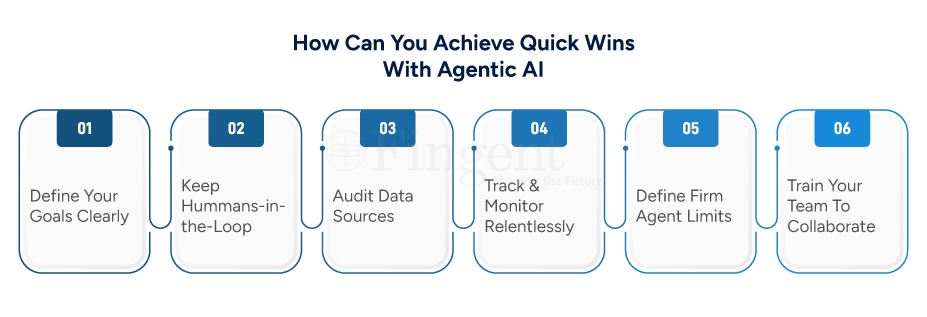
1. Define Goals First
Pick one pain point. Invoice matching or supplier onboarding. Define what “fixed” means and start where the risk is low.
Start narrow: Prove agentic workflows on routine tasks, then grow.
2. Keep Humans in Key Spots
Max autonomy tempts, but loop in people for big spends or contracts. It builds trust, catches drifts.
Two patterns work well in practice:
- Centralized for control (simple approvals)
- Hierarchical scale in multi-agent systems (complex chains)
3. Fix Data Upfront
Audit data sources early because bad data will derail agents. Set standards, loop feedback for better decisions.
In procurement, unify S2P data: Centralize spend, contracts, and suppliers for accurate agent reasoning.
4. Track Relentlessly
Monitor resolutions, accuracy, costs, and compliance. Refine based on real runs. Track ROI: Did negotiations yield expected savings?
5. Security from Jump
Apply zero-trust access, audits, and RBAC. Define firm agent limits and require review for high-value contracts.
6. Build Team Skills
Train on collaborating with agents. Learn from wins/losses together. Procurement teams need sessions on overriding agents safely.
Pitfalls We’ve Seen
Vague goals derail projects. Spell out success criteria, limits, and escalations. Define risky suppliers clearly.
Fix data gaps before agentic AI development. Start with clean vendor master data. Build security in from day one. Add explainability for audits. Avoid black-box agents. Add alerts and rollback controls.
Vendor lock? Pick open APIs. Accountability? Map chains now, like “agent proposes, human approves.”
Your 4-Phase Start
Phase 1: Target repetitive procurement task with data access, like invoice automation. Test with AI agent development company—learn feasibility.
Phase 2: Quantify: Autonomy rate? Cost drop? Tweak for 70% auto-handle. Add features like risk scoring.
Phase 3: Add cases (e.g., contracts), boost autonomy. Train teams, set governance. Roll to adjacent: Spend analytics next.
Phase 4: Deploy widely, monitor drifts. Key: Sponsorship, cross-teams (IT/procure/finance), change prep. Aim for 50% task automation by year-end.
Drive AI Success Faster! Start Small with the Right Expertise. Gain Quick Wins.
Fingent as Your Partner
Need help with agentic AI development? As one of the best agentic AI development companies for enterprise procurement, we tailor our solutions to your stack. We pilot fast, integrate seamlessly, govern safely, and train your team. No lock-in: We build your skills.
From multi-agent designs (one for discovery, one for negotiation) to monitoring (drift alerts), we shorten your path and reduce both cost and risk. We’ve delivered significantly better ROI in tail spend for manufacturers. Now it’s your turn.
Act Now
Agentic AI development is already reshaping enterprise workflows. The advantage goes to teams that start small and learn fast.
Pick one workflow. Run one pilot. Measure outcomes.
Invoice disputes. Forecast adjustments. RFP evaluation.
Start there. We’ll help you map it.
Stay up to date on what's new
About the Author
Featured Blogs
Stay up to date on
what's new
Talk To Our Experts
Your company spent two million dollars on an AI project. The pilot looked strong. The demo worked. Then the results flatlined. You are not alone!
Most companies face AI adoption challenges. They see very little or almost no measurable return from their AI adoptions. Failure to reach scale leads to money down the drain.
The problem is not the model. The problem is people, process, and strategy. Although these issues are fixable. Let’s see how!
Why AI Adoption Is Essential
AI drives speed, accuracy, and better decisions. It removes repetitive work and frees your teams to focus on high-value tasks. Most companies adopting AI see a significant change in operational efficiency.
However, when companies make large shifts rapidly, they face AI adoption challenges. Pilot projects work, but scaling fails. Teams push back, and the systems block progress. Skills fall short. Data is unreliable to say the least. These and many such reasons are why companies struggle with AI adoption. Here’s more on the common challenges in AI adoption for businesses.
Barriers To Enterprise AI Implementation
1.Workforce Readiness
What is the role of workforce preparedness in AI adoption? Most teams do not have the skills to run AI at scale. Half of all businesses cite a lack of skilled talent as their top blocker. According to Statista, in 2025, the biggest barriers to AI adoption were the lack of skilled professionals, cited by 50% of businesses, a lack of vision among managers and leaders, cited by 43%, followed by the high costs of AI products and services at 29%.
Skills shortages show up in three ways:
- You try to hire: The talent pool is small and expensive.
- You try to upskill: Training takes time.
- You rely on a few experts: If they leave, your project fails.
The fix is simple. Build a blended model. Hire where needed. When training your teams, create a culture of learning. Spread knowledge across teams.
2. ROI Uncertainty
Leadership wants clear returns. Few companies define them well. Many teams track with no clear outcome. They guess at goals, and they use vague metrics. Some AI projects take time to show impact. Early benefits are small and indirect. Many leaders expect fast results and lose interest before the project matures.
To improve results, companies must define one primary outcome, set clear timelines, and track progress with simple metrics.
3. AI Adoption Issues in Legacy Systems
How do legacy systems impact AI implementation? Many companies face integration issues. Old systems store data in incompatible formats. Since data lives in silos, infrastructure is slow. APIs fail to support real-time data. Integration becomes expensive. Your team struggles to connect modern tools with outdated systems.
The fix is a staged approach —modernize in small steps, consolidate data, and clean your core systems before scaling AI.
4.Lack of Clear Objectives
Many leaders approve AI projects without a clear goal. Teams pick use cases that sound interesting but solve no real business problem. Without clear objectives, the project drifts. No one knows what success means. Results are hard to measure.
The better way—start with one business problem, slow response times. Set a specific goal and develop around it.
5. Concerns Around Data Security
Executives worry about data exposure. These concerns are valid. Poor data governance creates risk. Companies often do not know where data lives or who uses it. Data quality issues cost the US economy over three trillion dollars a year.
Regulated industries face higher standards. One mistake creates legal and financial risk.
The fix— address security early. Set rules. Clean your data. Ensure to safeguard confidential data.
6. Absence of Trustworthy Partners
Many companies try to build AI alone. Others hire partners with no real experience. Both paths fail. AI requires skill, time, and structure. Most teams lack the bandwidth. Vendors with weak industry knowledge add more risk. The result is predictable. Wrong use cases. Wrong tech stack. Poor rollout. Projects that never scale.
Work with partners who know your industry and have delivered real outcomes. Ask for evidence. Look for teams that focus on people and process, not only tools.
Break The Barriers to AI Adoption Harness AI With Expert Guidance & Clear Roadmaps
How Leaders Move Forward: Your AI Adoption Playbook
What is the best strategy for successful AI adoption? Most leaders ask this question after stalled pilots and unclear results. An MIT report shows that 95% of generative AI pilots fail. Only five percent deliver fast revenue growth. The problems are known. The blockers are clear. What matters now is a plan you can act on. The next steps give you a simple path to stable adoption, clear value, and long-term progress. Each strategy focuses on one goal. Reduce friction and improve accuracy. Strengthen trust. Create a system your teams trust and use with confidence.
Strategy 1: Use the 30 Percent Rule and Keep Control
AI should take the repetitive work, but your people should make the decisions that matter. A simple split works. AI handles most repetitive activities. Humans handle the strategic parts that drive value. Examples include support, finance, and legal review. AI processes the bulk of the work. Humans own edge cases, decisions, and context.
This model improves trust. Companies achieve greater consumer trust percentages when they implement responsible AI along with human supervision.
What the 30 Percent Rule Tells You
AI handles repetitive work well. Humans handle judgment and strategy. In legal work, AI reviews most clauses. Lawyers focus on the few that matter. In finance, AI handles routine analysis. Humans handle portfolio decisions and client strategy. Automating the wrong tasks destroys value. Protect the human layer. It creates the critical insight your business needs.
Strategy 2: Always Keep a Human in the Loop
AI needs continuous human guidance. During training, humans label data and adjust outputs.
Before launch, experts test the system and fix errors. After launch, teams monitor decisions and report issues. This reduces bias and mistakes. It also builds internal confidence.
Strategy 3: Build a Clear Roadmap
Do not start with advanced use cases. Start small.
Phase 1. Minimize operational barriers and streamline routine activities. Utilize RPA, chatbots, and document handling. These quick wins build momentum.
Phase 2. Predict future outcomes. Use forecasting, segmentation, and recommendation models. These projects offer long term value.
Phase 3. Scale what works. Integrate with core systems. Build new business models.
Each phase supports the next. Set clear metrics for each phase and track them without excuses.
Strategy 4: Bring in AI experts who know what they are doing
Strong partners shorten your learning curve. Choose partners who know your industry. Ask for real case studies. Confirm they understand organizational change. Check their ability to work with your existing systems. A good partner brings a clear method. They guide you from assessment to deployment and support scaling.
Start Small and Focus On Quick Wins!
How Fingent Can Help You Adopt AI
Fingent guides companies from confusion to clarity. Their model is simple and proven.
Stage 1. Reduce Friction
Fingent identifies repetitive processes. We deploy RPA, document processing, and chatbots. This frees your team to focus on high value tasks.
Stage 2. Predict Outcomes
Fingent builds predictive analytics, recommendation engines, and segmentation models. Our experts help you improve forecasting and customer insights. We strengthen your governance and data discipline.
Stage 3. Scale and Advance
Fingent expands successful use cases. We integrate with core systems. Additionally, we support long-term transformation and new business value.
CASE STUDY: The Sapra & Navarra Success Story
AI/ML Claims Management Solution
Industry – Legal/Finance
Key Metrics:
- Case Settlement Time: Reduced from years to 1-2 days
- Settlement Cost Reduction: Over 50% reduction
- Business Impact: Enabled expansion into new insurance domains
Solution: A light-touch workers’ compensation solution powered by AI and ML
Key Success Factors:
- Clear problem identification (reduced settlement time)
- AI augmenting human expertise (not replacing lawyers)
- Human-in-the-loop approach for strategic decisions
- Decrease in average total claim costs and claim cycle time
What Sets Fingent Apart?
We provide human oversight as a standard. We run validation loops and follow strong governance. We fix data issues with clear mapping, cleanup, and security.
We start small, but ensure big results. We focus on modernizing legacy systems and integrating AI without disrupting operations. And that’s not where we stop. Fingent supports cultural change and upskilling to help businesses build confidence in leveraging new-age technologies to their maximum benefit.
Discuss your ideas with us and hear our expert solutions tailored to your unique needs.
Stay up to date on what's new
About the Author
Featured Blogs
Stay up to date on
what's new
Talk To Our Experts
Risk is everywhere in finance. Markets move. Competitors shift. Regulations change. Customers default. Economic conditions surprise. Every single day, financial institutions face decisions that could cost them— or save them— millions.
Financial risk management isn’t optional. Companies must prepare for it and act fast when danger appears. Traditionally, this meant armies of analysts. Spreadsheets. Historical data. Gut instinct. Teams working around the clock, analyzing numbers, looking for patterns –are consumed by slow, expensive, and prone to human error processes.
Then came AI, revolutionizing the entire concept of financial risk management.
Let’s explain exactly how AI in financial risk management converts risk from a threat into a controllable, predictable encounter. Read on!
Grasping Financial Risk: Important Types
Currently, AI in financial risk management is transforming how banks, investment firms, and insurance companies safeguard their interests. Why? Because it identifies risks humans miss. Because it moves faster than markets.
1) Credit Risk: When Borrowers Don’t Pay
One number matters: will the borrower repay? Default is the biggest financial risk most institutions face.
Credit risk happens when customers borrow money and can’t—or won’t—pay it back. A business takes a loan. Economic conditions worsen. Revenue drops. They default. The bank loses capital.
The Traditional approach went the predictable way. Analyze the borrower. Review their credit history. Check financial statements. Make a decision.
The outcome? It was slow. Based on incomplete information. Missing emerging patterns.
AI in financial risk management, on the other hand, spots default patterns long before humans can, scanning everything from income trails to market mood in one sweep.
The result: fewer bad loans. Better portfolio quality. Reduced losses.
2) Market Risk
Markets are volatile. Stock prices swing. Interest rates shift. Currency values fluctuate. These movements directly hit your portfolio.
A portfolio worth $100 million today might be worth $95 million tomorrow. Or $105 million. The risk is the uncertainty. There lies the potential for large losses.
Traders want to know how things could break. AI in financial risk management fires through thousands of what-ifs in seconds, exposing losses early and mapping out hedges before the storm arrives.
3) Operational Risk
Operational risk is different. It’s about your systems. Your people. Your processes. What happens when a server goes down? When does an employee make a mistake? When does a payment system fail? These aren’t market movements. These are internal failures. And they’re expensive.
AI detects early warning patterns—from fraud signals to system slowdown. This way, the teams can step in quickly and stop failures before they hit.
4) Liquidity Risk
Sometimes you need cash fast. Market disruptions and unexpected obligations come up. A liquidity crisis means you can’t meet your needs. You’re forced into bad positions. But AI predicts liquidity stress scenarios. It models cash flow needs. It identifies tight periods. It helps institutions maintain sufficient reserves. All in all, it prevents desperate situations.
5) Regulatory Risk
Compliance costs money. Missing regulations cost more – Fines, reputational damage, operational restrictions, to name a few. AI in financial risk management tracks regulatory changes. It flags requirements affecting your institution. It then proposes compliance adjustments.
How AI Spots Financial Risks Before They Break Your Balance Sheet
AI learns from patterns. With more data, it gets smarter. With more transactions, it improves. Unlike humans, it doesn’t get tired or miss signals. It runs without breaks. Without human limitations.
1. Real-Time Pattern Recognition
Your competitors are processing data in hours. AI processes it in milliseconds. It processes real-time data. Current market conditions. Live transaction flows. Updated customer behavior. Emerging economic signals. All simultaneously. All continuously.
Machine learning algorithms identify patterns humans would never spot. It catches subtle correlations that your team wouldn’t.
2. Predictive Analytics
AI predicts. Then it prepares you.
Machine learning models analyze historical data to identify early warning indicators. Once patterns emerge, the AI forecasts. Not with guesses. With probability-weighted scenarios based on historical correlations and current conditions.
According to research combining data from 350 finance professionals, AI implementation led to a strong positive correlation (r = 0.72) between AI adoption and enhanced risk management strategies. Organizations using AI prevent problems entirely.
3. Deep Learning: Discovering Veiled Patterns
Apply deep learning to financial data, and something remarkable happens. It identifies relationships that traditional analysis misses. Non-linear patterns. Hidden correlations. Complex interactions between multiple risk factors. Stock market predictions. Fraud detection. Credit risk assessment. All improved dramatically with deep learning.
4. Real-Time Risk Dashboards: Visibility When You Need It
Risk information is only valuable if you see it in time to act.
AI in financial risk management feeds real-time dashboards. Current portfolio risk. Exposure by asset class. Concentration risks. Liquidity status. Regulatory compliance posture.
Portfolio managers see emerging problems instantly. They don’t wait for monthly reports. They don’t rely on yesterday’s data. They have today’s reality. Right now. Every second.
5. Automated Risk Evaluation
What previously required days now only takes seconds. Loan applications. Investment evaluations. Counterparty assessments. These required human analysis. Days of review. Potential for inconsistency.
AI in financial risk management automates these assessments. Consistent criteria. Applied instantly. To every application. Every evaluation.
Power Your Business Operations with Seamless AI and Intelligent Integration
Real-World Use Case
Recent research shows that organizations using AI in financial risk management see a 17% better forecast accuracy and a 22% fewer errors. That’s a competitive advantage. Let’s delve into two use cases:
Use Case 1: Credit Risk Prediction — 99.4% Accuracy
What happened:
A research team built an AI system to predict credit defaults.
The results:
XGBoost accomplished 99.4% accuracy. LightGBM won the business case—90.07% accuracy while approving 95% of applications. It reduced false negatives—people wrongly rejected—while catching the real risks.
What AI discovered:
The AI identified key predictors: age, income, employment duration, and family size. It discovered non-linear patterns humans would never spot.
Why this matters:
Banks approve more customers while reducing defaults.
Use Case 2: Fraud Detection — 98.3% Accuracy with Explainability
What happened:
A research team tested 7 different AI models to catch fraud in real-time transactions. Machine learning. Deep neural networks.
The results:
The performance was exceptional. Seven AI models tested. LightGBM dominated with 98.3% accuracy with a near-perfect 0.96 AUC-ROC. And with five explainability layers built in, both regulators and customers can see exactly why each transaction was flagged.
The real-world challenge they solved:
Catches fraud in milliseconds with transparent reasoning.
Why this matters:
Fraud costs financial institutions billions per annum. Traditional systems miss these sophisticated frauds. But AI catches it in milliseconds. It explains its reasoning. It’s compliant. It’s reliable.
What Is The Future Of AI In Financial Risk Management?
1. Regulatory AI Integration
Regulators are waking up. They see AI in financial risk management as improving financial stability. They’re developing frameworks for responsible AI use in finance.
By 2026, expect regulatory requirements for:
- Model transparency
- Bias testing
- Stress testing integration
- Data governance
- Audit trails
Banks prepared early will have a competitive advantage. Those rushing in unprepared will face costly compliance retrofitting.
2.Generative AI Expansion
Large language models are entering risk management. Not replacing traditional machine learning. Complementing it.
Generative AI in financial risk management applications is emerging:
- Risk report generation
- Regulatory interpretation
- Scenario narrative generation
- Decision support
3. Cross-Institutional Risk Mapping
Individual firms can handle their own risks, sure! But systemic risk is a different beast entirely. That’s why regulators are testing shared AI frameworks that swap anonymized stress signals, giving the whole system an early-warning pulse so institutions can adjust, brace, and stop one failure from triggering a chain reaction.
4. Explainable AI (XAI) Development
“The AI says you’re risky but we can’t explain why” isn’t acceptable in banking.
Explainable AI is emerging. Machine learning models that explain their decisions. Not just predictions, but reasoning.
How Can Companies Implement AI Risk Management Solutions?
The tech isn’t the hard part. The real challenge is weaving in AI into your business in a way that actually works. And that takes a plan.
Consider this part your guide: where to begin, what needs immediate attention, and how to maintain team cohesion without inciting a small uprising.
Ready? Let’s analyze it:
Step 1: Evaluate Your Existing Risk
For each risk category, understand current performance:
- How frequently does it occur?
- What’s the average impact?
- How effective is your current mitigation?
This assessment becomes your baseline. The benchmark you’ll measure AI improvements against.
Step 2: Establish Goals Specific to Your Organization
Each organization has its own priorities. Get crystal clear. Vague aspirations don’t drive implementation. Measurable objectives do. Such as:
- Reduce credit defaults by 25% within 12 months
- Achieve 90% fraud detection accuracy
- Achieve 95% regulatory compliance
Set specific targets. Track continuously. Adjust as you learn.
Step 3: Data Foundation First
Before deploying AI, address data quality:
- Data availability
- Data accuracy
- Data integration
- Data governance
- Data documentation
Step 4: Collaborate With Seasoned Providers
Not every AI deployment is identical. Choose a partner with proven experience implementing AI in financial risk management. Look for:
- Industry experience
- Risk expertise
- Proven results
- Robust governance
- Change management
- Ongoing support
A good partner isn’t just building models. They’re embedding AI into your culture. Training your people. Ensuring sustainable adoption.
Step 5: Pilot Approach
Don’t go all-in immediately. Test first.
- Start with a specific, high-impact use case
- Run a 12-16 week pilot
- Measure rigorously
- Once the pilot proves value, scale to broader implementation.
Step 6: Change Management
Technology doesn’t work without people accepting it. Your teams might fear AI. Will it replace my job? Can I trust its decisions? Will it work?
Address these concerns:
- Education: Help people understand how AI works.
- Collaboration: Design workflows where AI and humans work together. AI provides insights. Humans make decisions.
- Quick wins: Show early positive results. Build confidence.
- Feedback loops: Let teams suggest improvements. Show that their input matters.
- Incentives: Reward adoption.
Teams that embrace AI become your competitive advantage. Teams that resist become bottlenecks. Your change management determines which.
What Are the Main Challenges of AI in Financial Institutions?
AI in finance doesn’t fail because the algorithms are weak. It fails because the real-world barriers are messy, human, and deeply operational. Before any institution chases advanced models, it must confront the five roadblocks that quietly determine whether AI becomes a breakthrough or a breakdown.
Challenge 1: Data Quality and Availability
The biggest AI killer isn’t the tech. It’s the data. Most institutions wrestle with:
- Siloed systems
- Missing or thin historical data
- Errors, duplicates, and patchy quality
- Conflicting definitions across teams
- Privacy rules that block usage
Solution: Fix the foundation first. Clean the data. Connect the systems. Enforce governance. No shortcuts here.
Challenge 2: Model Explainability
“Because the AI said so” doesn’t fly with regulators. Deep models are powerful, but they’re black boxes—and that creates trouble:
- Can’t justify decisions to regulators
- Can’t defend outcomes in customer disputes
- Teams stop trusting the system
- Legal teams panic over liability
Solution: Prioritize explainable AI. Choose models that show their logic.
Challenge 3: Complications that Arise in Integration
AI does not operate independently. It lives inside legacy systems. That’s where things break:
- Old platforms built long before AI
- Real-time decision pressure
- Slow or clogged data pipelines
- Outputs that don’t plug cleanly into business workflows
- Operational risks if the AI layer goes down
Solution: Design integration early. Rely on APIs and microservices. Stress-test everything. Build fallback plans for when— not if—systems fail.
Challenge 4: Talent Shortage
AI talent is scarce and pricey. You need builders, engineers, MLOps, risk experts, and change leaders. Getting all of them under one roof? It’s a battle.
Solution: Blend internal growth with external muscle. Upskill analysts.
Challenge 5: Uncertainty in Regulations
The rules are changing beneath everyone. That means:
- Risk of non-compliance
- Expensive rework as policies evolve
- Falling behind if you wait too long
- Heavier scrutiny during audits
Solution: Stay close to regulators. Join industry working groups. Build flexible, compliant-ready systems. Document everything so you’re always audit-ready.
Worried That AI Implementation Will Burn Your Pockets? Take It Slow With Our Step-by-Step AI Adoption Journey
How Can Fingent Help You Implement AI Risk Management?
Fingent specializes in helping financial institutions implement AI in financial risk management successfully. We understand not just the technology, but the business reality of financial services.
Our methodology combines:
- Deep domain expertise in financial services and risk management
- Proven AI implementation experience across multiple financial institutions
- Data architecture excellence ensures quality information flows to AI models
- Change management capability helps teams adopt AI tools
- Ongoing optimization ensuring AI systems improve continuously
Why Fingent Succeeds Where Others Fail:
Fingent doesn’t just build models. We build sustainable AI programs.
Our competitive advantages:
- End-to-end ownership — we manage the entire implementation, not just model development
- Risk domain expertise — consultants understand financial risk, not just AI
- Change management focus — ensuring teams actually adopt and use AI tools
- Proven track record — successful implementations across major financial institutions
- Ongoing partnership — we don’t disappear after implementation; they optimize continuously
- Regulatory expertise — ensuring implementations comply with current requirements and adapt to future ones
Stay up to date on what's new
About the Author
Featured Blogs
Stay up to date on
what's new

