Category: Business
Over the past couple of years, digitization has enabled technology-driven small companies to outclass established business houses worldwide. With industries ranging from taxi-services to banking, transforming digitally, more and more enterprises are realizing the importance of making digitization their number one priority. The tech-savvy consumer base, which consists of the population below the age of 30 and covers 50% of the global population, is considered to be the key driver behind this realization. Such folks have the rising affinity to expect every business organization they interact with to provide the fastest and most satisfying experiences each time. As a business, turning deaf ears to customer’s expectations can lead to unrevivable consequences. From AI to blockchain, IoT and RPA, the list of digital innovation you need to pay attention to are huge.
It’s nearing the first quarter completion of 2019 and we thought this would be the perfect time to show you the digital innovations that we believe will reshape businesses in the coming months and future years. Here are our top 5 picks from technologies that enterprises need to watch out for by 2022:
Flexible Cloud Computing
When cloud computing became mainstream a couple of years ago, there was a rush from enterprises to build their technology competence on the cloud. This resulted in several businesses having their own private cloud ecosystems that supported their own limited digital innovations. Today, many available digital tools require a complex network of cloud resource. This has reshaped the cloud computing ecosystem which has now transitioned into intelligently connected networks that have Public, Private and Hybrid cloud partitions working in sync to help businesses derive value from technology running on these platforms.
Different IT workloads may need to be run simultaneously over multiple cloud platforms to achieve enterprise goals and this has resulted in the so-called Multicloud saga. This is one area which will see more developments and interest from the business community in 2019 as the previous year saw major cloud service providers acquiring or developing solutions to club their multiple cloud ecosystems to serve client interests.
Related Reading: Find how a cloud platform like INFINCE can help businesses leverage technologies more efficiently.
Blockchain in Mainstream
The past couple of years saw considerable investments from the business community in the blockchain. We believe there will be mainstream applications coming out in 2019 that will revolutionize areas such as data security, digital identity verification, and intelligent automation. Sectors such as BFSI, logistics, regulatory bodies, and government agencies have already started using blockchain to set up complex autonomous verification and validation systems that require minimal human intervention, thanks to the capacity of blockchain to be immutable.
In the coming years, more mainstream consumer-facing areas of businesses would be driven by blockchain based autonomous operational interfaces and it could set the stage for innovations akin to self-driving cars. Many technology companies would be coming out with mainstream solutions having blockchain essentials embedded into their core and these would further enhance business capabilities for enterprises worldwide.
Related Reading: Find how blockchain technology can transform the supply-chain industry.
Digital Modelling
While this concept has been around for a while, we think it will make more impact this year as more companies are investing in this front. The idea is to create a digital persona for every product or service business has to offer its customers. This persona would be used to arrive at choosing the right supporting digital enablers like data generators (sensors, IoT enabled devices, etc.) as well as the right decision path (data models and implementations of data science to arrive at success models). Such persona would be used to ascertain an offering’s readiness to the market, the cost required to maintain it viable, the processes and business models that need re-defining to support it and so on. The entire exercise though a bit complex will bring about a strategic advantage to adopters as their business offerings would be more aligned for digital success than competitors.
Related Reading: Digital innovation is transforming today’s business. Find how your business can benefit from digital transformation too.
Immersive Experiences
2019 will see consumer experiences moving to a more immersive phenomenon where almost everyone from a local retail shop to an e-commerce giant will offer interactive experiences courtesy of technology like augmented and virtual reality. Gartner says that by 2022, nearly 70% of all businesses would be using immersive customer experiences in some form on an experimental basis. Such immersive technology will find its way into numerous consumer-facing scenarios like demonstrations, virtual assistants, field services and so on. With gadgets supporting immersive experiences like smart glasses and wearables being available for very affordable prices, the consumer base requiring such experiences will grow tremendously in the coming years. The possibilities are limitless and businesses small or big can capitalize on this opportunity to improve their competence.
Related Reading: Check out the ongoing battle between AR and VR and find which technology has the potential to mainstream first.
Conversational Intelligence
Artificial intelligence is no longer a trend to watch out for because it has already gone mainstream over the last two years. Today, the focus should be on solutions that have been made available by harnessing the power of AI. One major solution that has gained attention now are conversational bots. From websites to major apps, a multitude of consumer-facing interactions is now handled by programmed bots that can interpret queries and respond intelligently.
Be it ordering food from a restaurant, booking a cab or even carry out a banking transaction, tech-savvy consumers are increasingly depending on personal digital assistants or bots to aid them in every step of the way. The proliferation of smart devices like smart home speakers, wearables and other IoT enabled home and personal electronic devices have created immense possibilities for a business to connect more effectively with end users. Today, you can ask your smart coffee maker to brew a coffee in the most precise variants of taste and smell without even having to touch the coffee maker. You can simply ask the personal assistant on your phone to do so.
Related Related: Find unconventional ways Artificial Intelligence is driving business value.
The top technologies mentioned above concludes that 2019 and the years to come is going to be a breakthrough year for several technological innovations. Business leaders need to hone their digital skills to keep pace with the rapidly growing market. On the positive side, most of these technology platforms or solutions come in affordable subscription basis and hence it is pretty much accessible to any enterprise despite their business size. However, the biggest differentiator for your success is the right technology advisory and implementation.
This is where our consultants at Fingent can become your best asset. With years of experience in empowering multiple businesses to achieve their digital aspirations, our world-class services can help you achieve your digital dreams seamlessly. Talk to us to know more about how we can help you embrace the above innovations and much more into your mainstream business operations.
Stay up to date on what's new

About the Author

Tony Joseph

Tony believes in building technology around processes, rather than building processes around technology. At Fingent, he specializes in custom software development, especially in analyzing processes, refining them, and then building technology around it. He works with clients on a daily basis to understand and analyze their operational structure, discover (and not invent) key improvement areas, and come up with technology solutions to deliver an efficient process. You can reach him at [email protected], Skype: tony_fingent
Featured Blogs






Stay up to date on
what's new



Talk To Our Experts
Despite the industry buzz over the past few years, benefits realization and simple operational stability after go-live are arguably the biggest challenges companies are facing when implementing their new ERP systems. Recently, 60% of organizations failed to realize the business benefits they expected from their ERP implementations!
Among the business management tools available today, numerous studies illustrate the key factors to consider before choosing an ERP system for your business. The “Clash of the Titans” report by Panorama Consulting summarized quantitative results from hundreds of ERP implementations across the globe. The results showed that implementing the SAP ERP system, and implementing the Oracle ERP system produced very different results for different businesses!
For instance, an Oracle customer spends less on its implementation. Compared to this, a SAP customer is able to offer an implementation timeline that is relatively close to what was forecasted to be.
Another research considered a data set of over 2000 respondents from 61 countries, to illustrate the value of the people’s respective ERP implementation. The results showed that SAP held the largest market share of three vendors, with a 22% share.
The Key Factors That Make SAP Stand Out
- SAP or Systems, Applications, and Processes deal with data planning.
- The use of SAP has been compatible with large corporations such as Microsoft and IBM. Oracle, on the other hand, stands for Object Relational Database Management Systems (ORDBMS) and can be hosted in a number of platforms.
- SAP is a business management tool that allows real-time tracking in addition to the management of sales, finance, accounting, and human resources.
- SAP does not follow the traditional information system management where each management tool is considered as an individual system that operates independently.
- SAP integrates business applications using ERP (Enterprise Resource Planning Software) and on the other hand, Oracle, an Object Relational Database Management System (ORDBMS), is used in enterprise environments.
- Development and deployment in SAP can include Oracle as a database system as it can be integrated with numerous databases.
- SAP performs with a single information pathway alone for their entire enterprise and all other common information.
- SAP applications cannot interact with their own systems but can interact with other processes in order for tangible business events to happen.
- SAP ensures easier functions of management. This includes integration and other functions.
- The SAP model runs on a programming language of the fourth generation. It is known to us as Advanced Business Application Programming (ABAP).
Related Reading: Check out how SAP HANA technology is the new game changer for industries.
On the other hand, Oracle is an Object Relational Database Management System (ORDBMS) that comes from the massive Oracle Corporation.
The Oracle Database Management System is created with at least a single instance of a particular application. These specific instances are specific processes of the operating system, also benefit the storage!
In a nutshell, the key differences between Oracle And SAP are as follows:
| SAP | Oracle |
| The highest share of the market | Highest selection rate when shortlisted |
| Highest short-listing rate | Longest implementation duration |
| Lowest selection rate when shortlisted | The highest delta between planned and real implementation time frame |
| Longest payback period | The tiniest percent of users who realized between 81- and 100-percent of its advantages |
Who is King In The Area Of Business Software?
SAP and Oracle compete mainly in the areas of Business Software like ERP, CRM, and SCM. SAP is said to have more installs than Oracle in bigger companies. Let’s have a walk-through across some key reasons:
-
SAP Being The Pioneer
SAP ERP ran to the list first. SAP was already well established as a full ERP solution when Oracle was just starting to establish a Financials package for companies! By virtue of being first, SAP is well embedded in this environment.
-
A Much Better Integrated Solution
The core SAP ERP modules were built from scratch to full integration. So when a change is made, all other related modules are updated immediately. This comes useful when you extend it with a CRM or SCM functionality.
-
Mind-Share And Brand Recognition
Most companies/ people tend to have considered ERP implementation also as a status decree! They believe it increases their brand value.
-
Support Factors
SAP has a much larger pool of developers and consultants with a much larger installation base!
Read: 5 Tips For Getting The Best Out Of Your ERP System
CIO Strategies Matter! – How SAP Drives Ahead Of The Game!!
There are several case studies to validate why SAP is preferred over Oracle by many Business and CIOs. They are as follows:
-
SAP being the pioneer in ERP implementation
As SAP has been the leader and the pioneer in implementation, it preferred over Oracle with a brand value which indicates ERP leadership and preference.
-
SAP is an in-house built product
SAP was built in house. It has worked with industry experts to evolve the ERP processes and is able to build a robust solution. It allows customers to customize SAP functionality and yet get the client specific processes defined in ERP.
-
Robust integrated and scalable ERP
SAP has designed a highly integrated ERP which has world-class performance and scalable to multiple solutions. It also easies integrations with 3rd party solutions.
-
IS –Solutions
SAP has provided additional IS solutions which are optional but they allow businesses to have specialized processes on single ERP which is well integrated and reap benefits for “best industry solutions”
-
SAP Analytics
Integration on ERP and BI is notable and provides unbeatable performance and flexibility to define reports. Analytics based reporting Management to take real-time decisions
-
SAP Support services
SAP provides class support services which give Business assurance of resolution in critical situations.
-
SAP provides implementation methodology and Best practices and Tools
These tools provide a fool-proof implementation road map and reduce risks during the course of implementations. Following this guidance one can implement SAP in as less as 4 months; which means faster ROI.
SAP HANA with its “in memory” capability ensures super speed of processing data. The new UI solutions via Fiori give top class User experience.
In a nutshell, hiring the best qualified, focused and unbiased ERP can make your business more successful. So stay focused with our latest articles and blogs on SAP versus Oracle ERP implementation to go-live successfully!!
Stay up to date on what's new
About the Author

Featured Blogs
Stay up to date on
what's new
Talk To Our Experts
Why is SAP HANA considered a Game-Changer?
Advanced data crunching abilities of today’s technologies are hungry for their watermark moment! The older technologies are not being dexterous enough to meet with the needs of today’s businesses. So, in February 2015, SAP released ‘Business Suite 4 SAP HANA’, or ‘SAP S/4HANA’ for short, as a replacement for its predecessor, ‘SAP R/3’ and ‘Business Suite’ platforms.
This change will not only affect their existing clients but also the systems integrators (SIs) because they have built their businesses by promoting firms adopt and customize SAP applications!
In-Memory Technology of SAP HANA – The Game Changer
S4/HANA will run on the SAP HANA database platform alone. The previous enterprises could prefer databases from other vendors such as Microsoft, Oracle, and IBM. SAP HANA is considered much more innovative in functionality than its older version. Let’s find why exactly SAP HANA is considered the game changer!!
Related Reading: Learn why should you choose SAP and how you can plan your budget for it.
What Makes SAP HANA Create A Material Difference To Business Success?
HANA is a High-Performance Analytic Appliance. It is an in-memory platform for processing high chunks of transactional and operational data in real time. The in-memory technology provides prompt responses to queries without any waiting time. This is considered a game changer in the industry as the whole database is stored on the server memory for real-time analysis. The processing is with the data stored in disks where analysis is done in increments via redundant disk read-write activity.
According to SAP, adoption trends of SAP HANA by clients is constantly mounting across multiple industries with already 6400+ customers using this platform. This number is likely to grow in the year, according to SAP.
- Rapid forecasting and business strategy development without delays
- Business performance can be monitored better in real time
- Improved marketing campaigns through data analytics
- Prevent unplanned disruptions and avoid risks in business operations
- Accurate business decision making.
Time To Enable Some real-time functionality to analytics – SAP HANA does it ALL!
Enabling real-time functionality to analytics, business applications and data services are the highest priorities of CIOs. SAP HANA is the biggest, game-changing technology to impact these initiatives.
Key business drivers for SAP HANA adoption
- Real-time Analytics and Dashboards – SAP HANA permits information to be displayed dynamically without the need for aggregation. It can be presented in different dimensions for decision making and also for verifying business progress. Using real-time or historical data with prebuilt predictive libraries, analytics can be performed well.
- Data warehousing – Streamlining of data is important for better management. SAP HANA does this by offering predictive analytics. Thus trends are identified and it becomes easier to take better decisions on business strategies.
- Optimized Business Functions – SAP HANA runs with the in-memory technology that accelerates application performance. It helps in providing real-time reporting and also in offering BI tools. SAP HANA can run complex ERP or MRP applications to customize information using real-time data. This is how the firms that use SAP HANA are able to act promptly and adapt to changing business requirements or the latest market trends!
- Big data Rules – Gaining business insights and targeting clients with personalized offerings is the prime motive for any business. Big data analytics is used for the same. For this, HANA suite offers big data development and analytics tools.
- Swift And Accurate Decision Making With Automation Advances – Advanced analytics feature in SAP HANA can be used to transform business insights into actions for swift and accurate decision making in businesses.
Adoption Of SCRUM Framework – SAP HANA is Undoubtedly A Game Changer
SAP has adopted SCRUM as the framework and this helps in performing operations in short, iterative cycles.
SCRUM uses ‘time-boxed’ iterations. These iterations are termed “sprints. The objective of every sprint is to build a tested, workable piece of the system, that is ready to be released to production. These iterative cycles are based on the ‘Lean’ principles of software development. This helps in carrying out detailed analytics in real-time and on a transactional system directly. This is exactly why in-memory computing and SAP HANA are termed game changers because they function with such a powerful framework. This platform also provides a package for integrating multiple data sources. It also helps to perform various types of analytics that is, predictive, spatial, text, and so on. It can run simultaneously with SAP ERP software where analysts can access real-time transactional data instead of waiting to run daily or weekly reports.
Related Reading: Confused between Odoo CRM and SAP CRM? Learn how to make the right choice.
SAP HANA To Provide Real-Time Access To Business
Eliminating duplicate data and expensive data storage and improving query performance are features provided by SAP HANA along with real-time data analytics and support for end-user adoption. HANA Enterprise provides the most value and flexibility for higher BI solutions along with providing solutions for organizations that have a lot of non-SAP data, need real-time replication or require complex data transformation, cleansing or merging,
SAP HANA does not need additional software for data access. HANA Enterprise enables business users to immediately access their analytical data in real time, in a single environment, without affecting existing applications.
SAP HANA Technology – The Economic Impact
With the cost-saving efficiencies of SAP HANA, the software development costs for enterprises reduced by almost 70%, administration costs reduced by over 20% and hardware spending reduced by 15%. Thus, SAP HANA is clearly proving to benefit organizations in both ways, that is, to business and technology.
SAP discloses that the adoption of S/4HANA has doubled year over year to more than 5,400 customers as it published its full-year financial results.
With its potential to process large chunks of data in server memory by combing the capabilities of database, data-processing and application platform execution. SAP HANA is considered to be the next major breakthrough in enterprise IT.
All of us in IT are aware that better business decisions are made only when data is available in a meaningful format and at the right time. It is time to extract the benefits out of SAP HANA for successful business execution. Keep your eyes clapped on our latest articles about SAP HANA to learn more!!
Stay up to date on what's new
About the Author
Featured Blogs
Stay up to date on
what's new
Talk To Our Experts
Over the years the real estate market has witnessed a tremendous change in the way it runs the business. Intense market competition has compelled the real estate firms to rethink traditional strategies and innovate. Therefore, modern realtors are considering various real estate innovations as opportunities to build up their valuation.
One such innovation prevailing in the real estate market today is the concept of an amenity-packed mobile app. Applications connecting tenants with a pool of amenities are the latest makeover tools adopted by realtors. These apps are now the trending treats offered by real estate companies to retain their existing tenants and attract new ones.
Amenity Apps – The Next Big Thing In Real Estate Market
Recent reports have revealed that the vacancy rate of offices in New Jersey and Westchester County, has increased to 20%. Even the overall vacancy rates of Manhattan is above 8.5%, approximately. With such high vacancy rates in the most competitive real estate markets, realtors have realized the need to adopt differentiated strategies to retain tenants. Hence, realtors are now stepping out of their specialty to foster services beyond the boundaries of property business. The most innovative approach through which builders are now keeping their buildings 100% leased is by introducing amenities.
Why Amenity Apps?
In today’s world where competition is at its peak, workers often fail to maintain a work-life balance. While striving to beat the nerve-racking competition of the modern world, employees are missing out on the necessary routines of life. Regular exercises, health checkups, haircuts, laundry or even picking up a meal becomes a hassle when work is tough.
Realizing these challenging situations of today’s workforce, some prominent realtors like Tishman Speyer and Sterling Bay, created amenity apps for their employees in New York. These apps are helping the workers to achieve a balance between personal and professional life. With these apps, property builders are extending their services to bring in amenities to the doorsteps of their customers.
Life hacks provided through prompt mediums like mobile and tablets are making buildings more attractive for tenants to stick on. Extending real estate services to provide better lives for tenants are not only upgrading the value of buildings but are also turning office markets to service businesses.
Related Reading: How Top Real Estate Companies Leverage Technology to Soar New Heights.
How To Woo Tenants With The Perfect Amenity App?
With amenity apps creating a hue in the real estate market, property builders are striving to introduce spellbinding services through innovation. Office landlords and building owners are integrating technology with small-scale businesses to woo their tenants. But to create an impact in the market, it is necessary to load these amenity apps with captivating features. To help realtors deduce the best amenities for their apps, here’s a short list of the popular ones that are boosting the customer retention rates for some leading real estate enterprises. While food services have already become the baseline of several amenity service apps, few other amenity types are also achieving an eminent position.
Health & Fitness
With healthcare activities gaining popularity among the current young workforce, several real estate firms are loading their amenity apps with wellness services. On-suite fitness programs like massages, meditation, yoga, and other healthcare programs are the prominent features of multiple amenity apps. hOm introduced by the Brookfield Property Partners is one such innovative example of technology-packed amenity provider that offers unique fitness events to create healthy communities.
Closer Communities
Leading real estate providers are trying their best to create active and lively communities. Lack of time and rush life often makes it difficult for residents to engage well with their neighborhood. With a motive to diminish such hostility and create more engaging communities, property builders are now incorporating emerging technologies to implement amenities that bring people together. Services like group discussions, ride sharing, community meetings, travel management, human resource services, etc. are attractive features of amenity apps.
Access to Building Amenities
Gated communities often extend a wide range of amenities for their residents. Generally, these amenities are offered through common communication channels like emails and telephones, which makes it difficult for residents to reach them. Hence, property owners are now featuring portals to bring these building services closer to tenants. Recently Silverstein Properties introduced the Residential Community App which allows tenants to access rent payments, tenant referrals, community and neighborhood maps, shuttle services, discounts, offers and much more through their smartphones and tablets.
Eco-Friendly Environment
With the increased concern of protecting nature, property owners are now focusing on amenities that serve both tenants and nature. The SL Green Realty Corp., initiated a suite called SL Living Green that connects residents with group discussions, educational talks, recycling projects, eco-friendly waste disposal schemes, etc. to enhance their wellness and style of living. These amenity features allow tenants to feel responsible towards nature which attains them a unique experience.
Other Popular Amenities
Few other personal styling and emergency medical care amenities are popularizing among tenants. Medical aids like backup child care, health screening, drug delivery etc are some of the highly accepted medical features of amenity apps. Also, few real estate firms are designing their amenity apps to deliver styling amenities like blowouts and manicures, shoe shining, hair styling etc. to desired locations.
Related Reading: Self Showing App, an IoT application built by Fingent streamlines the complete inspection and leasing procedures of real estate firms. Find more in the case study here.
How Are Real Estate Amenity Apps Winning Hearts In New York?
Isolated lives of metropolitans have marred the quality of life. The struggles to socialize, stay fit and even to groom well, are becoming the increased concern of the modern generation. Hence, the leading real estate firms are empowering their amenity apps with services to sort these hassles of the modern world. One such enterprise is Tishman Speyer, who has integrated technology with small-scale services to create unique experiences for its tenants.
Tishman Speyer, a diversified real estate firm operating properties of worth $89 billion, including the iconic Rockefeller Center in Manhattan, rolled out an app called Zo. The Zo. app is winning hearts in New York, by exclusively connecting its employees to an unparalleled collection of services. They offer exclusive deals which include wellness programs, social and interest group gatherings, backup childcare, on-site health screening, and medical services, dry cleaning pick up and delivery, personal styling, individual meal delivery, catering, and much more. These services are enhancing the living standards of Tishman workers and tenants by creating a hassle-free work environment for them.
Another leading real estate developer in New York, entering the emerging war of landlord amenities is Sterling Bay. They have introduced their own app offering expanded eye-catching amenities for their workers.
Extreme competition in the real estate market is determining the growth of property businesses on the basis of the number of people in it and not by the square footage. More than magnificent buildings, residents are now attracted to communities that deliver unique and lively environment. Tenants prefer buildings that provide amenities through advanced technology channels that enhance the living experience. Incorporating smarter technologies and utilizing real estate software, is emerging to be an essential ingredient in real estate business today.
With emerging technologies transforming communities, the real estate market is witnessing a new era of property services beyond bricks and mortar.
Related Reading: A Property Management Software can be a boon for real estate managers if adopted the right one. Find the secrets of finding the right property management software here.
Read More: Mobile App Development : 4 Tips To Consider
Stay up to date on what's new
About the Author

Featured Blogs
Stay up to date on
what's new
Talk To Our Experts
While most sectors have battled their respective digital disruption by enhancing their own digital capabilities, the real estate sector has been considerably slow to react. This is rather astonishing when you look at the size of the real estate business globally where it surpasses all other sectors to form the most valuable commodity valued at over $217 trillion. In the digital era, no industry is safe from disruptions and this includes the real estate sector as well.
How will custom software transform the real estate business?
With the overwhelming majority of today’s buyers belonging to the millennial group, the sector is witnessing an increased demand for digital innovation. From finance to aesthetics, there is a wide range of applications for technology in the real estate sector and this includes both commercial and residential assets.
What drives the need for digital in the real estate sector?
The three main driving forces behind digital adoption in the real estate sector are
- Buyer Experience
- Transparency
- Compliance
The buyer experience is the ultimate selling point for any property today be it commercial or residential. From the discovery of the property to guaranteed maintenance operations after a sale, today’s buyers need seamless services on all fronts. This could be made possible through a highly connected digital ecosystem that is spread across the entire buyer journey. There is a need for bringing a mature and trustworthy operational model for real estate dealings. Custom digital software can help bridge the gap between realtors, property managers, landlords and tenants in a multitude of ways and bring about transparency and accountability in matters where large financial transactions are involved. Besides the real estate sector draws quite a big eye from the authorities and compliance standards for safety which are amongst the toughest of all sectors. With a digital backbone, it becomes easier for compliance requirements to be validated and audited by government agencies. For buyers, this provides peace of mind and a hassle-free tenure with all risk aspects sorted, at both individual and government level.
What can digital transformation do for the real estate sector?
Now that you are well aware of the need to drive digital innovations, it is time to have a look at ways in which digital transformation can reshape the real estate sector. A gamut of technology innovations exists today that can deep dive into the various nuances in the sector and create lasting experiences for buyers and tenants and transform properties into global commodities. Let us examine the top 5 ways in which the real estate sector can transform with custom software.
Discovery of properties
In the 1980s, close to 22% of home buyers relied on newspaper ads and 8% relied on their friends to discover new properties to buy. In 2017, more than 51% relied on the internet to make a property or a home purchase decision. The internet has become the hotbed for real estate marketing and if you are not out online with full guns blazing, chances are that your listed property or home may not attract any potential interest from the buyers of today. Real estate developers and sellers need to have an attractive website for their property in addition to maintaining a sizable listing on the most popular property portals amongst buyers. Doing your homework on SEO and taking steps to include feedback from powerful search analytical tools provided by search engines like Google themselves, you can improve the online presence of your property considerably.
Related Reading: A Property Management Software can be a boon for real estate managers if adopted the right one. Find the secrets of finding the right property management software here.
Changing the role of real estate agents
Most digital disruptions have focused on massively reshaping the roles of personnel involved and here too, the picture is not different. With the rise of digital portals and custom software, buyers and sellers can connect more directly without losing a hefty price in terms of commissions. But agents are not completely left out as well. They, on the other hand, have a plethora of marketing and customer service tools to offer more privileged and customized services for buyers. The transformation can, however, be a bit painful for real estate agents dealing with residential properties as they can be choked out by a large number of digital listing portals wherein sellers can directly provide information, arrange site visits and even proceed with legal documentation without the agent’s help.
Transforming site visits
By the year 2025, nearly 20 million households in the US would be owned exclusively by folks in the millennial generation. If you expect them to drop by after work or on a Sunday for a property visit, then chances are you will never hear from them after the first inquiry. In the digital age, you can use custom software to schedule and arrange for a suitable site visit time slot that is favorable for both the potential buyer and the agent. It can even facilitate pre-visit conditions such as a deposit, online application, valid document proof, etc. Going a step further, virtual and augmented reality embedded apps can provide a 360-degree walk-through of the property on the buyer’s mobile phone anytime and anywhere. With such digital innovations, the target market would not hesitate in spending an extra premium thanks to the splendid buying experience.
Related Reading: Self Showing App, an IoT application built by Fingent streamlines the complete inspection and leasing procedures of real estate firms. Find more in the case study here.
Setting the terms of leasing or buying
Gone are the days, when you needed hours of documentation to create a transparent lease or buying agreement that aligns with regional laws and complies with all relevant risk management standards. Today custom real estate software can provide digital lease or buying agreements that can be validated by local, regional or national government authorities directly without middlemen leading to significant cost reduction in the entire process. A digital portal could record every transaction from the first site visit pre-requisites to valid document audits, payment information, terms and conditions of the agreement including periodic rental revision agreements, automated payment schedules, etc. Such a massive transformation can bring about significant changes to both residential and commercial real estate properties.
Preventing fraudulent transactions
Having a digital backbone brings with it guaranteed transparency and accountability for every transaction or commitment made between a buyer and a seller. Besides, digital portals having direct validation credentials with government authorities can provide digital verification of documents, identity proofs and other associated legal requirements for every transaction. This can aid in transparent pricing schemes, elimination of bribes and middlemen fees, provide streamlined tax revenue to governments for every deal in the real estate sector thereby eliminating fraudulent transactions.
Related Reading: Read through the case study to know how Fingent developed a customized all-in-one property management solution for one of their leading real estate client here.
Summing up
Though much of the transformation mentioned above is in various initial stages, the real estate sector holds immense potential for future digital innovation. Custom software for the real estate sector can challenge traditional buyer-seller relationships and even wipe out middlemen in the long run as we mentioned in one of the possibilities above. However, staying ahead and relevant at the same time in the digital era is what key players in the sector need to focus their attention on. Write to us to know how our digital transformation specialists can enable the best of real estate innovations for you.
Stay up to date on what's new
About the Author
Featured Blogs
Stay up to date on
what's new
Talk To Our Experts
The real estate industry has traditionally been a technology laggard, with antiquated systems, ad-hoc processes and manual documentation ruling the roost. However, things are changing, with innovation and tech disruption set to change the fundamental paradigms of the real estate sector.
Can real estate technology advances actually predict property prices?
Leveraging Machine Learning Algorithms to Predict Real Estate Property Prices
Smart purchasers and investors look at the value of the property rather than the price. Just as the price of a stock denotes nothing about its inherent value, and one needs to delve into the PE and other ratios to estimate the value of the stock, the price of a property says little about its actual worth, and one has to dig into the underlying data to get to the true worth of a property.
The opacity and lack of access to underlying information surrounding property hitherto inhibited a proper and objective analysis of the true worth of property. Often, the only information available to the stakeholders is the prices at which previous properties of a similar nature, in the same locality were sold. As such, the asking price for properties has always been subjective, depending on what the seller thinks the property is worth, with a loose estimate of the prices other properties have sold in the locality and other subjective insights constituting the basis for asking price.
However, things are changing, and changing fast. Real estate data sets are growing larger and larger with every passing day, every single day, thanks to the ever-improving computing power and cloud storage capabilities. Smart retailers and other stakeholders have already deployed several new tools and services that leverage such data, and many more tools and services are in the offing.
The National Association of Realtors estimates about 42% of buyers looking at property online as the first step in their home buying process. Most of them now delve into further details, such as the crime rates in the neighborhood, availability of public transit, the profile of local businesses such as gyms, groceries, restaurants, and several other factors.
It gets better. Machine learning now infuses objectivity and transparency in property pricing, besides promising a scientific basis into price fixation of property.
Machine learning models, comprising of hundreds of explanatory variables, offer insights into almost every aspect of a specific property, to a very a high level of accuracy and objectivity. Such models scour through piles of data and are capable of not just identifying an accurate price for the property, but also identifying hidden gems among the swathes of properties available for sale. Buyers and may use such insights to quote a fair and accurate price for the property, Sellers may likewise quote a fair price and sell their property faster, without the risk of under-selling themselves. Banks and financial institutions may use the insights to offer loans based on the predicted future value.
Related Reading: How Top Real Estate Companies Leverage Technology to Soar New Heights.
Identifying Correlated Variables
Home buyers and investors often end up making unscientific comparison among two properties and are often deluded by a lesser price for a property, oblivious to the far inferior value on offer.
While the obvious variables such as the number of bedrooms and square foot area may be obvious and explicit, some variables remain hidden or not too obvious.
Some variables are also closely correlated with others. Some pairs, correlated by nature, such as “Basement finished area” and “Basement unfinished Area,” and other pairs, correlated by deduction, such as “Overall condition” and “Year built” help to identify the true worth of a property relative to the asking price.
Machine learning models not only factor in such variables but also give proper weight to each variable. For instance, two homes may seem similar while considering the obvious variables, but property A may offer far better value owing to the superior quality of plumbing materials used in construction and availability of groundwater compared to property B.
Related Reading: Find how Fingent developed a customized solution to streamline all the processes in a property management life cycle. Check out the case study – Rentmoji: All-In-One Property Management Platform.
Unearthing Seasonal factors
Seasonality has an impact on property prices, but the impact may be subtle or hidden. Crunching historical data makes explicit trends in sales prices associated with seasons. For instance, sales may be more surfing summer months, when the new school year starts, leading to a spike in prices. Such seasonal prices help property investors leverage their buys, property sellers price their property more accurately, or postpone their sell for a few months to get a better price, and more.
Related Infographic: Major Challenges of Big Data in The Real Estate Industry
Identifying the True Value of Extraneous Factors
Buyers always consider the neighborhood of the property, in terms of crime rates, the quality of grocery shops in the vicinity, the proximity of schools, and other factors. However, such analysis is often done ad-hoc, and on a generic basis. The “devil” in the detail may often be overlooked. Machine learning models factor in the extraneous factors at a much deeper level, correlating factors such as frequency of power cuts in the locality, unemployment in the locality, frequency of transportation links, school ratings and more, all of which not only offer an objective and scientific basis on the true worth of the property, but also have an immediate bearing on the property prices.
However, the true value of machine learning is the ability to derive valuable trends and insights from the data. For instance, analysis of police arrests and the chemical compounds in sewers indicate the use of crack cocaine, indicating that gentrification could soon arrive. When the crack is replaced by cocaine, it may indicate that gentrification may already be complete. Such insights may not be available at plain sight and may be impossible to decipher without the analysis of such underlying data.
While real estate technology now makes it easy to predict property prices with a high level of accuracy and objectivity, the challenge is creating the underlying data models in a robust way. The machine learning system is only as good as the algorithm which powers it. Success depends on creating linear models, co-opting all possible categorical variables and historical data associated with each variable.
Related Reading: Read through to find how trending technology is disrupting the real estate industry.
Stay up to date on what's new
About the Author
Featured Blogs
Stay up to date on
what's new
Talk To Our Experts
The digital transformation wave that is transforming businesses across the world has had major influences on the way custom software development is treated by technology teams. Today software development is all about improving the experiences at multiple levels for businesses. Experiences include customer experiences from their end customers during a transaction journey and operational experience of staff who utilize technology solutions to drive more customer love. Technology is bound to change and business owners must be willing to meaningfully bring about changes in their custom software development concepts to incorporate the best solutions to run their business smoothly.
Reap your success in the digital age following these 5 custom software development trends
Let’s have a look at the changing trends in custom software development that warrants big attention from businesses across sectors. Following are our picks of the top 5 contenders in technology trends that every team engaged in custom software development must be aware of:
1. The growth of open source technology
A decade ago, you might not have found too many takers for open source technology. But, today only less than 3% of worldwide businesses do not use any form of open source software in their enterprise technology stack. In the initial days, it was largely seen as a playground for beginners in software development to try out building applications for free. Today the world’s biggest technology companies like Google and Facebook utilize open source software to run their most mission-critical systems. They also contribute significantly to the maintenance and growth of developer communities around these open source technologies. Take a look at all the leading application development technology available today like Java, PHP, Angular, React, Hadoop, etc. They are all open source and powers some of the world’s biggest enterprise and consumer-facing digital applications. If your business has frequent technology requirements, then this is a trend in custom software development that definitely needs to be on your top priority.
2. AI-ready software
AI is already a mainstream component of almost every digital platform that people use today. From e-commerce to movie streaming, companies are rolling out machine learning capability to help software learn more about its users and automatically provide them with great experiences. AI-powered chatbots are today serving queries of billions of people online and businesses are investing heavily in making these bots more intelligent by the minute. For software developers, it is essential to know the in and out of writing code that blends well with self-learning algorithms to provide optimal value for businesses utilizing applications that run this code. AI has a key role to play in the future when it comes to interacting with end customers directly. Hence custom software developers need to focus their skills on creating meaningful front-ends that can resonate AI actions, scalable back end engineering that can supplement complex AI algorithms and powerful databases that can deal with the huge volume of data that needs to be handled by AI systems to create meaningful experiences.
Related Reading: Find the top AI trends of 2019.
3. Cloud takes new dimensions
The world’s best run businesses today run their technology core on the cloud. From platforms to infrastructure, cloud computing has transformed the way enterprises use software applications. 73 % of the world’s businesses have at least one application or an infrastructure element on the cloud. From becoming more agile in terms of application engineering to saving fortunes by removing on-premise infrastructure costs, businesses are re-inventing themselves in the digital age. The benefits are endless – scalability on demand, global availability, top gun service providers in every niche, etc. With cloud computing, your technology workforce can be empowered with mobility i.e. the freedom to work wherever they want and with whatever resources they need. This is yet another trend that every business needs to take seriously to improve their ROI on technology investments.
Related Reading: Find how a cloud platform like INFINCE can untangle technology for business.
4. Security to be given a top priority
While the rise of cloud computing and the transition of on-premise software engineering to rich internet applications have created better digital experiences, they have opened new cans of worms for developers to deal with. In the US alone it was reported that there are over 130 large scale targeted breaches of confidential user data residing on enterprise applications of businesses. This figure is growing at an exponential rate of 27% every year as well. Security aspects cannot be overlooked now not even for the smallest of applications. Any vulnerability in your code will turn into a feasting ground for cyber threats in an increasingly internet dominated world. It’s not enough to write a great code but also to practice secure coding standards to enhance safety and ensure customer data is never compromised.
Related Reading: Find which option is a better choice for your business, Custom Software or Off-the-shelf.
5. Customers are the heart of everything
Today it is not just your sales process or your customer relations team that needs to have end-consumer centric thinking on their operations. Even your custom software development team needs to have a work objective centered on a customer-first philosophy. Human behavior of your target digital audience needs to be modeled and referred to while creating applications. This is crucial for recommendation systems, lasting user experiences and above all improve brand loyalty by creating wonderful digital experiences. Feedback systems need to convey responses directly to core technology teams and they need to drill this feedback into the very depths of every implementation and every programming logic they use to achieve business goals.
These are our picks for the top 5 trends in custom software development that businesses of all sizes need to consider today. In an increasingly digital age where customers dictate the fate of every single of your investment, it is imperative for organizations to have a comprehensive look at how these trends can be incorporated into their technology roadmaps. Those failing to do so are in for massive repercussions as it doesn’t take decades for big corporations to fall to their heels for lack of innovation. The examples are right in front of you. Investing in the right technology with the right advisory is crucial for businesses to continuously innovate and stay relevant in changing times.
[Custom Software Vs Off The Shelf – Fingent]
Stay up to date on what's new
About the Author

Featured Blogs
Stay up to date on
what's new
Talk To Our Experts
If you’ve ever tried decorating your home using the IKEA app, or used a Snapchat filter, or even played Pokemon Go, then Augmented Reality (AR) has already invaded your life. Although AR remains a revolution yet to happen, it is evolving rapidly to transform the way we work, learn, play and connect.
Tim Cook quotes –
“AR will happen, it will happen in a big way, and we will wonder when it does, how we ever lived without it. Like we wonder how we live without our phone today.”
So what exactly is Augmented Reality?
The word itself answers the question!
“Augmented”, originated from the word “augment”, means to add or enhance something. With the power of narrowing spaces between Reality and Virtual Reality, AR enhances physical objects with digital information to create an interactive experience of the real-world environment.
Google defines Augmented Reality as – “a technology that superimposes a computer-generated image on a user’s view of the real world, thus providing a composite view.”
How Augmented Reality Is Creating An Impact in the Travel Industry
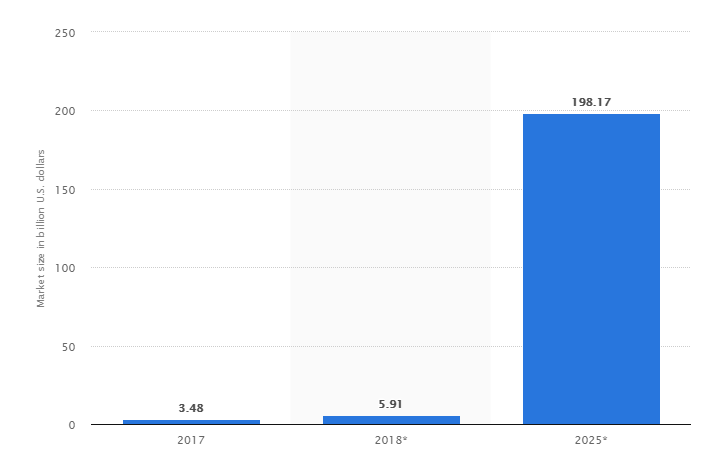
With the power of gripping human minds, AR is changing the game for marketers. Technology is opening magical doors for industries to enrich their customer experience. According to a Statista report, the Augmented Reality market is estimated to grow from 5.91 billion to more than 198 billion U.S. Dollars by 2025.
However, the travel and tourism sector has already shown remarkable transitions with Augmented Reality.
How is the travel industry leveraging the wonders of AR and what lies for them in the future – are a few questions answered in this blog?
Importance of Augmented Reality in the Travel Industry
Before we dig into the innovative uses of AR in the industry, let’s take a look at how the technology is turning important to the sector.
Unlike other industries, travel and tourism is a highly researched sector. A customer never plans his travel, stay, or food places to visit, without thorough research. The quest for information does not stop for a customer even after he/she arrives at their destination. Moreover, all this information is searched on various mobile devices. A survey by Opera Mediaworks reveals that around 66% of travelers prefer using smartphones for travel research and booking.
Here is where Augmented Reality jumps in to make a change!
AR capacitates the ability to enhance search experiences by providing enticing and interactive information. With innovative mobile apps, these augmented experiences can be extended to travelers, easing their travel search and building up trust. Experts predict that embracing the power of AR can prove to become a boon for the travel and tourism industry.
How Is Augmented Reality Reshaping The Tourism Industry?
Augmented Reality is turning to be the traveler’s new ally! Layering digital information over existing reality, AR is easing the planning journey and boosting travel experiences for tourists. Although the industry has not completely leveraged the technology, yet a few pioneering mobile apps are creating indelible travel experiences.
1. Apple Map – “Flyover” Mode
Apple maps with its flyover option are enabling iOS 11 users to explore cities in the 3D view. Navigating with this feature is a lot like watching a 360-degree video where one can change the point of view by walking around. The flyover mode integrates augmented reality with Apple Maps to enable users to take a walk through the city while at home.
2. App in the Air – ARvis
App in the Air, a travel planning app, is easing the quest of finding flights for its users. The app allows users to view a plane seat at its true scale, enabling them to make better booking decisions on the basis of comfort. With an augmented view of the inside of a flight, travelers can directly compare their carry-on luggage to the airlines permitted baggage size.

3. Wikitude
Voted by the Augmented Planet Magazine as the best-augmented reality browser of 2010, this app enables users to locate restaurants, stores, and other places nearby. Using location-based augmented reality, Wikitude recognizes interesting places around for travelers to visit. The only thing they ought to do is point the app to the desired direction.
Why Is Augmented Reality The Future Of Travel Industry?
Tourism is all about creating unique experiences, and augmented reality has the potential to support tourism with innovative modes of customer servicing. It is believed that in the coming year’s AR will disrupt the business models of the sector. Here is a list of how augmented reality is providing long-term values for both customers and the tourism industry alike.
1. Innovating Advertising and Marketing
It is not surprising that mobile devices play a vital role in booking travel services. According to Expedia, 78% of travelers reveal that the informative content from destinations or travel brands influence their decision-making process and 46% reveal that ads with informative content are influential. Clearly, there’s an appetite for mobile advertising with compelling content.
Augmented reality holds the potential of enabling tourist companies to narrate their services more creatively. Providing virtual tours of hotel suites and other amenities with a single tap on mobile screens, not only eases the research process for travelers but also helps them make better booking decisions.
AR ad formats, also build a customer’s trust towards the service and increase the probability of turning one-time guests into long-term customers. AR empowers travel brands to inspire customers with interactive information and engaging experience.
2. Enhancing Travel Convenience with AR Apps
Travels can turn hectic with a lack of proper and timely information. With AR, travel brands are extending mobile apps for tourists, to enhance their travel experience and convenience.
AR Travel Apps to Ensure No Tourist Is Lost: Finding your way in an unfamiliar town is challenging. AR turns navigation apps cooler with added digital elements like arrows and other valid information. By integrating phone cameras with Google Maps, AR can enhance a traveler’s experience of exploring a new town.
AR Cutting Down Language Barriers: It is pretty much unthinkable to travel to a foreign land without a translator. But with augmented reality, smartphone cameras can translate foreign languages for users.
AR Extending 24/7 Tour Guide: Finding a perfect store or restaurant is getting simpler than ever before. With Augmented Reality, smartphones are turning into tiny encyclopedias. Screening through hotel reviews or locating historic buildings has become more seamless and interactive with AR travel apps.
[Source : Florence Travel Guide – Italy – Augmented Reality]
3. Creating Attractive Destinations
Teleporting seems possible with augmented reality. Enabling to view the evolution of landmarks in time perspective, enjoy 3D models of places, and experience travel through time, AR is allowing theme parks and zoos to create extraordinary attractions. One of the greatest examples would be the L.I.V.E. Centre theme park, which leverages AR/VR to combine art, culture, architecture, design, and retail with projections, surround sound, and special effects.
Thus to summarize, augmented reality promises to strengthen the four components of travel and tourism – transport, accommodation, catering, and tourist attraction. Accounting for the innovations of AR in the industry, experts predict travel and tourism to be the first industry to revolutionize soon with augmented reality.
Related Reading: Find how Augmented Reality can be the future of communication and security.

To unfold the hidden opportunities for your business with emerging technologies like AR/VR, contact the tech experts at Fingent today!
Augmented Reality is already enhancing travel experiences with innovative mobile apps. Is this the beginning of a revolution or is it the only transformation augmented reality can bring into the industry?
Augmented Reality is already enhancing travel experiences with innovative mobile apps. Is this the beginning of a revolution or is it the only transformation augmented reality can bring into the industry?
Stay up to date on what's new
About the Author

Featured Blogs
Stay up to date on
what's new
Talk To Our Experts
Most of us, technology geeks or not, are eager to stay first in line to catch up with the latest game-changing technology trends. Here we are to know which technologies will thrive in 2019!
The Potential Technology Trends You Need To Explore In 2025
Have you ever looked up at the sky and clapped your eyelids on a bat? This is commonplace. But what if it was a drone. Or would it be a flying fleet? Since we don’t belong to the Jetsons family, the latter is not expected but we are close to it! 2019 is definitely a transformative year for technological innovation!
According to Gartner, the Top 10 Strategic Technology Trends for 2019 are Block chain, Artificial Intelligence, Empowered Edge, Privacy and Digital Ethics, Quantum Computing, Immersive Experiences, Augmented Analytics, Autonomous Things, and Digital Twins!
This is just the tip of the iceberg. Following are the emerging technology trends and catalyzing technical innovation that we can expect to see more of in 2019!!
Related Reading: Find how digital innovation is transforming today’s business world.
1. Blockchain Technology – The ‘New Internet’
Some call Blockchain technology the ‘New Internet’. The blockchain is the brainchild of a person or group of people known by the pseudonym, Satoshi Nakamoto. It permits digital information to be distributed but not duplicated.
It was first devised for the digital currency, Bitcoin. It is also called the “digital gold”. To this day, the total value of the currency is nearly $112 billion US!
“Blockchain solves the manipulation problem”, says Vitalik Buterin, inventor of Ethereum.
2. Artificial Intelligence (AI)
Apart from AI-powered chatbots, 2019 will witness chip manufacturers such as Intel, NVIDIA, AMD, ARM, and Qualcomm shipping specialized chips that speed up the execution of AI-enabled applications.
2019 will also be the year for hyperscale infrastructure companies like Amazon, Microsoft, Google, and Facebook.
Related Reading: Check out the top AI trends of 2019.
3. Cloud-independent edge computing
The study from IDC illustrates that 45 percent of the entire data created by IoT devices will be stored, processed, analyzed and acted upon close to or at the edge of a network by 2020! Edge computing is a mesh network of data centers that process and store data locally before being sent to a centralized storage center or cloud.
4. Privacy and Digital Ethics
Facebook, recently witnessed the biggest security breach in which 50 million accounts were compromised. Facebook, later clarified that data of 30 million accounts were stolen.
People are becoming more nervous about how organizations and third-parties are using their personal data.
5. Quantum Computing
The world is behind building the first fully-functional quantum computer. Also called the supercomputer, this is expected to be a cloud service rather than an on-prem service. IBM is already offering cloud-based quantum computing services. For instance, the automotive, financial, insurance, pharmaceuticals, military, and research industries have the most to gain from the advancements in Quantum Computing.
6. Immersive Experiences
Conversational platforms are changing the way in which people communicate with the digital world. Virtual reality (VR), augmented reality (AR) and mixed reality (MR) are changing their approaches to know more about people’s perception.
7. Augmented Analytics
Augmented analytics relies on augmented intelligence. This uses machine learning (ML) to transform how analytics content can be developed, consumed and shared.
“Through 2020, the number of data scientists will grow five times faster than the number of experts”, says David Cearley!
8. Autonomous Things
Autonomous things, such as robots, drones, and autonomous fleet, use Artificial Intelligence techniques to automate their functions that were previously performed by humans.
9. Digital Twins
A digital twin is a digital representation of real-world items that are interlinked. Cearley states that there can be digital twins of people, processes, and things!
A DTO is an aspect of the Digital Twin evolution that is a dynamic software model that relies on operational or other data. DTOs help drive efficiencies in business processes.
Apart from these, there are other key technology trends that organizations need to explore in 2019. These include:
10. Cybersecurity and Risk Management
According to the estimates from the firm Gemalto, the data breaches were 4.5 billion in the first half of 2018! The University of Maryland study found that hackers attack computers every 39 seconds.
In 2019 we will be facing a more sophisticated array of physical security and cybersecurity challenges.
Cybersecurity is thus the digital glue that has held IoT, Smart Cities, and the world of converged machines, sensors, applications, and algorithms operational throughout!
11. Smart Spaces
A smart space is a physical or digital environment in which humans and technology-enabled systems interact in an increasingly open, connected, coordinated and intelligent ecosystems, according to Gartner! The world of technology is to enter accelerated delivery of smart spaces in 2019.
12. Self-powered data centers
Data centers grow every minute with the implementation of virtual servers and storage, energy-efficient buildings. In 2019, the data centers are expected to run on its own self-contained power plants!
13. IoT integration
2019 will witness more IoT implementation. An International Forrester IT survey that said among a recent group study, 82% of respondents were unable to identify all of the devices connected to their networks. Of this lot, 54% were nervous about device security, and 55% were concerned about integration!
Related Reading: Find the role of Data Analytics in Internet of Things (IoT)
14. More self-service IT kiosks for business users
2019 will be a year of IT innovation designed to build better communication between IT and end users. The self-service IT kiosks to be set up would enable users to log on and choose what they want for the apps that they build.
15. The Internet of Things and Smart Cities
50 billion equipment, including smartphones, and others are expected by the IoT to be wirelessly connected via a network of sensors to the internet by 2020!
The term “Smart City” means creating a public/private infrastructure to conduct activities that protect and secure citizens. It integrates communications (5-G), transportation, energy, water resources, waste collections, smart-building technologies, and security technologies and services!
To upgrade your business with the latest technology trends on the table, contact the experts at Fingent today! Also, read through our latest blogs to learn more about accelerated technological development!!
Stay up to date on what's new
About the Author
Featured Blogs
Stay up to date on
what's new
Talk To Our Experts
Also known as Intelligent Automation, Robotic Process Automation leads to business success with the robots being able to perform complex tasks. Recent researches have shown that robotic process automation can help in successfully carrying out 87.5 percent of the tasks on time on its own!
According to Forrester Research, 2018, “CIOs should use robotic process automation to digitize and optimize operations, to create and act upon advanced insights, and to drive business technology innovation.”
Institute for Robotic Process Automation and Artificial Intelligence, define RPA as an application of technology that aims to automate repetitive business processes. RPA tools help a company to configure software—a “robot,” so to speak—in order to capture and interpret applications for processing transactions, manipulating data, triggering responses, and communicating with other digital systems.
Everything you need to know about using Robotic Process Automation For Your Business Growth: Tips and Tricks!
Over the next three decades, statistics show that over 76 million baby boomers, rather freshers will retire and only 46 million new workers will be available to replace them! During this time, the demand for labor will rise, making robotic automation a real and viable solution! But this does not indicate that Robotic Process Automation means career extinction!!
Robotic Process Automation – Important Insights and Forecasts!
North America bagged the highest in 2017 for using RPA and the trend is expected to continue over the forecast period. The reason is the increased penetration of automation and process management solutions across the region. The fastest-growing region is expected to be the Asia Pacific. It was valued at USD 45.9 Million in 2017. Automation, which includes machine learning, robots, and AI are the strong sectors for market growth in the Asia Pacific region.
Let’s walk through the major ways in which Robotic Process Automation drives business growth:
Cost Savings By Making Work Robo-Automated!
Implementing Robotic Automation in your business enables 24/7/365 operational functionality at the cost fraction of an individual! Through work process automation, administrative costs are reduced immediately and no additional back-office resources are required. Implementing RPA requires an initial financial investment, but it increases the overall efficiency and productivity. It ensures the reduction of errors as well.
Advanced Analytics Prove Business Process Optimization
Data is King! Recent studies have shown that the use of automation ensures 100% compliance of data-driven regulatory standards (HIPPA, PCI, etc.). Integrating technology within any enterprise infrastructure function enhances the ability to predict future results and optimize business processes.
Through the use of Robotic Process Automation, operational processes can be assessed based on the performance data of your business. By creating a constant data-driven feedback loop, higher levels of efficiency can be measured. This cannot be achieved with human operation.
Improved Performance, Efficiency, Quality and Reliability
Robotic tasks and workflows are efficient and ensure 100% accuracy and availability. Automation eliminates repetitive functions.
RPA helps employees to apply their skills and experience toward core business objectives. This is made possible with automation as repetitive mundane tasks can that drive innovation and growth.
Protection from Injurious Tasks
Also termed Musculoskeletal Disorders (MSDs), Repetitive Strain Injury occurs from performing the repetitive tasks at high speeds. This results in swelling and cramping. When performed continuously at high intensity for a longer duration, it results in a chronic disorder!
According to the statistics, in 2012, the manufacturing industry had the fourth highest number of MSDs, with 37.4 incidents per 10,000 workers. In such cases, robots are the best suited for completing repetitive tasks, thus saving employees from dangerous work disorders!
Automation Workflow Independence With RPA Integration: Correct Those Brittle Workflows
What can be more charming than the freedom to integrate with any available technology? A prime advantage of RPA integration is it does not require Information Technology (IT) resources.
When funding for large IT projects is a bottleneck for corporations because of its need for programmatic integration with enterprise-wide systems and applications, it forms a major IT development barrier.
For instance, consider the success of Software as a Service (SAAS) solutions such as Salesforce, Zendesk, GoToMeeting, Slack, Workday and so on. These have witnessed tremendous success by their ability to be deployed with very limited technology backbone. Similarly, Robotic Process Automation bypasses the IT sector through its “View Layer” integration approach. The centralized engine it has is trained to communicate and operate with existing applications at the desktop level and not the back office. Thus robotic process automation rules and workflows can be defined by anyone!!
Surface Automation and Document Processing With RPA: Need to Handle Brittle Workflows
RPA is useful when you need to automate the process of adding data to or manipulating data within one of those systems. This is called Surface Automation. RPA provides an effective solution for accessing and working with data housed in those systems.
Additionally, RPA tools are used by businesses for Document Processing. These RPA tools can open a file, parse its contents, and move files.
The concern is since RPA engages with systems on a surface level, the workflows built with RPA are brittle. For instance, If a document’s format changes, the RPA process must change accordingly. So now there is a need to streamline these brittle workflows.
The Future Is Now With Robotic Process Automation!!
The Robotic Process Automation (RPA) market size was valued at USD 357.5 Million in 2017 globally. This value is expected to reach a CAGR of 31.1% over the forecast period.
The ever-mounting demand for Business Process Automation (BPA) through the use of Artificial Intelligence (AI) and software robots are featured to be the key growth-driving factor for the market.
Integrating RPA in the core business enables a business to streamline IT and business operations.
Also, its ability to mimic the numerous skills of humans, without human intervention while consistently carrying out prescribed functions and scaling up or down to meet the demand is expected to augment the market demand!!
Robotic Process Automation will play a significant role in the automation of Customer Experience and be a key factor in your business in the near future! Consult our experts at Fingent to know how Robotic Process Automation can bring incredible changes to your business.
Related Reading: CTOs Guide – How Robotics and AI Can Improve Customer Experience
Stay up to date on what's new
About the Author

Featured Blogs
Stay up to date on
what's new

