Category: Custom software
Fingent recognized as the Top PHP Development company by the TechRivewer.
Immense expertise, constant innovative thinking, and deep market understanding make the perfect blend to remarkable excellency. Proclaiming these qualities, Fingent yet again outruns its way to rank the Top PHP Development Company in 2020.
PHP is the most common programming language used in web development today. Be it the simplest applications, or the most advanced ones like Drupal, vBulletin, MediaWiki, or be it the most popular WordPress. Everything works on PHP today. And so it becomes imperative for businesses to find and rely on the right PHP development providers for best services.
Research and review hubs like TechReviewer makes it convenient for businesses to select from a vast pool of development companies. Analyzing through their capabilities, success stories, and client reviews, TechReviewer helps businesses connect with the right technology partners by compiling lists of the leading software outsourcing companies.
Related Reading: Find out how Fingent created Mohawk 360, an integrated day camp management platform, utilizing PHP.
Fingent, a web development company that has proved its worth by delivering upscale web solutions to clients across the globe, is recognized by the brand-new research & analytics agency, TechReviewer.co, as the Top PHP Development Company in 2020.

With extensive experience in delivering full-cycle PHP development services along with deep technology expertise, enables Fingent to hit the lists of leading PHP development firms, making it the most reliable, experienced and reasonable company to outsource software development.
Related Reading: Check out our case study to know how Fingent helped develop an Appointment Management System using PHP expertise.
Established in 2003, Fingent strives to solve complex business challenges with customized software solutions. With an active client base across 14 countries and expertise in over 20+ industries, Fingent is a front runner in catering PHP development services. Our research and development team is dedicated to analyzing products based on market trends and targeted audiences. This enables us to provide our clients with an extra edge that helps them sustain and relish the cut-throat market environment.
“We help our clients understand technology in a way that they can leverage the best tools to provide unique and innovative customer experiences. For us, it is not just providing software solutions to our clients, but to help them reshape and transform with technology.”
– Dileep Jacob, Senior Vice President, Global Operations, Fingent.
Being featured among the leading PHP development companies is indeed a great honor for us. We take this opportunity to thank our clients and partners who have placed immense trust in our approaches and services. We will continue to justify the trust with utmost dedication, expertise, and innovative business solutions.
Learn how we can help transform your business for a better future. Get in touch with our experts today to know more about our services, expertise, and technologies.
Also, read more on why Fingent Stamps its authority as a leading CodeIgniter developer of 2020.
Stay up to date on what's new

About the Author

Featured Blogs







Stay up to date on
what's new



Talk To Our Experts
How is AI poised to transform our future?
“Artificial Intelligence is the new electricity. It has the potential to transform every industry and create huge economic value”, says Chinese-English scientist and entrepreneur, Andrew Ng. The impact of artificial intelligence on our daily lives cannot be overlooked. From smartphones to ride-sharing apps, smart home devices, Google search, and Social media- there is hardly any industry or sector that is left untouched by AI.
There has been a huge surge in patenting of artificial intelligence in the last few years. PwC estimates that by 2030, AI would contribute a whopping $15.7 trillion to the global GDP. Analysis by the World Intellectual Property Organization (WIPO) states that the number of AI-related patent applications rose from 18,995 in 2013 to 55,660 in 2017. WIPO Director-General, Francis Gurry says that “We can expect a very significant number of new AI-based products, applications, and techniques that will alter our daily lives and also shape future human interaction with the machines we created”.
Industries such as healthcare, automotive, and financial services were the fastest to adopt AI.
Following are a few key domains that would be impacted most by AI in the coming years:
Related Reading: How AI Integration Helps Maximize Your Business ROI
AI will transform these areas in the coming years:
1. Transport
The general public would widely adopt self-driving vehicles. Apart from cars, self-driving vehicles would also include delivery trucks, autonomous delivery drones, and personal robots. Commutes may shift towards an on-demand approach like the Uber-style “cars as a service approach”. Commute-time would be viewed as a time to relax or just another way to work productively. People would live further away from their homes, reducing the need for parking space. This would change the face of modern cities.
However, enhanced connectivity, real-time tracking, traffic gauging, route calculations, peer-to-peer ride-sharing, and self-driving cars would be impossible without personal user data. This calls for the need to implement more stringent measures to secure the data and privacy of citizens.
2. Home/ service robots
Robots have already entered our homes in the past fifteen years. Recent advances in mechanical and AI technologies substantiate the increasing safety and reliability of using home robots. In the foreseeable future, we can expect special-purpose robots to deliver packages to our doors, clean offices and enhance security.
We are already familiar with the vacuum cleaning robot – Roomba, which has gained its place in millions of homes across the world. The AI capabilities of these kinds of robots are being increased rapidly with drastic improvements in the processing power and RAM capacity of low cost embedded processors. Low cost and safe robot arms are being used in research labs all over the world. Further advances enabled by deep learning will enable us to better interact with robots.
3. Healthcare
Healthcare is a promising domain for the use of AI technologies. AI-based applications have started gaining the trust of doctors, nurses, and patients. By revising the policies and other commercial regulations regarding the development and usage of such applications, AI can be used to improve health outcomes and quality of life for millions of people in the coming years. Patient monitoring, clinical decision support, remote patient monitoring, automated assists to perform surgeries, and healthcare management systems are some of the potential applications of AI in healthcare.
4. Education
AI has the potential to enhance education at all levels, by providing personalization at scale. While computer learning will not replace human teachers, Massive open online courses (MOOCs) will help students learn at their own pace with techniques that work for them. AI technologies such as Natural language processing, machine learning, and crowdsourcing are giving an impetus to online learning. If these technologies can be meaningfully integrated with face-to-face learning, AI will find more applications in our classrooms.
5. Entertainment
AI has already transformed this domain to a considerable extent. AI-driven entertainment is gaining huge traction and response from the masses with overwhelming enthusiasm. AI-enabled entertainment will become more interactive, personalized and engaging by 2030. However, the extent to which technology replaces or enhances sociability is debatable. More research is required to understand how to leverage these attributes of AI for the benefit of society.
Related Reading: Building Incredible Mobile Experiences by Combining AR and AI
Concerns about AI
Advances in AI have already impacted our lives. However, you may also have heard of the dire predictions regarding AI made by some of the brightest minds such as the late scientist Stephen Hawking and Elon Musk (Tesla and SpaceX chief). Pew Research Centre surveyed some 979 technology experts to find out whether advancing AI and related technology would help or harm humanity. 63% of the respondents were hopeful of a better future in 2030. Many of them said that all would go well only if the concerned authorities paid close attention to how these tools, platforms, and networks are engineered, distributed and updated.
Following were the concerns that were mentioned most often:
- Individuals would lose control over their lives due to the use of AI
- Surveillance and data systems that favor efficiency over human betterment would be dangerous.
- AI would cause millions of people to lose their jobs leading to economic and social upheaval.
- As people continue to depend on AI, their cognitive, social and survival skills would be diminished.
- Cybercrime, cyberwarfare and the possibility of essential organizations being endangered by weaponized information would open new facets of vulnerabilities.
Overcoming the concerns
Following are a few solutions to take positive advantages of AI:
- The global population should join hands and create cohesive approaches in tackling AI’s challenges.
- The development, policies, regulation, and certification of autonomous systems should undergo essential transformations to ensure that any kind of AI development would be directed towards the common good.
- Corporate and government organizations should shift their priorities towards the global advancement of humanity rather than profits and nationalism. AI advances should be aimed at human augmentation, regardless of economic class.
Nicholas Beale rightly said, “AI done right will empower.” As artificial intelligence continues to be embedded in most human endeavors, let us make broad changes for the better. Let us be more thoughtful about how these technologies are implemented constructively.
If you would like to know more about Fingent’s development and implementation approach on AI, give us a call.
Stay up to date on what's new
About the Author

Featured Blogs
Stay up to date on
what's new
Talk To Our Experts
What are the most trending technology stacks of 2022?
What are the crucial things that you would consider when developing a software for your business or startup? Along with planning your budget, time, and effort, you need to choose the right technology stack to get your project off the ground successfully.
What is a software stack? Why do you need to choose one? What are the popular development stacks out there in the current market? This post explores.
What is a technology stack?
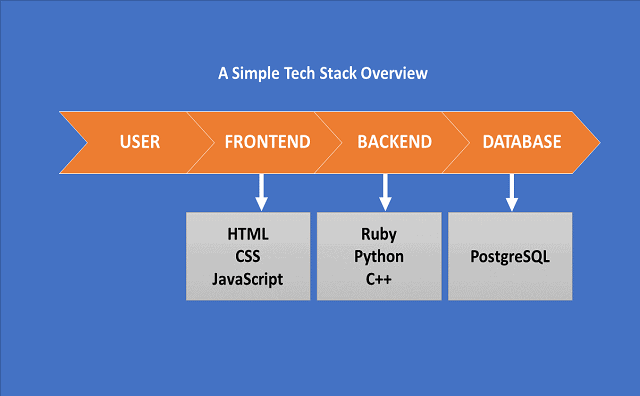
A technology stack, also known as software stack or development stack is a data ecosystem that enlists the underlying tools, frameworks, and libraries used to build and run your application. For instance, Facebook’s exhaustive application stack includes PHP, React, GraphQL, Cassandra, Hadoop, Swift, and a host of other frameworks.
A tech stack is broadly divided into two: client-side (frontend) and server-side (backend). While backend technologies include web frameworks, programming languages, servers, and operating systems, frontend technologies include HTML, CSS, JavaScript, and UI frameworks and libraries.
Why choose a software stack to develop your application?
Software stacks are to your applications, what a deep foundation and girders are to a building. The competitiveness and viability of your application depend upon the technology stack that you choose. Your software stack choice has a long say in your web application development as it influences:
- How your app works
- How it will behave in the future
- The scalability of your product
- The purpose of your project/business
- Your choice of data and application storage (Cloud or Local)
- The capacity of your server systems (whether it’s made for high-read operations or high-write traffic)
As software development standards and trends change within the blink of an eye, it is important to be updated on the most popular tech trends that currently reign the market. By analyzing the strengths and weaknesses of popular application stacks, you can start developing your product with improved confidence, as you get to know the ways to mitigate development risks.
So, what are the leading stacks of software development in 2022? Here they are:
1. The MEAN Stack
The MEAN (MongoDB, Express.js, AngularJS, and Node.js) is one of the most popular tech stacks of 2022. Being an end-to-end JavaScript stack, you use a single language throughout your stack. Thus, you have the opportunity to reuse code across the entire application, decreasing needless reinvention. Another advantage of using MEAN is that all the technologies are free and open-source with the support of a vibrant community. The applications of MEAN stack are perfect for cloud hosting since they are flexible, scalable, and extensible. The stack can be deployed easily as it includes its own web server. The database can be scaled on-demand to accommodate usage spikes temporarily.
Read more: How we optimized a MEAN Stack project for better performance
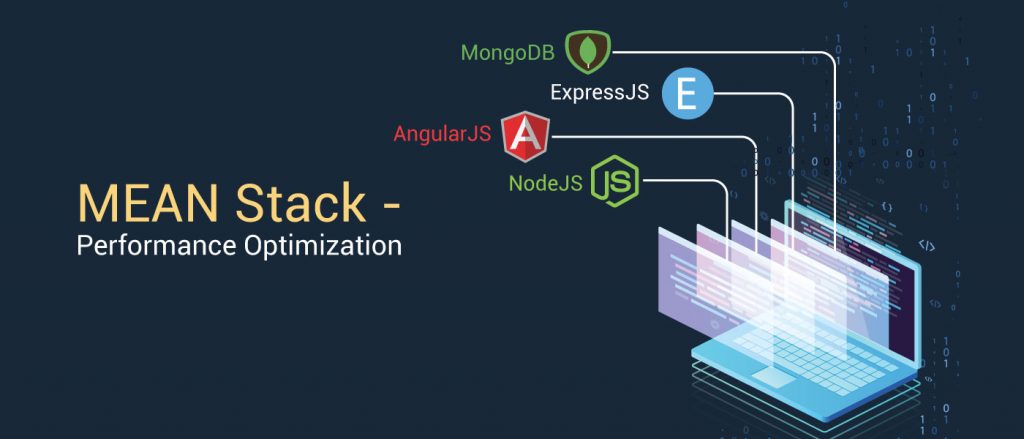
MEAN allows you to use a single team of JavaScript developers who can work adaptively. While MEAN isn’t perfect for every application, it excels in various uses like calendars, mapping and location finding, and news aggregation sites.
2. The MERN Stack
The MERN stack is very similar to MEAN, in which React replaces Angular. Since React uses Virtual DOM, changes can be implemented easily. React uses JSX, which is a modification of JavaScript, enabling seamless component work. React is one of the most popular frameworks used for building high-end, single-page applications with interactive UIs.
Since 2022 is all about enhancing UI, MERN stands to gain. However, while working with React, developers have to deal with limited core functionality since React is a library and not a framework. Hence most developers resort to third-party services.
3. The MEVN Stack
In this version of MEAN, Angular is replaced by Vue.js as a front-end framework. This framework has shown immense popularity over the last few years. Its popularity is expected to continue to 2022 as it is a lightweight solution compared to Angular. Vue.js offers basic out-of-the-box functionality. This functionality can be extended using third-party services. You can say that Vue.js combines the best features of Angular and React to give you great performance and a rich set of tools.
4. The LAMP Stack
The LAMP can be called a classic, time-tested stack of technologies – Linux, Apache, MySQL, and PHP. The LAMP still remains one of the most common ways to deliver web applications and was one of the first open-source software stacks which is still widely used. Popular open-source CMS such as WordPress and Drupal use LAMP. The stability, simplicity, and power that accompany LAMP have made it the platform of choice for developing new custom web apps.
The LAMP stack can efficiently handle dynamic pages wherein the content changes every time it is loaded. LAMP being open-source and non-proprietary, you can choose components based on your specific business requirements. Instead of using Linux as the OS, you can use Microsoft Windows to form a WAMP stack or MAC OS to form the MAMP stack. PHP can also be swapped for Perl or the increasingly popular Python language.
Read more: Why Is It High-Time To Find Alternatives For Microsoft Silverlight?
Since the LAMP has been around for more than a decade, you can avail of the benefits of a substantial LAMP ecosystem.
5. The Serverless Stack
2022 is the best time to build on cloud infrastructure or in other words- to go serverless. Serverless computing platforms provide all the services and tools thus making infrastructure management much simpler. You can easily scale up to hundreds of thousands of users overnight. AWS Lambda was one of the first serverless platforms. Google cloud is another significant provider of serverless computing services.
6. Flutter for Web
Flutter for Web can be called a game-changer in the cross-platform development world. It uses the same UI and business logic on all platforms. With Flutter, you don’t have to spend time on deployment. You can fix bugs, add new features, and build UI without compromising on speed.
What should be your next step
Having learned the tech stack meaning and its impact on your application development, here are a few tips that will help you make a wise choice:
- While building software or an application, employing a consistent, standardized software stack is of utmost importance.
- You have to create your backend with a set of tools designed to work together, reducing development time and streamlining resources.
- In today’s overcrowded stack field, you are spoilt for options. You cannot go for a one-size-fits-all approach while choosing a stack for your project. You need to find a web stack that provides unique advantages for your application.
Now that you’ve made it this far, do you agree that these are the most important tech stacks for software development in 2022? Can you think of any other names that need to be included in this list? Do let us know!
Here at Fingent, we set out to adopt the most efficient technology stacks that can make your software product highly competitive and fulfill your organization’s unique requirements. If you have any questions left, our technology consultants are ready to offer you a piece of expert advice. Feel free to drop us a message, any time.
Stay up to date on what's new
About the Author

Featured Blogs
Stay up to date on
what's new
Talk To Our Experts
How DevOps Uses Test Automation Tools to Accelerate Software Development
The goal of DevOps is to build faster, effective, and responsive applications by bringing together the development team and the operations team. It is a cultural shift to remove all barriers between Dev and Ops and provide shorter as well as frequent software deliveries, thus enabling organizations to respond in a much agile manner with respect to the constantly changing customer demands and expectations.
In a nutshell, DevOps via effective collaboration, communication, streamlined delivery, and automation of processes will accelerate software development in the following key ways:
- Faster time to market
- Reduces risks of failures in each release
- Enhances error fixing and recovery time
- Improves the checking process efficiency
- Speeds up the rate of change
- Allows managers to make improved and effective trade-off decisions
- Enables rapid and continuous feedback
- Offers flawless continuity throughout the Software Development Lifecycle
Testing in DevOps starts from the very beginning of application development and hence it is important to make sure that the development team and the operations team work closely with each other to ensure continuous integration and prompt delivery by continuous testing and monitoring.
Related Reading: Test Automation Trends to Accelerate Development Cycles in 2020
Automation Testing in a DevOps Environment
DevOps is categorized into the following 4 processes:
- Continuous Integration
- Continuous Delivery
- Continuous Testing
- Continuous Monitoring
The testing teams require to align their test design, automation, as well as test case development along with DevOps to ensure that the frequent changes made have not affected the final product.
Unlike the traditional approach, automation testing in a DevOps environment requires moving test automation scripts to a control tool which is of an enterprise version. This system of centralized enterprise-level testing results in an integrated test suite that offers centralized execution and reporting.
Let us walk through the different ways in which DevOps makes use of test automation tools:
How DevOps Uses Test Automation to Speed Up Software Development and Delivery
DevOps testing lays its core focus on test automation within the application’s development pipeline to ensure that by the time the application is deployable, it is done without any further confusion. Some of the popular test automation tools of DevOps are Selenium and Water.
Here is a quick rundown on the popular DevOps tools:
1. New Relic– New Relic offers an end to end visibility along with improved customer experience and dynamic infrastructure. It also helps the DevOps team to save their time spent in monitoring applications.
2. Jenkins – Jenkins is a DevOps automation tool used for checking the execution of redundant tasks. Jenkins is an open-source CI/CD (Continuous Integration/ Continuous Delivery) server that allows users to automate various phases involved in the application delivery pipeline.
3. Splunk – This automation tool is used to access machine data. It offers operational effectiveness to both the development as well as the operations teams in DevOps. It offers enterprises the ability to be more productive, competitive, secure, and reliable.
4. Selenium – Being the most popular automation testing tool for DevOps, Selenium is designed to meet the specific needs of a wide range of different browsers. It makes use of lesser resources and supports parallel test execution which reduces the overall time required for the testing process. The test cases prepared can be run on any operating system as well.
Cucumber, Jasmine, JUnit, and JMeter are other popular test automation tools used by DevOps to accelerate application development and deployment.
Related Reading: How To Measure The Effectiveness Of Your DevOps Program
Future of Test Automation in DevOps: Enhancing Application Development
With the evolution of continuous testing, DevOps has enhanced its test automation strategies where it is supported by practices such as a test-case design that is risk-based, stateful test data management, service virtualization, as well as seamless integration into the DevOps set of test automation tools.
To get the best out of test automation and to learn how to incorporate test automation tools using DevOps to accelerate your application development and deployment, talk to our experts today.
Stay up to date on what's new
About the Author

Featured Blogs
Stay up to date on
what's new
Talk To Our Experts
Why Clutch Ranks Fingent As The Top Software Development Company In Australia?
Over the past 16 years, Fingent has partnered with clients across 4 continents and collaborated with start-up, mid-market, and large enterprises to solve business challenges with the latest custom software development practices. Our core values make us highly attentive to society, peers, family & self, and above all, customers. We are grateful that this client focus is recognized in reviews on Clutch and has enabled us to achieve the position of the leading software developer in Australia.

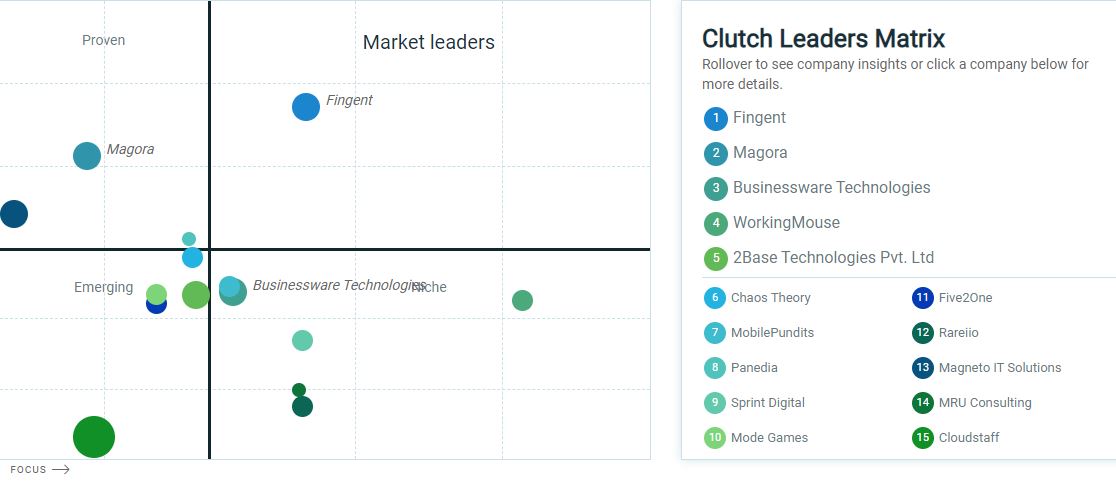
Clutch is a B2B rating and review platform with thousands of company profiles. Clutch carefully analyzes and evaluates industry data, brand reputation, and most importantly, client testimonials to craft authentic descriptions of development companies and their services. When a company is facing a business challenge, Clutch stands as a directory to browse through and find the right solution provider. Clutch connects businesses with leading performers, who receive industry recognition for their excellent services. When it comes to software development, Fingent ranks as the Top Software Developer in Australia. Here’s a peek into Clutch’s leader matrix, where Fingent stands top on the charts of Market Leaders in comparison to the competing companies.
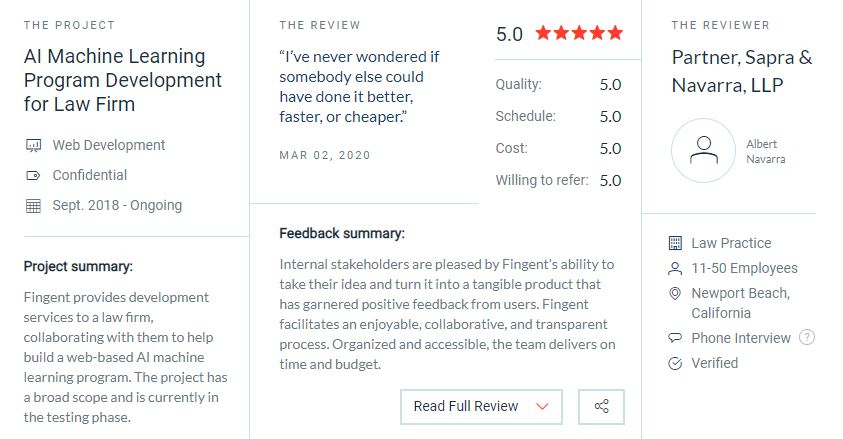
We are extremely thankful to the clients who took the time to share their experiences about Fingent solutions and services on Clutch. Most recently, Sapra & Navarra LLP left us a review on our ongoing development services for their law firm. We were hired by Sapra & Navarra LLP to build a web-based AI machine learning program. Besides receiving 5.0 stars in the Clutch evaluation categories of cost, scheduling, quality, and willingness to refer, Sapra & Navarra LLP appreciated our accessibility and efforts to prioritize being available to answer any questions or concerns. They also applauded our organization, including our robust agendas of maintaining transparency through meetings and conference calls.
Check out a summary of the perfect 5.0 review below!
Once again, we are very grateful to our clients for sharing their positive feedback on Clutch. It inspires us to continue delivering unique, budget-friendly solutions on time.
“We are excited to have been chosen as a top ASP.NET developer and NodeJS developer for 2020 by Clutch.”
– Stephen Cummings, Senior Vice President – Business Development, Fingent
If you’re looking for a technology partner who can build a web or mobile app, deploy RPA or AI technology, or provide software consulting, please get in touch! We’d love to discuss your latest project.
Stay up to date on what's new
About the Author
Featured Blogs
Stay up to date on
what's new
Talk To Our Experts
How AI is bringing change to the software testing practice
Artificial Intelligence is penetrating into multiple functions performed by the software industry. In software testing, the technology holds the potential to be a game-changer. Imagine the capability of your software to test and diagnose itself and make self-corrections! This will lead to huge savings on your resources. With this in mind, let’s try and understand exactly how AI will impact the traditional way of software testing.
Before we proceed, let’s get one thing clear – Do we really need AI in software testing?
Do We Really Need AI in Software Testing?
Software testing came into existence as a result of the evolution of development methodologies. It fed the need for robust, error-free software products. Testing was a laborious task for sure. However, automating software testing required traceability and versioning, both of which were critical and needed careful consideration. Something was needed to resolve this.
As businesses move towards digital transformation and the software market continues to grow, businesses expect a real-time risk assessment across all stages of the software delivery cycle. AI in software testing is the right response to these challenges. AI can develop error-free applications while enabling greater automation in software testing. This helps meet the expanded, critical demands for testing. It improves the quality of engineering and reduces testing time allowing the tester to focus on more important things. The verdict is clear then – We Really Need AI for Software Testing!
Five Impressive Ways AI Impacts Software Testing
1. Improves object application categorization
AI is widely used in object application categorization. When tools and testers are created, unique pre-train controls can be created. Once the hierarchy of the controls is categorized, testers can create a technical map to obtain labels for the different controls.
In the near future, AI will become capable of observing users perform exploratory testing on the testing site. And once user behavior is assessed, it can assign, monitor, and categorize the risk preference.
2. Automation of test case writing
Gone are the days of web crawlers. As automation is picking momentum, AI tools have become capable of learning business usage scenarios of test applications.
Related Reading: Unconventional Ways Artificial Intelligence Drives Business Value
They can automatically collect insightful data such as HTML pages, screenshots and page loading time and eventually train ML models for expected patterns of the app. And as soon as they are executed, any variations are marked as potential issues. This makes it easier for the tester to find and validate differences and fix issues.
3. Enhanced accuracy
To date, source analysis requires human resources to accomplish the task. Unfortunately, because of the enormity of the data, even the best experts could overlook, or miss out on observing certain critical defects. Human error and the tendency to lose focus further impairs the experts involved in software testing. It can be disastrous if bugs caused by these errors are caught by consumers before project stakeholders. Product positioning and brand reputation can be jeopardized.
Thankfully, AI can teach systems to learn source analysis and, in the future, apply this acquired knowledge. This ensures that testers have greatly enhanced accuracy. It eliminates the probability of human error and also shortens the time to run a test and increases the possibility of finding defects or bugs.
4. Automation without the user interface
AI-based techniques can be applied for non-functional tests such as performance, security and unit integration. It can also be applied on various application logs which assists in developing auto-scaling capabilities such as bug prediction.
AI algorithms can enhance UI testing, predict the next test, determine the outcomes for subjective and complex tests and much more. In other words, AI could increase the overall test coverage while it increases the depth and scope of the test itself.
5. Reduces cost and decreases time to market
The need for manually repeating a test is time-consuming and extremely expensive. But with AI, such tests can be automated to repeat several times over. Each time the software test is repeated automatically, the source code gets modified to correct any bugs. This eliminates the additional cost of repeating the test and increases the speed of the test from days to hours, which in turn saves more money.
Related Reading: Quality Assurance in Software Testing – Past, Present & Future
Allow AI to Revolutionize your Business
AI has proven to have a significant impact on software testing with its benefits ranging from optimization to extraordinary savings. It enables testers to move beyond the traditional route and dive toward precision-based testing processes. This can prove invaluable to your business. To find out how you can make this happen for your business, contact us.
Stay up to date on what's new
About the Author
Featured Blogs
Stay up to date on
what's new
Talk To Our Experts
Fingent Receives High Praise from Leading Businesses Around The World!
In today’s increasingly digital marketplace, technology is key to gaining a competitive advantage. Of course, with technology advancing at an unprecedented rate, determining how to most effectively deploy the latest technologies is easier said than done. As a top custom software development company, we build high-quality, cost-effective web and mobile solutions that deploy the newest technologies and meet all of your enterprise needs.
We’re committed to delivering the best quality and customer service — and for that reason, we’re a trusted partner to some of the world’s leading enterprises and businesses.
We know how important it is for potential buyers to peruse client testimonials and understand what it’s like to work with us before signing a contract, and that’s why we’ve partnered with the ratings and reviews platform Clutch.
Of more than 300 firms, Clutch ranks us among the top 3 software developers in NY! Clutch determines industry leaders based on market research and client feedback, so we’re immensely grateful to the clients who have left reviews for us. One of our recent reviews was from Wage CALC, a company that provides attorneys and legal professionals with a better way to manage their wage and hour cases with wage & analysis software.
Wage CALC was in need of custom software development services. They were looking for a trustworthy, well-known developer — and they found us on Clutch! Deploying a Microsoft Excel prototype that they’d created, we built their cloud-based app from the ground up.
“I’ve had such an excellent experience with them. Fingent exceeded my expectations.” — Founder & CEO, Wage CALC
The client was impressed that we were able to break down their complex, formula-heavy prototype. They commended our professional and responsive team and were particularly appreciative of how our SVP helped to streamline communication between our team in India and theirs in California.
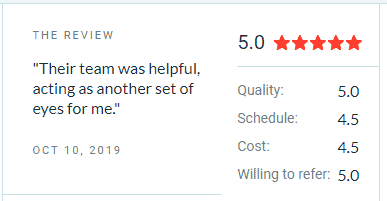
We received another 5-star review from a large transportation and logistics company that specializes in oil and gas equipment pickup and delivery. There’s a significant technology gap when it comes to processing orders, invoicing, and workflow management within the logistics industry, and we were prepared to change that.
We developed an end-to-end transportation management solution. The solution allows customer service representatives to assign vehicles for order pickup and delivery, while drivers can use a mobile version of the solution to send documentation and process tickets and billing. The company’s accounting team also uses the system to do invoicing, collect payments, and close orders.
“The management system is light years ahead of anything else in our industry.” — IT Director, Transporation Company
The client appreciated our consistency and availability, along with our team’s impressive knowledge and talent.
Meanwhile, The Manifest, Clutch’s partner site listing market experts, ranks us as the #1 custom software development company.
Fingent is not just recognized by the Clutch! A few well-known rating sites like the Software World, have also appreciated Fingent for its expertise in software development and technology solutions.
Learn more on why Fingent is the most trusted Tech Partner for emerging enterprises, and how our expertise can benefit your business. Contact us today — we offer free consultations!
Stay up to date on what's new
About the Author
Featured Blogs
Stay up to date on
what's new
Talk To Our Experts
It’s Time to Bid Goodbye to the Legacy Technology!
The decade’s end has seen numerous inevitable changes in the technology market. It hasn’t been long since we bid adieu to Python 2, and now Microsoft Silverlight is nearing its end-of-life!
This surely brings a million questions to your curious mind!
Why did Microsoft decide to end all support for Silverlight? What are the next best alternatives available in the market? And most of all, is it okay to still keep using Silverlight?
Read on as we answer it all!
What is Microsoft Silverlight?
Silverlight, an application framework designed by Microsoft, has been driving rich media on the internet since 2007. Created as an alternative to Adobe Flash, this free, browser focused developer tool facilitated web development by enabling computers and browsers to utilize UI elements and associated plugins for rich media streaming. With the emergence of video streaming platforms like Netflix and Amazon Prime, Silverlight turned out to be a great option to enable sophisticated effects.
So What Led To The Demise of Microsoft Silverlight?
A couple of things, but mostly Silverlight could not catch up with the rapidly evolving software market!
When Microsoft Silverlight was released in 2007, it looked like a huge success. Especially with the successful online streaming of the huge Beijing Olympics coverage in 2008, the political conventions of 2008, and the 2011 Winter Olympics, Silverlight was on a roll, later pulling in major video streaming platforms like Netflix and Amazon Prime onboard.
However, Silverlight could not shine for long. A few problems started to surface soon. Bugs in several applications were just one manifestation. The worst issues came about with Microsoft misjudging the real requirements of the market.
Although Silverlight reduced the user’s dependency on Flash to access rich graphics, animations, videos, and live streams online, it did so with a heavy reliance on Microsoft tools at the backend. Using Microsoft .Net Framework and XAML coding format, Silverlight offered the support for Windows Media Audio(WMA), Windows Media Video(WMV), advanced audio coding and the rest.
This seemed difficult, as well as risky for developers, especially to depend on a single vendor’s framework. Meanwhile, constant push to upgrade Silverlight made things more complicated, leaving developers more comfortable adopting low cost opens source alternatives like Flash and JavaScript over Silverlight. With HTML5 -and other browser standards on the rise, Silverlight became an outlier in the market.
In 2013, the Redmond giant stopped the development of Silverlight but continued to roll out bug fixes and patches regularly. In September 2015, Google Chrome ended support for Silverlight, followed by Firefox in March 2017. Microsoft-edge does not support Silverlight plug-ins at all, and with modern browsers transitioning to HTML5, Microsoft did not see any need to keep maintaining this application framework.
So, it’s official! Microsoft has announced the support end date for Silverlight to be on October 12, 2021.
And what is Netflix going to do? Well, Netflix currently supports Silverlight 4 and Silverlight 5. So Netflix viewers, using it on Windows XP or Windows 7 PC (both themselves now unsupported) can use either the Silverlight plug-in or HTML5 player.
What Happens After October 2021?
Not to worry, there won’t be a big boom on October 12, 2021!
It is true that Silverlight will be completely unsupportive after the said date and will no longer receive any future quality or security updates. But however, Microsoft is not preventing or terminating any Silverlight applications for now.
So should you still be using Silverlight?
Well, no! Fewer users will be able to still use Silverlight driven apps. However, this would turn worse, with developers wanting to work in a dead-end development environment, which will immensely raise the cost of supporting Silverlight apps.
What Are The Next Best Options?
No doubt Microsoft Silverlight has served as a great option for developing rich apps. However, with the end of support for Silverlight, here’s listing a couple of new tech stacks that promises to be more reliable alternatives.
AngularJS, a popular framework maintained by Google is simply a great option for developers around the world. It is an open-source framework designed to address the challenges of web development processes and offers ease in integrating with HTML code and application modules. Moreover, it automatically synchronizes with modules that make the development process seamless, and following a DOM methodology, it focuses on improving performance and testability. Adding to this, AngularJS uses basic HTML that enables building rich internet applications effectively. Also, with an MVC built architecture and various extensions, this technology proves to be a great option for designing applications that are dynamic and responsive.
ReactJS is another application framework that can easily be labeled as a “best seller”, based on the popularity and affection it has gained in the developer community. Launched in 2013, the ReactJS framework is today well regarded and used by leading companies like Apple, PayPal, Netflix, and of course Facebook. React Native is a variant of the ReactJS JavaScript library that combines native application development with JavaScript UI development, to build web pages that are highly dynamic and user-responsive. While native modules allow implementing platform-specific features for iOS and Android, the rest of the code is written with JavaScript and shared across platforms.
Related Reading: React Native Or Flutter – The Better Choice For Mobile App Development
With technologies running in and disappearing from the market, it can be quite difficult to decide on the stack of digital tools that would best fit your business. Our business and solution experts can help ensure that you transform with the right technology to meet industry challenges and enhance your revenue opportunities. To discuss more on how we can help you identify the right technology for your company, get in touch with our experts today!
Stay up to date on what's new
About the Author

Featured Blogs
Stay up to date on
what's new
Talk To Our Experts
Testing Types And Strategies: Choosing A Testing Method
Understanding the basics of software testing is crucial for developers and quality assurance specialists equally. To deploy a better software and to find bugs that affect application development, it is important to learn about the different types of software testing.
Types Of Software Testing
Testing is a process of executing a software program to find errors in the application being developed. Testing is critical for deploying error-free software programs. Each type of testing has its advantages and benefits. Software testing is broadly categorized into two types; Functional and Non-Functional testing.
Functional Testing Versus Non-Functional Testing
Functional Testing is used to verify the functions of a software application according to the requirements specification. Functional testing mainly involves black box testing and does not depend on the source code of the application.
Functional Testing involves checking User Interface, Database, APIs, Client/Server applications as well as security and functionality of the software under test. Functional testing can be done either manually or by making use of automation.
The various types of Functional Testing include the following:
- Unit Testing
- Integration Testing
- System Testing
- Sanity Testing
- Smoke Testing
- Interface Testing
- Regression Testing
- Beta/Acceptance Testing
Non-Functional Testing is done to check the non-functional aspects such as performance, usability, reliability, and so on of the application under test.
The various types of Non-Functional Testing include the following:
- Performance Testing
- Load Testing
- Stress Testing
- Volume Testing
- Security Testing
- Compatibility Testing
- Install Testing
- Recovery Testing
- Reliability Testing
- Usability Testing
- Compliance Testing
- Localization Testing
The 7 Most Common Types Of Software Testing
Type 1: Black-box Testing
Black-box testing is applied to verify the functionality of the software by just focusing on the various inputs and outputs of the application rather than going deep into its internal structure, design, or implementation. Black-box testing is performed from the user’s perspective.
Type 2: White-Box Testing
The White-Box software testing strategy tests an application with access to the actual source code as well as focusing on the internal structure, design, and implementation. This testing method is known by different names such as Open Box testing, Clear Box Testing, Glass Box Testing, Transparent Box Testing, Code-Based Testing, and Structural Testing. White-box testing offers the advantage of rapid problem and bug spotting.
Type 3: Acceptance Testing
Acceptance Testing is a QA (Quality Assurance) process that determines to what extent a software attains the end user’s approval. Also known as UAT (User Acceptance Testing) or system testing, it can be testing the usability or the functionality of the system or even both. Depending on the enterprise, acceptance testing can take the form of either end-user testing, beta testing, application testing, or field testing. The advantage of acceptance testing is that usability issues can be discovered and fixed at an early stage.
Related Reading: Quality Assurance in Software Testing – Past, Present & Future
Type 4: Automated Testing
Automated testing is a method in which specialized tools are utilized to control the execution of various tests and the verification of the results is automated. This type of testing compares the actual results against the expected results. The advantage of automated testing is that it avoids the need for running through test cases manually, which is both tedious and error-prone, especially while working in an agile environment.
Type 5: Regression Testing
Regression testing is a testing practice that verifies whether the system is still working fine, even after incremental development in the application. Most automated tests performed are regression tests. It ensures that any change in the source code does not have any adverse effects on the application.
Type 6: Functional Testing
Functional Testing tests for the actual functionality of the software. This type of testing focuses on the results of the system processing and not on how the processing takes place. During functional testing, the internal structure of the system is not known to the tester.
Type 7: Exploratory Testing
As the name indicates, Exploratory testing is all about exploring the application where the tester is constantly on the lookout for what and where to test. This approach is applied in cases where there is no or poor documentation and when there is limited time left for the testing process to be completed.
Related Reading: A Winning Mobile Testing Strategy: The Way to Go
All the methods mentioned above are only some of the most common options of software testing. The list is huge and specific methods are adopted by development vendors based on the project requirements. Sometimes, the terminologies used by each organization to define a testing method also differ from one another. However, the concept remains the same. Depending on the project requirement and scope variations, the testing type, processes, and implementation strategies keep changing.
Like to know more about Fingent’s expertise in custom software development and testing? Get in touch with our expert.
Stay up to date on what's new
About the Author

Featured Blogs
Stay up to date on
what's new
Talk To Our Experts
Fingent Tops Among The Global B2B Companies Listed By Clutch
We can expect software development to go to new and exciting places in 2020. At Fingent, we couldn’t be more proud of what we’ve accomplished this year and look forward to what’s to come. We are thrilled to announce that Fingent has been included in the Clutch 1000, a list of the 1,000 top global leaders on Clutch!
We are ranked #5 on the Clutch 1000, which puts us in the top 1% of the over 160,000 companies on their site! We are also one of over 140 custom software development companies on the list, as well as the only company based in White Plains, New York.

Clutch is a Washington, DC-based B2B ratings and reviews platform. Their team of independent analysts conducts interviews with the past clients of service providers. These verified reviews form the basis of the ratings and rankings on their site! Fingent is thankful to all of our past clients who made this award possible by leaving us reviews on Clutch!
“We are thrilled to have been featured among the Clutch Top 1000 Companies by Clutch!” – Varghese Samuel, CEO & MD, Fingent
Looking for more? Clutch has two sister sites, the Manifest and Visual Objects! The Manifest compiles company shortlists based on service lines and geographic location. We are proud to be one of the leading businesses on the Manifest under the software development category! On Visual Objects, users can look through our solution portfolios to find the best fit for their next project.
We are thankful to all of our clients who have allowed us to be part of their projects! Your success is our success. Looking to start a new project? Get in touch with us today!
Stay up to date on what's new
About the Author
Featured Blogs
Stay up to date on
what's new

