Category: Technology
Are you stuck in AI pilot purgatory?
Many businesses get a great start on AI. They have promising AI pilots. Then, they are stuck in a particularly painful purgatory, never able to breathe real life into their projects. This means they often fail to deliver measurable value.
In this article, we’ll discuss why scaling AI is important. We’ll look at how you could get trapped in AI pilot purgatory. Then, we’ll provide a practical guide for companies to move from testing to actual use through a strong AI for enterprise.
Drive Maximum Business Impact With AI. Our Experts Can Help You Adopt AI with Clear,Stress-free, Quick-Win Strategies.
Why AI Scaling Matters
Launching a single AI model is easy. The real challenge is using it in various departments or locations. It also needs to meet client needs.
For companies, AI for enterprise is not a passing fad. It is an operating strategy that helps your enterprise make better decisions, cuts down on costs, and increases your competitiveness in the market. In its proper deployment, AI in the enterprise transforms all functions. It mechanizes routine tasks, foresees customer behavior, and discovers new sources of revenue.
But few AI initiatives ever get into production. In fact, Gartner estimates that over 40% of AI projects will be discarded by 2027. Most of these projects end up discarded because they can’t deliver ROI or retain stakeholder confidence.
When you get a project underway as soon as you can, it saves you effort, money, and time. Yet why is scalability so important?
- Enterprises need to move from experimentation to impact, fast. Pilots test feasibility, and scaling proves the value of the project. AI insights help businesses make smarter marketing and logistics choices. This intelligence spreads across the organization.
- Scaled AI systems learn continuously, which improves performance outcomes over time rather than staying as a one-off experiment. This provides ROI sustainability.
That’s why AI scaling from pilot to production separates visionary firms from those just experimenting with innovation.
Understanding the AI Pilot Purgatory Challenge
Many organizations are eager to begin new initiatives. Pilot projects are a great choice because they show potential. But somewhere between understanding the concept and production, the excitement fades. We call this stage the AI Pilot Purgatory, a place where great ideas stall. So, what keeps enterprises stuck here?
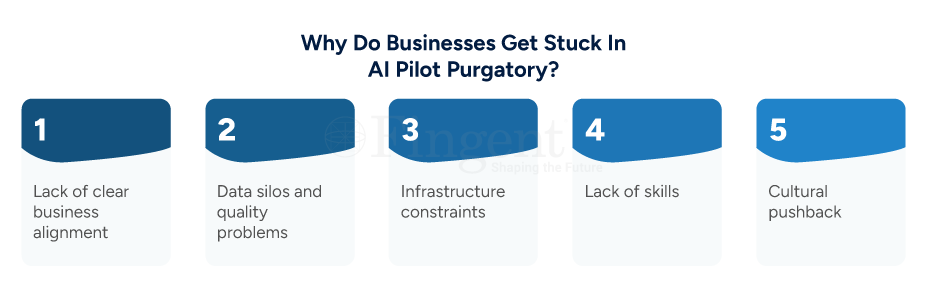
- Lack of clear business alignment: Many pilots show off new tech but fail to prove their value. Without measurable business outcomes, a pilot struggles to secure leadership support.
- Data silos and quality problems: AI hungers for good data. If data is disparate across departments, it can end up being inconsistent. This will hinder scaling.
- Infrastructure constraints: AI needs top-notch cloud infrastructure, data pipelines, and MLOps platforms to scale, but most companies ignore that.
- Lack of skills: To scale, data scientists won’t be enough. You require a team consisting of engineers, domain specialists, and a manager. They will keep an eye on the progress.
- Cultural pushback: Employees will push back against AI because they don’t believe in its decision, or they are afraid of being completely automated.
Eventually resulting in adoption barriers. To help your pilot escape purgatory, you need a complete enterprise AI strategy. This strategy should blend technology, governance, and cultural readiness.
Strategizing a Blueprint from Pilot to Production for AI Success
When you transition from pilot to production, the process isn’t done overnight. It is a structured journey that follows a blueprint. Here’s a blueprint to help your business scale AI from pilot to production.
1. Start with Business Value, Not Technology
Before coding for your project, determine high-impact business challenges that can be addressed with the help of AI. You can inquire:
- What are the most important processes in my company that can use automation? Are there any areas that can implement prediction to ease workflows?
- How should the project’s success be measured (KPIs, ROI, or time saved)?
This makes your AI for enterprise investment business-focused, not an experimental lab.
2. Build a Scalable Data Foundation
When your data is ready, AI success starts there. Construct central data lakes and maintain clean, labeled, and easily available data for departments. Invest in data governance frameworks such that data is of good quality and compliant.
3. Plan Scalability in Advance
Use reusable and modular blocks in building AI models on a strong foundation. Enforce MLOps practices that help integration, version control, and auto-deployment. This makes your AI a repeatable and scalable system rather than a one-time project.
4. Establish a Cross-Functional AI Taskforce
Scaling AI is an enterprise project, not an IT one. It involves more than one entity to make it work. So, you can bring in business leaders, data scientists, engineers, and compliance teams. Join forces towards a single purpose.
5. Use Ethical and Secure AI Practices
Enterprises need to focus on fairness and data privacy. To safeguard important data, establish an AI ethics board that looks carefully into policies that protect information. You can show accountability and regulatory compliance with XAI models.
6. Measure and Learn
Every successful enterprise AI strategy has ongoing feedback loops. Continuously track model performance, user adoption, and business results. Subsequently, retrain and improve models to keep pace with changing business objectives.
Strategize a Successful AI Journey for Your Enterprise. Assess AI Readiness, Spot Opportunities, and Integrate AI into Your Workflows.
Real-World Examples: Industry-Wise AI Scaling
Let’s explore how different industries are scaling AI in the enterprise effectively.
1. Banking and Financial Services
Banks lead with AI for enterprise when they use predictive analytics to detect fraud. They also use it to assess credit risk and personalize customer experiences.
Example: JPMorgan Chase’s COiN platform checks legal documents in seconds. This cuts down on spending for manual work and lowers operational costs.
Value: They experience all-round risk management and wiser decision-making.
2. Retail
AI for enterprise enables retailers to build buying experiences that are unique to their customers. It also streamlines supply chains.
Example: AI is employed by Walmart to predict customers’ demand. If their demand is altered, they modify stocks in real time.
Value: They get reduced wastage of products and improved customer service
3. Healthcare
Healthcare organizations gain from using AI in the enterprise. It helps with the before–diagnostics and predictive care. It also makes a notable difference to patient engagement.
Example: Diagnostic systems powered by deep learning can help analyze patient data and medical imaging in real time. The AI solution can be integrated with Electronic Health Records (EHRs) and lab databases. It also keeps HIPAA compliance and ethical transparency with enterprise AI strategy frameworks.
Value: Improved diagnostic accuracy, faster report turnaround time, and enhanced collaboration between clinicians and AI systems.
4. Manufacturing
AI in the enterprise changes manufacturing. It helps with predictive maintenance and quality control.
Example: Top players are using AI sensors that monitor machinery and prevent any breakdown.
Value: With this, they saved money, cut downtime, and achieved improved product consistency.
5. Nonprofits and the Public Sector
Non-profit organizations have greatly benefited from scaling AI implementations in enterprises for their workflows. It helps them to enhance engagement with donors and optimizes the way resources are utilized.
Example: UNICEF employs AI-driven data analytics to understand which regions require emergency aid.
Value: AI helped enhance their response time and effectively use their resources.
Common FAQs
Q. What is enterprise AI, and how is it different from general AI?
A. Enterprise AI is the use of artificial intelligence within large business settings. Enterprise AI is different from general AI. While general AI is used for consumer, as opposed to business, purposes and research, enterprise AI is designed to reinvent core business processes. Decision-making, prediction, automation, and customer interaction are just a few of them. It is about structured frameworks, governance models, and scalable infrastructure designed to enable the enterprise environment. Consider it as AI designed to deliver performance, compliance, and influence at scale.
Q. What is the timeline to deploy AI in a firm?
A.The timeline for implementing AI in the enterprise within a business relies on three key considerations: scope of business, data maturity, and complexity. A pilot would take 3–6 months, and a scaled deployment would take 12 to 24 months. Data-driven organizations with an adaptable culture can reduce the adoption time. Scaling is needed to plan extensively. That involves using AI to enhance processes and employee retraining. It can also establish MLOps for continuous improvement.
Q. Can small or medium enterprises scale AI successfully?
A. Yes! A size 500 fortune is not necessary to do business using AI for an enterprise. When an AI application is cloud-based, it allows SMEs to apply scalable analytics and automation. Begin small. Begin with one that has a high impact, such as sales forecasting or customer support automation. Pilot first, then roll it out incrementally. Strategic use of AI for enterprise has nothing to do with size but with clarity, intent, and action.
Q. How secure are enterprise AI implementations?
A. Enterprise AI rollouts put security at the top of the agenda. All serious AI systems abide by data protection legislation, like GDPR, and follow industry best practices. Security best practices include:
- Encryption of data in motion and rest
- Role-based access control implementation
- Conducting regular model audits
- Explainable AI (XAI) brings a whole new level of transparency
When done right, yes, enterprise AI can be secure. As secure as the systems it runs on. In fact, it can be even more secure because of its built-in anomaly detection and predictive monitoring.
How Can Fingent Help
At Fingent, we help businesses with their enterprise AI strategy. We guide them from ideas to full-scale implementation. We focus on finding real business value. We build data-driven roadmaps and facilitate responsible adoption across the enterprise. We help organizations:
- Move from pilot to production confidently
- Implement scalable and secure AI structures
- Make all transactions transparent and compliant
- Return quantifiable ROI with intelligent automation and analytics
Start your AI journey or move past pilot purgatory with Fingent. We can help you speed up transformation using AI for enterprise solutions that really work.
Think, Transform, and Evolve with AI
Scaling AI is not just about technology — it’s about transforming the way enterprises think, work, and evolve. Companies can avoid pilot purgatory by embracing an AI-based strategy that is robust and more powerful. Scalable infrastructure and an innovative culture are required. This can unlock the full potential of AI. The companies that succeed today will be leaders tomorrow.
Stay up to date on what's new

About the Author

Featured Blogs







Stay up to date on
what's new



Talk To Our Experts
AI Adoption in enterprises is a no-brainer. Shouldn’t everyone be on it by now? You would think so. Businesses that have adopted it successfully are acing it. Predictive analytics, smart automation, and informed decision-making are a breeze for them.
For a few, however, AI adoption in enterprises is still patchy. Most companies have success in proof-of-concepts but fail to replicate them. In recent years, more businesses have seen the need to discard AI projects before production.
That’s why this blog talks about the most significant challenges in AI adoption, and how businesses can overcome them. Read on!
Discover How Your Business Can Harness AI For Maximum Impact
Why Enterprises Struggle with AI Adoption?
More than three-quarters (78%) of businesses apply AI in one or more business processes. While CEOs all concur that AI is the future, many find that scaling beyond pilots is challenging. Difficulty in cross-department collaboration, skills gap, unclear ROI, and security issues are some reasons.
Here is an overview of the main reasons why companies are having trouble applying AI:
- Data Complexity and Silos : AI models depend on data quality. Yet, 72% of enterprises admit their AI applications are developed in silos without cross-department collaboration. This fragmentation reduces accuracy and scalability.
- Talent and Skills Gap: AI adoption demands data scientists, ML engineers, and domain experts. But 70% of senior leaders say their workforce isn’t ready to leverage AI effectively.
- High Costs and Unclear ROI: Enterprises hesitate when infrastructure, integration, and hiring costs overshadow immediate returns. In fact, only 17% of companies attribute 5% or more of their EBIT to AI initiatives.
- Organizational Resistance to Change: Employee resistance is a major issue. 45% of CEOs say their employees are resistant or even openly hostile to AI.
- Security, Privacy, and Issues with Compliance: AI consumes sensitive data. Due to this, abiding by laws like GDPR becomes difficult. Lacking effective governance, companies are worried about reputation damage and penalties.
A Look into the Risks and Blockers of Scaling AI Across Organizations
Even when pilots succeed, enterprises face barriers in scaling AI across the organization. The key factor is the lack of understanding of the way AI models operate. Model drifts that reduce accuracy, integration challenges, and cost overruns are some reasons that could impede scaling. Let’s look at some key risks and blockers of AI adoption in enterprises:
1. Shadow AI and Rogue Projects
Departments start “shadow AI” projects with little IT governance. Local success translates to enterprise-wide failure, forming silos, duplication, and the danger of non-compliance.
2. Model Drift and Maintenance Burden
AI models are degrading over time with changing market trends and user behavior. Enterprises don’t know the price of ongoing monitoring and retraining. This results in “model drift,” which reduces accuracy and reliability. Poorly trained models may amplify biases, risking reputational and legal challenges.
3. Lack of Interoperability Standards
With more AI platforms emerging, firms battle interoperability. They are often hampered by integration challenges in scaling AI owing to variable data formats and incompatible systems.
4. The Hidden Costs of Scaling Infrastructure
Scaling AI doesn’t take just algorithms. There’s more behind the curtain. Cloud storage, GPU computing power, and security controls cost money. Most firms underestimate these hidden expenses, leading to cost overruns.
5. Cultural Misalignment Between Business and IT
Successful AI demands cross-functional alignment. IT is worried about security and compliance, and business units are always in a rush. The clash of cultures gets in the way of execution and keeps enterprise-wide scaling at bay.
Tips To Overcome These Challenges
AI adoption challenges in enterprises are common. But that does not mean that they aren’t impossible to overcome. Here are some tips to speed up AI adoption in enterprises:
- Establish Crystal Clear Business Goals: AI must address business priorities, not simply adopt technology for the sake of it. Leaders need to determine high-impact opportunities. Fraud detection, customer service automation, and demand forecasting are priorities.
- Invest in Data Readiness : High-quality, integrated data is key. Enterprises require good governance and integrated data in real-time. Organized data habits are far more likely to derive ROI from AI.
- Organize Cross-Functional Teams :AI is best with IT, business, regulatory, and domain subject matter experts in collaboration. It enables scalability and reduces ethical risk.
- Upskill and Reskill Talent: Cultural readiness is needed for AI deployment. Only 14% of organizations had a completely synchronized workforce, technology, and growth strategy—the “AI pacesetters”. Learning investments prevent more transition problems.
- Pilot Small, Scale Fast: Pilot projects must produce quantifiable ROI before large-scale adoption. This instills organizational confidence and reduces financial risk.
- Emphasize AI Governance and Ethics: Open models, bias testing, and compliance frameworks establish employee and customer trust.
- Collaborate with Seasoned Providers: Companies that lack in-house expertise bring value by partnering with seasoned AI providers like Fingent, which are focused on filling skill gaps, managing integration, and scaling responsibly.
Popular FAQs Related to AI Adoption in Enterprises
Q1: What are the main barriers to AI adoption in enterprises?
The primary inhibitors of AI adoption in enterprises are siloed data. The absence of competent talent, vague ROI, cultural opposition, and governance are a few other factors that pose challenges in AI adoption.
Q2: Why do AI pilots work but get stuck on scaling?
This happens because scaling needs robust data systems, governance, and alignment at departmental levels. Without them, pilots do not work in production.
Q3: How can businesses overcome AI adoption challenges?
AI adoption challenges in enterprises can be overcome if you first set clear business objectives. Once that is done, invest in upskilling employees and partnering up with seasoned AI providers like Fingent.
Q4: Is AI adoption in enterprises worth the risks?
Yes! Best-practice adopting firms are more likely to see positive returns and ROI. But firms with no AI strategy witness business success only 37% of the time. Whereas firms with at least one AI implementation project succeed 80% of the time.
Q5: Which are the industries that benefit most from AI adoption?
Tech seems to come immediately to mind. But the past few years have seen other industries jostle for space on the top list of adopters. The pharmaceutical industry has discovered what AI can do for clinical trials. Chatbots and virtual assistants have revolutionized banking and retail. Predictive maintenance has smoothed out many a problem for the manufacturing industry.
Strategize a Smooth AI Transition. We Can Help You Effortlessly Integrate AI into Your Existing Systems
How Can Fingent Help?
At Fingent, we deal with the intricacies of AI implementation in business organizations on a regular basis. Our capabilities are:
-
- Scalable AI solution planning based on business objectives.
- Effective data governance models.
- Glitch-free integration with legacy systems.
- Ethical and transparent AI model building.
- Cultural transformation through adoption and upskilling initiatives.
Whether your business is just starting pilots or fighting to scale, Fingent can assist in optimizing ROI and mitigating risks. Learn more about our AI services here.
Knock Those Barriers With Us
AI adoption barriers in business still keep organizations from realizing potential. The silver lining? With the right strategy and partnerships, businesses can blow past the challenges and drive a successful AI adoption journey.
The future of AI adoption in enterprises is not algorithms; it’s about trust, collaboration, and a vision for the longer term. Those who act today will reign supreme tomorrow. Give us a call and let’s knock these barriers down and lead your business to making a success of AI.
Stay up to date on what's new
About the Author
Featured Blogs
Stay up to date on
what's new
Talk To Our Experts
US corporations are encountering a sea of challenges currently: frequent geopolitical events that complicate supply chains, unprecedented tech disruptions driven by AI and automation, the intense race for semiconductor dominance, and skyrocketing R&D costs at home. These massive challenges demand a fundamental shift in the way global businesses conduct their operations.
The traditional model of offshoring—often viewed as a means to cut costs—has now given way to Global Capability Centers (GCCs). These global centers no longer serve as simple back offices. Instead, they function as strategic innovation hubs critical to enterprise-wide growth and resilience. For US companies to not only survive but lead in this new era, embracing the GCC 3.0 model is no longer an option—it’s a vital business priority.
What is GCC 3.0, and how does it equip US corporations to sustain and lead the competitive global business landscape? Let’s cut to the chase.
Discover How Fingent’s Global Capability Center Can Accelerate Your Business Growth
The Evolution of GCCs: From Arbitrage to Innovation
The journey of Global Capability Centers is a clear reflection of the changing priorities of multinational corporations (MNCs), especially in the U.S. Understanding this evolution is key to grasping the value of the GCC 3.0 model.
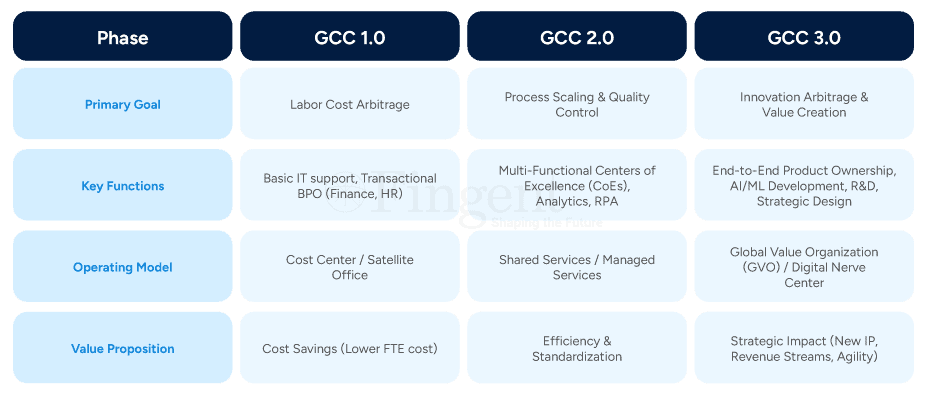
GCC 1.0 was the genesis, focused purely on cost reduction by leveraging lower labor costs in offshore locations. This model was primarily opted for managing standardized, transactional tasks.
GCC 2.0 matured this model by shifting to Centers of Excellence (CoEs). Centers started owning end-to-end processes, focusing on quality, standardization, and scaling core business processes like accounting or IT infrastructure management.
GCC 3.0 is the most recent and critical phase, in which these centers move from execution to co-creation and from delivery to design. GCC 3.0 centers in areas like AI/ML development, cybersecurity, product design, and strategic R&D now act as the digital powerhouses expediting global enterprise transformation, driving the future vision of the parent company.
Why India is the Global Leader of GCC 3.0
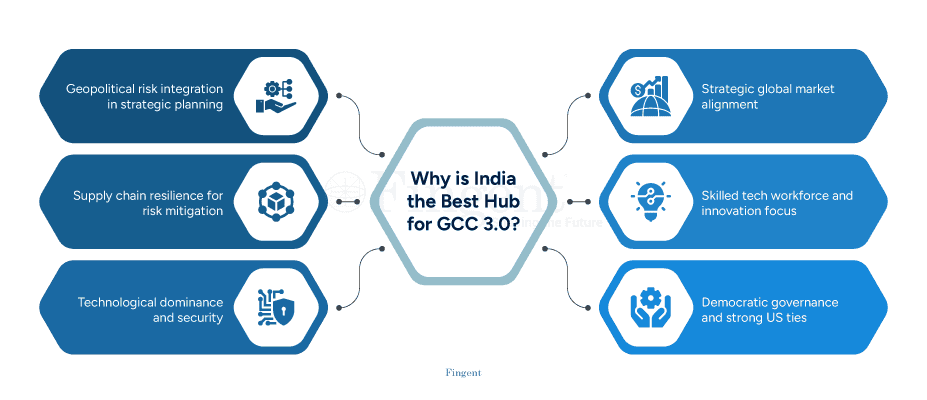
While other geographies offer viable options, India has firmly cemented its position as the undisputed global capital for GCC 3.0. India’s ecosystem is uniquely equipped to deliver the high-value functions required for strategic innovation arbitrage.
1. Unmatched Talent Depth and Scale
India hosts nearly 50% of the world’s active GCCs. Every year, the country produces more than 1.5 million graduates in Science, Technology, Engineering, and Mathematics (STEM). It allows Indian GCCs to cultivate a massive pool of professionals skilled in advanced technologies such as Generative AI, Cloud Engineering, Data Science, and Cybersecurity. This distinctive combination of scale and skill is simply not available anywhere else.
2. Strategic Cost-to-Value Proposition
The advantage is no longer just labor cost. GCC 3.0 in India provides a compelling cost-to-value proposition. Businesses in the U.S. can gain access to top-rated engineering teams that can drive global product roadmaps at considerably affordable costs (compared to Silicon Valley). This, eventually, translates into improved productivity and innovation at scale. Partnering with Indian GCCs also helps in addressing the surging R&D expenditures undermining U.S. operations.
3. Full-Fledged IT Ecosystem and Strategic Autonomy
India’s GCC market is driven by a robust and mature infrastructure consisting of thriving startup ecosystems, government aids and tax incentives for the ‘Digital India’ initiative, and strong academic-industry connections such as joint research with Indian Institute of Technologies (IITs). This level of growth and development allows Indian GCCs to take on strategic autonomy, owning end-to-end product mandates, driving independent innovation roadmaps, and co-authoring patents for the parent company.
GCC 3.0 Capability Comparison: India vs. Vietnam vs. Mexico
The choice of location for a GCC must align with a company’s strategic goal, not just proximity or basic cost. For the innovation-driven mandate of GCC 3.0, India stands out against key alternative options like Vietnam (often cited for Southeast Asia diversification) and Mexico (the primary near-shoring option for the Americas).
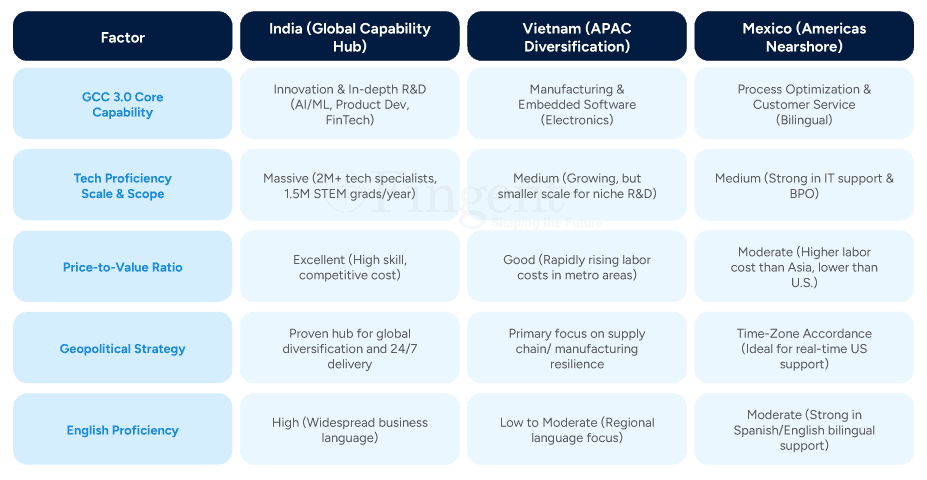
Tip: For US businesses whose long-term goal is innovation scale and in-depth technology leadership, India’s ecosystem—with its sheer size, specialization in advanced digital skills, and a mature operating model—offers a distinct advantage over the manufacturing-focused talent of Vietnam and the proximity/time-zone benefit of Mexico.
The Key Advantage of Embracing GCC 3.0 for US Companies
By choosing the GCC 3.0 model, U.S. companies gain transformative advantages that promote long-term global competitiveness:
1. Speed-to-Market and Digital Agility
GCC 3.0 centers operate as 24/7 innovation engines. A team in India can pick up development work as the US team signs off, enabling genuine “follow-the-sun” development cycles. This continuous workflow, combined with a skills-first approach known as Talent 3.0, allows for the rapid deployment of capabilities. It significantly increases the speed of digital transformation initiatives (often by 2-3X).
2. A Citadel of Resilience and Compliance
As supply chains turn highly volatile and data regulations become more complex, distributed GCC 3.0 networks contribute to enhancing business resilience. GCC 3.0 teams facilitate effective data governance and risk mitigation across global boundaries by integrating regulatory compliance frameworks and cybersecurity regimes.
3. Innovation as a Service
The transition from cost arbitrage to innovation arbitrage makes GCCs a fresh source of Intellectual Property (IP). Instead of simply executing tasks, GCC 3.0 teams are hired to co-create new products, design innovative digital services, and identify new revenue streams using advanced AI and data analytics. GCCs turn cost centers into innovation engines, which directly impacts the top line of the parent company.
Speed Up Development Cycles. Drive Faster Results. Scale Your Team With Fingent’s Global Capability Center
Conclusion: Taking the Next Step
The challenges nagging US businesses—from geopolitical friction and runaway R&D costs to the pressure of the AI revolution—are too significant to address with a decade-old operating model. Viewing the Global Capability Center as merely an extension for cost savings is a relic of the past.
GCC 3.0, led by India’s strong talent-driven and innovation-focused ecosystem, is the non-negotiable strategic imperative for US corporations.
India’s
GCC 3.0 model provides a scalable, sustainable path to access the world’s deepest pool of advanced technical talent, embed 24/7 agility, and transform core business functions into centers of strategic innovation.
US firms must look beyond mere survival in the global competition landscape and leverage India’s GCC 3.0 capabilities to sustain and lead it. There is no better time than now to pivot from a cost-centric mindset to a value-centric, innovation-driven strategy.
Stay up to date on what's new
About the Author
Featured Blogs
Stay up to date on
what's new
Talk To Our Experts
SDK (Software Development Kit) and API (Application Programming Interface) – two terms you must be acquainted with in the software development world. Both are equally crucial. But they have radically different functions.
Understanding the difference between SDK and API can make a big difference in how quickly your business can be built. An SDK will help developers with the right tools to build applications from scratch, while an API will enable these applications to communicate with other software systems.
What will this blog help you with? You will get a deep dive into SDK vs API. Find where they differ. Understand when to implement them. See how they’re used alongside one another in the real world. This will give you clarity on what is the best choice for your business.
Transform Your Ideas Into Bespoke Software Solutions Our Experts Can Help You Leverage The Best-In-Class New-Age Technologies
What Is an SDK and What Is It Used For?
An SDK is a kit. A Software Development Kit. It is a collection of tools, libraries, documentation, samples, and debuggers that enable developers to develop applications for a particular platform. SDKs are toolboxes where you can create something new. Rather than writing everything from scratch, developers are given a head start with pre-coded bits of functionality.
Common Uses of SDKs:
- Developing Mobile Apps: Android SDK, iOS SDK.
- Developing Games: Unity SDK, Unreal Engine SDK.
- Integrating Payment: PayPal SDK, Stripe SDK.
- Social Media Apps: Facebook SDK to integrate login and sharing features.
- Developing IoT: AWS IoT Device SDK to connect hardware devices to the cloud.
Example:
You’re developing a ride-sharing app. For this, you need to build the core app first. So, you’ll likely use the Android SDK or iOS SDK for this. With the help of these kits, you can design the interface, access GPS and manage push notifications. Once that is done, you can now test the app before launch. Without SDKs, creating even a simple app would take months.
How is an SDK Different From an API?
An API specifies how two computer programs will interact. It is a group of rules and guidelines that enables your app to make requests and pass data. If an SDK provides the environment for building an app, an API is a bridge that connects your app to other platforms or services.
Example
In that same ride-sharing app mentioned before:
- The SDK will assist you in creating the app (driver dashboard, booking system, user profiles).
- The API integrates your app with Google Maps for navigation and the Stripe API for payment.
The SDK builds the app. The API hooks it up to the rest of the world.
SDK or API – Which Is Easier to Use?
APIs. They are definitely lighter and easier to use. Especially if your app only needs to “speak” with another service. This may be apt for functions like receiving weather updates or checking payments.
SDKs are more complicated because they take a full development environment, but they’re also more capable.
Analogy:
- API = Ordering food. You make a request, and the restaurant delivers.
- SDK = Meal kit. You cook with the provided ingredients and instructions, but get more control over the outcome.
SDK vs API: Which One Should Developers Use?
Businesses often face the question: SDK vs API—Which one is better for my project? The answer depends on project goals.
Choose an SDK if:
- You are building a new app from the ground up.
- You desire pre-packaged debugging and testability.
- You require platform-specific functionality such as camera, GPS, or push notifications.
Choose an API if:
- You wish to extend your app’s functionality without developing new functionality.
- You only require isolated data or services (e.g., currency rates, weather, geolocation monitoring).
- You desire rapid integration with third-party platforms.
Sometimes You Need Both
For instance, a Fintech company developing a mobile banking app might:
- Develop the app’s basic structure using an SDK.
- Integrate payment gateway, fraud detection, and regulation compliance systems using APIs.
How SDKs and APIs Work Together In App Development?
Here’s the magic: SDKs and APIs aren’t rivals—they’re teammates.
- SDKs build the environment and core functions.
- APIs bring external connectivity and expand what the app can do.
Example
Imagine building an e-commerce app:
- The SDK lets you design what you need for the app like the shopping cart, product catalog, and interface.
- API will assist in the integration with PayPal to make payments, FedEx for shipping, or Shopify to track orders.
Examples of SDKs and APIs In Real-World Applications
- Facebook SDK & API: Developers use the SDK to embed Facebook login or sharing buttons. APIs pull user profile information from Facebook servers.
- Google Maps SDK & API: The SDK lets you embed maps into your app. The API provides data like routes, distances, and traffic.
- Stripe API: Let’s businesses accept secure payments globally.
- Twilio SDK: Developers integrate SMS, voice, or video features into apps.
Extended Business Use Cases
1) Healthcare
SDKs make it possible to introduce safe video and voice calls, screen sharing, chat, even AI-driven medical advice, into healthcare apps. Developers can embed the pre-built modules into telemedicine apps with ease to facilitate seamless consultations.
APIs enable health platforms to safely draw and refresh patient information, laboratory tests, medical history, medications, and coverage. Patients and doctors can retain all the information they need for remote consultations, speeding up and allowing for decision-making.
2) Banking Facilities
SDKs allow for the integration of important features like biometric login, push notifications, account dashboards, and secure in-app communication. They support security protocol compliance and improved user experience.
APIs integrate bank applications with payment processors to enable real-time transfer of payments, payment of bills, and cross-border payments. They are also linked with anti-fraud systems, providing real-time alerts and verification checks to enable fewer instances of unauthorized access or fraudulent use.
3) Retail & E-commerce
SDKs allow capabilities such as AR-powered product previews, personalized push, loyalty tracking, and in-app talk through chatbots. These capabilities drive the shopping experience to make it interactive, user-friendly, and customized for customers.
APIs integrate shopping platforms with inventory systems to post-live inventory figures. APIs also tie up with delivery partners for tracking, and payment processors for secure multi-currency transactions. All this facilitates seamless order placement to delivery.
4) Travel & Hospitality Services
SDKs allow developers to integrate features like mobile check-in, loyalty program integration, in-app messaging, and even AR previews of a hotel room or travel destination. Such pre-developed modules save time and deliver value-added customer experience.
APIs bridge apps with map websites for navigation, flight and hotel databases to enable instant booking facilities, and payment gateways to enable secure transactions. APIs also communicate with third-party services such as weather reports and travel insurance companies to enhance the customer experience.
Common Questions About SDK vs API
Q. Can you use an SDK without an API?
A. Yes, but most SDKs include APIs for communication.
Q. Do APIs come inside SDKs?
A. Often, yes. An SDK may use APIs along with libraries, documentation, and tools.
Q. Are SDKs only for mobile apps?
A. No. SDKs are available for desktop, gaming, IoT, cloud, and web development.
Q. What comes first – API or SDK ?
A. Startups often begin using APIs for quick integration, then move to SDKs for more customization.
Q. Are APIs free to use?
A. Many APIs offer free tiers to understand how things work, but advanced features often require subscriptions.
Q. Can SDKs work offline?
A. Yes, some SDKs let developers build and test apps offline, though APIs usually require an internet connection.
Take A Look At How Fingent Is Building Smarter Software Engineering Teams With AI
How Fingent Can Help You Choose Better
The SDK vs API debate is about knowing when and how to use each. SDKs give developers the complete toolkit to build apps, while APIs extend and connect those apps to the outside world.
At Fingent, we help businesses identify what they need for their business. This can be software solutions with SDK, API, or a mix. Fingent has the right expertise to help you build applications that are secure, scalable, and future-proof your business.
Whether you’re launching a new app or modernizing business infrastructure, we are here. Our experts can assist you in making the correct decision between SDKs and APIs.
Stay up to date on what's new
About the Author
Featured Blogs
Stay up to date on
what's new
Talk To Our Experts
All businesses are built on data. But the question is: Is your business truly driven by data? Or are you merely gathering data without a strategy? An effective Data Engineering strategy might be the key to standing out in the market instead of lagging behind.
Let us help you find out.
Data Engineering: The Backbone of Modern Business Intelligence
In a data-driven age, where information is currency, the businesses that harness data are the only ones staying competitive. Raw data can be a terrifying nightmare because it can be messy and disorganized. Above all, you will find it nearly impossible to uncover valuable insights. That’s why you need Data Engineering.
Drive Business Excellence with Intelligent Data
Harness Data Engineering for Boosted Operational Success
What is Data Engineering?
Simply put, Data Engineering is all about creating, building, and maintaining systems. It enables you to collect, store, analyze, and separate relevant data. In other words, it refines raw data into a more digestible form. This allows you to now harness its power to its full potential. Without this crucial step, businesses are left drowning in a sea of digital clutter. They miss out on valuable opportunities for growth and innovation.
If you want to unlock the true potential of your data assets and stay ahead of the competition – let data engineering pave the way for success.
Why Is Data Engineering a Big Deal?
The significance of Data Engineering solutions has escalated with the exponential growth of data. Every email, customer interaction, and IoT sensor signal contributes to the data wave companies need to handle. A report from Market Data Forecast indicates that the worldwide big data and data engineering services market is anticipated to grow to around $325 billion by 2033, increasing from $75.55 billion in 2024.
Without Data Engineering solutions, companies are overwhelmed by information and unable to derive value from it. With data engineering, they achieve clarity, efficiency, and a competitive edge.
Here’s what it accomplishes:
- Arranges and tidies data so that companies can effectively utilize it.
- Streamlines data processes, minimizing manual work and mistakes.
- Combines various sources for a comprehensive business perspective.
- Enhances storage and processing, reducing expenses and increasing efficiency.
- Ensures security & compliance because no one wants a data breach headline.
Now that we get the “why,” let’s break down the “how.”
Key Components of Data Engineering
Building Data Engineering solutions isn’t just about dumping everything into a cloud server and hoping for the best. It requires a solid foundation:
- Data Ingestion – Start with this first step: collect data from multiple sources such as APIs, databases, IoT devices, and social media.
- Data Storage – Your business will need a reliable home for your data – be it a traditional data warehouse (structured) or a data lake (unstructured).
- Data Processing – This is the stage where your raw data is cleaned, altered, and organized. Consider ETL (Extract, Transform, Load) pipelines that set up data for analysis.
- Data Orchestration – Automation solutions ensure the data processes operate smoothly while minimizing human errors.
- Data Governance & Security – GDPR and CCPA require uptight data security.
- Real-Time Analytics—Companies must stream data processing to make decisions quickly and on the go.
Data Engineering vs. Data Science: What’s the Difference?
They may seem very similar, but they are very different. Let’s simplify this for you. Data Science is like being a detective. One that digs into data to uncover patterns, trends, and insights. On the other hand, data engineering is like setting up a world-class crime lab that assists the detective in getting to the right clues. So, while one finds relevant data, the other makes sure the data is easily available and usable.
Without Data Engineering, data scientists lose almost 80% of their time because they have to clean and organize data instead of actually analyzing it. However, they can focus on extracting value and driving business impact with it.
Top Tools & Technologies in Data Engineering Solutions
The tech stack for Data Engineering solutions is constantly evolving, but here are the must-haves:
Data Storage & Management
- Amazon Redshift / Google BigQuery – Scalable cloud data warehouses.
- Apache Hadoop / Apache Spark – For massive distributed data processing.
- Snowflake – A high-performance, cloud-native data platform.
ETL & Data Pipeline Tools
- Apache Airflow – Automates and manages workflows.
- AWS Glue / DBT (Data Build Tool) – Streamlines ETL processes.
- Talend / Informatica – No-code ETL platforms for enterprises.
Streaming & Real-Time Processing
- Apache Kafka – Handles real-time data streaming like a pro.
- Google Dataflow – Processes real-time and batch data seamlessly.
- Flink – High-performance, scalable data streaming.
Data Governance & Security
- Apache Ranger – Manages security policies across data lakes.
- Collibra – Enterprise data governance at scale.
- Okta – Identity management and access control.
The Future of Data Engineering
The world of Data Engineering is only getting bigger. Here’s what’s next:
- AI-powered automation – ML-driven pipelines that self-optimize.
- Serverless data engineering – No infrastructure management, just pure efficiency.
- Data Mesh – Decentralized data ownership for more agile businesses.
- Edge Data Processing – Processing data closer to the source (IoT, mobile devices, etc.).
Real-World Examples of Data Engineering in Action
To demonstrate the impactful capabilities of Data Engineering, take a look at these success stories from Fingent’s collection:
-
Improved Decision-Making in Retail
Premium Retail Services (PRS) managed field marketing services for Samsung’s US market. Their representatives collect over a million data points monthly from over 12 retail segments. However, their reporting systems were outdated, and relying on PowerPoint and Excel led to delays and inefficiencies.
Solution: Fingent took the bull by the horns, so to speak, by developing a customized data analytics and visualization platform.
Result: This solution transformed complex datasets into intuitive visuals. It also automated data input and streamlined field data management. This enhanced their performance reviews and improved decision-making.
-
More Reliable Financial Forecasts
Quantlogic, a research firm, processed over 200,000 data touchpoints across 12 verticals in real-time in the financial sector. Its goal was to refine predictive algorithms for better investment planning.
Solution: Fingent implemented an advanced predictive analytics platform.
Result: This platform improved data quality and predictive accuracy. Thus, enabling Quantlogic to make more reliable financial forecasts.
-
Data Analytics to Determine Hospital Performance
The National Health Service (NHS) England struggled to evaluate hospital performance. This was due to their incongruent data sources and complex metrics.
Solution: Fingent deployed a comprehensive data visualization solution. This solution offered interactive graphs that linked across multiple disciplines. This system provided detailed analyses of key performance indicators.
Result: Now, NHS England can make informed decisions to enhance patient care and enjoy operational efficiency.
AI Tools for Data Analysis: Your Co-Captain to Business Success
A Look into The Future of Data Engineering
The field of Data Engineering is swiftly evolving. Here’s what businesses can anticipate:
- AI-Powered Automation: This will eliminate the need to monitor data pipelines manually. Machine learning algorithms will automate data pipelines and self-optimize whenever necessary.
- Serverless Data Engineering: When you shift towards serverless architectures, your business will be able to focus on data processing instead of battling to be the tech support. The benefit? Grater scalability and cost efficiency!
- Data Mesh Architecture: This approach enables you to own data. Each of your departments would be like a mini startup—independent, flexible, and accountable.
- Edge Data Processing: With this, you can process data right where it began. IoT devices and mobile applications will see reduced latency while enabling real-time analytics.
How Fingent Can Help
We understand that navigating the complexities of Data Engineering is not as easy as it seems. Yes, it requires expertise and a forward-thinking approach. At Fingent, our experts specialize in crafting tailored Data Engineering solutions. And we ensure the solutions we provide always align with your business objectives. Let’s take us through our services:
- Custom Software Development: We will build scalable and robust applications that meet your specific data needs.
- Digital Transformation Consulting: We will be there to guide your journey to data-centric architectures.
- Cloud Strategy Consulting: We are equipped to design and implement flexible and scalable cloud-based data solutions.
Contact us today to discuss Data Engineering solutions.
Stay up to date on what's new
About the Author
Featured Blogs
Stay up to date on
what's new
Talk To Our Experts
Nonprofits are driven by purpose, passion, and people—but in the current digital-first era, passion alone doesn’t cover expenses. If you’re not leveraging technology to enhance your impact, you’re missing out on significant money (and chances). This is where apps for nonprofits play a role—your nonprofit’s digital multi-tool that aims to unite, motivate, and advance your mission at a rapid pace.
Imagine shouting out your nonprofit’s mission from a mountaintop for all to hear. Except the mountain fits in everyone’s pocket. That’s the power of mobile apps for nonprofits: small screen, massive impact. Let’s explore how to make this happen for you.
Power Your Nonprofits with New-Age Technology Solutions
The Technology-Fueled Evolution of Nonprofits
Let’s be real: technology has transformed the game for nonprofits. Recall when fundraising involves going door to door or depending on phone networks. Remember those awkward cold calls? Now that smartphones are in almost everyone’s pocket, the situation has transformed.
Mobile applications for nonprofits aren’t merely fashionable—they’re revolutionary. They enhance procedures, cultivate important connections with benefactors, and create avenues for influence that seemed unimaginable only a decade ago.
Here is an interesting fact: According to Ericsson, there are now 7.1 billion smartphone connections floating around—that’s 87% of all mobile phones on the planet. A chunk of those belongs to that one person we all know. The one with a phone for work, one for personal use, and probably a backup, just in case. If your nonprofit has an app, you will reach and stay on this person’s radar. If not, all your effort is going into a deep, silent void.
Can a Nonprofit Have an App?
Yes! And not just any app—nonprofits are creating platforms that spark action and build communities. From raising funds to managing events, apps for non-profits are the digital backbone of modern philanthropy. Here’s a quick breakdown:
Types of Mobile Apps for Nonprofits
- Donation Apps: Think of one-tap donations with options for monthly giving. No hassle, and right at your donors’ fingertips.
- Apps for Managing Volunteers: Efficiently arrange schedules, monitor hours, and connect with your volunteers effortlessly.
- Advocacy Apps: Turn users into advocates by spreading awareness and rallying support with just a click.
- Event Management Apps: Simplify the chaos of charity runs, galas, or fundraisers. Booking tickets, and RSVPs – all done efficiently.
- Cause-Specific Apps: Tailor an app for a specific mission and watch your impact grow.
Every kind of app has its specific function, yet the primary aim remains consistent: linking your nonprofit with advocates in impactful, significant ways.
Key Features of Mobile Apps for Nonprofits
What makes an app shine? Features that put your cause—and the people who care about it—front and center. Here’s what your app should have:
- Seamless Donation Options: Make it easy to give. Donors shouldn’t have to jump through hoops. Give them options – PayPal, Apple Pay, credit card- whatever is convenient for them.
- Push Notifications: Consider these as gentle reminders. “Hey, your favorite charity is $200 away from its goal! Want to help?”
- Engaging Content: Share stories, videos, and updates that tug at heartstrings and keep supporters coming back.
- Social Media Integration: Let your users spread the word by sharing campaigns directly to their networks.
- Impact Reports: Show donors where their money is going with transparency tools and updates.
- Intuitive Design: If your application is cumbersome, it won’t attract users. Make it intuitive and sleek.
- Gamification: Add a bit of fun—think leaderboards, milestones, or rewards for contributions.
Benefits of Mobile Apps for Nonprofits
Why should nonprofits jump on the app bandwagon? Let’s spell it out:
- Enhanced Donor Involvement: A mobile application provides your cause with a constant connection to your supporters’ hearts (and finances). Consider it as your organization’s dedicated supporter.
- Streamlined Fundraising: One-tap donations, recurring gifts, and fundraising events with digital tickets—everything is easier with an app.
- Broader Reach: Geography! What geography? Mobile applications allow you to connect with donors worldwide without leaving your chair.
- Data-Driven Insights: Curious about why certain campaigns perform better than others? Analytics assist in monitoring user actions and enhancing your approach.
- Expense Reduction: Transforming processes such as volunteer management or event sign-up allows for greater time and resources to focus on what truly counts—your objective.
- The fact of the matter: Nonprofits that utilize mobile apps for raising funds have seen a 26% boost in donor retention rates. Now, imagine what that could mean for your organization.
Fundraising for Nonprofits: Transforming Potential into Unparallel Success
How to Approach Mobile App Development for Nonprofits
Building an app might sound intimidating, but it doesn’t have to be. Here’s a simple, actionable roadmap:
- Define Your Goals: Start with clarity. What’s the purpose of your app? Is it for fundraising, volunteer management, or advocacy?
- Understand Your Audience: Research what your donors and supporters actually want. A clunky app that misses the mark won’t get downloaded twice.
- Find the Right Developer: Look for developers with a proven track record in creating affordable app solutions for nonprofits. Ask for portfolios.
- Focus on User Experience: Your app should be simple enough for your tech-averse grandma and cool enough for a Gen Z donor.
- Launch, Test, Iterate: Don’t expect perfection right away. Launch a beta version, collect feedback, and enhance it using user input.
Obstacles in Mobile App Development for Nonprofits
To be honest, creating an app isn’t as easy as pie. Let’s discuss some of the challenges and look at ways to address them successfully.
- Budget Constraints: Look for grants or partners who can provide affordable app solutions for nonprofits.
- Technical Expertise: Consider outsourcing to developers who understand nonprofits or use app-building platforms that require little coding knowledge.
- User Adoption: Getting people to download and use your app can be tough. Offer incentives—like exclusive content or easy donation tracking—and promote the app relentlessly on your website, emails, and social media.
- Maintenance Costs: Apps need updates, bug fixes, and security patches. Plan for these in your budget, or work with a developer offering ongoing support.
- Data Security: Protecting donor information is non-negotiable. Choose developers who prioritize security and compliance.
Bring Customers Closer To Your Brand!Build Intuitive Mobile Apps That Elevates Customer Experiences
Fingent Can Assist in Developing User-Friendly Mobile Applications for Nonprofits
Mobile giving surged by an impressive 205% from 2020 to 2022. Impressive, right? So, don’t let the opportunity pass—allow Fingent to assist you in capturing it. Fingent, a worldwide frontrunner in tailored software solutions, understands how to develop applications that are not only functional but also transformative. Here’s how we can assist:
- Tailored Solutions: Whether you need a donation platform or a volunteer app, Fingent builds tools that perfectly match your goals.
- Affordable App Solutions for Nonprofits: Our scalable, budget-friendly approach ensures quality without overspending.
- Proven Expertise: Fingent’s track record speaks for itself, with nonprofits worldwide reporting increased donor engagement and simplified operations.
- Emphasis on Usability: The user experience is fundamental to our designs, ensuring that your app resonates with users of all ages and technical abilities.
Are you prepared to make your nonprofit’s app vision come true? Fingent’s knowledge of mobile app development for nonprofits will assist you in enhancing your mission, engaging with donors, and increasing your impact like never before. Talk to us today and discover your possibilities with new-age technologies.
Stay up to date on what's new
About the Author
Featured Blogs
Stay up to date on
what's new
Talk To Our Experts
Are developing mobile apps a trend? Think again. By 2029, the mobile app market is expected to rake in a jaw-dropping $781.7 billion— yes, billion—with a “B.” It’s a sign that the mobile app industry isn’t merely expanding; it’s racing into the future as if fueled by 5G steroids. Whether purchasing groceries, booking doctor’s appointments, or completing a course, mobile apps have become the foundation of our everyday existence. Are you prepared to take your portion of this expanding opportunity?
For companies, this conveys a straightforward message: if you aren’t putting resources into developing mobile app solutions, you’re missing out on potential revenue. However, what distinguishes a successful app? A strategic, innovative mobile app development solution could be the breakthrough your business requires.
Power Up Your Business Operations & Services with An Intuitive Mobile App Bring Your Ideas To Life With The Best-in-class Mobile App Developers
How Do I Start Developing Mobile Apps?
Creating a successful app involves more than just programming. It’s about designing an experience that embraces the spirit of innovation. Do you want to create an application? Excellent! But where should you begin? Let’s explain step by step:
Know Your “Why” and “Who”:
Why are you building this app? It could be to solve a problem, fill a gap, or stay competitive.
Who is it for? Understanding your audience will guide you in your development journey.
Spy on Your Competition:
Market research isn’t optional. Study what others are doing right—and wrong. Find your edge.
Pick Your Platform:
Are you team iOS, Android, or both? Your decision impacts budget, timelines, and user experience.
Budgeting:
Apps aren’t cheap, but the right plan ensures every penny counts.
Bring in the Pros:
DIY might sound tempting. But remember, experts save you from rookie mistakes.
Did you know? By 2025, global consumer spending on mobile apps is projected to reach $270 billion. That is nearly 2.5 times the amount spent in 2020.
What is A Mobile App Development Process?
Let’s help you walk through the journey from concept to launch. Building an app isn’t just coding. It’s a combination of creativity and precision.
1. Plan Like a Pro
Start with a roadmap. Define your objectives, features, and milestones. Think of it like assembling a puzzle. Ensure each piece fits perfectly to see the big picture. A solid plan prevents costly detours later.
2. Design That Wows
First impressions matter. Tools like Figma or Sketch help create sleek, user-friendly designs. Remember: simplicity wins. Imagine scrolling through an app that’s smooth, intuitive, and visually delightful. That’s the goal.
3. Code It Right
Whether it’s Swift, Kotlin, or React Native, your code is the engine of your app. Agile development keeps things flexible and fast, like a Formula 1 pit crew constantly optimizing for peak performance.
4. Test, Then Test Again
Bugs are a buzzkill. Imagine launching an app only to have it crash—an instant deal-breaker. Automated and manual testing ensures a smooth, glitch-free experience. Think of it as quality control for your app’s reputation.
5. Launch and Learn
Once live, gather user feedback and iterate. The best apps evolve with their users. Have you ever observed how your preferred apps frequently refresh with “new features”? That’s not a coincidence—it’s the key ingredient for remaining pertinent.
How Much Does it Cost to Develop an App?
Prepare yourself—developing mobile app costs differ greatly. Typically, creating a simple app could range anywhere between $40,000 to $60,000. Complex apps may exceed $300,000 or higher. Elements such as application type, platform, and characteristics all contribute significantly.
The cost budgeting could be divided into:
- Simple Apps: Think calculators or note-taking apps. These cost less due to limited features.
- Moderate Complexity: Social media apps or e-commerce platforms fall under this, with added user interfaces and backend support.
- High Complexity: Apps with advanced technologies like Artificial Intelligence (AI), Augmented Reality (AR), Virtual Reality (VR), or blockchain require significant investment.
Pro Tip: Start small. Test the waters, gather feedback, and scale as needed.
A Few Examples of Industry’s Popular Mobile App Development
Want some inspiration? Here’s how the big players are nailing it:
- CBN Superbook Bible Mobile App: A revolutionary mobile app that aims to enable kids to grasp bible stories quickly with interactive features. The app was selected as one of the ‘top ten iTune apps for kids’.
- Medi-Weightloss: A mobile application to support the weight loss journey with quickly accessible diet recipes, fitness routines, journals, and supporting articles.
- GeoSure: A handy app for travelers to stay informed in real-time about the vulnerabilities, climate, threats, and government policies of selected destinations.
- Uber: Revolutionized transportation by blending geolocation and real-time tracking.
What’s common among them? They solve real problems, keep user experience at the core, and evolve constantly.
Selecting the Perfect Mobile App Development Solution
The ideal mobile app development solution integrates technical skills, teamwork, and innovative strategies to realize your vision. Here are key aspects you can take into account before you begin the process:
1. Expertise That Matches Your Vision
Look for a partner with a proven track record in developing mobile app projects similar to your idea. Examine portfolios and client reviews to assess their expertise.
2. Transparent Communication and Realistic Timelines
Ensure the development team values open communication. They should provide regular updates and realistic timelines to keep your project on track.
3. Comprehensive Support Services
Post-launch support is critical. A reliable mobile app development solution includes bug fixes, updates, and scalability options.
4. Up-to-Date Tech Stack
Ensure that your developer utilizes the most recent technologies to make your app future-ready. Regardless of whether it’s Swift, Kotlin, or Flutter, your technology stack is important.
5. Cost-Effectiveness Without Compromising Quality
High-quality doesn’t always mean high cost. Seek developers who can balance affordability with excellence, ensuring your budget goes further.
Fuel Customer Engagement with Interactive Mobile Apps
Practical Tips for a Successful Mobile App Development Journey
The mobile app market, as discussed at the outset, is burgeoning with a steady growth rate of 7.84% per year (CAGR 2022-2029). Tapping into it is a no-brainer but you have to do it right to be successful. Here are some tips to ensure that:
1. Think Big, Start Small:
Begin with a Minimum Viable Product (MVP). That will help you explore the market. Focus on solving a core problem before adding those dazzling extras. Do not try to build your app in one day.
2. Focus on User Experience (UX):
Keep navigation intuitive and design visually appealing. Users should immediately understand it. Design your app to be so user-friendly that even your tech-inept aunt can use it independently without needing assistance. Merge elegant design with effortless navigation—since first impressions count, and users won’t grant you another opportunity to create one.
3. Leverage Analytics:
Use tools to track user behavior and app performance. Data is the ultimate truth-teller. Use analytics to track what users love (or hate) about your app. Insights from user behavior and performance metrics can turn your app into a fan favorite.
4. Ride the Wave of Trends Shaping the Future of Mobile Apps:
2025 is charging ahead with game-changing innovations! If you’re building an app, staying informed about trends is essential. In fact, it’s a matter of survival. Here’s how the future is rewriting the app playbook:
- AI: Your Personal Assistant 2.0 – Imagine apps that know what you need before you do. From personalized shopping to predictive health alerts, AI is taking apps from smart to downright ingenious.
- 5G: Speed Like Never Before – Thanks to real-time AR/VR and effortless streaming, 5G offers you a gateway to instant gratification. Were you aware that by late 2024, the world saw 163 million new 5G subscriptions, totaling 2.1 billion? By the year 2030, we’re looking at 6.3 billion. You’re already falling behind if your app isn’t designed for this ultra-fast technology.
- Platforms with Low-Code – A computer science degree is no longer necessary to create applications. With the help of platforms such as Bubble and AppGyver, anyone can turn ideas into reality. It’s coding made accessible—because innovation shouldn’t have a barrier to entry.
- Blockchain for Secure Apps – Safety isn’t an option; it’s essential. Blockchain is present to transform your app into an impregnable defense against cyber dangers while gaining user confidence with transactions and records that cannot be hacked.
- Sustainable Technology – Sustainability extends beyond being just a trendy term; it’s a user requirement. Create applications that reflect environmentally friendly principles, and see your user community expand while contributing positively to the Earth.
5. Prioritize Security and Privacy:
The app world doesn’t wait for anyone. Trends change, user needs evolve, and competition never sleeps. Adopt agile methodologies to pivot quickly and stay relevant. And don’t skimp on security—nothing kills trust faster than a data breach. Build your app like it’s guarding a treasure chest (because, in a way, it is).
How Can Fingent Help?
Apps are more than just tools; they are experiences. Whether you’re a startup or a Fortune 500 firm, the secret to success is in adopting trends and providing a smooth experience. With a robust mobile app development solution, your app might become the next major success.
Fingent provides comprehensive mobile app development services customized to meet your business requirements. From concept development to after-launch assistance, we’re here to bring your vision to life. Check out Fingent’s Mobile Application Development section to discover how we can assist you in crafting something remarkable.
The future of developing mobile app solutions is bright. Are you ready to create something extraordinary?
Stay up to date on what's new
About the Author
Featured Blogs
Stay up to date on
what's new
Talk To Our Experts

“Give me six hours to chop down a tree and I will spend the first four hours sharpening the axe.”
– Abraham Lincoln
Stay up to date on what's new
About the Author

Featured Blogs
Stay up to date on
what's new
Talk To Our Experts
Businesses need modern technology to survive today’s ever-evolving market. The right enterprise software solution can help businesses thrive. However, not all businesses might have the necessary in-house skills to develop one, and let’s be honest, off-the-shelf software does not fit all needs. Thanks to custom software development vendors, enterprises can access technology experts on the go to build customized technology solutions that cater to their unique business needs.
According to a survey by Deloitte, 79% of U.S. executives currently outsource software development. However, any business application is only as good as the developer who creates it. Choosing the right software development partner is a crucial responsibility.
If your business plans to hire an app development partner, here’s a quick checklist that can help. But before we get started, let’s look at why you need to choose the best software development vendor.
Have an Innovative Idea for Your Next Application?
Why Do Businesses Need Software Development Vendors?
Organizations rely on app development partners to:
- Bridge talent gaps and save in-house hiring costs
- Drive value by developing end-to-end solutions
- Access the best of technology, skills, and expertise
- Avoid development delays and cut operating costs
- Increase speed-to-market and enhance core competencies
- Mitigate the risks of running an in-house development project
You can easily unlock these advantages by choosing the right software development vendor. But what happens if you choose the wrong app development partner? Here are the risks!
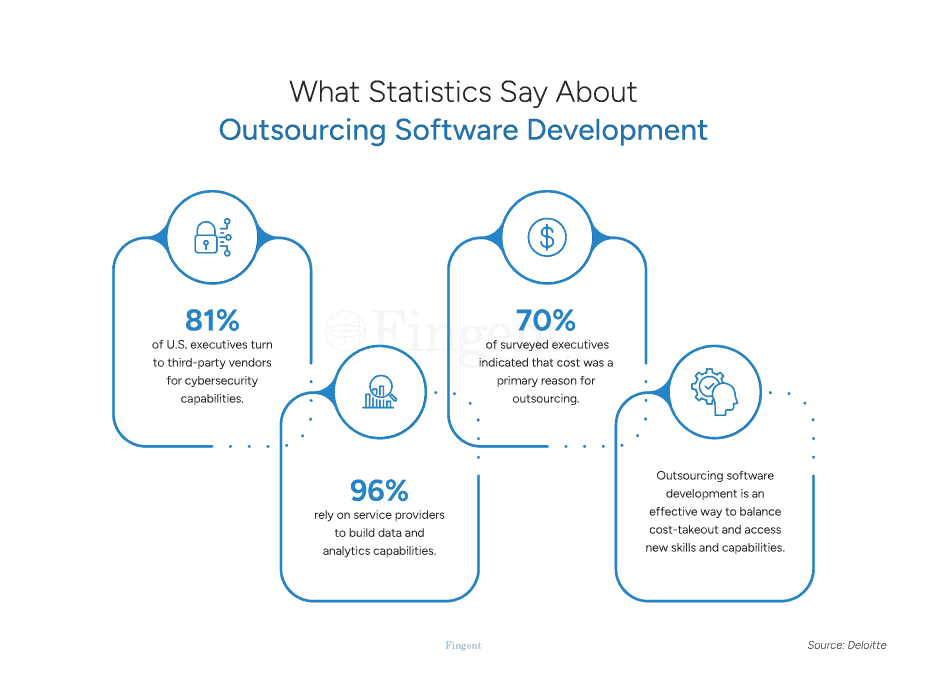
Risks of Choosing a Wrong Software Development Vendor
Wrong software vendor selection can leave a lasting impact on your company.
- Poor-quality software rollouts can lead to massive sales losses. It can force your customers to go to competitors.
- Ill-fitted software solutions affect your day-to-day operations and increase your team’s workload.
- A bad match will never help you with add-ons and customizations you might need for the future.
- Botched software can cause frequent business disruptions. It can affect your customer experience, reputation, and brand.
- Faulty software can lower your team’s morale and engagement. Constant software glitches add to employee frustration and fatigue.
- A wrong vendor may not be able to meet your deadlines. They may also charge you more than expected. There is always an inherent risk of hidden costs.
- Communication breakdowns can create misunderstandings between the vendor and your stakeholders.
- Inadequate security measures opted by the vendor can put your business at risk. It can increase the chance of damaged, lost, or stolen data.
How can you avoid these risks? Ace software development vendor selection by using our checklist (below).
Why is Legacy Software Modernization Inevitable for Businesses?
Checklist: How to Choose the Right Software Development Vendor?
1. Define Your Needs and Goals
The first step to finding the right developer is identifying your goals. Why do companies seek to build customized software? Some of the common reasons are:
- Enhancing customer experience and satisfaction
- Improving workforce productivity and operational competency
- Tracking and managing staff responsibilities
- Automating specific tasks and repetitive functions
- Boosting reliability and security
A good discernment of your objectives and business needs will allow you to proceed to the next steps more efficiently.
2. Set up a Budget
Defining your goals should help you prepare a detailed budget. At this stage, it is important to determine the capital, expenditures, and forecasted return on investment (ROI).
Assess the factors that impact the cost of your software development project:
- Type of software you need and its level of complexity
- Custom software or off-the-shelf software
- UX/UI design considerations
- Backend infrastructure and dependencies
- Integrations with other applications you use
- Location of the app development partner
- Development time, resources employed
- Investments in new technologies
- Estimates/rates quoted by the software development vendor
Any business’s priority is to produce high-quality software. However, keeping the project within budget is vital for business success.
3. Research Potential Vendors
Research potential software development vendors. Assess the selected app development partners based on the following factors:
- Do they have experience working on the type of software you need?
- Have they worked in your industry or domain in the past?
- Do they handle the entire software development lifecycle? Do they provide post-launch application maintenance and support?
- Do they help train your staff on the new software?
- What are the services they offer?
- Does their rate fit your budget?
- What other value-added services do they provide software development? Developing an e-commerce application, maybe?
4. Shortlist Top Software Development Vendors
Choosing from hundreds of service providers can be overwhelming. Once you do the research and specify your requirements, you can start shortlisting the options you find appealing.
Here are a few ways to narrow down your list:
- Read through the company profiles, case studies, and client testimonials of potential vendors.
- Use any credible B2B rating platform to check out their ratings and reviews. Platforms like Clutch, GoodFirms, etc. list the top vetted software development partners.
- Filter vendors based on their minimum project costs, team size, average ratings, and location.
- Keep your list short so you can reach out to the selected firms quickly.
5. Talk to Each of the Selected Vendors
A direct conversation with the software development vendor gives you a fair idea of their services and expertise.
Before meeting a vendor, prepare a set of questions that will help you gauge their work:
- What technologies and programming languages are your team proficient in?
- What are the industries and domains that you primarily cater to?
- What project management tools do you use to manage your workflows?
- How do you ensure the quality of your software?
- What is your project engagement model?
- What software development methodology do you follow—Agile, Waterfall, RAD, Lean?
- How do you determine the costs of your work?
- Is my budget and expected timeline realistic for my project?
Above all, it’s crucial to identify if the potential vendor’s way of operating and objectives align with your requirements.
6. Narrow Down Your List Further
A direct conversation with each vendor should help you narrow your choices between two or three developers.
- Consult your leadership team. Weigh the pros and cons of each vendor based on your analysis.
- Shortlist your selection to one or two providers. Ensure they can understand your needs and match your company’s culture.
7. Data Security and Privacy Measures
Your business software needs to handle confidential company data. Is your software development partner capable of protecting your application from cyber threats?
- Before choosing a software development vendor, undertake an intellectual property due diligence inquiry.
- Find out how the vendor will be handling your data and assets.
- Review their integrated security and IP protection program.
- Determine the internal measures you should adopt to safeguard your enterprise’s IP.
- Identify which functions need to be managed in-house and what should be outsourced.
8. Compliance, Reliability, and Support
Along with analyzing the vendor’s cybersecurity offerings, you also need to verify:
- Does the vendor’s development and delivery practice/policies comply with the essential regulations?
- Have you done extensive background checks to ensure the integrity and reliability of the vendor?
- Did you do a proper technical and strategic vetting of the selected development vendor?
- Is the vendor equipped to address unexpected IT outages and disruptions?
- What are the risk management policies/processes followed by the software development vendor? Do they have a robust disaster recovery plan?
- Does their development process align with your organization’s sustainability goals?
- Does the vendor stick to responsible application design, development, and maintenance that can reduce the environmental impact?
Choosing the right software development partner requires careful planning. It’s indeed a very tricky job to pick out the right one from a huge list of potential vendors. The checklist aims to make the job simple for you.
Nearshore vs In-House Software Development: Know The Pros & Cons
Software Development Company vs. Freelancer: Which is Better?
What is the difference between a freelancer and a software development company?
- A freelancer is an individual who works independently on software development projects.
- A software development company is a professional organization that provides software development services.
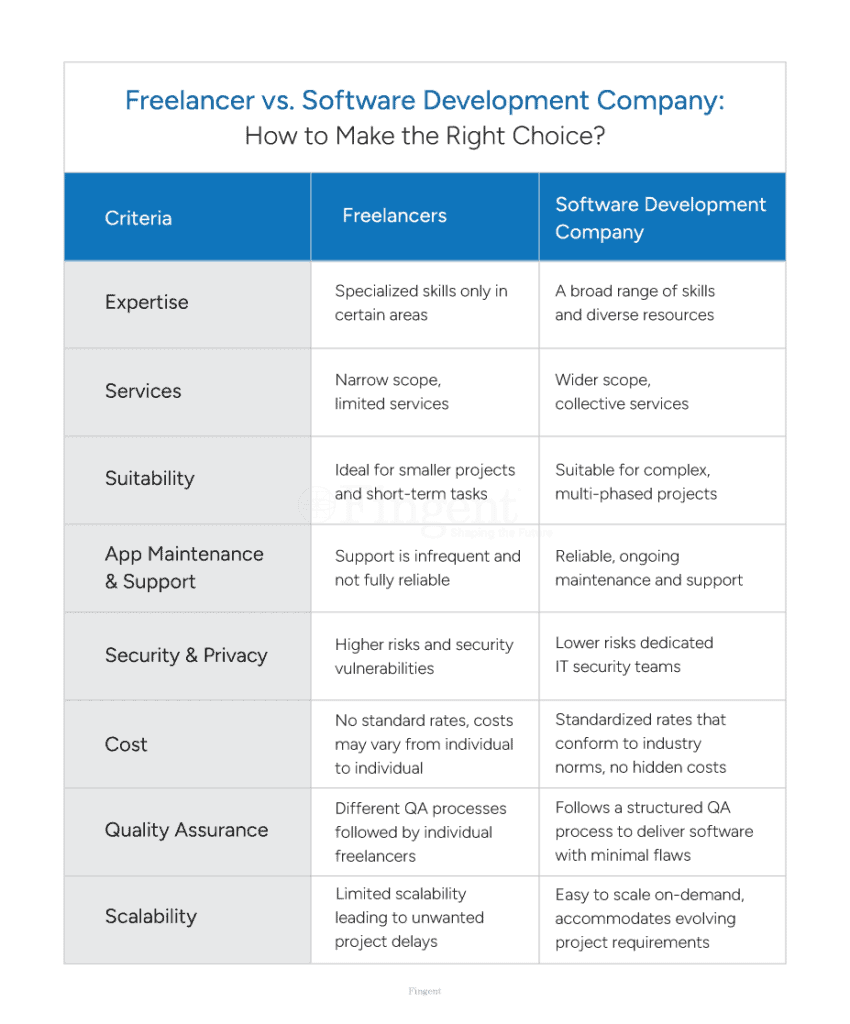
How does working with a software development company help your business?
- A team of certified professionals well-versed in multiple areas
- Access to the latest technologies and specific domain expertise
- A reliable vendor-customer contract (agreement) to back you
- Round-the-clock support and IT help desk
- Transparent communications, no hidden surprises
- Standardized pricing with no additional costs
- Dedicated ongoing maintenance and support
Transform Your Business With the Right Software Development Vendor
The best software development vendor:
- Works with you throughout the entire development process
- Helps navigate the complexities of software creation and maintenance
- Makes incremental changes for continuous software enhancement
- Develops tailor-made solutions that align with your business goals
- Improves your business’s efficiency, productivity, and financial performance
Let Us Help You Ease Your Digital Transformation Journey
Why Choose Fingent as Your Software Development Partner?
Since 2003, Fingent has been a reliable and capable software development partner for leading global brands, including several Fortune 500 companies.
- An impeccable track record as a successful custom software vendor
- Experience in new and emerging technologies—AI, AR, VR, IoT, blockchain, and more
- Legacy application modernization, cloud migration
- Multi-platform development—web, mobile, cloud, and more
- Diverse offshore talent pool with experienced developers and tech professionals
- Tech certifications, partnerships, centers of excellence
Build scalable and robust applications by partnering with a professional custom software vendor. Contact us to get an extended consultation.
Stay up to date on what's new
About the Author
Featured Blogs
Stay up to date on
what's new
Talk To Our Experts
Wine and wisdom get better with age. But software doesn’t. That’s why experts say legacy software modernization is inevitable for modern businesses.
Picture this! Ten years ago, you might have owned a PC running Windows XP. But today, your new computer runs Windows 11. The latest OS makes your current PC more powerful and capable than the one you owned ten years ago. Likewise, your business is no longer the same as it used to be when you started it. Using legacy, underperforming software to manage your business can stall its growth. So, how can you make your business software robust and relevant? Thanks to legacy software modernization services for making your applications relevant and competitive.
This article explores why you need to invest in application modernization.
Don’t Allow Outdated Technology To Sloth Your Business Growth
Can Clinging To Outdated Technology Cost High For Your Business?
Yes! Holding on to outdated technology can cost your business more than it saves. These real-world examples prove the damaging effects of legacy software on businesses.
The Rise and Fall of Blackberry
The tale of Blackberry is a classic example that reveals the pitfalls of legacy software.
What was once a leader in the smartphone market lost ground to rival operating systems—iOS and Android. And the reason? Failure to innovate and reluctance to get rid of legacy system elements.
In 2011, Blackberry made a revenue of $20 billion. Fast forward to 2022, the figures dropped to $718 million. The same year, Blackberry decommissioned the infrastructure and services used by their legacy software and phone operating systems.
Myspace, The Lost Space
The story of Myspace is no different from that of Blackberry. Launched in 2003, Myspace was the first social network to reach a global audience in the pre-Facebook era.
Post-2007, Myspace started losing millions of users to its rising rival, Facebook. The most cited reasons behind Myspace’s failure are lack of usability and flexibility, low innovation, and slow load times.
Delta: Back-to-Back IT Outages
In August 2016, Delta Airlines suffered a loss of $150 million due to an outdated reservation system. Built in the 1960s, the system underwent a major crash caused by a power failure. The incident forced Delta to delay or ground most of its flights for at least six hours worldwide.
How can one forget the recent CrowdStrike outage that disrupted Delta’s operations worldwide? The incident affected Delta’s crew-tracking software, forcing them to cancel over 7,000 flights over five days. According to a CNBC report, the five-day outage cost the airline nearly $500 million.
How Does Legacy Software and Technology Impact Your Business?
Here are a few ways outdated applications affect your business’s performance and growth.
1. Lack of Interoperability
Legacy applications struggle to integrate and communicate with each other. Poor interoperability can hamper your progress. It can also slow down the adoption of more efficient processes.
2. Security Vulnerabilities
Outdated security measures and lack of updates can make legacy apps more susceptible to cyber threats.
3. Outdated Technology
Legacy applications often rely on outdated technology. Obsolete technology can make them incompatible with modern standards and best practices.
4. Limited Scalability
Scaling legacy applications to accommodate evolving demands can be challenging and expensive.
5. High Maintenance Costs
Legacy applications demand extensive resources and maintenance. This can result in escalating costs over time.
6. Inefficient Performance
Outdated software code and technology can mar the performance of legacy applications. This can hinder productivity, resulting in knowledge silos and slow response times.
7. Poor User Experience
Legacy applications fail to provide the Uber-like, personalized experience that today’s customers seek.
8. Operational Disruptions and Delays
Finding the right talent to track, maintain, and support legacy applications is arduous. This can lead to operational disruptions and delays in resolving critical issues.
Legacy Application Modernization: Excerpts From A CTO
How Can Businesses Solve the Risks of Legacy Software?
We’ve seen the risks legacy apps can expose your business to. That said, what’s the right approach to solve them?
Enter legacy software modernization—a process that allows you to upgrade or transform outdated, inefficient software systems into more contemporary, efficient, and adaptable solutions.
In a recent survey, RedHat highlights the primary benefits of application modernization. With legacy software modernization services, more than 50% of companies have achieved:
- Improved security (58%)
- Greater scalability (53%)
- Enhanced reliability (52%)
These findings show the potential value that application modernization can bring to companies.
Why Is Legacy Software Modernization the Way Ahead for Businesses?
Sticking to legacy technology will undermine your future projects and growth plans.
According to McKinsey, 70% of business transformation’s impact depends on technology. If the technology you use is old and obsolete, your entire IT budget will be spent maintaining legacy applications and infrastructure.
91% of customers consider ending relationships with companies that use obsolete software technologies.
The message is clear. Companies need to modernize if they want to remain competitive.
How Does Legacy Software Modernization Benefit Your Business?
In 2022, IDC predicted that most legacy applications would be updated by 2024. 65% of the applications will use cloud services to extend functionality or replace inefficient code.
Modernizing legacy apps will make them more secure, flexible, and scalable. Here are some of the top benefits of legacy app modernization:
1. Enhanced Customer Experience
Modernized applications offer new features, improved performance, and reliability. With a revamped UI and UX, modernization enhances customer experience and satisfaction.
2. Improved Employee Experience
Modernized applications boost employee productivity and collaboration. They help employees do their jobs faster while saving productivity. Features like automation and analytics allow employees to focus on more strategic initiatives. It helps reduce the risk of employee burnout and boost workplace morale.
3. Streamlined Data Management and Governance
Modernized applications improve data management and governance efficiency within your organization. It helps ensure the quality, consistency, security, and usability of your data.
4. Cost Reduction
Modernized applications drive operational efficiency, cut unnecessary maintenance costs, and boost employee productivity. All these lead to tremendous cost savings in the long run.
5. Increased Agility
Modernized applications allow businesses to be more agile and responsive to change. Contemporary applications help you adapt quickly to evolving market trends and needs. Restructuring and refactoring legacy software will make it more maintainable and adaptable.
6. Improved Cybersecurity and Compliance
Modernized applications incorporate the latest security standards and technologies. This will help safeguard your data against unwarranted access, cyber-attacks, and theft.
Ensuring compliance with industry standards is an integral component of application modernization. It helps avoid costly compliance issues. With app modernization, you can also reduce the risk of security breaches.
7. Hybrid IT—Best of Both Worlds
Modernization combines the preservation of critical components with functionality enhancement. Today, hybrid IT is a principal cloud strategy pursued by many companies. Hybrid IT brings to your table the best of both worlds. It blends the security and control of an on-premises environment with the flexibility and scalability of cloud services.
Enterprise Application Modernization Trends and Best Practices To Look Out For
Busting the Common Myths About Legacy Software Modernization
# Myth 1: Modernization Is Expensive
Studies reveal that successful modernization boosts annual revenue by 14% and can lower application maintenance and running costs by 30% to 50%.
You can prioritize your modernization strategy to control costs and complexity. For example, a smart application rewrite can be more effective than building a new application from scratch.
# Myth 2: Modernization Requires a Strong Internal IT Team
Hiring in-house staff with in-depth technical knowledge consumes your budget and time.
Engage with an external software vendor to handle your IT backlogs. An outsourcing partner can reduce your dependency on strong in-house IT teams. They provide you with the right mix of talent and technology to transform your legacy applications. Besides, you can save a lot on in-house hiring and maintenance.
# Myth 3: Modernization Will Disrupt My Business
Fear of operational disruptions forces many businesses to opt out of modernization.
Not all modernization scenarios need a platform switch. Usually, a wrapping approach is possible instead of a replacement strategy. Wrapping can be done in two ways:
- Adding a layer of API on top of the Service Oriented Architecture (SOA) in the legacy system. This will enable the legacy application with new capabilities. There is no need to install any special infrastructure.
- Another way is to connect an API directly with the back-end legacy system. It will give each system a separate wrapper. It avoids the need to integrate local service data with other services.
Today, custom software development vendors use RESTful APIs across many application modernization requirements. This way, newer functionalities can be enabled by migrating just the applications.
# Myth 4: If It’s Not Broke, Why Fix It?
Many businesses are complacent with the status quo. After all, why even touch something that works, right? Well, not exactly.
Risk can creep out from just about anywhere. Outdated security protocols, compatibility issues, evolving regulations—several aspects pose hidden costs or threats to your competitiveness.
Modernizing legacy applications is essential to cover your bases. Legacy software modernization is a critical hinge on which your business’s survival depends. It makes your business more resilient in the face of uncertainty.
# Myth 5: Modernization Involves Rigorous Planning and Complications
Building a modernization strategy requires a significant time investment. Modernizing without a priority can drive up costs and complexity.
Assessing the full scope of your organization’s needs upfront pays off in the long run. Take time to analyze the trade-offs between business and technology. Prioritize your needs and features. Find out what can enable a smooth modernization journey. Partner with a trusted custom software development company to execute your app modernization project.
How Can Companies Get Started With Legacy Software Modernization?
Here are four steps to begin your legacy application modernization journey:
1. Assess the Business Need to Modernize
Find out what is driving the need for modernization. Identify the opportunities that modernization will offer your business.
2. Choose Specific Modernization Efforts
Analyze the modernization efforts needed to meet your defined business goals. Map specific business outcomes and defined patterns of activity. Select a provider that can deliver the essential services.
3. Create a Modernization Roadmap
Identify the timeline for each phase of modernization. Ensure the journey in each phase adds incremental value while ensuring business continuity.
4. Make the Essential Changes to Adapt
Make necessary changes to your data structure and governance policies. Adapt your culture, skillset, and organizational requirements to benefit from the new workflows and resources.
Strategize Your Legacy Software Modernization Journey With Experts
How Can Fingent Help You With Legacy Software Modernization?
Right consulting support can make a real difference in legacy application modernization services. How does modernizing legacy apps with Fingent help you?
We help customize and integrate the best hybrid solution for your circumstances. Our team brings in:
- Deep cloud expertise
- Relevant skill sets for app modernization
- Logical integration of multiple business applications
- Excellence in the latest technologies
- Strategic vision and support
- Industry and domain expertise
- Customization to suit your specific needs
Gain fast solutions and low-cost implementation with our legacy software modernization services. Address your key constraints and modernize your application portfolios with Fingent. Contact us to know more.
Stay up to date on what's new
About the Author
Featured Blogs
Stay up to date on
what's new

