Tag: AI
How the insurance industry delivers service has evolved significantly in the last decade.
Regardless of what form of insurance sales or policy management your organization is engaged in, you can attest that face-to-face interactions are no longer routine and are, in fact, an oddity.
As the insurance industry’s new normal, more and more interactions between customers, industry experts, other organizations, and adjustments claims occur digitally. Though phone-based communications will continue to be a part of the customer service process for the foreseeable future, customers, care providers, other insurers, and virtually anyone else with whom an insurance company interacts have come to expect a largely digitized experience.
For any organization to thrive in the insurance industry of tomorrow, it must take steps to evolve its processes today. That means creating a cohesive modernization strategy and investing in leading-edge technology solutions.
Read more: Answering the Burning Questions of Business Leaders on Digital Transformation!

Top Challenges Facing the Insurance Industry
To understand what a modernized strategy looks like in the insurance industry, it’s vital to examine some of the top challenges businesses will face in the coming years.
1. Staffing Shortages
Historically, the insurance sector has contended with turnover rates somewhere in the range of 8-9%, according to Insurance Business America, but that span climbed to 12-15% by September 2022.
That additional turnover significantly impacts business continuity and diminishes the customer experience. It can also negatively influence insurers’ ability to replace members of leadership that are retiring or stepping away from the industry.
2. Skyrocketing Costs
Inflation and numerous other factors have contributed to rising costs of everything from healthcare to vehicles higher than ever before. Naturally, some of these cost increases are passed onto insurers and their customers, so insurance companies must find ways to absorb some of these expenses while mitigating rate increases for their clients.
Insurers should also explore ways to reduce their operating costs to keep coverage prices lower. Otherwise, businesses may find it challenging to retain customer accounts, particularly in sectors like automotive insurance, where consumers can freely shop around and change policies in six-month intervals.
3. Antiquated Legacy Systems
Some legacy systems hinder the ability of many businesses to embrace digital transformation. These aging platforms can make it challenging to comply with relevant regulatory requirements and increase an organization’s overall operating costs.
The longer that insurance companies cling to antiquated systems, the harder it will be for them to streamline traditionally tedious practices, such as claim management. Therefore, insurance companies must replace these inefficient, disjointed platforms with modern, unified alternatives.
The Role of Digital Transformation in Solving These Challenges
Digital transformation can bring modern technologies to any business process to improve its operation. Fast-growing digital transformation technologies include machine learning, artificial intelligence (like ChatGPT), customer relationship management platforms, and intelligent document processing software.
Digital transformation holds the key to solving the insurance industry’s most significant problems, and it appears that many in the industry realize this, as recent projections estimate that insurance technology spending will increase by 25% between 2022 and 2026 in the US and UK.
A cohesive digital transformation strategy will lay out a roadmap for replacing aging technologies with modern alternatives, and once these technologies have been replaced, the cost savings are almost immediate.
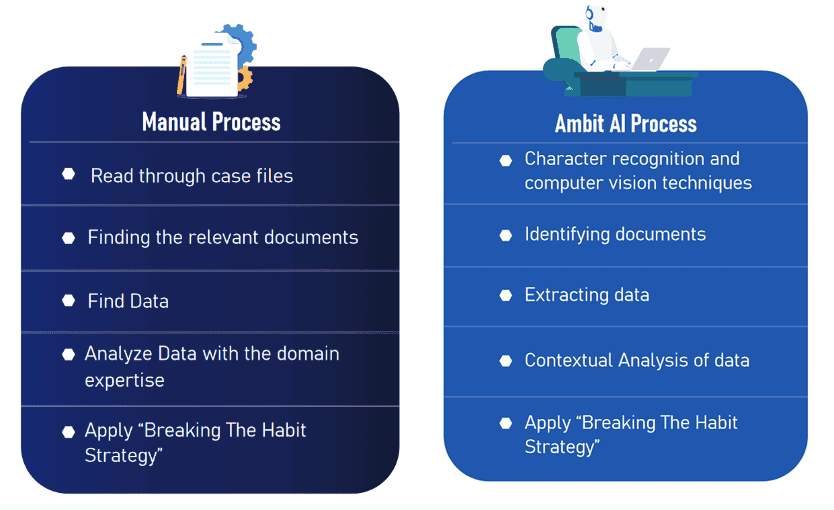
In one example of how a digital transformation strategy led to practical innovation, Fingent joined forces with the California law firm of Sapra & Navarra, LLP to develop Ambit, an AI and ML program that simplifies and enhances the management of workers’ compensation claims. Claims may include hundreds of pages consisting of a variety of letters, affidavits, forms, and other documents from claimants, doctors, lawyers, investigators, employers, and witnesses, among others. Utilizing both artificial intelligence and machine learning, the Ambit system streamlines the claims management process, reducing claim costs, and helps break the old practices of:
- Taking too long to assess claims
- Treating similar claims inconsistently
- Not equipping claim adjusters with modern tools
Instead, Ambit improves the efficiency of all parties — insurance carriers, self-insured companies, lawyers, and claim adjusters — while reducing costs for insurers by 57%.
The Ambit solution was designed to:
- Easily ingest the many documents in the claims process
- Quickly identify missing, processed & corrupted pages
- Review structured and unstructured documents automatically
- Identify areas of concern
- Suggest potential legal defenses
- Automate calculations and reminders for important legal deadlines
- Generate case summaries, with action plans
These automation capabilities not only make life easier for claims managers but enable organizational leaders to offset productivity issues created by ongoing labor shortages by reducing onboarding time for new hires. These capabilities result in more uniform handling of the claims while speeding their resolution and lowering their overall costs.
In general, automation technologies, such as those implemented during a digital transformation initiative, will also decrease operating costs, enabling insurance companies to increase their profitability and offer their customers more competitive premiums.
Read more: How AI Drives Digital Transformation In The Insurance Industry
The Essential Components of Digital Transformation
The technology trend in insurance is clearly moving from the strictly paper-based methods of the past to the digital. Beyond static websites to mobile apps. Beyond email to text and chat. Beyond processes driven by people to more and more intelligent automation that speeds up and uniformly handles all kinds of processes from marketing, and operations, to customer service.
Every organization’s digital transformation roadmap should be as unique as the business itself, but every digital transformation strategy must include a few core elements:
- Clear objectives
- An integrated plan
- A leadership-driven approach
- Investments in the right technology
When creating your organization’s digital transformation strategy, you should start by defining your “why.” In other words, you must identify the reasons you are undertaking this initiative in the first place.
From there, work with a digital transformation partner who can help you create an integrated plan that includes everyone from executive members to line-level employees.
Digital transformation efforts — even small ones — require the active support of top management. Change is the hardest thing to achieve in the organization and without the sponsorship of the corporate leaders, the effort is unlikely to succeed.
Finally, you will need to replace outdated, inefficient technology with modern, robust solutions. When appropriate,
partner with a custom software development firm that can provide you with a purpose-built solution you need for your business. They are equipped with the personnel and experience to generate a solution in the minimum timeframe and without the need to increase in-house headcounts.
If your organization has been exploring ways to improve the customer service experience, increase productivity, improve profitability, and streamline its operations, it is more than ready to embrace digital transformation.
Successfully facilitating digital transformation requires a cohesive strategy, some cutting-edge technologies, a commitment to doing things better, and the right development approach.
Read more: Digital Twin Improving Predictability and Risk Management in Insurance!

How Fingent Can Accelerate Your Process
Naturally, the cornerstone of any digital transformation initiative is technology choices. These may be an off-the-shelf system for standard processes, the integration of existing systems or, your transformation may demand a custom solution that can accommodate your business needs unlike systems available to anyone else.
At Fingent, we specialize in creating resilient custom software solutions that are able to change and adapt according to your requirements. We work with insurance industry clients to help them streamline mission-critical business processes, and – as in all our projects – we accomplish this by providing dynamic, unique software that incorporates the most appropriate technology, such as the latest in machine learning and artificial intelligence technologies.
Connect with Fingent today to accelerate your digital transformation with the help of an experienced software development partner.
Stay up to date on what's new

About the Author

Featured Blogs







Stay up to date on
what's new



Talk To Our Experts
No longer the stuff of science fiction, artificial intelligence (AI) and machine learning (ML) are revolutionizing the way customers interact with brands. Businesses that have embraced these technologies can reshape the customer experience, curate one-of-a-kind buyer journeys, and strengthen bonds with their target audiences.
As your organization works to remain competitive in the modern business ecosystem, it must tap into the power of AI and ML technologies to provide a superior customer experience.
How Are AI and ML Enhancing Customer Experience?
Artificial intelligence and machine learning solutions can profoundly impact every facet of the customer experience. By leveraging these technologies, your business can:
1. Facilitate Hyper-Personalization
Customers who interact with your brand are looking for a personalized experience. As such, brands that put their products and services at the center of attention instead of prioritizing experience will miss the mark. Likewise, blasting your customers with generic advertising content or sending them broad, basic messages simply won’t cut it anymore. Instead, you must personalize every interaction to deliver timely and relevant content to each user.
Artificial intelligence and machine learning technologies facilitate a level of hyper-personalization that was thought to be unachievable just a few years ago. In a 2022 Salesforce survey, 88% of consumers reported that an experience provided by a company is almost as important as the product. Using AI and ML technologies, you can personalize customer experiences by utilizing real-time data, like their browsing history, purchasing habits, etc.
Artificial intelligence and machine learning solutions can also eliminate friction from the customer journey. For instance, AI- and ML-powered chatbots can leverage information from past interactions to create personalized messages for each consumer. This will minimize customer frustration by reducing how often consumers are asked to repeat information they have previously provided.
2. Allow Customers to Stay Connected 24/7
Customers expect access to timely and relevant support around the clock. However, staffing your customer support department 24/7 is financially infeasible. So how do you bridge the gap between customer expectations and the fiscal limitations of your business? AI and ML solutions are the clear answer.
With artificial intelligence and machine learning technologies, you can provide your customers with access to automated support like chatbots. These bots can respond immediately to customers and resolve many basic product- or service-related issues without tying up your customer support staff. This capability will not only allow you to reduce the workload on your team but also help you provide more timely and omnichannel service to customers, no matter when they reach out for assistance.
3. Conduct Predictive Behavior Analyses
The sooner you can identify consumer behavior trends, the better your chances of capitalizing on emerging opportunities. Unfortunately, traditional analytics solutions do not facilitate real-time decision-making because they often rely on data that is days (or even weeks) old.
The good news is that artificial intelligence and machine learning technologies enable you to conduct predictive behavioral analyses using real-time data, guiding your decision-making processes and enabling you to adapt to emerging trends like never before.
4. Enhance Your Understanding of Target Audiences
Artificial intelligence and machine learning technologies allow you to step into your target audience’s mind. You can use these newfound insights to guide your digital marketing strategies, refine products and services, and enhance the customer experience.
Due to how AI and ML learn and evolve, these technologies will only become more effective over time as they get access to more data, better helping you anticipate how your target audiences are likely to behave in the future. This enables you to proactively eliminate friction points from the buyer’s journey and paves the way for increased sales and better profitability.
Read more: Is AI-powered mobile app what you need for your business now?

Use Cases: Major Industries that Have Embraced AI and ML
Artificial intelligence and machine learning technologies are going mainstream, and many industries are taking advantage of these powerful tools for both B2C and B2B interactions. Business leaders in these sectors understand that these technologies will significantly impact their organizations’ ability to compete, both now and in the future.
Some of the industries that are using AI and ML technologies on a broad scale include:
- Software development
- Language processing and transcription
- Retail
- Customer service
- Marketing
- Manufacturing
- Finance
- Agriculture
- Logistics and transportation
- Healthcare
The healthcare and logistics sectors were some of the earliest adopters of artificial intelligence and machine learning technologies, whether by predicting the likelihood of patients developing certain diseases or by providing customers with more accurate shipping estimates. These industries (and every other on this list) utilize AI and ML technologies to enhance the customer experience.
These technologies also provide meaningful insights into the efficiency of business operations. Organizational leaders can use the information gleaned from these technologies to proactively address critical organizational growth hurdles and promote business continuity.
How Your Business Can Optimize Customer Experience with AI and ML
Artificial intelligence and machine learning technologies will empower your business to revolutionize the customer experience along every meaningful touchpoint. First and foremost, these technologies will help your business truly understand the customer journey and its impact on organizational profitability. And once you understand the state of your business and how well it is currently managing the customer experience, you can begin using your AI and ML tools to refine the customer experience.
If you want to maximize your return on investment, consider incorporating artificial intelligence and machine learning technologies into as many business processes as possible. You can use these solutions to automate redundant processes, hyper-personalize advertising content, and refine the customer experience from top to bottom.
Read more: Use cases and business benefits of deploying Machine Learning!
Tap into the Power of AI and ML with Fingent
Are you ready to harness the power of artificial intelligence and machine learning so that you can provide your clients with the experience they deserve? If so, then it is time to explore a partnership with Fingent.
At Fingent top custom software development company, we provide customized artificial intelligence applications and machine learning solutions. Cumulatively, these technologies will differentiate your brand in the competitive digital marketplace and enable you to modernize the customer experience.
To learn more about Fingent’s suite of services and solutions, contact our team today. Together, we can reshape your customer experience and set the stage for the growth of your business.
Stay up to date on what's new
About the Author

Featured Blogs
Stay up to date on
what's new
Talk To Our Experts
We currently live in the eon of Artificial Intelligence. Whether we like to admit it or not, AI has suffused its way into every industry in all of its beautiful ingenuity.
Did You Know?
“The global artificial intelligence market size was valued at USD 93.5 billion in 2021.” – Grand View Research
“AI could contribute up to $15.7 trillion1 to the global economy in 2030.” – Sizing the Prize, PwC Report
What is Artificial Intelligence?
Artificial intelligence (AI) is a simulation of human intelligence processed by electronic gadgets that enables the execution of an array of advanced functions, like seeing, understanding, and translating spoken and written language, data analysis, and many more.
From robots that can navigate a warehouse by themselves to virtual assistants that understand what people are saying and act upon that information, we can see Artificial Intelligence in play everywhere.
Read more: Reimagine Your Business with AI. Here’s How!
Artificial Intelligence-Based Code Generation Tools
Let’s take a look at code-generation tools that are based on AI technologies. This article will discuss three such tools – Codex, Co-pilot, and ChatGPT.
1. Codex
As announced by the Artificial Intelligence Research Company OpenAI, the Codex model series is a successor of the GPT-3 series and is trained with both natural language and billions of lines of code. It is most competent in Python and is proficient in many more languages, including C#, JavaScript, Ruby, Swift, TypeScript, SQL, and even Shell.
Due to its understanding of many languages, Codex can transcribe simple commands in natural language and execute them according to the user’s preference. This makes building a natural language interface into existing applications possible. It also helps speed up the work of professional programmers and helps amateurs get started with coding.
2. Copilot
GitHub Copilot, fabricated by GitHub and OpenAI, is a cloud-based AI tool that assists users of Visual Studio Code, Visual Studio, Neovim, and JetBrains integrated development environments (IDEs) with auto-completing code.
GitHub Copilot is trained on billions of lines of code and uses this knowledge to turn natural language prompts into deft coding suggestions. It is famous for evaluating and suggesting improvements for social media profiles, facilitating online presence across various digital channels.
Copilot uses AI technology to engage with potential leads through messages and categorizes them based on responses. It is trending with a whopping 4.67-star rating and is widely praised for its enormous support.
3. ChatGPT
OpenAI released yet another ingenious model called ChatGPT. It is a long-form question-answering AI that addresses complex questions conversationally. This is a revolutionary technology because it not only understands human language but is also trained to learn what humans mean when they ask a question.
The New York Times headlined, “ChatGPT and other chatbots is a ‘code red’ for Google search engine.”
While The Indian Express, in an article, stated that “When it was introduced, ChatGPT’s ability to break down complex problems and explain everything in a human-like manner led many to proclaim that Google’s days as the numero uno search engine are numbered.”
ChatGPT is undeniably a hot topic, and its reasons stand strong. Its dialogue format makes it possible to provide answers to any follow-up questions, accept its mistakes, challenge incorrect premises, and reject inappropriate requests.
Its specifically trained ability to understand the human intent behind every question and provide helpful, harmless answers while discarding parts of the question that do not make sense only adds to its special nature.
Read more: Is AI-powered Mobile App What Your Business Needs Now?
Benefits Of These AI Tools
1. Codex –
“You just ask the computer to do something, and it just does it,” said OpenAI CTO Greg Brockman in the video demo of Codex.
Codex is good at co-referencing resolutions. It also links nouns in the prompt/input to their proper variables and functions in the code. Codex can also execute mundane tasks, like rendering web pages, launching web servers, and sending emails.
As AI technology takes over all the tedious parts, the programming process is prone to become more efficient. OpenAI shows Codex has a 37% accuracy rate in effectuating coding tasks.
2. Copilot –
A new study by GitHub revealed that Copilot works as an AI code programming assistant, significantly increasing developer productivity and happiness.
This particular AI-based code generation tool stands out because of its simplicity. You can describe the task you desire, outcome, or suggestion in the comments, and Copilot can come up with what it thinks are the proper lines of code. On the other hand, you can infer just your intentions with an incomplete prompt, and Co-pilot will do the code generation according to the same prompts.
3. ChatGPT –
Firstly, it reflects its efficiency by handling large volumes of conversation without needing breaks, which is undoubtedly helpful for customer service or other applications with a high demand for conversation. It also personalizes these conversations allowing them to feel unique for different users.
Using ChatGPT is highly cost-effective because it eradicates the need to hire human employees to handle conversation tasks. It is also available 24 hours a day throughout the week and has a great language support system.
How It Enables Reduced Costs
Embracing Artificial Intelligence is a deft, cost-effective decision that most businesses and industries need to make. AI helps companies progress on many fronts, but the most imperative is its impact on the company’s pocket.
Implementing AI-based code generation tools such as Codex, Copilot, and ChatGPT reduces the need to hire miscellaneous employees to perform repetitive, tedious tasks. This, in turn, reduces the chances of any mishaps that may cost the company money to fix. Using these tools as assistants also greatly helps employees with their workload.
Using a more personalized, accurate, and compactable AI technology in your business can attract many potential clients and customers. This ultimately creates a profit for your business while also helping you establish your roots in the industry.
35% of consumers feel the desire to see more companies using chatbots. This is the perfect time to build the software you “ever needed” at a reduced cost.
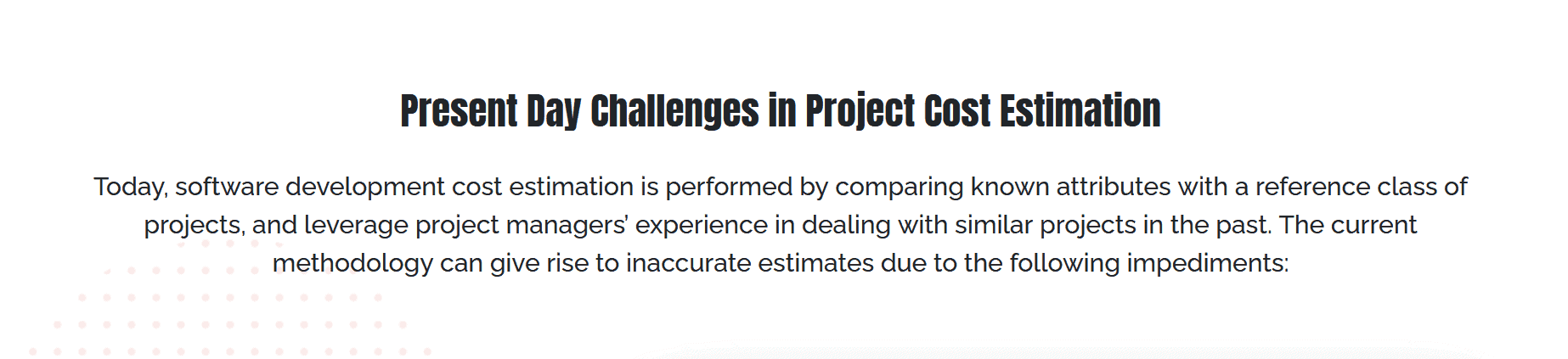
Read more: Artificial Intelligence and Machine Learning for Faster and Accurate Project Cost Estimation
Myths Around The Use Of AI Tools
The long-standing fear of technology taking over mankind has always had its chokehold on innovation. It is time to debunk the myths that surround AI and let technology progress.
Myth #1 – AI Is Going To Take Over Every Job Sector
One thing to remember is that no matter what, Artificial Intelligence tools will not replace the developers but increase developer productivity. It is reasonable to believe that AI has the potential to disrupt labor, but to compare labor from humans to machines directly is an unnecessary simplification. AI tools exist solely to enable humans to work in a newer and smarter way.
Myth #2 – AI Is Magic
The idea that AI tools can magically make sense of any and all of your messy data is completely erroneous. AI does not work on the principle of “load and go,” and the quality of input data is more important than the AI algorithm. This implies that the data being prompted has to be relevant to the problem being solved and specific to a set of use cases and a domain of knowledge.
What The Future Holds For The Industry With AI Tools
AI has consistently altered the course of the world multiple times and will continue to do so in the future. Although it is not a mainstream technology, billions of dollars are spent annually on AI research and development.
Did You Know?
As of the latest 2022 data, the global AI market is worth $136.6 billion. By 2030, the global AI market is expected to reach $1.81 trillion.
Some other industries that are largely affected by AI tools include –
- Software Development Companies
- Information Technology
- Finance
- Manufacturing
- Customer Service
- Education
Get Future-Ready With The Best of AI
Using AI-based code generation tools can give you the upper hand you have been waiting for. Unlock your business’s potential with Fingent, the top custom software development company. Get in touch with our experts for a power boost and to get ahead of the competition.
Stay up to date on what's new
About the Author
Featured Blogs
Stay up to date on
what's new
Talk To Our Experts
From the moment we wake up, mobile apps have become an inseparable part of our lives! From sleep trackers to fitness apps to alarm clocks and everything in between, we rely on mobile apps to accomplish almost every daily task. Mobile apps also play a vital role in more complex choices in life, like dating. A world without smartphones and their apps cannot exist any longer. In such a scenario, businesses must continue to make smartphones smarter to stay relevant. The best way to achieve that is to empower mobile apps with Artificial Intelligence.
Are you wondering if your industry can benefit from AI-powered mobile apps? This blog will discuss that and explain how you can benefit from them. Let us begin by understanding how AI-powered mobile apps are impacting business.
Impact Of AI-Powered Mobile Apps on Businesses
“The measure of intelligence is the ability to change,” said Albert Einstein. That is a reality in technology. Growth requires change, and change requires intelligence. AI achieves growth by bringing in that much-needed change in mobile apps.
AI is instrumental in driving innovation in mobile apps. Today many users neglect applications that do not have innovative features. This calls for developers to be on the ball when it comes to facilitating digital transformation with the help of AI.
AI-powered apps are experiencing higher than anticipated demand. According to Fortune, the AI market size is projected to grow from USD 387.45 billion in 2022 to USD 1,394.30 billion by 2029. A staggering figure indeed!
Well, that is not all. Here are some facts that are keeping mobile app developers and publishers on their toes:
- There are over 6.5 billion smartphone users worldwide.
- On average, an American looks at his phone 344 times each day. That is once every four minutes.
- 88% of mobile time is spent on mobile apps, and the app percentage continues to increase yearly.
- 47% of established organizations have applied an AI strategy to their mobile apps.
AI-powered mobile apps can help businesses conquer their market. Let us understand why and how they can prove to be game-changers for top industries.
Top Industries That Can Benefit from AI Mobile Apps and How
Mobile apps allow users to do many things more conveniently, quickly, and smartly. AI-powered mobile apps have turned smartphones into on-the-go computing machines. That is why many top industries leverage it to provide new solutions, engage their customers, and thus stay on top of their competition. Here are examples of five top industries that are benefiting from mobile apps:
1. Ecommerce
eCommerce customers prefer to use retail apps over mobile websites for their shopping needs. Top companies like Amazon increased their sales by engaging with and offering customer deals through mobile apps.
It was also noted that mobile apps somewhat level the playing field for small businesses trying to compete with established businesses in their sector. Mobile apps also increase the probability of customers purchasing more than what they would buy when they visit the website. It is imperative that businesses adopt AI-powered app development as part of their growth strategy.
2. Healthcare
AI applications can build sophisticated machines, analyze chronic conditions and quickly provide medical data to medical staff. Using AI-powered mobile apps in the healthcare industry can minimize in-person doctor visits allowing doctors to quickly and efficiently treat their patients in real-time. They improve the medical facility and expedite services.
Fitness apps have become unbelievably popular after the pandemic. The development of AI-powered mobile apps also encourages people. When fitness apps are merged with health apps, they can measure health parameters like blood pressure and pulse. AI-powered mobile apps can also be synchronized with wearable devices.
3. Education
AI-powered mobile apps allow teachers to create interactive learning materials for their students. Such learning helps the education industry to make learning more fun and interesting. Plus, it beats geographic barriers by enabling students to access educational content worldwide.
It can increase productivity among faculty and permit them to give more attention to their students. AI-powered mobile apps can automate back-office tasks like grading, arranging, facilitating parent-guardian interactions, managing enrollment, and more.
4. Human resource management
AI-powered driven systems can aid in the blind hiring process. Using ML software, HR staff can examine applications based on specific parameters from anywhere in the world. It can scan applicants’ profiles or resumes and provide recruiters with the talent pool they are looking for.
5. Real estate
The real estate industry can benefit from AI-powered mobile apps in a big way. Since most realtors and property owners already use smartphones to rent or buy properties, real estate professionals can use mobile apps to showcase their listings on these platforms. The development of niche applications can help renters to find homes directly through the app.
Read more: How Realtors Are Winning Tenants With Innovative Mobile Apps

How Can You Identify AI Capabilities For Your Company?
No business can afford to sit back and ignore the capabilities of AI-powered mobile apps. However, rushing to adopt AI without thinking it through can be damaging. To fully realize its capabilities, you must approach it with a clear business goal. This means you must narrow it down to your business’s most valuable AI capabilities. How can you do that? Keep in mind these two fundamental steps:
- Identify potential use cases of AI-powered applications in your business
- Sort those potential use cases into just a few top priorities.
How Can Fingent Help?
The possibilities for business growth through AI-powered mobile apps are endless. Fingent is an expert when it comes to AI-powered technologies. We specialize in implementing your solutions into the mobile environment.
We have delivered successful projects globally. Here are three case studies:
1. Ambit
Ambit is an AI machine learning program that simplifies a time-consuming worker’s compensation process that usually takes up to three years. Among several other benefits, this solution offers insurers a 57% reduction in costs. Combining AI with the client’s litigation strategy, Fingent helped develop a solution that now cuts the average case settlement time to 1-2 days at a settlement cost of $15000.
2. AI-powered chatbots
As their technology partner, Fingent helped the University of North Carolina (UNC) develop an automated intelligence-driven ecosystem that facilitates seamless interaction between students and their instructors utilizing AI-powered chatbots. Enhanced learning is made possible by employing a Watson-powered Teaching Assistant (AiTA).
Read more: Using Chatbots to Create an Enhanced and Engaging Learning Experience
3. MUSA
Fingent developed MUSA, an AI-powered virtual assistant, to improve in-house HR teams’ response time. This minimized their workload as MUSA took over the management of routine tasks and gave the HR team more time to focus on their core function.
Top benefits of the solution:
- Improved the HR team’s response time.
- Automation of Frequently Asked Questions (FAQs) minimized workload considerably.
- Helps provide instant and accurate responses to common queries.
- Improved ability of the HR team to handle more complex queries and circumstances.
With a highly efficient team of experienced developers, Fingent custom software development experts are committed to understanding your business needs, using the latest and most advanced technologies to work out the perfect solution for you, and working tirelessly to deliver high-level apps that will transform your business. We have delivered successful projects globally. We are known to offer robust, cost-effective, and customer-centric mobile applications to enterprises and startups.
Give us a call, and let’s discuss how these capabilities can help your business.
Stay up to date on what's new
About the Author

Featured Blogs
Stay up to date on
what's new
Talk To Our Experts
Machine learning is changing the face of everyday life, science, and business. It is revolutionizing all industries, from advancing medicine to powering various cutting-edge technologies. Though Machine learning (ML) was a part of AI’s evolution until the 1970s, it evolved independently. It has become a chief response tool for cloud computing and eCommerce.
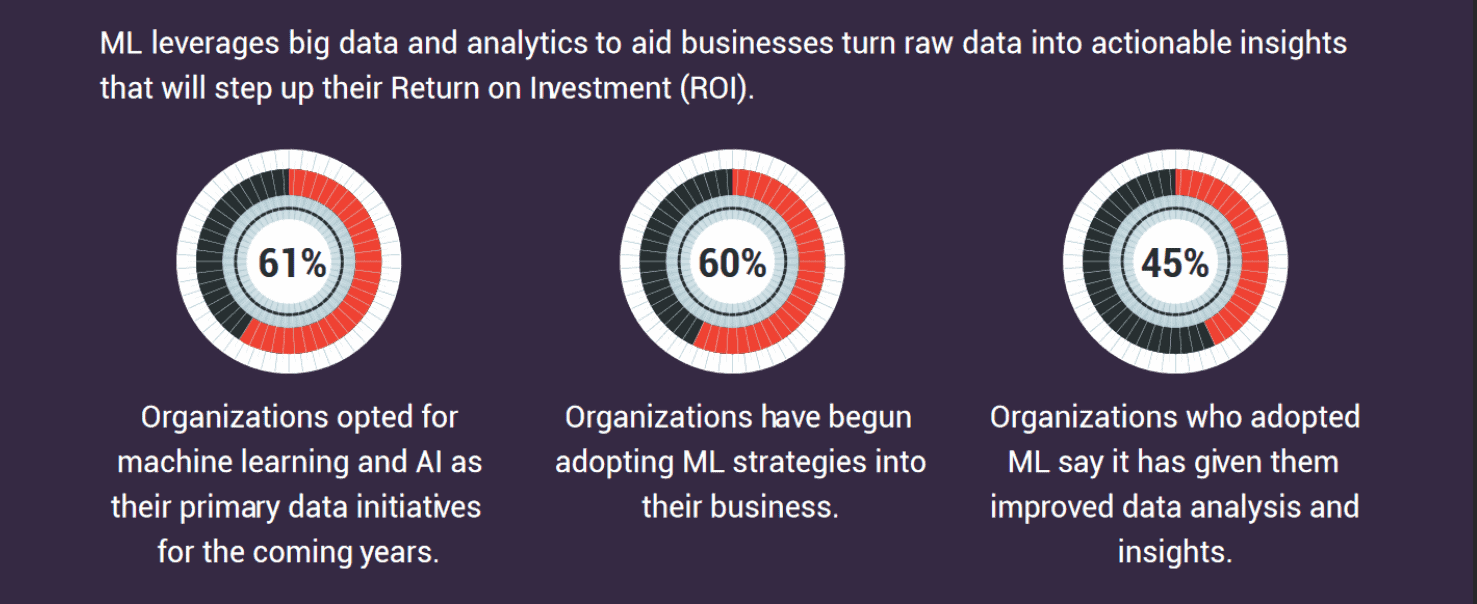
The goal of machine learning in business is to adapt to new data independently and make decisions and recommendations based on thousands of analyses. Machine learning enables systems to learn, identify patterns and make informed decisions with minimal human intervention.
Today, ML is a necessary aspect of modern business. It uses algorithms and neural network models to improve the performance of computer systems. Machine learning in business and manufacturing is enabling organizations to achieve notable strides. These strides include increased performance and efficiencies, improved processes, and enhanced security.
This article will discuss the benefits of machine learning in business and its use cases.
Remarkable Benefits of Machine Learning for Businesses
According to Fortune Business Insights, the global market size for machine learning in business is expected to grow to USD 209.91 billion by 2029, exhibiting a CAGR of 38.8% during the forecast period. ML has been and continues to scale operations tremendously. Across industries, ML has led to a boom in affordable data storage and faster and more reliable computational processing.
Here are six remarkable benefits of machine learning in business:
1. Automation for better decision-making
Most businesses find themselves wasting precious time sorting through duplicate and inaccurate data. Such businesses benefit from using the predictive modeling algorithms of ML in their processes. Such a process will understand duplicate inaccurate data and distinguish the anomalies. It enables the organization to avoid inaccurate reporting that can result in poor customer retention.
Instead, this will allow businesses to use their accurate database to detect wasted costs, missed opportunities for sales, and revenue capital. In addition, organizations can overcome challenges and risks that arise due to miscommunication or poor performance metrics. Thus, businesses can streamline their operations and improve decision-making which could be translated into better ROI.
2. Increased scalability with minimum expense
Semi-supervised machine learning algorithms can help organizations leverage useful insights from customer profiles and enable them to view their brands from customers’ perspectives. Doing so will equip organizations with relevant insights to build their brand by improving their products and services.
3. Predictive maintenance
Predictive maintenance that ML aids manufacturing firms’ power to follow best practices that lead to efficient and cost-effective operations. The historical and real-time data predict problems and stipulate strategies to solve those problems. Plus, workflow visualization tools can eliminate issues and unwanted expenses incurred due to those issues.
4. Financial analysis
ML can greatly assist as it gathers and analyzes large volumes of quantitative and accurate historical data. It is used for portfolio management, loan underwriting, fraud detection, and more.
5. Personalization
Using machine learning in business will allow organizations to know their customers better and provide them with a more personalized customer experience. Organizations no longer need to rely on guesswork because ML models can process different types of information collected from numerous sources and provide relevant data about their customers.
6. Cybersecurity
ML technologies can improve cybersecurity to solve cyberattacks once and for all. Empowered by ML, intelligent security programs can gather and process data about cyber threats and respond to them in real time. ML models can detect the slightest deviations in patterns and flag them. Or destroy an attack in its nascent stage.
Read more: Can Machine Learning Predict And Prevent Fraudsters?

Top Use Cases
Machine Language has made its mark across industries and found a place in many different applications. Here are some top use cases:
1. Enhanced social media features
Businesses can use machine learning algorithms to create attractive and effective social media features. For example, ML algorithms in Facebook enable it to identify and record a person’s activities. These activities include records of chats and the amount of time that person spends on each post. It uses this data to determine what kind of friends and topics may interest that person and accordingly make suggestions.
Read more: Why Time Series Forecasting Is A Crucial Part Of Machine Learning
2. Product recommendation
Product recommendation is an advanced application of machine learning techniques. It has been the most popular application of almost every eCommerce website today. This technique allows websites to track a consumer’s behavior based on their previous purchases, search patterns, and cart history. It enables the website to make apt product recommendations to that consumer.
3. Recognition
Image recognition is one of the most significant and notable ML and AI techniques. It is adopted further for pattern recognition, face detection, and face recognition.
4. Sentiment analysis
Sentiment analysis is a real-time ML application. It determines the emotion or opinion of the speaker or the writer. For example, a sentiment analyzer can detect the thought and tone of a written review or an email. It can analyze the review-based website, decision-making applications, and more.
5. Access control
Most large businesses are actively implementing ML models to determine the level of access an employee should be granted. This application of machine learning can ensure the security of the organization.
6. Bank Domain
Banks are using ML to prevent fraud and protect accounts from hackers. Machine learning algorithms determine what factors to consider in creating a filter to prevent an attack.
Read more: Machine Learning – Deciphering the most Disruptive Innovation
How Fingent Can Help with Deploying the Best of ML
Leveraging the capabilities of machine learning in business can open the door to many opportunities. It is wise for any organization to take advantage of ML rather than lag behind competitors. However, we understand if you have questions. That’s why Fingent software development experts are here to help you. We can deploy the best machine-learning models efficiently and smoothly.
As a partner, Fingent can work with your team as you take on digital initiatives for sustainable business growth. We enable our clients to make data-driven decisions by efficiently deploying machine learning in business. Our cost-effective services will save you a considerable amount of time and money.
Furthermore, we do not follow a one-size-fits-all strategy. We provide custom software development services that cater to your needs. Therefore, look no further if you are looking for a reliable, efficient IT partner to deploy the best machine-learning models.
Stay up to date on what's new
About the Author
Featured Blogs
Stay up to date on
what's new
Talk To Our Experts
From the mundane to breathtaking, AI is disrupting virtually every business process in all sectors. People are ceasing to associate Artificial Intelligence with science-fiction dystopias as Artificial Intelligence (AI) is taking more commonplace in our daily lives. While such acceptance in mainstream society is a new phenomenon, it is not a new concept in business. Today, AI has become imperative to maintain a competitive edge.
This guide will help business owners who are serious about maintaining a competitive edge in their business sector by adopting AI.
Rising Need for Adopting AI In Business
Did you know that 52% of companies accelerated their AI adoption plans after the pandemic? Why?
Artificial Intelligence in business is seen as a supporting tool. It is adept at processing and analyzing a trove of data much faster and more efficiently than a human brain can. Since AI can synthesize courses of action and present them to the human user, businesses can use AI to help investigate the probable consequences of each action. That way, businesses can streamline the decision-making process. This is what makes AI valuable throughout many industries.
Artificial Intelligence is a form of software that can make decisions independently. It can act even in situations not foreseen by programmers. AI has a wider latitude of decision-making capabilities than traditional software – whether it is simply helping visitors or performing a task as complex as monitoring a wind turbine to predict its maintenance.
Read more: Conversational AI: Reimagining Customer Experiences
How To Identify If Your Business Needs AI?
AI software and tools can make business processes much simpler and more effective. Besides, implementing AI in business ensures cybersecurity defense, powers customer service, and more. But how do you know when you must adopt AI in business? Here are a few scenarios:
Scenario 1: Do you need to enhance your customer experience?
Are you struggling to provide your consumers with quick, easy, and personalized solutions? AI-powered digital assistants can help your business resolve customer queries by imitating human conversation. Chatbots are among the most promising trends in customer engagement and customer experience. Perhaps most business owners realize how imperative this AI technology is to their business. Perhaps that is why the chatbot market is set to reach 1.25 billion USD by 2025.
Scenario 2: You know the value of sentimental analysis but do not know how to leverage it.
Businesses use sentimental analysis to monitor and analyze customers’ opinions and emotions from various texts on a website, social media, and product or service comments. Skimming through large amounts of data to churn out customers’ sentiments can be daunting. All thanks to AI-assisted sentiment analysis, you can now quickly understand how your customers feel about your services or products.
Scenario 3: Your business has suffered due to inaccurate forecasting.
Accurate sales forecasting helps businesses predict future sales for long-term business growth. It can also enable the detection of potential problems to avoid them. Implementing AI-based CRM software can help detect how each data element relates to sales performance.
Scenario 4: You have a great online presence but an awful in-store experience.
If that describes your business, it is time to adopt AI to provide the next level of a personalized in-store experience. AI can enable instant access to products or services and contribute to smarter buying decisions.
A Quick Guide to Implementing AI For Your Business
AI applications can be used in many ways depending on organizational needs and the business intelligence (BI) insights derived from the data collected. Here are some tips to explain the steps businesses can take to ensure their implementation is a success:
1. Know your options.
Find out your options and what AI can and cannot do. This will help you decide if you want to add specific AI technology or change the entire app.
2. What is your business goal?
Working on an ‘end-first’ process will help refine the list to select specific features or capabilities that best suit your business goals.
3. Find out how AI can benefit the end-users
This is crucial as it gives you the two main objectives for a successful implementation. Then, choose the software and hardware you need to make this process a reality.
4. Evaluate your internal capabilities
You need to consider if you have enough skilled employees in-house who can manage the process and if you have the budget to outsource it.
5. Choose between building or integrating the system
Remember building an AI system from scratch can take several months. On the other hand, if you choose to use a premade system, your AI partner will help install the software app, train your staff, and fulfill your business needs.
6. Test system
Testing the system for a predetermined time will help you understand if the clients are more satisfied, and if the employees work more efficiently.
7. Choose the right partner
A good AI partner will be clear about the offer, value, and terms of cooperation.
8. Make refinements
After you gather a reasonable amount of data evidencing the success of an AI solution, you can start making refinement changes to the solution.
Watch more: How Artificial Intelligence Can Enhance Your Customer Experience!
Avoid 4 Common Mistakes While Implementing AI
A well-considered plan can lead to success, but a mistake can cost you considerably in terms of time and resources. Here are four common mistakes to watch out for when implementing AI:
- Not applying AI to the right use cases: If AI is incongruous with your business goals, your time and resources will be wasted
- Not diligent in hiring the right talent: Hiring the right AI team is like putting together the right football team that can win. Hire candidates with specialized skill sets and experience that match your business needs.
- Ignoring data: Ensure all teams are responsible for organizing, vetting, and maintaining data.
- Inadequate intervention: Inadequate intervention could result in AI recommendations that hinder business objectives. Hence, ensure interventions are scalable and repeatable.
How Fingent Can Help You With Personalized AI Software Development
Artificial Intelligence is for every future-oriented business. How exactly you will use AI depends on your business goal and how well it was implemented. At Fingent top custom software development company, the AI developers are equipped to design intelligent solutions to help solve your business problems, automate tasks, and improve customer experience.
Our suite of AI solutions includes data capture and processing. Our AI developers are also proficient in analytics, multi-platform integration, and ML solutions.
Let us help you reach your business goal with intelligent AI-driven solutions. Give us a call today.
Stay up to date on what's new
About the Author
Featured Blogs
Stay up to date on
what's new
Talk To Our Experts
The strategic significance of advanced technologies as a critical business component is recognized by enterprises like never before. Besides business modernization and cost reduction, advanced technologies allow you to compensate for labor shortages, improve brand value and competency, and expedite research and innovation processes. However, several companies jump onto the bandwagon without properly understanding the practical applications and benefits of advanced technology in their business. Only 23% of small and medium-sized enterprises (SMEs) worldwide can invest in and grow with new digital tools, indicates the World Economic Forum. This data proves why companies should analyze advanced business technology examples before adopting digital tools.
Read more: Using technology to build customer trust: Your business plan for 2022

To simplify your understanding, here’s a quick rundown of five advanced business technologies we believe will help you cope with the new business and economic environment.
- Simplifying Workflows With Cloud
- Low-code Applications
- Robotic Process Automation (RPA)
- Document Data Extraction
- AI Assistants
As these business technologies become more affordable and handy, businesses are ardently pursuing them to automate customer service, streamline workflows, differentiate products and services, and reach new markets. Depending on your budget, implementation timeline, priorities, and unique business requirements, our team at Fingent helps you build the roadmap for technology adoption.
Let’s take a closer look at the five inevitable technologies for business transformation today:
Read more: How to gain maximum value from your technology investments?
1. Simplifying Workflows with Cloud
Workflow management is a highly overlooked enterprise strategy that directly impacts productivity. Managing different stakeholders, heaps of confidential data, and a series of preset and conditional tasks manually can lead to several errors such as employees missing key steps, policy violations, compliance issues, and monetary losses. By taking your workflows online, cloud-based workflow management applications increase your productivity.
Cloud-powered workflows or workflow management tools:
- Are scalable, centralized, customizable to your needs, easy to integrate, secure, reliable, and hassle-free.
- Offer a seamless and unified collaboration interface by preventing users from toggling between different messaging apps or communication channels.
- Reduce your dependency on in-house IT team by passing on the software maintenance responsibilities to the third-party software vendor.
- Can be accessed via any authorized network (with approved access credentials), on any device, from anywhere, 24/7. This has been a huge game-changer for several companies that switched to remote operations during the pandemic.
Example of a Cloud-based Workflow Tool
Finding a cloud workflow management tool that can be customized to your company’s requirements is daunting. The platform should integrate well with your organizational processes without disrupting your existing workflow. This is where digital workplace applications like InfinCE make the difference.
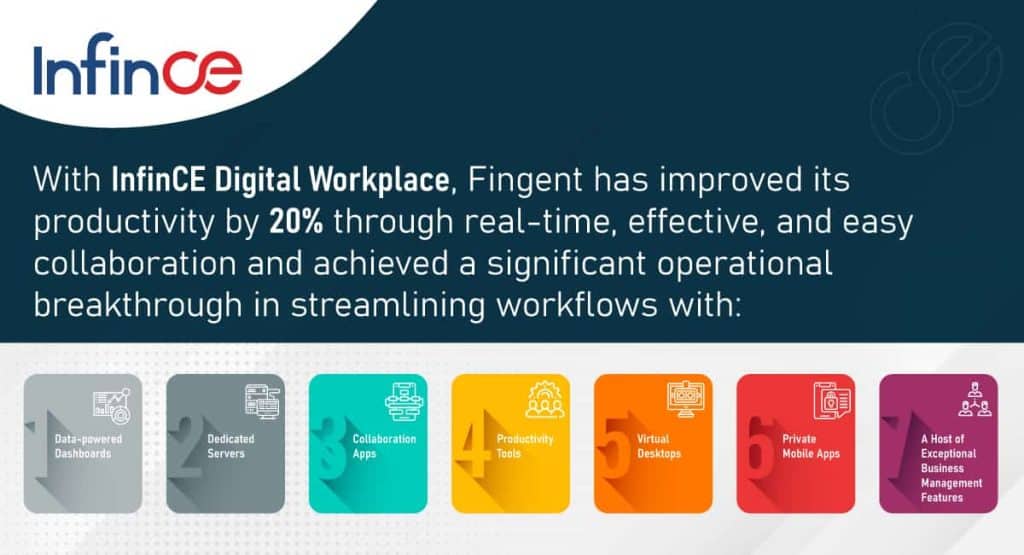
With InfinCE Digital Workplace, Fingent has improved its productivity by 20% through real-time, effective, and easy collaboration. Data-powered dashboards, dedicated servers, collaboration apps, productivity tools, virtual desktops, private mobile apps, and a host of exceptional business management features enabled us to achieve a significant operational breakthrough in streamlining workflows.
Read the full case study here.
2. Low-code Applications
Gartner estimates that by 2025, 70% of enterprise applications will use low-code or no-code technologies. Digital business transformation requires pushing custom software solutions to the market at lightning speed. This demand has given rise to low-code applications that will break the technological and organizational silos of application development, automation, integration, and governance. Low-code development enables business users to bring innovative ideas to life by just dragging and dropping low-code elements through a graphical user interface.
In simple words, low-code development enables “citizen” developers or non-tech users (such as business analysts or marketers) to build dashboards and survey or contact forms faster. Professional developers, on the other hand, can leverage low-code techniques to perform more efficient tasks such as legacy application modernization or back-end integrations with improved agility and velocity.
Use Cases for Low-code Applications
- Customer engagement applications and portals
- Mission-critical applications such as ERP software, payments manager, etc.
- Data analysis applications, BI dashboards, and data management software
- Mobile apps for customer engagement
- Order processing, inventory, order fulfillment, supply chain, and accounting apps
Salesforce Lightning, Microsoft Power Apps, and Zoho Creator are some of the leading low-code applications today. SAP users can leverage the unified low-code/no-code (LCNC) solutions on SAP Business Technology Platform (BTP) to rapidly build and extend applications, and automate tasks and processes.
3. Robotic Process Automation (RPA)
Robotic Process Automation (RPA), often referred to as software robotics, is an easy-to-use software technology that allows anyone to automate digital tasks within their business processes. RPA allows users to create software robots or “bots” that can learn, emulate, and then execute rules-based business processes. According to Forrester Research, RPA software revenue is expected to reach $6.5 billion by 2025, while RPA-related services revenue could hit $16 billion in the same year.
Potential Use Cases for RPA
We offer free proof of concepts to help you understand how RPA can improve your business efficiency and customer experience. Some of our top use cases include:
- Automating discharge protocols and data management to increase HR productivity in healthcare.
- Daily retail process automation such as order processing, inventory and warehouse management, etc. to save time and resources.
- Reducing customer wait times through RPA-enabled chatbots that answer customer queries in real-time.
- Error-free, automated billing and invoices to keep your financial systems and reports up-to-date.
- HR teams can automate the maintenance of personnel data and records, streamline onboarding, and manage payroll seamlessly.
Download our white paper to learn more about how Robotic Process Automation can simplify your business operations
4. Document Data Extraction
Extracting quality data out of unstructured or poorly structured data sources and documents for further processing, migration, and storing has been a biggest obstacle in automating back office operations. If you are entering structured invoices to a robust ERP tool like SAP, your payments can be automated and system records can be generated automatically. Due to the high costs of data extraction, several businesses extract only critical information fields, for example, the payment field within an invoice. Businesses are compelled to manually extract data from other important fields, such as validating the invoice’s compliance with VAT.
AI-integrated OCR Software for Document Extraction
Optical Character Recognition (OCR) is an affordable, game-changing technology that automatically extracts data from the digital images (photos) of large files, scanned documents, and sub-titles or captions superimposed on an image. It reduces the time spent in manual data entry and extraction by automatically converting typed, handwritten or printed text into machine-readable text. AI-powered automated data extraction tools like DocuSign, Docsumo, Kofax Capture, and Amazon Textract leverage OCR technology to reduce the chaos involved in document data extraction and enable businesses to create an efficient workplace.
Our team helps customize document data extraction software that can save your time and money by eliminating transcription and transposing mistakes.
5. AI Assistants
One of the most common examples of small business automation today is the use of AI-powered virtual assistants. They can save your employees’ productivity by automating the most repeatable customer interactions, such as technical support, appointment scheduling, lead qualification, and order management. AI virtual assistants like Google Assistant and Alexa can understand and act according to your voice commands and customize responses to your queries. Understanding customer intent through natural language processing and recognition allows AI assistants to maintain a human-like conversation.
Chatbots are a popular category of AI assistants that are designed specifically for text-based channels like SMS, email, and live chat. Recent years have witnessed a rise in chatbot adoption among several business verticals, product and service lines, websites, mobile apps, customer portals, and so on. Data shows that 58% of B2B companies and 42% of B2C websites are using chatbots to make their websites and mobile apps more interactive. More than 56% of businesses believe chatbots to be driving digital disruption in their industry.
Case Study: AI Virtual Assistant for HR
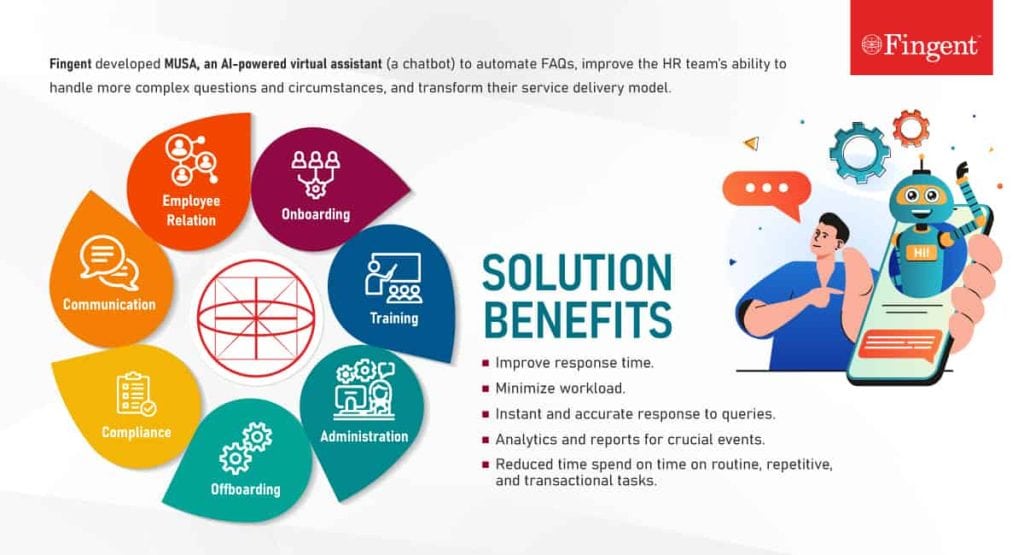
Fingent’s HR team was pressed to transform their service delivery model as routine, transactional tasks affected their performance and efficiency. To solve their struggle, Fingent developed MUSA, an AI-powered virtual assistant (a chatbot) and integrated it with Fingent Hub, Fingent’s internal employee management system. MUSA is short for Multi Utility Assistant. Employees can ask MUSA any queries related to HR and IT DevOps processes at Fingent, and they’ll get answered instantly. MUSA has improved our HR team’s response time by minimizing their workload and allowing them to focus on areas requiring more attention.
Read the full case study here.
Business and Technology Are Inseparable
Gartner writes that businesses leading with technology employ advanced tech to boost their customer experience and revenue growth, have a clear understanding of their priorities, goals, and strategies, and invest in solutions tailored to their needs. Technology allows businesses to lower the walls within and between their organizations, customers, providers, suppliers, and so on. Organizations perceiving technology as a key business consideration will be able to match the pace of business change and stay relevant and competitive.
How can your company embrace growth in a new era of transformation and business technology trends? If you feel you’re getting caught in the technology maze, take a quick break to contact us.
Our consultants can simplify your technology adoption strategy based on your priorities, customer needs, financial resources, and technical requirements.
Stay up to date on what's new
About the Author
Featured Blogs
Stay up to date on
what's new
Talk To Our Experts
Better businesses need better cyber security.
Regrettably, threats to cyber security have become the new norm across public and private sectors. The pandemic affected all types of businesses. If anything, uncertainties around remote working amplified cybercrime. As a result, cyber security’s importance has become more clear now than ever before.
As cyberattacks become more sophisticated, businesses will have to stay one step ahead. Security professionals need strong support from advanced technologies like Artificial Intelligence (AI) to protect their companies from cyber threats.
AI can enable security teams to handle greater and more complex threats than ever before. More specifically, it has proven to identify and prioritize threats. In some cases, AI has even taken automated action to quickly remediate security issues. This article considers how AI can redefine the cyber security needs of an organization.
Before we discuss further, let’s find out the impact cyberattacks can have on businesses.
How Cyberattacks Affect a Company’s Performance and Value
Protecting a company against cyber threats is costly. It can impact the relationship between your company and your customers.
Unfortunately, cyber threats are never static. Millions are created each year and are becoming more and more potent.
In a survey conducted by Hiscox-Cyber Readiness Report, 28% of the businesses that suffered attacks were targeted on more than five occasions in 2020. Companies have lost millions to such cyber security breaches. Companies like financial services, technology, and energy were hit the hardest.
That is not all. Cyber security breaches have caused several other damages including:
- Outlays such as insurance premiums and public relations support.
- Operational disruption.
- Altered business practices.
- Business’s standing and customer trust.
- Stolen intellectual property including product designs, technologies, and go-to-market strategies.
- Legal consequences.
Read more: Quantum Vs Neuromorphic Computing – What Will the Future of AI Look Like!
How AI Contributes to Cyber Security
Cyber threats are real and certainly worrisome to businesses. It is important to protect critical digital assets.
However, it takes planning and commitment of resources. With good security operations, you can stay on top of most of the most serious cyber threats. True, there may be smart thieves, but Artificial Intelligence can provide smarter security.
Here are 5 specific ways AI can contribute to cyber security:
1. Robust Zero-Day Malware Detection
Malware is unpredictable. And signature-based tools will not detect attacks that have never occurred before. Given that, is it possible to defend against something unpredictable? Yes!
AI is cable of grasping all the possibilities and finding relationships that traditional security tools would miss. While traditional security strategies have their place in cyber security, they are insufficient to detect and prevent zero-day attacks.
Zero-day attacks are best detected by automatically identifying aberrant behavior and alerting administrators immediately. AI can enable organizations to be more proactive and predictive with their security strategies.
Artificial Intelligence provides visibility and security for an organization’s entire data flow. AI helps organizations gain such visibility by dismantling each incoming file to search for any malicious elements. Simultaneously, it also looks at the user and network behavior and anomalies from expected activities.
Together with ML, AI adapts its behavior to new network conditions, constantly adapting to evolving security conditions. Even those hackers who use modern ML penetration methods cannot be fool AI-enabled cyber security.
We cannot stop security breaches from happening. But Artificial Intelligence helps organizations avoid potential disruptions before attackers wreak havoc.
2. AI Can Safeguard Large Amounts of Data
Whether a company is small or mid-sized, there is a lot of data exchanged between customers and the company every day. This information must be safeguarded from potential cyber threats. Cyber security experts cannot always inspect all the data for potential threats.
AI is the best option to detect threats to routine activities. Because of its automated nature, AI can sift through large amounts of data in real-time and identify any hazards lurking amid the chaos.
Read more: Artificial Intelligence and Machine Learning – The Cyber Security Heroes Of FinTech!

3. AI Takes Care of Redundant Cyber Security Operations
Hackers constantly modify their methods but the fundamental security practices do not change. Plus, they may weary your cyber security worker.
Artificial Intelligence takes care of redundant cyber security operations while imitating the best of human traits. It also does a thorough analysis of the network to locate security flaws that may harm your network.
4. AI can boost response time
Ideal security is the one that can detect security threats in real-time. The principle of ‘a stitch in time saves nine’ applies here.
Integrating AI with cyber security measures is a sure way to detect and respond to attacks immediately. Unlike humans, AI does not miss a spot when examining your system for risks. Besides, it can detect risks early, thereby boosting response time.
5. Authenticity Protection
Most websites allow users to log in and access services or make purchases. You will need greater protection as such a site contains private information and sensitive material. To maintain customer trust, it is important to ensure all data about your guests remains safe while accessing your site.
Artificial Intelligence can provide an enhanced security layer. AI can secure authentication when a user wishes to connect their account. Login measures like CAPTCHA, fingerprint, and facial recognition are used to determine if the attempt is legitimate or not.
Read more: Safeguarding IT Infrastructure from Cyber Attacks – Best Practices

Do Not Be Afraid!
Fingent is your reliable security partner. We provide professional security with reliable service. As a proactive security partner, we look ahead to ensure your business is successful far into the future.
Using AI’s real-time monitoring capabilities, we can spot potential issues before they become a major problem. Security experts Fingent are aware that cyber security threats are not limited to work hours. Our professionals at Fingent software development experts will be there for your business whenever you need us.
We are in business today because of the reputation we built with our customers. We offer a unique level of enterprise IT support, and our clients can rest easy knowing that their business is always protected.
Give us a call and let’s discuss your security needs.
Stay up to date on what's new
About the Author

Featured Blogs
Stay up to date on
what's new
Talk To Our Experts
AI is not just a technology; it has become part of daily lives. Thanks to AI, we witness new kinds of development in each sphere of life every day. We can access many points with AI now more than we could ever before. From the research that we do on the internet to the goods that come to our doors, AI is directing our lives and business. It has solved many problems faced by humanity. And, revolutionized technology in all industries.
Coined at Dartmouth College in 1956, Artificial Intelligence (AI) gave succeeding generations a potential for information technology that can benefit humans in a profound way. Apart from bringing efficiencies, AI is also bringing new possibilities. These possibilities continue to create new models and opportunities for businesses that tap into them. Quantum and neuromorphic computing is the way forward.
This blog takes a deeper look into quantum and neuromorphic computing and explores which companies can benefit from these technologies.
A Look at The Future Of AI
The possibilities Artificial Intelligence can create are seemingly endless. Innovations are constantly taking place in the AI world. Given that, many business and information technology leaders are looking to better understand how it will affect their business now and in the future.
Taking a look at the future scenarios for how AI could evolve can help IT leaders demystify this emerging technology. Two such technologies are called neuromorphic or quantum computing. They offer us a new way forward by fulfilling our AI-related dreams. The quantum computing market alone is expected to reach $2.2 billion by 2026, so it’s definitely worth looking into.
The future of AI also depends on improving the capacity of intelligent systems by using powerful hardware. Hardware such as neuromorphic computing and quantum computing will allow companies to build AI solutions that are extremely fast and can encapsulate more data and knowledge.
For example, a virtual assistant may now have the computing capacity to handle one or two products. But with more powerful hardware, it could cover more products. Advantages in this area are ongoing.
Let’s examine these in detail.
Read more: Answering The Top Burning Questions On AI Implementation For Businesses!
A Deeper Look into Quantum and Neuromorphic Computing
Neuromorphic computation and quantum computing always seemed that they were years away. The fact is commercial neuromorphic chips and quantum computers are in use today. These two new technologies are going to change what looked like a straight path to Artificial Intelligence.
1. Neuromorphic computation
Neuromorphic computation attempts to imitate the way a human brain works. In simple terms, hardware and software elements of a computer are wired to mimic the human nervous system and cerebral system.
The goal of neuromorphic computation is to create devices that can learn, retain information, and make logical deductions just like a human brain does. It also attempts to imitate the human brain by searching for new information.
However, unlike quantum computing neuromorphic computing does is not that demanding. Where quantum computers need temperatures close to absolute zero, neuromorphic computers can easily work in normal conditions.
This increases its practicality and potential to integrate this technology in all kinds of devices.
2. Quantum computing
Quantum computing deals with the world of atoms and subatomic particles inside those atoms. Unlike neuromorphic computation, quantum computing works on the principle of quantum entanglement.
So, the smaller the computer gets, the more powerful they seem to become. Quantum computing provided powerful new possibilities.
Though it is more complex than traditional computing, quantum computing opens the door to potentially solving very large and complex computational problems. It can potentially deliver a big computational upgrade for ML and AI computing.
Quantum computers will not replace traditional computers. Instead, they will require the support of traditional computers for their specialized abilities.
Read more: Driving Business Innovation and Success Through Sustainability

Industries That Can Leverage Quantum Computing and Neuromorphic Computation
1. Industries That Can Leverage Neuromorphic Computation
a) Aerospace and defense: Neuromorphic computing architecture can help in pattern recognition, event reasoning, and robust decision-making. It can also aid in adaptive learning and autonomous tasking for energy-efficient agile Air Force platforms.
b) Self-driving cars: Similar to space communications, neuromorphic computing enhances self-driving. In imitation of the human brain, neuromorphic chips attempt to think and learn on their own and then adapt their learning to unexpected scenarios on the road.
While conventional computers run commands sequentially, neuromorphic computers process and store data almost at the same time. This makes self-driving cars more energy efficient. It can also help autonomous vehicles learn skills and execute tasks more efficiently.
c) Healthcare: Neuromorphic platforms can be used for the hardware-based implementation of ML methods in treating Chronic Obstructive Pulmonary Disease (COPD) in home-care environments. Real-time analysis of data can be obtained by bringing data from the backend onto a neuromorphic chip.
Furthermore, securing sensitive medical data on a single chip complies better with patient privacy regulations. Since neuromorphic platforms process data near a patient, it offers a large fault tolerance for medical applications.
Moreover, hardware-based neuromorphic systems require less computational power making them perfect for PoC medical devices.
2. Industries That Can Leverage Quantum Computing
a) Aerospace: By considering an exponential number of variables, quantum computing could help determine the optimal alternative for each route. It can also help find the best way to allocate resources so that the crew and passengers are impacted as little as possible.
b) Healthcare and Pharmaceuticals: Harnessing the power of quantum computing can significantly accelerate the timelines of various stages of the pharmaceutical research and development process. It can help life science companies by accelerating the speed of the pre-clinical phase and reducing the cost of drug development.
c) Finance: Quantum computing will be able to help solve the problems of customers in finance institutes. It can optimize investment portfolios and financial derivatives. It can also enable the institutions to accurately characterize anomalous transactions and rapidly detect fraud.
d) Chemistry: It is likely that quantum computing can be applied to simulate the properties and behavior of new molecular structures in chemistry. It can address the probabilistic challenges of quantum mechanics. In the future, quantum computing is expected to predict molecular properties for new molecules.
Read more: Data and AI: How It Has Transformed Over The Years And Trends To Watch out For!

Conclusion
In the coming years, advances in Artificial Intelligence will reach the superintelligence stage. However, the transition to new technology has already begun.
Most businesses are incorporating this unique fixture as it has helped with better sales and forecasts. It has also given businesses growth opportunities. We are sure you want to get started with this too.
Give us a call and let’s discuss what is best for your business.
Stay up to date on what's new
About the Author
Featured Blogs
Stay up to date on
what's new
Talk To Our Experts
Businesses are always on the lookout for ways to optimize processes and gain greater visualization. When processes work efficiently, the output of the product is higher. This leads to workflows that run smoothly with minimum errors and higher capacity. A good reason for the growing popularity of process automation and visualization.
Automation and visualization are the future of the business strategy. Gone are the days of carefully filling in graph paper by hand. Today, process automation and visualization help enterprises up their game by allowing access to real-time models capable of accurately capturing the nuanced data sets.
In this blog, we will expand on how enterprises can up their game with process automation and visualization.
How Enterprises Can Up Their Game with Process Automation and Visualization
Data visualization enables human operators to manage vast sets of data, glean insights from different information sources, and perform operations more intuitively and strategically.
In the current data-immersed world, data visualization can significantly add value by conveying large datasets visually. What does this mean for your business? This means a better grasp of critical customer data.
According to the IDC, the collective sum of the world’s data is predicted to grow to 175 zettabytes by 2025. Processing such large amounts of data can become a problem.
By allowing automation and the right programs to sort out your business data, you can generate graphs. You will be able to use these graphs to up your game in business competition.
Data visualization offers businesses the hope of getting a grasp on data. Fortunately, the human brain can process and recognize trends, identify potential issues, and forecast future development from clear visual displays.
Read more: How Powerful Is Data Visualization With Tableau

Look Out for Upcoming Powerful Trends in Automation and Visualization
1. AI and ML
Artificial Intelligence and Machine Learning render visualization more accurate and efficient. These technologies enable businesses to handle customer feedback without bias. Process automation allows you to sort the feedback in real-time and according to your specifications.
2. Unlock Big Data with Data Democratization
Large amounts of data are hard to understand. It requires data scientists and other experts to unlock its treasures. Not anymore. Advanced no-code data analysis platforms can automate your data process. This is called the democratization of data.
Democratization of data leaves it malleable and easy to display allowing your employees any level of tech support. When this is paired with the data visualization type, it can unlock big data results for teams at all levels of your organization.
3. Video Visualization Is Here to Stay
Young and old alike tend to retain the information they see over what they hear. This would mean that video infographics will be the future.
Video applications for business strategy and customer retention are key areas for future strategic data visualization implementation.
4. Real-time Visualization for Early detection
Knowing a problem at the exact moment it arises can assist businesses in customer retention and brand presence. Early detection can have a dramatic impact on the bottom line.
Process automation can help run a dashboard that allows users to submit their error reports to your customer support. Then the reviews can be tagged and analyzed using sentiment analysis.
5. Mobile Optimized Visualization
An increased number of people access the internet on their mobile devices. Your business needs mobile-optimized data visualization to stop customer churn.
It enables you to know if your potential customers are learning about your services through social media or an online review board. Though mobile-optimized visualization is an easy step, it is critical to keep your business on top of the game.
Read more: 7 Awesome Data Visualization Tools

Business Applications of Process Automation and Data Visualization
1. Financial Service and Insurance
The finance service industry is a prime candidate for process automation and data visualization. Two top requirements of this industry are customer response time and compliance with strict regulations.
When automated, quick decisions can be made based on pre-defined rules like loan applications, claims processes. businesses can use data visualization to make reliable predictions or risk calculations in the financial industry.
Insurance fraud can cost billions of dollars damage. Process automation and data visualization can improve fraud detection.
Read more: Deploying RPA for Finance, Healthcare, and IT Operations.
2. Distribution and Logistics
Process automation and data visualization can minimize costs by planning transport promptly, reducing costs of downtimes and maintenance.
3. Sales
Data visualization can greatly improve relationships with your customers. It helps you know the needs of your customers better, and address each of them directly in real-time.
4. Marketing
Data visualization and process automation can reduce marketing costs substantially. These technologies can help evaluate the demographics, location, transactions, and interests of your customers. Visualizing these details can help you understand their purchase patterns.
Thus, data visualization can be used to create and target new customer segments. Cross-selling is another advantage. At the same time, data visualization may reveal that customers are dissatisfied. Identifying this and responding quickly can counteract the situation to retain your customer base.
5. Healthcare
Process automation and data visualization enable cheaper healthcare. It can help predict disease occurrence and proactively propose countermeasures.
6. Science and research
Visualization enables the evaluation of the data of an experiment. Process automation and visualization can be advantageous especially when an experiment generates large amounts of data within seconds.
7. Production
Large amounts of data are generated during production. Using process automation and visualization can help plan preventive maintenance and prevent production delays or downtimes.
Prepare Your Business For The Future With Fingent
Fingent helps enterprises automate document-based processes. We can help you create safer sharing and collaboration. Our platform allows you to create teams, assign roles and privileges, and streamline communication.
Fingent’s partner integrations allow you to use it together with your existing software. Our top-level measures protect our users’ data. The encryption we provide ensures content integrity and prevents alteration.
Fingent top custom software development company can help your organization reach the goal of paperwork elimination. Doing so can lead to efficient resource distribution throughout the organization.
What’s more, it reduces carbon footprint. Our experts bring along specializations supported by scientific rigor and in-depth knowledge of advanced techniques to design, develop, and deploy solutions for process automation and visualization.
Give us a call today and let’s get talking.
Stay up to date on what's new
About the Author
Featured Blogs
Stay up to date on
what's new

