A comprehensive guide to developing mobile apps in 2024 and beyond!


Introduction

Mobile apps – it seems like the world cannot function without them anymore! 2021 has seen a dramatic shift to online shopping. Increased reliance on the digital world pushes businesses to turn to mobile apps to tap a higher customer base. This makes it imperative for businesses to leverage the benefits of mobile application development. Regardless of their size, all businesses can use mobile application development to improve their revenues.

This blog will help you understand all that you must know about mobile application development. We will give you a basic idea of the app development process, different types of mobile apps, and the cost of developing mobile apps.

What is Mobile Application Development?

Mobile application development is the process of creating specific software applications that work on mobile devices. It involves creating installable software bundles, implementing back-end services, and testing the application on target devices. Mobile application development is also about the strategic process of designing, building, and launching a successful mobile app.

Mobile app development is a technique that leverages all the benefits a mobile device has to offer. This process takes into account the limitations of mobile devices and helps businesses to balance cost with functionality.

Types of Mobile Applications

Mobile applications are designed and developed with various frameworks. These include:

1. Native mobile apps

These are developed exclusively for a single platform written on one programming language for a particular operating system, for example, Android mobile apps or iOS mobile apps. As they are built to work on a specific OS or platform, native mobile apps are faster, more reliable, and offer offline capabilities.

2. HTML5 mobile apps

These apps help you enjoy the write-once-run-anywhere approach. Most of the Zoho apps are built using HTML 5. HTML5 mobile apps are compatible with cross-platforms and are cost-effective.

3. Hybrid mobile apps

These apps consist of back-end code and native viewer capabilities. Some of the world’s leading apps, like Gmail, Twitter, Amazon, etc., are hybrid apps. Hybrid apps can take advantage of plugins that allow developers to access the native features of platforms. In addition, they are faster to develop and simple to maintain.

Read more: Hybrid Mobile Apps: When and Why to Choose It For Your Business

hybrid mobile app

4. Progressive web apps

Progressive web apps operate in a browser but act like native mobile apps. This means that no installation is involved, and PWAs are secure, cheaper, faster, and easier to develop.

Each mobile application development approach has its own advantages and disadvantages. Hence choose a method that matches your strategy. Your choice will help you achieve the desired user experience and build native features needed for your application.

Watch video: How To Choose The Right Mobile App Development Approach 

Mobile Application Development Platforms

Two important mobile application platforms are iOS and Android. iOS is Apple’s mobile operating system specifically built for iPhones. Android runs on mobile devices manufactured by Google and various OEMs. Though there are many similarities between the two, each of them uses a different software development kit. For example, some of the top Android programming languages include Java, Kotlin, C++, C#, BASIC, Lua, etc. Examples of leading iOS programming languages include Swift, Objective-C, React Native, Flutter, etc.

Besides Android and iOS mobile application development platforms, there are cross-platform development programs such as Apache Cordova, Xamarin, Ionic, Python, Ruby, etc.

Read more: Top Technologies Used to Develop Mobile Apps
mobile app

Leading mobile application development companies like Fingent help you choose the right combination of programming languages and SDKs for developing your mobile apps.

Mobile Application Development Process

Even with all the evidence pointing in favor of developing an app, it is important to thoroughly run through the mobile application development process. This will help you understand how your application will fit in with your goals and your market niche. Choose a path that will give shape to your vision.

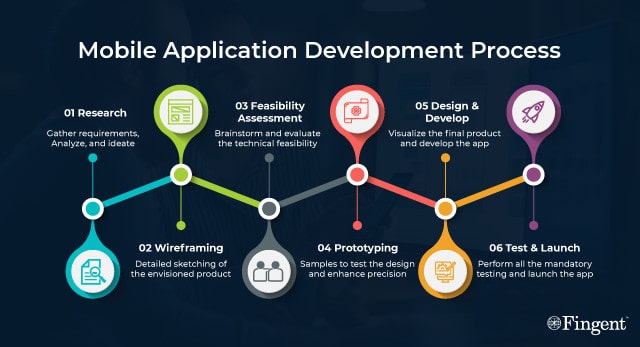
Here is an overview of the mobile app development lifecycle:

  • Research: All apps begin with an idea. However, it can be successful only when that idea benefits the customer. Ensure that your analysis includes the demographics, motivations, and behavior patterns of your buyers.
  • Wireframing: Drawing a detailed sketch of the envisioned product will help you uncover usability issues. After sketching, wireframing will help refine your idea and organize all components.
  • Assess technical feasibility: Asking questions, brainstorming ideas, and reviewing the status will help your team decide the initial functionality’s feasibility.
  • Prototype: This step will help you see if you are moving in the right direction. It will also allow different stakeholders to have a first look at your app and validate the information you have gathered.
  • Design: Create multiple variations of the screen. The clear visual direction will help you visualize the final product.
  • Develop: This is the core phase of the app development process, where you actually develop the mobile app.
  • Testing: The app is delivered to users to test the user experience. Their feedback and opinions will help you add what your app lacks from their point of view.
  • Launch: Publish your app to the app store. However, plan regular maintenance to fix bugs and enhance user experience.
mobile application development

Having understood the lifecycle of mobile app development, it is vital to learn how ‘front-end’ and ‘back-end’ fit into mobile application development.

Mobile Application Front-end and Back-end

Mobile application front-end and back-end services are two core components of the mobile application.

The mobile front-end (client-side rendering) is the visual and interactive part of the user’s application. In contrast, the back-end (server-side rendering) delivers high-quality mobile applications that delight and retain users. The mobile app’s back-end stores, secures, and processes the data.

Some of the key front-end jobs include web designing, UI designing, UX designing, and front-end development. Back-end developers create the services to process the business logic and access the database, cloud services, and file servers to render the app on the server-side.

For applications where there is no interaction with a server, the role of the back-end and front-end developers can be performed by one person. For applications that require internet connection and interaction with a server, you will need two separate developers for each component.

Read more: Everything a CEO Needs to Know About Software Development Outsourcing

software development outsourcing

End-to-end Mobile App Testing

To stay on top of the competition in the mobile application market, you must test your application before starting the actual sprint. Here are nine steps to ensure the success of your mobile application:

  • A developer must outline the list of all the cases and create a test plan.
  • Decide whether the test will be manual or automated.
  • Define test cases for different functionalities.
  • Begin with exploratory manual testing as it does not require the initial investment.
  • After detecting the patterns of outcomes and the frequency, consider automating the predictable ones.
  • Start the sprint with usability and beta testing.
  • Access the performance of the entire system.
  • Conduct security and compliance tests to deal with exceptions and unpredictable situations.
  • Launch the application to the app store and fix any issues.

These steps of mobile application testing ensure the efficient and enjoyable performance of the entire system.

Read more: Mobile app development: 4 tips to consider 

Mobile app development

The Cost to Develop a Mobile App

Ballparking the cost of mobile app development is anything but straightforward. Partly, it depends on your choice to develop it in-house or to hire an app development agency. Building an in-house team will incur additional costs such as office space, hardware, and software requirements.

On the other hand, if you choose to hire a mobile app development agency, you can enjoy a cost-efficacy and competitive advantage. These include the agency’s location, experience, and size. It also consists of the complexity of your app and back-end scalability.

Read more: Are you planning to develop a mobile application for your business? Then explore our template and share your requirements with us. We will get back to you with a ballpark estimate.

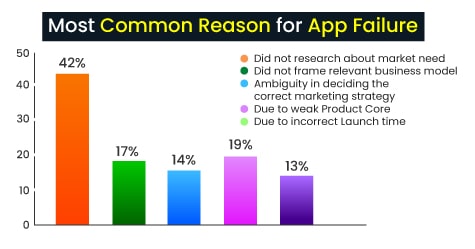
Five Reasons Why Mobile Apps Fail and How to Prevent The Let-down

Though mobile application development technologies advance year over year, the failure of mobile applications has been a concern for entrepreneurs. However, only ill-planned and ill-executed apps are set to fail.

It is critical to identify the pitfall areas and turn them into positives. Here are a few reasons that can lead to poor mobile applications. You will also find a few tips that help you to avoid mobile application failure.

1. Lack of market research

A tiny mistake in mobile app adoption can quickly turn into a major disaster. If your app does not address your target market needs, then it will not get downloaded. Even if it is downloaded, it may not be used after the first try. A great dream can thus quickly turn into a nightmare that leads to disappointment.

What can you do?

First, do not rush into creating a mobile app. Instead, begin your mobile app development by conducting detailed user study /market research. For your research to be effective, ask yourself, ‘which solution will my app provide that my target audience needs?’

To answer that question, you must define your target audience and investigate further about them. Understanding your market and your specific users will help you create an app tailored to what they actually need.

Second, know your competition. Do a competitor analysis to improve your mobile strategy. Doing so will help connect your idea with your target audience.

2. Lack of robust mobile app strategy

Without a well-designed strategy, your app will fail. This is especially true if you are new to the industry. A poor move at the strategy level is one of the key reasons for mobile app failure.

What can you do?

Every successful mobile app development is a result of a great strategy. It is a creative effort to incorporate consumers’ needs into an app that can accomplish a specific task quickly and effectively. Goal setting is an essential step. Here are some questions you can ask yourself:

  • What will be my mobile app’s selling point?
  • What features should I incorporate?
  • What benefits will my app offer the user?

Such clearly defined goals will help you quickly map out your strategy.

3. Lack of good design

Poor app design and development can lead to bad business because users will ditch your app in the first crucial 8 seconds if the design isn’t great. Substandard coding and improperly implemented technology will lead to epic failures.

What can you do?

Remember, great design can bring in happy customers. Unfortunately, skipping the testing process is often the reason why some apps fail. Smart mobile app developers take time to conduct several QA tests throughout the creation of your app. This will help you deliver an app that is bug-free and user-friendly.

4. Failure to execute the plan precisely

You may encounter some serious competition in your industry. Or your team may experience some conflicting priorities from some key members. Another possibility is that you may run out of cash.

What can you do?

  • Your mobile app can succeed if you have an original idea to offer something appealing to your target audience
  • Ensure to work with people whom you can trust. And cooperate with your mobile app development partner
  • Have a conservative budget that is well planned and generously funded

Following these steps will ensure that you have the money to build and launch your app successfully.

5. Failure to market your app

After all the hard work, it might still fail if you do not market your app rigorously.

What can you do?

  • Have a crystal-clear marketing message aimed at your target customers
  • Focus on the solution
  • Explain how your target user can benefit from it
  • If possible, plan to offer discounts and other perks to attract users

Marketing your app clearly and effectively will ensure that your customers do not move on to your competition.

Tips for Building Successful Mobile Apps

Did you know that, on average, a user spends 20 minutes on a mobile app each day? Another incredible fact is, the app installs increased by 31% in 2021. Furthermore, it is expected to surge in the coming years. This means there is hope for your app. Read on to find out how to approach building a successful mobile app that achieves your business goals.

  • Be Agile but know your limits:  Being agile and quickly reacting to the ever-changing needs of our customers leads to success, but it comes with a price. It is important to know when to be agile.
  • Be alert to risks: Be enthusiastic and optimistic about your product but be realistic about the risks and problems. Identifying the risks early will help you react faster and more accurately.
  • Build trust: Make your users feel unique and appreciated. Transparency and trust are the foundation for genuine interactions between the application and its users. To achieve this, you can create a trustworthy rating or review system and a functional service system.

Read More: Building a Business Mobile App in 2021? Here’s What You Need to Know

Mobile App

Develop Your Mobile Application with Fingent

The increasing adoption of remote work culture, online shopping, telemedicine, and e-learning has surged the demand for portable devices, particularly smartphones and tablets. This again has increased the need for mobile apps across all lines of business. According to App Annie’s forecast, the number of mobile app installs will reach 258 billion by 2022, an incredible 45% rise from 2019.

Fingent specializes in mobile app development, and our experts can help position your app for success right from idea to launch. In addition, leading B2B review firms like Clutch and Business of Apps have recognized our mobile app development expertise. Contact us to know more.

Stay up to date on what's new

    About the Author

    ...
    Girish R

    Girish is a seasoned technology leader with over 17 years of industry experience. As the Head of Mobile App Development at Fingent, he leads the delivery of innovative, high-performance mobile solutions that help businesses stay ahead in a rapidly evolving digital landscape. As an active tech blogger, Girish is passionate about exploring and writing on emerging technologies, open-source platforms, mobile ecosystems, and the latest advancements in the world of gadgets and innovation.

    Talk To Our Experts

      Mobile App Development – Complete Guide for 2026

      Introduction

      Mobile applications aren’t anymore a luxury or simply a channel to tout your business. More than 70% of our digital media time is consumed by smartphones today. Mobile apps claim 93% of the total time spent on a smartphone, while the remaining 7% of mobile time is consumed by web browsers. This proves why the demand for mobile application development services is intensifying year over year.
      A well-structured native iOS, native Android, hybrid, or cross-platform mobile app boosts your digital engagement, leading to long-term bottom lines such as unswerving customer loyalty and recurring sales. Though an astounding number of small and large businesses are experiencing the benefit of mobility, some are yet to build the right strategy. If you are planning to build a mobile app for your business or want to enhance your existing application, you’ve come to the right place.
      This blog covers the key aspects of mobile app development, including the development process, approaches, platforms, cost of development, and the tips to avoid failures and attain success with mobile app development. Let’s get started without further ado.

      What is Mobile Application Development?

      Mobile application development is the process of creating specific software applications that run on a mobile device (such as applications for smartphones and digital assistants), and utilize a network connection to work with remote computing resources. The development process involves creating installable software bundles, implementing backend services, and testing the application on target devices. In short, mobile app development is the strategic process of designing, building, and launching a mobile app successfully.
      The importance of building a business mobile app is growing rapidly as businesses across industries aim to meet user expectations and seek real-time, convenient ways to conduct transactions and access information. By the end of 2023, it is estimated that the total number of mobile app downloads will amount to 299 billion, worldwide.
      Data Source: Sensor Tower
      A well-structured mobile app helps you leverage all the benefits offered by the mobile device and the OS for which it is developed. The development process takes into account the limitations of mobile devices and allows you to balance cost with functionality.

      Top Mobile Application Development Platforms

      Mobile application development platforms bring together all the tools you would require to build your app from start to finish under a single umbrella, as a unified software offering. A mobile development platform saves your developer from juggling different software to complete various tasks involved in the development lifecycle. This prevents data loss and eliminates the risks caused by the wrong classification of data. Using a single software package to carry out the development process – from planning to UI/UX design and testing – saves your cost and time.
      Mobile application development platforms differ according to the operating system (OS) they cater to. Here is a list of the top mobile app development platforms:

      1. Android

      Sponsored by Google, the Android mobile OS is designed primarily for touchscreen mobile devices such as smartphones and tablets. As of July 2022, Android holds 44.46% of the mobile OS market share in the United States. The biggest advantage of Android OS is that its source code can be downloaded, customized, and distributed by anyone at no cost. The Android OS supports running multiple apps simultaneously on a single mobile device and offers immense flexibility to customize the UI during development to get the desired outcomes.

      2. iOS

      Unlike the Android OS that can run on numerous hardware brands, the iOS operating system is a proprietary software that runs only on Apple’s devices, such as iPhone or iPad. Developers can leverage the iOS Software Development Kit (SDK) to create mobile apps for Apple devices and distribute the apps through the App Store maintained by Apple Inc. As of July 2022, Apple’s iOS holds 55.22% of the mobile OS market share in the United States.

      3. Hybrid

      As the name suggests, a hybrid mobile application blends both native and web programming capabilities within a single application. It allows developers to build applications for multiple operating systems on a single platform. A hybrid application is written using the web technologies – HTML, CSS, and JavaScript – and then the code is embedded into a native application wrapper, which gives it the power of a true native application that can work efficiently on any native platform. Hybrid mobile development platforms are used by organizations that wish to reach a large audience base within a short time, so they don’t have to build two or more separate but similar applications for each OS type.

      Mobile Application Development Approaches

      Here are the top four mobile application development approaches adopted by businesses worldwide:

      1. Native Mobile Applications

      Native mobile apps are platform-specific applications developed using the programming languages, SDKs, tools, and frameworks provided by the platform itself. These apps are designed to run natively on the operating system (OS) of the device such as iOS or Android. As they are built to work on a specific OS or platform, native mobile apps are faster, more reliable, and offer offline capabilities.

      2. Hybrid Mobile Applications

      Hybrid mobile applications are built using standard web technologies such as JavaScript, CSS or HTML5. These apps combine the elements of both native as well as web applications. Some of the world’s leading apps such as Gmail, Twitter, Amazon, etc. are examples of hybrid apps. Developers can leverage plugins and APIs to integrate web technology with native app features. Hybrid mobile apps are faster to develop and easier to maintain.

      3. Cross-platform Mobile Applications

      A cross-platform mobile application works across platforms using a single code base which makes it compatible to run on different operating systems like Android, iOS, and Windows. A cross-platform app can be written using different programming languages and frameworks, but it’s compiled to run like a true native application running directly on the device’s OS. It’s easy to build and maintain cross-platform apps.

      4. Progressive Web Applications

      Progressive Web Applications (PWAs) present an alternative approach to traditional mobile app development by avoiding the need for app store delivery and installations. PWAs are cheaper, more secure, faster, and easier to develop. They operate via a browser, but act like native apps. PWAs provide users an “app-like” experience by leveraging a set of browser capabilities such as performing a background process, adding a link to the device home screen, and working offline.
      Each mobile application development approach has its own advantages and disadvantages. So, choose a method that matches your business purposes and strategy. Right choice helps you achieve the desired user experience and build the native features needed for your application.

      Top Mobile App Development Technologies

      Mobile app development technology refers to the various tools, frameworks, programming languages, components, libraries, and other technologies used to create applications that work on smartphones and portable connected mobile devices. Let it be native Android or native iOS, or a cross-platform app, you need to familiarize yourself with the leading technologies and frameworks that power your app.
      Here are some of the top mobile app development technologies that dominate the market in 2022:
      React Native

      React Native offers a best-in-class JavaScript library for building native user interfaces for your iOS and Android apps, using a single code base that can be shared across all platforms. It allows developers to iterate at lightning speed and create truly native apps without compromising your user experiences.

      Flutter

      This software is distributed freely to the users on a trial basis, usually with a limited-time offer. After that, the users are expected to pay if they want to continue to use this application software. Some examples of shareware are WinZip, SnapTouch, and Adobe Acrobat.

      Xamarin

      Xamarin is an open-source mobile app platform for the .NET which offers tools and libraries specifically for building apps for Android, iOS, tvOS, watchOS, macOS, and Windows.

      Swift

      If you are building something specific to Apple OS (native to Apple), Swift is the language to seek. Swift is a popular iOS application development language that offers advanced features with minimal coding that can be easily maintained. Swift is a powerful and intuitive language loved by Apple developers who use it for macOS, iOS, watchOS, tvOS, and so on.

      Ionic

      Ionic is a modern, open-source mobile development framework that offers seamless app UX across iOS, Android, and the Web from a single shared codebase. Ionic is built on top of Angular JS and Apache Cordova. Ionic is the easiest way for web developers to build, grow, and scale cross-platform mobile apps.

      Apache Cordova

      Apache Cordova is a free and open-source mobile development framework that leverages HTML, CSS, and JS to target multiple platforms with one code base. The framework is an ideal choice if you want to extend your application across more than one platform, without having to re-implement it with each platform's language and tool set.

      Sencha Ext JS

      Sencha Ext JS is a highly comprehensive JS framework for building data-intensive, cross-platform web and mobile applications for any modern device. It offers numerous enterprise-ready tools, components, and libraries to create stunning mobile and web applications.

      The list of mobile app development frameworks and tools is expanding day by day. To choose the right development technology for your mobile app, you need to consider factors such as platform feature support, speed considerations, cost of development, security risk, efficiency of the app, and after launch updates.

      Mobile Application Development Process

      With all the facts and trends substantiating the significance of business mobile apps in 2022, it is important to look at the mobile application development process step-by-step.
      Here is an overview of the mobile app development lifecycle:

      Mobile Application Front-End and Back-End

      Front-end and back-end are two interconnected core components of a mobile application.
      The mobile front-end (client-side rendering) is the visual and interactive part of the mobile application that a user interacts with, while the back-end (server-side rendering) stores, secures, and processes the data.
      Some of the key front-end jobs include web designing, UI designing, UX designing, and front-end development. Back-end developers create the services to process the business logic and access the database, cloud services, and file servers to render the app on the server-side.
      For applications where there is no interaction with a server, front-end and back-end developer roles can be performed by one person. For applications that require internet connection and interaction with a server, you need to hire separate developers for developing each component.

      End-to-end Mobile Application Testing

      To stay on top of competition in the mobile application market, you must test your application before starting the actual sprint. Here are nine steps to ensure the success of your mobile application:
      These steps of mobile application testing ensure efficient performance of the entire software system.

      White Paper

      Have you selected the right mobile app development approach? If not yet, download our white paper to learn more about native, hybrid, cross-platform, and progressive apps.

      How Custom Mobile Apps Help Grow Your Business

      Custom mobile apps are tailor-made applications created to address the requirements of a specific audience rather than a massive group of people. Custom mobile app development provides the functionality and features that plain off-the-shelf solutions cannot. Compared to pre-packaged, canned solutions, customized applications offer the following benefits:
      Custom mobile app development reduces your TCO by automating repetitive manual tasks, increasing employee productivity, lowering integration costs, and quickly accommodating new changes or processes. PricewaterhouseCoopers (PwC), one of our prominent customers, reported an 80% increase in productivity and a 67% faster ticket resolution rate after Fingent helped them implement a mobile-based smart ticketing system.
      If you are looking for a tailor-made mobile app that can simplify your business operations and enhance your customer experience,
      take a look at our case studies.

      The Cost to Develop a Mobile App

      Mobile app development cost hinges on several factors. Arriving at a ballpark figure depends on whether you want to develop the app in-house or outsource your project to an external app development agency, or if you want to modernize your existing legacy system. Building an in-house team incurs additional costs, such as renting an office space, hiring new employees, and meeting hardware and software requirements.
      The cost of developing a mobile app largely depends on its features and functionalities. The price also hinges on various other factors such as the development team’s size, number of devices and platforms supported by the app, and more. Here are a few aspects that decide the cost of your mobile application.

      1. Features of The App

      Before starting the development project, find out what you expect the application to do. What type of features do you like to include? What are the different functionalities that you are planning to cover? Having more features and functionalities means paying a higher price to your developer. Make a precise list of features and functionalities you would like to include as it influences your app development cost.

      2. Different Devices and Platforms

      Regardless of the type of application you develop, ensure that your app is compatible with the latest and earlier versions of the device’s OS you are opting for. If your app has more screens, you will need better design and user experience to make your app easily navigable. So the development cost also depends on the device OS and platform selection.

      3. Native or Cross-platform Development

      Both native and cross-platform development methods have their own pros and cons, specifically with respect to the development cost. Cross-platform gives your mobile app a uniform look and feel across all the OS that you target and is highly reusable through multiple OS. A native app, on the other hand, offers 100% hardware support and allows you to access the inbuilt capabilities of a user’s device, without sacrificing on the design elements unique to the native platform.
      Native mobile app development cost is higher than cross-platform or hybrid due to its exceptional personalization features, speed, performance, and platform-specific advantages. However, if you want to launch a mobile app quickly at minimal development cost, a cross-platform approach is the right choice. In simple words, the cost of developing a mobile app differs on a case-to-case basis.

      4. In-house Development or Outsourcing

      Arriving at a ballpark estimate also depends on whether you want to develop your mobile app in-house or outsource your project to an external app development agency. Building an in-house team incurs additional costs such as renting an office space, hiring new employees, and meeting hardware and software requirements.
      When you choose to outsource your work to a mobile app development company, you can enjoy cost efficacy and competitive advantage. Consider the agency’s location, technical and industry expertise, previous projects, size, turnaround speed, and references from their clients before engaging them. You should also define the scope and complexity of your app and back-end scalability requirements before employing a third-party developer.

      More insights on mobile app development cost:

      Are you planning to develop a mobile application for your business? Explore our template and share your requirements with us. Our team will get back to you with a ballpark estimate.

      Five Reasons Why Mobile Apps Fail and How to Prevent the Letdown

      Though mobile application development technologies advance year over year, failure of mobile applications is a major concern for entrepreneurs. Only poorly-executed and ill-planned apps are subject to fail in the market. Here are five pitfalls you should avoid to prevent your app from losing out:

      1. Lack of Market Research

      If your mobile app does not address the needs of your target market, it will not enjoy sufficient downloads. Data shows that 80 to 90% of mobile apps downloaded are abandoned after the first use.
      The solution?
      First, do not rush into creating a mobile app just because your business needs it. Conduct a detailed market study to understand what your users actually need. Ask yourself, “Which solution should my app provide that my target audience needs?”
      To answer that question, you must define your target audience and analyze their buying patterns, online behavior, and overall customer habits. This will help you create a mobile app tailored to your goals and customer needs.
      Second, know who your competitor is. Do a competitor analysis to improve your mobile strategy and connect your idea with your target audience.

      2. Absence of a Robust Mobile Strategy

      A poor strategy can fail your app. It takes a bit of creativity and thoughtfulness to incorporate customer needs into a mobile app that can accomplish a specific task quickly and effectively. Proper goal setting improves your mobile app strategy. Here are some questions you can ask yourself:
      Clearly defined goals are crucial in mapping out a robust mobile app strategy.

      3. Poor App Design

      Users will ditch your app in the first eight seconds if they find your app’s design and usability unappealing. Substandard coding and outdated technology can cause epic failures.
      What can you do?
      Remember, great designs bring happy customers. Nearly 58% of iOS apps failed in 2021 due to insufficient testing. Smart mobile app developers take time to conduct several QA tests throughout the different phases of app creation. End-to-end testing ensures that your app is bug-free, user-friendly, and intuitive.

      4. Failure to Execute the Plan Precisely

      It’s common for new business owners to encounter aggressive competition, manage conflicting priorities, or run out of cash. How can you resolve these predicaments and launch your mobile app?

      5. Failure to Market Your App

      After all the hard work, it might still fail if you do not market your app rigorously. Here are a few tips to boost your marketing efforts:

      Tips to Build Successful Mobile Apps

      billion
      $ 0

      According to a report from data.ai, the global app downloads reached 37 billion in the first quarter of 2022, with the biggest ever consumer spending on apps hitting a whopping $33 billion. The message is clear. There is hope for every mobile app. Here are three important tips to help you approach app building with confidence.

      Staying agile and responding quickly to the ever-changing customer needs take you to success, but it comes with a price. It is important to know when to be agile. So pursue realistic goals.
      It is good to be enthusiastic and optimistic about your product, but be wary of the risks and problems. Identifying the risks early will help you react faster and more accurately.
      Make your users feel unique and appreciated. Transparency and trust boosts genuine interactions between your application and its users. To achieve this, you can create a trustworthy rating or review system and a functional service system.

      Develop Your Mobile Application with Fingent

      As we enter the second half of 2022, it’s evident that mobile is the key to success. Investing in a mobile app is the most effective way to match your business model to your key audience’s behavior. If you are an influential enterprise with an active mobile app in the market, your mobile app growth strategy should focus on improving your existing product and deliver more value to customers.
      Fingent specializes in mobile app development and our experts can position your app for success, right from idea to launch. Leveraging insights from the above mobile app development tips and guidelines can help you get a leg up on the competition, cut costs, improve your brand’s visibility, and engage your customers in incredible ways. Contact us to know more.

      Stay up to date on what's new

        About the Author

        ...
        Girish R

        Girish is a seasoned technology leader with over 17 years of industry experience. As the Head of Mobile App Development at Fingent, he leads the delivery of innovative, high-performance mobile solutions that help businesses stay ahead in a rapidly evolving digital landscape. As an active tech blogger, Girish is passionate about exploring and writing on emerging technologies, open-source platforms, mobile ecosystems, and the latest advancements in the world of gadgets and innovation.

        Talk To Our Experts

          A niche business is no longer a term used often these days due to growing competition in every sector. In the world of startups and well-established enterprises, the companies that stand out clearly in front of their customers will only survive and succeed. Smartphones and fast data packs are beneficial to companies in terms of reaching out to their customers via desktop and mobile websites. But having such a front is a norm today and you will have to think of giving a little more to engage them. According to studies, business mobile apps have a higher rate of conversation when compared to desktop or mobile websites. You must be thinking how will a custom mobile application development help boost your business? Here’s how –

          1. Better customer relationship

          it solutions provider

          A custom business app offers customers a way to access your services and products directly. Especially, if you are a product-oriented company, you can have your products laid out better over the standard formats of e-retailers. Also, you can send offers, notifications, and even receive feedback from customers in real-time. You can even have a dedicated app team that offers support 24 x 7 and sorts query for customers with in-app emails and chat.

          2. Creating and maintaining database

          A custom app will give you the opportunity to access existing customer data and acquire new ones. Also, your app will have your own specialized security features that will safeguard your data against potential leaks and threats.

          3. Integration with current services

          If you are a software provider then a good way to offer more to your clients is by creating a custom app that syncs with your software. There can be reports, updates, and even a way to access information quickly and easily. To further improve client satisfaction, you can even hire a dedicated support team for app management. Such integration will definitely give your software some extra brownie points while marketing it.

          4. Generate revenue

          mobile application development

          Apps are not just a great way to connect with your customers but can also work as a good revenue source for the business. You can charge customers a little extra for app services or an upgrade. Also, you can have in-app advertisements that add income to your kitty whenever your app is accessed by the customers.

          5. Increase customer base

          An app ensures that a customer is in your space and the only things they can surf around are your products and services. Having a custom app gives you a chance to put your case forward to new customers and even attract them with in-app offers. You can start giving them free trials and additional discounts via app downloads to add to your revenue. A custom app will define your uniqueness as it adds up to a brand identity for your business.

          6. Project Management

          Apart from seeking and retaining customers, your entire team can benefit from having an app that works for internal purposes only. Custom logins at each hierarchy can give them access to groups, documents, tasks, calendars, and more to run your business smoothly no matter where they are working from. This is beneficial especially if you have several teams working from different locations. Each team can receive updates regarding the project. Also, it helps in sending critical issues to all the personnel quickly.

          Building a custom mobile app for your business is vital in this day and age of competition. Once you are clear about what you want, it’s a good idea to approach companies such as ours that build custom apps from the ground up.

          Stay up to date on what's new

            About the Author

            ...
            Ashmitha Chatterjee

            Ashmitha works with Fingent as a creative writer. She collaborates with the Digital Marketing team to deliver engaging, informative, and SEO friendly business collaterals. Being passionate about writing, Ashmitha frequently engages in blogging and creating fiction. Besides writing, Ashmitha indulges in exploring effective content marketing strategies.

            Talk To Our Experts

              ×