Tag: Mobile Application Development
A comprehensive guide to developing mobile apps in 2021 and beyond!
- Introduction
- What is Mobile Application Development
- Types of Mobile Applications
- Mobile Application Development Platforms
- Mobile Application Development Process
- Mobile Application Front-end and Back-end
- End-to-end Mobile App Testing
- The Cost to Develop a Mobile App
- Five Reasons Why Mobile Apps Fail and How to Prevent The Let-down
- Tips for Building Successful Mobile Apps
- Develop Your Mobile Application with Fingent
Introduction
Mobile apps – it seems like the world cannot function without them anymore! 2021 has seen a dramatic shift to online shopping. Increased reliance on the digital world pushes businesses to turn to mobile apps to tap a higher customer base. This makes it imperative for businesses to leverage the benefits of mobile application development. Regardless of their size, all businesses can use mobile application development to improve their revenues.
This blog will help you understand all that you must know about mobile application development. We will give you a basic idea of the app development process, different types of mobile apps, and the cost of developing mobile apps.
What is Mobile Application Development?
Mobile application development is the process of creating specific software applications that work on mobile devices. It involves creating installable software bundles, implementing back-end services, and testing the application on target devices. Mobile application development is also about the strategic process of designing, building, and launching a successful mobile app.
Mobile app development is a technique that leverages all the benefits a mobile device has to offer. This process takes into account the limitations of mobile devices and helps businesses to balance cost with functionality.
Types of Mobile Applications
Mobile applications are designed and developed with various frameworks. These include:
1. Native mobile apps
These are developed exclusively for a single platform written on one programming language for a particular operating system, for example, Android mobile apps or iOS mobile apps. As they are built to work on a specific OS or platform, native mobile apps are faster, more reliable, and offer offline capabilities.
2. HTML5 mobile apps
These apps help you enjoy the write-once-run-anywhere approach. Most of the Zoho apps are built using HTML 5. HTML5 mobile apps are compatible with cross-platforms and are cost-effective.
3. Hybrid mobile apps
These apps consist of back-end code and native viewer capabilities. Some of the world’s leading apps, like Gmail, Twitter, Amazon, etc., are hybrid apps. Hybrid apps can take advantage of plugins that allow developers to access the native features of platforms. In addition, they are faster to develop and simple to maintain.
Read more: Hybrid Mobile Apps: When and Why to Choose It For Your Business

4. Progressive web apps
Progressive web apps operate in a browser but act like native mobile apps. This means that no installation is involved, and PWAs are secure, cheaper, faster, and easier to develop.
Each mobile application development approach has its own advantages and disadvantages. Hence choose a method that matches your strategy. Your choice will help you achieve the desired user experience and build native features needed for your application.
Watch video: How To Choose The Right Mobile App Development Approach
Mobile Application Development Platforms
Two important mobile application platforms are iOS and Android. iOS is Apple’s mobile operating system specifically built for iPhones. Android runs on mobile devices manufactured by Google and various OEMs. Though there are many similarities between the two, each of them uses a different software development kit. For example, some of the top Android programming languages include Java, Kotlin, C++, C#, BASIC, Lua, etc. Examples of leading iOS programming languages include Swift, Objective-C, React Native, Flutter, etc.
Besides Android and iOS mobile application development platforms, there are cross-platform development programs such as Apache Cordova, Xamarin, Ionic, Python, Ruby, etc.
Read more: Top Technologies Used to Develop Mobile Apps
Leading mobile application development companies like Fingent help you choose the right combination of programming languages and SDKs for developing your mobile apps.
Mobile Application Development Process
Even with all the evidence pointing in favor of developing an app, it is important to thoroughly run through the mobile application development process. This will help you understand how your application will fit in with your goals and your market niche. Choose a path that will give shape to your vision.
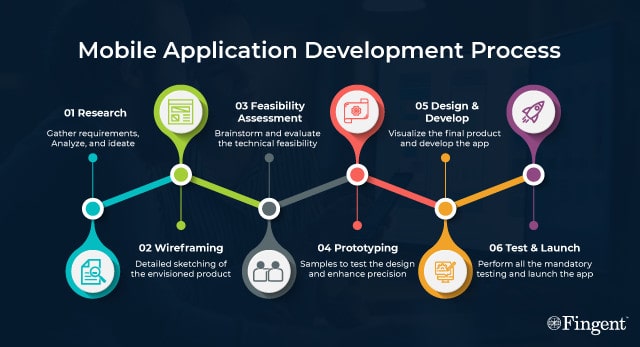
Here is an overview of the mobile app development lifecycle:
- Research: All apps begin with an idea. However, it can be successful only when that idea benefits the customer. Ensure that your analysis includes the demographics, motivations, and behavior patterns of your buyers.
- Wireframing: Drawing a detailed sketch of the envisioned product will help you uncover usability issues. After sketching, wireframing will help refine your idea and organize all components.
- Assess technical feasibility: Asking questions, brainstorming ideas, and reviewing the status will help your team decide the initial functionality’s feasibility.
- Prototype: This step will help you see if you are moving in the right direction. It will also allow different stakeholders to have a first look at your app and validate the information you have gathered.
- Design: Create multiple variations of the screen. The clear visual direction will help you visualize the final product.
- Develop: This is the core phase of the app development process, where you actually develop the mobile app.
- Testing: The app is delivered to users to test the user experience. Their feedback and opinions will help you add what your app lacks from their point of view.
- Launch: Publish your app to the app store. However, plan regular maintenance to fix bugs and enhance user experience.
Having understood the lifecycle of mobile app development, it is vital to learn how ‘front-end’ and ‘back-end’ fit into mobile application development.
Mobile Application Front-end and Back-end
Mobile application front-end and back-end services are two core components of the mobile application.
The mobile front-end (client-side rendering) is the visual and interactive part of the user’s application. In contrast, the back-end (server-side rendering) delivers high-quality mobile applications that delight and retain users. The mobile app’s back-end stores, secures, and processes the data.
Some of the key front-end jobs include web designing, UI designing, UX designing, and front-end development. Back-end developers create the services to process the business logic and access the database, cloud services, and file servers to render the app on the server-side.
For applications where there is no interaction with a server, the role of the back-end and front-end developers can be performed by one person. For applications that require internet connection and interaction with a server, you will need two separate developers for each component.
Read more: Everything a CEO Needs to Know About Software Development Outsourcing

End-to-end Mobile App Testing
To stay on top of the competition in the mobile application market, you must test your application before starting the actual sprint. Here are nine steps to ensure the success of your mobile application:
- A developer must outline the list of all the cases and create a test plan.
- Decide whether the test will be manual or automated.
- Define test cases for different functionalities.
- Begin with exploratory manual testing as it does not require the initial investment.
- After detecting the patterns of outcomes and the frequency, consider automating the predictable ones.
- Start the sprint with usability and beta testing.
- Access the performance of the entire system.
- Conduct security and compliance tests to deal with exceptions and unpredictable situations.
- Launch the application to the app store and fix any issues.
These steps of mobile application testing ensure the efficient and enjoyable performance of the entire system.
Read more: Mobile app development: 4 tips to consider

The Cost to Develop a Mobile App
Ballparking the cost of mobile app development is anything but straightforward. Partly, it depends on your choice to develop it in-house or to hire an app development agency. Building an in-house team will incur additional costs such as office space, hardware, and software requirements.
On the other hand, if you choose to hire a mobile app development agency, you can enjoy a cost-efficacy and competitive advantage. These include the agency’s location, experience, and size. It also consists of the complexity of your app and back-end scalability.
Read more: Are you planning to develop a mobile application for your business? Then explore our template and share your requirements with us. We will get back to you with a ballpark estimate.
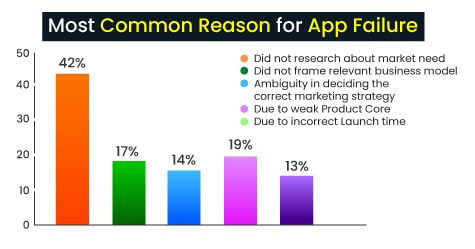
Five Reasons Why Mobile Apps Fail and How to Prevent The Let-down
Though mobile application development technologies advance year over year, the failure of mobile applications has been a concern for entrepreneurs. However, only ill-planned and ill-executed apps are set to fail.
It is critical to identify the pitfall areas and turn them into positives. Here are a few reasons that can lead to poor mobile applications. You will also find a few tips that help you to avoid mobile application failure.
1. Lack of market research
A tiny mistake in mobile app adoption can quickly turn into a major disaster. If your app does not address your target market needs, then it will not get downloaded. Even if it is downloaded, it may not be used after the first try. A great dream can thus quickly turn into a nightmare that leads to disappointment.
What can you do?
First, do not rush into creating a mobile app. Instead, begin your mobile app development by conducting detailed user study /market research. For your research to be effective, ask yourself, ‘which solution will my app provide that my target audience needs?’
To answer that question, you must define your target audience and investigate further about them. Understanding your market and your specific users will help you create an app tailored to what they actually need.
Second, know your competition. Do a competitor analysis to improve your mobile strategy. Doing so will help connect your idea with your target audience.
2. Lack of robust mobile app strategy
Without a well-designed strategy, your app will fail. This is especially true if you are new to the industry. A poor move at the strategy level is one of the key reasons for mobile app failure.
What can you do?
Every successful mobile app development is a result of a great strategy. It is a creative effort to incorporate consumers’ needs into an app that can accomplish a specific task quickly and effectively. Goal setting is an essential step. Here are some questions you can ask yourself:
- What will be my mobile app’s selling point?
- What features should I incorporate?
- What benefits will my app offer the user?
Such clearly defined goals will help you quickly map out your strategy.
3. Lack of good design
Poor app design and development can lead to bad business because users will ditch your app in the first crucial 8 seconds if the design isn’t great. Substandard coding and improperly implemented technology will lead to epic failures.
What can you do?
Remember, great design can bring in happy customers. Unfortunately, skipping the testing process is often the reason why some apps fail. Smart mobile app developers take time to conduct several QA tests throughout the creation of your app. This will help you deliver an app that is bug-free and user-friendly.
4. Failure to execute the plan precisely
You may encounter some serious competition in your industry. Or your team may experience some conflicting priorities from some key members. Another possibility is that you may run out of cash.
What can you do?
- Your mobile app can succeed if you have an original idea to offer something appealing to your target audience
- Ensure to work with people whom you can trust. And cooperate with your mobile app development partner
- Have a conservative budget that is well planned and generously funded
Following these steps will ensure that you have the money to build and launch your app successfully.
5. Failure to market your app
After all the hard work, it might still fail if you do not market your app rigorously.
What can you do?
- Have a crystal-clear marketing message aimed at your target customers
- Focus on the solution
- Explain how your target user can benefit from it
- If possible, plan to offer discounts and other perks to attract users
Marketing your app clearly and effectively will ensure that your customers do not move on to your competition.
Tips for Building Successful Mobile Apps
Did you know that, on average, a user spends 20 minutes on a mobile app each day? Another incredible fact is, the app installs increased by 31% in 2021. Furthermore, it is expected to surge in the coming years. This means there is hope for your app. Read on to find out how to approach building a successful mobile app that achieves your business goals.
- Be Agile but know your limits: Being agile and quickly reacting to the ever-changing needs of our customers leads to success, but it comes with a price. It is important to know when to be agile.
- Be alert to risks: Be enthusiastic and optimistic about your product but be realistic about the risks and problems. Identifying the risks early will help you react faster and more accurately.
- Build trust: Make your users feel unique and appreciated. Transparency and trust are the foundation for genuine interactions between the application and its users. To achieve this, you can create a trustworthy rating or review system and a functional service system.
Read More: Building a Business Mobile App in 2021? Here’s What You Need to Know

Develop Your Mobile Application with Fingent
The increasing adoption of remote work culture, online shopping, telemedicine, and e-learning has surged the demand for portable devices, particularly smartphones and tablets. This again has increased the need for mobile apps across all lines of business. According to App Annie’s forecast, the number of mobile app installs will reach 258 billion by 2022, an incredible 45% rise from 2019.
Fingent specializes in mobile app development, and our experts can help position your app for success right from idea to launch. In addition, leading B2B review firms like Clutch and Business of Apps have recognized our mobile app development expertise. Contact us to know more.
Stay up to date on what's new

About the Author

Featured Blogs







Stay up to date on
what's new



Talk To Our Experts




Stay up to date on what's new
About the Author
Featured Blogs
Stay up to date on
what's new
Talk To Our Experts
Leading Mobile App Development Frameworks in 2021
The COVID-19 forced social distancing and lockdown policies are driving a steady rise in mobile usage. In Q3 of 2020 alone, 33 billion new apps were downloaded globally, according to a recent report. Mobile users worldwide have spent 180 billion collective hours each month of the third quarter, with a whopping spend of $28 billion on technology apps. Undoubtedly, the pandemic would have a lasting impact on mobile app development trends and technologies going forward, just like how it transformed the consumer mobile behavior.
It is true that a well engaging and standout business app will enhance branding and retain customers. Every business that wants to sell its products, extend assistance, offer service, or share information will definitely strive to make its mobile app user-friendly and accessible to customers. Besides identifying how your mobile application will function or what resources you’ll require, it’s important to figure out which mobile development platforms or technology in mobiles will serve your needs better.
Watch Video: How to choose the right mobile app development approach
Let it be Android mobile apps development, iOS, hybrid, or cross-platform, you need to familiarize yourself with the mobile development application tech in vogue.
Five major programming languages used to develop mobile apps today
The five major programming languages that are largely used for mobile app development include:
1. Swift
If you are building something specific to Apple OS (native to Apple), Swift is the language to seek. Swift is a popular iOS application development language that offers advanced features with minimal coding that can be easily maintained. Swift is a powerful and intuitive language loved by Apple developers who use it for macOS, iOS, watchOS, tvOS, and so on.
2. C++
C++ forms the simplistic base for most of the programming languages and possesses the power to create dynamic technology apps. C++ is highly sought after today to develop multi-platform apps. You can write code in C++ to develop the application once and use it on different platforms (Android, iOS, and Windows) without sacrificing the app’s performance or security. The simple and effective compiler-based approach makes it a versatile tool that can be used for multiple platforms. Its sister language, Objective-C, was earlier used for app development in Apple systems, prior to the introduction of Swift in 2014.
3. Java
Since the introduction of Android in 2008, this object-oriented programming language has been the popular and official language for Android mobile app development. An extremely versatile language, Java helps keep your app flexible, modular, and extensible. Java is easy to handle and many open source libraries are made available for users to choose from.
4. HTML5
There is no better technology to use than HTML5 if your organization is looking at developing web-frontend applications for mobile devices. Organizations that consider cross-platform mobile app development as a daunting task often resort to HTML5 as it helps you deliver the right functionality and exceptional user experience. The “write-once-run-anywhere” advantage offered by HTML5 accelerates your time to market, improves your app’s visibility, makes development affordable, and supports offline browsing.
5. PHP
A rather easy language to learn, PHP is object-oriented and uses a three-layered model to help create dynamic mobile apps and web applications. It is highly suitable for apps that require database integration. Popular PHP frameworks such as Laravel, Lumen, CodeIgniter, and Symfony are being used extensively for building mobile apps that require complex backend and exhaustive data migration. Large scale app projects prefer this open-source language a lot as it simplifies caching, authentication, and even routing.
A host of advanced technology tools are available for those who are looking forward to creating their own mobile apps using these programming languages. These developer tools are perfect for building mobile apps from scratch and even offer multi-platform capabilities for reaching larger audiences.
Read more: How to Empower your Business with an iOS Application
Top tools that can help you get started with building your own mobile app
1. PhoneGap
PhoneGap, also known as Apache Cordova, is an open-source mobile app development framework that uses CSS3, HTML5, and JavaScript, to create native applications for Android, Windows, and iOS. This framework allows mixing native and hybrid code snippets which results in apps that are neither truly native mobile nor web-based applications.
2. Appcelerator
This open-source framework is the best choice to develop hardware-based apps. The framework uses HTML, PHP, and JavaScript to create native apps for iOS, Android, and Windows UWP.
3. RhoMobile
RhoMobile Suite is based on the powerful Rhodes open-source framework that supports native app development for multiple platforms. It’s highly used to build cross platform and native consumer and enterprise mobile applications. RhoMobile uses web technologies like CSS3, HTML5, JavaScript, and Ruby to build apps for most of the operating systems including iOS, Android, and Windows.
4. WidgetPad
WidgetPad is one of the best open-source frameworks for cross platform mobile application development. It uses web technologies like JavaScript and HTML5 to offer a multitude of options like source code editing, versioning, and distribution. This open-source framework enables developing applications for platforms like Android, iOS, and web.
5. MoSync
MoSync is an open-source multi-platform mobile app development kit that utilizes programming languages such as JavaScript, PHP, Ruby, and Python. It is integrated with Eclipse-based IDE and enables native mobile app development for multiple platforms using C/ C++ programming.
Case Study: Explore how a Video Making Mobile App developed by Fingent transformed our customer’s experience. Click here to download the case study!
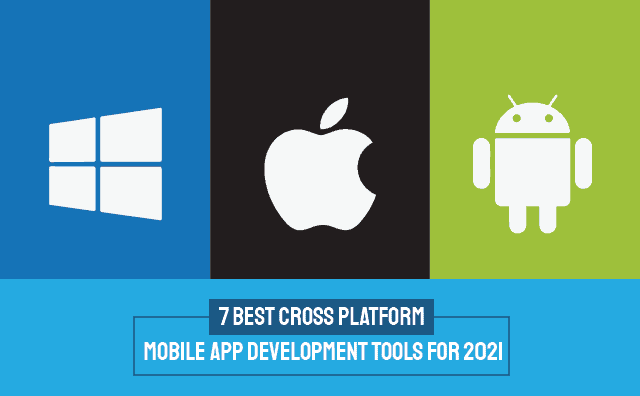
Leading mobile application development frameworks that developers need to explore in 2021
1. Flutter
Flutter is the new trending cross-platform mobile application development technology in town. It uses “Dart” as a programming language instead of JavaScript which facilitates rapid and effective analysis, fabricates UIs, includes highlights and fixes bugs in milliseconds. The open source cross-platform SDK by Google extends a wide range of plugins backed by Google and allows mobile apps to be built for both Android and Apple iOS platforms.
2. React Native
This JavaScript open-source framework has become the most preferred native mobile app development technology. It offers ample support to IDEs and other mobile app development tools and enables the development of native apps for iOS and Android platforms. ReactNative framework allows to build native mobile apps with JavaScript, using the same design as React. Apps built using React Native are real mobile apps, that cannot be distinguished from an app built using Objective-C or Java or Swift.
3. Ionic
Ionic uses the HTML5 programming language and is widely preferred for mobile app development today. It combines HTML, CSS3, and JavaScript to build native apps and create their UI functionalities with ease. This mobile app development technology works on iOS’s UIWebView or Android’s WebView. Ionic is built on top of Angular JS and Apache Cordova. Ionic is the easiest way for web developers to build, grow, and scale cross-platform mobile apps.
4. Xamarin
This cross-platform framework with coding advantages of C# uses single code across iOS, Android, Windows, and other platforms. With the benefits of code sharing, Xamarin builds applications that render exact native app experience. It is the most time and cost saving framework for mobile app development. Xamarin allows you to deliver native Android, iOS, and Windows apps with a single shared .NET code base. The framework offers access to the full spectrum of functionality exposed by the underlying platform and device, including platform-specific capabilities.
Get your FREE mobile app specification template here!
5. NativeScript
Originally developed by Progress (Telerik by Progress), NativeScript is one of the most desired open source frameworks to develop Apple iOS and Android apps today. NativeScript allows developers to build mobile apps using JavaScript or by any other language that trans-compiles to JavaScript (eg: TypeScript). Native API reflection, Angular integration, and Vue.js integration are some of the notable features of NativeScript. The framework also allows developers to re-purpose third-party libraries from Maven, npm.js, and CocoaPods into their apps without using any wrappers.
6. Felgo
Felgo, previously known as V-Play Engine is a popular cross-platform development framework used to create mobile games and apps. Felgo uses Qt as its core framework which simplifies the development of games and apps. With Felgo, you can create flexible and modern apps compiled natively from a single code-base for Android, iOS, Desktop, Web, and Embedded platforms.
7. Mobile Angular UI
Mobile Angular UI is an open source mobile framework that combines the best features of Angular js and Bootstrap 3 syntax, including the missing components of Bootstrap. It provides fresh UI components such as navbar, sidebars, modals and overlays, switches, etc. Since it makes use of Angular js and Bootstrap, it’s easy for developers to learn the framework and get started. Mobile Angular UI allows businesses to build HTML5 hybrid mobile and desktop apps with less effort.
Are you looking forward to building an innovative mobile app to boost your revenue?
Get your FREE mobile app specification template here!
Trends that will dominate the mobile app development arena in 2021
- Chatbots and voice assistants will automate the most frequent human interactions. AI integration will improve user engagement and save businesses a lot of money. It’s reported that by 2025, 95% of all customer interactions are expected to occur via channels that support Artificial Intelligence (AI).
- Statista reports that by 2022, the global AR headset shipments will cross 30 million units, which is 12 times more than the figures recorded in 2020. As Augmented Reality becomes highly pervasive today, critical industry fields such as training, safety, industrial maintenance, education, and healthcare will have to adopt AR-powered mobile/tablet apps.
- Increasing initiatives undertaken by e-commerce players in the recent years have spurred the growth of mobile wallets/ digital wallets such as Apple Pay, PayPal, and Amazon Pay. In the United States alone, mobile wallet market size is set to register a CAGR of 15% during 2020-2026. Convenience, ease of use, availability of inexpensive smartphones, and extensive promotion from banking service providers are some of the reasons that encourage shoppers and consumers to adopt mobile wallets.
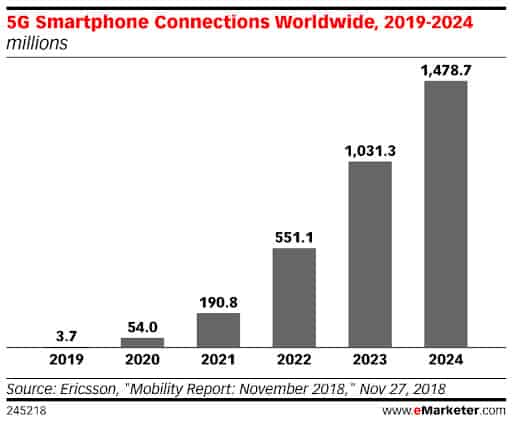
- The increasing consumer demand for faster data speed, low latency, enhanced user experience driven by Augmented Reality (AR) and Virtual Reality (VR), UHD videos, seamless video calling, and gaming experience will forcibly drive 5G adoption in 2021. Research discloses that the 5G services market is projected to grow at a CAGR of 43.9% during 2021-2027, with a revenue forecast of USD 414.50 Billion by 2027.
- Loading time affects your bottom line terribly. An e-commerce site that makes $100,000 a day will lose $2.5 million sales annually, even if there is a 1-second delay in its loading time. Accelerated Mobile Pages (AMP) plugin launched by Google is becoming a mandatory factor that determines your mobile site’s ranking. AMP-optimized web/ mobile pages will rank faster and better and own the double-chance of converting visitors into customers.
Read More: Mobile App Development : 4 Tips To Consider
Thus, we come to the conclusion that mobile apps have become the most convenient source of contact between businesses and customers. But when it comes to choosing the best technology to create exemplary mobile apps, there are multitudes of options. The best way is to have a ground plan and seek the help of a custom software development company like ours that offers full-cycle app development as per your requirement. Talk to our expert right away!
Stay up to date on what's new
About the Author
Featured Blogs
Stay up to date on
what's new
Talk To Our Experts
As we enter 19 years into the millennium, we find that Java has been running on 10 billion devices. The world is yet to witness innovative and user-friendly Java trends that will have a profound effect on application development in the year 2019!!
From peer-to-peer, open source and embedded to wireless and Juxtapose applications, Java has been the most popular programming language in the world of application development, with the highest rating of 16.746 percent, according to the Tiobe index!
A Retrospective Of Java Trends
Java so far has given a step-up to many of the light-weight programming platforms, as for Eclipse, Java Development Kit (JDK), the Oracle JDeveloper, as well as the Eclipse and other Open Source Applications. Let us take a look at the Java trends that made a breakthrough in application development.
-
Emergence Of EE4J and MicroProfile Projects
The Eclipse Foundation has emerged with pride with the introduction of projects like EE4J and MicroProfile.
MicroProfile has provided insight into how a more open Java EE community could flourish. Both Java EE and Spring technologies benefited out of this rise, by bringing accelerated innovation.
-
Emergence Of Kotlin
Kotlin, the JVM-compatible programming language has caught the strong attention of the Java/ Android community. Its concise coding syntax and interoperability with Java have already made it a hit in the world of application development. Kotlin is first-class support for Android and is expected to additionally improve its use for mobile application development in 2019!
-
Java SE 6 Updates And The OpenJDK 10 Release
2018 also witnessed the updates of Java SE 6. These updates, however, are not publicly available as yet! The code restores are only available through the Java SE Support program and in Solaris 10’s Recommended Patchset Cluster and were mainly a couple of security fixes. OpenJDK 10 was released on 20 March 2018, with the adoption of certain new features.
-
Ensuring Seamless Configuration Of Applications With Containers And Java Runtimes
The Collection framework has managed to leverage more benefits of the use of containers and Java runtimes. This offers a seamless configuration of Java applications and consistent memory management.
-
Frequent Alteration To Features – To Ensure A Well-Planned Application Development
Yet another major development was the introduction of a ‘six-month release’ interval.
This ensured frequent iterations and faster introduction of features to Java applications. These characteristics were decided to be made available through enterprising shops.
Technology Trends in Java – What To Expect In 2019
Java is a programing language that can run on nearly any system (Thanks to the platform-agnostic JVM!), it has started to get easier to use and scalable than ever before! Below are listed the major trends that we could predict for the year 2019.
-
Java Continues To Evolve – Java SE 10 Contribution
Java is a programming language that is used by more than 9 million developers. It contains extensive libraries that shape the whole enterprise application development. With the release of Java SE 10, which was created in close collaboration with the OpenJDK Community, came several new added features. Java is also ranked as the #1 developer choice for cloud, with over 12 million developers and over 21 billion cloud-connected Java virtual machines!!
-
Real-time Specification
The Real-time Specification for Java (RTSJ) is into existence.
Java creator, James Gosling, and Sun’s real-time guru, Greg Bollella have described embedded systems as “the new frontier in which predictable execution takes precedence” over other system attributes, such as speed, bandwidth, and payload-carrying capacity. They are promoting real-time Java applications for embedded use! With the RTSJ, they have managed to solve the language and runtime issues.
-
Project Juxtapose
Sun’s JXTA open source platform has gained ample acceptance among developers.
Using Project Juxtapose, Sun hopes to influence standards that will govern future Web services development. With this, Java developers will be able to focus their capability to contribute more for Java application development.
-
The Java Effect On Scripting Languages
Scripting languages such as Jython, which is a complete implementation of the Python language, is coded in cent percent Java. Python, Perl, and PHP to name a few other programming languages are receiving widespread attention.
-
Wireless Applications With Its Ease Of Use
Wireless application development in Java has gained noticeable traffic due to its open-source platform nature. The reason being Nokia, the world’s largest mobile telephone maker, has committed to using the open source Symbian OS for all of its future handsets!!
Both kinds of Wireless Java applications, Local and Network applications, is more challenging because they are developed on one platform (such as Solaris or MS Windows) but deployed on a totally different one (such as a cell phone or PDA). It is a concern that, while emulators enable developers to do some of their testings on the development platform, they need to test and evaluate the application in a totally different environment of a live wireless network. This is however made easy!!
-
Growing demand for Java developers
Java being a statically-typed language, it is faster and easier to maintain with fewer bugs. It is also backward compatible, which means old versions of the language will still run perfectly even after new versions are released. This is a big relief for businesses who would otherwise worry about rewriting their code every time a new version comes out. Coupled with its portability, developers know that investing in Java will pay dividends for a long, long time.
-
Mobile Application Development in 2019
In less than two years, the demand for mobile enterprise applications is estimated to rise five times faster!! Android currently dominates the smartphone market with 80.7% (compared to Apple’s 17.7%) and will continue its expansion! Java will, as a result, continue to be the driving force behind mobile application development trends!
-
The IoT Era And Java
The Internet Of Things is among the latest development trends in Java! As of now, Java is currently one of the few technologies that are capable of adding life to IoT. It is indeed true that Java’s future lies in the Internet of Things.
Mike Milincovich, Eclipse Foundation strongly believes that Oracle will help to develop a definite end-to-end storage data solution in 2019!! Like the Kona Project that is currently working on Java APIs for embedded systems.
The Java ME platform allows vendors to build secure mobile enterprise applications for the Internet of Things. The language is supported by the Intel IoT platform!
With all these advanced features and development, Java continues to grow and evolve. Java has undeniably achieved the top spot among the most popular programming languages in the world!
Stay up to date on what's new
About the Author
Featured Blogs
Stay up to date on
what's new
Talk To Our Experts
A niche business is no longer a term used often these days due to growing competition in every sector. In the world of startups and well-established enterprises, the companies that stand out clearly in front of their customers will only survive and succeed. Smartphones and fast data packs are beneficial to companies in terms of reaching out to their customers via desktop and mobile websites. But having such a front is a norm today and you will have to think of giving a little more to engage them. According to studies, business mobile apps have a higher rate of conversation when compared to desktop or mobile websites. You must be thinking how will a custom mobile application development help boost your business? Here’s how –
1. Better customer relationship

A custom business app offers customers a way to access your services and products directly. Especially, if you are a product-oriented company, you can have your products laid out better over the standard formats of e-retailers. Also, you can send offers, notifications, and even receive feedback from customers in real-time. You can even have a dedicated app team that offers support 24 x 7 and sorts query for customers with in-app emails and chat.
2. Creating and maintaining database
A custom app will give you the opportunity to access existing customer data and acquire new ones. Also, your app will have your own specialized security features that will safeguard your data against potential leaks and threats.
3. Integration with current services
If you are a software provider then a good way to offer more to your clients is by creating a custom app that syncs with your software. There can be reports, updates, and even a way to access information quickly and easily. To further improve client satisfaction, you can even hire a dedicated support team for app management. Such integration will definitely give your software some extra brownie points while marketing it.
4. Generate revenue

Apps are not just a great way to connect with your customers but can also work as a good revenue source for the business. You can charge customers a little extra for app services or an upgrade. Also, you can have in-app advertisements that add income to your kitty whenever your app is accessed by the customers.
5. Increase customer base
An app ensures that a customer is in your space and the only things they can surf around are your products and services. Having a custom app gives you a chance to put your case forward to new customers and even attract them with in-app offers. You can start giving them free trials and additional discounts via app downloads to add to your revenue. A custom app will define your uniqueness as it adds up to a brand identity for your business.
6. Project Management
Apart from seeking and retaining customers, your entire team can benefit from having an app that works for internal purposes only. Custom logins at each hierarchy can give them access to groups, documents, tasks, calendars, and more to run your business smoothly no matter where they are working from. This is beneficial especially if you have several teams working from different locations. Each team can receive updates regarding the project. Also, it helps in sending critical issues to all the personnel quickly.
Building a custom mobile app for your business is vital in this day and age of competition. Once you are clear about what you want, it’s a good idea to approach companies such as ours that build custom apps from the ground up.
Stay up to date on what's new
About the Author

Featured Blogs
Stay up to date on
what's new
Talk To Our Experts
There are over two billion smartphone users in the world, and an average US adult spends about 3 hours and 15 minutes a day on mobile apps alone. The spread of the BYOD culture has led to smartphones permeate the enterprise in a big way as well.
The huge surge in adoption and popularity of enterprise mobility is not just owing to the unmatched convenience it offers, but also owing to its potential to unleash innovation that transforms enterprises and enable it to remain competitive in a highly challenging environment.
Unlocking New Possibilities
The direct impact of mobility is the ability to transform a static enterprise, limited by geography, to a dynamic enterprise transcending geographical limitations. A bigger benefit is, however, the ability to leverage mobility to realize opportunities and satisfy customers. IBM Institute for Business Value reports 84% of CIOs rating mobile solutions as a critical investment to get closer to customers.

Smart enterprises have unleashed several innovations that ushered in new business models, with enterprise mobility apps at its core. Businesses have leveraged mobility to offer new products and business models, ranging from Uber taxi solutions to distance learning courses, and from smart apps that allow customers to order their menu before setting out to the restaurant, to apps that allow passengers to choose their seats, meals, and special preferences at flights, and much more. Such innovation has permeated almost all sectors, freeing up staff, saving the customer’s time, improving accuracy, and offering a greater deal of choice and flexibility.
- Financial services leverage mobility to deliver new workflows, aimed at improving customer services, while strengthening their compliance practices at the same time. Mobility becomes an effective means to innovative and cope with the increasing pressure to meet continuously changing regulatory requirements and competitive threats while providing enhanced customer service experiences at the same time.
- Healthcare companies leverage mobility solutions to push healthcare information to patients and offer innovative options. Smart apps, for instance, allow patients to self-diagnosis and transmit key parameters to the physician.
- Retailers embrace mobile technologies to expand their customer base, offer better and innovative options for their customers. E-commerce itself was a path breaking innovation that has been extended to mobility in a big way. This apart, smart-devices offer a platform allowing customers to pay and purchase in many innovative ways.
- Manufacturers leverage mobility to forge an effective collaboration among employees, contractors, third parties, and even customers, at a global scale. Many manufacturers have successfully innovated with mobile apps to deliver end user requirements of reliable and fast access to critical design applications.
Centralization of the core end-user activities in the cloud at the backend enables unbridled access to mission critical applications on any device, and anywhere, and is a key enabler of delivering innovative business processes.
Another key area where enterprise mobility apps have a big impact is marketing. Today’s customers demand multi-channel engagement, with mobile devices a key element in the mix. Delivering innovative apps to serve the needs to the customer in the simplest way, and also stand out from the competition is the key to retaining customers.
Transforming the Enterprise
Mobile apps have transformed the workings of an enterprise in a big way, unlocking new possibilities, improving productivity manifold, accelerating the velocity of work, and more. The innovations in this space have been continuously on the rise.

The first wave of mobility resulted in apps connecting executives on the move, to facilitate real-time and instant decision making. Several apps also made work seamless. For instance, apps allowed employees to upload a presentation and use it at the client site. As mobile technology advanced, more complex innovations have started to emerge, such as enabling field service executives to connect to experts in the command and control center, to spare the need for revisits or even deploy highly paid technocrats to site visits. Apps powered by Augmented Reality enhance the insights available to a customer-facing employee.
Mobility facilitates a radical redesign of work. Consider the case of a debt collection team, or a machinery service team. The old way of assembling at the office every morning and making a list of site visits is highly inefficient as well as inflexible. Mobile apps automatically assign the next port of call for a debt collector or technician based on distance, expertise, and other factors, improving efficiency manifold, speeding up work, and delivering results in better job satisfaction as well. Mobile apps also keep the team updated on latest knowledge and information. In-built Location tracking capabilities allow team leaders to remain in control of the situation, without having to intrude.

For top management, mobility apps enable the enterprise and its key stakeholders to get access to contextual data in real-time. When routed through powerful analytical engines of today, the raw data is crunched into actionable insights, extremely useful to make high-quality business decisions based on real and emerging trends, and also seize the moment with a customer, improving customer satisfaction manifold.
A Survey by Constellation Research reveals more than 80% of the enterprises are aware of the impact of mobile transformation on internal and external stakeholders and have established dedicated teams to work on solutions
While the potential for mobile apps to transform the workplace and business is unlimited, such benefits do not realize without a nicely designed app that serves its intended purpose. We are experts at building highly intuitive power packed apps, with a veneer of simplicity, as our hundreds of customers, cutting across industries will vouch. With us as your partner, your mission to unleash innovative transformation becomes that much easier. Contact us now.
Stay up to date on what's new
About the Author
Featured Blogs
Stay up to date on
what's new
Talk To Our Experts
The customer is truly the king in today’s hyper-competitive environment. Businesses who are too busy to pamper the customer would soon find themselves free of hassles, as customers move elsewhere and the money starts to dry up.
Improving customer service is the name of the game when it comes to retaining customers. Providing a superior product that satisfies customer wants is the basic requirement to remain in business. But in today’s tech-neutral and information age, many providers can offer the same thing. As such, service becomes the key differentiator. Businesses who can offer superior products and back it up with top-notch customer service rakes in the moolah.
So how to go about improving customer service? Regardless of how customer service is to be improved, the underlying solution is to streamline workflow.
Need for Speed
Speed is of the essence in improving customer satisfaction. Today’s customers, born and bred in a fast paced world are attuned to getting things done instantly and do not like to wait. Forrester estimates 45% of US customers will abandon an online transaction if the business fails to address their concerns or questions fast enough.
Enterprises can respond with speed and agility only if they get their workflow right. Often, the required information is trapped in silos, preventing the executive from accessing it in a timely manner to serve the customer. In many cases, the customer interaction touch points are messed up that executives delay in contacting the customer who initiates a query.
Customers who cannot get in touch with a responsible executive when they need to are invariably lost forever.
Need for Accuracy
Along with speed, it is also important to get things right the first time round. It takes 12 positive customer experiences to make up for one negative experience. The implications are more ominous in today’s highly competitive environment where a wrong move must simply push the customer away to a competitor.
Automation drives accuracy. the A main cause for errors is disjointed systems and manual working. Many processes are still done manually, simply because no one has the time to digitalize it, or because the best quick fix to overcome a disjointed system is manual intervention. Automating whatever possible, and integrating manual processes to the enterprise system contributes to accuracy in a big way.
Need for Customization
Today’s customers prefer marketers to engage with them on a personalized basis. Even without personalized one-to-one interaction, deep segmentation to offer special discounts and services, location based instant-offers, and more, reaps rich rewards. There is also benefit in understanding the customer, and offering something of value, in terms of curated content.

The role of analytics is crucial in getting personalization right. Integrating big data analytics to the workflow allows the enterprise to gain insights about the customers, their background, buying habits, preferences, and more, and enable dealing with them
Need for Flexibility
Today’s businesses have no option but to fine tune their systems and workflows around the customers. The old functional workflow, or arranging workflows and systems according to organizational departments, and expecting customers to make adjustments are today a sure-shot recipe for disaster.
A case in point is the need to offer multiple touch points for customer support. Research by Salesforce estimate 61% of customers prefer phone assistance, 60% of customers prefer email, 57% prefer live chat, 51% prefer dealing with an online customer base, and 34% of customers prefer “click-to-call” support automation. Successful businesses build their workflow along such popular channels, rather than, say, not make available live chat because it is inconvenient for the workforce and an added overhead.
How to Streamline the Workflow
The root cause for disjointed workflows and silos that impede efficiency, and by extension come in the way of improving customer service is many work processes being developed on an ad hoc basis when the need arises, and such process lingering on. The enterprise needs to bite the bullet and review existing workflows, with an aim to smoothen it, keeping the customer in mind. Keep the end in mind, and work backwards, rather than try to define an end by defining the most convenient workflow.
It helps to adopt a granular approach, breaking processes into discrete steps. Such an approach allows the top management to set policies, the middle managers to issue guidelines, and empowers customer facing staff to do what is required at the moment. Needless to say, such an approach has to be accompanied by a culture of openness and empowerment.
In today’s mobility driven age, developing mobile apps and solutions for customer support and other critical functions allow employees to react instantly, and engage with the customer at the time of their choice. Powerful mobile apps, residing in the cloud, drawing in the most relevant information from all sources empower field service technicians, marketers, top management, and others, by enabling them to engage with customers in an informed manner, without dilly-dallying for the need of information or resources. It also allows customer service and other executives to engage with customers as soon as they initiate a conversation, equipped with full data.
Having a partner who knows their stuff is essential in developing solutions for streamlining workflow and improving customer service. An experienced partner can offer proven and practical data-driven solutions to solve your workflow issues effectively. When you partner with us, you can leverage our skilled and talented team for whom developing solutions to streamline your workflows is their primary focus. You can also leverage our years of experience in the field, and spare yourselves of expensive trial-and-error, or investment to reinvent the wheel.
Stay up to date on what's new
About the Author
Featured Blogs
Stay up to date on
what's new
Talk To Our Experts
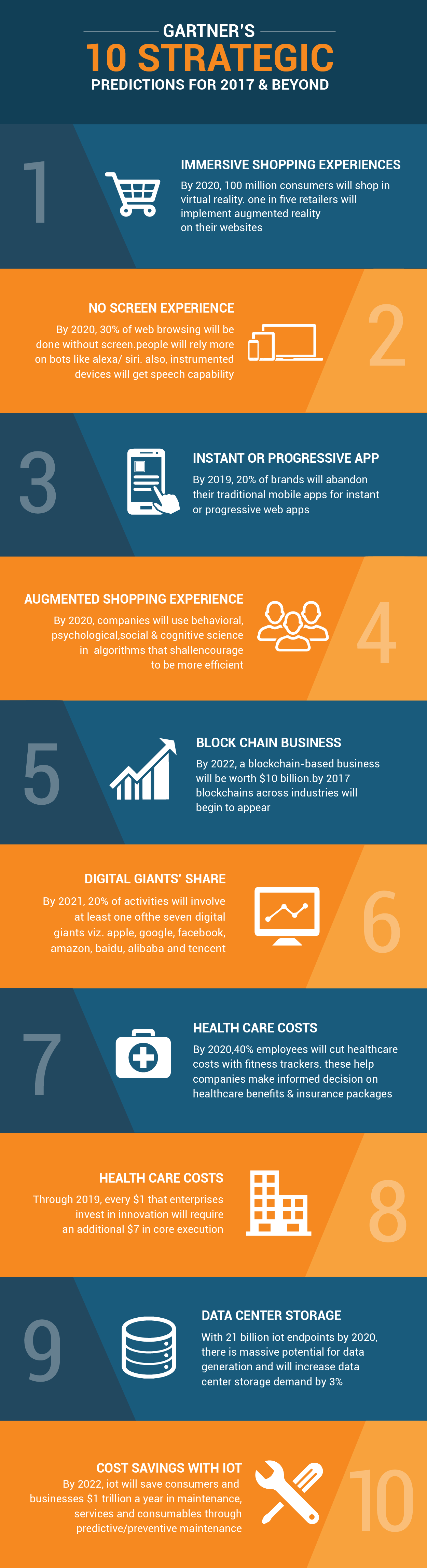
Here are the ten emerging and strategic business and technology trends that will shape the way individuals and businesses will derive value from technology in 2017. Vice president and Gartner Fellow, David Cearley, mentioned 3 themes, viz., intelligent, digital, and mesh that will be the disruptive technology forces for the coming years.
Stay up to date on what's new
About the Author
Featured Blogs
Stay up to date on
what's new
Talk To Our Experts
Every month almost 50,000 apps are released to the app store, along with almost 20,000 games
This means that, on an average, around 20,000 apps and games are released to the app store per day.
In March this year, there were 41,801 apps and 17,103 games submitted to the app store, making it a total of 58,904 apps and games.
So what does all this mean for app developers?
On one hand, it means that the competition is real and it is not with just the apps in your vertical. Secondly, it implies that it takes more than just a regular old good quality app, to make it successful.
What you need to do
It is all about leveraging the right metrics. You need to measure the right metrics and alter your apps according to them.
That way you get to analyze where your apps stand in the current scenario and make favourable changes to deliver a 5 star rated mobile app.
Now let’s get into the metrics.
Important Application Metrics that Developers should Focus on
App Crashes
Mobile apps do crash, at some point during its use. There is a certain crash rate that measures the number of crashes per app load (app load basically means the launch of an app), which is typically 1-2%, depending upon the kind of app, its usage and the like. You get these details on your app store.
Network Errors
 These are basically the HTTP errors that show up every time the app is interfacing to a networked service. These can often lead to app crashes and delay in response time, even after several retries.
API Latency
It is common to make use of several services and APIs for your apps. Latency is the time period between a request and a response. In other words, the round time from a request to a response. Ideally, it is best to keep it at 1 second.
Monthly Active User/Daily Active User
The MAU or the DAU is a rough measure of the user base of the application. You need to keep regular track of this particular metric, and see if it’s growing or shrinking or not moving at all (stagnant), to get a coarse idea about the success of your app. This is particularly important if your revenue model focuses on advertising, because it clearly calls for a substantially large user base to be successful.
Metrics related to Devices and OS
Apps are used across a wide range of devices. Getting to know where your key users use your app, whether it is on a smartphone or a tablet, and on what OS or OS version (whether it is iOS 8 or 7 etc.), can be useful in helping you focus the efforts on just where the users are.
Retention Rate
 Retention rate is the percentage of users who return to your app, depending on the date of their first visit. Also known by the name of “cohort” tracking, it allows you to identify your most engaging and valuable users. This in turn, lets you target your personalization efforts towards important users.
Length of Session
This is the time length between the opening of the app and closing. It lets you see how much time your users are spending on your app individually. It is also an indicator of your user’s engagement level. The more the session length, the more is their engagement.
Acquisition
Your customers may find your app through a number of channels, like a random search in the app store, by word-of-mouth, through in-app referrals and such other things. The acquisition cost allows you to see where your users are coming from, that is, through which of those channels mentioned. It also helps you analyze their behaviour once they start using your app. It shows the value driven by the users when they get immersed in the app.
Apart from these, there is another metric that can be derived from the data available in the store, related to app submissions.
A Sustained Growth Rate
 Every year, and as a matter of fact, every month, we can almost definitely see an increase in the number of apps released to the app store. When you take a year by year comparison, you will be able to see that every month has seen a growth from the previous year. When you draw them on a graph, you will find that the lines never intersect. Such a steady and consistent growth pattern, indicates a market that has a lot of momentum.
And finally, the most important app metric:
The App Store Star Rating
This is the most public of all metrics. It provides a clear indication of the success of an app and its impact on users. It is something that the users pay attention to as well. A poor rating in the app store can have a lot of bad consequences in the long run. Hence, you need to make sure that, at any cost, your app has a good rating.
These are some of the major app metrics that developers need to take care of. CTOs too, need to make sure that their developers are all aware of these metrics, and that they know how to measure them effectively to create successful mobile apps.
Need help in identifying those metrics that matter? Talk to our experts.
Stay up to date on what's new
About the Author
Featured Blogs
Stay up to date on
what's new
Talk To Our Experts
Your field service technicians are the pacesetters of your business. It is the effort and dedication that they put in their work that reflects as satisfied customers and improved revenue for your business.
Now don’t you want to make their work easier and more efficient?
Companies that have invested in mobile technology for their field service workers in the past have found more success than their counterparts in the industry. And up to 66% of field service companies currently use an automated field service solution, out of which a major 41% have a mobile based one.
Adopting an efficient and effective field service app (one that is right for your business too – How to Select the Perfect Field Service Automation Solution for your Business), can actually empower your technicians and help them to increase their productivity, thereby resulting in improved service delivery. As a result, this increases customer loyalty and satisfied customers tend to buy more/do more business with you, thus guaranteeing repeat Business.
Here are 8 reasons why your field service technicians need a good field service mobile app:
 Skip filling out timesheets once and for all – Paperwork is something that we all dread. Filling out time and job sheets at the customer’s site is not just frustrating but time-consuming for the technicians. A good field service mobile app will allow your technicians to record easily, all aspects of their job like the time spent at the site, parts, and tools used for the job, and follow-up required for the job, if any.
- Avoid confusions – And by confusions, I mean about everything from the location of the customers to the skillset required for the job. The dispatchers get to see where exactly their field technicians are, what each of their job statuses is and the like through mobile apps, and can assign jobs accurately based on their availability, proximity or even skills. The technicians, automatically receive updates on their job assignments including location, issue and contact details in real-time. With the help of an in-built GPS, they can devise the most efficient route to the site too.
- Figure accurate job estimates and quotes instantly – Technicians can quickly work out the costs for the job, and inform the customer about the exact cost along with other details on what the problem is, what needs to be done and how long it will take to complete the job.
 Keep accurate track of inventory – A technician in urgent need of a particular part or tool can immediately look it up on his mobile device, and place order. He is always informed about the inventory available, and when in need he knows where to find it.
- Eliminate redundant and incorrect data entry – As against the old-fashioned paper-based system of reporting, technicians do not have to take down job details while at the site and re-enter it back in office. They can record data right from the customer’s site and it gets reported in office in real-time. It also means there are lesser chances for errors and lesser frustration trying to read illegible handwriting.
- Communicate effectively with customers – With the help of photos, customer signatures, inspections and other such app-integrated capabilities and their backups, communication with the customers is always effective. There are much lesser chances for miscommunication as all aspects of even past jobs can be retrieved easily.
- Improve customer perception – Customers generally tend to find companies that use the latest and most convenience boosting technology, to be modern. The trust factor is also on the higher side. Hence, technicians can improve the trust factor by answering all of the customers’ questions, and providing accurate calculations with the help of service and equipment history.
 Improve overall team communication – Field service mobile apps help keep the entire team connected at all times. The technicians can easily reach the office, their supervisor or even their colleagues for any kind of communication or urgency at any time.
Help your field service technicians grow by equipping them with efficient mobile apps. You will be not just doing them a favour, but your whole company benefits as well.
For more insights on field service mobile apps, take a look at our insights or talk to our experts.
Stay up to date on what's new
About the Author
Featured Blogs
Stay up to date on
what's new

