








Top Technologies Used to Develop Mobile App
The onset of globalization has encouraged business operations on an international scale. It offers companies the opportunity to reach new customers in new markets. Exposure to unknown markets and sometimes even known markets can expose businesses to greater competition and greater risk. However, efficient management of the supply chain can do away with many of these risks and put you on the path to success.
The challenges in the supply chain can include being unsure of the reliability of your suppliers, and their quality, cost, lead time, lot size, and more. Your business will surely profit if you had a way to monitor your supplies and the risks to your business.
Yes, clear visibility is crucial.
This is where custom software can benefit your business!
Custom software equips you with a way to collect, organize, and monitor the supplier-related information that is most meaningful to your business. This blog discusses which functions of the supply chain can be better managed with custom software and also talks about the benefits this can bring to your business.
Efficient management of the supply chain depends primarily on data gathered at each stage of the supply chain process. The success of the business hinges on the way companies use those insights to make decisions that optimize demand, supply, inventory, and deliveries.
That is why custom software is essential to managing the supply chain. Custom software can enable organizations to make better use of their data as it gives structure to the information already in their possession.
Through the use of custom software solutions, companies can identify faults in their supply chain process. Such visibility can help them make better inventory decisions or inform their customers of the shipping status for their confirmed orders.
Essentially, custom software is instrumental in improving business operations and relationships with both customers and suppliers.
Read more: Build or Buy Logistic Software: An End To The Prolonged Discussion
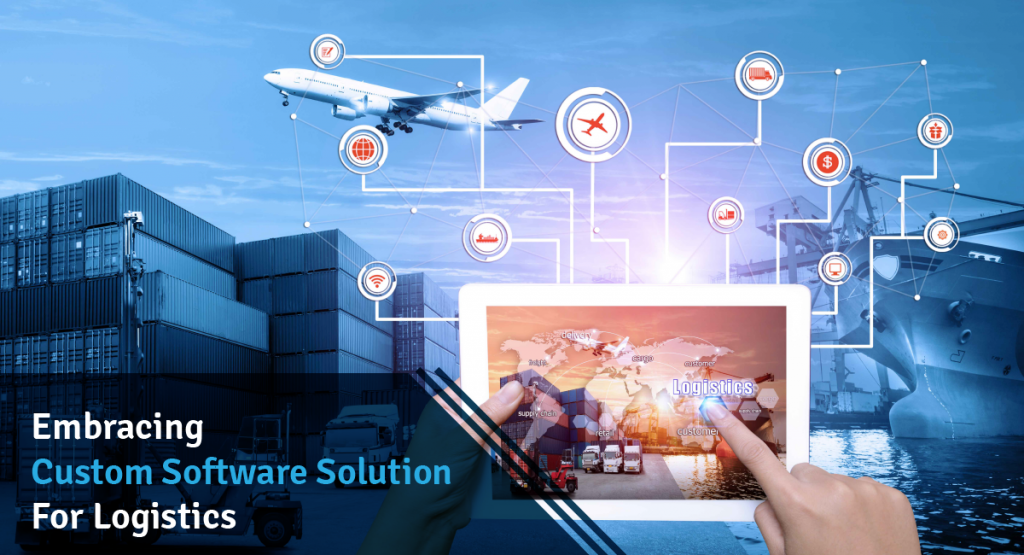
Every business is unique in its functions. A software can address the specific company challenges only when customized and tailor-built after crucially analyzing the workflows and industry pain points. Here are a few to look into.
Knowing exactly where your item is at any given time is important for all businesses as it allows you to sell the item before it even reaches your warehouse. Custom software can help you sell this way because it can pinpoint the exact location of your item and the time that it will reach your warehouse.
This will allow you to provide a guarantee to your customer that he will receive the product he purchased. Streamlining the supply chain will help achieve faster response times and increase customer loyalty.
With the help of custom software, you can sell your item while it is on the move or as it is in the making. It can help you estimate how many items you must produce, eliminating excessive production.
You can keep a good relationship with your suppliers with custom software. Real-time data will allow you to know if you are running out of stock or if your tools and equipment need repair or replacement. This data will help you contact your suppliers immediately and thus minimize any potential delays.
You will also have details such as account receivables and other information at your fingertips when dealing with your suppliers. This will ensure that you are up to date with payments and discounts. As a result, you notice that your communication and cooperation with dealers and vendors improve considerably.
Custom software will create highly streamlined processes for supply chain management, especially for businesses that operate from different locations across the globe.
Fully customized software enables companies to accumulate all business data in one centralized location. Employees greatly benefit from this as they can now gain access to the latest versions of data, even if they are accessing it from multiple locations or branches.
Bottlenecks in the supply chain are a direct result of the ineffective system in place that does not allow teams in different locations to communicate and align statuses to fulfill overall objectives. Companies that experience such bottlenecks miss opportunities and lose customers because they are unable to provide what their customers want.
An unsatisfied customer walks out on you and straight into the open arms of your competition. If you are beginning to notice lower satisfaction rates, numerous complaints, or bad reviews from the customers, it is time to explore custom software that can give you a business-targeted approach to customer experience.
When a business looks to meet or exceed customer demands, they have to rely heavily on its supply chain. Internal bottlenecks can slow down the entire process and risk order fulfillment. To prevent such bottlenecks, a business must understand what causes them and how to prevent them.
Custom software can help a business identify such bottlenecks and thus help efficiently manage the supply chain.
Read more: Custom Fleet Management Software in Supply Chain
It is clear that custom software comes with many benefits. It is also obvious that it saves money with time. While off-the-shelf software may come with a lower initial cost, investing in custom software will give more benefits to the supply chain management cycle. It improves sales functions and boosts productivity.
Custom software that is fully optimized to the supply chain will improve business function in a way no off-the-shelf software can. Fully optimizing the supply chain process can be lean and seamless through the use of custom software. If the business growth process is left unchecked by the off-the-shelf software solutions it can become highly chaotic. Custom software gives companies a higher level of control over all supply chain operations while taking control over the growth process.
A company that is digitally driven by custom software automatically enables a more proactive and open business. If this is what you want for your business, give us a call.
Our experts at Fingent thrive on creating custom solutions for our clients. They will be happy to talk through the game plan with you and show you how your business can excel with custom software for your supply chain.



Tony believes in building technology around processes, rather than building processes around technology. At Fingent, he specializes in custom software development, especially in analyzing processes, refining them, and then building technology around it. He works with clients on a daily basis to understand and analyze their operational structure, discover (and not invent) key improvement areas, and come up with technology solutions to deliver an efficient process. You can reach him at [email protected], Skype: tony_fingent



There couldn’t be any better empirical evidence than COVID-19 to prove the transformational impact of AI on healthcare. Had AI not been there, it would be unviable to develop and distribute vaccines at record speed, empower public health officials and front-line workers, support equipment manufacturers, take critical life-saving actions, and respond to these abnormal times.
Leading pharmaceutical company Moderna relied on automated processes and AI algorithms to rapidly bring out their covid vaccine nominee for its first clinical trial. From an anticipated 15% chance of success, AI helped the pharmaceutical company lift their success rate to a whopping 50%, placing the vaccine efficacy levels close to 94.5%. AI’s role in healthcare isn’t limited to pharmaceuticals alone.
In this piece, we’ll see what AI holds in store for healthcare now and in the coming years.
Read more: AI in Medicine – Yesterday, Today, and Tomorrow

Over these years, AI has brought more sophistication into what humans do, particularly in segments like healthcare. Here’re a few AI healthcare transformations currently underway:
AI and the Internet of Medical Things (IoMT) have helped launch several consumer health applications and self-health monitoring devices such as wireless-enabled wearables, activity trackers, pedometers, smartwatches, and other physical fitness monitoring gadgets. These healthcare technology applications encourage people to take proactive measures for maintaining a healthy lifestyle and allow consumers to be in control of their health and well-being. Similarly, healthcare professionals can rely on AI to better understand what their patients need. With insightful patient data, caregivers can provide the necessary guidance and support, thereby enabling people to stay healthy.
Read more: 5 Healthcare Digitalization Trends Crucial in 2022 and Beyond
It’s well established that the early detection, screening, and treatment of cancer can improve outcomes. American Cancer Society is successfully using cloud ML engine on Google Cloud Platform to analyze breast cancer images with 12x improved speed. Advanced deep learning models are being used to detect Diabetic Retinopathy (DR) during the early and asymptomatic stages. This helps save diabetic patients from the daunting issue of irreversible blindness caused by lesions on the retina. The proliferation of consumer wearables and self-health monitoring devices, combined with AI allows doctors and caregivers to detect potentially life-threatening ailments at more treatable stages.
The market value of global AI in medical diagnostics is estimated to be worth $3988.0 million by 2026. Leading AI platforms such as IBM Watson Health and Google DeepMind Health enable a large number of healthcare organizations to unlock massive amounts of clinical data to boost medical diagnosis.
Combining machine learning and neuroscience, AI helps build powerful neural networks that are capable of imitating human abilities. Watson can review and store huge volumes of medical data scattered across journals, seminars, conferences, treatment case studies, and umpteen other sources. AI’s ability to ingest enormous amounts of data, decipher images, and discover hidden patterns escaping even the most-canny human eye are expected to significantly transform healthcare in the near future.
Read more: Deploying Digital Twins in Healthcare
In the past, clinical decision support systems (CDSS) were fed by inaccurate datasets that led healthcare professionals to make flawed assumptions. Diagnostic errors are one of the top reasons behind higher mortality rates and prolonged hospital stays. Thanks to AI, ML, and the growing volumes of real-time clinical data gathered from numerous healthcare apps and devices. Clinical decision-making is now more precise and efficient with the emergence of AI-powered CDSS.
Sepsis Watch, a deep learning tool installed in the emergency department of the Duke University Health System has considerably lowered sepsis-induced patient deaths. The tool flags sepsis patients who are at medium to high risk, allowing doctors to identify early signs of sepsis. Not only does AI reduce diagnostic errors, it also suggests the best practices for post-surgical care and patient discharge, as well as recommends medications and follow-up checks to optimize patient care.
The average cost of bringing a pharma product to the market is exploding year over year. Manual R&D processes and the time taken to conceive, design, and conduct clinical trials slow down drug production and increase the costs involved. The latest advances in AI help streamline drug research and discovery and reduces the time to market for new drugs. Researchers can use AI-enabled simulations on their devices to explore the impact of new therapies or medicines, thereby reducing the risk of testing in live conditions.
AI allows training and quick catch-up sessions to be held from anywhere, even after a medical resident leaves the campus post a tricky clinical case. AI-powered chatbots can answer queries on the fly, at any hour of the day. With instinctive AI diagnostic support and a low level of supervision, the next generation of medical students will definitely rely on automated self-learning platforms.
Read more: How Virtual Reality Improves the Standard of Medical Education and Training

Real-time data, technological advancements, and innovation are driving the industry forerunners to discover new AI opportunities in healthcare. Here’re a few healthcare AI innovations to behold in the coming days.
Google is running experiments to develop transformative AI imaging and diagnostic tools that can assist clinicians and even address the dearth of talent in a possibly grueling situation (like the global pandemic). Further research is being held to improve the detection of breast and lung cancer, sight-threatening eye conditions as well as skin diseases.
Research proves that 30% of individual health effects are congenital. All of us carry 4 to 5 million genetic variants, each of which can influence our health traits. The cost to sequence a genome and poor sequencing data have marred genomic analysis in the past, preventing clinicians from identifying genetic disorders and high-risk diseases at an early stage. Deep neural networks such as DeepVariant exhibits top-class accuracy in analyzing genetic variants and sequencing genome data.
The advent of AI is helping medical researchers and pharma companies worldwide to reduce in-person assessments in clinics. Various digital endpoints, such as smartphones, healthcare software, wearable sensors, EHRs, video conferencing, and numerous physical fitness monitoring devices are being used to gather data with the patient’s consent. This has drastically shifted medical trials from clinics, thereby reducing the risk of compromised immunity, exposure to fatal viruses, respiratory or cardiac malfunction, and other lethal health risks. Decentralized clinical trials allow institutional and federal health boards to review existing processes, implement new regulations quickly, listen to feedback and concerns, take proactive steps, and make healthcare more accessible to everyone.
Necessity commands invention. Over the past two years, we saw how healthcare stakeholders around the globe took efforts to harness AI technologies – for discovering new drugs, extending the capability of existing drugs, reducing the time to distribution, screening for COVID-19 symptoms, supporting clinical decisions, automating hospital operations, and so on. Key U.S. healthcare decision-makers surveyed by Intel stated that their trust in AI in processing medical records has increased by 67%. As AI gets infused into more crucial areas of healthcare, it’s important to earn customer confidence and comfort, and support from various stakeholders in the ecosystem.
Case StudyHow Fingent partnered with Casenet’s Advanced Solutions Group to develop TruCare Insights. Download!
Fingent helps develop innovative, AI-integrated, custom healthcare software applications to improve your competitive advantage, time-to-market, ROI, and clinical precision. As the world enters a new era of health, it’s important to choose the right technology partner that helps adopt the right technology at the right time. We have an eminent list of healthcare clients, including NHS, Novita Healthcare, Mundipharma, and Casenet, LLC among others.
Contact us to understand how we’re helping businesses build trust and deliver sustained outcomes by making the most of our experience and technology.


 Static Web Application
 Dynamic Web Application
 eCommerce Web Application
 CMS Web Apps
 Portal Web Application
 Single-Page Application
 Multi-Page Application
 Rich-Internet Web Applications
 Progressive Web AppsStatic Web ApplicationDynamic Web ApplicationeCommerce Web ApplicationCMS Web AppsPortal Web ApplicationSingle-Page ApplicationMulti-Page ApplicationRich-Internet Web ApplicationsProgressive Web Apps

1. Database Technologies

2. Client-Side Programming

3. Server-Side Programming
1. Database Technologies
Due to its simplicity and multifunctionality, MySQL is
one of the most preferred databases utilized for web application development.
Other popular database technologies include Oracle Database, PostgreSQL,
Microsoft SQL Server, Microsoft Access, MongoDB, and RavenDB.
2. Client-Side Programming
To develop the client-side of an app that the users interact with, you can choose
highly efficient front-end JavaScript frameworks such as
3. Server-Side Programming
Frameworks such as Go, Ruby, Java, Django & Python are some of the most
powerful back-end development technologies.

Web development has progressed over the years and is progressing with the emergence of newer technologies. A website is the face of a business rather than mere codes. More than one-third of visitors prefer to hold on to websites with attractive content and a clean layout. In 2022, companies are more than ready to apply the latest web development trends to improve conversions and develop engaging websites without having to code. If you want to stay ahead, it is vital to focus on the latest trends, updates, techniques, and web development approaches. Why developers should bring out more innovative web development approaches- the fact is it boosts business growth rather exponentially and globally.

.NET Core gives you consistency across all architectures by running your code with the same behavior. Be it gaming, IoT, mobile, or AI – we can help you develop high-performing, secure, cost-effective, and flexible applications in any domain with .NET Core. Let’s Discuss Your Project

C# is a highly versatile programming language commonly used for developing websites, Windows applications, and games. With its foundation deep-rooted in the Microsoft platform, C# is one of the most-cherished and reliable languages to build robust applications. Let’s Discuss Your Project

ASP.NET is a framework for building web apps and services with .NET and C#. ASP.NET allows you to build large and complex applications by reducing the amount of code required. This, in turn, reduces the application development time and costs involved. Let’s Discuss Your Project

Take advantage of the cloud through hybrid cloud-based solutions with Microsoft Azure. We can help you migrate your solution to the cloud, enabling you with on-demand and secure resources of Azure. Scale according to your needs and improve your business agility. Let’s Discuss Your Project

Fingent’s Microsoft team can help you develop robust SharePoint solutions that empower your organization with efficient collaboration and communication. We can help you build intuitive interfaces and simple navigation features for effective document management. Let’s Discuss Your Project

Microsoft Power Apps enables you to build low-code, professional-grade apps that can modernize your business processes and drive innovation across your organization. Infuse your enterprise apps with AI and automation, powered by PowerApps. Let’s Discuss Your Project

Leveraging Microsoft Power BI, we enable businesses to develop interactive visualizations and business intelligence capabilities through simple and intuitive interfaces. Enrich your business as well as end-users with custom reports and dashboards powered by insightful data. Let’s Discuss Your Project

By leveraging UWP API, we help you create universal apps that run on Windows 10 compatible devices without the need to be re-written for each. As the name suggests, the Universal Windows Platform allows you to create apps that run on multiple types of devices. Let’s Discuss Your Project

Using WPF, we incorporate visually stunning user experiences into your Windows desktop applications that include features like rich user interface, media, complex business models, animation, effects, styles, templates, controls, data binding, and so on. Let’s Discuss Your Project

Our expertise with Microsoft data platforms can empower you with real-time data for improved decision-making. Our Microsoft capabilities can help in uniting several disparate information sources and create reports from across varied systems and databases. Let’s Discuss Your Project

We help you develop highly responsive and highly available applications on Cosmos DB using the popular open source software APIs. Experience low latency, high throughput, real-time responses, and tunable consistency with this multi-model, NoSQL database service. Let’s Discuss Your Project
The web development industry is in flux and is constantly evolving. Therefore, it is paramount for us always to look ahead and learn about what's coming up or any risk being left in the web development dust. Web development is defined through the upcoming trends and changes in the digital world. Businesses around the globe are in a quest to build outstanding websites to up their online presence with all-new frameworks, tools, and advancements. If you want your business to stay ahead of the race, the smartest thing u can do is to try out innovative and experimental things like Augmented Reality (AR) or Artificial Intelligence. Here's a quick glance at some of the exciting developments likely to happen in the near future.
Data Science is impacting web development positively. Data science helps extract significant user information on a large scale using statistics, analytics, artificial intelligence, and machine learning. Using the extraction of meaningful information, web development is now guided into a more fruitful system to impact the business's bottom line. With data science and machine learning, you can target the right customers with personalized content at the right time within your application.

Product visualization is the most sought-after requirement among today's customers. Augmented reality has the potential to change the shopping game. Most online shoppers prefer shopping sites to integrate some form of augmented reality for a personalized experience. AR experiences in different ways are the key for customers to become more engaged in various platforms and the digital world overall. The future is not too far, where AR experiences will move into the mainstream and cease to be viewed as a niche technology.

Pageless website is a new-age concept that takes an alternative choice on web design. The entire contents of a website are displayed on a single page with an endless scroll instead of having multiple pages. With responsive elements, guided narrative, and intuitive scrolling, users can surf the entire contents of the website with ease.

The Metaverse is the new kid on the block that seeks to bring together many different technologies to offer users a new web experience. Today, users view content on the web. But on the Metaverse, users will be immersed in the content. Thanks to technologies like Virtual Reality, Augmented Reality, Machine Learning, and other forms of Artificial Intelligence. Metaverse is the next iteration of the internet where users can navigate through a virtual space instead of the current two-dimensional screen.

The cost of a complicated and custom web application development process would again differ from pre-defined, packaged, and general-purpose applications. For example, suppose the app requires developing APIs and plugins or complex technical stacks, separate UX/UI elements, brand identity development, etc. In that case, the pricing will go up as the advantages are humongous.


A polished web app is almost a mandate for successful digital businesses today. Many apps have changed the public's perception of what they can expect and what is possible. It includes everything a typical user might look for in an app regarding design, usability, reliability, and security. Here's a rundown on five apps that has made a difference to the world.
Facebook is a free social networking website that allows people to connect with others online. It lets users share photographs, post comments, post links to interesting content on the web, live chat, and watch videos. Facebook's success is attributed to its ability to appeal to both people and businesses and its ability to interact with websites around the web by providing a single login that works across multiple sites.
WhatsApp is a free, multi-platform messaging app that lets users make video and voice calls, send text messages, share their status, and make payments, all with just an internet connection. The most appealing feature of this app is that it works on various phones and computer operating systems, which bestows uninterrupted conversations anytime, anywhere. WhatsApp serves more than 2 billion people in over 180 countries, with over a billion daily active users.
Uber is a transportation company that has developed an app to allow passengers to hail a ride, and drivers get paid. The app integrates with Google maps for tracking locations, routes and directing people to their destination. Uber uses smartphone app technology to connect passengers and drivers via a car-for-hire method. Most people love the simplicity of opening the app, telling where they want to go, and then seeing an Uber driver show up in a matter of minutes.
Instagram is a free, popular photo-sharing app that Facebook acquired in 2012. It allows users to edit and upload photos and short videos through a mobile app. Like other social networking platforms, Instagram users can like, comment, share and bookmark others' posts. It also includes a feature of private chats and video conferencing with friends.
TikTok is a social media platform that allows users to create and share short videos. A young crowd commonly uses the app as an outlet to express themselves through singing, dancing, comics, and lip-syncing, making fun videos and sharing them across a community. In addition, users can follow other users, like, and comment on other users' videos. TikTok app quickly soared to popularity and amassed over 500 million monthly active users, the US being the most popular country where it is downloaded over 80 million times.


A web application is the first point of access to your business and brand for your customers. Your app is the place that reflects what you do, your services, products, and your reputation. You can stand out from your competitors by having a web application that looks interesting and clearly communicates quality information to your customers. Therefore, hiring a professional web application development company is judicious to understand your vision and shape the application accordingly.
A company or business without a web app or website may question the legitimacy of the business. So, having an app is an opportunity to build a great first impression and give people assurance that you’re a genuine business.
Web applications play a crucial role in the branding process of a business. Showcasing your brand to your prospective customers is the key to positioning your business in the market. A web application is an underlying framework for branding your products or services because branding acts as the bridge to maintain a proper communication channel between potential customers and your business.
Clearly conveying to the customers who you are, what you provide, and what your brand represents raises your business popularity coupled with building a customer base. A web application is your brand's voice that reaches out to the world through multiple social media platforms.
Your app is one of the most powerful assets for helping business owners improve customer relationships and increase efficiency. In addition to showcasing your offering or describing who you are, your application is one of the key tools for connecting with your existing customers and keeping them engaged. In order to create customer loyalty, you need to give your customers a reason to return.
Web applications come in handy with a lot of scopes to build customer loyalty programs to win customers’ hearts. Even simple changes to your app can go a long way toward building your brand and encouraging more customers to use your app frequently. Your application can be the key to increasing customer loyalty, a critical piece of the puzzle.
As your business expands, your web applications need upgrades. Off-the-shelf applications are neither flexible nor scalable, limiting their capabilities. Custom web applications are developed specifically to suit your business requirements. It is completely scalable and flexible, harmonizing with your business growth and demands. Custom applications grow with your business without any hassles of switching to new applications or extra license purchases. Moreover, the advent of cloud-native apps further enhances the flexibility and scalability of applications by adding more value to the business.
The prompt and user-friendly customer support offered by web applications becomes more approachable and less intimidating for customers. So, the users of the app feel more comfortable with the company and are likely to stick on for a long time.
Web apps help to create an engaging space for customers to interact with brands and provide a dedicated space to track and manage all the customer support queries. The beauty of web applications is that they can be accessed at any time from any location. Hence, providing any customer assistance is never an obstacle.

Years of Experience

Centers of Excellence (CoE)

Completed Projects

Transparent Project Management

Qualified Professionals

Dedicated QA Practices


If you’re a business with an expanding online retail footprint, your hard work actually begins once a customer places an order. Each new order triggers a multifarious chain reaction, right from confirming the order through payment acceptance to picking, packing, and finally shipping the consignment to the right location. As digital shopping becomes the primary buying method today, it’s important for brands to simplify online ordering for their customers.
How can you make your order processing and fulfillment smooth enough for both your customers and employees?
If you’re a small business, you might be able to handle your orders with basic pre-packaged software. But as your business grows, you need a customized order management system to fulfill the orders gushing in. With a custom order processing software, your business can bring the best of both worlds, that is, streamline your order processing and fulfillment and simplify order placement for your customers.
View Infographic: Custom Software vs. Commercial Off-the-shelf Solutions
Order management refers to the set of processes used by an organization to track, manage, and fulfill an order, right from the time when it (order) is placed by a customer to when it is safely delivered at the right destination.
Order management systems are software tools used to monitor the end-to-end customer order journey. With order management software, you can organize and automate processes, keep track of your merchandise, control the delivery process, and ensure that your customer receives the right order at the right time in a good condition.
Say you’re running an online medical procurement store. A clinic places an order with you for disposable saliva ejectors. Your order management software checks if the payment was successful, send the order details to your warehouse, tracks the order form when it is being picked, packed, and shipped, and finally ensures that the saliva ejectors were delivered properly.
Modern order management systems are capable of going beyond delivery and order fulfillment. They can record customer service actions, track returns or exchanges, prevent shipping errors and processing delays, and save profits by reducing refunds and reshipping costs. By collecting vital metrics that define your success and efficiency, your business can identify what’s working and what needs to be improved.
Investing in an off-the-shelf order processing system is enough if you’re content with your business’s status quo. But it wouldn’t suffice if you’re thinking of expanding your business. Offering personalization is the only way to make yourself stand out from the competition and attract more customers. That means, making some serious changes to your existing workflow. When you try to alter your current workflow to incorporate personalization, your canned software offers limited ways to do it successfully. This is where a custom software solution comes to your rescue.
Watch Video: Why Your Business Requires Custom Software
Custom order management software allows you to configure the workflows required to meet your specific business needs. If off-the-shelf software provides you with 80% of the functionality, custom software allows you to tailor the remaining 20% (or even more) to enhance your workflows and make your business future-proof.
We’ve done it in the past and we’re doing it now as well!
We’ve simplified what was once considered complex order processing, with custom-built ordering software that lets customers place orders quickly and allows businesses to track every order with improved efficiency and sophistication. Here’re a few inspiring stories.
Texas-based Cheetah Transportation Systems leveraged Fingent’s custom software development services to implement a personalized transportation management system. The new system allows Cheetah’s customers to view their order status in real-time and access up-to-date shipping data. With a customized software solution, Cheetah re-imagined their logistics and supply chain operations:
Another pretty interesting digital transformation story is that of AEC Advisors. The New York-based investment banking and corporate finance advisory firm experienced a business transformation with a customized survey management cum analytics and reporting software developed by Fingent.
A custom order management application for a manufacturer who builds customized sheds for growing families needing more space! That’s the story of Lakeside Cabins, headquartered in Ohio. The manufacturer wanted us to build an in-house software customized to support the different stages of their building processes. Fingent created a personalized, flexible, easy-to-maintain, and scalable order management software with the following features:
Interested to explore similar success stories? Click here to read our top case studies.
A customized order management software offers the best features your business would actually require. Collaborate with the right software development partner to identify your unique business needs. Avoiding unwanted features helps you get cost-effective custom software within a shorter development cycle.
Your customers may want to split orders and deliver them to multiple addresses. Using an off-the-shelf software to split your shipments will increase your fulfillment costs due to longer development cycles. A customized order processing software offers the flexibility to split consignments, choose multiple payment modes for a single order, and a horde of other capabilities that will enable you to deliver an Amazon-like experience to your customers.
Read more: Custom software solutions – the ideal way to build business apps

Most off-the-shelf software don’t offer flexibility in integration, making you spend more on missing software integrations. In contrast, custom order processing software offers makes it easy to integrate with necessary third-party ware that can improve the accuracy of your order fulfillment process. Fingent develops powerful APIs and plugins that support seamless integration of third-party tools with your custom software.
When your custom order management software does the heavy-lifting by automating invoicing, billing, banking integration, payment, and stock management, you can focus on improving your customer service. Automating mind-numbing operations will allow you to keep your order processing tasks much more organized and easier.
Most pre-packaged order management solutions offer functionalities that your business doesn’t require and demand you to pay extra for useful features. A custom software solution is designed and developed after defining your objectives clearly. So you end up paying only for the features you use.
Read more: Know What’s Driving Custom Software Development Costs in 2022
When you’re in complete control of your order management system, you will attain better visibility, productivity, and cost control. Custom software befits businesses of any size- small or large, as it can save your costs and support your long-term growth plans. Whether your requirement is to develop a custom inventory/ order/ warehouse/ transportation management software, our developers have considerable experience in handling anything that comes our way.
Read more: How to Choose the Right Custom Software Development Firm
Our core experience in developing B2B e-commerce applications, customized product ordering systems, tailored self-service payment portals, and an array of bespoke software solutions makes us a trusted software development partner to hundreds of organizations worldwide, including Fortune 500 companies.
If you want to learn more about custom software or would like to know how it can improve your bottom line, get in touch with us.
Tony believes in building technology around processes, rather than building processes around technology. At Fingent, he specializes in custom software development, especially in analyzing processes, refining them, and then building technology around it. He works with clients on a daily basis to understand and analyze their operational structure, discover (and not invent) key improvement areas, and come up with technology solutions to deliver an efficient process. You can reach him at [email protected], Skype: tony_fingent
If you’re a business with an expanding online retail footprint, your hard work actually begins once a customer places an order. Each new order triggers a multifarious chain reaction, right from confirming the order through payment acceptance to picking, packing, and finally shipping the consignment to the right location. As digital shopping becomes the primary buying method today, it’s important for brands to simplify online ordering for their customers.
How can you make your order processing and fulfillment smooth enough for both your customers and employees?
If you’re a small business, you might be able to handle your orders with basic pre-packaged software. But as your business grows, you need a customized order management system to fulfill the orders gushing in. With a custom order processing software, your business can bring the best of both worlds, that is, streamline your order processing and fulfillment and simplify order placement for your customers.
View Infographic: Custom Software vs. Commercial Off-the-shelf Solutions
Order management refers to the set of processes used by an organization to track, manage, and fulfill an order, right from the time when it (order) is placed by a customer to when it is safely delivered at the right destination.
Order management systems are software tools used to monitor the end-to-end customer order journey. With order management software, you can organize and automate processes, keep track of your merchandise, control the delivery process, and ensure that your customer receives the right order at the right time in a good condition.
Say you’re running an online medical procurement store. A clinic places an order with you for disposable saliva ejectors. Your order management software checks if the payment was successful, send the order details to your warehouse, tracks the order form when it is being picked, packed, and shipped, and finally ensures that the saliva ejectors were delivered properly.
Modern order management systems are capable of going beyond delivery and order fulfillment. They can record customer service actions, track returns or exchanges, prevent shipping errors and processing delays, and save profits by reducing refunds and reshipping costs. By collecting vital metrics that define your success and efficiency, your business can identify what’s working and what needs to be improved.
Investing in an off-the-shelf order processing system is enough if you’re content with your business’s status quo. But it wouldn’t suffice if you’re thinking of expanding your business. Offering personalization is the only way to make yourself stand out from the competition and attract more customers. That means, making some serious changes to your existing workflow. When you try to alter your current workflow to incorporate personalization, your canned software offers limited ways to do it successfully. This is where a custom software solution comes to your rescue.
Watch Video: Why Your Business Requires Custom Software
Custom order management software allows you to configure the workflows required to meet your specific business needs. If off-the-shelf software provides you with 80% of the functionality, custom software allows you to tailor the remaining 20% (or even more) to enhance your workflows and make your business future-proof.
We’ve done it in the past and we’re doing it now as well!
We’ve simplified what was once considered complex order processing, with custom-built ordering software that lets customers place orders quickly and allows businesses to track every order with improved efficiency and sophistication. Here’re a few inspiring stories.
Texas-based Cheetah Transportation Systems leveraged Fingent’s custom software development services to implement a personalized transportation management system. The new system allows Cheetah’s customers to view their order status in real-time and access up-to-date shipping data. With a customized software solution, Cheetah re-imagined their logistics and supply chain operations:
Another pretty interesting digital transformation story is that of AEC Advisors. The New York-based investment banking and corporate finance advisory firm experienced a business transformation with a customized survey management cum analytics and reporting software developed by Fingent.
A custom order management application for a manufacturer who builds customized sheds for growing families needing more space! That’s the story of Lakeside Cabins, headquartered in Ohio. The manufacturer wanted us to build an in-house software customized to support the different stages of their building processes. Fingent created a personalized, flexible, easy-to-maintain, and scalable order management software with the following features:
Interested to explore similar success stories? Click here to read our top case studies.
A customized order management software offers the best features your business would actually require. Collaborate with the right software development partner to identify your unique business needs. Avoiding unwanted features helps you get cost-effective custom software within a shorter development cycle.
Your customers may want to split orders and deliver them to multiple addresses. Using an off-the-shelf software to split your shipments will increase your fulfillment costs due to longer development cycles. A customized order processing software offers the flexibility to split consignments, choose multiple payment modes for a single order, and a horde of other capabilities that will enable you to deliver an Amazon-like experience to your customers.
Read more: Custom software solutions – the ideal way to build business apps
Most off-the-shelf software don’t offer flexibility in integration, making you spend more on missing software integrations. In contrast, custom order processing software offers makes it easy to integrate with necessary third-party ware that can improve the accuracy of your order fulfillment process. Fingent develops powerful APIs and plugins that support seamless integration of third-party tools with your custom software.
When your custom order management software does the heavy-lifting by automating invoicing, billing, banking integration, payment, and stock management, you can focus on improving your customer service. Automating mind-numbing operations will allow you to keep your order processing tasks much more organized and easier.
Most pre-packaged order management solutions offer functionalities that your business doesn’t require and demand you to pay extra for useful features. A custom software solution is designed and developed after defining your objectives clearly. So you end up paying only for the features you use.
Read more: Know What’s Driving Custom Software Development Costs in 2022
When you’re in complete control of your order management system, you will attain better visibility, productivity, and cost control. Custom software befits businesses of any size- small or large, as it can save your costs and support your long-term growth plans. Whether your requirement is to develop a custom inventory/ order/ warehouse/ transportation management software, our developers have considerable experience in handling anything that comes our way.
Read more: How to Choose the Right Custom Software Development Firm
Our core experience in developing B2B e-commerce applications, customized product ordering systems, tailored self-service payment portals, and an array of bespoke software solutions makes us a trusted software development partner to hundreds of organizations worldwide, including Fortune 500 companies.
If you want to learn more about custom software or would like to know how it can improve your bottom line, get in touch with us.
Tony believes in building technology around processes, rather than building processes around technology. At Fingent, he specializes in custom software development, especially in analyzing processes, refining them, and then building technology around it. He works with clients on a daily basis to understand and analyze their operational structure, discover (and not invent) key improvement areas, and come up with technology solutions to deliver an efficient process. You can reach him at [email protected], Skype: tony_fingent
Every small business requires an array of software to run its operations smoothly and successfully. When starting a new business, it may seem like your off-the-shelf software would suffice all your needs. As your business grows, your business management software should scale to meet your team’s evolving needs, boost the efficiency of your workflows, and be flexible to support new use cases. Custom software or a software application tailor-made to address your specific business requirements helps improve your market competency and realize ROI at a faster pace.
How will you determine if custom software is the right fit for your small business?
Read on this post to learn more about custom software for small businesses.
Read more: 5 Reasons Why Custom Software is Important for Your Business
The classic “build vs. buy” decision is a pertinent question that every small business faces when addressing their software needs. Considering the cost, time, energy, and resources dedicated to custom software development, many SMEs adopt packaged software in a haste. Look out for these warning signs before deciding whether to build or buy.
Find out if your employees are satisfied with your existing off-the-shelf software. Do they still stick to old-school tricks or find manual methods faster and more convenient? Are your employees forced to discover alternative workarounds to use the software? Do they still rely on spreadsheets and how-to guides for using the software? All these signs indicate that your off-the-shelf software lacks employee approval and can fail your business eventually.
Rolling out enterprise-wide canned software that commands an advanced level of technical expertise will inflict more harm. It will complicate the processes for your employees and incur heavy training costs. Complex shelf software will fail the very purpose of technological innovation, that is, to simplify human efforts. If only less than 20% of your employees find the software workable, it’s better to build a customized solution.
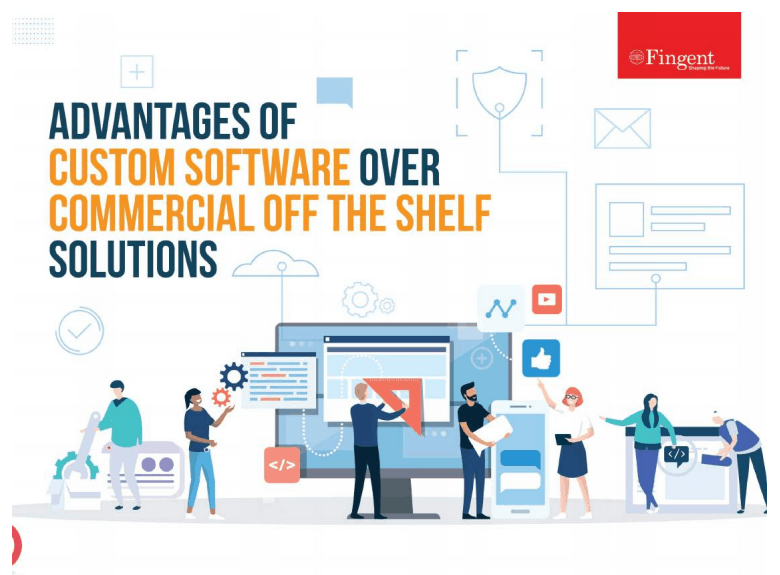
View Infographic: Custom Software vs. Commercial Off-the-shelf Solutions

Is your software forcing your employees to spend their valuable time on routine activities that don’t require human thought and creativity? If your software isn’t allowing you to leverage the potential of automation, it can minimize your employees’ productivity and workplace efficiency. Automation of mundane tasks with minimal or adequate supervision is a must for small business growth and success.
Adapting a rigid off-the-shelf solution for your small business needs requires you to subscribe to third-party apps and pay multiple licensing fees. Most biz owners end up paying full price for unwanted features. Some companies would want to integrate estranged business applications to increase the usability of their shelf software. All these challenges lead to increased software spending.
Your business data comes from multiple sources such as your website, emails, social profiles, chat, and conversation histories, helpdesk, and so on. How far is your canned software allowing you to make use of this data? Are your decisions driven by live data? If your dashboards aren’t getting updated in real-time and reports throw only past information, it’s time to consider custom software. Integrating multiple business systems and exporting all the useful data insights onto a centralized, user-friendly platform in real-time will empower small businesses to make rightful decisions.
Watch Video: Why Your Business Requires Custom Software
Small business competition has intensified in recent years. Thanks to the increasing democratization of digital innovation! Access to technological advancements is no longer limited to large enterprises. With a custom-built software, your small business can stay relevant and competitive.
Custom software development guarantees 100% alignment with specific business needs. You can rest assured that no crucial operations are left unsupported and there aren’t any wasted features. Share your unique requirements with a trusted custom software development company like Fingent and get exactly the features you would require on a long-term.
Ready-to-use software is highly vulnerable to cyberattacks due to the widespread availability of code and proliferation of users. Owning custom code places your small business under lock and key and keeps your sensitive information hack-proof. Customized solutions offer built-in security with a specialized approach to development. Better compliance and data governance improves your organization’s reputation and trust.
Attaining profitability amid stiff competition needs your employees to put in their best performance. Experienced custom software companies like Fingent can help you identify the workflows or business functions that can be improved with the right technology. This makes your business more efficient and maximizes the productivity of your employees.
Improved business efficiency transforms to lower operational costs. Technologies like automation enable your employees to complete more tasks in less time, without feeling monotonous. Custom software actually costs lesser than off-the-shelf solutions, considering the extra dollars you would spend on subscriptions, licenses, third-party integrations, software upgrades and maintenance, and other overheads required to make the shelf software workable.
Read more: Know What’s Driving Custom Software Development Costs in 2022

Modern business might come to a standstill if technology stops working. A typical readymade software provider puts you into a long wait with back-to-back support tickets and repeated calls, whereas a dedicated custom software development partner offers access to a direct line of technical support to resolve your issues immediately.
Read more: The Dos and Don’ts of Custom Software Development
Hiring the services of an experienced custom software development agency will help you focus on developing a sustainable business model. How can you identify the right software development partner for your small business? Here’re a few tips we recommend:
Selecting the right custom software development partner is a meticulous job. Check out our earlier post covering these and more crucial tips in detail.
Also read: How to Choose the Right Custom Software Development Firm
Over the past two decades, Fingent has been serving as a reliable and capable tech partner for many leading global brands, including Fortune 500 companies. With an impeccable track record as a successful custom software development partner, we’ve helped improve cash flow and business efficiency for many clients. If hiring in-house developers is costing you a fortune, extend your development team with our dedicated talent pool at reasonable rates.
Read more: Top Benefits of Outsourcing Software Development Services
We’re in track of the latest tech development trends and help our clients explore new and emerging tech such as Augmented Reality (AR), Virtual Reality (VR), Internet of Things (IoT), 3D Web Configurator, Robotic Process Automation (RPA), Artificial Intelligence (AI), and so on. If you’re an aspiring small biz owner trying to make the most of technology without burning a deep hole in your pocket, connect with our team and get started. Let’s help you build scalable and robust small business software.
Tony believes in building technology around processes, rather than building processes around technology. At Fingent, he specializes in custom software development, especially in analyzing processes, refining them, and then building technology around it. He works with clients on a daily basis to understand and analyze their operational structure, discover (and not invent) key improvement areas, and come up with technology solutions to deliver an efficient process. You can reach him at [email protected], Skype: tony_fingent
Every small business requires an array of software to run its operations smoothly and successfully. When starting a new business, it may seem like your off-the-shelf software would suffice all your needs. As your business grows, your business management software should scale to meet your team’s evolving needs, boost the efficiency of your workflows, and be flexible to support new use cases. Custom software or a software application tailor-made to address your specific business requirements helps improve your market competency and realize ROI at a faster pace.
How will you determine if custom software is the right fit for your small business?
Read on this post to learn more about custom software for small businesses.
Read more: 5 Reasons Why Custom Software is Important for Your Business
The classic “build vs. buy” decision is a pertinent question that every small business faces when addressing their software needs. Considering the cost, time, energy, and resources dedicated to custom software development, many SMEs adopt packaged software in a haste. Look out for these warning signs before deciding whether to build or buy.
Find out if your employees are satisfied with your existing off-the-shelf software. Do they still stick to old-school tricks or find manual methods faster and more convenient? Are your employees forced to discover alternative workarounds to use the software? Do they still rely on spreadsheets and how-to guides for using the software? All these signs indicate that your off-the-shelf software lacks employee approval and can fail your business eventually.
Rolling out enterprise-wide canned software that commands an advanced level of technical expertise will inflict more harm. It will complicate the processes for your employees and incur heavy training costs. Complex shelf software will fail the very purpose of technological innovation, that is, to simplify human efforts. If only less than 20% of your employees find the software workable, it’s better to build a customized solution.
View Infographic: Custom Software vs. Commercial Off-the-shelf Solutions
Is your software forcing your employees to spend their valuable time on routine activities that don’t require human thought and creativity? If your software isn’t allowing you to leverage the potential of automation, it can minimize your employees’ productivity and workplace efficiency. Automation of mundane tasks with minimal or adequate supervision is a must for small business growth and success.
Adapting a rigid off-the-shelf solution for your small business needs requires you to subscribe to third-party apps and pay multiple licensing fees. Most biz owners end up paying full price for unwanted features. Some companies would want to integrate estranged business applications to increase the usability of their shelf software. All these challenges lead to increased software spending.
Your business data comes from multiple sources such as your website, emails, social profiles, chat, and conversation histories, helpdesk, and so on. How far is your canned software allowing you to make use of this data? Are your decisions driven by live data? If your dashboards aren’t getting updated in real-time and reports throw only past information, it’s time to consider custom software. Integrating multiple business systems and exporting all the useful data insights onto a centralized, user-friendly platform in real-time will empower small businesses to make rightful decisions.
Watch Video: Why Your Business Requires Custom Software
Small business competition has intensified in recent years. Thanks to the increasing democratization of digital innovation! Access to technological advancements is no longer limited to large enterprises. With a custom-built software, your small business can stay relevant and competitive.
Custom software development guarantees 100% alignment with specific business needs. You can rest assured that no crucial operations are left unsupported and there aren’t any wasted features. Share your unique requirements with a trusted custom software development company like Fingent and get exactly the features you would require on a long-term.
Ready-to-use software is highly vulnerable to cyberattacks due to the widespread availability of code and proliferation of users. Owning custom code places your small business under lock and key and keeps your sensitive information hack-proof. Customized solutions offer built-in security with a specialized approach to development. Better compliance and data governance improves your organization’s reputation and trust.
Attaining profitability amid stiff competition needs your employees to put in their best performance. Experienced custom software companies like Fingent can help you identify the workflows or business functions that can be improved with the right technology. This makes your business more efficient and maximizes the productivity of your employees.
Improved business efficiency transforms to lower operational costs. Technologies like automation enable your employees to complete more tasks in less time, without feeling monotonous. Custom software actually costs lesser than off-the-shelf solutions, considering the extra dollars you would spend on subscriptions, licenses, third-party integrations, software upgrades and maintenance, and other overheads required to make the shelf software workable.
Read more: Know What’s Driving Custom Software Development Costs in 2022

Modern business might come to a standstill if technology stops working. A typical readymade software provider puts you into a long wait with back-to-back support tickets and repeated calls, whereas a dedicated custom software development partner offers access to a direct line of technical support to resolve your issues immediately.
Read more: The Dos and Don’ts of Custom Software Development
Hiring the services of an experienced custom software development agency will help you focus on developing a sustainable business model. How can you identify the right software development partner for your small business? Here’re a few tips we recommend:
Selecting the right custom software development partner is a meticulous job. Check out our earlier post covering these and more crucial tips in detail.
Also read: How to Choose the Right Custom Software Development Firm
Over the past two decades, Fingent has been serving as a reliable and capable tech partner for many leading global brands, including Fortune 500 companies. With an impeccable track record as a successful custom software development partner, we’ve helped improve cash flow and business efficiency for many clients. If hiring in-house developers is costing you a fortune, extend your development team with our dedicated talent pool at reasonable rates.
Read more: Top Benefits of Outsourcing Software Development Services
We’re in track of the latest tech development trends and help our clients explore new and emerging tech such as Augmented Reality (AR), Virtual Reality (VR), Internet of Things (IoT), 3D Web Configurator, Robotic Process Automation (RPA), Artificial Intelligence (AI), and so on. If you’re an aspiring small biz owner trying to make the most of technology without burning a deep hole in your pocket, connect with our team and get started. Let’s help you build scalable and robust small business software.
Tony believes in building technology around processes, rather than building processes around technology. At Fingent, he specializes in custom software development, especially in analyzing processes, refining them, and then building technology around it. He works with clients on a daily basis to understand and analyze their operational structure, discover (and not invent) key improvement areas, and come up with technology solutions to deliver an efficient process. You can reach him at [email protected], Skype: tony_fingent
Language gives power. Using NLP (Natural Language Processing), conversational AI gives businesses the power to stay on top of the game.
Why can we say that?
Today, digital-first marketing is a growing trend and conversation is the defining element of a digital-first customer experience.
Is your mind racing with questions like what is Conversational AI? How does it work? What are its benefits? Can my business benefit from Conversational AI?
Well, this article answers each of those questions. By the end of this article, you will understand all you need to know about conversational AI.
Conversational AI is a subset of Artificial Intelligence. It uses Machine Learning (ML), Natural Language Processing (NLP), neural networks, and speech recognition technologies to mimic human conversation. Conversational AI can empower businesses to automate highly personalized customer service resolutions at scale. This makes the customer’s experience unique and relevant while reducing the effort and resolution time of the company. As a result, you have happy customers who stay loyal to your brand.
Conversational AI is becoming one of the most popular technologies. The global conversational AI market size is expected to grow at a CAGR (Compound Annual Growth Rate) of 21.8% by 2026.
This unique technology is used to engage customers in services such as support, marketing, helping a prospect enter a funnel, and even sales. Conversational AI will make brands more human and help engage with customers more personally.
The most common use of conversation AI experience is through voice assistants. This allows brands to participate in direct and uninterrupted conversations at scale.
Read more: Capitalizing on AI Chatbots Will Redefine Your Business: Here’s How!

As mentioned earlier, NLP is one component that enables conversational AI. It is an umbrella term that includes NLU (Natural Language Understanding) and NLG (Natural Language Generation).
Human language is complex. People can say the same thing in many different ways. However, a computer can decipher customers’ intent with the help of natural language understanding technology. It looks at the context of what a customer said to accurately understand what a person needs. Leveraging NLU can enable conversational AI to understand grammatical mistakes, abbreviations, slang, and misspellings just like a human would.
Once it understands what a customer wants, ML is used to determine the appropriate response. Over time, conversational AI learns which response is the best and improves its accuracy.
Finally, NLG creates an easy-to-understand reply that’s as human-like as possible. Advanced conversational AI can use contextual awareness to remember bits of information to facilitate more natural conversation.
Conversational AI technology has substantial benefits for businesses across industries. Here are the most important benefits:
Reading dry FAQs can be boring and may drive your potential customers to your competition. On the other hand, having the choice to take part in a conversation can be more engaging and has the potential to convert your leads.
Because conversational AI can use past interaction history or other relevant data, it can personalize each customer interaction. It spares the customer the trouble of searching through multiple pages to find answers to his questions.
Conversational AI allows industries such as healthcare and hospitality to provide real-time information to their end-users. AI-powered chatbots can be accessed more readily than live support. Such quick support helps avoid long waiting times improving customer experience. Improved customer satisfaction can impact customer loyalty and referrals.
Read more: 5 Leading Chatbot Use Cases Explained with Real-life Examples

Customer care costs have a high impact benefit on finance industries. Conversational AI can help keep customer care expenditures in check. It can improve overall efficiency and productivity by handling routine issues much faster. These bots can also reduce customer support tickets.
They can deflect the number of routine tickets sent to human agents and boost team productivity. Chatbot templates can be used to collect information and help resolve clients’ queries faster. AI-powered bots provide relevant information faster and boost the accuracy rate over time. They can learn from past interactions and continuously evolve.
Lead generation is the foremost goal of sales and marketing teams in industries such as insurance. Virtual assistants can engage visitors who browse the site and improve lead generation.
Conversational AI can come to the rescue when a business experiences a sudden rise in the volume of chats. Plus, these chatbots are cheaper and faster than hiring new agents. With automated operations, businesses can focus on other important functions.
Additionally, conversational AI can determine a customer’s emotional needs and communication preferences from previous interactions. Hence, deploying a conversational chatbot is a wise decision during the holiday season.
Conversational AI enables your brand to reach a wider audience as it can understand both verbal and written speech. For example, you can reach elderly and hearing or vision impaired customers who find it difficult to navigate the web.
Conversational AI can considerably reduce website costs. When properly implemented, a conversational AI chatbot provides live support and assistance 24/7. They can qualify leads by asking predefined sales queries to nurture the lead.
Once the lead fills a form or signs up for a newsletter, the chatbot can analyze the text of the lead and find the most appropriate response. This is especially useful for banking services and increases their revenue.
Conversational AI chatbots can quickly act on positive user intent and present a service or product that meets their preferences.
Conversational AI helps businesses form customer relationships that last and ultimately sell more products. It can help in cross-selling and upselling products, finding specific products, and placing orders. It can also answer FAQs, make suggestions about the size, and even help with returns.
Conversational AI can be used to provide a simplified and intuitive customer experience. It can facilitate transactions, help with account services, and assist customers to apply for loans.
Among the best use cases of banking are helping find a nearby ATM, assisting with mobile deposits, and sending billing reminders and notifications.
Conversational AI can help distribute products, resolve claims, and increase customer awareness and education. It can also manage renewals, and gather customer feedback and reviews.
In many ways, conversational AI can make things easier for patients, doctors, nurses, and other healthcare staff.
It can improve operational efficiency by answering common health questions, booking appointments, and checking up on patients. It can even escalate emergency cases.
Read more: MUSA: Fingent’s AI-powered Virtual Assistant Helps Employees With HR & DevOps Queries
Today, customers expect a quick resolution and seamless conversations when interacting with your business. Conversational AI will assuredly provide personalized assistants that both serve and predict customer needs.
There is no doubt that conversational AI will continue to evolve into a sophisticated technology. Given that, your organization needs to clearly understand what conversational AI is so you can leverage it and build customer experience around it.
Give us a call, get your business set up with Conversational AI, and get set to reap the rewards.
Data is the very foundation of insurance operations. Until the introduction of modern data analytics technologies, insurers used to make decisions based on the insights garnered from historical data. The advent of cloud computing, the divergence of data sources, the instrumentation of datasets, and the availability of real-time data have fundamentally transformed the way insurance operates today. Modern insurance carriers seek innovative methods to visualize and contextualize data from both physical and digital assets. With digital twins, insurance leaders can make the most of data, assess their readiness to face disasters, prevent damages before they occur, and optimize core insurance operations. This post explores why digital twins are vital for insurance companies in the future.
Read more: Is Digital Twin Promising A New Era for Healthcare?
Digital twins are computerized models or virtual replicas (simulations) of physical objects such as devices, assets, products, or processes. The biggest advantage of digital twins is that they operate in real-time, taking cues from updated data. This holds immense potential for the insurance industry, which heavily relies on data insights to make critical business decisions. Digital twins leverage connected technologies (IoT, sensors, real-time data monitoring systems) to help insurers define new policies or packages, mitigate risks, reduce administration costs, and enhance core insurance operations such as underwriting, claims processing, new policy creation, fraud detection, customer assets evaluation, etc. They also allow insurance companies to prevent unplanned downtimes and discover new growth opportunities.
These stats prove why digital twins are important for insurance companies going forward:
Digital twins can act as a virtual insurance lab for executives to predict and evaluate any risk scenario and make smart decisions. With digital twins, Insurance is moving to Assurance, a new business model that saves huge compensations from being paid off by averting losses before they occur. Let’s consider the example of a cargo vessel that is ferrying goods from one port to another. Telematics is alerting the vessel’s crew that the ship will soon be exposed to a sea storm. The vessel’s digital twin can collect data from the entire ship’s systems and assess how the storm will impact the vessel. This enables the captain to quickly turn their route and reach the safest port nearby. This is a classic example of how digital twins help upgrade insurance into assurance.
Digital twins transform five core areas of insurance operations:
Underwriting refers to the process of pricing risks based on risk assessment. With real-time streaming of data and virtual simulations, underwriters can gain a better understanding of pricing risks based on different scenarios. Digital twins allow insurers to analyze more heterogeneous datasets within a short span of time, such as cases of heart attacks, house fires, vehicle mishaps, earthquakes, floods, and other catastrophic incidents that don’t occur frequently. This enables underwriters to fix more competitive premiums. Commercial line insurers can leverage digital twins to process workers’ compensation claims more effectively, reduce premium audits, and customize premiums to match the changing workforce.
By creating virtual replicas of customer habits, insured assets, and external events affecting customers’ assets and decisions, insurers can gain a more comprehensive view of the volatile market. Digital twins can simulate consumer behavior patterns based on their online activities, shopping data, and search habits. This allows insurance executives to understand customer journeys and practice context-relevant selling across the omnichannel spectrum. Insurers can also push one-click purchases across different customer touchpoints to boost distribution. The more you know about the customer, the better you can provide personalization. With online simulations and near-real visualizations, insurers can improve cross-selling and upselling.
Digital twins help fast-track claims processing by reproducing the scenarios or circumstances behind the appeals, such as conditions of damage, car accidents, fire breakouts, etc. Claim adjusters can leverage digital twins to simulate accidents and assess their impact on the claimant’s property or other valuable possessions. This avoids the need for expert examination and helps precisely determine the insurance company’s liability. To prevent unwanted delays in claims processing, executives can compare the virtual and physical records of an accident or a house fire. Thus, digital twins in claims processing allow insurers to respond quickly to their customers.
Like HR, Finance, Procurement, Inventory, and other corporate functions that can be augmented with automation, several back-office operations in insurance companies can be improved using digital twins. It’s possible to create the virtual simulation of a blockchain-based smart contract prior to implementing the actual contract. Insurance carriers, customers, claim adjusters, and relevant policy stakeholders can explore how the smart contract would work in real-life and ascertain how secure the contract would be. While blockchain ensures transparency and trusted execution of smart contracts, digital twin stores and evaluates the insurance data in real-time. This helps avoid any legal disputes and complications in the future.
Read more: How Blockchain enables the insurance industry to tackle challenges
FBI reports that in the United States, the total cost of non-health insurance fraud alone accounts for USD 40 billion per year. The rising insurance fraud costs force carriers to increase their premiums, which has a direct bearing on many American families who will have to pay higher premiums every year. Thanks to digital twins, it’s now possible to reproduce an event that resulted in a catastrophe or damage. Claim adjusters can determine the claim’s accuracy by comparing the applicant’s data with the simulated version of the incident. As a result, inconsistent claims can be detected quickly to reduce the carrier’s liability and save costs.
Leading reinsurer Swiss Re has partnered with Microsoft to establish a Digital Market Center for building “risk digital twins” – a virtual world that leverages AI and big data to create simulations expounding different risk scenarios. Swiss Re uses this knowledge to forecast supply chain risks, disasters, and other financial exposes. It allows insurers, business owners, and end consumers to make cost-effective and timely interventions.
Read more: Transforming Insurance with AI
Piprate, an Irish Insurtech startup joined the Digital Twin Consortium in 2020 to promote the potential of digital twin technology in the insurance industry. Piprate builds digital twins of insurance risks to solve the industry’s predicaments related to vital financial data acquisition and data sharing.
AI Journal reports that the insurers who participated in their pilot study titled “Digital Twins of Risk AI” (a UK grant-funded project) were able to gain a 360-degree view of risk in real-time across 100% of their portfolios.
To face the disruption and navigate the uncertainty triggered by the COVID-19 pandemic, insurers need to evolve from self-contained businesses to strategic players in a partnership ecosystem. Besides streamlining data from discrete devices, digital twins offer a valuable source of intelligence for insurers. Following the unpredictable times ahead, insurance leaders will have to rethink their long-term plans and gain the ability to amend packages and make interventions in real-time. Fingent enables insurance leaders to prepare for a more agile and intelligent future by leveraging digital twins and other leading insurance technologies.
Get in touch with us to know more!
Reinventing. Transforming. Scaling – that is what Cloud Native can mean for businesses today!
Cloud-Native can help businesses achieve phenomenal success and improve their ability to deliver more features faster to their customers. It can bring in a major competitive advantage.
This technology increases the velocity of the business and the method to structure their teams to take advantage of automation and scalability.
Are you a business that is starting a digital transformation journey? Or are you wondering what Cloud Native is and why you need it?
This blog describes the advantages of Cloud Native capabilities to speed up your productivity and increase your company’s innovation output. It also discusses upcoming trends to look for.
Read more: Unlocking Opportunities with Cloud Continuum!

Most organizations today are in the midst of a massive data transformation to out-innovate their rivals. The Cloud Native approach allows organizations to build modern applications by leveraging its benefits based on the pay-as-you-go pricing model.
Here is how moving to a Cloud-Native approach improves your business agility:
Moving to the Cloud Native approach enables developers to build apps that function like building blocks that can be used later for other projects. It makes it easier for developers to access and reuse components created for earlier projects.
How does this improve business agility?
Two types of customers are affected by the Cloud Native approach – external customers (those who purchase from you) and internal customers (those development teams).
Downtime can be detrimental to a business’s survival. However, Cloud Native offers a remedy to this. Moving to Cloud-Native keeps operations lean enough to survive whatever turn the market takes.
It also improves business continuity and aids in disaster recovery as it reduces downtime and increases resource availability. It allows employees to work from any location and enables integrated and automated backups. It can also unify processes on a single interface and improve visibility.
Cloud-Native is a significant means of spotting an opportunity a moment before a competitor. It provides businesses the ability to respond in hours to sudden changes in the market.
Cloud-Native apps are ideal instruments in turbulent or hypercompetitive markets. Whether a business needs new ways to connect with customers or is undergoing digital transformations, Cloud Native apps enable them to take advantage of sudden opportunities in the market.
Read more: Cloud-Native Application Development: How It’s Powering App Delivery
Here are the most relevant Cloud-Native trends businesses can watch out for:
Serverless computing is a next-gen technology that ensures agility, cost-effectiveness, and scalability. Essentially, it is a new way of running applications and services that enables developers to focus on building customer-centric applications and optimizing application design.
The operational cost of serverless computing is much lower as it enables IT and development teams to work together. It allows them to share the responsibility of developing and maintaining a product.
Another noteworthy trend is the adoption of distributed cloud. It is a method that combines the benefits of the public cloud with an organization’s ability to maintain governance of the infrastructure.
Distributed cloud or Multicloud allows businesses to use the infrastructure of multiple cloud providers simultaneously. You can leave IT management to the providers by deciding the location of the individual services and data archives.
In the future, businesses will have to free themselves from the rigid divisional barriers that are not compatible with the flexibility of organizations.
A composable application will allow for a more modern software design and organization model. This will allow businesses to quickly create and dispose of the features that are according to the specific business needs.
The ability to perform multiple business operations with minimum dependency on the technology team is key to business growth and sustainability.
Using Kubernetes, organizations can create flexible solutions that extensively use low-code or no-code tools. Given that, the non-technical team is free to focus on their roles without specific programming skills.
Read more: A Comprehensive Guide To Modern Cloud Application Development

The Cloud Native approach proposes a truly effective model and makes business innovation through the integration of applications.
To embrace the benefits of the cloud, be ready to embrace changes within your entire project lifecycle. In other words, adopting Cloud Native applications means being ready to welcome future developments in cloud services.
It means opening the doors to opportunities for the future digital business. The cloud-native approach not only helps business innovate faster but help them react to marketplace events with more agility. Wondering how to make this happen for your business?
Let’s have a chat!
Tony believes in building technology around processes, rather than building processes around technology. At Fingent, he specializes in custom software development, especially in analyzing processes, refining them, and then building technology around it. He works with clients on a daily basis to understand and analyze their operational structure, discover (and not invent) key improvement areas, and come up with technology solutions to deliver an efficient process. You can reach him at [email protected], Skype: tony_fingent

