Category: Custom software
Frameworks are the backbone of mobile app development. They are essential to building dependable apps quickly. When choosing a framework, you can choose between native or cross-platform applications. Though both approaches have advantages, cross-platform applications work on multiple devices regardless of their operating system.
Different companies use different technologies to build and design great apps. Various company requirements have led to the emergence of four major frameworks in the market – React Native, Flutter, Ionic, and Xamarin.
If you are considering building a cross-platform application, you must understand the basics of the available frameworks and their unique strengths and features. Doing so will help you choose one that is most relevant to you. That is why we have put together this comparison. We will help you understand the key differences between Flutter, React Native, Ionic, and Xamarin.
Top 4 Characteristics to Consider While Choosing A Mobile App Framework Of 2022
The six most significant reasons to choose a cross-platform mobile development app are:
- Decreased development process
- Cost efficient
- Improved user experience
- Improved performance
- Improved quality
- Increased reach
You can determine the best mobile app framework based on the characteristics on which we can compare the four tools. Let us begin with features.
1. Features
Flutter
Flutter is the best UI toolkit that comes with fully customized widgets. Its layered architecture will ensure quick component rendering. Several popular organizations use Flutter. Its features include:
- Built-in Cupertino widgets
- Supports iOS and Android platforms
- It is comprehensive and precise
- Visuals are both appealing and engaging
- Ability to develop high-performance apps
- Rich motion APIs
Xamarin
Xamarin allows code sharing on multiple platforms. It is known to offer a development ecosystem with a back-end, API, and components. Xamarin’s’ features include:
- Faster development time
- Lesser bugs
- Best backend infrastructure
- A component store that contains cross-platform libraries, third-party libraries, and UI controls.
- Allows application indexing and deep linking
Ionic
Ionic is useful if you want to build interactive hybrid mobile and progressive web apps with cross-platform applications. It also has another lightning and powerful version called Ionic Studio that provides an easy visual development environment. Ionic’s features include:
- Fast and powerful
- Allows complete control over app building
- Allows development of both native and progressive web applications
- Easy to handle
- Allows for a single code base app building
React Native
React Native is a widely used JavaScript library that helps to develop rich apps to give the best user experience. It allows developers to create platform-specific versions of various components. React Native’s features include:
- Single codebase across multiple platforms.
- Low-code requirement.
- Declarative API for predictive UI.
- Compatible with third-party plugins.
- Supports both iOS and Android.
2. Development ease
Development of the app should be easy and should offer smooth user engagement.
- Flutter is known to provide the best. It is extremely efficient and offers great performance.
- Xamarin can be used to develop the UI. Using Xamarin.Forms to develop apps can reduce time and simplify the process.
- Ionic does not apply native elements. Instead, it applies Cordova to offer a native look and feel.
- React Native works in tandem and offers a better user experience similar to native apps.
3. Performance
Performance is a crucial factor to consider as it shows how apps will perform when different frameworks are used.
- Flutter tops all of the other apps in performance. It offers amazing speed as it uses Darts.
- Xamarin can be used to develop apps similar to native apps. It is focused on business rationale. On the other hand, Xamarin. Forms work with the concept of broad code sharing. This may decrease the performance of the code in various operations.
- Ionic does not offer performance similar to native apps. Since Ionic tools use web technologies to render the app, it tends to reduce the speed.
- React Native can be leveraged to build apps similar to native apps. It allows developers to use native modules for scripting code for complex operations.
4. Top pros and cons
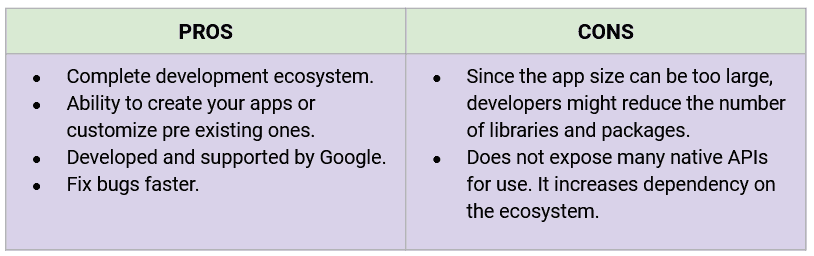
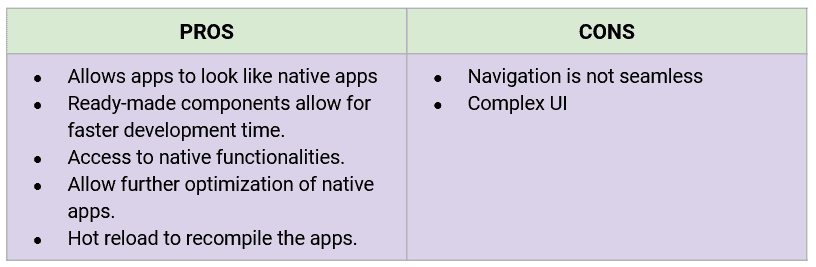
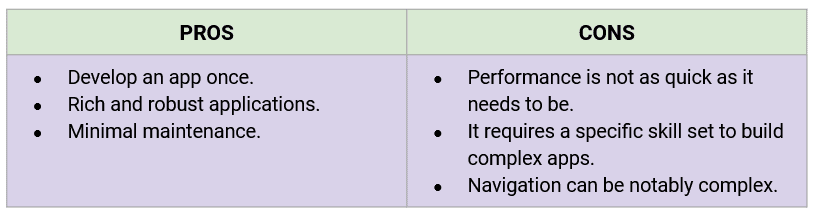
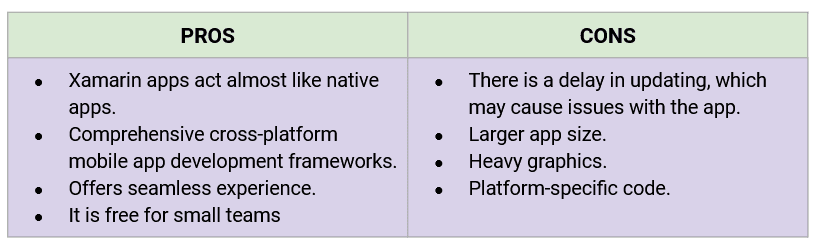
Each framework has its pro and cons. Please take a closer look at them:
Flutter
React Native
Ionic
Xamarin
Read more: Top Technologies Used to Develop Mobile App
Identifying What Suits Your Project
Every situation is unique. It might turn out that your technical requirements will lead to a solution. Still, this is how you can identify what suits your project:
- Flutter is a good option if the existing tech stack no longer satisfies your needs but it should be a very careful choice for startups.
- Xamarin usually fits most projects. It might be a little tricky to have everything you want, but in the long run, you will get it.
- Ionic excels in terms of performance. If you are a beginner in cross-platform development, Ionic may be the best option.
- React Native works wonders for MVPs and projects that need heavy interactivity. However, if your project is loaded with performance-hungry features, it may be best to skip it.
How Fingent Can Be Your Right Mobile App Development Partner
As a leading custom software development company, Fingent has years of experience in developing apps using various platforms for app development. Our app development team has hands-on experience in developing iOS and Android apps. No matter how complicated your app idea is, we can help you find the best solution. Let’s get talking.
Stay up to date on what's new

About the Author

Featured Blogs







Stay up to date on
what's new



Talk To Our Experts
Modernization is a desire to stay relevant and grow. App modernization does just that for businesses. It enables them to stay relevant and grow. In line with that, organizations worldwide are scrambling toward digital transformation. How does that benefit businesses?
App modernization or updating older software for newer computing approaches extends the lifespan of an organization’s applications while allowing it to take advantage of technical innovations. It is like renovating an old house to improve efficiency, safety, structural integrity, and more.
However, there have been occasions when the app modernization project has failed. This has been a concern to most business owners considering digital transformation. Are you one of them? If so, through this blog, you can learn why and how to avoid app modernization failure.
First things first. Does your company need app modernization? If so, why?
Why Your Company Needs App Modernization
Apart from what we discussed earlier in this blog, app modernization integrates new features to keep up with the latest business requirements. Even so, many business leaders wonder if their business needs app modernization. Here is a list of specific reasons for you to consider:
- It allows you to create new features and services that align with your current business needs and goals. In addition, you can personalize these features to ensure long-term value creation.
- Educating new and older employees becomes easier as app modernization can automate tedious and repetitive processes.
- App modernization helps you leverage the benefits of the cloud environment, allowing you to provide fast and efficient customer service.
- Cloud-native applications offer top-notch security features as compared to legacy applications.
- App modernization allows you to add newer features, services, and functions. These, in turn, increase customer satisfaction leading to increased revenue.
Why, then, does app modernization backfire at times? And how can you ensure the success of the project?
Read more: Why modernize your legacy systems? What’s the best approach to legacy systems modernization?
Why Some App Modernization Projects Fail
When an app modernization project fails, it may pose serious problems for your business, including wasted resources and time. Failed app modernization may hinder agility and keep your business from capitalizing on modern technology. It was noted that an alarming 79% of app modernization projects still fail. Why? Surprisingly, the failure is not due to the new system or methodology, nor caused by the modernization vendor. The reasons are much deeper. Here are the top 5 reasons why app modernization projects fail:
1. Ignoring the business process
Modernization efforts fail when the business process (accounting, inventory, finance) is poor, and a business tries to correct it with new systems. That will never work. Businesses must first understand what is slowing them down. Determining the problem is the right foundation for successful app modernization.
2. Implementing new systems without considering drastic business changes
When entirely new systems are implemented without considering the drastic business changes, the employees are forced to adapt quickly. In addition, such practice forces the business to evolve to fit the new software. Instead, the software must adapt to fit the current business process and requirements.
3. Businesses mistakenly assume that they are ready for a complete revamp
Most businesses believe that they are ready to replace the old system with new systems, and the business will run better. Now that is a huge mistake. Completely replacing all systems can send your business and your employees into shock. It may even change how customers interact with the business. A better approach is to modernize in calculated steps.
4. Failing to adopt an agile software
The pandemic helped us see that agility is king. Adopting inflexible applications can have disastrous consequences on your business. If you want to be future-ready, replace rigid applications with agile applications.
5. Failing to consult the end user
Modernization projects that do not involve the IT department and the end user fail as they do not consider how the new solution fits business needs.
Read more: Advancing Business Software Development With Cloud Native

The Secret to A Successful App Modernization Project Journey
Every business that embarks on a modernization project journey faces many challenges. The success of your app modernization efforts comes down to two key components: your IT team and your employees. As teams go through this journey, use these secrets to avoid failure and ensure success.
Secret 1. Build a cross-functional team
When choosing a team or developing an innovation group, build a cross-functional team that can focus on developing the culture, process, and tools needed to improve the modernization process.
Secret 2. Toss it, sort it, and commit to it
An effective business principle is to welcome all ideas and sort them, but when a decision is reached, you must commit to it and execute that above all else. Doing so will ensure the progress of the project.
Secret 3. Map out the development workflow
Mapping out a development workflow can help you when you encounter complexities in the project. It helps you look at every tool being used and identify dependencies.
Secret 4. Set milestones
Projects may change. Setting small modernization goals will help you adjust your long-term plans and reduce engineering risk. Focus on many small steps when planning for a major milestone. Doing so will ensure smooth progress from one step to another.
Secret 5. Prioritize data into categories
If you prioritize data into high, moderate, or low categories, you can decide what safeguards to have for each category.
Secret 6. Do not sew a new cloth on an old cloak
Take a hard look at your development workflow and identify habits that could derail your app modernization process. Don’t just patch up old problems with a new tool. Remember, these problems can derail new tools, so don’t patch, fix.
Secret 7. Keep your team in the loop
Your team may find it challenging to develop the knowledge they need to work on the new tools. Keeping them informed about the new tools and training them to navigate new workflows can ensure the success of application modernization.
Several aspects may factor into a successful modernization. That is why modernization endeavors are so challenging. However, implementing the above secrets can help the success of app modernization efforts.
Speaking to an expert can help you understand how to proceed with your app modernization needs. Why not reach out to us at Fingent and discuss your project with our software development experts?
Stay up to date on what's new
About the Author

Featured Blogs
Stay up to date on
what's new
Talk To Our Experts
Digital presence is no longer confined to a static website. The advent of backend frameworks has helped raise the standards of web development. The backend frameworks are an important aspect of web development. These frameworks help in creating necessary online platforms and applications. Finding a suitable framework that ensures utmost scalability and performance is the key to a successful business.
However, with many choices available in backend frameworks, finding one that suits a specific business goal can be challenging. This is why we want to help you dive deeper into the popular backend frameworks so you can make the right choice. Here is an unbiased comparison of two popular and trusted backend frameworks: Node.js and Ruby on Rails (ROR).
An Overview Comparison of Node.js and Ruby on Rails
Node.js
Node.js is a server-side open-source tool. It attributes its success to the single-threaded process used for web loads and async programming. Businesses can also use Node.js-based frameworks to enhance the backend capability of a project. This technology can build single-page applications, websites, and backend API services.
Market Stats Of Node.Js
- 66.8% expressed interest in continuing to develop with Node.js frameworks.
- A survey revealed that 85% of Node.js developers use it for web app development.
- There also has been 3.5% of stack overflow questions addressed regarding Node.js a month.
Node.js Use Cases
- Nasa: By creating a single database for any query, Nasa could reduce access time by 300%.
- Netflix: When they migrated from Java to Node.js, they decreased their startup time from 40 minutes to 60 seconds.
Read more: Learn why Fingent is recognized as a Top Node.js Company by TopDevelopers.co!
Ruby on Rails
Ruby on Rails is an open-source web application framework written by Ruby. It is the best option for beginners to help them build and deploy web applications and websites.
Market Stats of Ruby on Rails
- Ruby on Rails powers 394,000 websites
Ruby on Rails Use cases
- GitHub: GitHub has over 61 million repositories for its 22 million users worldwide. Using Ruby on Rails, they improved performance, documentation, and features.
- Airbnb: Airbnb boasts over 7 million listings in over 220 countries and regions. Ruby on Rails enabled them to reduce the TTM.
Pros and Cons of Node.js and Ruby on Rails
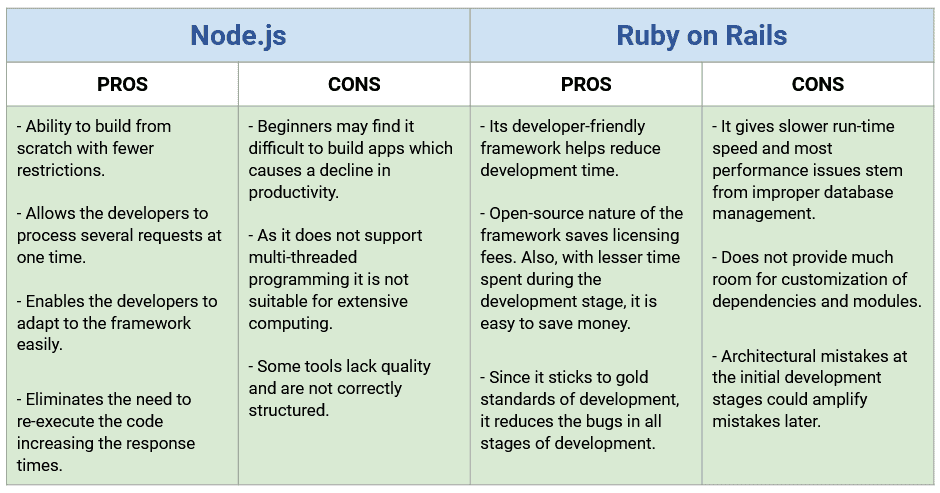
Now that we understand the pro and cons, let us look at a few other comparisons.
Performance and Speed
Performance is important when building complex and large projects.
Node.js creates the perfect environment for small tasks that do not affect the main application thread. Plus, the JavaScript engine can make multitasking more efficient.
Ruby on Rails can create efficient web applications with satisfactory performance. RoR applications may slow down in rare cases, like when the traffic scales significantly.
Application Architecture
It is important to choose flexibility when choosing a framework. A framework should be a guide, not a standard.
Node.js enables developers to handle multiple concurrent requests with high performance. in addition, it supports asynchronous communication between various components providing high performance. It ensures faster, flexible development modules and reduces time to market.
Ruby on Rails, on the other hand, follows MVC architecture. This architecture easier testing and decoupling because of the convenient separation of concerns. Also, since it follows the conventions of the configuration principle, it reduces developers’ legwork.
Scalability and Ease of Testing
Backend frameworks significantly influence web application scalability and ease of testing.
Node.js builds highly-scalable applications, and the event loop mechanism enables the server to process maximum requests. It is highly compatible with microservices. Hence, development teams can build applications more quickly as they scale. Node.js offers competent testing and debugging capabilities.
It is possible to scale with ROR if you invest more resources than other leading backend frameworks. However, Inadequate memory management and poor concurrency can create issues when trying to scale quickly on the ROR platform. Testing is simple and effective in ROR, considerably reducing intricacies during the testing phase.
Microservices Compatibility
Node.js builds smaller parts of services and code modules to efficiently handle multiple concurrent requests. Hence, Node.js and Microservices are an absolute combination for building enterprise-grade complex applications with higher scalability.
Though Ruby on Rails leans on monolithic architecture, it can be used in a microservices architecture. Hence, it is compatible with microservices’ needs and deployments.
Database Support
Node.js supports all kinds of databases. However, it is better to use a NoSQL database as it stores data in JSON objects because it offers more accessibility to Node.js.
Ruby on Rails comes configured for SQLite. However, it allows the use of multiple databases.
Hiring The Best Developers
The large community of Node.js and Ruby on Rails makes it easy to hire developers. If you are considering a backend tool for your project, Fingent top custom software development company can help define your project priorities to help you choose the stack that fits your needs.
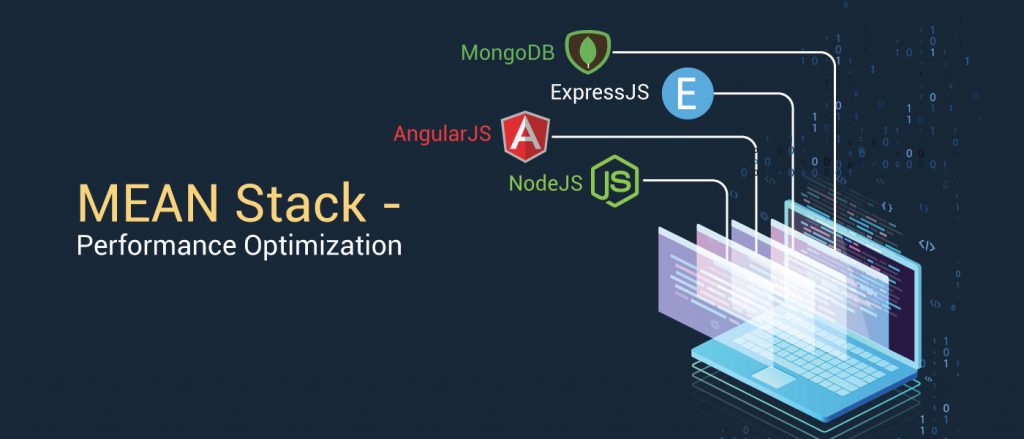
Read more: How we optimized a MEAN Stack project for better performance
Fingent provides you with top performing talent pool for all your development needs for both these frameworks. If you struggle to choose, our elite consultants will help you find the right framework that suits your business goals.
Reach out to us, and let’s talk about what that is.
Stay up to date on what's new
About the Author

Featured Blogs
Stay up to date on
what's new
Talk To Our Experts
Here’s another feather on our hat!
Fingent ranks amongst the “The Best Software Development Companies In Education – 2022” listed by the leading consumer education website, Online Degree!

This year’s focus is a huge testament to the work done by Fingent to address the most critical development issues that educators and students are currently facing in online and distance learning applications. Fingent’s digital products, learning systems, and custom software solutions for education are more intuitive and user-friendly and help drive better results with technology for educational institutions across the globe.
“With technology in the game, enabling people to quickly grasp concepts is not tough anymore, provided the right technology is implemented correctly. That’s where Fingent comes in! We make technology simple to access so that it can be leveraged to perform and provide the best!”
– Dileep Jacob, Senior Vice President – Global Operations, Fingent.
OnlineDegree.com is an educational platform founded by edtech startup veterans and academics in higher education. The site has appeared in hundreds of media outlets and publications for its work to educate working adults, academic professors, and administrators on various ways to improve the affordability and accessibility of higher education.
Ranking amongst the Best Software Development Companies in Education for 2022 is a big honor for Fingent and a step forward to many more innovations in the field of education. We believe in enabling industries to step into the future with smarter methodologies, renewed visions, and improved capabilities derived from the right technologies. Connect with us today, and learn how Fingent can help drive innovations and take your educational organization to new heights.
Stay up to date on what's new
About the Author

Featured Blogs
Stay up to date on
what's new
Talk To Our Experts
‘There is success through many advisers.’ This ancient proverb has proved not just true but very effective and powerful in this digital age. This is precisely what Open-Source Software (OSS) accomplishes. It allows for collaborative development where the community can modify and enhance the source code.
Open-source systems can help businesses adapt quickly to changing circumstances and facilitates controlled upgrades. Integration and maintenance become less of a hurdle. With the wide range of OSS possibilities, businesses are wise to tap into this huge potential for building a robust, secure, and yet, cost-effective infrastructure.
This blog will help you gain an in-depth understanding of how open-source can power your digital transformation journey!
How Open-Source Software Powers Digital Transformation
Vendors today provide various software solutions indispensable to a business’s software strategy. But finding the right software solution that caters closely to an organization’s needs has always been challenging! Meanwhile, OSS helps businesses build and maintain their IT ecosystem and enables sourcing highly creative developers with hard-to-locate skills. Engaging with domain experts and making their contribution to the OSS bank helps developers find satisfaction and boosts creativity. Judicious use of OSS can be of great benefit to any business.
Most IT leaders believe that OSS is either “very important” or “extremely important” to the enterprise software strategy. How do we know that? In 2021, developers downloaded over 2.2 trillion open-source packages. That is a 73% increase.
Read more: How to Ensure Safe Use of Open Source Libraries
Here are more reasons to justify this statement!
1. OSS Can Serve as A Ramp to The Future
Irrespective of whether you are a small business with limited resources or an established enterprise with an established IT ecosystem, open-source software’s ability to supply code that can be easily changed and customized to your specific needs is invaluable. Many businesses are turning to AI and blockchain to better understand customer needs and work towards fulfilling them. Open-source code can not only hasten the process but also ensure efficiency.
AI, ML, and AR/VR could feel like the proverbial butterfly always out of reach, and more so if your business does not have a well-established IT team. OSS can then serve as your ramp to the future. Your vendor or coder could build on the resources available to ramp up your IT capabilities and reach your desired situation.
2. OSS Can Be a Beacon for Talent
OSS provides coders and developers with access to code written by experts or extremely creative pioneers. This would be an immersive learning exercise. At the same time, experienced engineers could interact with others in their community, freshening their skills while keeping up with the latest in the IT industry. This exposure would, in turn, influence their recruiting and training activities.
The OSS is also a repository of “glueware.” It allows software engineers to create things outside their immediate area of expertise. While it requires ingenuity and skill to glue parts together to make a whole system, OSS provides not just the individual parts and the “glue” required to fix them. It is a new method of looking at the design, resulting in greater satisfaction and a sense of accomplishment.
3. OSS Can Build Engineering Discipline
Open-source projects have very clear frameworks. There is structure and good practices such as separation of concerns, abstraction, and isolation. A business of any size would benefit from following the same discipline in setting up its systems.
Maintaining clear standards of operability ad interoperability is another advantage. Using OSS ensures that the same standards are followed. Businesses do not have to invent standards and frameworks but can build on the foundation provided by OSS.
4. OSS Can Improve Your “Ilities”
Scalability, availability, and reliability – are just a few of the many aspects that OSS can help improve. Utility to ensure efficiency and avoid duplicating work can also be added to the list. Developers or vendors would likely prefer importing sections from a tried and tested OSS repository than building from scratch.
Read more: Artificial intelligence and Machine Learning For Faster and Accurate Project Cost Estimation

Dimensions of Open-Source Software
OSS boosts the digital transformation of businesses. It is good for businesses that lack the resources to meet the needs of IT development. OSS can yield different variations by its modularity. Consider a few pros and cons of OSS:
- Price: The price is very low to zero. However, one must consider the need for support, customization, and hosting while considering the cost of using OSS.
- Source Code: Full access to the source code helps developers evaluate the quality of the software and customize it to the needs of the business.
- Functionality: While individual systems from the OSS may be limited, they can be easily ramped up to serve all business needs.
- Modularity: OSS is modular. Hence it prompts the engagement of several experts in building a specific IT system.
- Development: OSS code is developed worldwide by motivated developers from a wide range of roles and functions.
- Distribution: OSS code is distributed over the internet, which is fast, efficient, and cost-effective.
- Licensing: A range of OSS licenses specify how the code can be used, modified, or redistributed. However, certain restrictive licenses only support the limited use of the OSS code.
- Monetization: Offering support services to help integrate the system, train users, and fix bugs is one way to monetize OSS. Offering to work out the deployment of OSS systems and taking care of backups, upgrades, and downtime is another way to monetize OSS.
Is Customization A Smarter Choice With Open Source?
Remember that OSS is another tool best suited for certain tasks and not so well suited for others. OSS might not be the best choice for your strategic activities or initiatives contrary to your cultural norms. Certain projects on OSS might have too high a level of uncertainty or too little support.
This does not mean that OSS should be put out of the picture. Do you need to adapt quickly to the fast-paced development in certain domains? Do you need greater effectiveness in attracting and retaining talent? Do you need a solution that requires utility, quality, and speed? OSS can help you in all these scenarios.
Read more: Odoo Migration: Why Is It Crucial and How to Do It Seamlessly!

How Can Fingent Help?
Fingent can leverage open-source technology to quickly develop your customized, dynamic business application. Our experts use PHP, AngularJS, jQuery, Magento, and several other open-source technologies to develop, implement and support a wide range of open-source technologies and resources. Our extensive experience working with open-source tools helps ensure that we can provide our clients with customized, innovative solutions quickly and efficiently without compromising on quality.
Intrigued to learn more about how we can help you develop and leverage the best business software solutions with open source. Connect with our experts now!
Stay up to date on what's new
About the Author

Featured Blogs
Stay up to date on
what's new
Talk To Our Experts
Machine learning is changing the face of everyday life, science, and business. It is revolutionizing all industries, from advancing medicine to powering various cutting-edge technologies. Though Machine learning (ML) was a part of AI’s evolution until the 1970s, it evolved independently. It has become a chief response tool for cloud computing and eCommerce.
The goal of machine learning in business is to adapt to new data independently and make decisions and recommendations based on thousands of analyses. Machine learning enables systems to learn, identify patterns and make informed decisions with minimal human intervention.
Today, ML is a necessary aspect of modern business. It uses algorithms and neural network models to improve the performance of computer systems. Machine learning in business and manufacturing is enabling organizations to achieve notable strides. These strides include increased performance and efficiencies, improved processes, and enhanced security.
This article will discuss the benefits of machine learning in business and its use cases.
Remarkable Benefits of Machine Learning for Businesses
According to Fortune Business Insights, the global market size for machine learning in business is expected to grow to USD 209.91 billion by 2029, exhibiting a CAGR of 38.8% during the forecast period. ML has been and continues to scale operations tremendously. Across industries, ML has led to a boom in affordable data storage and faster and more reliable computational processing.
Here are six remarkable benefits of machine learning in business:
1. Automation for better decision-making
Most businesses find themselves wasting precious time sorting through duplicate and inaccurate data. Such businesses benefit from using the predictive modeling algorithms of ML in their processes. Such a process will understand duplicate inaccurate data and distinguish the anomalies. It enables the organization to avoid inaccurate reporting that can result in poor customer retention.
Instead, this will allow businesses to use their accurate database to detect wasted costs, missed opportunities for sales, and revenue capital. In addition, organizations can overcome challenges and risks that arise due to miscommunication or poor performance metrics. Thus, businesses can streamline their operations and improve decision-making which could be translated into better ROI.
2. Increased scalability with minimum expense
Semi-supervised machine learning algorithms can help organizations leverage useful insights from customer profiles and enable them to view their brands from customers’ perspectives. Doing so will equip organizations with relevant insights to build their brand by improving their products and services.
3. Predictive maintenance
Predictive maintenance that ML aids manufacturing firms’ power to follow best practices that lead to efficient and cost-effective operations. The historical and real-time data predict problems and stipulate strategies to solve those problems. Plus, workflow visualization tools can eliminate issues and unwanted expenses incurred due to those issues.
4. Financial analysis
ML can greatly assist as it gathers and analyzes large volumes of quantitative and accurate historical data. It is used for portfolio management, loan underwriting, fraud detection, and more.
5. Personalization
Using machine learning in business will allow organizations to know their customers better and provide them with a more personalized customer experience. Organizations no longer need to rely on guesswork because ML models can process different types of information collected from numerous sources and provide relevant data about their customers.
6. Cybersecurity
ML technologies can improve cybersecurity to solve cyberattacks once and for all. Empowered by ML, intelligent security programs can gather and process data about cyber threats and respond to them in real time. ML models can detect the slightest deviations in patterns and flag them. Or destroy an attack in its nascent stage.
Read more: Can Machine Learning Predict And Prevent Fraudsters?

Top Use Cases
Machine Language has made its mark across industries and found a place in many different applications. Here are some top use cases:
1. Enhanced social media features
Businesses can use machine learning algorithms to create attractive and effective social media features. For example, ML algorithms in Facebook enable it to identify and record a person’s activities. These activities include records of chats and the amount of time that person spends on each post. It uses this data to determine what kind of friends and topics may interest that person and accordingly make suggestions.
Read more: Why Time Series Forecasting Is A Crucial Part Of Machine Learning
2. Product recommendation
Product recommendation is an advanced application of machine learning techniques. It has been the most popular application of almost every eCommerce website today. This technique allows websites to track a consumer’s behavior based on their previous purchases, search patterns, and cart history. It enables the website to make apt product recommendations to that consumer.
3. Recognition
Image recognition is one of the most significant and notable ML and AI techniques. It is adopted further for pattern recognition, face detection, and face recognition.
4. Sentiment analysis
Sentiment analysis is a real-time ML application. It determines the emotion or opinion of the speaker or the writer. For example, a sentiment analyzer can detect the thought and tone of a written review or an email. It can analyze the review-based website, decision-making applications, and more.
5. Access control
Most large businesses are actively implementing ML models to determine the level of access an employee should be granted. This application of machine learning can ensure the security of the organization.
6. Bank Domain
Banks are using ML to prevent fraud and protect accounts from hackers. Machine learning algorithms determine what factors to consider in creating a filter to prevent an attack.
Read more: Machine Learning – Deciphering the most Disruptive Innovation
How Fingent Can Help with Deploying the Best of ML
Leveraging the capabilities of machine learning in business can open the door to many opportunities. It is wise for any organization to take advantage of ML rather than lag behind competitors. However, we understand if you have questions. That’s why Fingent software development experts are here to help you. We can deploy the best machine-learning models efficiently and smoothly.
As a partner, Fingent can work with your team as you take on digital initiatives for sustainable business growth. We enable our clients to make data-driven decisions by efficiently deploying machine learning in business. Our cost-effective services will save you a considerable amount of time and money.
Furthermore, we do not follow a one-size-fits-all strategy. We provide custom software development services that cater to your needs. Therefore, look no further if you are looking for a reliable, efficient IT partner to deploy the best machine-learning models.
Stay up to date on what's new
About the Author
Featured Blogs
Stay up to date on
what's new
Talk To Our Experts
Manufacturing has long been a driver of global prosperity and economic growth. We all see astounding growth as the manufacturing industry evolves and keeps up with changing consumer needs.
This has led industry leaders to shift their focus from traditional to smart factory technology. A smart factory offers many benefits to operators, managers, and executives of companies in this industry. And yet, a few companies hesitate to start their journey the ‘smart way.’ If you are one of those companies, this article will help you with details and show you how a smart factory can bring its business operations and customer satisfaction to a new level.
Let us begin by understanding what a smart factory is.
What Is a Smart Factory?
Take a manufacturing facility and completely digitize it – that is what a smart factory is. The smart factory is a digitized manufacturing facility that uses digitized manufacturing methods, devices, and systems to continuously collect and share data. This data is used to make informed decisions that improve processes and address manufacturing challenges. The smart factory is a new industrial revolution phase focusing on real-time data, connectivity, automation, and Machine Language.
A smart factory uses the best digital and physical worlds to monitor the entire production line, from supply chain management to manufacturing tools. It can even monitor the work of an individual operator on the factory floor.
Why Is It Smart to Embrace the Smart Factory Movement?
According to a press release by Marketsandmarket, the smart manufacturing market was projected to reach USD 228.2 billion by 2027. It is expected to grow at a CAGR of 18.5% from 2022 to 2027. Then, most businesses consider smart factories highly beneficial and crucial across industries and sectors. Here are some of those significant benefits:
- Measure key performance indicators: A smart factory provides managers with automated data that is accurate. This data gives them the ability to measure key performance indicators more efficiently.
- Think ahead better and faster: Smarter predictive maintenance allows managers to predict and resolve maintenance issues better and faster.
- Efficient demand management: It can forecast more accurately and thus reduce waste enabling efficient demand management.
- Boosted productivity: Managers boost productivity as it can provide seamless data on machine maintenance and potential bottlenecks.

Key Elements of a Smart Factory
There are a few elements that make the smart factory what it is. Understanding these elements will help you see how it fits into your business.
1. Robotics
Robotics is a crucial element of a smart factory. Robotics enables smart material handling and adaptive operations. Besides, robots come with flexible infrastructure that can scale depending on business needs.
2. Big data and IoT
The Smart factory provides augmented access to large amounts of data obtained through the cloud and connected devices. This can empower manufacturers to identify patterns and insights, thus enabling them to make more informed decisions to optimize operations and improve productivity in the long run.
3. Cloud-based management
Cloud-based management includes a suite of professional software architecture that can be developed to empower highly efficient business operations. This can offer market reactivity and scalability. It can also provide real-time visibility into a business’s inventory and manage supply chain operations from the manufacturing to the end customer.
4. Virtual reality
Manufacturers have been using virtual reality for some time now. It uses computer-generated visuals that help improve the experience of the user. It trains engineers to handle complex virtual processes, maintenance systems, and troubleshooting.
5. Cybersecurity
Smart factories tend to increase cyber security threats. Thankfully, smart factory technologies are equipped to streamline cyber threats. For example, AI-powered bots act as guards 24/7, ensuring data security.
6. Additive manufacturing
Additive manufacturing is used for rapid prototyping, on-site manufacturing, and more. It saves time and costs spent on production and tool replacements. Quick reproduction, reconfiguration, and validation can also enable reverse engineering.
Read more: ERP Systems for Manufacturing: How it Improves Business Process
A Look into The Future of Smart Factories
Manufacturers that leverage smart factory technologies will unlock game-changing flexibility and agility. Emerging imperatives for the manufacturing industry include supply chain resilience, enhanced productivity, flexibility, and sustainability. In simple terms, only those manufacturing systems that enable a demand-driven and dynamically optimized value chain will survive and thrive.
1. Increasing demands
In the coming years, factories will face more stringent regulatory and compliance requirements ever. Such demands also merge with global trends toward adopting digitization. Given their ability to drive exponential productivity and sustainability benefits, digital technologies are at the heart of these changes.
2. Automation and beyond
Across the world, manufacturers began their digital transformation with automation to minimize manual operations and maximize output. But technological advances are enabling manufacturers to empower operators to understand operational data. Furthermore, newer platforms and integration technologies are driving down the cost of digital transformation.
3. Transformational gains
By implementing an integrated automation system, manufacturers can accelerate their sustainable manufacturing vision. Driven by the unrelenting need for agility and resilience, manufacturers can empower their workforce by adopting smart factories. By building future smart factories, they can unlock value benefits for all stakeholders along the way.
Creating a Smarter Future for Manufacturing with Fingent!
A smart factory is a direct way for manufacturers to excel in a competitive and dynamic marketplace. Partnering with the right app development company could mean make or break for you. Manufacturers need the right partner to help them implement solutions correctly. Fingent has been a consulting partner to several manufacturing companies and proved its mettle. Have a look at our Case Studies:
With the right partner, upgrading a traditional factory to a smart factory is much simpler than most imagine. Fingent builds custom solutions to integrate factories with smart solutions. Through our experience, we have already helped many businesses transform their traditional factories into smart factories.
Our experts at Fingent can help retrofit most existing manufacturing equipment and set up a centralized hub that can receive data from all the sensors. A cloud service could be set up to monitor and analyze from offsite. What is more, these solutions are upgradeable.
This allows established factories to upgrade at their own pace while keeping the upgrade cost low. Do you have a traditional factory that needs to become smart? Contact Fingent today!
Stay up to date on what's new
About the Author
Featured Blogs
Stay up to date on
what's new
Talk To Our Experts
The ongoing digital revolution is forever reshaping how businesses interact with their customers.
Modern technologies such as artificial intelligence, chatbots, machine learning software, and other solutions have allowed businesses to break away from traditional phone-based support models in favor of an omnichannel approach.
Countless businesses now allow customers to connect with support agents across multiple mediums, such as email, messenger applications, SMS, and on-site chat apps. However, far too many are still neglecting a core component of the service experience — self-service.
Whether your organization operates within the business-to-consumer (B2C) space or the business-to-business (B2B) space, you must offer customers self-service
options. We explore the role that self-service plays in the modern support experience.
When businesses understand the benefits of offering self-service, which technologies enable them to provide this type of support, and how to leverage ambitious custom software development services, it is easy to transform the high-value customer support vision into a reality.
Read more: Why Your Business Needs a Customized Order Management System
Why Customer Self-Service Experiences are Invaluable in the Digital Age
Consumer expectations are evolving as technology becomes increasingly ingrained in our daily lives. Smartphones allow consumers to access virtually limitless information on a whim.
When most individuals encounter a problem or want to acquire new information, they typically break out their smartphones, conduct a quick internet search, and select the most relevant results.
“How does this apply to customer service?” you ask. Simply, consumers have become much more self-reliant when encountering an issue with a product or service. The majority of your customers would much rather troubleshoot a product independently without having to
connect with a service agent. It’s also true when they want to purchase products or services.
Therefore, your organization must offer self-service support options if you want to meet the expectations of current consumers. By doing so, you can mitigate consumer frustration, expedite the resolution process, and demonstrate that your company is responsive to the needs and wants of your target audience.
That said, creating a self-service experience on your website can be a challenging and tedious process. That is why many companies turn to experienced digital transformation companies when they need a custom technology solution.
What Technologies Facilitate Self-Service?
When businesses partner with a software development team to provide custom services, a broad range of technologies is available that provide clients with a competitive advantage. Some of these technologies include:
1. Artificial Intelligence
Artificial Intelligence technologies are essential for creating dynamic self-service experiences. Without these technologies, self-service tools would be rigid and provide minimal assistance to your clients. Fortunately, AI allows developers to create innovative solutions unlike any off-the-shelf option.
2. Machine Learning
When used in conjunction with AI, machine learning software offers an immersive self-service experience. Over time, machine learning technologies can provide curated assistance based on past interactions with customers.
3. Chatbots
While chatbot technology is often used for lead generation, it can also be deployed to enhance the self-service experience. For instance, a consumer could provide information about their problem to a chatbot, and the program could connect them with resources to resolve the issue.
This approach will prevent the consumer from searching through your support page or reading your entire FAQs section to find the necessary information.
Read more: Prepare for the Future of Digital Innovation with these 10 Services From Fingent!

Top Ways Self-Service Enhances Customer Experiences
Self-service is rapidly becoming one of the most popular methods of customer support, and for a good reason. Reliable self-service enhances great customer experience in several distinct ways.
1. Reduces the Workload on Staff
If service tools handled even 20% of your customer support requests, then your staff would experience a significant decrease in their daily workload. Naturally, a lighter workload would improve morale and employee retention. Ultimately, this will reduce your hiring and recruiting costs.
In addition, reducing the workload on your staff directly impacts the quality of service they can provide your customers. Your team will have more time to devote to your customers because they will not be in a rush to handle the next service call.
2. Empowers Customers
They feel empowered when you provide customers and clients with user-friendly self-service options. They are no longer at the mercy of your support staff and can freely take matters into their own hands to resolve frustrating product issues.
Self-service can also minimize any product issue’s negative impact on brand loyalty. If a consumer experience only minor inconveniences when a problem occurs, they will be more willing to continue doing business with your company.
3. Reduces Costs
Performing support tasks manually is labor-intensive and time-consuming. As a result, you must maintain a fully-staffed support center to handle incoming customer service requests. The overhead associated with this can be excessive.
While self-service solutions will not eliminate the need to employ support staff, you can reduce the size of your support department. Each team member can work more efficiently and focus on handling complex product issues. Self-service will address the majority of minor problems.
4. Expedites the Delivery of Service
Few things negatively impact a customer’s brand perception than excessive hold times. By partnering with software development experts to deploy self-service solutions, you can significantly reduce wait times and expedite support delivery to your clients.
This approach will boost customer satisfaction and optimize the average lifetime value of each client.
How a Software Development Partner Can Help
When you partner with an innovative team of cloud-native software development professionals, you can expect cutting-edge solutions that leverage the latest self-service technologies.
In addition to custom software development services, your partner should offer business technology consulting. With proper consultation, you can refine your vision with timely advice that will improve your approach, incorporate more suitable technology, or align with your budgetary constraints.
If you would like to work with a passionate software development company dedicated to helping you shatter growth barriers with dynamic tech, let’s chat today.
Stay up to date on what's new
About the Author
Featured Blogs
Stay up to date on
what's new
Talk To Our Experts
Businesses are unique, like fingerprints! Their external and internal processes make them unique even in their sector. This makes it important to work on customizable solutions. After all, why would a customer come to you if you offer the same products and solutions as others? An end-to-end custom software solution will help you deliver unique customer experiences so that they are drawn to your business over other market leaders. Now is the time to take steps to start investing in end-to-end custom software that can offer you a competitive edge.
Whether to gain greater connectivity for IoT devices or to develop your own software, there is a horde of reasons why buyers and sellers gravitate toward end-to-end custom software solutions. Here is what you must know about end-to-end software and the impact it can have on your business growth and scalability.
What Is an End-To-End Custom Software Solution?
As the name suggests, an end-to-end custom software solution is a tool that has all the features necessary to execute the workflow from the very first step to the last one. This solution allows you to use an entire range of tools that you need to support and grow your business without using any third-party platforms.
Read more: Custom software development weighed against pre-packaged commercial software
Why And When Must You Think of Investing in A Customized End-To-End Solution?
End-to-end custom software solution serves specific needs and day-to-day requirements of your business. More importantly, it can automate your organization’s manual tasks and business activities. Being flexible to your business needs, these custom solutions can be more productive and have a positive influence on your business. It is easy to work with it. And it can even suggest which professionals could execute a task if the operating person leaves.
Here is when you must invest in an end-to-end custom software solution:
1. Do you need to juggle between software systems?
If so, an end-to-end custom software solution makes connecting different functionalities effortlessly. Even other software systems can operate in sync through an end-to-end custom software solution.
2. Do you need to automate daily activities?
The end-to-end custom software solution is an excellent resource for performing automation with utmost ease.
3. Are you looking for ways to streamline your business methodologies?
For business productivity, you need streamlined and effective methods. And that is exactly what end-to-end custom software solutions can help you generate. Also, it can aid the structured collection and storage of all data.
4. Are you struggling to optimize business services and improve business efficiency?
An end-to-end custom technology can optimize business services by saving time and effort. Besides, since it supports the business processes, you will ensure to satisfy your clients and earn their loyalty.
5. Are you struggling to enable workforce productivity?
Most custom software comes with templates that allow you to customize the entire process, from start to finish. This solution enables email automation, marketing automation, and content management. These elements enable workforce productivity.
6. Do you want to keep tabs on your business growth and maturity?
Since end-to-end technology works for multiple stakeholders, you will be able to keep tabs on income sources. This improves your brand identity.
Read more: 5 reasons why custom software development is important to your business

Top 6 Benefits of Implementing End-To-End Technology
All businesses across various industries can truly benefit from end-to-end custom software solutions. Here are the top 6 benefits for your consideration:
1. The ability to unify various processes in one concise format
Custom software provides an all-in-one cloud-based system that can correspond with your business goals, operations, and users. This system can unify hundreds of various processes into one concise format. This all-in-one tool allows you to streamline the payment process, optimize sales, and enhance logistics. It also allows you to monitor daily operations and take care of accounting. Above all, it smoothens the onboarding process.
2. Faster data migration
Transferring data from one source or tool to another is time consuming and tedious task. Implementing an end-to-end custom software solution smooths the data flow and enables easier and faster data migration from one source to another. This way, you have a complete overview of your prominent KPIs, metrics, and more within one platform.
3. No need to overpay
One of the most important benefits of investing in an end-to-end custom software solution is its cost-effectiveness. You will have to overpay if you have multiple systems from multiple vendors. Though the initial cost of off-the-shelf may seem lower, you are expected to take care of licenses, support packages, and other expenses that increase your initial cost.
Investing in end-to-end custom technology will cut your expenses significantly. On the flip side, you will also save money because of reduced errors, enhanced communication, improved productivity, and a simplified onboarding process.
4. Improved efficiency
Dealing with several vendors can lead to confusion. However, working with one vendor can help you optimize and automate your business. A custom solution can enhance overall efficiency and productivity. Minimized errors, improved security, optimized performance, and more lead to increased efficiency.
5. Grow and change along with your business needs
In business, change is inevitable. Changing an off-the-shelf software can be too expensive as you will have to buy additional licensing and add-on packages. With end-to-end custom technology, the developers can build it to scale as needed. This will allow you to keep up with the changing workflows, tasks, and integrations.
Additionally, custom software technology allows you to easily add new technologies and solutions, thus helping you stay on top of the latest innovations. Such a solution can bring your ideas to life and meet your specific business goals and requirements.
6. Competitive advantage
Off-the-shelf software is publicly available, and every other business uses it. How can using the same software will help you stand apart? Using the same software is like using a uniform; you cannot see the difference. To stay above the competition, you need an end-to-end custom software solution with unique features and functions configured solely for your business.
Watch more: How your business can stay Compliant, Smart, and Reliant with Custom Software!
Not an Expense but an Investment!
An end-to-end custom software solution will cover your basic business needs and empower your company to accomplish more. An end-to-end custom software solution is an investment rather than an expense. Fingent has worked with many leading businesses to create innovative and cost -effective custom software solutions that gained leverage and a competitive edge. We can help you too take your business to new heights! Give us a call, and let’s get started!
Stay up to date on what's new
About the Author
Featured Blogs
Stay up to date on
what's new
Talk To Our Experts
Custom software tackles the specific needs of users more comprehensively than traditional off-the-shelf packages. Efficiency, scalability, lower integration cost, uniquely tailored features, functions, profitability, and independence are a few of its major benefits. In simple words, custom software creates a more customer-centric approach to your business, which translates to more business.
Globalization has pressured companies to take bold steps in expanding their horizon and potential. The rapid increase in market trends, technological innovations, and increasing competitor growth has changed and raised customer expectations. Deploying custom software development solutions in your business can be a strong weapon in this vicious battle. This blog will show you why and also help you see if this might be the right time to implement it for your business.
Why Is There a Need For A Custom Software Solution?
Evolving times have made it necessary for businesses worldwide to step up to the challenge of being bold, unique, and versatile. “Be different or be forgotten” has never before been more relevant than today. Custom software gives you the tools you need to satisfy your customers.
Here are some more reasons why custom software development is the current need for businesses on a global scale:
1. High Security
Security nowadays is a prime preference provided by most companies. Getting hacked by cyberpunks is a nasty affair that not only compromises your company’s data and security but also ruins the reputation of your business. Compared to commercial off-the-shelf (COTS) Software, customized business software is better in terms of security and competence in saving data.
Mobile app formulating corporations exemplify this feature by merging features like two-way authentication and data encryption.
2. Efficiency
Custom Software is purpose-built to support unique operations and workflows promptly and productively. It refines the workflow by removing unnecessary factors and automating monotonous and tedious manual jobs. This way, it fulfills the fundamental goal of improving your company’s and its employees’ operational efficiency and productivity.

3. Scalability
Since customized software is created based on the unique needs of a business, it can easily be modified and embellished depending on the growing needs and requirements of the company. Scalability is one of the greatest significant advantages of custom software. It allows you to construct relatable software based on your business requirements. It can also cut costs associated with purchasing extra licenses and subscriptions to commercial software.
4. Cost-Effective
COTS software generally fails to work with existing and legacy applications. Businesses must invest further to ensure the software works well with their existing infrastructure. On the contrary, custom software can be built to adapt easily to an organization’s needs and integrate with any environment. Custom cloud software development goes one step further and enables you to build cloud-native applications at a much lesser cost.
Read more: Know What’s Driving Custom Software Development Cost This 2022!

5. Independence
Deploying custom software means freedom from the clutches of a commercial software vendor. You can avoid incessant price hikes for licensing and support. You will also remain unaffected when packaged software goes out of business, or a vendor terminates a product. With custom-developed software, you are in charge of creating and maintaining the software, which means you can update and modify it as regularly as you need.
These are just a few reasons for the increasing need for custom software solutions. It can effectively meet the demands of businesses irrespective of the company’s size. Technically progressive solutions can give you a stepping stone over opponents.
Using custom applications reports a 77% reduction in manual data entry! Learn more about why choosing custom software works over commercial off-the-shelf solutions. Scroll through our Infographic now!
Does Your Business Need Custom Software Solution Right Now?
Now that you know the benefits of custom software, the question is: do you need to implement it right now, or can you put it off for a while? Here is a checklist of symptoms. If you tick any of these boxes, it might just be time to get that ball rolling on a custom software solution:
1. Lack Of Efficiency
Are your employees struggling with mundane manual work? Is it resulting in delays, lower productivity, and errors?
Custom business software developed according to your requirements will empower your business to tackle these challenges by providing an all-in-one environment for employees to plan and execute the workflow, communicate effortlessly, and procure data anytime. By enabling automation and AI in the software, you will be able to eliminate the element of human error and conserve your human resources for more focused tasks.
2. Data Management Issues
Do you often struggle to access and track crucial data? Does it take ages to make sense of the data and put it to good use? Are you struggling with the threat of data leaks?
Data is probably the essential asset of any business. It is usually challenging to store, analyze and track crucial information, and keep the data secure from theft to maintain the data integrity in your industry.
A custom software solution can be built to include Business Intelligence (BI) solutions that can help you convert data into actionable insights. This will help you make intelligent data-driven decisions for your business. You can also customize security layers for your software to address the particular security risks associated with your business.
3. Low Customer Satisfaction
Have you been receiving more customer complaints lately? Are they dissatisfied with their interaction with your business?
Nobody knows your customers as you do. Integrating this knowledge into your software can be priceless in ensuring customer satisfaction. Custom software allows you to do just that. You can work with your developers to integrate insights from your customer base and market analysis and provide features that your customers will be happy with, which can lead to a seamless customer experience.
4. Business Expansion
Is your business expanding? Do you need to grow technologically?
Expansion and development are two constants in a business owner’s mind. Whether your business is expanding in terms of location, the number of employees, or customers, you unquestionably need to grow technologically.
You don’t want to add technological issues to the chaos of a quickly expanding business. Looking for new software solutions every time a component of your business grows will be a real challenge. With custom software, you can easily build on the existing software and add features as you scale.
Read more: Choosing the Right Software Development Vendor
How To Get Started?
As you can see, custom software can play an integral part in the operation and success of your business by improving productivity and increasing efficiency. It is an excellent investment in time-saving, cost-effectiveness, and risk reduction.
The first step is hiring a professional technical team to help you develop custom software. Fingent, a leading custom software development company, excels in crafting tailored software solutions for clients, perfectly aligned with their unique requirements. We can help you too.
Give us a call, and let’s discuss your requirements.
Stay up to date on what's new
About the Author
Featured Blogs
Stay up to date on
what's new

