SaaS Is Dead. AI-driven Custom Software Development Just Made Custom Software the Sensible Choice.
SaaS is dead. It died not because it is bad, but because it was never truly built for you.
For decades you believed that the phrase “there’s an app for that” was good enough for your enterprise. Buy the readymade license, configure the workflow, and ship the product. But the math behind the magic is exposing hidden costs and vulnerabilities. For the first time, IT leaders have a real alternative.
It is custom software development.
How AI-Driven Custom Software Development Is Killing SaaS
Speed was the last argument SaaS had. AI just took it away and exposed inherent weaknesses that cannot be overlooked.
You Can’t Get New Feature Updates When Needed
SaaS improvement happens when the vendor decides it happens and it is quite often gated behind a pricing tier you don’t have. Ask your vendor for a workflow change or a new feature addition that matters to your business, and it goes into a backlog behind ten thousand other requests.
AI-assisted development means your custom systems can keep adapting continuously: new logic, new integrations, new capabilities shipped on your schedule, tied to your priorities, not a quarterly release note from a company optimizing for its other ten thousand customers.
SaaS Becomes Expensive In The Long Run
SaaS pricing only moves one direction – always upwards. Median vendor price increases are running at 7.8% a year, with AI surcharges now standard practice across most of the market.
Custom software has the opposite trajectory: the AI tooling that builds and maintains it keeps getting cheaper and faster, which means your cost curve bends down over time instead of up. Run that forward three years and the “expensive to build” argument quietly flips into “expensive not to.”
SaaS has an increased surface area of security attacks
Multi-tenant SaaS platforms mean your data lives in the same environment as every other customer on that vendor: one shared attack surface, one shared blast radius. Custom software lets you architect security and compliance around your actual risk profile, not a vendor’s lowest common denominator built to satisfy their smallest customer and their largest one at once.
SaaS Apps Cause More Wastage Than You Can Imagine
According to BetterCloud, in 2026, the average enterprise uses 118 SaaS applications. With every passing year, this number gets bigger while consolidation and integration efforts move at snail speed or halt altogether. The bad news is, a significant amount of licenses could be underutilized and sitting idle.
According to Zylo’s 2026 SaaS Management Index, the average organization wastes $19.8M a year on unused SaaS licenses alone.
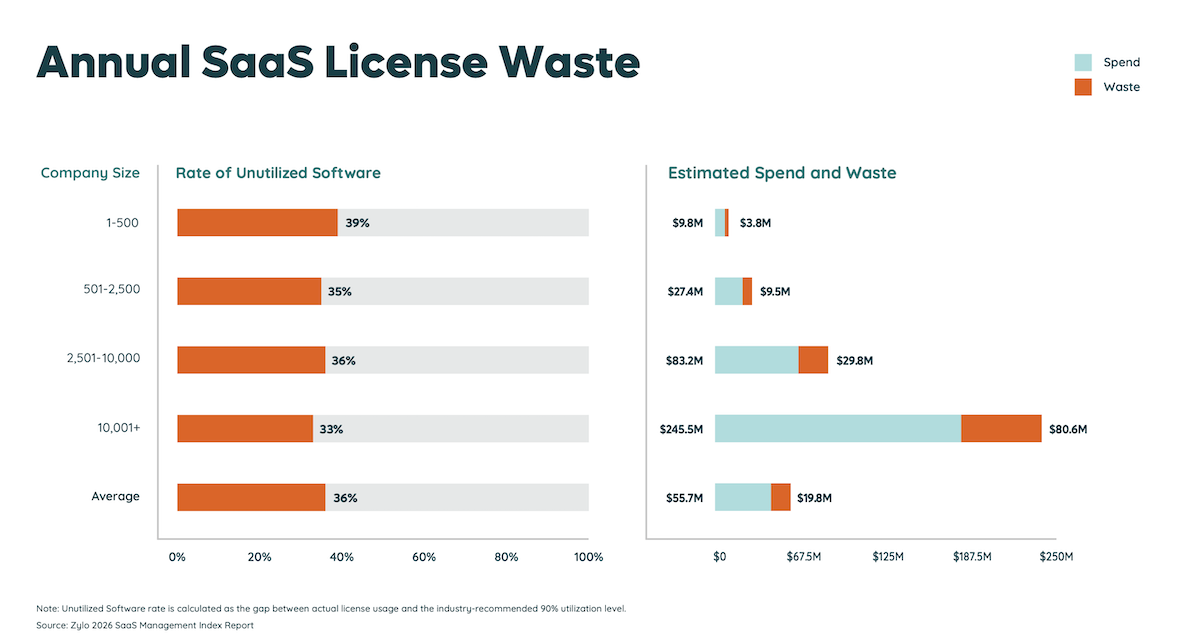
Source: https://zylo.com/blog/how-much-wasted-on-saas-spend
This wastage goes unchecked because business teams other than the IT team control at least 70% of this spend. This cost sprawl takes place because app licenses are often purchased without a security review, architecture review, or simply because a business leader missed asking “How does this fit into our current stack?”
Incidentally, shadow IT also follows a similar pattern. Software or hardware gets procured without IT oversight. In fact, Gartner projects that “by 2027, 75% of employees will acquire, modify or create technology outside IT’s visibility, up from 41% in 2022.”
And the vendors know it. As AI features get bolted onto every platform, pricing is shifting fast. 73% of vendors introduced AI surcharges in 2025–2026. 79% of IT leaders reported facing a SaaS pricing increase at their last renewal.
The Saas Lock-In Problem Nobody Prices In
Here’s the part that should really bother a CFO: the technology getting cheaper doesn’t mean your bill gets smaller. Gartner analysts point to vendor lock-in as a direct driver of rising SaaS costs.
Once a workflow, your data, and your team’s muscle memory are built around a platform, switching becomes expensive enough that vendors can raise prices with little fear of churn. You’re not paying for innovation. You’re paying a switching tax.
Custom software doesn’t eliminate that dynamic entirely, but it puts you back in control of it.
You own the roadmap, the data model, and the exit costs instead of renting all three from someone optimizing for their own retention metrics.
This price volatility creates complications. Even as AI token prices fell roughly 80% year-over-year, total enterprise spending on usage-based SaaS grew 320%, because consumption scaled faster than the cost reductions did. Most procurement teams have no framework for forecasting that kind of swing.
SaaS was sold on the promise of easiness and speed. Custom software, on the other hand, was deprioritized for lack of speed. However, it comes with the cost of heavy tool fragmentation and over-dependency.
Vast number of tools that do not fit in the workflow, or otherwise stitched together with fragile integrations, migrations, workarounds, which combined undermine actual efficiency.
But, AI has narrowed that gap fast. It has reduced the longer build cycle required for custom software development drastically.
AI Just Erased Custom Software’s Biggest Weakness: Time
AI-assisted software development is now an industry standard and no longer an experiment. Industry surveys put developer adoption of AI coding tools above 80%, with teams reporting roughly 55% faster task completion and significantly fewer defects per commit when AI-assisted workflows are paired with proper review.
Enterprises using agentic coding tools are reporting even sharper results: faster onboarding, dramatically reduced cycle times, and engineering teams shipping features faster than a year ago.
Custom software development is offering what SaaS could not, that too at an accelerated pace: software shaped exactly around your process, your data, and your customers, not a vendor’s median use case.
So the Real Question Isn’t “SaaS or Custom.” It’s “Which Parts of My Stack Need to Be Bought, Built, or Hybrid?”
SaaS is still an ideal choice for undifferentiated and standardized functions like email, expense reports, CRM functionalities, etc. However, applying the same business logic to all the systems that the business relies on is where the blindspot is.
It is necessary to make a conscious decision about when to buy, build or go hybrid.
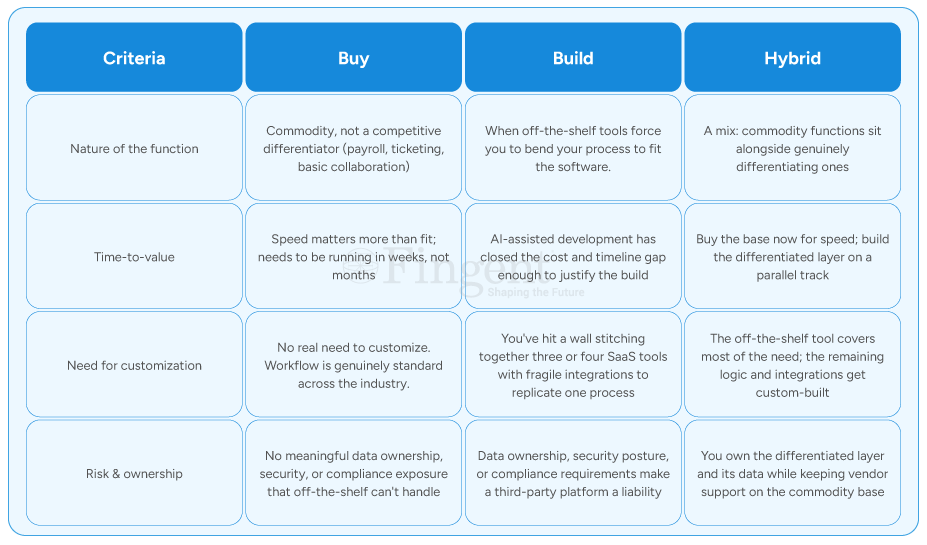
Buy When You’re Purchasing Time
- The function is commodity, not competitive advantage (payroll, ticketing, basic collaboration)
- Time-to-value matters more than fit (you need it running in weeks, not months)
- The workflow is genuinely standard across your industry, with no real customization need
Build When You’re Purchasing Advantage
- The workflow is core to how you compete, and off-the-shelf tools force you to bend your process to fit the software instead of the reverse
- You’ve hit a wall stitching together three or four SaaS tools with brittle integrations to replicate one connected process
- Data ownership, security posture, or compliance requirements make a third-party platform a liability, not a convenience
- AI-assisted development has brought the cost and timeline within reach of your budget and roadmap
Hybrid: Why Choose When You Can Have Both
A binary choice between buy and build is not always the mandate. Sometimes enterprises have the option to build a pragmatic solution where they get to buy the solution of their choice and build a differentiated layer on top of it. They can use AI-accelerated development to connect the two with integrations and custom logic to make the solution truly custom-built while giving the benefits of off-the-shelf software.
The Leaders Who Win This Decade Are Choosing Custom Software
The enterprises pulling ahead in the AI era aren’t the ones who declared “no more SaaS” or the ones who kept renewing every license out of habit. They’re the ones running a deliberate audit: which systems are commodity, which are core, and which no longer make sense to rent when building them is faster and cheaper than it’s ever been.
If your team is still defaulting to “let’s just buy a tool for that” without asking whether AI-assisted custom development changes the answer, you’re making a 2020 decision with 2026 economics.
Ready to find out which parts of your stack should be bought, built, or connected?
Stay up to date on what's new

About the Author

Tony Joseph

Tony believes in building technology around processes, rather than building processes around technology. At Fingent, he specializes in custom software development, especially in analyzing processes, refining them, and then building technology around it. He works with clients on a daily basis to understand and analyze their operational structure, discover (and not invent) key improvement areas, and come up with technology solutions to deliver an efficient process. You can reach him at [email protected], Skype: tony_fingent
Recommended Posts

27 Apr 2026 B2B
Top 15 Custom Software Development Companies in the USA for 2026
Custom software development is important for businesses today, as off-the-shelf software cannot meet the unique requirements of workflows, integrations, and scalability. In the United States, the custom software market is……

03 Mar 2026 B2B
Why Custom Software Is Winning in the AI Era
AI is not a feature you bolt on. It is an architectural decision. And architecture determines advantages. AI has moved past the pilot stage. It is no longer a capability……

24 Dec 2025 B2B
7 Signs Your Business Needs To Opt For Custom Software Development
Increased customer expectations and rapid digital change – ring a bell? Work has become increasingly complex for business professionals. There’s more competition, and you need smarter, faster, and connected systems……

23 May 2025 Manufacturing B2B
How Digital Transformation in Manufacturing Is Rewriting the Future of Production
Walk into any modern factory today, and you will notice something different. No noisy jungle of machines. No conveyor belts. No caution tape. It is alive—with sensors, data dashboards, and……
Featured Blogs







Stay up to date on
what's new



Talk To Our Experts