Agentic AI for Business: 8 Operational Signs You’re Ready

Most CTOs and CIOs have already sat through several agentic AI pitches this quarter, each one promising transformation with a slightly different slide template. Awareness was never really the problem. What’s missing is a practical way to check if agentic AI fits with current operations. This needs to consider the systems and processes already in place.

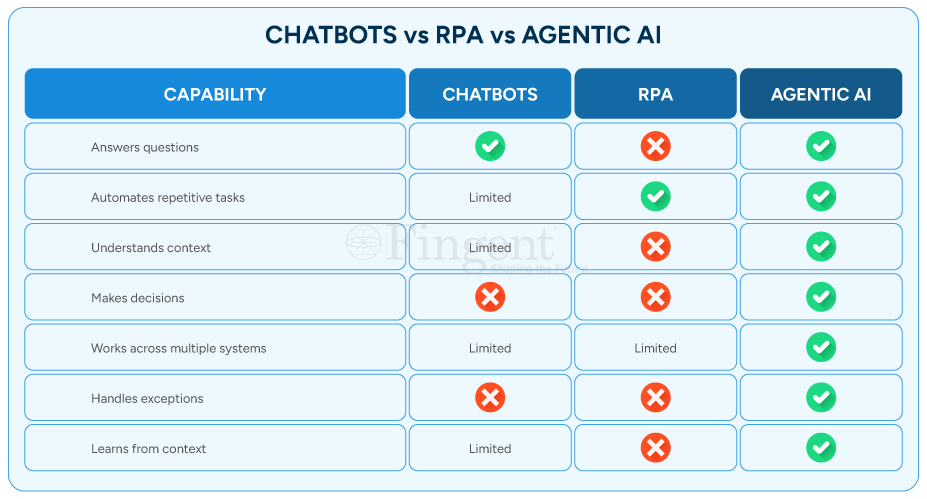
Chatbots and RPA automate individual tasks. But an agentic AI runs the whole workflow. It is a judgment-based, multi-step model that involves reading context, coordinating across systems, and taking action without someone approving every stage. One executes instructions, the other exercises judgment. That’s the actual dividing line.

Research indicates that software development projects are shifting from tools built for people to systems built for autonomous agents. That scale of projected investment says something. Agentic AI for business is becoming standard enterprise infrastructure, not a passing trend.

Not every business will see itself in the patterns below, and that’s fine. It usually just means agentic AI isn’t a priority yet. But for businesses already wondering whether they’re ready. The eight signs below are a faster way to find out than sitting through another vendor call. Often, several of these signs show up together. But they all trace back to the same ceiling. How much manual effort a business can absorb before growth stalls.

Discover How Agentic AI Can Transform Your Operations

Explore Now!

The 8 Signs That Indicate Your Business Is Ready for Agentic AI

You don’t need another strategy workshop to answer this question. Start by looking at where work slows down. Look at where manual effort keeps creeping up, and where your best people are stuck doing repetitive tasks instead of the work they were hired for. The more of these signs that sound familiar, the stronger the case for exploring an agentic AI solution.

1. The same multi-step process runs thousands of times a month

Tasks like loan applications, identity verification, refund requests, and customer onboarding follow a near-identical sequence every time. If employees must monitor every stage or manually resolve routine exceptions, the volume itself reveals the underlying constraint. The limit is not complexity, but manual execution.

2. Your staff’s time gets swallowed by reading, extracting, and re-entering data

KYC reviews, insurance claims, purchase order validation, regulatory forms all of it involves moving information from one place to another. When your most experienced people spend more hours transferring data than actually analyzing it, you’re burning expertise on work a system could handle.

3. Costs keep climbing because of manual processing, not because of growth

When workloads increase, plenty of organizations just hire more people rather than fixing the underlying process. Compliance teams expand every time regulations shift; support teams grow alongside the business. Over time, that pattern doesn’t just add headcount; rather, it adds errors, rework, and a ceiling on how far you can scale. This isn’t about eliminating the people doing this work today. It’s about moving them off transcription and into judgment calls the system can’t make. The teams that adopt early usually redeploy, not downsize.

4. Compliance documentation eats a disproportionate share of your operations

In industries governed by AML, GDPR, HIPAA, or SOX, huge amounts of time go into documentation, reporting, and recordkeeping. Because it’s scattered across departments, leaders often don’t realize just how much of the day gets absorbed by the same compliance work, repeated endlessly.

5. Manual handoffs are quietly slowing everything down

Beyond staffing costs, manual work slows decision-making. Requests sit in approval queues. Routine cases take longer than they should. Customers wait because someone has to physically move a case from one stage to the next. In logistics, this often looks like shipments stuck behind manual exception-handling rather than any real capacity problem. Here the process is the bottleneck, not the volume.

6. Fragmented tools are forcing your team to do the integrating

CRM here, ERP there, and a compliance tool that doesn’t link to either, and the employees end up copying data between platforms by hand. That’s when delays, duplication, and errors happen. Agentic AI doesn’t need you to replace what you’ve invested in. It can manage work across those separate systems instead.

7. Your automation falls apart the moment something unusual happens

RPA and rule-based bots only work inside the exact conditions they were built for. An unusual claim, a mismatched document, an incomplete form, or anything outside the rules, and the system stops and hands it back to a person. If your team spends more time rescuing automation than benefiting from it, the workflow needs judgment. More rules won’t fix that.

8. Work sits untouched overnight because it needs a decision, not a lookup

Claims, tickets, approval requests that arrive after hours often just wait until someone’s back at their desk. It’s rarely about task difficulty; it’s that the next step needs a judgment call the current system can’t make on its own. When timing becomes as much of a bottleneck as volume, you likely need something that can decide, not just queue.
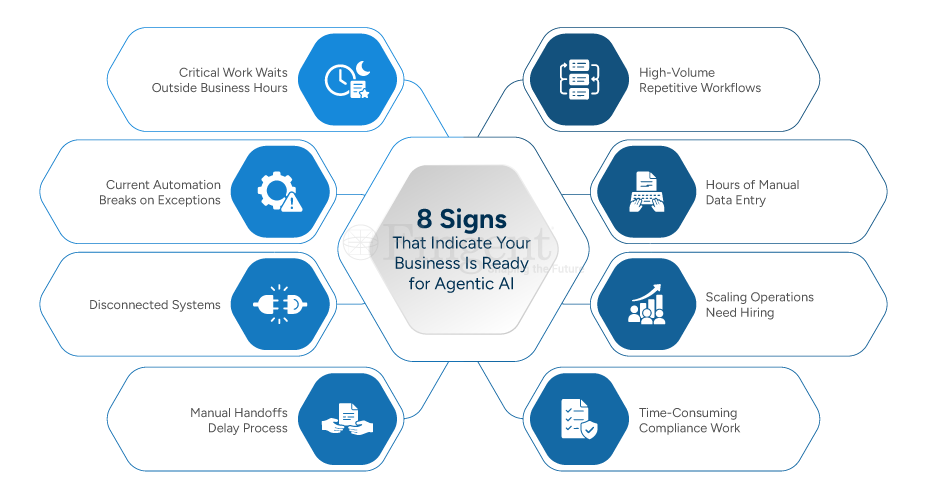
8 signs your business is ready for agentic AI
8 signs that indicate your business is ready for agentic AI
Manual handoffs delay process Disconnected systems Current automation breaks on exceptions Critical work waits outside business hours
Agentic AI for Business Infographics

What Agentic AI for Business Looks Like in Practice

Theory doesn’t move budgets; outcomes do. McKinsey research puts the share of organizations that have scaled at least one agentic AI system at roughly 25%, and most of those are still working within a single function rather than across the whole enterprise. Here’s what it looks like when a business resolves signs like these:

A lead-response automation project reached 96% accuracy in lead identification by having the AI agent screen every inbound message and filter out partnership pitches, HR emails, and junk before routing qualified leads to the right sales manager. Response time dropped to under an hour. This is one of our AI Use Cases

A call center quality assurance program saved 2,550 person-hours by automating the first pass on call reviews, so analysts could focus their attention on the conversations that actually needed human judgment.

A global marketing firm cut routine information lookups by 70% by having AI agents handle repetitive retrieval work, freeing employees to spend more time on customer-facing and strategic tasks.

Agent Washing and Its Perils

“Agent washing” is the industry’s term for a fairly common practice. A company labels a standard chatbot or scripted workflow as “agentic AI,” without the capability to back that claim up. Much of what is marketed as agentic AI today falls into this category. It can answer questions or run through predefined tasks just fine. But right up until something falls outside the script, it stops cold.

The real test is simple. Can the system make decisions across multiple steps? Figure out the next action based on context? And carry a workflow through to completion without waiting on a person at every turn? Or does it just assist, one step at a time while a person still drives? When evaluating vendors, it’s worth asking that question directly. And the answer usually makes clear which category the product actually falls into.

What This Actually Costs You to Find Out

A pilot on one workflow doesn’t require ripping out existing systems or committing enterprise-wide. It requires clean data, clear process boundaries, and someone accountable for oversight. The risk of testing is small. The risk of waiting is a widening gap between what your competitors’ operations can absorb and what yours can.

A Few Common Questions

Q. What is agentic AI for business, exactly?

A. It’s AI that can take a task from start to finish without someone checking in at every stage. It gathers the information it needs, decides what to do with it, acts, and reports back on the outcome.

Q. Is Your Business Ready for Agentic AI?

A. If you’re dealing with high-volume repetitive workflows, manual data extraction, compliance-heavy processes, disconnected systems, or slow handoffs between teams, you’re likely a good candidate. The more of the signs above that apply, the stronger the case.

Q. How do I know if my business is ready for Agentic AI?

A. Start by finding the one workflow where friction is worst. Then check whether the data behind it is clean and consistent enough to trust, and whether the process has clear enough boundaries for a system to operate within. From there, look at your existing systems and governance needs before launching a focused pilot, not an enterprise-wide rollout on day one.

Q. Why should businesses adopt Agentic AI?

A. Because as transaction volumes and regulatory demands grow, manual processes get more expensive and harder to scale. Agentic AI lets you grow operational capacity without growing headcount at the same rate.

Q. What is the future of Agentic AI in business?

A. Enterprise AI is moving toward connected workflows rather than isolated point solutions. Businesses are shifting from single-task assistants toward agents that coordinate work across functions, while still keeping people in the loop wherever judgment is genuinely needed.

Q. How do you implement Agentic AI in a business?

A. Most successful rollouts start with one clearly defined, high-friction workflow. Once that shows measurable results, organizations expand into other processes while keeping governance, security, and oversight intact.

Ready to Transform With Agentic AI? Let Us Help You Map High Scope Areas

Contact Us Now!

What Do You Do With This List?

The next step isn’t adopting agentic AI everywhere. It is to identify the one workflow where agentic AI can deliver measurable business value.

If you recognize four or more signs, assess the part of your process causing friction. Test AI on that specific area to see if it works and saves money. This ensures accuracy and builds confidence among your team before wider implementation.

You don’t need a roadmap for agentic AI everywhere. You need to know if it’s worth it for one workflow. Explore Fingent’s AI Hub to see how this plays out across industries. Talk to our AI experts directly; we’ll help you find that workflow and tell you honestly whether it’s ready.
Stay up to date on what's new

    About the Author

    ...
    ishaque

    Ishaque is a seasoned Application Architecture & Delivery Manager at Fingent with a strong passion for emerging technologies and digital innovation. He specializes in enabling secure, scalable application architectures, with a particular focus on AI-driven solutions. Ishaque is dedicated to helping organizations adopt modern development strategies that accelerate innovation while maintaining security, reliability, and business value.

    Recommended Posts

    Manual Order Processing vs Agentic AI

    31 Jul 2026 B2B

    Manual vs Agentic AI for Order Processing: What Businesses Need to Know

    Is your team still reviewing emails, entering data, and updating systems manually? Such manual processes open doors to data entry errors, unexpected delays, and revenue losses. You might have let……

    Top AI development companies in 2026

    24 Jul 2026 B2B

    Top AI Development Companies in 2026

    Finding the right AI development company to partner with is crucial. While AI adoption is accelerating, many organizations still struggle to move beyond pilot projects because of challenges such as……

    agentic workflow platforms

    03 Jul 2026 B2B

    Autonomous Agentic Workflow Platforms: A Comparative Analysis

    The adoption of AI co-pilots and virtual assistants has been quick. Businesses embraced them. AI tools, like chat assistants and coding copilots, promised faster work. They helped with smarter decisions……

    ai order processing

    11 Jun 2026 Logistics B2B

    AI Order Processing: The Smarter Way to Manage Orders at Scale

    Orders are the lifeblood of any business. But managing them is a whole different ball game. A customer submits a purchase order by email. Another person places an order through……

    Talk To Our Experts

      ×