Agentic AI for Logistics: From Reactive Operations to Autonomous Execution
Logistics has always been a competitive market. But somewhere between rising customer expectations, unpredictable carrier markets, labor shortages that won’t resolve, and supply chains that snap at the slightest pressure, complexity started becoming unmanageable.
Automation helped. Generative AI helped more. But both still need a human in the loop to do anything consequential.
Agentic AI for logistics changes the model entirely. This isn’t AI that tells you what went wrong. It’s AI that fixes it.
It reroutes delayed shipments, secures another carrier, updates the ERP, and keeps the customer informed before your operations team has their first coffee. That’s what Agentic AI for Logistics promises.
Further in this blog, you’ll read how Agentic AI works for logistics, what the top benefits are, and some high-impact use cases.
Discover How Your Enterprise Can Harness AI for Maximum Benefit
Why Logistics Needs Agentic AI More Than Ever
Today’s logistics operations are fighting on multiple fronts simultaneously: constant shipment disruptions, manual order processing backlogs, siloed TMS, WMS, and ERP systems that don’t communicate, labor shortages that show no signs of easing, complex carrier coordination across dozens of providers, zero real-time visibility across the supply chain, and customers who expect proactive updates as a baseline.
Traditional AI tells you there’s a problem. Agentic AI starts solving it.
Agentic AI understands a business goal, plans the steps required, and takes action across systems with minimal human intervention.
See how AI is already reshaping supply chain and logistics in Fingent’s analysis: The Role of AI in Supply Chain and Logistics.
Read More : Adoption of ai in logistics
How Agentic AI Works in a Logistics Environment
The architecture that makes this possible isn’t a single monolithic AI. It’s a network of specialized agents, each with defined responsibilities, collaborating continuously across your operation.
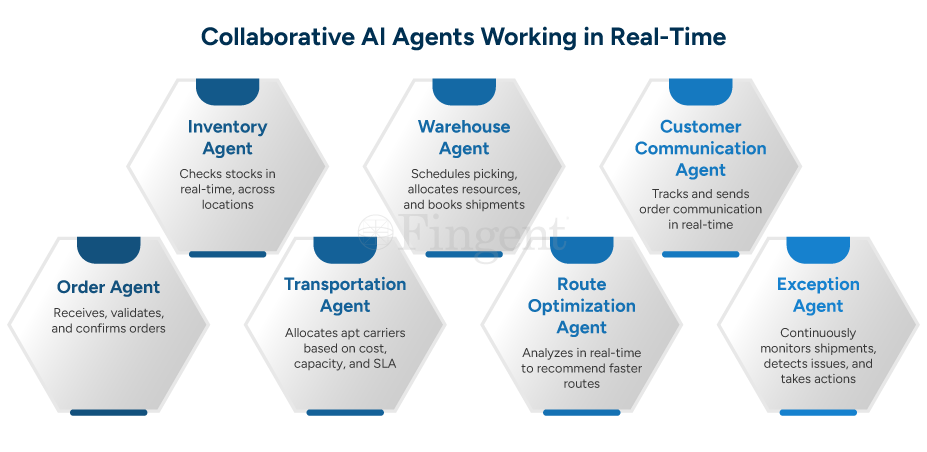
No handoffs waiting on human approval at each stage. No information lost between systems. The whole chain runs at software speed, not inbox speed.
What makes this different from traditional automation is that these agents don’t run sequentially and stop. When the Exception Agent detects a delay, it simultaneously triggers rerouting, carrier rebooking, ERP updates, and customer notification, all without a human orchestrating it. AI Agents also continuously learn and adapt. They learn from every interaction, adapt to changes in real-time, and improve decisions for future orders.
The Benefits:
- Faster fulfilment – reduced order cycle time
- Lower cost – optimized carrier and routes
- Better customer experience – proactive updates and fewer delays
- Resilient operations – early issue detection and auto resolution
- Smarter over time – continuous learning drives ongoing improvement
Take a deeper look at how autonomous agent workflows are architected for enterprise deployment.
High-Impact Use Cases of Agentic AI for Logistics
1. Autonomous Order Processing
A. Traditionally, every order format creates another manual task. Emails, PDFs, EDI, and Portals. Someone has to read each one, figure it out, key it in, and double-check it before the real work even begins.
Agentic AI skips the admin marathon. It reads the order, extracts the details, validates them against business rules and inventory, updates the TMS, and triggers approvals automatically. Humans step in only when the situation calls for judgment, not data entry.
See how Fingent automates logistics documentation and order workflows: AI-Driven Document Processing and Workflow Automation.
2. Intelligent Shipment Exception Management
A. Imagine a shipment gets delayed because of severe weather. In a traditional operation, a planner eventually notices, starts making calls, evaluates options, manually updates systems, and notifies the customer. This takes hours, sometimes longer.
With agentic AI for logistics, the Exception Agent detects the delay the moment it registers, identifies an alternate carrier, reroutes the shipment, updates the ETA, notifies the customer proactively, and updates the ERP. All automatically, all while the weather event is still unfolding.
The customer experience is better. The operational cost is lower. And your team didn’t have to manage a crisis they never had the chance to prevent.
3. Dynamic Route and Carrier Optimization
A. Static route planning is a fiction. Traffic changes. Fuel prices move. Weather develops. Carrier performance varies by lane, by day, by season.
Agentic AI evaluates all of it continuously: traffic conditions, fuel costs, weather forecasts, carrier performance history, and delivery windows. When the optimal choice shifts, agents switch carriers, adjust routes, and rebalance loads without waiting for a weekly review meeting to make it official.
Fingent’s AI-Powered Intelligent Freight Matching solution covers carrier optimization and freight assignment for logistics operations at scale.
4. Warehouse Coordination
A. The warehouse is where Agentic AI earns its keep. It’s the place where individuals, machines, stock, and time constraints all intersect.
AI agents consistently manage labor, enhance picking paths, arrange dock arrivals, synchronize robots with warehouse personnel, and initiate restocking before shelves become empty. The outcome? Reduced obstacles. Quicker output. A warehouse that adjusts instantly rather than trying to catch up.
Interested in observing how this appears in action? Investigate: AI-Driven Warehouse Automation.
5. Customer Communication Without Manual Follow-Ups
A. Customer service teams in logistics spend an extraordinary amount of time on status updates that a system should be handling automatically. “My shipment’s location?” should never require a human response.
Agentic AI monitors all shipments in real time, provides proactive updates when plans are modified, responds to status inquiries immediately, organizes deliveries, and only escalates issues that genuinely require human assessment.
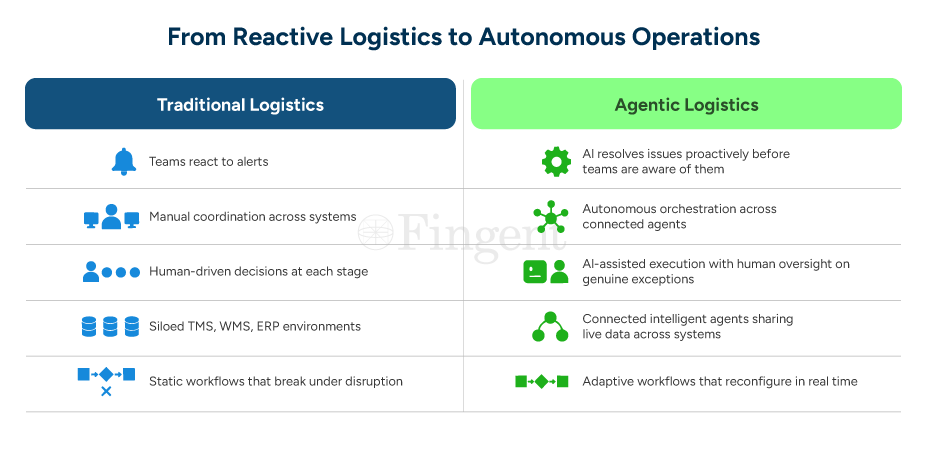
Business Benefits of Agentic AI for Logistics
Operational Efficiency
- Faster order processing with zero manual touchpoints on routine orders
- Dramatically reduced manual effort across order management, exceptions, and reporting
- Lower operational costs through automation of high-volume repetitive tasks
Better Customer Experience
- Proactive shipment updates before customers ask
- Accurate, real-time ETAs that reflect actual conditions
- Faster resolution of exceptions before they reach the customer
Smarter Decision Making
- Decisions made on live data
- Continuous learning from every transaction across carrier, route, and warehouse performance
- Predictive execution that anticipates disruptions rather than reacting to them
Increased Resilience
- Disruption recovery measured in minutes
- Adaptive operations that reconfigure around unexpected events
- Consistent SLA performance even during high-volume or high-disruption periods
Challenges to Consider Before Adoption
Taking the challenges into account doesn’t diminish enthusiasm for agentic AI in logistics. It aims to guarantee that the companies that implement it thrive, instead of participating in initiatives that are abandoned before providing benefits.
- Quality of data: Agents are only effective based on the data they utilize. Inaccurate master data leads to quick, assured incorrect choices.
- System integration: Connecting agents between TMS, WMS, ERP, and carrier systems require clear APIs and thoughtful design.
- Governance: Independent decisions require audit trails. It needs specified escalation processes and well-defined accountability structures from the outset.
- Human supervision: Agentic AI alters tasks performed by individuals, not the necessity of individuals themselves. Managing change is important.
- Security: Autonomous systems functioning within essential logistics infrastructure need strong access controls and oversight.
Change management: Teams overseeing manual processes now require organized transition assistance, not merely a new system. - Agentic AI does not replace humans. It enables them to concentrate on choices that truly need human evaluation.
How Partnering with Fingent Can Drive Agentic AI Solutions
Fingent builds agentic AI solutions across logistics, freight, warehouse operations, and supply chain workflows. Builds production systems, not pilots.
Whether you’re evaluating agentic AI for one workflow or planning full autonomous operations, the conversation starts with your actual pain, not a demo.
Power Up Your Logistics with Agentic AI Let Us Help You Discover High Impact Use Cases
Frequently Asked Questions
1. What is Agentic AI for logistics?
A. Agentic AI for logistics refers to autonomous AI systems. It is typically networks of specialized agents, that plan, decide, and execute logistics operations without requiring human instruction at each step. It is not like the traditional automation that follows fixed rules. Nor like generative AI that produces recommendations; agentic AI acts. It schedules carriers, redirects shipments, refreshes systems, and interacts with customers according to current conditions and established business goals.
2. Is agentic AI equivalent to robotic process automation (RPA)?
A. No. RPA follows rigid, established protocols and encounters issues when presented with situations outside its programmed limits. Agentic AI examines, modifies, and selects actions based on current circumstances. RPA simplifies a particular task. Agentic AI tackles the inconsistencies and decision-making that RPA was not intended to manage.
3. What is the usual duration for implementing agentic AI in a logistics setting?
A. The schedule relies on your data, integrations, and the extent of automation. One significant high-impact process, such as order processing or exception management, can be implemented in 8–12 weeks. Company-wide, multi-agent implementations in warehousing, transportation, and customer communication generally require 6–9 months, with a phased rollout providing value from the beginning.
4. How do we maintain control over decisions made by autonomous agents?
A. Through governance frameworks built into the deployment from the start. Every agent decision is logged with full audit trails. Escalation thresholds are configurable, so high-cost or high-risk decisions automatically route to human review. Real-time dashboards show exactly what agents are doing, and why.
5. What’s the realistic ROI timeline for agentic AI in logistics?
A. The first wins come quickly. Streamlining order processing and handling exceptions reduces labor expenses and removes expensive mistakes, frequently achieving favorable ROI in the initial year. Subsequently, the value accumulates as agents acquire knowledge, adjust, and enhance every process they engage with.
6. Can agentic AI handle seasonal demand spikes without additional configuration?
Yes. One of the core advantages of agentic AI over traditional automation is its ability to scale dynamically with volume. Agents process more orders, manage more exceptions, and coordinate more warehouse activity during peak periods without requiring additional configuration or headcount. The system adapts to demand rather than requiring humans to scale the system ahead of demand.
Conclusion
The future of logistics isn’t just automated. It’s autonomous.
McKinsey’s 2025 Global Survey on AI found that more than 88% of companies are using generative AI in at least one business function, yet for most, bottom-line impact remains minimal. The reason is simple: generative AI advises. Agentic AI executes. In logistics, the worth lies in the implementation.
Organizations transitioning from AI-assisted workflows to AI-driven operations will respond to disruptions more swiftly, enhance customer service, and expand without the increases in headcount that currently restrict growth.
Prepared to move from reactive to autonomous? Explore Fingent’s Agentic AI Solutions now.
Stay up to date on what's new

About the Author

Recommended Posts
17 Sep 2026 B2B
Agentic AI Governance: A Practical Framework for CXOs and IT Leaders
AI pilots are easy to approve. However, production says a different story. Once an AI agent starts making decisions, calling business systems, handling customer interactions, or triggering actions without waiting……

19 Aug 2026 B2B
Agentic AI vs RPA: Where Automation Hits a Ceiling
Most enterprises treat automation as one. That's the first mistake. Some keep funding RPA for problems it was never built to solve. Others replace working RPA bots with agentic AI……

07 Aug 2026 B2B
Agentic AI for Business: 8 Operational Signs You’re Ready
Most CTOs and CIOs have already sat through several agentic AI pitches this quarter, each one promising transformation with a slightly different slide template. Awareness was never really the problem.……

03 Jul 2026 B2B
Autonomous Agentic Workflow Platforms: A Comparative Analysis
The adoption of AI co-pilots and virtual assistants has been quick. Businesses embraced them. AI tools, like chat assistants and coding copilots, promised faster work. They helped with smarter decisions……
Featured Blogs








Stay up to date on
what's new



Talk To Our Experts