AI-Powered

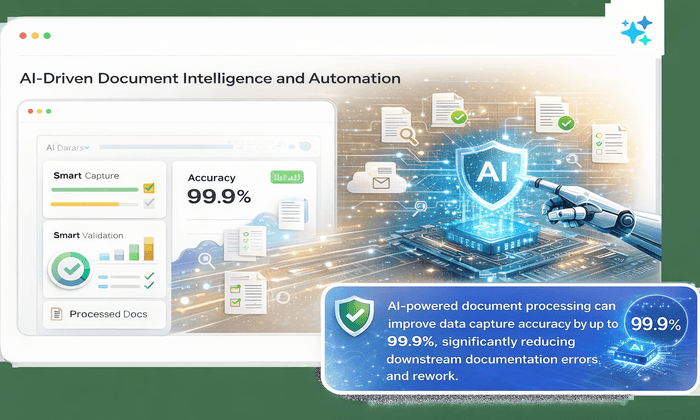
AI-powered document processing can improve data capture accuracy by up to 99.9%, significantly reducing downstream documentation errors and rework.


Manual data entry from scanned or photographed documents is slow and labor-intensive.

Optical Character Recognition (OCR) accuracy varies significantly with document quality, handwriting, and layout complexity.

Human-led verification introduces subjectivity, inconsistency, and fatigue-driven errors.

Low confidence in extracted data leads to additional validation cycles, increasing turnaround time.

Errors in critical documents can result in compliance risks, revenue leakage, or safety incidents.

Traditional document processing systems struggle to scale across geographies, languages, and document formats.
Extract text, tables, key-value pairs, and metadata from structured and unstructured documents.
Accurately interpret handwritten, printed, and mixed-content documents.
Handle variations in layout, format, and image quality.
Route extracted data seamlessly into downstream systems such as ERP, CRM, content repositories, or workflow automation tools.










Near-perfect accuracy in extracting mission-critical information from documents.
Faster, more reliable processing of high-volume document workloads.
Reduced operational risk caused by data entry errors or misinterpretation.
Improved compliance with regulatory and industry data standards.
Scalable document processing across regions, languages, and business units.
Employees are freed from repetitive data entry to focus on higher-value activities.
Improved trust in digital records for decision-making and automation.