Category: SAP
Stay up to date on what's new

About the Author

Featured Blogs







Stay up to date on
what's new



Talk To Our Experts

ERP is entering the AI era. For thirty years, ERP had one job. Record the transaction and keep the books straight. That job is changing with AI in ERP.
SAP now builds its Joule AI assistant directly into S/4HANA. It’s no longer just showing you the numbers. It can prepare your expense report, explain a compliance error in plain English, and catch an invoice mismatch before your finance team even opens the screen. ERP stopped being a filing cabinet. It’s turning into a colleague.
But here’s the catch. A colleague who can’t see your data clearly isn’t going to help you. It’s going to make confident mistakes faster than a human ever could. Gartner found that 63% of organizations don’t have, or aren’t sure they have, the right data management practices to support AI. That’s not a footnote you can skip past. It’s the whole ballgame.
So the real question for 2026 isn’t “should we adopt AI?” It’s “can our SAP environment actually carry it?”
5 Signs Your SAP Environment Isn’t AI-Ready
Most companies don’t fail at AI because they picked the wrong tool. They fail because nobody checked whether the ground underneath could hold the weight. Here’s what that looks like in practice.
1. Legacy systems and fragmented data
If your SAP landscape is a patchwork of ECC, spreadsheets, and side systems that don’t talk to each other, AI has nothing solid to stand on. You can’t build a smart forecast on data that lives in five places and agrees with none of them.
2. Heavy reliance on manual processes.
If someone still has to key in, check, and re-key the same number three times, that’s not a process AI can plug into. AI speeds up whatever pattern already exists. Feed it a slow, manual habit, and you just get a faster version of the same mess.
3. Limited integration across business systems
Finance, supply chain, and procurement often run as separate islands in older SAP setups. AI needs the whole picture. One corner of it is really just a guess dressed up as a dashboard.
4. Poor data quality or accessibility
Duplicate vendor records. Missing fields. Data locked away where only IT can find it. AI trained on messy data doesn’t get smarter. It gets confidently wrong, and confident wrong answers are worse than no answer at all.
5. Automation that breaks when exceptions occur
Old automation follows a script. The moment something unusual happens, it stalls or fails quietly. Add AI on top of a system that can’t handle a curveball, and you’ve just given the curveball a bigger stage.
Modernize your Business Now! Plan Your S/4HANA Migration and AI Adoption Strategies with us.
How to Prepare Your SAP ERP for AI
Getting ready isn’t one big leap. It’s six deliberate steps. Skip any one, and the failure point just moves further down the road.
1. Assess your current SAP architecture and processes
Before you build anything new, know exactly what you’re standing on. Which modules are up to date? Which processes are still manual? Where do the bottlenecks actually live? Not where everyone assumes they live. Modernize or migrate where needed. SAP ECC mainstream maintenance ends December 31, 2027. After that, no more patches or compliance updates. With many customers still moving to S/4HANA, the deadline is closer than it looks.
2. Establish a strong data foundation
AI is only as good as the data you feed it. Clean master data, consistent naming, one source – this can make or break everything that follows.
3. Locate high-value AI use cases
AI shiny-object chase may be thrilling. But stop. Select two or three scenarios that decrease time, lower expenses, or minimize mistakes. Demonstrate the worth initially. A single specific, quantifiable success will generate more confidence than five lofty projects that can’t be clarified in a board meeting.
4. Introduce AI gradually
Allow AI to generate the report. Allow a person to make the final decision. Begin with support, then gradually cede more control as confidence develops. It is built one correct answer and one successful handoff at a time.
5. Build an AI governance framework.
Decide who owns the AI, who approves its decisions, and perhaps most importantly, who is accountable when it gets something wrong. Because “the AI did it” is an explanation. It is not an accountability model.
Where AI Is Transforming SAP in 2026
Finance
AI integrated into S/4HANA now manages cash flow predictions, automatic reconciliations, and anomaly identification in transactions that would require a person days to detect manually. For a finance team buried under month-end close, that’s not a minor convenience. That’s hours of a controller’s week handed back.
Supply chain
Stop planning from yesterday’s patterns. AI reads live signals, predicts demand, and helps prevent shortages and overstock before they happen.
Procurement
AI spots supplier risks, flags contract red flags, and turns days of spend analysis into minutes. The value isn’t replacing judgment. It’s giving the team a head start before the judgment call has to be made.
Operations
Workflow automation paired with predictive insight means fewer surprises on the shop floor and fewer emergency calls at 6 a.m. because a machine failed with no warning. Predictive maintenance flags wear and tear before it becomes downtime.
Customer service
AI-assisted responses inside SAP’s customer experience tools help service teams resolve account-specific issues faster, without losing the thread of what the customer already said. Nobody should have to explain their problem twice.
None of this works if the data underneath is fragmented. Every gain here assumes that the foundation from the section above is already in place.
Good News for SAP ECC Users!
You don’t have to wait until SAP S/4 HANA migration to adopt AI! Begin capturing value from AI on ECC while keeping your future S/4HANA plans in view.
Check out this practical guide to AI adoption for SAP ECC users.
FAQs
1. What is AI in ERP?
AI in ERP means putting AI directly into the system that runs your business most effectively. Instead of simply recording what happened, the ERP can now look ahead, spot patterns, and make recommendations. It can even take action.
2. How is AI employed in ERP systems?
AI gives the ERP a new job description. It can predict, spot anomalies, answer questions, and, through AI agents, actually get work done. The ERP is no longer just keeping score. It is starting to help run the play.
3. What are the benefits of AI in ERP?
The biggest benefit is not that the ERP becomes “smarter.” It is that people spend less time doing work the system can handle. That means faster closes, fewer manual errors, quicker decisions, and processes that can adapt when reality changes instead of following the same script regardless of what is happening.
4. Where can AI make the biggest impact in ERP?
The best AI use cases turn better predictions into faster decisions and real business value. Begin with finance and supply chain, areas rich in data where timely decisions are crucial. Consider cash flow, demand, fraud, purchasing, and upkeep.
5. How can businesses prepare their ERP systems for AI?
Do not start with the AI. Start with the foundation.
Take an honest look at your architecture. Remove the unnecessary data. Select a few key issues where AI can provide quantifiable benefits rather than attempting to implement AI throughout the whole ERP system. And ensure individuals are informed from the outset. The goal is not to remove human judgment. It is to give people better information and more time to use it.
6. How is AI used in SAP ERP?
SAP is putting AI directly into the workflows where work already happens. Joule, SAP’s AI copilot, works across S/4HANA, SuccessFactors, and Ariba. That matters because context matters. The AI meets people where the work happens, instead of sending them off to another tool.
7. Does SAP S/4HANA use AI?
Yes. The larger change is regarding the position of AI. It is transitioning into finance, supply chain, procurement, and operations, evolving from an add-on to an essential element of ERP functionality.
SAP Transformation Is Beyond Migration
Moving to S/4HANA Cloud doesn’t make a company AI-ready. It makes it AI-eligible. That’s a real difference, and it’s the one most transformation budgets miss.
The common thread in stalled AI projects isn’t the software. It’s treating migration as the finish line instead of the starting point. A modern ERP core is necessary. It simply isn’t sufficient by itself.
Genuine readiness integrates four elements functioning cohesively: a contemporary foundation, a refined data strategy, automation capable of managing exceptions, and AI employed with purposeful intention. Neglect one, and the other three bear the burden by themselves.
Don’t Wait Too Long! Explore Your SAP S/4HANA Migration Options Now!
How Fingent Can Help
Fingent works with SAP customers on exactly this gap, between migration and true AI readiness. That means architecture assessments that tell you the truth about where you stand. Data foundation work that doesn’t get skipped for a deadline. And AI use cases chosen for measurable value, not for the demo.
We’ve seen enough rushed rollouts to know the teams who slow down for the data foundation are the ones who move fastest once AI actually goes live. We can make that happen seamlessly. Not sure where your SAP environment stands? Talk to our expert today.
Stay up to date on what's new
About the Author
Featured Blogs
Stay up to date on
what's new
Talk To Our Experts
Everyone talks about the ECC deadline like it’s a wall you hit on one specific day. It’s not. It’s a slope. And you’re already standing on it, whether you’ve noticed or not.
Waiting does not keep the SAP S/4HANA migration where it is today. It makes the eventual move more expensive, harder to staff, and harder to execute well.
This isn’t another “ECC is ending, act now” post. You’ve heard that one. This is about what actually happens to your business, quarter by quarter, the longer you wait. Because the deadline isn’t the real risk. The compounding consequences of delay are. Here is a realistic look at what waiting could cost your SAP S/4HANA Migration.
SAP S/4HANA Migration Costs Start Rising
With 2027 nearing, all SAP customers remaining on ECC begin vying for the same group of consultants, implementation partners, and project schedules. That rivalry does not reduce prices. It elevates them.
Consulting and implementation expenses rise as demand reaches its highest point. Flexibility disappears. Early movers can evaluate multiple implementation partners, compare migration approaches, and choose the path that fits their business. Late movers take whoever’s available.
Waiting doesn’t just cost more money. It costs you the choices that made the project worth doing well in the first place.
Waiting Can Cost You! Map Your SAP S/4HANA Migration Journey Today.
The SAP Talent Crunch
Here’s a question worth sitting with. If all the companies delaying migration choose to transition within the same 18-month period, where do you think the skilled S/4HANA experts will go?
They go to whoever got there first.
- The best SAP experts won’t stay on the shelf for long
The experts who know how to migrate a complex SAP landscape safely are a limited resource. That group doesn’t grow just because demand spikes. - Getting the right expertise gets harder exactly when you need it most
Urgency doesn’t summon talent. It just makes you more desperate to find it, at exactly the moment you have the least room to negotiate. - Rushed teams and premium contractors become the fallback
When you can’t get your first-choice partner, you take what’s available. That often means paying a premium for a team that’s learning your environment on the fly, under a deadline you didn’t choose.
A migration is only as good as the people running it. Wait too long, and you don’t get to pick your team. Your team picks you, based on whoever still has an opening.
Technical Debt Becomes Business Debt
Every year you stay on a legacy system, you’re not standing still. You’re adding another layer of custom code, another point integration, another workaround nobody fully documented. Technical debt doesn’t sit quietly. It compounds.
- Legacy customizations and integrations get harder to maintain
The people who built them move on. The documentation gets thinner. Each year adds friction to a system that was already stretched. - That debt makes the eventual migration more complex and more expensive
You’re not migrating a clean system anymore. You’re migrating a system wrapped in years of patches, each one now a dependency the migration has to account for. - The real cost hides in your team’s time
Every hour spent keeping a legacy system limping along is an hour not spent improving how the business actually runs. Technical debt has a way of quietly becoming business debt, and nobody notices the transfer until the bill comes due.
The system doesn’t care that you’re busy. It keeps accumulating debt whether or not you’re paying attention.
Delayed Migration Can Delay AI Readiness
AI depends on reliable, accessible business data. Remember, clean data gives AI something worth thinking about. Bad data makes smart automation a lot less smart.
Modernization isn’t a separate project from AI adoption. It’s the foundation AI adoption stands on. A modern S/4HANA environment gives automation and intelligent workflows something solid to work with. A fragmented legacy environment gives them nothing but guesswork.
Here’s the part that’s easy to miss. Every quarter you delay migration isn’t neutral. It’s a quarter your competitors spend building AI-enabled processes while you’re still deciding when to start. That’s not a technical cost. That’s a strategic one, and it compounds the same way technical debt does.
Waiting doesn’t just delay a system upgrade. It delays the business advantage that upgrade was supposed to unlock.
However, there’s good news for ECC users. While they await SAP S/4HANA migration, they can still build a practical path to AI adoption. This makes modernization strategies much stronger and scalable.
Explore How SAP ECC Users Can Build a Practical Path to AI Adoption
Operational Risk Goes Up
Less time means less testing, less fixing, and less preparation. That increases the chances of discovering critical problems after go-live instead of before it.
- Rushed migrations carry a higher risk of disruption
Compressed timelines leave less room for testing. That means issues that should have been caught in the sandbox can surface in production instead. - Business continuity gets harder to protect
Moving critical processes under a tight deadline leaves less room to handle the unexpected, and something unexpected always shows up. - Testing, training, and process redesign are the first things cut
They’re also the things that determine whether your team can actually use the new system well on day one. Skip them to save time, and you’re just moving the delay downstream, into your own operations.
Speed feels like progress. Under a rushed deadline, it’s often just risk wearing a faster badge.
What Waiting Until 2027 Could Really Mean
Two paths, and they diverge more than most people expect.
Start now, and you get planned investment instead of panic spending. You get access to the talent you actually want. You get a phased transformation that gives your team time to adjust. You get lower disruption because you had time to test, train, and adapt.
Wait, and you get higher costs because you’re competing for the same scarce resources everyone else waited for too. You get constrained options because the good partners are already booked. You get rushed decisions because the calendar, not your judgment, is setting the pace. Rushed work leaves less room for error—and more room for disruption.
Explore Your SAP S/4HANA Migration Options
FAQs on SAP S/4HANA Migration
1. What happens if you don’t migrate to SAP S/4HANA by 2027?
A. Your ECC environment experiences a loss of mainstream support. This means there will be no further regular patches or compliance updates. You can still execute it, but you’re doing so without support, a risk that increases daily.
2. What happens if you delay SAP S/4HANA migration until 2027?
A. A well-planned migration can quickly become a scramble. Costs may rise, and experienced SAP talent can be harder to secure. Data cleanup, testing, training, and fixes get squeezed for time.
3. What are the biggest challenges of SAP S/4HANA migration?
A. The technology is rarely the biggest headache. The baggage is.
Years of customizations, messy data, and complicated integrations add up. Business processes that have quietly become dependent on the way things were done 10 or 15 years ago. And, of course, the people who actually have to use the new system.
That is why good migration starts long before the technical cutover. Clean up what you can. Simplify what you can.
4. How long does an SAP S/4HANA migration take?
A. It varies based on the scale of the company. For instance, a significant corporation may require over a year. This includes scheduling, data cleansing, evaluation, training, and go-live. That is why starting early matters. Start early, and you have time to fix problems. Start late, and the deadline starts making the decisions.
5. What are the risks of delaying SAP S/4HANA migration?
A. Higher consulting and implementation costs.
Scarcer access to experienced SAP consultants and implementation partners.
More technical debt, customizations, and legacy complexity to unravel later.
Delayed access to modern automation, analytics, and AI capabilities.
Less time for proper testing, training, and problem-solving.
6. How can businesses prepare for SAP S/4HANA migration?
A. Begin by taking an honest look at what you have today. What is truly essential? What is outdated? Which customizations still earn their keep? Where is bad data slowing people down? Which integrations could cause trouble?
Then ask the bigger question: What should the business be able to do better after the move?
That changes the conversation from “How do we move SAP?” to “What can we finally improve?”
7. How can businesses reduce SAP S/4HANA migration risks?
A. Give the project enough breathing room. Test properly. Clean the data. Train users. Address issues while they remain manageable. Select a partner for implementation who has prior experience in this area. Choose an implementation partner that has actually done this before. Experience matters when the surprises start arriving—which they will.
Control the timeline before it controls you.
How Fingent Can Help
Fingent is an SAP Silver Partner, and we’ve walked enough clients through this exact decision to know how it usually plays out. The businesses that start early get options. The businesses that wait get a countdown.
We help you assess where your SAP environment actually stands, not where you assume it stands. We build a migration plan that fits your business instead of the calendar. And we make sure the foundation is solid enough to support what comes after migration, including the AI capabilities that make the whole investment worth it.
Every quarter of delay can narrow your choices. Start early, and you decide how the migration happens.
Not sure where your migration timeline should start? Talk to a SAP migration expert.
Stay up to date on what's new
About the Author
Featured Blogs
Stay up to date on
what's new
Talk To Our Experts
Warehouse management does not usually make headlines. Until it becomes the reason orders are late, inventory is inaccurate, and customers start asking uncomfortable questions. That is where many SAP WM users find themselves today.
SAP’s warehouse strategy has changed – it’s quite literally in its sunset period – the SAP ECC sunset.
Support for WM in S/4HANA ended on December 31, 2025. This means the final transition window for on-premise customers closed on May 31, 2026. Besides, mainstream support for SAP ECC (EHP 6-8) will end in December 2027.
This is an issue that requires immediate attention. Why?
SAP EWM Public Cloud is the destination. SAP EWM migration 2026 is the journey. The businesses that start now gain time, flexibility, and control. The ones that wait inherit urgency.
Think No More! Transition Now to the Modern SAP Systems with the Industry’s Best.
Why SAP WM Is No Longer Enough
SAP WM was designed to cater to a different purpose of warehouse management. It handled storage bins, transfer orders, and goods movements within a single warehouse. Complexity was manageable, and volume was predictable.
However, today, warehouses need to manage inventory throughout various locations. They have to support omnichannel fulfillment and adapt quickly to changing customer requirements.
SAP WM is not equipped to tackle most of the challenges modern warehouses face. To meet these growing demands, SAP shifted its warehouse strategy to SAP EWM. The platform helps businesses improve visibility in real-time. Embedded analytics is another superpower with which real-time operational data is integrated into business processes directly. Cloud features increase efficiency and have the ability to scale operations with greater agility. This is just scratching the surface.
SAP is not maintaining WM anymore. EWM is the only direction.
Read More: Optimize Your Warehouse Management Processes With SAP EWM
What Changes with SAP EWM Public Cloud in 2026
SAP EWM migration 2026 is not simply about switching from one warehouse system to another. It is about trading warehouse stability for warehouse agility. Doing so without sacrificing either. Let’s explore:
1. Standardized Cloud-First Architecture
Clean core is no longer optional. In 2026, it is how modern SAP environments survive.
SAP EWM Public Cloud reduces heavy customization, relies on standard processes, and uses SAP BTP for extensions instead of modifications that complicate every future upgrade.
The old model asked IT teams to spend their time maintaining custom code. The new model asks them to create business value.
Fewer retrofit projects. Faster innovation cycles. Hence, your team spends less time fighting the system and more time moving orders.
2. Embedded Intelligence and Automation
SAP Joule brings AI into the flow of warehouse operations. This enables smarter monitoring and predictive replenishment. And then there is exception handling. Many issues can be identified, routed, and resolved automatically before they slow operations down. Fewer bottlenecks lead to quicker decisions.
3. Real-Time Visibility Across Warehouse Operations
Inventory visibility in WM was always a snapshot. Aging before the report finished running. SAP EWM Public Cloud replaces snapshots with real-time visibility, giving warehouse teams the insight to act before problems start driving decisions.
4. Better Integration Across the SAP Ecosystem
Native SAP integration greatly minimizes the requirement for custom middleware. It also lowers the need for complicated point-to-point integrations. SAP EWM Public Cloud is closely integrated with SAP S/4HANA, SAP BTP, procurement, transportation management, and supply chain planning solutions.
5. Scalability for Modern Supply Chains
Multi-site operations, omnichannel fulfillment, and seasonal demand spikes are standard operating conditions now, not edge cases. SAP EWM Public Cloud handles all of it. Faster deployment models get new sites live quicker. Elastic cloud infrastructure means peak season does not require capacity that sits idle for ten months of the year.
Read More: SAP EWM for SAP S/4HANA Cloud private edition
Key Business Benefits of Migrating to SAP EWM Public Cloud
SAP EWM Public Cloud does more than modernize the warehouse. It can:
- Decrease expenses associated with infrastructure and on-site system upkeep. On-premise WM comes with a familiar routine: servers to maintain, patches to install, upgrades to manage, and budgets that quietly disappear into infrastructure. SAP EWM Public Cloud takes that work off your plate. SAP manages the technology. Your team moves the business forward.
- Eliminate manual tasks and disconnected systems. Automation and exception handling absorb the repetitive decisions that used to need a supervisor’s judgment call.
- Enhance inventory precision. WM’s batch-based updates mean stock counts are often outdated by the time anyone acts on them. In EWM, a pick, pack, or putaway updates inventory instantly across the system, meaning fewer stockouts and fewer emergency reorders.
- Provide a real-time view of warehouse performance and business activities. What is visible in real time is what gets managed in real time.
- Gain access to new capabilities. WM upgrades meant months of testing, downtime, and consulting fees. EWM Public Cloud delivers new capabilities through regular release cycles, without a separate project or business disruption.
- Improve order accuracy and speed fulfillment. AI-driven task prioritization and wave management keep work moving through the warehouse.
- Scale warehouse operations without adding unnecessary complexity. On-premises infrastructure requires businesses to pay for peak-demand capacity all year long. Cloud infrastructure changes the equation, scaling with demand instead of sitting idle while the bills keep arriving.
Common Challenges Businesses Should Prepare For
Every transition comes with its share of challenges. Here are some things that you need to be aware of so you can deal with them effectively:
- Change management
This is what most businesses underestimate. Warehouse teams that have worked in WM for years need time and genuine leadership support to adapt. It is not just a system change. It is a process change. - Process standardization
This can become hard when years of custom workflows are embedded in WM. Some reflect genuine business requirements. Others are workarounds for limitations EWM no longer has. Separating the two early saves significant effort during migration. - Data migration complexity
Master data quality in WM environments is often inconsistent. Cleaning it before migration is far less expensive than inheriting the problems inside EWM. - Integration planning
Integration planning matters for businesses with non-SAP systems in their landscape. Map every dependency before the project starts. - User training
Training cannot be the final step. It needs to run alongside the configuration. Your users do not have to wait for it to see only when it goes live.
How Businesses Can Prepare for a Successful Transition
Here are some actionable steps to follow for a smooth and effective transition:
1. Assess: Start with an honest assessment of current warehouse processes. Not what the documentation says. What actually happens on the floor.
2. Classify: This is for every WM customization: Is this a genuine business requirement or a workaround? Requirements get addressed in EWM. Workarounds get retired.
3. Build a phased roadmap: Migrate one site or one process area first. Validate thoroughly. Apply those learnings before scaling. The first site is your most valuable pilot.
4. Commit to a Clean Core Strategy: Use SAP BTP for extensibility rather than modifying the EWM core. The fewer customizations you carry into SAP EWM migration 2026, the easier future upgrades become.
5. Align warehouse teams: From day one, not after the system is configured. The people who know the warehouse best are the most valuable input to a migration that will actually work.
SAP EWM Implementation: Roadmap & Strategies for Success
Frequently Asked Questions
1. What is changing for SAP WM in 2026?
SAP WM support is effectively ending. Specific on-premise customers have until May 31, 2026, to make a final transition. After that, businesses on WM face mounting security and compliance risk. This is because SAP ECC mainstream support ends in December 2027 with no further development planned.
This is no longer a future planning exercise. It is a business deadline.
2. Can SAP WM be migrated to SAP EWM Public Cloud?
Yes. SAP EWM Public Cloud is SAP’s recommended successor to WM.
Companies can choose a brownfield, greenfield, or phased migration approach. Many run WM and EWM side by side for a period to validate operations and reduce go-live risk.
3. What is the difference between SAP WM and SAP EWM Public Cloud?
SAP EWM Public Cloud does much more than SAP WM ever could.
It gives warehouse teams real-time visibility, AI-powered task prioritization, built-in analytics, and seamless integration across the supply chain. It also brings advanced capabilities such as labor management, yard management, slotting, wave management, and automation support into the picture.
4. When should companies move from SAP WM to SAP EWM?
Before flexibility turns into urgency. Start now, and you can plan, pilot, and refine the migration. Those who wait until 2027 risk tighter timelines, fewer resources, and far fewer options.
5. How long does SAP WM to EWM migration take?
Every migration is different, but messy data has a way of extending timelines. Warehouse complexity, customizations, and the number of sites matter. In most cases, good planning and clean data are what keep the project on track.
6. How to migrate from SAP WM to SAP EWM Public Cloud?
Start by understanding how your warehouse works today. Assess your data, create a phased roadmap, and run WM and EWM side by side before cutover. Involve warehouse teams early and often. Technology enables the change. People make it stick.
Map Your Path Forward
2026 is not the year to keep watching this one.
SAP WM’s time is over. Not because it failed, but because the warehouses it was designed to serve no longer exist in the same form. SAP EWM Public Cloud is what warehouse management looks like when it catches up to modern operations.
The businesses that move now design the migration on their terms. The ones that wait manage it under pressure. The question is not whether to migrate. The question is how to execute your SAP EWM migration 2026 strategy well and before time starts dictating the terms.
Fingent has guided businesses through SAP EWM migrations across logistics, freight, and distribution. If your team is mapping the path forward, we would like to be part of that conversation.
Stay up to date on what's new
About the Author
Featured Blogs
Stay up to date on
what's new
Talk To Our Experts


Stay up to date on what's new
About the Author
Featured Blogs
Stay up to date on
what's new
Talk To Our Experts
Enterprises are drowning in data, but still starve for clarity. Not because the data is missing. Because insight does not emerge automatically from systems, even very good ones.
This is the real context in which Generative AI with SAP matters. Not as a trend. Not as a promise. But as a way to finally close the gap between enterprise data and executive decision making.
The question leaders should ask is not whether AI is powerful. That is already settled. The real question is this. Can AI reason with enterprise data in a way leaders can trust?
What Is Generative AI in SAP?
Why Generative AI matters in the SAP ecosystem?
SAP systems run the most sensitive and consequential processes in the enterprise. Finance, procurement, supply chain, compliance, and human capital. These are not experimental domains. They are where risk lives.
For decades, SAP has captured transactions, enforced controls, and produced reports. But reports describe the past.
Your SAP system knows your business. So why does getting answers still feel like an interrogation?
This is where Generative AI with SAP changes the dynamic. It shifts SAP from being a system you query into a system that can explain, summarize, and suggest. Not autonomously but responsibly.
This matters because intelligence that sits outside the ERP rarely scales. Intelligence that lives inside core systems can.
Leverage the Power of Generative AI with SAP Unlock Unique Possibilities for Your Business
What Are the Potential Applications of Generative AI Within SAP?
There is considerable buzz surrounding generative AI. Most of it is not relevant to enterprise leaders.
In the SAP context, generative AI is not about creative output. It is about cognitive support. It reads enterprise data, understands business context, and helps humans interpret complexity.
Say, your SAP system already knows what happened. Generative AI helps you understand the reasons for it. It also helps in evaluating possible future results, based on real data.
This is the reason Generative AI with SAP distinctly differs from independent AI tools. It does not live on the edges of the business. It works inside enterprise governance, authorization, and process logic.
The same controls leaders already trust. The same systems that run finance, supply chains, and people operations. That difference matters.
Does that mean it replaces judgment? No! It sharpens judgment by removing friction.
How Does SAP Integrate Enterprise Data With Generative AI?
Enterprise leaders are right to worry about hallucinations, data leakage, and compliance risk. Open AI models trained on the internet are not designed for regulated enterprise environments.
SAP takes a different approach. Generative AI is grounded in enterprise data. It is not free floating. It does not guess. It reasons within defined boundaries.
SAP integrates generative AI through controlled access to structured business data, metadata, and process context. Responses are traceable. Permissions are enforced. Auditability remains intact.
Here is the logical test leaders should apply. If AI cannot explain where an insight comes from, should it influence a decision? With Generative AI with SAP, that traceability is built into the design.
Where Generative AI Fits in SAP Landscapes?
Enterprise architecture is not forgiving. One poorly integrated capability can introduce risk far beyond its value.
So, where does generative AI belong? The answer is simple. It belongs where decisions already happen. Let’s look at a few key factors that explain this:
1. SAP S/4HANA and Core Business Processes
SAP S/4HANA is the digital core of the enterprise. It handles financial close, inventory valuation, order fulfilment, and production planning.
These processes already generate immense data. What they lack is interpretation at speed.
Imagine a CFO during close week. The numbers are finalising and the variances appear. The question is not what changed. The question is why.
With Generative AI with SAP, the CFO does not need to pull multiple reports. The system can summarise drivers, highlight anomalies, and explain trends using actual ledger data.
2. What Role Does SAP BTP Play in SAP’s AI Strategy?
SAP Business Technology Platform is the quiet enabler behind most enterprise innovation.
It connects systems. It governs data. It allows extensions without destabilizing the core.
For generative AI, BTP is critical. It provides the layer where AI services can interact with SAP and non-SAP data securely. It is also where enterprises control how and where intelligence is applied.
Without this layer, Generative AI with SAP would remain a series of disconnected experiments. With it, AI becomes part of enterprise architecture.
3. What Are SAP AI Core, SAP AI Launchpad, and Joule?
These components exist for a reason. Enterprises do not just need AI. They need AI that can be managed.
SAP AI Core handles the operational side. It deploys and runs AI models in a controlled way. SAP AI Launchpad gives visibility. It allows teams to monitor, govern, and refine AI use cases.
Joule is where leaders and users feel the impact. It is the conversational layer that allows natural interaction with enterprise data.
4. Integration With Enterprise Data and Workflows
Adoption fails when intelligence feels foreign.
Generative AI works best when it feels native. Embedded in approvals. Embedded in analysis and embedded in daily work.
When insight arrives on the same screen where action is taken, friction disappears. This is not convenient. It is operational leverage.
Enterprise Benefits of Generative AI with SAP
Enterprises adopting generative AI inside SAP environments are not chasing novelty. They are solving pressure points.
Decision cycles shorten because insight arrives faster. Manual analysis decreases because summarization is automated. Risk exposure reduces because anomalies surface earlier.
But there is a deeper benefit: Confidence. Leaders act faster when they trust the reasoning behind the numbers. Generative AI with SAP does not replace reports. It explains them.
That explanation is what turns data into leadership action.
Is Generative AI in SAP Secure for Enterprise Use?
Security concerns are not a fear. They are responsible.
SAP approaches generative AI with the same discipline it applies to financial data. Access is role-based. Data usage is governed. Models do not train on customer data by default.
This matters because AI that cannot be governed will not be adopted, especially not at scale.
The real question is this: Can Artificial Intelligence be introduced without increasing risk? With Generative AI with SAP, the answer is yes, when implemented correctly.
Enterprise Use Cases of Generative AI with SAP
Enterprises that treat generative AI as a novelty will see novelty results. Enterprises that treat it as an extension of enterprise reasoning will see real transformation. Generative AI with SAP is not about replacing systems or people. It is about helping leaders think better, faster, and with greater confidence.
- Intelligent Finance
Finance teams spend an enormous amount of time explaining results. Not just reporting them.
Generative AI can summarise financial performance, explain variances, and support scenario exploration using actual SAP data.
Instead of digging through spreadsheets, finance leaders ask focused questions. The system responds with context, not guesses.
That changes the rhythm of finance.
- Procurement Processes
Procurement (which includes contracts, suppliers, compliance, and pricing) is complex by design. Generative AI simplifies that intricacy. It aids teams in quickly reviewing contracts, uncovering hidden risks, and assessing supplier behavior instantly with reduced manual work. Improved choices, enhanced oversight. It doesn’t replace negotiation. It elevates it.
In procurement, speed without insight is a risk multiplier. Insight without speed is useless. Generative AI with SAP balances both.
- Document Processing
Invoices, contracts, regulatory documents. Enterprises are buried in them.
Classification, extraction, summarization—Generative AI compresses hours of work into minutes. Errors reduce. Visibility improves. This is not glamour, but rather an operational relief.
Achieve 99.99% Scalable Operational Accuracy with AI-Driven Document Processing!
Why Strategic Partnership Matters?
Technology rarely fails because it does not work. It fails because it is misapplied.
Generative AI requires discipline. Use case selection matters. Governance and integration matters.
Without experience, enterprises either overreach or underdeliver. A strategic partner helps avoid both.
How Fingent Can Help!
Fingent approaches Generative AI with SAP from a business-first perspective.
We help leaders identify where intelligence will create measurable value. We design architectures that respect enterprise constraints. We embed AI into workflows that already matter.
Our focus is not experimentation. It is outcomes.
Stay up to date on what's new
About the Author

Tony Joseph

Tony believes in building technology around processes, rather than building processes around technology. At Fingent, he specializes in custom software development, especially in analyzing processes, refining them, and then building technology around it. He works with clients on a daily basis to understand and analyze their operational structure, discover (and not invent) key improvement areas, and come up with technology solutions to deliver an efficient process. You can reach him at [email protected], Skype: tony_fingent
Featured Blogs
Stay up to date on
what's new
Talk To Our Experts
Warehousing has changed radically. Next-day delivery is no longer impressive—it’s assumed. And 95% inventory accuracy? That’s not “good enough” anymore. That’s leakage.
As the traditional LE-WM (Logistics Execution – Warehouse Management) came to an 31st December, 2025, organizations have no choice but to shift to modern warehouse management systems. Although there remain many options, experts suggest SAP EWM for SAP S/4HANA Cloud Private Edition as the best move, not as a cosmetic upgrade, but as a structural shift.
SAP EWM for SAP S/4HANA Cloud Private Edition gives you the operational depth of classic on-premise EWM, paired with the scalability and resilience of the cloud.
This guide walks through what “Private Edition” actually means, how it compares to your other options, and how to deploy it without destabilizing daily operations.
What Is SAP EWM for SAP S/4HANA Cloud Private Edition?
Private Edition is the middle ground most enterprises are actually looking for. It preserves control and customization while offloading infrastructure and platform maintenance to SAP.
Here’s the simplest way to think about it.
Public Cloud is efficient—but opinionated.
You follow SAP’s rules. You change your processes. Customization is limited by design.
On-premise is powerful—but heavy.
You own everything. Including the servers, the patching cycles, and the operational friction that comes with them.
Private Edition sits between those extremes. SAP manages the infrastructure, security hardening, and core platform operations. You, meanwhile, retain backend access,
configuration freedom, and the ability to keep meaningful custom code. The system behaves like classic EWM, just without the self-managed plumbing.
In other words, you get control without carrying the full IT burden. For complex warehouses, that balance matters.
When SAP EWM runs on S/4HANA, order accuracy rises to 99–99.9%. Shipping errors—and the returns and credits they trigger—drop fast.
That’s worth thinking about.
Functional Comparison: SAP EWM vs. Stock Room Management (WM)
While both paths satisfy modernized operations, they serve very different operational ambitions. As organizations make a shift from the traditional LE-WM (Logistics Execution – Warehouse Management) that is no longer usable since December 31st, 2025, two realistic options typically arise.
Option 1: Stock Room Management (The “Lite” Path)
This is essentially legacy LE-WM, trimmed down to meet minimum compatibility requirements.
- Upside: Minimal disruption. Familiar functionality.
- Limitations: No innovation layer. No embedded labor management. No advanced slotting. No native Fiori mobility.
- Reality check: It keeps operations running, but it doesn’t make them better.
Stock Room Management is viable only if your warehouse is small, stable, and unlikely to evolve.
Option 2: SAP EWM (The Scalable Path)
EWM is designed for operational complexity—high SKU velocity, automation, and performance optimization at scale.
- Capabilities: Wave management, value-added services, kitting, cross-docking, labor management, and real-time task orchestration.
- Trade-off: Greater functional depth means more design effort. With the right partner, that complexity becomes leverage rather than risk.
For growing or highly automated supply chains, EWM isn’t an upgrade. It’s a prerequisite.
The Gap That Actually Matters
- Labor Management: WM estimates. EWM measures. That difference alone drives major productivity gains.
- Material Flow Systems: WM relies on external middleware. EWM communicates directly with conveyors, sorters, and AGVs.
- Slotting Intelligence: WM fills space. EWM minimizes travel, cutting internal movement.
This is not a slight enhancement; it is systemic effectiveness.
Choose SAP Solutions That Best Fit Your Buisness Needs Get Consultation From the Industry’s Top Experts
What are the Business Benefits of SAP EWM for SAP S/4HANA Cloud private edition?
Private Edition EWM consistently turns warehouse operations from cost centers into performance engines, with measurable ROI across accuracy, cost, and speed. So why make the move now? Because the economics are difficult to ignore.
1. Near-Perfect Inventory Accuracy
With real-time, bin-level visibility, EWM pushes inventory accuracy to 99.9%. Deloitte’s findings are consistent on this point.
That means fewer write-offs, fewer reconciliation exercises, and far less “phantom stock.”
2. Meaningfully Lower Operating Costs
By orchestrating labor, space, and equipment more intelligently, EWM reduces warehouse operating costs. Task interleaving alone eliminates a surprising amount of wasted motion.
3. Faster Fulfillment Cycles
Organizations using EWM report order cycle times improving by roughly 35%. That flexibility—shipping later while still meeting cut-offs—translates directly into service differentiation.
4. Fewer Returns, Fewer Escalations
Driven largely by higher pick accuracy, companies can now have fewer wrong shipments. Fewer customer apologies.
Deployment Options: Why Architecture Decisions Matter
Embedded and decentralized EWM serve very different operational realities. Choosing incorrectly doesn’t just impact IT—it affects uptime on the warehouse floor. EWM isn’t just “installed.” It’s placed deliberately within your landscape.
1. Embedded EWM
This model integrates EWM directly into the S/4HANA ERP system, removing the requirement for a separate layer.
- Functionality: EWM offers a unified data model while simplifying replication by functioning directly inside S/4HANA
- Ideal for: Warehouses that are small to medium in size.
- Limitation: ERP inactivity corresponds to warehouse inactivity
2. Decentralized (Side-by-Side) EWM
EWM runs on a dedicated instance, integrated with ERP.
- Most appropriate for: High-capacity, automated, or round-the-clock distribution centers.
- Advantages: Performance segregation, robustness, continuous warehouse operation.
- Industry norm: Complex automation almost always favors this model to maintain sub-second response times.
This choice isn’t a technical preference. It’s operational risk management.
Top Use Cases To Look At
Real companies, real results. This section highlights success stories from Zalando (30% reduced IT costs) and Bechtle (30% savings in cross-docking). These proven implementations show exactly how SAP EWM and S/4HANA transform operations across various sectors.
Don’t take our word for it. Look at the numbers.
Use Case 1: Online Fashion Retail
An excellent example of this is Zalando, an online fashion retailer
Zalando migrated one of the world’s largest SAP S/4HANA landscapes to the cloud to handle massive peak volumes.
- Result: Reduced IT maintenance tasks by 30% and cut the cost of generating business insights by 30%.
- Impact: They can now spin up “sandbox” copies of their productive warehouse systems in hours, allowing them to test new logistics features instantly without risking the live environment.
Use Case 2: IT E-Commerce
Bechtle, a major IT provider needed to double its revenue by 2030. The challenge to that goal? A labor shortage in its warehouses.
- Result: Integrated SAP EWM with autonomous mobile robots (AMR) for cross-docking.
- Impact: Calculated savings of more than 30% in cross-docking operations. The robots now move goods from receiving to shipping automatically, freeing human workers for complex tasks.
Frequently Asked Questions
Q: Is Private Edition actually secure?
A: In most cases, it is more secure than on-premises. SAP handles continuous monitoring, patching, and infrastructure hardening at scale.
Q: Can we retain our Z-customizations?
A: Yes. That’s one of the defining advantages of Private Edition.
Q: Is SAP EWM better than WM for S/4HANA Cloud?
A: Absolutely—and by a significant margin. WM keeps the lights on. EWM actually moves the needle. It provides the intelligence, automation, and immediate control that contemporary warehouses require.
Q: How does SAP EWM improve warehouse productivity?
A: By replacing guesswork with precision. EWM measures labor, optimizes travel paths, orchestrates tasks, and keeps automation in sync. The result? Faster cycles, fewer errors, and teams that get more done without working harder.
Q: How long does migration from LE-WM to EWM typically take?
A: Most organizations see measurable ROI within 6–9 months, depending on scope.
Q: What about heavy automation?
A: EWM’s built-in MFS communicates directly with PLCs, often removing the need for separate middleware layers.
Q: Will warehouse staff need retraining?
A: Yes—but adoption is usually faster. Fiori-based mobile apps are significantly more intuitive than legacy RF screens.
Learn More on How SAP EWM Can Be a Game Changer for Your Business
How Fingent Helps You Make the Move Without the Pain
Fingent bridges strategy and execution, ensuring EWM delivers operational value—not just technical compliance.
Migrating to SAP EWM for SAP S/4HANA Cloud Private Edition isn’t just an IT project. It reshapes processes, behaviors, and expectations on the warehouse floor. Fingent approaches it accordingly:
- Assessment: Clear guidance on Embedded vs. Decentralized—no guesswork.
- Customization: Purpose-built extensions where they add value, ruthless simplification where they don’t.
- Integration: Seamless connectivity across automation, mobility, and ERP.
- Enablement: Practical training that sticks beyond go-live.
The deadline is fixed. The competitive gap isn’t.
You can treat this as a compliance exercise. Or you can use it to build a warehouse that moves faster, runs leaner, and is far harder to outpace.
Connect with our experts now and explore your possibilities with the SAP EWM for SAP S/4HANA Cloud private edition.
Stay up to date on what's new
About the Author
Featured Blogs
Stay up to date on
what's new
Talk To Our Experts
Picture this: it’s Monday morning. Your finance team isn’t drowning in invoice processing. The tools handle the routine, your team can handle the remarkable. Strategic thinking. Complex problem-solving. Building genuine customer relationships.
This isn’t fantasy anymore. This is what SAP Business AI is making possible.
SAP’s Q3 2025 release isn’t an upgrade—it’s a pivot point, launching over 400 AI features and 40 Joule Agents that redefine what “progress” looks like. They’re fundamental capabilities that reimagine how enterprises operate. How do they compete and how do they win in an increasingly complex business landscape?
SAP Business AI isn’t just another technology release. It’s a declaration that the future of business operations is intelligent, automated, and available right now.
What’s New in the SAP Business AI Q3 2025 Release?
The latest S/4HANA Cloud Public Edition drops a smart AI homepage that tells you exactly what needs attention—no hunting, no guessing. It slashes resolution time by up to 46%. Faster clarity, faster action. Upon login, users immediately see high-priority items. The system learns what matters to each person.
This is where SAP Business AI differs fundamentally from earlier generations of enterprise software. It’s not forcing users to learn complex interfaces or memorize technical specifications. It meets people where they are. In their language. In their workflow. The Q3 2025 release introduces a remarkable expansion of these capabilities. Please note a few:
Finance agents optimizing with precision:
- International Trade Classification Agent — handles complex trade regulations automatically
- Cash Management Agent — streamlines cash operations with intelligence
- Bid Analysis Agent — clarifies spending patterns
- Receipt Analysis Agent — automates expense verification
Supply chain agents managing disruptions:
- Shop Floor Supervisor Agent — proactively manages factory floor disruptions, boosting supervisor productivity by 50%
- Supplier Onboarding Agent — accelerates vendor integration
- Production Planning and Operations Agent — coordinates complex logistics with precision
Customer experience agents transforming engagement:
- Digital Service Agent — increases sales and service staff productivity by 50% for agent-handled tasks.
- Catalog Optimization Agent — reduces translation time by 70% and decreases time spent adding descriptions per asset by 65%.
But here’s what really stands out: SAP is embedding these capabilities directly into the applications you’re already using. No separate tools. No complex integrations. SAP Business AI works within your flow of work.
Drive Smarter Operations with SAP Our Experts Can Help You Identify & Leverage the Right SAP Solutions for Your Business
AI That Feels Natural to Use
One often-overlooked aspect of successful SAP Business AI adoption: it doesn’t require a PhD in data science to use. Users interact with AI through natural language. They ask questions. They get answers. They make requests. The AI understands context and delivers results.
SAP Analytics Cloud now lets users:
- Generate complex formulas from natural language queries, cutting creation time by 60%
- Create chart summaries with a 96% reduction in time spent writing and updating summaries
- Author scripts 75% faster with AI assistance
How Does SAP Business AI Support Digital Transformation?
Digital transformation gets thrown around a lot. Everyone’s “transforming.” But genuine transformation requires intelligence embedded into every process. Every decision. Every workflow.
SAP Business AI makes this possible. It’s not a separate tool bolted onto your existing systems. AI isn’t something your team has to learn to use. It’s something they use naturally as part of their daily work.
The transformation happens across three dimensions:
First, data becomes actionable. Organizations shift from information overload to valuable insights. SAP Business AI enables:
- Predictive analytics gives CFOs accurate forecasting capabilities
- Supply chain managers predict disruptions before they happen
- HR teams are finally spotting top talent through clear, data-driven insight.
Second, automation cuts the drudgery:
- Invoice matching and reconciliation
- Spend optimization and analysis
- Cash flow management
- HR onboarding processes
Third, your organization becomes agile. SAP Business Technology Platform allows businesses to:
- Scale operations quickly
- Develop new products for new markets
- Release innovative services faster than ever before
- Reduce time to value by up to 35%
These aren’t theoretical improvements. They’re happening today. Almost two-thirds (64%) of organizations report satisfaction with their current ROI on AI—higher than any other technology investment.
What Industries Can Benefit Most From SAP Business AI?
In 2025, winners are the ones letting AI work smarter so they can too. More efficiently. SAP Business AI makes this possible. The capabilities are here. The track record is proven. The ROI is clear—organizations report 16% ROI in year one, growing to 31% within two years. The only question is whether you’ll implement SAP Business AI now and build a competitive advantage, or wait until your competitors do.
Your supply chain can be more resilient and efficient. Your finance operations can be more accurate and predictive. Your customer experience can be more personalized and seamless. SAP Business AI enables all of this. Right now!
How does it do it? Let’s explore:
1. The Supply Chain Industry: Where Complexity Meets Opportunity
The supply chain industry faces global uncertainty. Geopolitical tensions. Shifting tariffs. Natural disasters. Inconsistent demand. Traditional approaches to supply chain management simply can’t keep pace.
With SAP Business AI, supply chain organizations achieve:
- 50% increase in field technician productivity through AI-assisted mobile execution
- 25% boost in inventory planner productivity through AI-assisted analysis
- 90% reduction in compliance disclosure processing costs and 67% reduction in fines
The system predicts disruptions using real-time external data related to weather, port congestion, and political risk. It models dynamic scenarios and prepares contingencies. It provides early warning systems and real-time visibility across the entire network.
2. Finance Management: Precision and Insight
Finance teams operate under constant pressure. Close cycles. Regulatory compliance. Risk assessment. Fraud detection. Cash flow management. The complexity keeps growing while the time available keeps shrinking.
SAP Business AI delivers measurable impact:
- 60% reduction in time searching for invoice details with supplier invoice verification
- 85% increase in on-time payment rates through AI-assisted payment exception analysis
- 66% reduction in time to set up costing calculations
- 80% increase in purchaser productivity for delivery date updates
- 70% reduction in certificate processing time
3. Customer Experience: Intelligence at Every Touchpoint
Customers expect instant responses. Personalized experiences. Seamless interactions across channels. Organizations that deliver win. Those that don’t lose customers to competitors.
SAP Business AI enables customer experience at scale:
- 50% increase in sales and service staff productivity
- 70% reduction in translation time for product catalogs
- 65% decrease in time spent adding product descriptions
- 90% reduction in average cost per AI-handled contact for utilities
For service organizations, SAP Business AI transforms operations. Customer service cases get analyzed and routed intelligently. Common issues get resolved automatically. Complex issues get prioritized for human attention. Team productivity increases. Customer satisfaction improves.
4. Businesses Looking to Modernize: Moving Beyond Legacy Constraints
Many enterprises are stuck. They want to modernize but worry about complexity and disruption.
Key modernization benefits include:
- 95% faster information searches and 90% faster navigation tasks in SAP S/4HANA Cloud
- 214% to 761% ROI over five years with proper implementation
How Can Businesses Adopt The New SAP AI Capabilities?
Here’s what many organizations get wrong about SAP Business AI: they think the challenge is technology. It’s not. The technology works. The challenge is implementation. Adoption. Change management. Integration with existing processes.
Successful SAP Business AI implementations share common characteristics:
They start with clear objectives– What specific problems are we solving? What outcomes do we want? Getting crystal clear on this prevents expensive wandering.
They build organizational readiness – Your team needs to understand AI. Not at a technical level, but conceptually. What can it do? What can’t it do? How should they work with AI systems? Organizations that invest in this education see dramatically better adoption and results.
They prioritize data quality – SAP Business AI works with whatever data you feed it. Bad data in equals mediocre results. Good data in equals excellent results.
They move methodically – Rather than trying to activate everything at once, successful implementations start with specific use cases. They prove value. They build momentum. They iterate and expand from there.
Why Do Companies Need a Trusted SAP Partner for Implementation?
The right partner isn’t a bonus—it’s the breakpoint. Organizations everywhere are finding that seasoned partners turn uncertain outcomes into undeniable wins..
A reliable SAP partner brings:
- Industry experience — they’ve done this before and understand your specific challenges
- Change management expertise — helping your organization adopt new capabilities effectively
- Accelerated time to value — seeing meaningful results in months rather than years
- Risk mitigation — avoiding common pitfalls through proven playbooks
Manufacturing sectors achieve remarkable integration rates because operational cultures already embrace continuous optimization and data-driven decision-making. Workers view AI as a natural automation evolution, not a threat.
Partner Up With a Certified SAP Consulting Company for Unmatched Expertise
How Fingent Can Help You Embrace SAP Business AI
Choosing the right implementation partner matters profoundly. Fingent specializes in helping enterprises unlock the full potential of SAP Business AI. We understand the technology at a deep level. They understand implementation challenges. We understand your industry. They’ve helped organizations across supply chain, finance, and customer experience leverage SAP Business AI to drive transformational results.
Our approach combines:
- Deep technical expertise with genuine industry knowledge
- Focus on the highest-impact use cases for your specific context
- Data readiness guidance and organizational change management
- Internal capability building so you’re not dependent on consultants long-term
Fingent’s experience spans industries and use cases:
- Helping manufacturing companies leverage supply chain AI to improve forecasting
- Helping financial services firms implement fraud detection and cash management agents
- Helping retailers transform customer experience with intelligent catalog optimization and personalization
More importantly, Fingent understands the integration challenge. SAP Business AI doesn’t exist in isolation. It has to click into your systems without friction. That’s where Fingent delivers—tight integration, zero drama—helping you dodge the 87% failure trap and join the few who actually see real ROI.
Stay up to date on what's new
About the Author
Featured Blogs
Stay up to date on
what's new
Talk To Our Experts
Procurement isn’t back‐office drudgery anymore. It’s a strategic powerhouse. It drives savings. It sparks innovation. It can even transform how companies compete.
Imagine procurement as your supply‐chain engine. If it’s poorly maintained, you sputter. You waste fuel. You risk a breakdown. SAP Ariba procurement solution acts as a serious performance booster for your procurement process—it really gets things moving.
Let’s understand what SAP Ariba actually is and the benefits it brings. Then we can see how to get it working for you.
What is SAP Ariba?
SAP Ariba is an online platform where buyers and suppliers meet, no passports required. Think of it as managing all your purchases, supplier deals, and payments — minus the paperwork.
SAP bought Ariba for $4.3 billion in 2012. You would be surprised to know that currently, more than five million businesses use it to process almost $3.75 trillion in transactions annually.
The Core Solution Modules:
-
- Sourcing & Auctions
Run RFPs, RFQs, and auctions in minutes. You feel like you have a master negotiator by your side. - Contract Management
Create, store, and renew contracts in one central repository. - Supplier Management
Onboard suppliers. Qualify them. Monitor performance like a detective on high alert. - Buying & Invoicing
Streamline order placements, authorizations, and billing management. Controlled purchasing guarantees that all acquisitions remain compliant. - Spend Analysis
Get real‐time insights on your spend. Machine learning classifies data instantly. You see savings opportunities at a glance. - Business Network
Connect with millions of suppliers from various countries. Discover partners. Negotiate terms. Transact electronically.
- Sourcing & Auctions
Discover How SAP Ariba Can Transform Your Business Operations
Why Businesses Pick SAP Ariba for Procurement
Top SAP Ariba users achieve 8.7 percent savings on addressable spend each year. Bottom performers average just 3.3 percent. That’s a 2.7× difference. One benchmark showed procurement overhead costs falling from 0.65 percent of spend to 0.38 percent. That’s like hiring a finance team with zero salaries.
Here are some more reasons:
Quicker, More Productive Procedures
Manual procurement seems akin to relying on a horse and carriage while bullet trains are available. SAP Ariba slashes cycle times. Leading firms complete sourcing events sooner. Teams free up hours to focus on strategy rather than paperwork.
Enhanced Compliance and Risk Control
Contracts auto‐populate into purchase orders. Approval workflows enforce budget and policy rules. Audit trails capture every change. Supplier risk monitoring tracks financial health and compliance certifications. You get early warning signals before issues disrupt your supply chain.
Stronger Supplier Collaboration
Suppliers access a self‐service portal. They view purchase orders. They update the order status. They submit invoices. All digitally, without email tags or phone calls. Better collaboration leads to fewer errors. It also builds stronger partnerships.
Data‐Driven Decision Making
Spend analysis illuminates patterns. Real‐time dashboards track key performance indicators. Machine learning automatically classifies spending categories. Your decisions get smarter—fast.
Mobile Procurement
Approve requisitions anytime, anywhere, because procurement is in your pocket. Buyers can order catalog items while commuting. Sourcing teams can manage RFPs from the airport lounge.
Key mobile features include:
-
-
- Task tracking and notifications for sourcing and contract activities
- One‐tap requisition creation and approval
- Non‐catalog item requests when catalogs fall short
- Purchase order tracking and goods receipt confirmation
- Secure single sign‐on integration
-
Think of it as carrying your procurement office in your pocket.
AI and ML for Smarter Decisions
SAP Ariba procurement includes AI and ML across key functions. These features power smarter, faster decisions.
AI‐powered capabilities include:
-
-
- Smart sourcing recommendations that analyze past data to suggest optimal strategies
- Predictive spend analytics forecasting demand and spending patterns
- Automated invoice matching reduces manual effort and catches errors
- Supplier risk assessment using financial and market indicators
- Natural language processing for conversational queries and reports
-
SAP Ariba Use Cases for Enterprises
Supplier Risk Mitigation
A pharmaceutical company needed strict control over API suppliers. They used SAP Ariba to monitor financial stability and certifications. When a key supplier showed distress signals, they qualified backups before production stalled. The solution enabled:
-
-
- Verification of regulatory documents for completeness and validity
- Monitoring supplier financial stability and compliance certifications
- Proactive quality notifications from suppliers about defects or non-conforming items
- Integration with SAP S/4HANA for direct material procurement
-
COVID-19 Supply Chain Durability – SAP Ariba Exploration
Amid COVID-19, SAP did a noble gesture. It provided complimentary access to SAP Ariba Discovery for 90 days (March-June 2020). This they did to facilitate prompt connections between buyers and suppliers. Recorded results consist of:
-
-
- Buyers posting immediate sourcing needs and receiving rapid supplier responses
- One customer found a new source for hospital beds in just 35 minutes
- Minimized disruption from shipment delays, capacity issues, and demand spikes
-
FAQ: SAP Ariba
1. How does SAP Ariba cut procurement costs?
SAP Ariba procurement solutions attack costs from multiple angles. Here’s how it saves you money:
Competitive Sourcing Events
Online auctions and RFx events create real supplier competition. Top-performing companies achieve sourcing savings of 10.96 percent. Bottom performers? Just 2.6 percent. When suppliers know they’re competing, prices drop naturally.
Contract Compliance Enforcement
Every PO automatically reflects your negotiated pricing. No more maverick spending. No more paying retail when you negotiated wholesale.
Spend Visibility and Consolidation
SAP Ariba procurement gives you complete spend visibility across your organization. Consolidate those purchases. Leverage your volume. Watch costs drop.
Dynamic Discounting
SAP Ariba procurement solutions enable early payment discount programs. You improve supplier cash flow. They reward you with lower prices. Everybody wins.
2. How Does SAP Ariba Streamline Procurement?
SAP Ariba procurement turns into a smooth highway. Have a look:
Smart Approval Routing
Purchase requisitions automatically choose the right approvers based on rules you set. No more hunting down busy managers. No more requests sitting in email inboxes. Approvals happen fast—often with just a mobile tap.
Guided Buying Experience
Your employees aren’t procurement experts. Guided buying steers them toward preferred suppliers and compliant products. Think Amazon for your business purchases. Easy for users. Compliant for procurement.
Electronic Everything
Faster processing. Fewer errors. Better accuracy.
Automatic Three-Way Matching
SAP Ariba procurement solutions system automatically matches your purchase order against the goods receipt and the invoice. Perfect match? Payment processes automatically. Discrepancy detected? The system flags it for quick resolution. No more manual reconciliation nightmares.
Supplier Self-Service Portal
Your suppliers get their own portal. They check the PO status. They submit invoices. They track payments. All without calling your buyers. Your team stops playing phone tag. Suppliers get better visibility. Relationships improve.
Mobile Procurement
Procurement doesn’t stop when you leave the office. Approve urgent POs from anywhere. Review sourcing events during your commute. Check the order status at the airport. Procurement moves at business speed.
Real-world results? Companies report 40 to 60 percent cycle time reductions. Some achieve 50 percent faster transaction cycles.
3. Is SAP Ariba Right for Small Businesses?
It’s about complexity, not size. Ariba handles enterprise-level challenges, even for smaller teams. Think thousands of suppliers. Complex approval hierarchies. Multi-site operations. High transaction volumes. If that’s your world, SAP Ariba fits perfectly.
But what about smaller companies?
Mid-Market Packages Exist
SAP provides streamlined packages tailored for mid-sized companies. These consist of:
Streamlined features focused on core needs
-
-
- Faster implementation timelines
- Lower upfront costs
- Cloud delivery that eliminates infrastructure expenses
-
When to Choose SAP AribaGo for it if you:
Manage 50+ suppliers
-
-
- Process hundreds of POs monthly
- Struggle with spend visibility
- Need better contract compliance
- Want to unite fragmented procurement processes
-
When It Might Be Overkill
Skip it if you:
-
-
- Buy from just a handful of suppliers
- Process fewer than 50 POs per month
- Have simple approval needs
- Lack procurement complexity
-
4. Is Procurement Data Safe in SAP Ariba?
Procurement data remains sensitive. Pricing negotiations. Supplier information. Contract terms. Payment details. You need bulletproof security with multiple layers of protection. That is what you get.
Military-Grade Encryption: Your sensitive pricing stays confidential because your data is always encrypted.
Role-Based Access Control
Not everyone should see everything. SAP Ariba procurement solutions ensure finance sees financial data. Procurement sees sourcing information. Suppliers only view their own transactions.
Single Sign-On Integration
Password fatigue is real. Worse, it’s a security risk. SAP Ariba integrates with your enterprise identity system. IT maintains centralized control. Security improves while user experience gets simpler.
24/7 Threat Monitoring
Cyber threats never sleep. Neither does SAP Ariba’s security team. Threats get identified and neutralized fast.
Complete Audit Trails
Every action gets logged. Who approved what? When changes happened. What terms were negotiated? These audit trails serve two purposes. They support security investigations if problems arise. They satisfy regulatory compliance requirements.
Security isn’t just about preventing breaches. It’s about building trust. When your CFO and suppliers trust the platform, adoption accelerates. Value realization improves.
Drive Business Efficiency With SAP! Our Experts Can Help You Ideate Custom SAP Ariba Solutions Suited For Your Business
Streamline SAP Ariba Journey with Fingent
Navigating solo can be perilous. Why so? Due to the power and intricacy of SAP Ariba. You need to:
-
-
- Configure workflows that match your processes
- Integrate with existing ERP systems
- Migrate supplier and contract data
- Train users across the organization
- Manage change resistance
- Optimize settings for your industry
-
Miss any of these steps? Your project stalls. Adoption suffers. ROI evaporates.
What Fingent Brings
Fingent has delivered 800+ SAP projects over 20+ years. We know how to streamline SAP Ariba implementation so you avoid costly mistakes. And we provide strategic consulting, not a generic solution.
From strategy to go-live and beyond
SAP Ariba ensures a seamless journey—every step handled with precision and purpose:
-
-
- Requirements gathering
- Solution design
- System configuration
- Testing and validation
- User training
- Go-live support
- Post-launch optimization
-
Proven Results
A healthcare client partnered with Fingent to optimize their SAP Ariba procurement deployment. Results included:
-
-
- 15 percent additional cost savings in year one
- Automated contract renewal workflows
- Enhanced supplier performance tracking
-
Consider: you might attempt to ascend Everest through a process of trial and error. Or, you might employ a skilled sherpa who has reached the summit numerous times. Which option gets you to the top safely?
Stay up to date on what's new
About the Author
Featured Blogs
Stay up to date on
what's new
Talk To Our Experts
SAP AI for Finance – it had to happen, and it is reshaping the course and trajectory of the finance world. Streamlining processes is easier. Manual effort and errors are reduced. Financial insights are more accurate and available in real time. This is revolutionary in an industry where every move can make or break millions of dollars.
Let’s get comfortable with the subject, then. That will help you understand what exactly SAP AI in Finance is, how it can help you, and how you can implement it.
What Is SAP AI in Financial Services?
SAP AI in financial services is the utilization of intelligent forms of technology to reach the goal of upscaled speed, efficiency, and accuracy of the work done by human employees in the financial services industry. Essentially, its task is to take everything humans can do and complete it faster and better. This is inclusive of data analysis, forecasting, fraud detection, and customer service. As the age-old saying goes, knowledge is power; only this time around, knowledge comes in the form of data. The force of machine learning algorithms and predictive AI models lends SAP AI the ability to recognize patterns and correlations about market trends or customer sentiment.
How does this benefit you? It gives you pragmatic insights in real-time. Which translates to informed decisions that are effective. This means operational efficiency and mitigation of risk. All this amounts to a competitive edge like never before.
Operate Your Business Smarter With The Right SAP Solutions
How Does SAP Use AI in Finance?
Financial Services stand to gain major benefits with the integration of AI. Imagine what natural-learning insights can do for your business. Add machine learning models and predictive models to the mix. Think contextual recommendations and dynamic dashboards. Rigorous data surveillance is SAP’s superpower. This is the key to rapid innovation. It does this while maintaining the fine balance between compliance, accountability, and high-performance decision-making.
You can see some examples here that highlight AI-powered finance solutions with SAP:
- AI forecasting and predictive analysis: Business owners use AI models to run scenario analysis to recognize weak links and establish mitigation plans to cushion potential impact.
- Block chaining: these is a network of digital ledger systems. They consist of enormous databases, and AI helps to analyze them and identify trends.
- Credit decisions: AI-powered algorithms can assess social media activity and factor in a person’s creditworthiness.
- Customer Service: Chatbots are the rising trend in the AI industry. Simple, repetitive tasks are so much better handled by bots. FAQs? Give them to the bots and free your manpower.
- Fraud detection: Tighten cybersecurity with the power of SAP. It analyzes and practices on large volumes of data to recognize and predict potential threats.
- Quantitative trading: With the aid of analytical and predictive AI models, businesses can create algorithms to recognize patterns and trends, analyze historical data, and then boost trade speed.
What Are the Benefits of SAP AI for Finance Teams?
SAP Taulia conducted a survey for 600 global finance leaders and found that 97% of them use AI to improve process automation and efficiency, and 96% of them use it for cash forecasting. It is working for them, and it can work for you too.
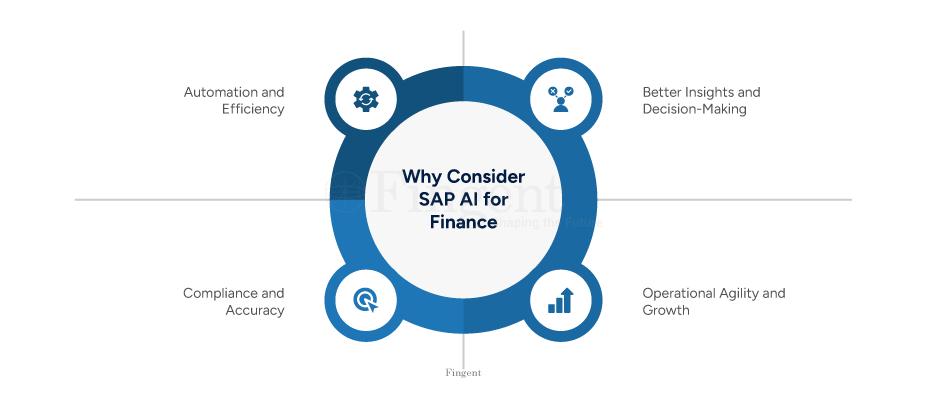
Let us look into some of the benefits of SAP AI for finance teams:
- Automation and Efficiency
A major and most popular feature of artificial intelligence is its ability to automate routine. Think invoice matching, cash flow management, and data entry. Delegate these tasks to SAP and let your finance experts focus their time and energy on higher-value activities. Increasing operational efficiency means a reduction in operational overhead. This invariably means an increase in return on investments for the finance team. - Insights and Decision-Making
It isn’t news to you how powerful your business can be if it can recognize anomalies and market trends. With predictive forecasting as its backbone, AI algorithms can analyze financial data to recognize anomalies and market trends. This creates a path to more accurate and real-time cash flow forecasting. In addition to its benefit in forecasting, AI can also predict the risk of late payments for invoices, identify suspicious activities, and alert teams in real time. This proactive approach to risk management is a boon to the company. - Compliance and Accuracy
Take your eye off the constant monitoring of financial regulations and tax laws. Keep your eyes on the ball and run your business instead. With SAP AI, this task is seamlessly automated to detect inconsistencies, propose corrections, and provide real-time surveying. When you trust SAP AI to handle the automation and survey of databases, there is a significant drop in the rate of human error. Especially in areas of financial reporting and transaction processing, this leads to greater data integrity. - Operational Agility and Growth
SAP AI for Finance grants businesses the unbeatable gift of agility. Think what real-time analyses can do for you. Quick reactions to changing market conditions and business needs can make all the difference in this market. It does more. It optimizes sequential finance processes. It manages working capital. It provides strategic insights. Altogether, it helps steer your business towards a sustainable and profitable future.
Prepare Your Business For The Future Adopt a Seamless Modernization Journet With Our SAP Experts
What Are Some Use Cases of SAP AI for Finance?
What are the possibilities of SAP AI in financial services? Unending really. For instance, SAP predicts a 71% reduction in accounts receivable matching effort. It also talks about the potential of identifying high-risk accounts quickly. Time savings on summarizing financial data could be increased to 50%! There is more.
Let’s dive into some practical ways AI is used in SAP for financial operations.
- Financial Insights
SAP AI can provide real-time financial insights to enable teams to make better data-backed decisions. AI helps simplify complex databases and offers systematic recommendations to improve results. - Error Resolution
Overlooked errors can slow down operations during the financial closing process, but with the integration of SAP’s AI-generated insights, businesses can easily identify anomalies and resolve them. It also closes the gap for human error and helps reduce IT costs by automating error resolution. - Assisted Configuration
Depreciation and tax codes are simplified and automatically handled by SAP AI. It provides comprehensive, user-friendly explanations to users and also automates configuration assistance. This ensures that even the most complex business setups are managed with ease.
How Can Fingent Help With SAP AI for Finance?
Fingent enables businesses to drive digital services and supports financial and accounting functions with the help of SAP S/4HANA. This application of SAP can create a well-networked, digitally connected, and data-driven structure for your organization. As a SAP Silver partner, this is our area of expertise, and our tech wizards are tuned in to all the nuances of using SAP to custom-fit the needs of your business. You can be sure they will help create a personalized SAP AI model for your business with an algorithm built to please you. Let’s get talking, and you will see what we mean.
Stay up to date on what's new
About the Author
Featured Blogs
Stay up to date on
what's new
Talk To Our Experts