Powering Smarter Private Jet Charter Advisory

Business Objectives:

  • Enhance operational visibility
  • Power seamless collaboration
  • Centralize trip planning & management

Industry

Private Aviation / Travel

Solutions:

Custom web application to streamline trip management & sales.

Results:

  • Centralized management
  • Efficient trip planning
  • Streamlined documentation
  • Real-time insights into business performance

Location:

USA

About the Client

The client is a trusted private jet charter advisor. Founded by industry professionals, the organization brings over 20 years of combined expertise in aircraft brokerage, charter operations, and aviation advisory. They offer personalized guidance to help customers make informed decisions at every stage of travel, from choosing private charter operators to aircraft, pricing, and lounge services.

The client serves as an intermediary between customers and private charter operators. Their operations rely on critical information and constant collaboration. They wanted to leverage technology to centralize customer management, charter operations, sales, finance, and reporting into one connected system. This could help them improve operational visibility and control.

Case Overview

Fingent proposed a custom web application to manage the client’s 36-step sales process. The solution covers the entire workflow, from receiving a customer request to trip release, reporting, and post-trip activities. It includes dedicated modules for Planning Trips, Sales Funnel, CRM, Aircraft Information, Airport Details, and Reports & Analytics.

The application strengthens the client’s ability to manage private charter operations efficiently. Integrations with third-party tools like Tuvoli, Avinode, AC-U-KWIK, and existing client systems boost the app's performance a step ahead. Overall, the app helps connect critical workflows, improves collaboration, and provides greater visibility across the business.

CHALLENGES

Roadblocks Faced In The Existing Systems

Improve end-to-end workflow visibility

Streamline charter request and booking processes

Centralize data and management

Strengthen reporting and business insights

Connect sales, operations, and finance workflows

SOLUTION

Fingent’s Approach - Modernizing Trip Planning with Customized Technology

The application empowers the team to manage the entire sales cycle, from initial customer contact to post-trip activities, from a single application. Users can also store and manage documents, customer communications, and other critical data in one place. This improves transparency and makes information easier to access.

The application also provides quick, actionable insights. Users can see which operators generate the most sales, which aircraft are used most often, and how the business is performing overall.

End-to-end trip management

CRM for client and operator management

Sales funnel management

Easy access to aircraft and airport information

Want to explore our client's full story?

BENEFITS

Making An Impact On Client Success

The application helps streamline workflows and drive operational visibility. Centralized data management simplifies collaboration and strengthens data security. Users can manage customer communications, trip details, and important documents all from a single platform. This improves transparency and reduces the complexity of managing critical information in Excel spreadsheets and disparate systems.

The application also simplifies trip release checklists. Teams can track required checks and ensure key steps are completed before a trip. This supports more consistent and well-coordinated trip operations.

Centralized management

Safer document sharing

Greater operational transparency

Real-time aircraft and operator insights

Reduced manual effort

Improved workflow

Better operational visibility

Enhanced services and brand trust

Have a similar challenge or an idea to discuss?

Download Case Study


    Subscribe to Fingent's emails and newsletters

    Stay up to date on what's new

      About the Author

      ...
      ftsamil

      Talk To Our Experts

        Accelerating Boat Lift Design & Sales with 3D Configurator

        Challenges:

        • Lack of realistic visualization of boat lift designs
        • Lengthy quoting process involving multiple teams
        • No instant design and quoting tool for sales

        Industry

        Marine Construction

        Solutions:

        Custom web application configurator with 2D & 3D visualization

        Results:

        • Realistic 2D, 3D view of custom designs .
        • Faster and accurate quote generation.
        • Reduced sales cycle time.
        • Ability to drive higher close rates.

        Location:

        Midwest USA

        About the Client

        The client is a Wisconsin-based marine construction company providing waterfront solutions for residential and commercial properties. They specialize in designing, installing, and servicing piers, docks, and boat lifts across Southeastern Wisconsin. The organization combines experienced design, engineering, fabrication, installation, and service capabilities to deliver reliable waterfront systems. Its approach focuses on creating durable solutions that help property owners protect their watercraft and make better use of their waterfront spaces.

        Designing boat lifts requires input from multiple teams, including designers, engineers, and the installation crew. The process typically begins with the design team creating a custom CAD representation of the proposed site. Sales representatives then run multiple rounds of discussions with customers and designers to finalize the design. Generating quotes also needed sales reps to manually map designs with entry lists to create a Bill of Materials. The process was time-consuming and slowed the sales process.

        Case Overview

        Fingent proposed a Custom Configurator Web Application with 2D and 3D design capabilities. The app is accessible to the client’s sales team, engineers, and administrators, improving collaboration and eliminating multiple rounds of discussions. It also integrates with the client’s ERP, Oracle NetSuite, to automate calculations. This helps sales reps instantly analyze the approved design, identify the required materials, dimensions, and components, retrieves the corresponding inventory and pricing data, and generate quotes with actual prices.

        The application empowers sales representatives to create and showcase customer-specific boat lift designs on the spot. They can make design changes, visualize the structure in 3D, and respond to customer requirements without waiting for input from other teams. The application significantly reduces the time and manual effort involved in preparing quotes. The automated process can reduce quoting effort by 60–70% while improving pricing accuracy.

        CHALLENGES

        Roadblocks Faced In The Existing Systems

        Heavy dependence on multiple teams for design

        Manual mapping of components to inventory in ERP system

        Limitations in getting a realistic view of proposed designs

        Longer quote preparation and approval times

        Longer sales cycles risking deal closures

        SOLUTION

        Fingent’s Approach - Custom Configurator Web Application with 2D and 3D Design

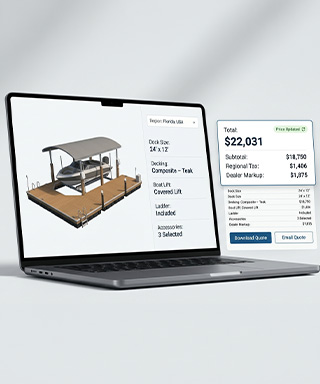
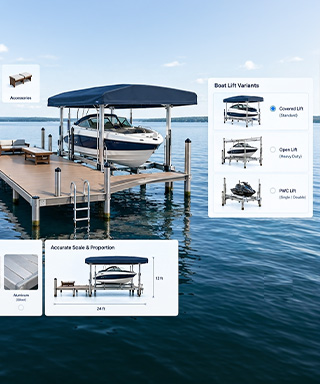
        The configurator enables users to seamlessly design unique boat lifts specific to a customer's requirements. Its 2D canvas allows users to adjust dimensions, select materials, and scale designs accurately. Users can also quickly place accessories using the drag-and-drop feature. The 3D view provides a realistic representation of the proposed boat lift. This helps customers better understand the final structure and make informed decisions.

        The application integrates with the client’s ERP, NetSuite, to automate price calculation. When a user opts to ‘Generate Quote’, the system analyzes the approved design and identifies the required materials, dimensions, and components. It then retrieves the corresponding inventory and pricing data from NetSuite. The system generates a quote with the required Bill of Materials (BOM). Quotes can also be exported as PDFs and shared with customers for immediate review and sign-off.

        2D Canvas for boat lift design

        Integration with NetSuite

        Realistic design visualization in 3D

        Want to explore our client's full story?

        Benefits-Custom Configurator Web Application with 2D and 3D Design

        BENEFITS

        Making An Impact On Client Success

        The web-based configurator helps the sales team make the most of site visits, conferences, and trade shows. Faster design discussions can shorten sales cycles and potentially improve close rates by 15–20%. Instant quote generation reduces quoting effort by 60–70% while improving pricing accuracy. By linking designs with actual inventory data, the application helps teams identify required components earlier. Better design and material visibility can reduce rework and material waste, while also lowering manufacturing complexity and associated costs.

        Faster and More Accurate Quoting

        Shorter Sales Cycles

        Higher Chances of Sales Conversion

        Reduced Construction Rework and Material Wastage

        60% reduction in manual effort

        15-20% improved close rates

        Improved workflow

        Better brand reputation & trust

        Have a similar challenge or an idea to discuss?

        Download Case Study


          Subscribe to Fingent's emails and newsletters

          Stay up to date on what's new

            About the Author

            ...
            ftsamil

            Talk To Our Experts

              Transforming Broadcast Operations Through Virtual Control

              Challenges:

              Lack of flexibility, operational complexity, and reliance on proprietary and expensive hardware in traditional production environments.

              Industry

              Media/Broadcasting

              Solutions:

              A Web-based Broadcast Production Control Platform

              Results:

              • Ability to scale production capacity without additional hardware or operator constraints.
              • Remote and virtual production control from anywhere.
              • Simplified operations through a single, unified control interface.
              • Reduces reliance on proprietary hardware.

              Location:

              Australia

              About the Client

              The client is a leading broadcast and media technology company. With over 40 years of industry experience, the organization operates across Australia, New Zealand, and the Asia-Pacific regions with expertise in systems integration, media software development, workflow automation, and innovative broadcast technology solutions.

              Broadcast and media companies face multiple challenges in a traditional production control environment. Most companies are stuck with rigid legacy production systems built for a single purpose. This makes it difficult for organizations to adapt to changing needs without completely reinventing their technology stack. Operating under such a setup often requires multiple operators to manage various tasks across separate systems, making operations complex and necessitating expansion of physical infrastructure.

              Case Overview

              Fingent partnered with the client to help develop a web-based production control platform that simplifies and modernizes live production/ boradcast workflows. The solution brings live video directly into the browser, allowing teams to manage and control productions remotely from anywhere.

              The application helps consolidate multiple production functions like device control, live video feeds, graphics, dynamic branding and metadata, and production switching into a single intuitive interface. This centralized approach simplifies operations, improves resource utilization, and removes the physical constraints traditionally associated with production environments. The application is a modern production ecosystem that reduces complexity, increases operational agility, and supports growth without the limitations of traditional hardware-centric systems.

              CHALLENGES

              Roadblocks Faced In The Existing Systems

              Operational Complexity Across Multiple Systems

              Reliance on Proprietary and Expensive Hardware

              High Manpower Requirements

              Integration Gaps with Existing Products

              Production Scaling Limitations

              SOLUTION

              Fingent’s Approach - A Web-based Production Control Platform

              The application helps consolidate multiple production functions into a single intuitive interface. With the application, users can enable device control, live video feeds, graphics, dynamic branding and metadata, and production switching all from a single point.

              The application is entirely built on commercial off-the-shelf (COTS) hardware. This offers users flexible deployment options across on-premises environments, private infrastructure, and the cloud. Native integration with Microsoft Entra provides secure identity and access management.

              Complete and streamlined control over device management.

              Live, low-latency WebRTC video directly into the browser.

              Operators can trigger sequential actions with a single customizable button.

              Want to explore our client's full story?

              BENEFITS

              Making An Impact On Client Success

              The application enables broadcasters to modernize production workflows without undertaking costly infrastructure overhauls. The virtual control room feature is especially a game-changer that centralizes operations, improves resource utilization, and removes the physical constraints traditionally associated with production environments. For organizations using the Panasonic KAIROS platform, the application unlocks even greater flexibility by enabling multiple productions to be managed simultaneously through a unified control environment. Overall, the application is a modern production ecosystem that reduces complexity, increases operational agility, and supports growth without limitations.

              Modernizes production workflows without replacing existing systems.

              Supports a wide range of production devices through a hardware-agnostic architecture.

              Eliminates the need for dedicated broadcast monitors through browser-based video previews.

              Ensures operational continuity even when connected devices experience failures.

              Ability to scale without limits

              Simplified operations

              Improved operational flexibility

              Modernization without costly overhauls

              Have a similar challenge or an idea to discuss?

              Download Case Study


                Subscribe to Fingent's emails and newsletters

                Stay up to date on what's new

                  About the Author

                  ...
                  ftsamil

                  Talk To Our Experts

                    Redefining Sales for Marine Construction with 3D Configurator

                    Challenges:

                    • Complex and lengthy multi-team quoting process
                    • Lack of an instant, sales-driven tool to drive higher close rates

                    Industry

                    Marine & Dock Construction

                    Solutions:

                    Custom web application configurator with 2D & 3D visualization

                    Results:

                    • Realistic 2D, 3D view of custom designs
                    • Faster and accurate quote generation
                    • Reduced sales cycle time
                    • Ability to drive higher close rates

                    Location:

                    Midwest USA

                    About the Client

                    The client is a marine construction company that provides end-to-end waterfront construction solutions. From design and structural engineering to fabrication and installation, they manage the entire process under one roof. They strive to construct waterfront spaces that are functional, aesthetically pleasing, and built to last, helping businesses and families enjoy memorable experiences by the water for years to come.

                    The company’s quote creation process often involves input from multiple teams, including designers, engineers, and the installation crew. A typical process required the design team to create a custom CAD representation of the proposed site. Each component in the design then had to be mapped to its corresponding cost in NetSuite, the company’s ERP system. This made it difficult for sales representatives to provide customers with an immediate visual and pricing estimate, delaying deal closures and slowing sales conversions.

                    Case Overview

                    Fingent proposed a Custom Configurator Web Application with 2D and 3D Design capabilities. The configurator is hosted on Azure, coded in React with WebGL & 3JS for 3D visualization, and accessible to the client’s sales team, engineers, and administrators. Admins have ACL controls over the User Module and Product Module, which list SKUs covering over 2,000 parts each, with their pricing & stock information in the client’s ERP (Oracle NetSuite).

                    The application enables the sales team to design docks on the go. They can create and present designs in real time during client conversations, giving customers a clearer view of the proposed structure and its specifications. Designs can be quickly assembled & modified using pre-existing parts or templates, visualized in 2D and 3D, and exported (to PDF). Quotes can be generated with a Bill of Materials (BoM) and instantly approved. This helps the sales team communicate design ideas more effectively, drive faster decisions, potentially reducing sales cycles.

                    CHALLENGES

                    Roadblocks Faced In The Existing Systems

                    Complex, multi-team quoting process

                    No instant design-to-quote capability

                    Limitations to visualize proposed designs

                    Longer quote preparation and approval times

                    Longer sales cycles

                    SOLUTION

                    Fingent’s Approach - Custom Configurator Web Application with 2D and 3D Design

                    The Custom 3D Configurator application makes it easy for users to create dock designs from scratch. Its 2D design canvas allows users to scale docks to the desired size and drag and drop accessories such as flagpoles, benches, and Dockboxes into the layout.

                    The application also integrates with Oracle NetSuite, the client’s ERP system, allowing users to access part numbers and automatically fetch the corresponding prices to generate quotes instantly with BOM (Bill of Materials).

                    2D & 3D design visualization

                    Drag-and-drop accessories

                    Integration with NetSuite automates price calculation

                    Want to explore our client's full story?

                    BENEFITS

                    Making An Impact On Client Success

                    The web-based configurator strengthens the client’s sales process with real-time 2D and 3D dock design and visualization. Sales teams can create and present custom designs on the go, refine them in real-time, and drive faster customer decisions. The application further accelerates sales by converting approved designs into accurate quotes and Bills of Materials (BoM). This reduces manual handoffs and quote preparation effort. Teams can move from design approval to pricing almost instantly, cutting quote creation time and shortening sales cycles.

                    Can cut quote creation time by up to 60- 70%

                    Better clarity of design with 2D & 3D visualization

                    Sales cycles can be shortened by 15-20%

                    Chances for higher close rates

                    Reduces manual effort

                    Improved workflow

                    Better client conversations

                    Boosted customer trust

                    Have a similar challenge or an idea to discuss?

                    Download Case Study


                      Subscribe to Fingent's emails and newsletters

                      Stay up to date on what's new

                        About the Author

                        ...
                        ftsblogadmin

                        Talk To Our Experts

                          Modernizing HRM/Payroll Application with SaaS Multi-Tenant Architecture

                          Challenges:

                          The company’s legacy platforms limited their scaling opportunities. Performance optimization was also becoming difficult. The company wanted to make a shift to a truly cloud-first, future-ready platform.

                          Industry

                          Technology

                          Solutions:

                          Modernization with SaaS Multi-Tenant Architecture

                          Results:

                          The scalable SaaS foundation enables smooth business expansion while delivering improved speed, stability, and a better user experience. Its centralized, cloud-native architecture also helps reduce operational overhead and simplify management.

                          Location:

                          US

                          About the Client

                          The client is a well-established provider of HR and payroll solutions. They focus on helping businesses across the Caribbean to streamline and simplify their workforce operations. Their platforms are designed to improve efficiency, ensure compliance with local regulations, and make everyday HR processes like payroll management, work permits, and employee data handling more seamless.

                          The client utilized an HRM solution that was largely monolithic. It made it harder to scale, optimize, and fully leverage modern cloud capabilities. As their customer base grew, the company wanted a more scalable, efficient, and modern architecture. Although they initiated an app migration to a scalable Azure SaaS model, the transition was largely a lift-and-shift effort to preserve the legacy structures and functionalities.

                          Case Overview

                          With multiple deployment models still in play, maintaining consistency and efficiency became increasingly complex. The client was in need of a development team that could offer a structured approach to modernize the platform, resolve technical issues, and make the application truly cloud-first, scalable, and future-ready.

                          Fingent addressed the requirement through a streamlined approach, beginning with a comprehensive analysis of the existing SaaS architecture. The next move involved identifying gaps and prioritizing pending tasks. It was followed by building a product plan with clearly defined milestones to migrate 60% of the existing clients into the new cloud platform and enable continuous improvement.

                          CHALLENGES

                          Roadblocks Faced In The Existing Systems

                          Legacy platforms and outdated technology

                          Complex system architecture

                          Limitations to scale

                          Inability to optimize operations over time

                          Lack of a truly cloud-first, future-ready solution

                          SOLUTION

                          Fingent’s Approach - Modernization with SaaS Multi-Tenant Architecture

                          At the core, the solution involved optimizing the existing codebase. This included refining the legacy components and introducing asynchronous processing where needed. The focus remained on improving the overall system efficiency through a secure, scalable SaaS model powered by a multi-tenant Azure architecture.

                          To support scalability, the application was further aligned with Azure PaaS capabilities. A strategic migration of the environment to the Canada Central region was also enforced to ensure better compliance and performance for regional users.

                          Focus on modernizing the user experience

                          SaaS Go-live and migration plan ensured a smooth transition

                          Building future-ready capabilities enabling subscription-based billing models

                          Want to explore our client's full story?

                          BENEFITS

                          Making An Impact On Client Success

                          With a strong foundation in place, the client is positioned to transition from a legacy-driven system to a modern, scalable SaaS platform. The optimized multi-tenant architecture and improved codebase are expected to significantly enhance system performance. With improved stability and user experience, the system can even support larger organizations with complex workforce needs. A centralized and cloud-native management reduces operational overhead while enabling faster onboarding of new clients. This boosts the company’s ability to smoothly expand into new markets.

                          Scalable SaaS foundation to support rapid onboarding and smooth expansion

                          Enhanced speed, stability, and overall user experience with code optimization

                          Region-specific hosting ensures better compliance and lower latency

                          Reduced operational overhead with a centralized, cloud-native management

                          Enhanced data security

                          Seamless expansion

                          Performance optimization

                          Cost optimization

                          Have a similar challenge or an idea to discuss?

                          Download Case Study


                            Subscribe to Fingent's emails and newsletters

                            Stay up to date on what's new

                              About the Author

                              ...
                              ftsamil

                              Talk To Our Experts

                                OCR Invoice Automation and Calculation

                                Challenges:

                                Manual ticket verification increased invoicing time. Detention tickets accounted for 20% of total daily orders.

                                Industry

                                Logistics

                                Solutions:

                                OCR Invoice Automation - AI-powered Ticket Time Extraction System

                                Results:

                                Increased autoinvoicing from 40% to 70% reduced manual interventions and processing delays, accelerating invoice completion and payment timelines.

                                Location:

                                US

                                About the Client

                                The client is a mid-sized transportation logistics company with an annual revenue of $20 million and an average of 10,000 orders per month. Operating across the mainland USA, the company partners with major oil refineries and other logistics providers to deliver comprehensive services to customers nationwide.

                                The company operated in a fast-paced logistics environment but continued to rely on physical paper tickets as proof of delivery and supporting documentation for invoicing. These tickets included handwritten timings, which were essential for calculating detention time at pickup and drop-off locations. Detention tickets accounted for 20% of total daily orders. The accounting team was required to manually verify these handwritten timings and apply the rate sheet to charge customers accordingly. This manual process created significant operational challenges. It required substantial labor. Extended billing cycles and delayed payments limited the team’s ability to process invoices efficiently.

                                Case Overview

                                The manual verification process consumed over 600 hours annually and delayed the issuance of detention invoices, impacting cash flow. During peak seasons, the growing volume of detention tickets further increased verification time. This extended invoicing cycles and added to manual labor requirements.

                                The company recognized that their customers would prefer to continue using physical tickets. Fingent thus proposed OCR Invoice Automation with AI-powered Ticket Time Extraction System that used Azure’s custom Document Intelligence model for handwriting recognition. This solution enabled the company to automate timing capture without changing processes for drivers or customers. The implementation reduced human errors, accelerated invoicing, and improved operational efficiency. Initial concerns about handwriting recognition accuracy were addressed by retraining the model with over 100 tickets, achieving an accuracy rate exceeding 95% for each ticket.

                                CHALLENGES

                                Roadblocks Faced In The Existing Systems

                                Excessive manual labor and cost.

                                Slow process. Extended billing cycles.

                                Frequent errors and inefficiencies.

                                Delayed invoicing and payments.

                                Delayed tickets accounted for 20% of total daily orders.

                                SOLUTION

                                Fingent’s Approach - A Custom AI-Powered Ticketing System

                                The AI-powered Ticket Time Extraction System for OCR Invoice Automation was developed using Microsoft Azure Document Intelligence. The solution automates the entire process—from document upload to data validation—ensuring accurate, consistent, and real-time extraction of key ticket details. Uploaded ticket images and documents are first classified through a Custom Document Classification Model, confirming standard formats before extraction.

                                Once validated, the system employs a Custom Data Extraction Model that leverages OCR and layout-based recognition to identify ticket timings, dates, and other essential fields from both structured and semi-structured documents. The extracted data is automatically transmitted back to the customer’s portal through secure API integration, where it is verified and matched against order details for accuracy and consistency.

                                Automated document classification and extraction using Azure Document Intelligence.

                                Intelligent calculation module ensures precision by automatically matching extracted timings with order details.

                                End-to-end integration with the customer portal for real-time validation and data synchronization.

                                Want to explore our full success story?

                                IMPLEMENTATION JOURNEY

                                Ensuring a Successful and Smooth AI Transition

                                The OCR Invoice Automation was implemented through four phases. It began with a detailed feasibility and design phase, where the existing automation process was analyzed to identify inefficiencies within the 59% automation baseline. Multiple OCR and vision models—including Azure Document Intelligence and Google OCR—were evaluated for accuracy and reliability. Based on this assessment, AI-driven calculation workflows were designed and aligned with order validation rules.

                                During the development and integration phase, the team built a robust document upload pipeline using Azure APIs and developed a document identification model for standardized invoice recognition. OCR, validation logic, and calculation modules were integrated with the client’s existing systems, followed by the implementation of exception handling workflows and an intuitive user interface for accounting staff review. Subsequent pilot and rollout phases focused on model fine-tuning, feedback-driven optimization, and full-scale deployment across all invoice types.

                                Launched a pilot with a subset of invoices in the preproduction environment.

                                Fine-tuned extraction models for handwritten and scanned tickets.

                                Optimized calculation logic for detention time validation.

                                Expanded automation across all invoice types. Incorporated user feedback loops for correction and learning.

                                Have a similar challenge or an idea to discuss?

                                BENEFITS

                                Making An Impact On Client Success

                                The OCR Invoice Automation with an AI-powered ticket time extraction system delivered measurable improvements across efficiency, accuracy, and operational performance. By automating core processes and reducing manual dependency, the system enhanced data reliability. In addition, it accelerated invoicing and empowered teams with actionable insights for continuous optimization.

                                Automation Efficiency: Increased autoinvoicing from 40% to 70%, reducing manual interventions.

                                Accuracy Gains: Significant reduction in errors through advanced OCR and calculation validation

                                Faster Invoicing Cycles: Reduced processing delays, accelerating invoice completion and payment timelines.

                                Data-Driven Insights: Reports provided visibility into error patterns, enabling continuous process improvement.

                                Faster invoicing

                                Enhanced accuracy

                                Intelligent decisions

                                Reduced operational costs

                                Download Case Study


                                  Subscribe to Fingent's emails and newsletters

                                  Stay up to date on what's new

                                    About the Author

                                    ...
                                    ftsblogadmin

                                    Talk To Our Experts

                                      Redefining Customer Support With a Custom AI Ticketing System

                                      Challenges:

                                      Manual email triage and ticket routing led to a time-consuming, inconsistent, and error-prone process, often leading to misclassified or delayed tickets.

                                      Industry

                                      Electronics

                                      Solutions:

                                      A Custom AI-Powered Ticketing System

                                      Results:

                                      80% reduction in manual handling time, a 40% boost in agent productivity, and significantly faster issue resolution with automated email parsing, ticket creation, and intelligent routing.

                                      Location:

                                      Japan

                                      About the Client

                                      The client is a global technology and electronics corporation employing over 110,000 people across 40+ countries. The company delivers solutions in IT infrastructure, communications systems, and enterprise services for both commercial and government customers. Its global support organization handles tens of thousands of service requests monthly, spanning enterprise servers, network devices, and digital transformation solutions.

                                      The client’s customer support teams managed inquiries through multiple shared inboxes, relying on manual review and entry into a legacy helpdesk platform. This process was time-consuming, inconsistent, and error-prone, often leading to misclassified or delayed tickets. Support managers had limited visibility into workloads and response times, creating uneven agent utilization and frequent SLA breaches.

                                      Case Overview

                                      Skilled agents were spending significant time on administrative triage instead of problem resolution. The result was slower responses, higher operational costs, and declining customer satisfaction across key business lines — prompting leadership to explore automation as a path to improved efficiency and service quality. When evaluating solutions, the client’s leadership considered two primary options: expanding their support workforce or adopting a commercial ticketing tool. Both were quickly ruled out.

                                      Adding staff would increase costs, and off-the-shelf ticketing software lacked the required intelligence. Stakeholders from Customer Support and IT identified that the real bottleneck lay in the manual interpretation and routing of incoming emails. Fingent proposed a Custom AI Ticketing System capable of understanding message intent, categorizing issues, and routing them instantly.

                                      CHALLENGES

                                      Roadblocks Faced In The Existing Systems

                                      Manual email triage and ticket routing.

                                      Time-consuming and error-prone processes.

                                      Excessive manual efforts. Reduced productivity.

                                      Misclassified and delayed tickets.

                                      Reduced customer satisfaction.

                                      SOLUTION

                                      Fingent’s Approach - A Custom AI-Powered Ticketing System

                                      The custom AI Ticketing System built on Microsoft .NET, PowerApps, and Azure AI Services is tightly integrated with the client’s in-house platform. The solution automates the entire lifecycle of incoming customer inquiries — from email receipt to ticket creation and intelligent routing — eliminating manual handling while ensuring precision, visibility, and compliance across the support organization. The AI Ticketing System is orchestrated through an agentic architecture. Distinct agents handle specific reasoning tasks.

                                      The AI layer functions as a distributed agentic system operating within the client’s Azure environment.

                                      Running on a serverless architecture using Azure Functions and Event Grid, the system scales automatically to process high email volumes in near real time.

                                      All agent interactions are captured within a central observability stack powered by Azure Monitor and Application Insights, providing end-to-end transparency, compliance, and explainability.

                                      Explore how our experts can turn your innovative ideas into reality

                                      IMPLEMENTATION JOURNEY

                                      Ensuring a Successful and Smooth AI Transition

                                      The project was executed in a phased approach to ensure accuracy and user adoption. It began with a four-week pilot program focused on a single department with a high volume of structured inquiries. During this phase, we measured the AI's performance on categorization accuracy and the time saved per ticket. The pilot was an immediate success, demonstrating high accuracy in ticket categorization and proving the system's ability to handle high email volumes.

                                      This early win built significant momentum and confidence among stakeholders. Following the pilot, the system was rolled out to subsequent departments over two months. Fingent conducted comprehensive training sessions for administrators and support agents, familiarizing them with the new automated workflows and the powerful reporting features of the Admin and Agent dashboards. One key challenge was ensuring the AI agents understood domain-specific product terms and acronyms that frequently appeared in support emails. Another challenge was latency during peak load.

                                      Instead of model retraining, Fingent introduced a lightweight terminology-mapping module powered by a curated reference database.

                                      This improved interpretation accuracy without modifying the base LLMs.

                                      Event-driven batching and asynchronous queue management were implemented to resolve latency during peak load.

                                      Have a similar challenge or an idea to discuss?

                                      BENEFITS

                                      Making An Impact On Client Success

                                      The AI Ticketing System architecture employs a modular, service-oriented design, integrated via secure REST APIs with internal tools, identity management systems (AD), and reporting interfaces. Built within the client’s private Azure infrastructure, the solution adheres to enterprise-grade governance, security, and data retention standards, ensuring robust performance, auditability, and operational resilience. Although the system has recently been deployed, the anticipated impact based on pilot results and performance projections is transformative. The company anticipates a dramatic reduction in manual labor and a surge in productivity.

                                      Efficiency Improvement: Time spent on manual ticket creation, categorization, and routing will be reduced by up to 80%.

                                      Faster Resolution Times: Time-to-resolution is expected to decrease significantly, directly boosting customer satisfaction.

                                      Increased Productivity: Expected to increase overall agent productivity and capacity by an estimated 40%.

                                      Enhanced Transparency: The new Admin Dashboard provides managers with real-time visibility into ticket volumes, agent activity, and more.

                                      Reduced manual efforts

                                      Boosted agent productivity

                                      Faster & simplified processes

                                      Enhanced customer experience

                                      Have a similar challenge or an idea to discuss?

                                      Download Case Study


                                        Subscribe to Fingent's emails and newsletters

                                        Stay up to date on what's new

                                          About the Author

                                          ...
                                          ftsblogadmin

                                          Talk To Our Experts

                                            Zero-Downtime High-Scale Platform Modernization for a 10 Million-Download Media App

                                            A mission-critical modernization executed without downtime. Learn how Fingent rebuilt core systems, APIs, and mobile experiences while millions of users stayed continuously online.

                                            Challenges:

                                            Overhaul the legacy system without disrupting ongoing operations to future-proof the website and mobile app of a religious media conglomerate.

                                            Industry

                                            Media/Nonprofit

                                            Solutions:

                                            Transformed a legacy platform into a scalable, future-ready digital platform for website and mobile app.

                                            Results:

                                            A modern, scalable, and future-ready tech stack that will support the future growth of the app across mobile and web platforms.

                                            Location:

                                            US

                                            About the Client

                                            One of the largest U.S.-based faith-driven media conglomerates known for producing faith-based, educational, and inspirational content across television, radio, and digital platforms. They wanted a website and mobile apps (Android & iOS) to help children learn timeless moral values and life lessons through engaging, Bible-based animated stories.

                                            The vision was to bring the scriptures to life for families worldwide through an interactive adventure series featuring two time-traveling children and their robot companion. This concept quickly gained popularity and raked up 10 Million+ downloads in Android and iTunes app stores.

                                            Case Overview

                                            Fingent collaborated with the global faith-based media organization to modernize the tech stack without disrupting existing app services, ensuring uninterrupted access for users throughout the transition.

                                            Both the backend and frontend architecture were replaced and upgraded to the latest version of a carefully assembled tech stack.

                                            The project resulted in a complete overhaul of a near-obsolete legacy system, replacing it with a secure, scalable, and future-ready platform built to support over 3 million users while setting the ground for future expansion.

                                            CHALLENGES

                                            Pain Points in Existing Architecture

                                            Upgrading the architecture without disrupting ongoing operations

                                            Legacy mobile tech stack no longer supported

                                            Urgent need to modernize the architecture to sustain growth

                                            Complex CMS upgrade of large volume, structure, and content organization.

                                            SOLUTION

                                            Modernizing a Legacy System for a Global Faith-Based Media Organization

                                            Fingent modernized the client’s existing platform to deliver a scalable, secure, and high-performing solution capable of handling over 20,000 concurrent users. The project emphasized modernizing the obsolete tech stack, a complete revamp of backend architecture, optimizing app performance, and ensuring uninterrupted access during the transition.

                                            Complete backend revamp with federated GraphQL via WunderGraph, Azure Functions for serverless scaling, and multi-layered caching

                                            Expanded capabilities in Node.js and native app development for a superior user experience

                                            Implemented a SmartClient architecture to enhance flexibility and responsiveness

                                            Conducted high-scale performance testing using Azure Load Testing to ensure stability for up to 20,000 concurrent users

                                            Explore how our experts can turn your innovative ideas into reality

                                            BENEFITS

                                            Creating Lasting Value Through Modernization

                                            The modernization initiative transformed the client’s platform into a modern, high-performing, future-proof, secure, and scalable solution. By enhancing system efficiency and ensuring uninterrupted service, Fingent helped the organization sustain its current audience while building a scalable foundation to expand its global reach further.

                                            Maximized scalability and improved performance to support peak user volumes

                                            Extensive testing across different call types, agent performance levels, and edge cases ensured reliable operation before deployment.

                                            Streamlined data flow and elimination of data silos through Wundergraph API integration

                                            Seamless migration with zero downtime during the architecture transition

                                            Improved security and maintainability through the Drupal 10 upgrade

                                            Enhanced system capability to handle 20,000+ concurrent users

                                            Disruption-free transition

                                            Future-ready architecture

                                            Unified digital ecosystem

                                            Rigorous load testing

                                            Have a similar challenge or an idea to discuss?

                                            Stay up to date on what's new

                                              About the Author

                                              ...
                                              ftsblogadmin

                                              Talk To Our Experts

                                                Transforming Call Center Quality Assurance with AI-Powered Automation

                                                Challenges:

                                                • Quality Assurance evaluated only 3% of 9400 daily calls across 350 agents.
                                                • Lack of visibility into widespread performance trends and compliance risks. Inability to identify customer satisfaction drivers.
                                                • The manual QA process consumed 2,550 hours monthly.
                                                • QA operational cost estimated at $0.7 million annually.

                                                Industry

                                                Media/Nonprofit

                                                Solutions:

                                                AI-Powered Call Center Agent Scoring Application

                                                Results:

                                                Evaluation coverage from 3% to 100% of all calls. Complete visibility of agent performance across all interaction types, times, and customer segments. Quick identification of performance gaps and training needs. Reduced manual efforts and operational costs.

                                                Location:

                                                US

                                                About the Client

                                                The client is a diversified media organization with an annual revenue of approximately $700 million and a workforce of over 1,500 employees. Operating across content production, broadcasting, digital media distribution, and publishing, the company serves millions of customers worldwide. With a strong focus on innovation, it continuously adapts to emerging technologies to stay competitive in the dynamic media landscape.

                                                The organization's call center handles an average of 9400 calls daily, through 350 customer service agents. However, their quality assurance program faced significant limitations. With only 12 dedicated QA agents, they could evaluate approximately 280 calls per day, which was just 3% of total call volume. This sampling bias prevented an accurate assessment of agent performance. Critical compliance issues or customer experience problems went undetected in the remaining 97% of calls. Coaching interventions were delayed by weeks due to insufficient data coverage.

                                                Case Overview

                                                The manual QA process consumed approximately 2,550 hours monthly, costing an estimated $0.7 million annually in QA labor alone. More critically, the organization lacked visibility into widespread performance trends, compliance risks, and customer satisfaction drivers. This limited their ability to proactively improve service quality and agent performance.

                                                The organization's leadership evaluated several alternatives, including hiring additional QA staff, implementing traditional call monitoring software, and using off-the-shelf solutions. However, these approaches would scale costs linearly due to the fundamental limitation of sampling-based evaluation. Moreover, off-the-shelf software could not provide the quality and specificity of evaluation. The decision to pursue AI-powered automation was driven by the technology's unique capability to evaluate 100% of interactions while maintaining consistent scoring standards.

                                                CHALLENGES

                                                Roadblocks Faced In The Existing Systems

                                                Inability to accurately assess agent performance

                                                Limited QA coverage –only 3% calls were reviewed

                                                Major compliance and customer experience issues went undetected

                                                High manual QA efforts and costs –2,550 hours monthly, costing an estimated $0.7 million annually

                                                Limitations to proactively improve service quality and agent performance

                                                SOLUTION

                                                Fingent’s Approach - AI-Powered Call Center Agent Scoring Application

                                                Fingent implemented a comprehensive AI-based Call Center Agent Scoring Application built on Microsoft Azure's cloud-native serverless architecture. The solution utilizes Azure Functions and Azure OpenAI Service with multiple GPT models for intelligent cost-optimized processing. The system processes call transcripts through a sophisticated pipeline featuring pre-processing modules for text normalization and PII removal.

                                                Advanced model-specific prompt engineering utilizing few-shot in-context learning with domain-specific knowledge injection is used to transform the organization's 10-criterion scorecard into structured evaluation instructions. Call ingestion occurs via REST API integration with the existing contact center platform. This triggers workflows that orchestrate evaluation through configurable sampling strategies—from targeted call types to full 100% coverage— for cost optimization.

                                                The platform integrates bidirectionally with existing systems and business intelligence tools.

                                                Comprehensive audit trails, data protection, and retention policies ensure compliance.

                                                The system maintains enterprise-grade security with role-based access control and integration with Azure Active Directory.

                                                Enable a smooth and effortless AI transition journey with Fingent

                                                IMPLEMENTATION JOURNEY

                                                Ensuring a Successful and Smooth AI Transition

                                                The implementation began with a comprehensive feasibility study involving detailed analysis of the organization's existing QA criteria, call types, and evaluation processes. The team conducted extensive testing of different evaluation strategies and LLM models to identify optimal performance and cost. The development phase focused on building the core Azure-based application backend, the PostgreSQL, and the CosmosDB. This was done by establishing secure API connections with their existing contact center platform for automated transcript ingestion.

                                                The rollout phase began with a pilot program covering specific call types and agent groups, gradually expanding to full deployment across all 350 agents. This phase involved fine-tuning based on real-world performance data, optimizing cost efficiency and processing strategies, and training managers and QA staff on the new system capabilities. Throughout the implementation, Fingent maintained a strong stakeholder engagement with regular progress updates, addressed technical challenges through iterative problem-solving, and ensured seamless integration with existing workflows to minimize operational disruption.

                                                Developed a React-based user interface for QA supervisors and managers to review and modify AI evaluations.

                                                Extensive testing across different call types, agent performance levels, and edge cases ensured reliable operation before deployment.

                                                Implemented comprehensive audit trails and integration with Power BI for reporting.

                                                Explore how our experts can turn your innovative ideas into reality

                                                BENEFITS

                                                Making An Impact On Client Success

                                                The AI-powered QA solution delivered improvements across multiple dimensions of the organization's call center operations. The most significant achievement was expanding evaluation coverage from 3% to 100% of all calls—a massive increase in visibility. This comprehensive coverage eliminated sampling bias and provided the first complete picture of agent performance across all interaction types, times, and customer segments. The automation generated substantial cost savings by reducing manual QA labor requirements significantly. QA staff can now focus on strategic coaching, trend analysis, and complex cases requiring human judgment.

                                                Coaches and managers gain access to comprehensive, objective performance data enabling fair and accurate agent assessments.

                                                Data-driven decisions can be made about training programs, coaching priorities, and performance management.

                                                The system provides the base to identify performance patterns, compliance risks, and improvement opportunities at scale

                                                Real-time alerts for compliance violations and quality issues enable immediate intervention.

                                                Quick identification of issues

                                                Strategic, data-driven training approaches

                                                Reduced QA operational costs

                                                Improved service quality & agent performance

                                                Have a similar challenge or an idea to discuss?

                                                Download Case Study


                                                  Subscribe to Fingent's emails and newsletters

                                                  Stay up to date on what's new

                                                    About the Author

                                                    ...
                                                    ftsblogadmin

                                                    Talk To Our Experts

                                                      Unlocking Marketing Intelligence with a Conversational AI Agent

                                                      Challenges:

                                                      The marketing team lacked access to actionable intelligence from 9,400 daily call center interactions. This limited their understanding of their customer behavior and changing trends.

                                                      Industry

                                                      Media/Nonprofit

                                                      Solutions:

                                                      Custom Conversational AI Agent to unlock marketing intelligence

                                                      Results:

                                                      Accelerated campaign development by 3 weeks. Faster intelligence gathering process. Enhanced clarity on customer needs and behavior. Data-driven and targeted marketing campaigns. Improved user engagement and brand trust.

                                                      Location:

                                                      US

                                                      About the Client

                                                      The client is a diversified media organization with an annual revenue of approximately $700 million and a workforce of over 1,500 employees. The company operates across multiple verticals, including content production, broadcasting, digital media distribution, and publishing, serving millions of customers worldwide. The company focuses on evolving with emerging technologies to stay competitive in a rapidly changing media landscape.

                                                      The company handles approximately 9,400 call center interactions daily. It's equivalent to 3.4 million annual conversations' worth of untapped user feedback. However, the marketing team had no scalable method to analyze these conversations. This left them unable to identify trends, measure sentiment, or understand the specific needs and motivations of their users, despite having an excellent data source at hand.

                                                      Case Overview

                                                      The lack of insight was a significant opportunity cost. Marketing campaigns were designed with incomplete information, limiting their effectiveness and ROI. Product development was reactive, relying on delayed or indirect feedback rather than real-time data. Crucially, the organization was missing the ability to proactively understand its users, which is essential for building loyalty and driving engagement in a competitive media landscape.

                                                      The leadership evaluated expanding customer surveys and manual call analysis teams. But surveys yielded low response rates, while manual analysis was unscalable and too expensive. Fingent recognized that an AI Agent-based solution can analyze 100% of call data in real-time while leveraging existing infrastructure from a parallel call center agent evaluation project. The initial concerns about AI accuracy and implementation complexity were addressed through a phased PoC and MVP approach, which demonstrated quick wins during the design phase.

                                                      CHALLENGES

                                                      Roadblocks Faced In The Existing Systems

                                                      Inability to convert 3.4 million annual customer interactions into insightful data

                                                      Manual and weeks-long intelligence gathering process

                                                      Inability to proactively understand customer needs and behavior

                                                      Lack of data-driven campaign development

                                                      Inability to build brand loyalty and drive customer engagement

                                                      SOLUTION

                                                      Fingent’s Approach - Custom Conversational AI Agent

                                                      The conversational agentic AI system was built on a cloud-native serverless architecture using Azure Functions. The solution features a React-based conversational chat interface embedded into the client's internal applications for easy access. Marketing users query the data using natural language, which is then routed to AI agents equipped with specialized tools.

                                                      The stack is designed for modularity and scalability, leveraging Python’s async capabilities for low-latency API interactions, paired with a responsive React-based front end. The serverless architecture using Azure Functions ensures efficient resource utilization. The system leverages PostgreSQL with pgvector to store embeddings for RAG ( Retrieval Augmented Generation), and a NoSQL store for unstructured data. The system includes a data pre-processing pipeline that embeds relevant data, stores metadata, and generates additional contextual information. The agentic AI system is powered by Azure OpenAI for planning and execution.

                                                      The system uses both REST APIs and MCP (Model Context Protocol) to access data and tools.

                                                      The architecture prioritizes scalability, fault tolerance, and extensibility.

                                                      Azure AD, RBAC, and additional security measures ensure enterprise-grade compliance.

                                                      Enable a smooth and effortless AI transition journey with Fingent

                                                      IMPLEMENTATION JOURNEY

                                                      Ensuring a Successful and Smooth AI Transition

                                                      Implementation began after validating the concept and identifying strategies to overcome key bottlenecks via multiple PoCs. The three-month project was structured across three distinct phases to ensure an agile and effective rollout.

                                                      Throughout the project, the team successfully navigated key challenges related to performance and data accuracy. To ensure fast response times when querying large volumes of data, the system's architecture was optimized for efficient data processing and caching. The reliability of the AI-generated insights was ensured by a validation process that combined automated confidence scores and source citations. This practical approach ensured the final tool was fast and reliable.

                                                      Phase 1 - Scope & Design: This initial phase of one month focused on identifying the core set of business questions, designing the agentic AI architecture, creating the data processing pipelines, and creating UI mocks.

                                                      Phase 3 - Pilot Rollout & Iteration: Early wins included successfully answering 78% of initial queries and reducing typical research tasks from hours to minutes.

                                                      Phase 2 - Development & Integration: The core development phase included building the React-based chat interface, developing the AI agent and its backend tools on Azure, establishing the data integration with their contact center platform, and finishing with a week of testing with various sample scenarios.

                                                      Explore how our experts can turn your innovative ideas into reality

                                                      BENEFITS

                                                      Making An Impact On Client Success

                                                      The solution transformed the marketing team’s intelligence gathering from a manual, weeks-long process to instant query resolution, accelerating campaign development time by 3 weeks. Estimated time savings averaged 85%, with some tasks that previously required over 4 hours of manual research now completed in under 15 minutes. This new capability led to several measurable improvements in marketing and product development operations.

                                                      Data-Driven Campaign Development: The team could now design campaigns based on a real-time understanding of user needs, concerns, and sentiment.

                                                      Efficient Content Generation: The ability to query the entire call database allowed for the rapid identification of powerful user testimonials and stories for use in content.

                                                      Accelerated Product Improvement Cycles: Direct, unfiltered feedback on products and services could be analyzed at scale to identify and prioritize enhancements.

                                                      Enhanced Regional Analysis: The marketing team could now perform demographic and regional analysis to create more user-specific strategies.

                                                      Improved customer engagement

                                                      Customer-specific marketing campaigns

                                                      Agile decisions in product strategy

                                                      Enhanced brand trust & loyalty

                                                      Have a similar challenge or an idea to discuss?

                                                      Download Case Study


                                                        Subscribe to Fingent's emails and newsletters

                                                        Stay up to date on what's new

                                                          About the Author

                                                          ...
                                                          ftsblogadmin

                                                          Talk To Our Experts
                                                            ×