Tag: Artifical Intelligence



Stay up to date on what's new

About the Author

Tony Joseph

Tony believes in building technology around processes, rather than building processes around technology. At Fingent, he specializes in custom software development, especially in analyzing processes, refining them, and then building technology around it. He works with clients on a daily basis to understand and analyze their operational structure, discover (and not invent) key improvement areas, and come up with technology solutions to deliver an efficient process. You can reach him at [email protected], Skype: tony_fingent
Featured Blogs








Stay up to date on
what's new



Talk To Our Experts

Enterprises are drowning in data, but still starve for clarity. Not because the data is missing. Because insight does not emerge automatically from systems, even very good ones.
This is the real context in which Generative AI with SAP matters. Not as a trend. Not as a promise. But as a way to finally close the gap between enterprise data and executive decision making.
The question leaders should ask is not whether AI is powerful. That is already settled. The real question is this. Can AI reason with enterprise data in a way leaders can trust?
What Is Generative AI in SAP?
Why Generative AI matters in the SAP ecosystem?
SAP systems run the most sensitive and consequential processes in the enterprise. Finance, procurement, supply chain, compliance, and human capital. These are not experimental domains. They are where risk lives.
For decades, SAP has captured transactions, enforced controls, and produced reports. But reports describe the past.
Your SAP system knows your business. So why does getting answers still feel like an interrogation?
This is where Generative AI with SAP changes the dynamic. It shifts SAP from being a system you query into a system that can explain, summarize, and suggest. Not autonomously but responsibly.
This matters because intelligence that sits outside the ERP rarely scales. Intelligence that lives inside core systems can.
Leverage the Power of Generative AI with SAP Unlock Unique Possibilities for Your Business
What Are the Potential Applications of Generative AI Within SAP?
There is considerable buzz surrounding generative AI. Most of it is not relevant to enterprise leaders.
In the SAP context, generative AI is not about creative output. It is about cognitive support. It reads enterprise data, understands business context, and helps humans interpret complexity.
Say, your SAP system already knows what happened. Generative AI helps you understand the reasons for it. It also helps in evaluating possible future results, based on real data.
This is the reason Generative AI with SAP distinctly differs from independent AI tools. It does not live on the edges of the business. It works inside enterprise governance, authorization, and process logic.
The same controls leaders already trust. The same systems that run finance, supply chains, and people operations. That difference matters.
Does that mean it replaces judgment? No! It sharpens judgment by removing friction.
How Does SAP Integrate Enterprise Data With Generative AI?
Enterprise leaders are right to worry about hallucinations, data leakage, and compliance risk. Open AI models trained on the internet are not designed for regulated enterprise environments.
SAP takes a different approach. Generative AI is grounded in enterprise data. It is not free floating. It does not guess. It reasons within defined boundaries.
SAP integrates generative AI through controlled access to structured business data, metadata, and process context. Responses are traceable. Permissions are enforced. Auditability remains intact.
Here is the logical test leaders should apply. If AI cannot explain where an insight comes from, should it influence a decision? With Generative AI with SAP, that traceability is built into the design.
Where Generative AI Fits in SAP Landscapes?
Enterprise architecture is not forgiving. One poorly integrated capability can introduce risk far beyond its value.
So, where does generative AI belong? The answer is simple. It belongs where decisions already happen. Let’s look at a few key factors that explain this:
1. SAP S/4HANA and Core Business Processes
SAP S/4HANA is the digital core of the enterprise. It handles financial close, inventory valuation, order fulfilment, and production planning.
These processes already generate immense data. What they lack is interpretation at speed.
Imagine a CFO during close week. The numbers are finalising and the variances appear. The question is not what changed. The question is why.
With Generative AI with SAP, the CFO does not need to pull multiple reports. The system can summarise drivers, highlight anomalies, and explain trends using actual ledger data.
2. What Role Does SAP BTP Play in SAP’s AI Strategy?
SAP Business Technology Platform is the quiet enabler behind most enterprise innovation.
It connects systems. It governs data. It allows extensions without destabilizing the core.
For generative AI, BTP is critical. It provides the layer where AI services can interact with SAP and non-SAP data securely. It is also where enterprises control how and where intelligence is applied.
Without this layer, Generative AI with SAP would remain a series of disconnected experiments. With it, AI becomes part of enterprise architecture.
3. What Are SAP AI Core, SAP AI Launchpad, and Joule?
These components exist for a reason. Enterprises do not just need AI. They need AI that can be managed.
SAP AI Core handles the operational side. It deploys and runs AI models in a controlled way. SAP AI Launchpad gives visibility. It allows teams to monitor, govern, and refine AI use cases.
Joule is where leaders and users feel the impact. It is the conversational layer that allows natural interaction with enterprise data.
4. Integration With Enterprise Data and Workflows
Adoption fails when intelligence feels foreign.
Generative AI works best when it feels native. Embedded in approvals. Embedded in analysis and embedded in daily work.
When insight arrives on the same screen where action is taken, friction disappears. This is not convenient. It is operational leverage.
Enterprise Benefits of Generative AI with SAP
Enterprises adopting generative AI inside SAP environments are not chasing novelty. They are solving pressure points.
Decision cycles shorten because insight arrives faster. Manual analysis decreases because summarization is automated. Risk exposure reduces because anomalies surface earlier.
But there is a deeper benefit: Confidence. Leaders act faster when they trust the reasoning behind the numbers. Generative AI with SAP does not replace reports. It explains them.
That explanation is what turns data into leadership action.
Is Generative AI in SAP Secure for Enterprise Use?
Security concerns are not a fear. They are responsible.
SAP approaches generative AI with the same discipline it applies to financial data. Access is role-based. Data usage is governed. Models do not train on customer data by default.
This matters because AI that cannot be governed will not be adopted, especially not at scale.
The real question is this: Can Artificial Intelligence be introduced without increasing risk? With Generative AI with SAP, the answer is yes, when implemented correctly.
Enterprise Use Cases of Generative AI with SAP
Enterprises that treat generative AI as a novelty will see novelty results. Enterprises that treat it as an extension of enterprise reasoning will see real transformation. Generative AI with SAP is not about replacing systems or people. It is about helping leaders think better, faster, and with greater confidence.
- Intelligent Finance
Finance teams spend an enormous amount of time explaining results. Not just reporting them.
Generative AI can summarise financial performance, explain variances, and support scenario exploration using actual SAP data.
Instead of digging through spreadsheets, finance leaders ask focused questions. The system responds with context, not guesses.
That changes the rhythm of finance.
- Procurement Processes
Procurement (which includes contracts, suppliers, compliance, and pricing) is complex by design. Generative AI simplifies that intricacy. It aids teams in quickly reviewing contracts, uncovering hidden risks, and assessing supplier behavior instantly with reduced manual work. Improved choices, enhanced oversight. It doesn’t replace negotiation. It elevates it.
In procurement, speed without insight is a risk multiplier. Insight without speed is useless. Generative AI with SAP balances both.
- Document Processing
Invoices, contracts, regulatory documents. Enterprises are buried in them.
Classification, extraction, summarization—Generative AI compresses hours of work into minutes. Errors reduce. Visibility improves. This is not glamour, but rather an operational relief.
Achieve 99.99% Scalable Operational Accuracy with AI-Driven Document Processing!
Why Strategic Partnership Matters?
Technology rarely fails because it does not work. It fails because it is misapplied.
Generative AI requires discipline. Use case selection matters. Governance and integration matters.
Without experience, enterprises either overreach or underdeliver. A strategic partner helps avoid both.
How Fingent Can Help!
Fingent approaches Generative AI with SAP from a business-first perspective.
We help leaders identify where intelligence will create measurable value. We design architectures that respect enterprise constraints. We embed AI into workflows that already matter.
Our focus is not experimentation. It is outcomes.
Stay up to date on what's new
About the Author
Tony Joseph
Tony believes in building technology around processes, rather than building processes around technology. At Fingent, he specializes in custom software development, especially in analyzing processes, refining them, and then building technology around it. He works with clients on a daily basis to understand and analyze their operational structure, discover (and not invent) key improvement areas, and come up with technology solutions to deliver an efficient process. You can reach him at [email protected], Skype: tony_fingent
Featured Blogs
Stay up to date on
what's new
Talk To Our Experts
Traditional automation excels at repetition. RPA follows scripts. GenAI generates insights.
But when conditions change mid-process, suppliers miss dates, forecasts shift, or approvals stall – these tools stop short. They alert. They suggest. Then they wait.
Enterprises don’t need more notifications. They need systems that take ownership of outcomes. That’s where agentic AI development enters the picture.
Why Agentic AI, Why Now?
When systems detect problems but cannot resolve them, teams become the glue.
In finance, forecasts trigger alerts but require manual adjustment. In IT ops, cloud overspend is flagged after the bill arrives. In sales ops, leads are scored but still sit untouched. The pattern is the same: insight without execution.
Agentic AI development closes that gap. It identifies issues, evaluates options, executes decisions within policy, and learns from outcomes. All without waiting on handoffs.
We’re seeing enterprises drive meaningful operational costs this way. With the agentic AI market projected to grow to USD 154.84 billion by 2033, the question is no longer if enterprises adopt, but who gains the lead.
Integrate AI Into Your Existing Systems The Smart Way. Reduce Friction. Maximize Results.
What Agentic AI Means for Your Operations
Agentic AI development builds systems that act independently. They sense issues, plan responses, execute fixes, and learn over time, all with minimal supervision. Forget rigid scripts. These systems handle surprises the way experienced operators do.
Picture your invoice disputes. An agent pulls contract data, cross-checks deliveries, flags errors, issues credits, and updates ledgers automatically. No more weekend escalations.
We mix perception (spotting anomalies), reasoning (weighing options), tools (accessing ERP systems), memory (past deals), and decisions (approving changes under limits). That’s agentic AI development in action, transforming chaos into smooth flows.
Expand this to tail-spend. Those 3,000+ low-value purchases eating your time? The agent aggregates them, benchmarks prices, bundles into bulk deals, and executes, freeing your team for strategic sourcing.
Why It’s Not Like Chatbots or Basic Bots
Generative AI spits out reports on supplier risks but stops there; now, you act. Virtual assistants book a meeting but can’t renegotiate contracts.
Agentic AI development goes further. It is platform agnostic, integrating with your existing enterprise systems, executing actions, tracking outcomes, and adapting over time.
In IT operations, this means more than dashboards. An agent detects abnormal cloud usage, reallocates resources, enforces budgets, and documents actions automatically. No ticket queues. No late surprises.
Key Benefits of Agentic AI for Enterprises
Agentic AI drives cost reduction and speed through autonomous, end-to-end execution. Let’s dig deeper:
1. Cut Costs and Speed Wins in Procurement
Procurement slows down when decisions wait on people, and systems don’t talk to each other. Agentic AI fixes this by orchestrating sourcing workflows end to end. Autonomous agents monitor pricing, flag cost gaps, recommend renegotiation paths, and route sourcing actions without manual handoffs. Teams stay focused on exceptions, while routine work moves faster with tighter control.
2. Faster, Smarter Decisions Daily
Markets shift fast—agentic AI processes signals instantly, beating human speed. In finance, it flags risky loans early; in procurement, it predicts shortages.
Finance teams love this for cash flow: The agent forecasts spend patterns from invoices and POs, flags variances, auto-adjusts forecasts, and suggests accruals, keeping your books tight.
Procurement leaders report improved supplier quality, too. Agents evaluate risks like financial stability or ESG compliance continuously, dropping underperformers proactively.
3. Personalize at Enterprise Scale
Personalization breaks when scale increases. Agentic AI fixes that by adapting actions, not just messages. AI agent development companies craft agents that adapt emails, terms, and follow-ups based on your data.
A B2B firm scored leads, personalized outreach, timed calls, and tweaked pricing. Result: more conversions, shorter cycles, bigger deals. Apply this to RFPs, you win more bids.
For enterprise architects, think spend categorization: Agents parse unstructured invoices, classify by GL codes, and flag maverick spend, ensuring compliance without manual reviews.
Enterprise Use Cases
Agentic AI automates enterprise workflows end to end, reducing risk, controlling spend, and keeping operations on track. Here’s how this shows up across enterprise functions:
1. Procurement and Supply Chain Wins
Disruptions keep you up at night. Multi-agent systems monitor everything: performance, forecasts, compliance.
One retailer used autonomous agent solutions to track inventory. When delays hit, agents negotiated premiums, sourced alternates, and adjusted forecasts, avoiding stockouts.
Dive deeper: Autonomous supplier discovery. Agents scan markets 24/7 for vendors matching your criteria, be it cost, location, or certifications. They score them, run background checks, and suggest switches, cutting cycle times 70%.
Dynamic contract negotiation takes it further. The agent drafts terms, simulates counteroffers, identifies risks (e.g., penalty clauses), and finalizes compliant deals, reducing review time.
2. Finance and Risk Scenarios
Banks run agentic AI development for portfolios. It scans borrowers, adjusts terms, ensures regs, all proactive.
During downturns, it flags risks and retains clients. Stable times? It optimizes profits.
In procurement, predictive spend analytics shines. Agents blend historical data, market trends, and real-time signals to forecast category spends, spot savings, and execute optimizations.
3. Infrastructure and Ops Examples
Cloud teams use agentic AI to predict demand and adjust resources automatically, improving cost efficiency and maintaining high availability without constant manual intervention. Procurement intake is simplified, without adding friction for IT teams
4. Sales and Threat Protection
Sales agents qualify leads, nurture them, and hand off hots. Cybersecurity agents spot insider threats, isolate systems, and log evidence. This stops breaches.
For finance, threat detection means spotting unusual PO patterns like duplicate invoices or off-contract buys and blocking fraud instantly.
Rollout Steps That Work
Agentic AI succeeds when enterprises start small, secure data early, keep humans in control, and track ROI rigorously. These steps show how to deploy autonomous AI agents safely, scale fast, and avoid costly missteps.
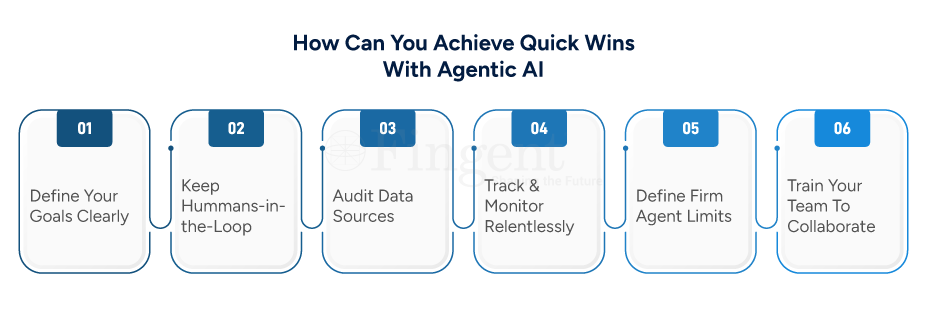
1. Define Goals First
Pick one pain point. Invoice matching or supplier onboarding. Define what “fixed” means and start where the risk is low.
Start narrow: Prove agentic workflows on routine tasks, then grow.
2. Keep Humans in Key Spots
Max autonomy tempts, but loop in people for big spends or contracts. It builds trust, catches drifts.
Two patterns work well in practice:
- Centralized for control (simple approvals)
- Hierarchical scale in multi-agent systems (complex chains)
3. Fix Data Upfront
Audit data sources early because bad data will derail agents. Set standards, loop feedback for better decisions.
In procurement, unify S2P data: Centralize spend, contracts, and suppliers for accurate agent reasoning.
4. Track Relentlessly
Monitor resolutions, accuracy, costs, and compliance. Refine based on real runs. Track ROI: Did negotiations yield expected savings?
5. Security from Jump
Apply zero-trust access, audits, and RBAC. Define firm agent limits and require review for high-value contracts.
6. Build Team Skills
Train on collaborating with agents. Learn from wins/losses together. Procurement teams need sessions on overriding agents safely.
Pitfalls We’ve Seen
Vague goals derail projects. Spell out success criteria, limits, and escalations. Define risky suppliers clearly.
Fix data gaps before agentic AI development. Start with clean vendor master data. Build security in from day one. Add explainability for audits. Avoid black-box agents. Add alerts and rollback controls.
Vendor lock? Pick open APIs. Accountability? Map chains now, like “agent proposes, human approves.”
Your 4-Phase Start
Phase 1: Target repetitive procurement task with data access, like invoice automation. Test with AI agent development company—learn feasibility.
Phase 2: Quantify: Autonomy rate? Cost drop? Tweak for 70% auto-handle. Add features like risk scoring.
Phase 3: Add cases (e.g., contracts), boost autonomy. Train teams, set governance. Roll to adjacent: Spend analytics next.
Phase 4: Deploy widely, monitor drifts. Key: Sponsorship, cross-teams (IT/procure/finance), change prep. Aim for 50% task automation by year-end.
Drive AI Success Faster! Start Small with the Right Expertise. Gain Quick Wins.
Fingent as Your Partner
Need help with agentic AI development? As one of the best agentic AI development companies for enterprise procurement, we tailor our solutions to your stack. We pilot fast, integrate seamlessly, govern safely, and train your team. No lock-in: We build your skills.
From multi-agent designs (one for discovery, one for negotiation) to monitoring (drift alerts), we shorten your path and reduce both cost and risk. We’ve delivered significantly better ROI in tail spend for manufacturers. Now it’s your turn.
Act Now
Agentic AI development is already reshaping enterprise workflows. The advantage goes to teams that start small and learn fast.
Pick one workflow. Run one pilot. Measure outcomes.
Invoice disputes. Forecast adjustments. RFP evaluation.
Start there. We’ll help you map it.
Stay up to date on what's new
About the Author
Tony Joseph
Tony believes in building technology around processes, rather than building processes around technology. At Fingent, he specializes in custom software development, especially in analyzing processes, refining them, and then building technology around it. He works with clients on a daily basis to understand and analyze their operational structure, discover (and not invent) key improvement areas, and come up with technology solutions to deliver an efficient process. You can reach him at [email protected], Skype: tony_fingent
Featured Blogs
Stay up to date on
what's new
Talk To Our Experts
Your company spent two million dollars on an AI project. The pilot looked strong. The demo worked. Then the results flatlined. You are not alone!
Most companies face AI adoption challenges. They see very little or almost no measurable return from their AI adoptions. Failure to reach scale leads to money down the drain.
The problem is not the model. The problem is people, process, and strategy. Although these issues are fixable. Let’s see how!
Why AI Adoption Is Essential
AI drives speed, accuracy, and better decisions. It removes repetitive work and frees your teams to focus on high-value tasks. Most companies adopting AI see a significant change in operational efficiency.
However, when companies make large shifts rapidly, they face AI adoption challenges. Pilot projects work, but scaling fails. Teams push back, and the systems block progress. Skills fall short. Data is unreliable to say the least. These and many such reasons are why companies struggle with AI adoption. Here’s more on the common challenges in AI adoption for businesses.
Barriers To Enterprise AI Implementation
1.Workforce Readiness
What is the role of workforce preparedness in AI adoption? Most teams do not have the skills to run AI at scale. Half of all businesses cite a lack of skilled talent as their top blocker. According to Statista, in 2025, the biggest barriers to AI adoption were the lack of skilled professionals, cited by 50% of businesses, a lack of vision among managers and leaders, cited by 43%, followed by the high costs of AI products and services at 29%.
Skills shortages show up in three ways:
- You try to hire: The talent pool is small and expensive.
- You try to upskill: Training takes time.
- You rely on a few experts: If they leave, your project fails.
The fix is simple. Build a blended model. Hire where needed. When training your teams, create a culture of learning. Spread knowledge across teams.
2. ROI Uncertainty
Leadership wants clear returns. Few companies define them well. Many teams track with no clear outcome. They guess at goals, and they use vague metrics. Some AI projects take time to show impact. Early benefits are small and indirect. Many leaders expect fast results and lose interest before the project matures.
To improve results, companies must define one primary outcome, set clear timelines, and track progress with simple metrics.
3. AI Adoption Issues in Legacy Systems
How do legacy systems impact AI implementation? Many companies face integration issues. Old systems store data in incompatible formats. Since data lives in silos, infrastructure is slow. APIs fail to support real-time data. Integration becomes expensive. Your team struggles to connect modern tools with outdated systems.
The fix is a staged approach —modernize in small steps, consolidate data, and clean your core systems before scaling AI.
4.Lack of Clear Objectives
Many leaders approve AI projects without a clear goal. Teams pick use cases that sound interesting but solve no real business problem. Without clear objectives, the project drifts. No one knows what success means. Results are hard to measure.
The better way—start with one business problem, slow response times. Set a specific goal and develop around it.
5. Concerns Around Data Security
Executives worry about data exposure. These concerns are valid. Poor data governance creates risk. Companies often do not know where data lives or who uses it. Data quality issues cost the US economy over three trillion dollars a year.
Regulated industries face higher standards. One mistake creates legal and financial risk.
The fix— address security early. Set rules. Clean your data. Ensure to safeguard confidential data.
6. Absence of Trustworthy Partners
Many companies try to build AI alone. Others hire partners with no real experience. Both paths fail. AI requires skill, time, and structure. Most teams lack the bandwidth. Vendors with weak industry knowledge add more risk. The result is predictable. Wrong use cases. Wrong tech stack. Poor rollout. Projects that never scale.
Work with partners who know your industry and have delivered real outcomes. Ask for evidence. Look for teams that focus on people and process, not only tools.
Break The Barriers to AI Adoption Harness AI With Expert Guidance & Clear Roadmaps
How Leaders Move Forward: Your AI Adoption Playbook
What is the best strategy for successful AI adoption? Most leaders ask this question after stalled pilots and unclear results. An MIT report shows that 95% of generative AI pilots fail. Only five percent deliver fast revenue growth. The problems are known. The blockers are clear. What matters now is a plan you can act on. The next steps give you a simple path to stable adoption, clear value, and long-term progress. Each strategy focuses on one goal. Reduce friction and improve accuracy. Strengthen trust. Create a system your teams trust and use with confidence.
Strategy 1: Use the 30 Percent Rule and Keep Control
AI should take the repetitive work, but your people should make the decisions that matter. A simple split works. AI handles most repetitive activities. Humans handle the strategic parts that drive value. Examples include support, finance, and legal review. AI processes the bulk of the work. Humans own edge cases, decisions, and context.
This model improves trust. Companies achieve greater consumer trust percentages when they implement responsible AI along with human supervision.
What the 30 Percent Rule Tells You
AI handles repetitive work well. Humans handle judgment and strategy. In legal work, AI reviews most clauses. Lawyers focus on the few that matter. In finance, AI handles routine analysis. Humans handle portfolio decisions and client strategy. Automating the wrong tasks destroys value. Protect the human layer. It creates the critical insight your business needs.
Strategy 2: Always Keep a Human in the Loop
AI needs continuous human guidance. During training, humans label data and adjust outputs.
Before launch, experts test the system and fix errors. After launch, teams monitor decisions and report issues. This reduces bias and mistakes. It also builds internal confidence.
Strategy 3: Build a Clear Roadmap
Do not start with advanced use cases. Start small.
Phase 1. Minimize operational barriers and streamline routine activities. Utilize RPA, chatbots, and document handling. These quick wins build momentum.
Phase 2. Predict future outcomes. Use forecasting, segmentation, and recommendation models. These projects offer long term value.
Phase 3. Scale what works. Integrate with core systems. Build new business models.
Each phase supports the next. Set clear metrics for each phase and track them without excuses.
Strategy 4: Bring in AI experts who know what they are doing
Strong partners shorten your learning curve. Choose partners who know your industry. Ask for real case studies. Confirm they understand organizational change. Check their ability to work with your existing systems. A good partner brings a clear method. They guide you from assessment to deployment and support scaling.
Start Small and Focus On Quick Wins!
How Fingent Can Help You Adopt AI
Fingent guides companies from confusion to clarity. Their model is simple and proven.
Stage 1. Reduce Friction
Fingent identifies repetitive processes. We deploy RPA, document processing, and chatbots. This frees your team to focus on high value tasks.
Stage 2. Predict Outcomes
Fingent builds predictive analytics, recommendation engines, and segmentation models. Our experts help you improve forecasting and customer insights. We strengthen your governance and data discipline.
Stage 3. Scale and Advance
Fingent expands successful use cases. We integrate with core systems. Additionally, we support long-term transformation and new business value.
CASE STUDY: The Sapra & Navarra Success Story
AI/ML Claims Management Solution
Industry – Legal/Finance
Key Metrics:
- Case Settlement Time: Reduced from years to 1-2 days
- Settlement Cost Reduction: Over 50% reduction
- Business Impact: Enabled expansion into new insurance domains
Solution: A light-touch workers’ compensation solution powered by AI and ML
Key Success Factors:
- Clear problem identification (reduced settlement time)
- AI augmenting human expertise (not replacing lawyers)
- Human-in-the-loop approach for strategic decisions
- Decrease in average total claim costs and claim cycle time
What Sets Fingent Apart?
We provide human oversight as a standard. We run validation loops and follow strong governance. We fix data issues with clear mapping, cleanup, and security.
We start small, but ensure big results. We focus on modernizing legacy systems and integrating AI without disrupting operations. And that’s not where we stop. Fingent supports cultural change and upskilling to help businesses build confidence in leveraging new-age technologies to their maximum benefit.
Discuss your ideas with us and hear our expert solutions tailored to your unique needs.
Stay up to date on what's new
About the Author
Tony Joseph
Tony believes in building technology around processes, rather than building processes around technology. At Fingent, he specializes in custom software development, especially in analyzing processes, refining them, and then building technology around it. He works with clients on a daily basis to understand and analyze their operational structure, discover (and not invent) key improvement areas, and come up with technology solutions to deliver an efficient process. You can reach him at [email protected], Skype: tony_fingent
Featured Blogs
Stay up to date on
what's new
Talk To Our Experts
Step into a clinic in 2025, and you’ll see something very different from the clinics of old. The clipboard? Gone. That waiting room magazine from 2019? History.
Instead, an AI system analyzed your symptoms before you arrived. It cross-referenced your genetic profile with millions of patient records. It flagged potential concerns. It suggested personalized treatment options. All this before you said a word.
AI in healthcare isn’t coming. It’s here. And it’s transforming everything.
AI in healthcare is no longer optional. It’s essential. For patients. For providers. For everyone who wants better, faster, cheaper medicine.
Through this blog, we aim to help you grasp exactly how AI in healthcare transforms medicine from reactive to predictive, and you’ll have a clear roadmap to implementation.
Top Applications of AI in Healthcare: Where It Actually Makes a Difference
How is AI transforming healthcare today? The global AI healthcare market is projected to explode from USD 19.27 billion in 2023 to an astounding USD 613.81 billion by 2034, growing at a CAGR of 36.83%. That’s not incremental growth. That’s a fundamental shift in how medicine works. Where can you see this the most?
In the three forces reshaping healthcare: Personalization, Diagnostics and Automation.
Think of diagnostics so fast they catch diseases before you even feel off. According to a Nature meta-analysis, AI in digital pathology achieves a mean sensitivity of 96.3% and a mean specificity of 93.3%. That’s expert-level performance, available 24/7.
Think of what it can do with admin tasks. Now, your hospital runs on paperwork. AI changes that. Doctors drown in electronic health records. Nurses waste hours on administrative tasks. Treatment is delayed. Mistakes happen. Costs explode. AI in healthcare solves these problems at their roots.
Here’s a look at what is possible:
Streamlining Administrative Tasks
Administrative work takes up to 30% of healthcare costs. Scheduling. Billing. Coding. Insurance claims. These tasks don’t heal patients. They drain resources.
AI in healthcare simplifies operational complexities:
- Identifies no-shows in advance and adjusts schedules effortlessly.
- It streamlines medical coding with high accuracy, ensuring claims are accurate and minimizing rejections
- Billing automation catches errors before submission, accelerating payments
- Insurance verification is completed in seconds instead of hours
Personalization: One Size Fits None
Every patient is different. Their genetics. Their lifestyle. Their environment.
AI in healthcare makes medicine personal:
- Tailored treatment plans
- Adjusted medication dosages
- Customized care pathways
- Personalized risk assessments
The result: better outcomes, fewer side effects, happier patients.
Improved and Quick Diagnosis: Speed Saves Lives
Diagnostic errors kill. A missed tumour. A misread scan. A delayed treatment. Human doctors are excellent but fallible. They get tired. They miss patterns. They have bad days.
AI in healthcare never sleeps. It analyzes millions of images, lab results, and patient histories in seconds. It spots patterns humans can’t see.
Another study shows diagnostic error rates dropped from 22% to 12%—a 45% reduction—when AI-assisted clinicians. For pulmonary conditions, AI detection accuracy reached 92% versus 78% for manual interpretation.
How Does AI Help in Disease Diagnosis and Early Detection?
Let’s dive into the real clinical punch of AI—how it sifts through massive datasets in seconds, spots diseases before symptoms whisper, chops medical errors nearly in half, and builds treatment plans that feel tailor-made instead of template-driven. It’s not just smart; it’s economical too, cutting hospital readmissions by 30% while pushing care quality up and costs down.
Cancer doesn’t wait. Neither does AI.
The biggest impact of AI in healthcare happens at the bedside. In the lab. In the diagnostic suite. Where seconds matter, and mistakes cost lives.
Analyzing Large Data Faster: From Weeks to Seconds
Pathologists’ examinations and radiologists’ studies take time. Both are limited by human capacity. AI in healthcare processes thousands of images simultaneously. It identifies cancer cells in pathology slides. It spots tumours in radiology scans.
What is the result? Diagnostic accuracy matches or exceeds human experts, delivered in seconds instead of weeks.
Diagnosing Diseases at the Early Stage: Catching What Humans Miss
Detecting issues early can save lives. Late detection ends them. The difference between stage 1 and stage 4 cancer is often a matter of months.
AI in healthcare identifies diseases before symptoms appear. It analyzes patterns in:
- Genetic data predicting cancer risk
- Imaging data detecting microscopic changes
- Lab results flagging abnormal trends
- data monitoring vital signs continuously
Did you know? AI flags 8% of patients for potential rare diseases. 75% of those flags are right.
Minimize Medical Errors
Medical errors kill more people than many diseases. Wrong diagnoses. Wrong medications. Wrong treatments. AI reduces these errors systematically. It double-checks prescriptions. It verifies treatment plans. It alerts clinicians to potential mistakes.
One study estimates that broader AI adoption could save the U.S. healthcare system roughly 200–360 billion USD per year.
Enabling Personalized Patient Care and Treatments
Every patient is their own chemistry experiment. One treatment works magic for one and falls flat for the next. Traditional medicine uses trial and error. It’s slow. It’s expensive. It’s often wrong.
AI in healthcare predicts treatment response. It analyzes:
- Genetic markers indicating drug metabolism
- Medical history showing past responses
- Lifestyle factors affecting treatment efficacy
- Population data identifying successful patterns
The result? Outcomes rise. Side effects fall. That’s the AI advantage.
Reducing Complications and Hospital Readmissions
Hospital readmissions cost billions. They indicate treatment failure. They harm patients.
AI predicts which patients are likely to be readmitted. It identifies risk factors. It suggests interventions. It monitors recovery remotely.
Raising Care Quality While Driving Costs Down
When healthcare costs increase, patients feel the weight first. Quality keeps declining. Access keeps shrinking. It’s time for a smarter system that delivers better care without bleeding budgets.
AI in healthcare reverses this trend. It improves quality while reducing costs.
- Early detection prevents costly late-stage trauma
- Predictive prevention stops disease progression
- Administrative automation slashes operational overhead
The result: high-quality care at lower costs. Accessible. Affordable. Effective.
AI in Healthcare: Concerns Around Data and Cybersecurity
AI doesn’t just open doors—it creates entire highways for attackers. Interconnected devices become hop-on points. Cloud storage turns into a “please steal me” jackpot.
Your medical data is your most valuable asset. It’s also your most vulnerable. Every AI system runs on data. Patient records. Genetic information. Medical images. Treatment histories. This data is sensitive. It’s personal. It’s protected by law.
But AI creates massive attack surfaces. Hospitals store petabytes of data. Wearables transmit information continuously. Cloud systems connect thousands of devices. Each connection is a potential vulnerability.
Use Case: AI Predictive Analytics for Disease Prevention
What Are the Biggest Challenges of AI Adoption in Healthcare?
Weaknesses in AI in healthcare systems include:
- Interconnected devices — Every connected medical device is a potential entry point for hackers
- Cloud storage — Centralized data repositories create high-value targets
- Human error — Staff click phishing links. They share passwords. They accidentally expose data
According to the Department of Health and Human Services, AI could help detect up to $200 billion in fraudulent healthcare claims yearly. But the same AI systems creating this value can be compromised.
The World Economic Forum warns: AI in healthcare risks could exclude 5 billion people if not implemented equitably, with proper data governance and security frameworks.
But data breaches are predictable. The question is damage control.
Approaches to Handling Vulnerabilities: Building Fortresses, Not Sandcastles
Healthcare organizations must implement robust cybersecurity:
- Continuous monitoring
- Regular penetration testing
- Staff training
- Incident response plans
- Vendor security assessments
AI in healthcare must be designed with privacy by default. Anonymization. Data minimization. Secure multi-party computation. Federated learning. In other words: the model learns, the data stays home.
FAQs on AI in Healthcare
Q: Will AI soon take over the duties of healthcare providers?
A: Most certainly not. It energizes them immensely.
AI handles the grunt work. That includes admin work, pattern-spotting, and data crunching. This helps clinicians focus on what actually saves lives: judgment, empathy, and complex care.
Q: How do we ensure AI is accurate and safe?
A: Test it. Monitor it. Control it. Models need diverse data, rigorous clinical testing, and nonstop drift checks. And human oversight? Non-negotiable. Think of AI as the copilot—it advises fast, and clinicians decide wisely. That’s how you get speed without sacrificing safety.
Q: How do we secure AI in healthcare from the start?
A: Lock it down from day one. Build security into the foundation. Privacy is the spine holding everything upright. Encrypt everything. Keep data anonymized by default. Use strict access controls. When you do all this well, AI doesn’t become a liability — it becomes armor.
Q: How long does implementation take?
A: Pilots land in 3–6 months. Full deployment takes 12–24.
Here’s the typical runway:
- Months 1–2: Define the problem, prep the data
- Months 3–4: Build and test the model
- Months 5–6: Pilot and validate
- Months 7–12: Roll out, refine, optimize
Short runway. Big payoff.
AI in healthcare is iterative. You don’t “finish.” You mature—step by step—toward higher automation and better outcomes.
Q: What if our staff resists AI?
A: Bring them in early. Show the value. Train for confidence.
Resistance isn’t a roadblock—it’s a flare. Pay attention. Reduce the tasks, not the staff. Place tools in their hands, not fear in their minds. Acknowledge minor achievements. Elevate the early adopters. AI doesn’t win by replacing people—it wins when it makes people feel stronger, sharper, and more in control.
Power Your Operations With Seamless AI Adoption Harness AI With Expert Guidace at Each Step
How Fingent Helps You Navigate AI Adoption
You’ve seen the potential. Now you need a partner who can turn potential into progress. Fingent cuts through the hype, draws a clear blueprint, and helps your teams adopt AI without the chaos or confusion. Practical guidance. Real-world execution. Tangible wins. That’s the difference.
Fingent helps healthcare organizations implement AI in healthcare successfully. Not as a vendor. As a partner.
Why Fingent Succeeds Where Others Fail:
- We understand medicine, not just technology
- Successful implementations across healthcare organizations
- We manage the entire journey, from strategy to optimization
- We ensure your teams adopt and embrace AI
- We build systems that meet HIPAA, FDA, and other requirements
- We don’t disappear after deployment; we optimize continuously
AI in healthcare is complex. Fingent makes it simple. And effective.
Your patients are waiting. Your clinicians are ready. The time is now.
Stay up to date on what's new
About the Author
Tony Joseph
Tony believes in building technology around processes, rather than building processes around technology. At Fingent, he specializes in custom software development, especially in analyzing processes, refining them, and then building technology around it. He works with clients on a daily basis to understand and analyze their operational structure, discover (and not invent) key improvement areas, and come up with technology solutions to deliver an efficient process. You can reach him at [email protected], Skype: tony_fingent
Featured Blogs
Stay up to date on
what's new
Talk To Our Experts


Stay up to date on what's new
About the Author
Tony Joseph
Tony believes in building technology around processes, rather than building processes around technology. At Fingent, he specializes in custom software development, especially in analyzing processes, refining them, and then building technology around it. He works with clients on a daily basis to understand and analyze their operational structure, discover (and not invent) key improvement areas, and come up with technology solutions to deliver an efficient process. You can reach him at [email protected], Skype: tony_fingent
Featured Blogs
Stay up to date on
what's new
Talk To Our Experts
Your ticket updates itself. Your hotel knows your name. Even your suitcase can tell you where it is. The transformation that we see today in travel is impressive and massive.
Did you catch this news about travel industry trends? The travel and tourism market is on fire.
This isn’t just about convenience. It’s also getting smarter, faster, and greener. Travellers of the future take trips that have been customized for them based on intelligent systems and data.
Evolution of Travel Industry Trends — From Railways to Real-Time Algorithms
AI in tourism is expected to rise from USD 2.95 billion in 2024 to USD 13.38 billion by 2030. That would be a 28.7% compound annual growth. How did we get here?
Travel wasn’t always this effortless. From Thomas Cook’s first railway excursion in 1841 to AI-curated itineraries today, the journey of travel itself has evolved. For decades, traditional agencies held the reins. They had the data, the deals, the power. Then came the internet — and it rewrote everything.
Online Travel Agencies handed control to the traveler. Price comparisons. Reviews. Instant bookings. Travelers value transparency more than anything else.
The global OTA market size was USD 830 million in 2019, is expected to reach an awesome USD 1.3 billion by 2026. What does this prove? That the power shifted from agencies to individuals.
Well, the revolution continued. The rise of smartphones transformed each traveler into their personal concierge. Need a flight? Tap. A hotel? Tap. Dinner by the ocean? Tap again. Get everything you want — exactly when you want it.
The travel tech market mirrors that momentum — growing. Behind that surge lies one truth: people crave instant, personal, friction-free experiences.
No waiting. No middlemen. Just movement.
What began with paper tickets has evolved into predictive algorithms that know your next move before you do.
Travel isn’t just from one place to another anymore — it’s from analog to intelligent.
Power Your Travel Business with the Right TechnologiesOur Experts Can Help You Assess, Identify & Implement Solution That Drive Success
Technology: The Powerhouse For Future Tourism Trends
Technology is not only supporting the industry, but it’s powering travel industry trends in 2025 and beyond. From the beginning of the journey to the moment a traveller comes home, tech drives every touchpoint. It’s faster. Smarter. And deeply personal. Here’s how travel industry trends are rewriting modern travel.
1) AI and Automation: The Invisible Travel Companion
AI isn’t about chatbots anymore — it’s the unseen brain of the travel world.
- 40% of travellers are already using AI.
- Six in ten won’t plan a trip without technology doing the legwork.
The takeaway? Travel stopped being about booking the moment AI learned to think ahead. It crafts experiences that feel surprisingly human. Platforms like Booking.com and Skyscanner are your personal travel scouts. They find the best deals before you even think to look. And those chatbots? They now handle most of the customer chats. They are managing everything from flight delays to refunds, minus the waiting music torture.
Machine learning ups the ante. Airlines use predictive models trained on booking data and holidays to adjust pricing dynamically. Every seat, every second optimized.
2) Biometric Technology: Your Face Is Your Passport
No paper. No queues. Just a glance. Faster identification. Smoother movement. More personal travel.
Airports like Changi and Dubai International are redefining efficiency. Hotels are joining the movement. Guests check in, unlock rooms, and get personalized greetings — all via facial recognition. Tech investments in biometrics are also pumped up.
3) Internet of Things (IoT): Interconnected Encounters
Connection means more than Wi-Fi — it means intelligence.
Intelligent sensors now keep traffic flowing, trace suitcases, and stem delays. Hotels are becoming living ecosystems. With IoT-connected rooms, guests operate everything — lights, temperature, TV surfing — from their phone. Hilton’s Connected Room allows guests to personalize and control things as soon as they arrive.
IoT quietly makes travel more human — connected, calm, and in control.
4) Virtual and Augmented Reality: Try Before You Fly
Seeing is believing. Now, it’s booking.
- You can use VR to preview a hotel, an attraction, or a site before booking.
- Passengers can preview flight cabins and destinations in 360 degrees.
Nothing in a pamphlet can really compare to having already been there when you have. Technology is transforming the reason we travel, not simply the way we do it.
The point isn’t to travel from point A to point B. It’s about constantly feeling motivated, seen, and understood.
It’s about always feeling motivated, seen, and understood. Travel is becoming a metamorphosis rather than a transaction.
5) Experiential and Personalized Travel
In 2026, travel will mirror the traveler. Experiences will be built around identity, emotion, and imagination — not just geography. Journeys are becoming extensions of personal expression: travelers want to live stories, not itineraries.
- 71% want to visit destinations inspired by fantasy or “romantasy” worlds.
- 53% are open to immersive role-play retreats modeled after books, films, or games.
- 78% are curious about AI-powered travel suggestions that match fictional aesthetics or film locations.
6) Hotels as Destinations
Hotels are becoming the experience itself.
- Most travelers choose destinations because of the hotels and the stay.
- Architecture, design, and ambiance now define the journey as much as the location.
- That’s why hotels are turning to technology to provide personalized experiences.
- Mobile booking, self-check-in, and automated room services are all enhancing customer experiences.
A stunning space isn’t just a place to stay. It’s a reason to travel.
7) Global Mobility Programs
Governments are racing to woo the new nomad class.
- Many countries (from Italy to South Korea ) now offer digital nomad visas.
- Programs like Jamaica’s “Work From Jamaica” and Barbados’s “Welcome Stamp” turn long stays into a breeze.
8) A Broader Demographic
Digital nomadism is diversifying fast:
- 53% do not own a home.
- 48% relocate every 1–3 weeks.
More women and Gen Z professionals are joining the movement, driven by online entrepreneurship and flexible careers.
The future of work and travel is merging into one borderless rhythm — mobile, creative, and global.
9) Voice-Activated and Mobile-First Booking
The booking experience is becoming conversational — fast, natural, and intuitive.
Voice AI has turned into a clever companion for every traveler. It recalls your choices, analyzes costs, and reserves instantly.
- Hotels now use voice devices for room controls, service requests, and local tips.
- Travel agencies report faster responses and happier customers with AI voice systems.
No need to type anymore—just say, “Find me a pet-friendly hotel in Chicago under $200,” and it’s done.
10) The Rise of Mobile-First Travel
Mobile apps are now central to the travel experience. Some platforms that have over 10 million downloads allow users to manage every stage of a trip — from booking flights to finding cabs and holiday packages.
Mobile platforms now serve as the traveler’s digital command center, delivering:
- Real-time flight and gate updates
- Local weather alerts
- Destination guides and event notifications
Voice, mobile, and AI are combining to make travel simpler than ever. No clicks. No confusion. Just seamless motion.
Travel in 2026 will be intelligent, empathetic, and truly focused. It is a defining shift in travel industry trends that’s shaping the future of the travel industry and setting the tone for future tourism trends beyond 2025. Because it’s not so much where we go anymore. It is about how mindfully, inventively, and seamlessly we arrive.
Discover How AI in Travel Can Enable Smarter Operations
How Fingent Helps Travel Companies Evolve
The travel industry’s digital shift demands partners who understand both technology and traveler behavior. Fingent—an ISO 27001-certified, award-winning software company with 20+ years of experience—builds intelligent, future-ready solutions for travel businesses.
We deliver personalized mobile and cloud based solutions, OTA compliant booking systems, loyalty programs, and travel portals. In 2026, travelers will seek experiences that are seamless, ethical, and highly customized — where a face serves as identification, a voice takes the place of payments, and individual values steer each decision. The future of travel is not arriving. It has arrived.
Prepared to guide the upcoming phase of travel innovation? Collaborate with Fingent and convert current technology trends into a future advantage in the market.
Stay up to date on what's new
About the Author
Tony Joseph
Tony believes in building technology around processes, rather than building processes around technology. At Fingent, he specializes in custom software development, especially in analyzing processes, refining them, and then building technology around it. He works with clients on a daily basis to understand and analyze their operational structure, discover (and not invent) key improvement areas, and come up with technology solutions to deliver an efficient process. You can reach him at [email protected], Skype: tony_fingent
Featured Blogs
Stay up to date on
what's new
Talk To Our Experts
Are you stuck in AI pilot purgatory?
Many businesses get a great start on AI. They have promising AI pilots. Then, they are stuck in a particularly painful purgatory, never able to breathe real life into their projects. This means they often fail to deliver measurable value.
In this article, we’ll discuss why scaling AI is important. We’ll look at how you could get trapped in AI pilot purgatory. Then, we’ll provide a practical guide for companies to move from testing to actual use through a strong AI for enterprise.
Drive Maximum Business Impact With AI. Our Experts Can Help You Adopt AI with Clear,Stress-free, Quick-Win Strategies.
Why AI Scaling Matters
Launching a single AI model is easy. The real challenge is using it in various departments or locations. It also needs to meet client needs.
For companies, AI for enterprise is not a passing fad. It is an operating strategy that helps your enterprise make better decisions, cuts down on costs, and increases your competitiveness in the market. In its proper deployment, AI in the enterprise transforms all functions. It mechanizes routine tasks, foresees customer behavior, and discovers new sources of revenue.
But few AI initiatives ever get into production. In fact, Gartner estimates that over 40% of AI projects will be discarded by 2027. Most of these projects end up discarded because they can’t deliver ROI or retain stakeholder confidence.
When you get a project underway as soon as you can, it saves you effort, money, and time. Yet why is scalability so important?
- Enterprises need to move from experimentation to impact, fast. Pilots test feasibility, and scaling proves the value of the project. AI insights help businesses make smarter marketing and logistics choices. This intelligence spreads across the organization.
- Scaled AI systems learn continuously, which improves performance outcomes over time rather than staying as a one-off experiment. This provides ROI sustainability.
That’s why AI scaling from pilot to production separates visionary firms from those just experimenting with innovation.
Understanding the AI Pilot Purgatory Challenge
Many organizations are eager to begin new initiatives. Pilot projects are a great choice because they show potential. But somewhere between understanding the concept and production, the excitement fades. We call this stage the AI Pilot Purgatory, a place where great ideas stall. So, what keeps enterprises stuck here?
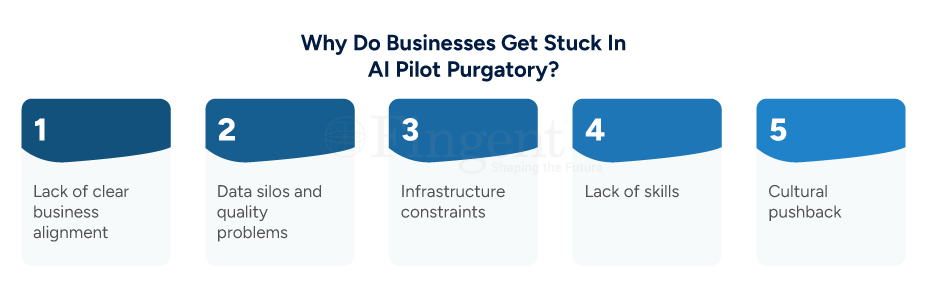
- Lack of clear business alignment: Many pilots show off new tech but fail to prove their value. Without measurable business outcomes, a pilot struggles to secure leadership support.
- Data silos and quality problems: AI hungers for good data. If data is disparate across departments, it can end up being inconsistent. This will hinder scaling.
- Infrastructure constraints: AI needs top-notch cloud infrastructure, data pipelines, and MLOps platforms to scale, but most companies ignore that.
- Lack of skills: To scale, data scientists won’t be enough. You require a team consisting of engineers, domain specialists, and a manager. They will keep an eye on the progress.
- Cultural pushback: Employees will push back against AI because they don’t believe in its decision, or they are afraid of being completely automated.
Eventually resulting in adoption barriers. To help your pilot escape purgatory, you need a complete enterprise AI strategy. This strategy should blend technology, governance, and cultural readiness.
Strategizing a Blueprint from Pilot to Production for AI Success
When you transition from pilot to production, the process isn’t done overnight. It is a structured journey that follows a blueprint. Here’s a blueprint to help your business scale AI from pilot to production.
1. Start with Business Value, Not Technology
Before coding for your project, determine high-impact business challenges that can be addressed with the help of AI. You can inquire:
- What are the most important processes in my company that can use automation? Are there any areas that can implement prediction to ease workflows?
- How should the project’s success be measured (KPIs, ROI, or time saved)?
This makes your AI for enterprise investment business-focused, not an experimental lab.
2. Build a Scalable Data Foundation
When your data is ready, AI success starts there. Construct central data lakes and maintain clean, labeled, and easily available data for departments. Invest in data governance frameworks such that data is of good quality and compliant.
3. Plan Scalability in Advance
Use reusable and modular blocks in building AI models on a strong foundation. Enforce MLOps practices that help integration, version control, and auto-deployment. This makes your AI a repeatable and scalable system rather than a one-time project.
4. Establish a Cross-Functional AI Taskforce
Scaling AI is an enterprise project, not an IT one. It involves more than one entity to make it work. So, you can bring in business leaders, data scientists, engineers, and compliance teams. Join forces towards a single purpose.
5. Use Ethical and Secure AI Practices
Enterprises need to focus on fairness and data privacy. To safeguard important data, establish an AI ethics board that looks carefully into policies that protect information. You can show accountability and regulatory compliance with XAI models.
6. Measure and Learn
Every successful enterprise AI strategy has ongoing feedback loops. Continuously track model performance, user adoption, and business results. Subsequently, retrain and improve models to keep pace with changing business objectives.
Strategize a Successful AI Journey for Your Enterprise. Assess AI Readiness, Spot Opportunities, and Integrate AI into Your Workflows.
Real-World Examples: Industry-Wise AI Scaling
Let’s explore how different industries are scaling AI in the enterprise effectively.
1. Banking and Financial Services
Banks lead with AI for enterprise when they use predictive analytics to detect fraud. They also use it to assess credit risk and personalize customer experiences.
Example: JPMorgan Chase’s COiN platform checks legal documents in seconds. This cuts down on spending for manual work and lowers operational costs.
Value: They experience all-round risk management and wiser decision-making.
2. Retail
AI for enterprise enables retailers to build buying experiences that are unique to their customers. It also streamlines supply chains.
Example: AI is employed by Walmart to predict customers’ demand. If their demand is altered, they modify stocks in real time.
Value: They get reduced wastage of products and improved customer service
3. Healthcare
Healthcare organizations gain from using AI in the enterprise. It helps with the before–diagnostics and predictive care. It also makes a notable difference to patient engagement.
Example: Diagnostic systems powered by deep learning can help analyze patient data and medical imaging in real time. The AI solution can be integrated with Electronic Health Records (EHRs) and lab databases. It also keeps HIPAA compliance and ethical transparency with enterprise AI strategy frameworks.
Value: Improved diagnostic accuracy, faster report turnaround time, and enhanced collaboration between clinicians and AI systems.
4. Manufacturing
AI in the enterprise changes manufacturing. It helps with predictive maintenance and quality control.
Example: Top players are using AI sensors that monitor machinery and prevent any breakdown.
Value: With this, they saved money, cut downtime, and achieved improved product consistency.
5. Nonprofits and the Public Sector
Non-profit organizations have greatly benefited from scaling AI implementations in enterprises for their workflows. It helps them to enhance engagement with donors and optimizes the way resources are utilized.
Example: UNICEF employs AI-driven data analytics to understand which regions require emergency aid.
Value: AI helped enhance their response time and effectively use their resources.
Common FAQs
Q. What is enterprise AI, and how is it different from general AI?
A. Enterprise AI is the use of artificial intelligence within large business settings. Enterprise AI is different from general AI. While general AI is used for consumer, as opposed to business, purposes and research, enterprise AI is designed to reinvent core business processes. Decision-making, prediction, automation, and customer interaction are just a few of them. It is about structured frameworks, governance models, and scalable infrastructure designed to enable the enterprise environment. Consider it as AI designed to deliver performance, compliance, and influence at scale.
Q. What is the timeline to deploy AI in a firm?
A.The timeline for implementing AI in the enterprise within a business relies on three key considerations: scope of business, data maturity, and complexity. A pilot would take 3–6 months, and a scaled deployment would take 12 to 24 months. Data-driven organizations with an adaptable culture can reduce the adoption time. Scaling is needed to plan extensively. That involves using AI to enhance processes and employee retraining. It can also establish MLOps for continuous improvement.
Q. Can small or medium enterprises scale AI successfully?
A. Yes! A size 500 fortune is not necessary to do business using AI for an enterprise. When an AI application is cloud-based, it allows SMEs to apply scalable analytics and automation. Begin small. Begin with one that has a high impact, such as sales forecasting or customer support automation. Pilot first, then roll it out incrementally. Strategic use of AI for enterprise has nothing to do with size but with clarity, intent, and action.
Q. How secure are enterprise AI implementations?
A. Enterprise AI rollouts put security at the top of the agenda. All serious AI systems abide by data protection legislation, like GDPR, and follow industry best practices. Security best practices include:
- Encryption of data in motion and rest
- Role-based access control implementation
- Conducting regular model audits
- Explainable AI (XAI) brings a whole new level of transparency
When done right, yes, enterprise AI can be secure. As secure as the systems it runs on. In fact, it can be even more secure because of its built-in anomaly detection and predictive monitoring.
How Can Fingent Help
At Fingent, we help businesses with their enterprise AI strategy. We guide them from ideas to full-scale implementation. We focus on finding real business value. We build data-driven roadmaps and facilitate responsible adoption across the enterprise. We help organizations:
- Move from pilot to production confidently
- Implement scalable and secure AI structures
- Make all transactions transparent and compliant
- Return quantifiable ROI with intelligent automation and analytics
Start your AI journey or move past pilot purgatory with Fingent. We can help you speed up transformation using AI for enterprise solutions that really work.
Think, Transform, and Evolve with AI
Scaling AI is not just about technology — it’s about transforming the way enterprises think, work, and evolve. Companies can avoid pilot purgatory by embracing an AI-based strategy that is robust and more powerful. Scalable infrastructure and an innovative culture are required. This can unlock the full potential of AI. The companies that succeed today will be leaders tomorrow.
Stay up to date on what's new
About the Author
Tony Joseph
Tony believes in building technology around processes, rather than building processes around technology. At Fingent, he specializes in custom software development, especially in analyzing processes, refining them, and then building technology around it. He works with clients on a daily basis to understand and analyze their operational structure, discover (and not invent) key improvement areas, and come up with technology solutions to deliver an efficient process. You can reach him at [email protected], Skype: tony_fingent
Featured Blogs
Stay up to date on
what's new
Talk To Our Experts
Automation handles the routine. Intelligence handles the remarkable.
With AI agent development more obtainable than at any time before, OpenAI AgentKit is revolutionizing the existing norms.
A year ago, creating an AI agent was like putting together a car from the ground up in your garage. Though excruciatingly slow and restricted to a select few specialists, it was feasible. Now, OpenAI AgentKit is shaking things up by making AI agent development more accessible than ever.
What Is OpenAI Agentkit and How Does It Work?
OpenAI AgentKit is an all-in-one platform to build, deploy, and optimize AI agents. With AgentKit, everything’s in one fully stocked kitchen—ready to cook. This isn’t just about simplicity. It’s about democratizing intelligence creation. When building AI agents becomes as intuitive as sketching a flowchart, suddenly, product managers, domain experts, and business analysts can contribute directly to agent design
The platform operates on four core building blocks that work together seamlessly:
Agent Builder: Visual Workflow Creation
Agent Builder functions like “Canva for building agents,” according to OpenAI CEO Sam Altman. This visual canvas lets developers drag and drop nodes to create multi-agent workflows without writing complex code.
Key features include:
- Drag-and-drop interface for workflow design
- Real-time preview runs before deployment
- Built-in versioning and collaboration tools
- Pre-built templates for common use cases
ChatKit: Embeddable User Interface
Think of ChatKit as the “face” your agent wears when meeting users. ChatKit ensures your agent presents professionally without requiring a fashion designer.
The toolkit handles complex features like streaming responses, thread management, and customizable branding automatically. The deeper value? It removes the “ugly prototype problem.”
Connector Registry: Data Integration Hub
The Connector Registry is OpenAI’s plug-and-play hub for data. It’s preloaded with Dropbox, Google Drive, SharePoint, and Teams. This centralized approach ensures security and gives administrators full control over how agents access organizational data.
Enhanced Evaluation Tools
OpenAI AgentKit introduces advanced evaluation capabilities that measure agent performance systematically:
- Datasets: Tools for creating and expanding agent test sets
- Trace Grading: End-to-end testing of complex workflows
- Automated Prompt Optimization: Self-improving prompts based on feedback
- Third-party Model Support: Testing capabilities beyond OpenAI models
These evaluation tools transform agent development from art to science.
How Can OpenAI AgentKit Help Developers Build AI Agents Faster?
There was a remarkable expansion in the AI agent market in 2025. A leap of 2.2 billion! Why?
The speed improvement is dramatic. Christina Huang, an OpenAI engineer, built an entire AI workflow and two agents live on stage in under eight minutes. What makes such speed possible? A Streamlined Development Process.
Traditional agent building was like being a one-person orchestra – you had to play every instrument yourself. OpenAI AgentKit gives you a full symphony where each section knows its part perfectly.
Traditional agent building required developers to:
- Create custom orchestration systems
- Build evaluation pipelines manually
- Develop frontend interfaces from scratch
Handle versioning and deployment separately
OpenAI AgentKit consolidates all these steps into a unified platform. When development cycles shrink from months to hours, experimentation becomes affordable. Teams can test wild ideas without betting the quarterly budget.
Unlock Quick Wins With AI! Integrate AI Into Your Existing Systems Effortlessly.
How to build AI agents with OpenAI AgentKit?
- Design: Use Agent Builder’s visual canvas to map workflows
- Connect: Link data sources through the Connector Registry
- Test: Run evaluations with built-in testing tools
- Deploy: Embed ChatKit interface into applications
- Optimize: Automate feedback. Measure. Improve nonstop.
What Are the Pros and Cons of OpenAI Agentkit?
As you already know, every powerful tool is a double-edged sword. OpenAI AgentKit is no exception.
Advantages:
- Speed and Simplicity: The visual design cuts development time from weeks to hours. It’s like a universal translator fluent in both business and tech.
- Enterprise-Ready: All agents’ data access can be audited and managed by administrators. This isn’t just about security – it’s about building the institutional trust that enables widespread AI adoption.
- Comprehensive Platform: Everything needed for agent development lives in one place. No more app-switching fatigue or losing context between seventeen different development tools.
Limitations and Challenges:
- OpenAI Ecosystem Lock-in: OpenAI AgentKit primarily works with OpenAI models, limiting flexibility for teams wanting multi-vendor approaches.
- Beta Limitations: Essential elements such as Agent Builder and Connector Registry are still in beta, indicating reduced stability and unfinished features.
- Pricing Uncertainty: Usage-based pricing makes costs unpredictable. Simple tasks can trigger complex multi-step actions that rapidly increase token consumption.
- Export Restrictions: Visual workflows can export to code, but once MCP servers are added, export functionality disappears entirely. It’s like being able to take photos everywhere except the places you most want to remember.
OpenAI AgentKit vs N8N: The Better AI Workflow Builder
You may wonder how to choose between OpenAI AgentKit and N8N. Both are excellent tools. But they excel in completely different scenarios. The complexity difference is like comparing a traffic light (N8N) to a traffic cop who can handle unexpected situations (OpenAI AgentKit). Both direct traffic, but only one can adapt to unique circumstances.
1. Core Philosophy Differences
N8N operates as a general-purpose workflow automation platform. It’s the digital equivalent of a master craftsman’s workshop – every tool has its place, and skilled hands can build almost anything.
OpenAI AgentKit focuses specifically on building intelligent reasoning systems. Rather than just connecting apps, it creates agents that can plan, act, and evaluate their own performance.
The philosophical difference is profound: N8N automates what you already know how to do. OpenAI AgentKit enables agents to figure out what they should do.
2. Architecture Comparison
N8N workflows follow deterministic chains where each node represents a single action. OpenAI AgentKit replaces this with dynamic agents powered by large language models. These agents decide what to do next, invoke tools autonomously, and can even spawn sub-agents to handle complex problems.
3.Integration Capabilities
N8N’s strength: Connects to hundreds of APIs and services.
On the other hand, OpenAI AgentKit ‘s approach is Narrower. But deeper integration focused on the OpenAI ecosystem. The Connector Registry prioritizes security, versioning, and controlled access over quantity.
Think of it this way: N8N is a polyglot who speaks many languages conversationally. OpenAI AgentKit speaks fewer languages but with the fluency of a native speaker.
Choose N8N when:
- Building traditional automation workflows
- Connecting multiple existing systems
- Need broad API compatibility
- Want open-source flexibility
Choose OpenAI AgentKit when:
- Building intelligent decision-making systems
- Need agents that can reason and adapt
- Require built-in evaluation and safety features
- Want integrated chat interfaces
Why Human-in-the-Loop Matters
“Trust but verify” works great with humans. With AI, it’s verify then trust, then verify again.
OpenAI AgentKit includes built-in guardrails, but they work best when combined with human oversight. Agents operate without true understanding – they simulate reasoning but can’t evaluate risk or take accountability for decisions.
Common AI agent failures include:
- Hallucinated actions: Making up nonexistent commands or resource IDs
- Misused permissions: Acting outside intended scope due to vague prompts
- Overreach: Attempting to approve their own access or bypass restrictions
- Lack of traceability: No proper record of authorized actions
OpenAI AgentKit supports several human oversight patterns:
- Approval Gates: Configure agents to pause before executing high-risk actions.
- Confidence Thresholds: Set minimum confidence levels for autonomous action. This is the AI equivalent of “when in doubt, ask for help.”
- Risk-Based Routing: Classify agent actions by risk level. Route high-risk actions through human approval automatically. Think of it as an intelligent triage system that knows when to call the doctor.
- Real-time Monitoring: Use OpenAI AgentKit ‘s trace grading to monitor agent reasoning in real-time. Humans can intervene when patterns look concerning.
Explore How Fingent Can Help Your Business Drive A Smooth AI Implementation Journey
Best Practices for Safe Agent Deployment
The goal isn’t to slow down agents but to ensure accountability. Well-designed human oversight actually increases trust and adoption by reducing fear of AI mistakes.
- Start Conservative: Begin with high human oversight and gradually increase agent autonomy as trust builds. It’s comparable to instructing someone on driving – you begin in vacant parking areas, not on the highway.
- Clear Boundaries: Define explicit limits on what agents can and cannot do. Use OpenAI AgentKit ‘s guardrails to enforce these boundaries automatically.
- Audit Trails: Keep thorough records of every agent’s activities and all human approvals. OpenAI AgentKit ‘s built-in tracing supports this requirement.
- Regular Review: Examine agent effectiveness and identify failure trends on a weekly basis. Use these insights to refine oversight rules and improve safety.
How Can Fingent Help
The best approach combines OpenAI AgentKit ‘s capabilities with enterprise-grade security and scalability. Every industry has unique challenges that generic AI solutions can’t address. Fingent brings vertical expertise that transforms AI adoption from a general-purpose into a specialized solution for your specific business context.
Companies choosing Fingent for AI implementation benefit from reduced project risk, faster deployment, and ongoing support that ensures long-term success.
We are equipped to handle:
- Multi-agent orchestration for complex business processes
- Integration with SAP, legacy systems, and cloud platforms
- Compliance with industry regulations and security standards
- Ongoing optimization and performance monitoring
In the world of AI implementation, there are two types of companies: those that learned from others’ mistakes and those that made the mistakes themselves. Fingent helps you join the first group. Contact us now!
Stay up to date on what's new
About the Author
Tony Joseph
Tony believes in building technology around processes, rather than building processes around technology. At Fingent, he specializes in custom software development, especially in analyzing processes, refining them, and then building technology around it. He works with clients on a daily basis to understand and analyze their operational structure, discover (and not invent) key improvement areas, and come up with technology solutions to deliver an efficient process. You can reach him at [email protected], Skype: tony_fingent
Featured Blogs
Stay up to date on
what's new
Talk To Our Experts
The field of software development is changing. The shiny new toy that transformed software development and delivery was once traditional DevOps. It is currently changing into something more intelligent, quicker, and astonishingly futuristic. That’s AI-driven DevOps! It is where your development pipeline essentially operates on autopilot, and automation gets a brain.
This change cannot be ignored. It is anticipated that by the end of 2025, three out of four businesses will employ AI-powered DevOps tools. It’s not just about speeding up the development process or cutting costs. It’s about reimagining what’s possible across the entire software lifecycle.
Let’s understand this power combo so you can tap into it.
It’s Time to Modernize Your Software Development Journey with AIDiscover How Our Experts Can Help
Understanding the Intelligent Evolution of AI-Driven DevOps
AI-driven DevOps elevates the software lifecycle at every stage. Planning. Coding. Testing. Deployment. Monitoring. All of it.
Picture this. Traditional DevOps is a team of skilled drivers on a busy highway. AI-driven DevOps is more like a fleet of self-driving cars. They predict traffic. Avoid accidents. Reroute in real time. Meanwhile, the drivers focus on strategy—not steering.
What sets it apart?
- Pattern intelligence: Learns from past data and real-time signals and spots trends and anomalies instantly.
- Predictive power: Predicts bottlenecks, bugs, and failures before they hit production.
- Continuous optimization: Fine-tunes processes on the fly. Keeps delivery pipelines running at peak speed.
How AI Helps in DevOps
AI transforms DevOps from compliance to critical thinking. Conventional automation is responsive: When X occurs, perform Y. Effective, yet constrained. AI works differently. It scans massive datasets. Detects patterns. Learns. Adapts. Improves. And it’s already happening. Around 60% of companies utilize AI-driven automation within their DevOps workflows. The payoff? Fewer errors. Faster releases. Teams with more time to innovate, less time firefighting.
In practice, that means AI can:
- Predict failures before they break production.
- Automate complex, repetitive work—no babysitting required.
- Analyze performance data and recommend smarter choices in real time.
- Continuously improve builds and deployments with every cycle.
Are there more benefits of AI in DevOps automation?
Benefits of Using AI in DevOps Automation
AI-driven DevOps is not about trimming minutes off build times. It’s about rethinking how software gets delivered. Faster. Smarter. Safer. With less friction. And it shows:
The AI DevOps market is expected to grow at a 19.95% CAGR and reach $81.14 billion by 2033.
It is anticipated that three out of four businesses will employ DevOps tools driven by AI by 2025. Here’s how the impact shows up:
1. Speed and Efficiency: AI supercharges delivery velocity.
- Teams using AI are about 30% more likely to be rated as highly effective
- Build times drop by up to 30%
- AI-driven testing catches and fixes issues about 25% faster than traditional methods
2. Quality and Reliability: AI doesn’t just make things faster — it makes them sharper.
- Predictive analytics spots failures before users even notice
- Intelligent code analysis uncovers hidden vulnerabilities and performance bottlenecks
- Certain fields may see a 35% boost in returns after adopting AI-powered automation
3. Cost Optimization: AI also trims the fat.
- Optimized resource allocation slashes infrastructure costs
- Less manual effort reduces operational expenses
- Avoiding outages saves hefty firefighting budgets
The numbers don’t whisper, they shout. Generative AI in DevOps is set to rocket from $942.5 million in 2022 to $22.1 billion by 2032, growing at 38.2% CAGR. It is a clear proof that businesses see AI automation as a serious ROI engine.
4. Stronger Security: AI turns security from a patchwork defense into a continuous shield.
- Always-on vulnerability scanning
- Automated threat detection
- Predictive security analytics
That means fewer breaches. Fewer compliance nightmares. Far less scrambling after the fact.
5. Predictive Superpower: Perhaps the biggest leap? AI makes DevOps proactive.
- It predicts system failures before they happen
- Forecasts resource spikes before they choke performance
- Flags bottlenecks before they slow releases
Instead of reacting to fires, teams can prevent them entirely — and focus on building what’s next.
AI-Driven DevOps Tools — The Technology Powering Transformation
AI-driven DevOps isn’t just an idea. It’s already here, humming quietly behind the scenes in some of the most powerful tools reshaping how software gets built and shipped. Each of these tools tackles a specific pain point — from code quality and security to performance optimization and incident response. And they’re only the opening act.
Artificial Intelligence is turning the DevOps toolchain into something alive: predictive, adaptive, and allergic to bottlenecks. These platforms don’t just automate; they evolve. Think of them as power tools with a brain. They are faster, sharper, and smart enough not to cut through the workbench.
Here’s a quick tour of the standouts:
-
- GitHub Copilot
Acts like an AI coding partner. It generates and completes code in real time, integrates with popular IDEs and CI/CD pipelines, and helps developers write cleaner code faster — with fewer bugs sneaking through. - AWS CodeGuru
A code critic that never sleeps. It uses machine learning to review code automatically.
To spot bottlenecks before they slow you down. To flag security risks the moment they appear. To suggest sharp optimizations before problems snowball. - Datadog
Turns monitoring into foresight. Its AI engines detect anomalies, run root cause analysis, and link signals from multiple sources — helping teams solve issues before users ever feel the glitch. - Azure DevOps
Supercharges Microsoft’s platform with AI muscle. It generates intelligent test cases, predicts deployment risks, and recommends optimizations to make releases faster and safer. - CircleCI
Makes pipelines feel like clockwork. It applies machine learning to schedule jobs smartly, balance resources, and cut down execution times while surfacing hidden bottlenecks. - Splunk
Watches everything, all at once. AI-driven analytics don’t just spot trouble. It foresees it, responds to it, and eliminates it before it expands.
- GitHub Copilot
Take a Look at How Fingent Is Enabling Smarter, Faster & Better Software Development With AI
How Is AI Shaping the Future of DevOps? — New Trends and Developments
AI is no longer just supporting DevOps. It’s reshaping it from the ground up. The trends taking shape in 2025 show a clear direction: development environments that think for themselves — intelligent, adaptive, and capable of fixing problems before they even surface.
The numbers leave no doubt. With the AI DevOps market expected to reach $8.61 billion by 2029, growing at 26.6% annually, this shift is far from temporary. It marks a new era in how software is built, secured, and delivered.
Let’s take a look at the future trends in AI-Driven DevOps. Here’s where the shift is headed:
1. Autonomous operations and self-healing systems: Picture systems that fix themselves before anyone even notices something’s wrong. AI-driven self-healing environments can detect, diagnose, and resolve issues on their own — and get smarter every time they do it. It’s a leap from firefighting problems to quietly preventing them.
2. Predictive analytics and intelligent forecasting: Machine learning models are moving beyond hindsight. They can predict:
- When systems might fail
- When will new features be needed
- How much infrastructure is needed to scale
- Even where security cracks could appear.
3. Conversational DevOps interfaces: DevOps tools are learning to speak human. Thanks to natural language processing, teams can ask questions in plain language instead of wrestling with dashboards and queries. It makes DevOps capabilities accessible far beyond the core engineering crew.
4. AI-enhanced security integration: Security is shifting left — and getting sharper. DevSecOps practices powered by AI can detect vulnerabilities instantly, simulate threats as they arise, and modify protections on the fly. The result: stronger defenses without slowing down delivery.
5. Cross-platform intelligence: AI is finally linking scattered tools and data silos together. It uses machine learning to deliver automated code reviews. It also spots bottlenecks and flags security risks. Plus, it suggests precise optimizations before small issues snowball.
Upcoming Developments in AI-Powered DevOps
Generative AI is stretching beyond just code completion. It’s beginning to draft test cases, spin up infrastructure, and even generate technical documentation. The result? Teams can deliver at high velocity without sacrificing quality.
Edge Computing Optimization
Apps are moving closer to users. AI-driven DevOps tools now handle sprawling edge deployments. They automate load balancing, predict traffic, and shift resources in real time by geography.
Continuous Intelligence
AI systems that never stop learning. They tweak configs, rebalance workloads, and improve reliability — instantly, without human input.
Collaborative AI Agents
Not one tool, but many. Specialized AI agents share insights and coordinate tasks. Together, they work like an orchestra.
And don’t overlook sustainability. AI is helping DevOps teams cut energy use, optimize cloud resources, and reduce waste. It’s good for the planet — and equally good for the bottom line.
Success Powered by AI Can Be Yours
To thrive in this fast-shifting landscape, businesses need partners who understand where DevOps is today and where it’s racing tomorrow. Because this shift isn’t only technical — it’s cultural. It takes sharper processes. Not just that, but stronger skills and the guts to evolve alongside the tech.
The truth? Not many can pull this alone. However, the right partner can fast-track adoption and help you dodge costly missteps to keep you ahead of the curve.
AI in DevOps is a moving frontier. The leaders of tomorrow will be the ones who start now — with clear strategy, trusted allies, and the drive to embed AI into their DNA.
As 2026 approaches, AI will keep pushing DevOps into uncharted territory. The question isn’t if you’ll embrace it. It’s how fast and how boldly you’ll lead the charge.
Stay up to date on what's new
About the Author
Tony Joseph
Tony believes in building technology around processes, rather than building processes around technology. At Fingent, he specializes in custom software development, especially in analyzing processes, refining them, and then building technology around it. He works with clients on a daily basis to understand and analyze their operational structure, discover (and not invent) key improvement areas, and come up with technology solutions to deliver an efficient process. You can reach him at [email protected], Skype: tony_fingent
Featured Blogs
Stay up to date on
what's new
Talk To Our Experts