Category: Technology
Testing Types And Strategies: Choosing A Testing Method
Understanding the basics of software testing is crucial for developers and quality assurance specialists equally. To deploy a better software and to find bugs that affect application development, it is important to learn about the different types of software testing.
Types Of Software Testing
Testing is a process of executing a software program to find errors in the application being developed. Testing is critical for deploying error-free software programs. Each type of testing has its advantages and benefits. Software testing is broadly categorized into two types; Functional and Non-Functional testing.
Functional Testing Versus Non-Functional Testing
Functional Testing is used to verify the functions of a software application according to the requirements specification. Functional testing mainly involves black box testing and does not depend on the source code of the application.
Functional Testing involves checking User Interface, Database, APIs, Client/Server applications as well as security and functionality of the software under test. Functional testing can be done either manually or by making use of automation.
The various types of Functional Testing include the following:
- Unit Testing
- Integration Testing
- System Testing
- Sanity Testing
- Smoke Testing
- Interface Testing
- Regression Testing
- Beta/Acceptance Testing
Non-Functional Testing is done to check the non-functional aspects such as performance, usability, reliability, and so on of the application under test.
The various types of Non-Functional Testing include the following:
- Performance Testing
- Load Testing
- Stress Testing
- Volume Testing
- Security Testing
- Compatibility Testing
- Install Testing
- Recovery Testing
- Reliability Testing
- Usability Testing
- Compliance Testing
- Localization Testing
The 7 Most Common Types Of Software Testing
Type 1: Black-box Testing
Black-box testing is applied to verify the functionality of the software by just focusing on the various inputs and outputs of the application rather than going deep into its internal structure, design, or implementation. Black-box testing is performed from the user’s perspective.
Type 2: White-Box Testing
The White-Box software testing strategy tests an application with access to the actual source code as well as focusing on the internal structure, design, and implementation. This testing method is known by different names such as Open Box testing, Clear Box Testing, Glass Box Testing, Transparent Box Testing, Code-Based Testing, and Structural Testing. White-box testing offers the advantage of rapid problem and bug spotting.
Type 3: Acceptance Testing
Acceptance Testing is a QA (Quality Assurance) process that determines to what extent a software attains the end user’s approval. Also known as UAT (User Acceptance Testing) or system testing, it can be testing the usability or the functionality of the system or even both. Depending on the enterprise, acceptance testing can take the form of either end-user testing, beta testing, application testing, or field testing. The advantage of acceptance testing is that usability issues can be discovered and fixed at an early stage.
Related Reading: Quality Assurance in Software Testing – Past, Present & Future
Type 4: Automated Testing
Automated testing is a method in which specialized tools are utilized to control the execution of various tests and the verification of the results is automated. This type of testing compares the actual results against the expected results. The advantage of automated testing is that it avoids the need for running through test cases manually, which is both tedious and error-prone, especially while working in an agile environment.
Type 5: Regression Testing
Regression testing is a testing practice that verifies whether the system is still working fine, even after incremental development in the application. Most automated tests performed are regression tests. It ensures that any change in the source code does not have any adverse effects on the application.
Type 6: Functional Testing
Functional Testing tests for the actual functionality of the software. This type of testing focuses on the results of the system processing and not on how the processing takes place. During functional testing, the internal structure of the system is not known to the tester.
Type 7: Exploratory Testing
As the name indicates, Exploratory testing is all about exploring the application where the tester is constantly on the lookout for what and where to test. This approach is applied in cases where there is no or poor documentation and when there is limited time left for the testing process to be completed.
Related Reading: A Winning Mobile Testing Strategy: The Way to Go
All the methods mentioned above are only some of the most common options of software testing. The list is huge and specific methods are adopted by development vendors based on the project requirements. Sometimes, the terminologies used by each organization to define a testing method also differ from one another. However, the concept remains the same. Depending on the project requirement and scope variations, the testing type, processes, and implementation strategies keep changing.
Like to know more about Fingent’s expertise in custom software development and testing? Get in touch with our expert.
Stay up to date on what's new

About the Author

Featured Blogs








Stay up to date on
what's new



Talk To Our Experts
Understanding the Importance of Times Series Forecasting
To be able to see the future. Wouldn’t that be wonderful! We probably will get there someday, but time series forecasting gets you close. It gives you the ability to “see” ahead of time and succeed in your business. In this blog, we will look at what time series forecasting is, how machine learning helps in investigating time-series data, and explore a few guiding principles and see how it can benefit your business.
What Is Time Series Forecasting?
The collection of data at regular intervals is called a time series. Time series forecasting is a technique in machine learning, which analyzes data and the sequence of time to predict future events. This technique provides near accurate assumptions about future trends based on historical time-series data.
The book Time Series Analysis: With Applications in R describes the twofold purpose of time series analysis, which is “to understand or model the stochastic mechanism that gives rise to an observed series and to predict or forecast the future values of a series based on the history of that series.”
Time series allows you to analyze major patterns such as trends, seasonality, cyclicity, and irregularity. Time series analysis is used for various applications such as stock market analysis, pattern recognition, earthquake prediction, economic forecasting, census analysis and so on.
Related Reading: Can Machine Learning Predict And Prevent Fraudsters?
Four Guiding Principles for Success in Time Series Forecasting
1. Understand the Different Time Series Patterns
Time series includes trend cycles and seasonality. Unfortunately, many confuse seasonal behavior with cyclic behavior. To avoid confusion, let’s understand what they are:
- Trend: An increase or decrease in data over a period of time is called a trend. They could be deterministic, which provides an underlying rationale, or stochastic, which is a random feature of time series.
- Seasonal: Oftentimes, seasonality is of a fixed and known frequency. When a time series is affected by seasonal factors like the time of the year or the day of the week, a seasonal pattern occurs.
- Cyclic: When a data exhibit fluctuates, a cycle occurs. But unlike seasonal, it is not of a fixed frequency.
2. Use Features Carefully
It is important to use features carefully, especially when their future real values are unclear. However, if the features are predictable or have patterns you will be able to build a forecast model based on them. Using predicted values as features is risky as it can cause substantial errors and provide a biased result. Properties of a time series and time-related features that can be calculated could be added to time series models. Mistakes in handle features could easily get compounded resulting in extremely skewed results, so extreme caution is in order.
Related Reading: Machine Learning Vs Deep Learning: Statistical Models That Redefine Business
3. Be Prepared to Handle Smaller Time Series
Don’t be quick to dismiss smaller time series as a drawback. All time-related datasets are useful in time series forecasting. A smaller dataset wouldn’t require external memory for your computer, which makes it easier to analyze the entire dataset and make plots that could be analyzed graphically.
4. Choose The Right Resolution
Having a clear idea of the objectives of your analysis will help yield better results. It will reduce the risk of propagating the error to the total. An unbiased model’s residuals would either be zero or close to zero. A white noise series is expected to have all autocorrelations close to zero. In other words, choosing the right resolution will also eliminate noisy data that makes modeling difficult.
Types of Time Series Data and Forecasts
Times series basically deals with three types of data – time-series data, cross-sectional data, and pooled data, which is a combination of time series data and cross-sectional data. Large amounts of data give you the opportunity for exploratory data analysis, model fidelity and model testing and tuning. The question you could ask yourself is, how much data is available and how much data am I able to collect?
There are different types of forecasting that could be applied depending on the time horizon. They are near-future, medium-future and long-term future predictions. Think carefully about which time horizon prediction you need.
Organizations should be able to decide which forecast works best for their firm. A rolling forecast will re-forecast the next twelve months, whereas the traditional, or a static annual forecast creates new forecasts towards the end of the year. Think about whether you want your forecasts updated regularly or you need a more static approach.
By allowing you to harness down-sampling and up-sampling data, the concept of temporal hierarchies can mitigate modeling uncertainty. It is important to ask yourself, what temporal frequencies require forecasts?
Keep Up With Time
As businesses grow more dynamic, forecasting will get increasingly harder because of the increasing amount of data needed to build the Time Series Forecasting model. Still, implementing the principles outlined in this blog will help your organization be better equipped for success. If you have any questions on how to do this, just drop us a message.
Stay up to date on what's new
About the Author

Featured Blogs
Stay up to date on
what's new
Talk To Our Experts
A Look Into The Cloud Computing Trends for 2024
“Fewer, but larger, public cloud platform providers and a maturing SaaS ecosystem will dominate enterprise cloud spending” – The Public Cloud Market Outlook, 2019 To 2022 Forrester Report.
Organizations are recognizing the importance of cloud computing and are adopting the technology steadily over the past few years. With recent technological advancements creating new excitement around the idea of cloud computing, the adoption is now skyrocketing!
According to Gartner, the worldwide public cloud services market will gain a positive growth of 17% in 2020. That is an increase from $227.8 billion in 2019 to 266.4 billion in 2020. This makes it vital for organizations to identify the forces that will shape the cloud computing market this year. This article will help you with this as we discuss five specific trends that will transform cloud computing in 2024.
Why Keep Up with Cloud Computing?
Aggregated mostly around Amazon, Google and Microsoft, the cloud market underwent a profound change in the recent past. The pace for cloud adoption and innovation will inevitably continue to accelerate across industries and regions providing new opportunities, and new levels of quality and efficiency. The question you must be asking is: What is in store for the cloud computing market and how should you prepare for it in 2024?
1. Shifting Gears from Multi-Cloud to Hybrid-Cloud
2019 has seen how organizations routinely deployed workloads across multiple clouds. In order to achieve expected outcomes in business, organizations will have to adopt the right and appropriate cloud strategy. A hybrid cloud computing structure uses an orchestration of local servers, private cloud, and third-party public cloud services to achieve desired results. According to The RightScale 2019 State of The Cloud Report, the hybrid cloud adoption rate was estimated at 58% last year.
In this transitional era, the hybrid-cloud will become an integral part of the long-term vision for industries on how they will meet their needs. It can provide a seamless experience to enterprises and help them solve complicated challenges around latency. Customers too won’t have to deal with two different pieces of infrastructure; on-premise and public cloud. Thus, the shift to a hybrid-cloud will make things easier for both the organization as well as the customers.
Related Reading: Hybrid Cloud Infrastructure: How It Benefits Your Business
2. Serverless Computing
“Serverless computation is going to fundamentally change not only the economics of what is back-end computing, but it’s going to be the core of the future of distributed computing,” says Satya Nadella, Chief Executive Officer at Microsoft. This comment clearly shows what the future of serverless computing is.
Serverless computing ensures that developers must only focus on their core product without worrying about operating and managing the servers. This is an advantage that moves enterprises to adopt serverless computing. According to Gartner, more than 20% of global enterprises will deploy serverless computing technologies by 2020.
3. Cloud Security will Become Paramount
Many organizations feel that cloud computing could pose security issues. They might have concerns about regulatory and privacy issues, along with compliance and governance issues. Consequently, security features of public data have become the key focus in coming years. It will not be just about access controls or policy creations. Aspects such as data encryption, cloud workload security, and threat intelligence will gain priority as part of an organization’s security measures. In future we will see security features such as privileged access management and shared responsibility models.
According to Kristin Davis of 42crunch.com, 2019 became the year where API Security threats came to notice. As the year progressed, we have observed a lot of high profile API breaches and vulnerabilities, including the ones at Facebook, Amazon Ring, GitHub, Cisco, Kubernetes, Uber, Verizon, etc. In their October 2019 report, Gartner estimates that by 2021, exposed APIs will form a larger attack surface than UIs for 90% of web-enabled applications. In coming years, we expect API security getting to the top of the agenda of a chief information security officer. Also, DevOps tools and processes are expanding to DevSecOps, to lower the risks and implement security by design.
Mihai Corbuleac, Senior IT Consultant at StratusPointIT predicts security acquisitions to make more headlines in 2020, it has made the headlines over the last year. It is because all cloud companies that can’t develop in-house modern security solutions have to look to buy them.
Related Reading: How Secure is Your Business in a Multi-Cloud Environment
4. Digital Natives
As the workforce evolves, the expectations of the workers will definitely increase. Those joining the workforce will be well-acquainted with cloud computing and its advantages. Such workers are called ‘digital natives.’
Organizations will have two sets of workers as a consequence: those who have adopted digital best practices and those who have not. This would call for a need to train the second set of workers, which is called ‘reverse mentoring.’ The adoption of cloud computing and related technologies will enable organizations to integrate both the workgroups into one unified workforce.
5. Quantum Computing
Quantum computing requires massive hardware developments. This opens up the potential to exponentially increase the efficiency of computers in coming years. It allows computers and their servers to process more rapidly than ever before. Quantum computing also has the potential to limit energy consumption. It requires lesser consumption of electricity while generating massive amounts of computing energy. Best of all, quantum computing can have a positive effect on the environment and the economy.
Are You Keeping Up the Pace?
Whether you are a large organization or a small one, cloud computing will remain a compelling, fast-moving force in future. Adopting cloud computing technology will enable organizations to mitigate risks and capitalize on opportunities. Ultimately, organizations will have a number of decisions to make with regards to cloud computing. It will include deciding when and how to adopt cloud computing technology, as well as for deciding on the specific model they would like to adopt.
Related Reading: Cloud Migration: Essentials to Know Before You Jump on the Bandwagon
With years of experience in helping clients transform their business by the power of the cloud, Fingent can help you understand and implement this technology seamlessly in your business. Contact us to know more.
Stay up to date on what's new
About the Author

Featured Blogs
Stay up to date on
what's new
Talk To Our Experts
Every new project in an organization goes through an analysis phase. The information collected during the analysis forms the backbone for critical decisions with regards to the complexity, resources, frameworks, time schedule, cost, etc. Over the years, there have been several techniques to simplify the project analysis phase, but most of them still remain inadequate when considering the accuracy of the outcome. Even clearly defined projects can fall out during the later stages without an accurate analysis methodology in place.
Mitigation of risk in software projects turns out to be of prime importance. Usually, it starts with delineating precise measurements concerning the scope, performance, duration, quality and other key efficiency metrics of the project. Advanced analysis techniques like Function Point Analysis (FPA) bring a clear picture regarding each of these metrics, chiefly related to the project scope, staffing, cost and time, which helps in the management, control, customization of software development right from its initial planning phases.
Function Point Analysis is a standardized method used commonly as an estimation technique in software engineering. First defined by Allan J. Albrecht in 1979 at IBM, Function Point Analysis, has since then underwent several modifications, mainly by the International Function Point Users Group (IFPUG).
What is Function Point Analysis?
In simple words, FPA is a technique used to measure software requirements based on the different functions that the requirement can be split into. Each function is assigned with some points based on the FPA rules and then these points are summarized using the FPA formula. The final figure shows the total man-hours required to achieve the complete requirement.
Components of Function Point Analysis
Based on the interaction of the system components internally and with external users, applications, etc they are categorized into five types:
- External Inputs (EI): This is the process of capturing inputs from users like control information or business information and store it as internal/external logic database files.
- External Outputs (EO): This is the process of sending out data to external users or systems. The data might be directly grabbed from database files or might undergo some system-level processing.
- Inquiries (EQ): This process includes both input and output components. The data is then processed to extract relevant information from internal/external database files.
- Internal Logic File (ILF): This is the set of data present within the system. The majority of the data will be interrelated and are captured via the inputs received from the external sources.
- External Logic File (ELF): This is the set of data from external resources or external applications. The majority of the data from the external resource is used by the system for reference purposes.
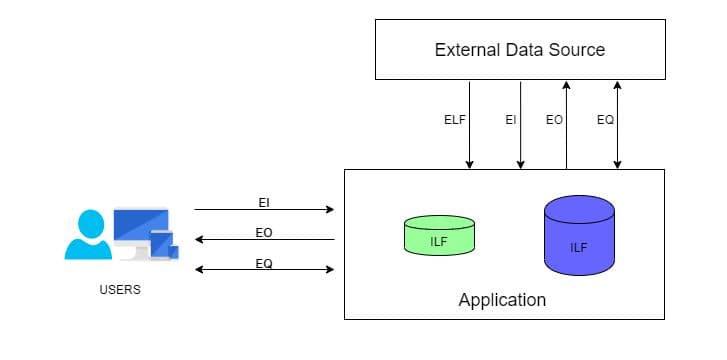 Source: https://bit.ly/2N2KFhy
Below are some abbreviations which need to be understood to know the logic in-depth:
Data Element Type (DET): This can be defined as a single, unique, non-repetitive data field.
Record Element Type (RET): This can be defined as a group of DETs. In a more generic way, we can call this a table of data fields.
File Type Referenced (FTR): This can be defined as a file type referenced by a transaction (Input/Output/Inquiry). This can be either an Internal logic file or an external interface file.
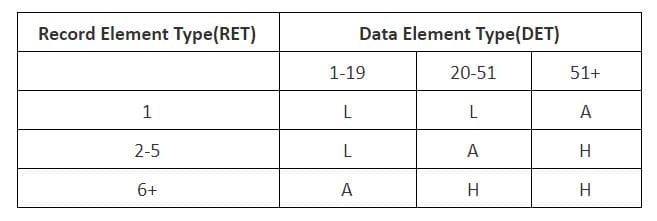
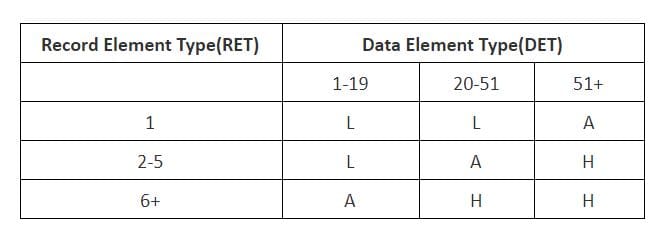
Based on the number of DETs and RETs, all the five components of FPA are classified into High, Average and Low complexity based on the below table.
For Internal Logical Files
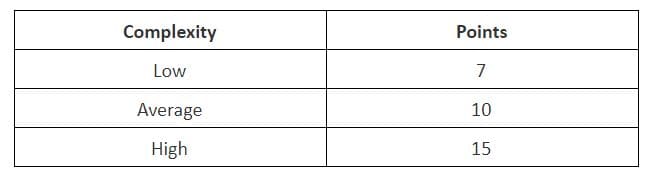
And based on the complexity, the FPA points are calculated
For External Logical Files
And based on the complexity, the FPA points are calculated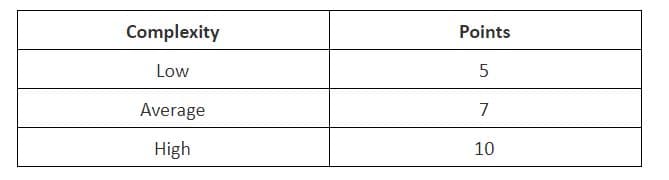
For External Input Transactions
As the External input is a Transactional type, the complexity is judged based on FTR instead of RET.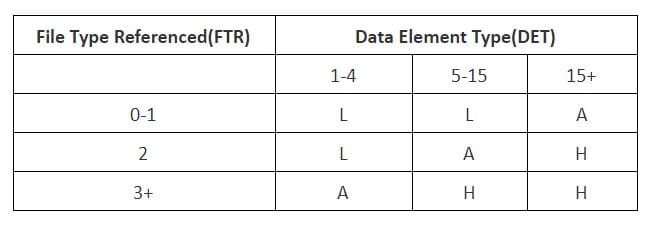
And based on the complexity, the FPA points are calculated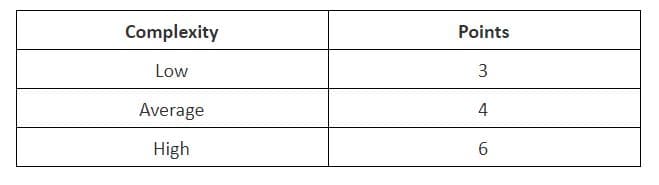
For External Output Transactions
As External Output is a Transactional type the complexity is judged based on FTR instead of RET.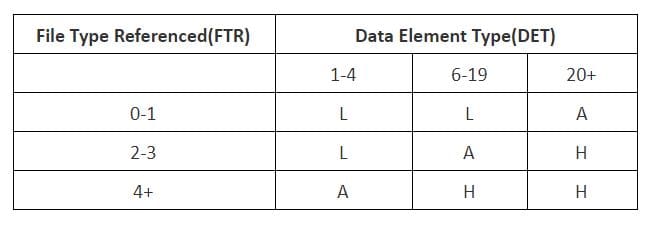
And based on the complexity, the FPA points are calculated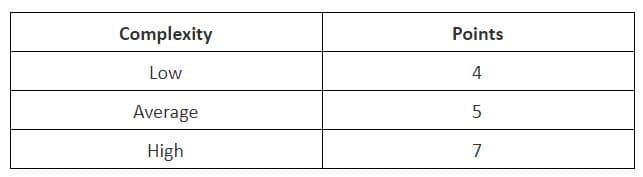
For Inquiries
As Inquiries is a Transactional type the complexity is judged based on FTR instead of RET.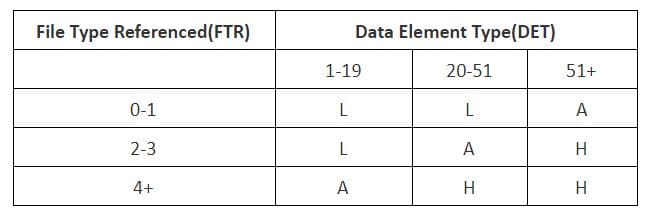
And based on the complexity, the FPA points are calculated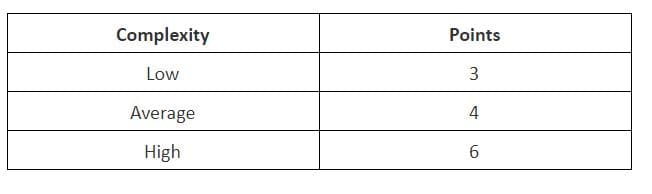
As we now have the reference chart to find the complexity of each variety of functions discovered in the system and that we also have the Points that should be assigned based on the complexity of each component. We can now look into the calculation.
Steps to Count the Function Points
Below are the steps used in counting the function points of a system.
1. Type of count: The very first step of this process is to determine the type of function count. There are 3 types of function point (FP) count.
- Development Project FP Count: This measures the functions that are directly involved in the development of the final system. This would include all the phases of the project from requirements gathering to the first installation.
- Enhancement Project FP Count: This measures the functions involved in the modifications brought in the system. That is the changes made to the system after production.
- Application FP count: This measures the functions involved in the final deliverable excluding the effort of already existing functions that may have existed.
2. Scope and Boundary of the Count: In the second step, the scope and boundary of the functions are identified. Boundary indicates the border between the application being measured and the external applications. Scope can be decided with the help of data screens, reports, and files.
3. Unadjusted Function Point Count: This is the main step of this process where all the function points produced from the above FPA components (External Inputs, External Output, Internal Logic files, External Logic files, Inquiries) are added together and labeled as unadjusted function point count.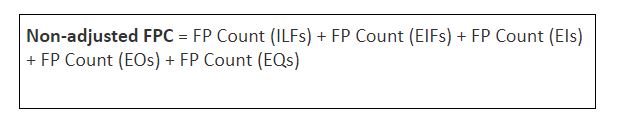
4. Value Adjustment Factor: In this step the value adjustment factor is determined. VAF contains 14 General system characteristics(GSC) of the system or application that defines the types of application characteristics and is rated on a scale of 0 to 5. The sum of all the 14 GSC rates are calculated to give out a mathematical value and is labeled as Total Degree Influence(TDI). TDI is used in the calculation of VAF and its value may vary from 0 to 35.
Below are the 14 GSCs listed and the mathematical formula for calculating the VAF.
- Data communications
- Distributed data processing
- Performance
- Heavily used configuration
- Transaction rate
- On-Line data entry
- End-user efficiency
- On-Line update
- Complex processing
- Reusability
- Installation ease
- Operational ease
- Facilitate change
- Multiple sites

Once the unadjusted function point and value adjustment factor is calculated, the Adjusted Functional point count is found out using the two values. This is done with the help of the following formula. 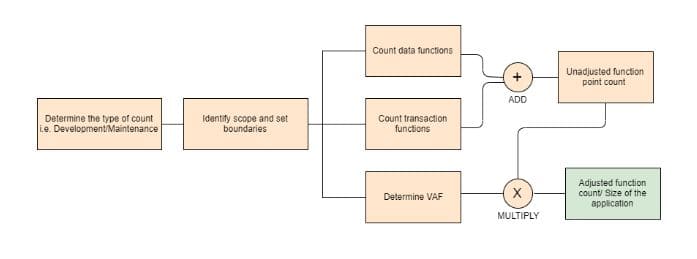

The Adjusted FPC is then multiplied with a numeric value, which is the effort based on the technology. Some of the examples are below.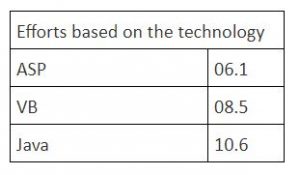
If the technology selected for a particular requirement is Java, then the formula to calculate the final hours are as follows:
FPC = (Non-adjusted FPC*VAF) * 10.6
This will give the total hours of effort required to achieve the requirement under analysis.
Merits of Function Point Analysis
- FPA measures the size of the solution instead of the size of the problem
- It helps in estimating overall project costs, schedule, and effort
- It is independent of technology/programming language
- It helps in the estimation of testing projects
- FPA gives clarity in contract negotiations as it provides a method of easier communication with business groups
Related Read: Quality Assurance in Software Testing – Past, Present & Future
References
- International Function Point User Group (IFPUG) – https://www.ifpug.org/
- ProfessionalQA.com – http://www.professionalqa.com/functional-point-analysis
- Geeksforgeeks – https://www.geeksforgeeks.org/software-engineering-functional-point-fp-analysis/
Stay up to date on what's new
About the Author

Featured Blogs
Stay up to date on
what's new
Talk To Our Experts
How AI and Voice Search Will Impact Your Business
“It is common now for people to say ‘I love you’ to their smart speakers,” says Professor Trevor Cox, Acoustic engineer, Salford University.
The Professor wasn’t exactly talking about the love affair between robots and humans, but his statement definitely draws attention to the growing importance of voice search technology in our lives. AI-driven voice computing technology has drastically changed the way we interact with our smart devices and it is bound to have a further impact as we move into coming years.
In this blog, we will consider six key predictions for AI-Driven voice computing in 2024.
How Essential Is AI-Driven Voice Search For Businesses?
Voice search is becoming increasingly popular and is evolving day after day. It can support basic tasks at home, organize and manage work, and the clincher – it makes shopping so much easier. No doubt about it, AI-driven voice search and conversational AI are capturing the center stage.
Related Reading: Why you can and should give your app the ability to listen and speak
Voice-based shopping is expected to hit USD 40 billion in 2022. In other words, more and more consumers will be expecting to interact with brands on their own terms and would like to have fully personalized experiences. As the number of consumers opting for voice-based searches keeps increasing, businesses have no option than to go all-in with AI-driven voice search. With that in mind, let’s see where this is going to be leading businesses in future.
Six key predictions for AI-driven voice search and conversational AI in 2024
1. Voicing a human experience in conversational AI
Chatbots are excellent, but the only downside is that most of them lack human focus. They only provide information, which is great in itself, but not enough to provide the top-notch personalized experience that consumers are looking for. This calls for a paradigm shift in conversational design where the tone, emotion, and personality of humans are incorporated into bot technologies.
Statista reports that by 2020, 50% of all internet searches will be generated through voice search. Hence, developers are already working on a language that would be crisp, one that is typically used in the film industry. Such language could also be widely used on various channels such as websites and messaging platforms.
Related Reading: Capitalizing on AI Chatbots Will Redefine Your Business: Here’s How
2. Personalization
A noteworthy accomplishment in voice recognition software enhancing personalization is the recent developments in Alexa’s voice profiling capabilities. Personalization capabilities already in place for consumers are now being made available to skill developers as part of the Alexa Skills Kit. This will allow developers to improve customers’ overall experience by using their created voice profiles.
Such personalization can be based on gender, language, age and other aspects of the user. Voice assistants are building the capacity to cater even to the emotional state of users. Some developers are aiming to create virtual entities that could act as companions or councilors.
3. Security will be addressed
Hyper personalization will require that businesses acquire large amounts of data related to each individual customer. According to a Richrelevance study, 80% of consumers demand AI transparency. They have valid reasons to be concerned about their security. This brings the onus on developers to make voice computing more secure, especially for voice payments.
4. Natural conversations
Both Google and Amazon assistants had a wake word to initiate a new command. But recently it was revealed that both companies are considering reducing the frequency of the wake word such as “Alexa.” This would eliminate the need to say the wake word again and again. It would ensure that their consumers enjoy more natural, smooth and streamlined conversations.
5. Compatibility and integration
There are several tasks a consumer can accomplish while using voice assistants such as Amazon’s Alexa or Google’s Assistant. They can control lights, appliances, smart home devices, make calls, play games, get cooking tips, and more. What the consumer expects is the integration of their devices with the voice assistant. Coming years will see a greatly increased development of voice-enabled devices.
6. Voice push notifications
Push notification is the delivery of information to a computing device. These notifications can be read by the user even when the phone is locked. It is a unique way to increase user engagement. Now developers of Amazon’s Alexa and Google Assistant have integrated voice push notifications which allow its users to listen to their notifications if they prefer hearing over reading them.
What Does It Mean for Your Business In 2024?
AI-driven voice computing and conversational AI is going to change all aspects of where, when and how you engage and communicate with your consumers. In coming years, IDC estimates a double-digit growth in the smart home market. Wherever they are and whatever channel they are using, you will be required to hold seamless conversations with your customers across various channels.
“Early bird catches the worm.” Be the first in your industry to adopt and gain the benefits of voice search and conversational AI. Call us top custom software development company and find out how we can make this happen for you.
Stay up to date on what's new
About the Author
Featured Blogs
Stay up to date on
what's new
Talk To Our Experts
Factors To Consider While Migrating Your Code To Python 3
It’s clear that Python 2 will be sunsetting on January 1, 2020. The Python Software Foundation (the organization behind Python) has stated that Python 2 will not be improved anymore after that day and no support will be provided to existing Python 2 users even if they find a security problem. The only option is to upgrade to Python 3 as soon as you can. Migrating your business suite from an old to a new software version comes with its own challenges. How can you ensure a successful and smooth migration to Python 3? Here is a guideline that addresses the prerequisites and key considerations.
Related Reading: Switching to Python 3: Is It An Apt Decision For Your Business?
Steps To Successfully Migrate To Python 3
The recommended steps or course of action is to follow intermediate steps in modernizing incrementally and addressing issues progressively. Simultaneously, it is also important to aim for cross-generational compatibility without replacing the code entirely. A seamless migration process requires the following steps:
1. Drop Support For Python 2.6 And Older Versions
It is to be noted that Python 2.6 is no longer supported freely and is not receiving fixes for bugs. Hence, solving issues that come across while working with Python 2.6 or older versions will be difficult. For instance, Pylint which is used for setting up a Linter coverage is not supported by Python 2.6.
2. Specify A Proper Version Support In The setup.py File
In the setup.py file, a proper trove classifier has to be mentioned. This will help in determining whether all packages are Python 3 compatible.
3. Ensure A Proper Test Coverage
Proper test coverage can avoid many bugs at production. For instance, your test suite must have at least 80% code coverage. The code coverage will let you know how much source code is executed during testing. coverage.py is the best-recommended tool to measure your test coverage.
4. Update Your Code
Most projects will include multiple third-party dependencies. It is thus important to ensure that all third-party packages are compatible. You can make a choice between two tools namely, Futurize and Modernize to port your code automatically.
5. Division
Python 3 evaluates 5/2 == 2.5 and not 2. That means, all divisions of int values in Python 3 result in a float value. Going through your code and adding from_future_import division to your files and updating the division operator to // or using floor division will do the needful.
6. Understanding The Confluence Of Text And Binary Data
It is important to decide which APIs take text and which of them take binary data. For instance, Python 2 made sure that APIs that take text work with Unicode and APIs that take binary data work with bytes. However, Python 3 takes text as str, and binary as bytes. Additionally, Python 3.5 adds the _mod_ method to the bytes type.
7. Utilize Feature Detection Instead Of Version Detection
Relying on feature detection helps in avoiding potential problems of compatibility errors. For instance, suppose you require access to a feature of importlib that is available in Python’s standard library since Python 3.3 version. Consider the fact that it is also available for Python 2 via importlib2 on PyPI. In this situation, it is very common to write code using the version. This will create issues with Python 4. It is thus better to utilize feature detection.
8. Prevent Compatibility Regressions
Once the code is translated and made compatible with Python 3, it is important to ensure that the code does not regress. You can use the Pylint for the same. Example, pip install pylint.
9. Check For Dependencies That Can Block Your Transition
The caniusepython3 will help you determine all projects that directly or indirectly can block your transition to Python 3.
10. Continuous Integration To Ensure Compatibility
It is important to run your tests under multiple Python interpreters such as tox by integrating them with your system.
11. Use Of Optional Static Type Checking
A static type checker such as mypy or pytype on your code will help in porting your code. It analyzes your code and checks whether it can run on Python 3 as well. For instance, if you tend to misuse a binary data type in one particular version of Python, running a static type checker will solve the issue.
The Python Software Foundation offers a comprehensive guide on how to achieve cross-generational compatibility for enterprises that require Python 2 and 3 to run simultaneously. More guidelines and steps to be noted while migrating to Python 3 can be found in these places:
- An official Python porting guide
- Reference to python-future
- Porting to Python 3 – Django Tips
To learn more about migrating to Python 3 seamlessly, stay tuned to our latest articles and blogs. If you are looking for a technology partner to help your business transform with the latest digital trends, then get in touch with our custom software development experts today!
Stay up to date on what's new
About the Author

Featured Blogs
Stay up to date on
what's new
Talk To Our Experts
Accelerate Your Transition to SAP S/4HANA With These Tips
Increasing digitization has caused businesses to face a multitude of challenges in their working environment. In order to map business processes and forecast better business decisions, your data and work processes to be analyzed in real-time. SAP S/4HANA is an intelligent ERP software designed to cover all your day-to-day enterprise requirements. It integrates crucial functions from various lines of businesses as well as industries and incorporates parts of SAP Business Suite Products.
SAP will be offering its support for its ECC ERP software until December 31, 2025. Any business that seeks continued support from SAP will need to migrate to SAP’s flagship ERP software, SAP S/4HANA. Prior to performing SAP S/4HANA implementation or migration, you need to define your business needs and priorities. Having an appropriate migration strategy is crucial for achieving your goals with minimal disruption.
Here are a few tips that will help you ensure a smooth transition to SAP S/4HANA.
Tip 1: Analyzing The Right Platform That Addresses Challenges
Switching to SAP S/4 HANA successfully requires businesses to first analyze their requirements and budget.
With the on-premise deployment of SAP HANA, the user gets to manage the entire HANA database, applications, OS, middleware, servers, networking, data centers, and virtualization. On-premise deployment of SAP S/4 HANA thus ensures control in addition to maximum risk reduction. This requires choosing a certified SAP HANA appliance from a hardware partner of SAP. Additionally, SAP HANA’s TDI (Tailored Data Center Integration) helps in reducing infrastructure costs.
Related Reading: How To Choose Best IT Infrastructure For SAP HANA
SAP S/4 HANA Cloud integration which is the SaaS version of S/4 HANA can function without the need for hardware, databases, or IT personnel. SAP HANA Enterprise Cloud is SAP’s very own cloud offer and provides improved flexibility, and scalability.
TIP 2: Providing User Support For Improved Decision-Making Process
The simple data model provided by SAP S/4 HANA makes it easier for decision-making and performance improvement. Hence, analyzing and identifying master grids in the system, specifically the key values that were not being used even after a key date provided by the user. This will prevent errors happening in the future. These benefits and necessary changes need to be provided to the users for better support to enhance the decision-making process.
TIP 3: Real-Time Insights From Prepared Data To Ensure Reduced Down Times And Costs
Real-time insights are crucial for businesses to be able to optimize various processes involved. SAP S/4HANA platform involves a simplified data model that makes data migration quick and simple. SAP HANA provides advanced analytical tools that help in analyzing large chunks of data in real-time. A preparatory activity of cleansing data is crucial to avoid risks of licensing, downtimes, and so on.
TIP 4: Creating A Deployment Group Of SAP Experts
A proficient group of SAP experts is the key to ensuring a successful transition to SAP S/4HANA. The deployment requires conducting workshops on functional planning, which can be performed by an SAP partner or can utilize internal resources with adequate training as well. Getting the deployment group of experts on board might even require prototypes and test systems to be installed. This can be done quite inexpensively with the cloud.
Related Reading: SAP HANA Technology: The Game Changer
TIP 5: Creating A Detailed Road-map For Business
Mission-critical applications can now be separated from peripheral LoBs (Business line applications) with the SAP BIModal IT. These applications are developed on the SAP cloud platform and allow SAP S/4HANA to perform as the digital core of organizations. Additionally, SAP business services provide technical support services during implementation.
TIP 6: Planning Migration with High Industry Standards
All actions from the planning phase to migration are critical and require to be methodical. The SAP must be in its latest version for a smooth transition. Also, it is equally important to have backups and archive points to avoid unnecessary risks.
TIP 7: Create SAP Sandpit Environment Initially As A Proof Of Concept
Implementing a proof of concept is vital before performing the actual migration process. This helps in identifying various issues and resolving risks if any. It also supports the decision-making process and improves the overall performance of the project.
SAP S/4HANA is the future of SAP. Ensuring a smooth transition to SAP S/4HANA is crucial for outcomes concerning data processing, analytics, overall performance improvement, and improved profitability. Get in touch with our SAP expert to get free guidance on migrating to SAP S/4HANA seamlessly.
Stay up to date on what's new
About the Author

Featured Blogs
Stay up to date on
what's new
Talk To Our Experts
How to Solve Accounting Challenges in Business with Augmented Intelligence
The challenges faced by finance and accounting teams are like the underwater icebergs that can crash a huge ship. The Titanic sank because of poor decision-making. Likewise, weak financial decisions can affect your business. This blog will help your finance and accounting teams to identify the hidden challenges and provide insights on how to use Augmented Intelligence to overcome complex business challenges effectively.
5 Reasons Why Augmented Intelligence Is Gaining Importance
Many businesses are embracing Augmented Intelligence because;
- Enormous volumes of data can be processed quickly and efficiently with Augmented Intelligence.
- Accounting tasks such as audits, payrolls, taxes, and banking can be automated using Augmented Intelligence.
- Due to its ability to continuously learn, Augmented Intelligence can constantly improve efficiency while eliminating the risk of human error.
- It enables humans to make crucial decisions without bias by providing fair information and recommendations.
- Tedious tasks such as bookkeeping can be automated and streamlined.
Top 4 Solutions Offered by Augmented Intelligence
Challenge 1: Protecting the business from fraud
According to the 2018 global fraud and identity report, 63% of businesses still continue to experience the same number or more fraud losses than the preceding year. And only 54% are ‘somewhat confident’ in their ability to detect fraudulent activity. The wide variety of fraud types and the enormity of the work involved in reviewing the data manually or by rule-based systems can make the detection and prevention of fraud a huge challenge.
Solution:
With the help of Augmented Intelligence, large transactions can be analyzed in real-time which helps in detecting fraud. Since Augmented Intelligence can even categorize the score of fraudulent activity, investigators are able to prioritize their work effectively. Once the fraud is detected, Augmented Intelligence allows you to reject the transaction outright. Since Augmented Intelligence continues to learn from past data, it can learn from investigators’ reviews and understand how to discern patterns that lead to fraudulent activities.
Related Reading: Artificial Intelligence and Machine Learning: The Cyber Security Heroes Of FinTech
Challenge 2: Risk Assessment
While evaluating potential risks in lending money or providing credit, businesses could end up denying credit without assessing their current situation using traditional methods. Worse yet, they could end up approving credit to churners who could affect profits. The organization might also face the challenge of explaining to the consumer the reason for denying them credit.
Solution:
Augmented Intelligence helps you assess your customers’ current income and recent credit history based on the enormous data that is available at hand. This allows for a more realistic and accurate assessment of each borrower. Such kind of assessment allows financial firms to make more individualized decisions. Besides, Augmented Intelligence can provide reason codes which would explain the important aspects involved in credit decisions, making it easier to provide reasons why credit is being denied.
Challenge 3: Trading and Investment
According to a 2018 survey conducted in the US, 70% of millennials use mobile banking in the US alone. And this figure is steadily increasing all over the world. Businesses cannot function without mobile applications. It has become a channel of interaction with customers who would like to review transactions, pay bills and find customer service. Failed interactions would translate into increased customer churn, lost transactions and even lost revenues.
Solution:
Augmented Intelligence can assist your business in detecting anomalies in transaction volume by identifying the triggers for such anomalies. Based on previous data patterns, the system can look at expected data volumes which can then be compared with real-time transaction values. This will help in your decision-making process because it clearly and quickly indicates the highs and lows of a transaction by suggesting solutions that meet each individual demand.
Challenge 4: Combating Money Laundering
It is estimated that the amount of money laundered globally in one year is 2 – 5% of the global GDP! And this seems to be increasing at an alarming rate. To combat money laundering, extensive investigations must be performed by the finance and accounting teams.
Solution:
Augmented Intelligence can detect suspicious and complex transactions and raise a red flag on such transactions so investigators can further examine them. Augmented Intelligence can learn from each experience and more effectively safeguard your firm.
Related Reading: The Future Of Communication and Security Using Augmented Reality
Discover New Growth Opportunities by Applying Augmented Intelligence
Augmented Intelligence can help finance and accounting teams reduce costs, improve operations, increase consumer satisfaction and reduce the time taken for various processes by 80-90%. It can also reshape your entire organization from internal operations to treasury services. It can assess the available unstructured content and help your business unlock valuable insights from them. This enables smarter decision making, which in turn helps in the growth of your business.
When your business adopts Augmented Intelligence as part of your methodology, it gives your customers benefits that will lead to loyalty and growth. Fingent top custom software development company has been helping many clients achieve this, and we can help you too. Give us a call and let’s discuss.
Stay up to date on what's new
About the Author

Tony Joseph

Tony believes in building technology around processes, rather than building processes around technology. At Fingent, he specializes in custom software development, especially in analyzing processes, refining them, and then building technology around it. He works with clients on a daily basis to understand and analyze their operational structure, discover (and not invent) key improvement areas, and come up with technology solutions to deliver an efficient process. You can reach him at [email protected], Skype: tony_fingent
Featured Blogs
Stay up to date on
what's new
Talk To Our Experts
How 5G Will Drive Enterprises to Invest More in Cloud
5G or the fifth generation of cellular networking technology is poised to create a breakthrough for enterprises, especially ones that rely on cloud and IoT. This is due to the ability of 5G to receive and transmit large volumes of data; approximately 10 times more than the capacity of the incumbent 4G-LTE network. For industries on the verge of transformation, 5G is expected to help them leverage the advantages of technologies like cloud, robotics, AI, IoT, and analytics.
It’s getting hard to imagine a single day without cloud technology. Right from putting your files into Dropbox to streaming the latest shows on Netflix to working remotely from home, cloud computing is impacting our lives. In this blog, we take a look at what effects 5G will rollout on cloud computing and why enterprises need to invest more in the new wireless revolution.
The Positive Effects Of 5G On Cloud
5G is capable to bring in 10 Gbps of capacity which is 10 times more than that of what 4G networks bring in today. 5G thus brings down the cost of a mobile network and thereby improves network efficiency. Its delivery latency is 50 times lower than that of 4G. While the current 4G LTE offers 5-12 megabits per second of speed at its peak, 5G users are expected to witness a speed of about 200 GB per second. The speed increase of 5G as compared to the 4G LTE is significant. This massive speed difference between 4G and 5G proves that 5G will enable the connected devices to communicate in speeds that are of high magnitude than before. All these facts denote that businesses will be adopting 5G as their primary network, not just as a backup.
Why Your Enterprise Needs 5G
With 5G technology, enterprises can utilize mobile cloud applications for streamlining their workflows as well as their offerings to customers. Businesses that use unified communication services can leverage the improved speed and service reliability features of 5G.
A large number of enterprises are now making significant investments in cloud-based mobile applications which offer them the advantages of reduced operational costs, increased time-to-market, improved workforce productivity, increased customer satisfaction, and so on.
Related Read: How AI and IoT are Creating an Impact on Industries Today
3 Ways 5G Will Grow Enterprise Investment In Cloud
5G is a viable option for enterprises to connect to various cloud providers in a cost-effective manner because of its wide bandwidth availability and improved security features, enhanced via network slicing and edge computing technologies.
1. Enabling Digital Transformation
Cloud has become the foundation for enterprises keen on digitally transforming their operations. The growing numbers of cloud-native platform providers such as Salesforce, AWS, and Microsoft Azure allow enterprises to move their current on-premises workloads to the cloud. This is where 5G can support enterprises to connect cost-effectively to these cloud platforms.
2. Preventing Bandwidth Restrictions
According to GlobalData, a third of 924 enterprises have deployed over 1000 IoT connected devices, most of which offer features such as smart grid and location tracking that utilize sensors. A large number of these sensors reach their maximum capacity while working with the already installed wireless technologies. For instance, most WiFi units have access points that support only up to 250 devices. Another concern is the interference of other devices as well as networks with the WiFi. This bandwidth limitation issue of enterprises can be addressed by using 5G features such as service-based architecture, network slicing, and so on.
3. 5G Offers Increased Mobility
Enterprises are increasingly using cloud-based applications from mobile devices via public cellular networks. Most of these applications have rich data. When enterprises use 5G, their enterprise mobility solutions can easily manage devices, ensuring great user experience as well as end-to-end security. 5G provides solutions to the concerns of security, reliability, and bandwidth, in addition to bridging the gap between cloud and mobility.
Related Read: Cloud Service Models – Choose the Right One for Your Business
5G Use Cases: Motivating Enterprises to Maximize Cloud Investments
Bandwidth and latency are important for enterprises. 5G enhances the network for enterprises in the following ways:
-
An Alternative To Fiber
Enterprises can make use of 5G that offers fiber-like bandwidth and latency features. It takes a shorter deployment time as cables are not required. 5G can thus be a great alternative to fiber utilized for the enterprise data network. 5G can also be used as the primary connectivity for businesses in branch networks, especially in rural areas where fiber deployment is difficult.
-
Working With Existing SD-WAN Solutions
Many enterprises require quality WAN services for increased throughput. This is possible through 5G network slicing. Through logical partitioning of networks and creation of new environments via a fixed or mobile-based capability, and by ensuring security, networks can be purpose-built for enterprises. These networks can be deployed with existing SD-WAN solutions or fixed networks to become more responsive to applications as well as the environments they work on.
-
Private Wireless Networks
Several enterprises are using sensors and remote equipment in private wireless networks, which are highly customized. These networks require a highly secure environment. The dedicated network offered by 5G is aimed at reducing cyber threats. A private 5G network can ensure high security, reliability, and improved bandwidth.
5G: What To Expect in 2020
According to a recent forecast by Gartner, worldwide 5G wireless network infrastructure revenue is expected to reach $4.2 billion by the year 2020. 5G is increasingly enabling new service-based models and use cases, bringing about a new wave of innovation. Recent research showed that service providers can benefit up to $619 billion globally by the year 2026.
In a nutshell, 5G will be completely resetting the experience of cloud computing through mobile devices. Fingent offers custom cloud application development services for businesses across the globe. To know more about how you can leverage 5G on the cloud, call us right away and talk to our strategists!
Stay up to date on what's new
About the Author
Featured Blogs
Stay up to date on
what's new
Talk To Our Experts
6 Ways Cognitive Analytics Contributes To Business Profitability
The ocean of data is deep and seemingly limitless, and its levels are rising exponentially. To stay afloat in the competitive market today and reap good ROI, businesses must learn to connect their data analytics strategy to their business decisions. Here, we are discussing the multiple ways in which cognitive analytics can help your business maximize revenue by converting your data into actionable insights.
What is Cognitive Analytics?
Cognitive analytics is a field of analytics which equips a computerized model to imitate the human thought process, which in turn supports business intelligence and a better decision-making process.
In other words, this branch of analytics draws inferences from the patterns deduced from data provided, and then draws conclusions based on the available knowledge. It then puts the findings back into the knowledge base and thus keeps building a system that gets smarter with time, just like a human mind. These patterns, inferences, and conclusions enable businesses to make smarter decisions and reap increased ROI.
Related Reading: What is Cognitive Computing?
The leading market research firm MarketsandMarkets estimates that by 2022, the cognitive market size will increase by USD 10.95 billion at a Compound Annual Growth Rate (CAGR) of 42.9%.
The report forecasts that many businesses are turning to cognitive analytics to increase their ROI. The challenge is in knowing how to churn data into useful insights that will augment your business growth.
Churn it Right to Get True Insight
Economic Scholar W. E. B. Du Bois once said: “when you have mastered numbers you will in fact no longer be reading numbers, any more than you read words when reading books; you will be reading meanings.” How true that is with cognitive analytics! When you do it right, you gain incredible insights that help you make smarter and better decisions; which in turn will help you reap ROI.
Here are a few ways to effectively apply cognitive analytics in your business:
1. Start small, with a focus on the long term
As businesses are moving from preserving data to sharing it, they also need to learn how to create and capitalize on new opportunities. To achieve your goals, you need to make detailed plans in collaboration with technology experts. Since cognitive technologies generally support individual tasks, scaling up would require integration with processes and existing systems.
Approach cognitive analytics with the focus on modernizing your existing systems. Such an approach minimizes risks, maximizes revenue, solves business issues, and redefines customer experiences.
2. Don’t get hung up on perfection
If you are trying to source data either through commercial or open sources, it is smarter to have specific use cases in mind. Additionally, to drive new insights, it is helpful to have different data sets interconnected. This helps you fill the gaps between data and increases the quality and usability of the data. Clearly, it is not enough to achieve or build up complex data, which could take years. Aim to start with what you already have.
3. Do not hoard data ownership and access
Cognitive analytics can successfully reap ROI when the organization gives data access to as many people as is necessary. This includes all those who are involved in data definition, data verification, data creation, data curation, and data validation. If you want to tap into the true value of data, it is imperative to design an effective data governance policy.
4. Ensure talents matches the task
If you want to get your frontline staff to use the data insights, it isn’t enough to upgrade your software. It is important to integrate insights into everyday workflow. Find ways to eliminate the underlying distrust of analytics among individual members of your staff. Ensure that everyone involved receives the necessary training and analytics literacy. Matching the right talent with the right task ensures that your organization has better insights and can help you make better decisions which leads to higher ROI.
5. Use a secure and reliable hybrid cloud
Having a secure and reliable hybrid cloud enables your organization to link data across multiple cloud environments. It also makes sure that your staff can search and locate data quickly from the cloud.
Related Reading: Why Cloud-First Businesses Should Consider Hyper Hybrid Cloud?
6. Encourage generating counterintuitive insights and new ideas quickly
To keep your business on the cutting edge, your staff should feel free to come up with new ideas and try them out before you finalize or discard an idea. To this end, it is vital to provide the appropriate environment, tools, and technology to your staff. Encourage them to find new features quickly, run correlations and perform the analysis.
Set up Fundamental Building Blocks
We have seen the fundamental building blocks of cognitive analytics.
Besides transforming the execution of core business functions, it is also changing the nature of competition. To achieve the true purpose of cognitive analytics, that is, churning data into insights, you must strengthen your business’s fundamental building blocks.
Stay ahead of your competition by utilizing Fingent’s analytics and visualization services. Develop the ability to read not just data or numbers, but to infer insights, and use them to increase your return on investment. Take the next step in analyzing your big data by connecting with our expert.
Stay up to date on what's new
About the Author

Featured Blogs
Stay up to date on
what's new