Category: Technology
By now, we all know that we are living in the midst of billions of devices and machines that are connected to the internet and to each other. Need more evidence to believe it?
Well, Gartner predicts the number of internet connected devices and things to grow to almost 21 billion by 2020. IoT is in fact, huge and growing.
We humans are literally on the verge of being outnumbered by connected devices in the coming years. Now, I bet we didn’t see this coming when we first started using smartphones!
And get this, each of these devices, whether they are smart or wicked smart or even not so smart, are constantly collecting data through various sensors around them. In fact, a lot of our personal information is being accessed by our smartphones alone for crying out loud!
Is it almost time to start fearing the appalling situation of “Technological Singularity”?
Are we all going to get phased out by the intelligent machines one day?
We will have to let time answer that question, although we do have a hold over it through security measures.
Security and privacy are two of the most questionable aspects of IoT. Especially, now that the number of devices, as well as the amount of data are increasing rapidly, it becomes all the more difficult to monitor its use.
Connected everything – is it a boon or a bane?
When you take consumer devices like smartphones, think of the data it collects from your applications. It takes note of everything we do with our phones, wherever we go, including things like what we eat, what mode of travel we use, which route we choose, who we communicate with, what pictures we take and so on.
When it comes to fitness and health care, we have wearables and other smart devices that monitor our heart rate, our sleep time, our exercise routines and the like.
Likewise, we have sensors sending and receiving information on a number of devices we use on a daily basis. Combining all this information, along with analytics in the cloud, the value and amount of information that can be collected about our health and lifestyle is massive. The issue here is that, the level of technology has grown so much that, it surpasses the ability of law to control and protect how this data might be used. And needless to say, the endless number of devices being used, the amount of data generated and the applications that use the data, together make it worse. It is pretty hard to ensure security on such a wide scale.
Wearables

Delving a little deeper into wearables, a study in 2015 showed that around 41,000 patents were granted from 2010 to 2015 for wearable technologies. This only shows the pace at which wearables are advancing.They are seen more as a means to overcome some of the common issues of the modern society, and encourage people to move more. They help us in leading healthier lifestyles by tracking our sleep patterns, monitoring temperature, heart rate, glucose levels and the like.
For example, the Microsoft Band, makes use of galvanic skin response sensors, just like the ones used in lie detectors to track your activity levels, heart rate and more.
CES (Consumer Electronics Show) this year saw the first ever Bluetooth connected pregnancy test along with its app.
What we earlier thought to be science fiction, is a reality now.
In healthcare, though, we do have the HIPAA (Health Insurance Portability and Accountability Act of 1996) rules and regulations to monitor and control the sharing of health information. They are pretty strict as well. Devices like Fitbit are majorly being discussed around the world, on whether or not they violate the HIPAA rules. So, we do seem to have a certain safety element around health wearables.
Privacy?
According to a paper published by the Federal Trade Commission (FTC) on Consumer Data Privacy and the IoT, out of many issues that could affect data privacy, there are four basic ones that need our constant attention, namely security, data minimization, choice, and notice.
Data minimization is the practice of limiting the amount of data collected from various devices, to only what’s necessary for the application, and deleting any old information as well, all for privacy purposes. The paper mentioned that such data minimization affected innovation, as even though collecting extra information may not seem to be useful at present, it may help future applications and functions, and restricting such possibilities affects the chances of better, improved applications for the consumers.
Notice and choice refer to the information given to the consumers about the amount and kind of data they are going to be sharing, and the option for them to opt in and opt out.
How many times have you seen an application asking for access to your smart phone’s camera, contacts, location and the like?
Even an app that doesn’t seemingly need to read your contacts, like a fitness app, prompts you for such information. Sometimes these permissions are hidden in clickthrough approvals of end user agreements necessary for the app to function or to activate a device or an app.
And many other apps claim to use “bank grade security” and “encryption” as protection measures for your data, but seldom do people know even the meaning of those terms.
Hence, the bottom line remains, that security and privacy are indeed two important aspects of IoT and data collection. But a lack of standards, and rules to ensure adherence to the same makes it an ever growing concern in the IoT era.
What are your thoughts on security and sharing of data across devices? Let us know in the comments below.
Stay up to date on what's new

About the Author

Featured Blogs








Stay up to date on
what's new



Talk To Our Experts
With the rise in the use of mobile phones and other smart devices, came the need for software to be ubiquitous. The amount of big data being dealt with, by enterprises across industries has also been on the rise. While we were busy wanting to access everything from everywhere, cloud computing was the technology that made it all manageable for companies and available for us.
Everyone wants to access everything from everywhere.
Cloud computing was introduced in 2000, to meet all of these demands, and provide people with ubiquitous, convenient and on-demand access to the network. It basically made use of a pool of shared configurable processing resources, such as the network and servers, that could be promptly provisioned and released with very little management efforts. The Internet of Things (IoT), also helped a great deal in keeping devices connected and enabled sharing of resources.

However, now we are faced with even higher levels of data, demand for flexible provisioning of resources as well as ubiquitous, on-demand access to the network. This explosion of data usage is what led to the emergence of a new, innovative computing mechanism that can provide healthy and strong real-time data analytics to clients, known as Fog Computing.
Fog computing, also known as fogging, is a kind of distributed computing system or infrastructure, in which only some of the application services are handled by the remote data centre (such as the cloud) while the rest of the services are handled at the network edge in a smart device. It is basically aimed at improving efficiencies and reducing the amount of data that is sent to the cloud for analysis, processing and storage.
While fog computing is often chosen for efficiency purposes, it can also be used for security and compliance reasons.
How it works
In a fog computing environment, most of the data processing happens in a smart mobile device, through a data hub, or on the edge of the network, through smart routers or other gateway devices.
In the normal case, a bundle of sensors generate immense volumes of data and send them to the cloud for processing and analysis. This process is not so efficient as it requires a huge bandwidth, not to mention the costs. The back-and-forth communication between the sensors and the cloud also affects the performance, leading to latency issues.
In fog computing, the analysis of data, decision-making as well as action, happen simultaneously, through IoT devices, and only the relevant data is pushed to the cloud for processing.
The architecture
A fog computing environment comprises three basic components:
- The Internet of Things (IoT) verticals or devices
- The Orchestration layer
- The Abstraction layer
All of these layers include physical as well as virtual systems that play an important role in the efficient and dynamic functioning of the fog computing system.
The IoT verticals consist of tenant applications or basically products which are rented for use. They support multi-tenancy, which enables multiple clients to host their application on a single server or a single fog computing instance. This is a very useful feature, as fog computing environments are all about flexibility and interoperability.
The orchestration layer is for data aggregation, decision making, data sharing, migration and policy management for fog computing. It consists of different APIs such as Data API and Orchestration layer API. The orchestration API holds the major analytics and intelligence services for fog computing. It also includes the policy management module, which is meant to facilitate secure sharing and communication in a distributed infrastructure.
The abstraction layer provides a uniform and programmable interface to the client. Like the cloud computing model, this layer makes use of virtualization technologies and provides generic APIs that clients can apply while creating applications to be hosted in a fog computing platform.
How does fog computing find its relevance in the real world?
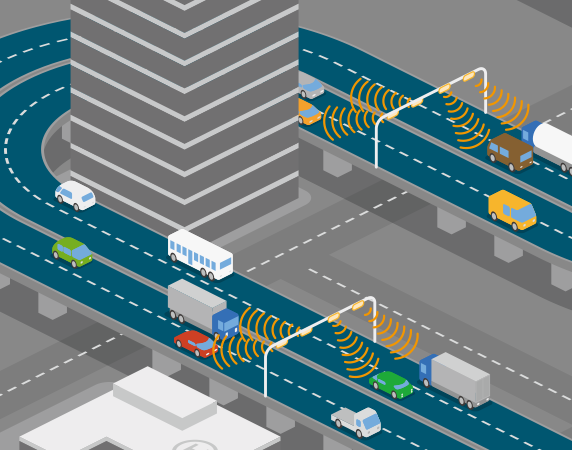
Consider the example of Smart Transportation Systems (STSs). The traffic light system in a state, say, Chicago, is equipped with sensors. On an occasion of celebration, the city is likely to experience a surge of traffic around specific times, depending on the occasion. As and when the traffic starts coming in, data gets collected from the different individual traffic lights. The application that is developed by the city to monitor traffic and adjust light patterns according to timings, which runs on each edge device, automatically takes control and changes light patterns in real-time. They work according to the traffic patterns and obstructions that rise and fall, collected by the sensors. Thus, traffic is monitored flawlessly.
In the normal case, there is not much traffic data being sent to the cloud on a daily basis for analysis and processing. The relevant data here is the data that is different from the usual scenario, that is on a day of celebration or a parade. Only this data is sent to the cloud and analyzed.
Why “fog” computing
The word fog in fog computing is intended to convey the fact that cloud computing and its advantages need to be brought closer to the data source, just like the meteorological relevance of the words fog, meaning clouds that are closer to the ground.
By all means, this technological innovation is something that the world really needs now. For all those businesses who have been waiting to find the perfect solution to your data issues, fog computing is definitely the way to go.
Image credits: Quotesgram, Atelier
Stay up to date on what's new
About the Author
Featured Blogs
Stay up to date on
what's new
Talk To Our Experts
For a long time now,there has been a seemingly prevalent trend in the world of business. Leading companies or market leaders often fail to stay on top of their industries, as technology or market conditions suddenly change.
For example, Xerox was once the market leader in copier machines, but later on, Canon took over the small-copier space. Wal-mart took over the once popular Sears.
In the software industry too, there was once a time when Apple computers brought in and popularized the idea of personal computing and literally established the standards for user-friendly computing as well. But they went behind by almost 5 years, in the introduction of portable computers from the market leaders in this space.
As you can see, this has been a consistent pattern in most industries. Established companies often invest heavily and aggressively in technologies that are essential to retain their existing customers, but seldom foresee the directions of their future journey together. They fail to focus on investing in certain other advanced technologies that might be important for their future customers. Hence even though they are successful in retaining their current customers and dominating the market, their slack on meeting future demands of customers brings them down.
Why does this happen?
The real reason for losing the wave
From a broad perspective, it may be the result of several issues combined, like a lack of proper planning and execution, short-term investment issues and internal issues too, such as bureaucracy, monotony, inefficiency and the like. But the main reason for this pattern is actually right at the heart of the paradox. All established companies fall prey to one of the most popular and undeniable principles of management – being close with customers.
Even though most business managers have everything under control, customers have a certain dogmatic power over a company’s investments. Businesses always make it a point to direct their activities to what customers want. Whether it’s the introduction of a new product, or new technology or venturing into new channels of distribution, the first priority of businesses is to look up to what customers want – is it something that their customers would want? Is it going to be profitable? Is the market big enough? – the questions are many.
This is how most businesses fall into the cycle. It’s fine as long as the customers are satisfied. But the problem arises when the customers reject a certain new technology or product, because it doesn’t meet their needs as effectively as the company’s current product or technology. In the end, they find themselves being burned by the very technologies or products that their customers led them away from.
From an ongoing study of technological changes, it has been consistently found that most established companies stay ahead in their respective industries, in developing new technologies that address the performance needs of their next-generation customers. However, industry leaders don’t really focus on being in the forefront of commercializing new technologies that don’t meet the initial demands of mainstream customers and focus on appealing to emerging markets alone.
In order to remain on top, businesses need to identify those technologies that serve the next-generation needs of customers, and pursue them only while keeping themselves protected with the technologies and processes that serve mainstream customers as well. There is only one solution for it – creating organizations that remain independent from the mainstream business.
Striking that fine balance, takes time, effort, and most importantly many failures. We might be able to see more businesses in future, embracing this approach.
Stay up to date on what's new
About the Author
Featured Blogs
Stay up to date on
what's new
Talk To Our Experts
In the wake of the age of mobility, and increasing demands for high-quality web and mobile applications, DevOps is fast becoming the most reliable and preferred strategy for most organizations. It’s cross-functional collaboration and speed are making it more like a go-to strategy, as it enables quick delivery of software solutions, which is precisely what is needed in the current business scenario. Moreover, as businesses are in the process of digital transformation around the world, an agile environment is only a necessity, as a lot of business aspects linked to the transformation process like growth, customer loyalty, and satisfaction, competition differentiation etc., need to be taken care of well. DevOps helps in creating such a responsive IT environment, enabling organizations in rapid development and deployment of high-end software solutions.
But how far is DevOps successful? How can an organization judge for itself whether it’s DevOps initiative was, or will be successful? Sure, a lot of organizations are following it, but given the transformational scenario that most organizations are in, it could be difficult to measure its success, because DevOps by itself is not exactly a formal framework and it doesn’t provide a lot of guidance. Organizations simply have to learn into it.
There are some metrics or elements that accurately help in measuring the success of DevOps. Most organizations make the mistake of measuring a number of elements, which often may not be necessary and retreat to ones that can be easily collected. But, the issue is that some of these metrics that matter for DevOps may not be as familiar to organizations. For example, the speed of deployment, rate of change and the like are metrics that are only applicable to DevOps, which in turn is a comparatively new concept for organizations.
So what are the metrics that should be considered for DevOps?
The elements that matter
Importantly, we need to consider people-centric metrics, and process and technology centric metrics as well for DevOps. Out of these, people-centric metrics are probably the most difficult to collect, but often prove to be the most useful. They can actually be one of the most powerful influencers on a DevOps program. Hence, internal metrics like staff training and retention rates should be strongly considered.
When it comes to
When it comes to process metrics, we need elements that help to measure the effectiveness of interlinked processes throughout the delivery process. It helps to see if the collaboration is effective. It also helps to identify deficiencies within the processes that need more work.
Technology metrics are those such as uptime and capacity to support expected web traffic, which basically help in reviewing the technologies used in the DevOps process. It also includes insights derived from failures or errors like failed releases, code defects and the like.
Another important thing to note while determining metrics is to sustain a comprehensive or holistic approach. Sticking to just one or two aspects of measurement like operational or developmental metrics, may not provide the required results. As a matter of fact, there are chances of it having a negative impact on behavioral improvements in the organization.
To start off, here are a few dimensions which can be used to measure the effectiveness of DevOps:
- Collaboration and sharing – This literally forms the base of a DevOps program and is hence the most important measure. They help in judging the acceptance or resistance to the program, on an ongoing basis, which is a valuable indicator of the effectiveness of DevOps. As mentioned before, some of the metrics in this dimension might be easier to collect such as staff retention rates, training, and turnover, while others like employee morale might be more difficult. Another aspect to look into here, is how metrics in other dimensions are affecting elements in this dimension. For example, how far are MTTR (Mean Time To Repair) changes affecting employee morale, retention, absenteeism and the like. Automated surveys and other means to get employee feedback are other areas that may be considered for this dimension.
- Efficiency – This dimension mainly focuses on developmental and operational aspects. The capacities and capabilities. Moving from the traditional ratios like server to admin, businesses are now using customer-centric ratios like FTE (Hours worked by a Full-Time Employee) to customers. This value is expected to increase in the coming years, as more enterprises are now moving to automation and the cloud. Other metrics such as examining costs on an application basis and cost of release are good measures in improving data center efficiencies.

- Quality – This dimension focuses on elements related to service delivery. For example, metrics like percentage of applications rolled-back because of code defects. Now this metric could initially be high for organizations that have just begun on their DevOps initiative. This is probably due to extra time required for the purpose of making the new processes effective, and other related things. These metrics might give other useful insights when combined with other indicators. For example, the rate of rollbacks when combined with the change volume indicator, could provide more important insights.
These are some other metrics in this dimension:
Cycle time – time required to complete a stage or several stages within a project
MTTR – average time taken to restore a service or repair a defective part

- Business value – This dimension is focused on external things – like the impact of DevOps on meeting business goals. It includes elements like customer value or loyalty, time to market and the like. The lead time too provides businesses with an analogous metric that helps to know how well DevOps is meeting the need to deliver high-quality software services fast. This is specifically important as a long lead time may mean more defects in code and issues in testing.
The Net Promoter Score (NPS) is another important metric, which is a simple method to measure customer loyalty. Even though this measure has been traditionally used for marketing purposes for a long time, customer loyalty is also affected by the fast and timely delivery of software services through high-quality web and mobile apps.
In conclusion, measuring the effectiveness of your DevOps program is crucial for ensuring continuous improvement and achieving desired outcomes. It requires defining and tracking relevant metrics, such as deployment frequency, lead time, and MTTR. To establish a robust and effective DevOps program, partnering with a custom software development company can provide the expertise needed to set up proper metrics and implement DevOps best practices.
Image credits: Prashant Arora’s blog
Stay up to date on what's new
About the Author
Featured Blogs
Stay up to date on
what's new
Talk To Our Experts
If you thought “digitizing” your business was all about incorporating some kind of technology into your processes, and that replacing your people and papers with technology would do the trick, then you are in for some new information. That’s right.
Digital business transformation has more to it than you probably imagined. It is more about doing things in different ways and producing new and improved business designs, all with the common goal of blurring the lines between the physical and virtual worlds.
Digitization is not just dehumanizing or mechanizing work
Most people understand digitization to be either an extension of automation or pretty much the same thing. But according to Gartner, the goal of digitization is to create and deliver new value to customers and not just improving the quality of already existing services.
For example in a hospital, nurses and doctors use clipboards and forms for access to patient details, to jot down further medicine details and the like. Merely replacing these paper forms with tablets and other devices is not digitization in itself. Internally, there are improvements in terms of efficiency and effectiveness, when compared to paper-based manual transcription and for patients too, the quality of already existing care is improved.
Though there are a thousand benefits to the entire health organization by doing just that, like better accuracy and speed while entering data into the Electronic Health Record systems, it does not actually count for digitization as here the patients do not experience any additional value.
Instead, what if the entire care and control system is redesigned with the help of smart machines and the Internet of Things (IoT)?
The smart devices can be programmed to do most of the data collection, analysis and monitoring of the patients themselves, which leaves only the talking, the touching and empathizing to be done by the nurses – basically what we humans do best. The devices can monitor the patient’s health conditions continuously and keep checking for any vital signs of discomfort or variations, and alert the nurses and doctors well ahead in case of an issue.
Technologies like, hands-free conversational interfaces, can be used for data entry in hospitals, rather than typing in the data manually, thereby utilizing what comes naturally to human beings to make work easier. All these technologies help them in being proactive in their approach, thereby delivering more effective care and the end result is thus, better outcome for the patients as well as the doctors.
So, it is evident now, that digitization is not just dehumanizing or mechanizing work. It is rather a way or means for people to go back to their more “natural state”.
Digitization is not just dehumanizing or mechanizing work. It is rather a way or means for people to go back to their more “natural state”
Letting humans revert to what they are best at
With all the smart devices that can think for themselves in place, you might wonder, “so what is the need for people or what is our role in an organization?”
It is not about completely eliminating people from the scenario or taking them out of the processes. It is more about redefining their roles and getting them to do what they are best at. That way, they don’t have to be stalled with other tasks like data entry and paperwork, that bring down their efficiency and productivity.
Janelle Hill, vice president and analyst at Gartner says, “We now have the ability to use machines to support and augment people to help them realize their potential, not have them bogged down in paperwork and systems data entry. We need to think about how to identify the right work for the people.”
A digital business environment provides innumerous opportunities for innovation and improvements, which can help organizations in winning over customers with additional value and gaining the competitive advantage. Such value though, can be created only through a complete rethinking and redesigning of work itself. People need to be assigned work they are good at, while leaving the rest to be done by the smart machines. Thus, the full value of digitization can only be achieved through proper definition of work and not merely by inserting digital technologies into the existing processes.
“People need to be assigned work they are good at, while leaving the rest to be done by the smart machines. Thus, the full value of digitization can only be achieved through proper definition of work and not merely by inserting digital technologies into the existing processes.”
Source: Gartner
Stay up to date on what's new
About the Author
Featured Blogs
Stay up to date on
what's new
Talk To Our Experts
To explain the whole story, from the beginning to the end, in a sentence would be: “Parse was the most popular mobile backend-as-a-service (mBaas) for mobile applications, acquired by Facebook in 2013 and Facebook recently announced that it is completely shutting it down in a year’s time (by Jan 2017)!”
The Parse framework provides a hosted back-end infrastructure with unlimited opportunities for third party developers with its products like, Parse Push, Parse Core, Parse Social, etc., to build their mobile apps (Android, IOS, and Windows) by using a single SDK. Facebook’s announcement on its shutdown, followed by their migration tools and assistance, simply disguise a world of hurt for businesses that based their future on Parse. It’s shutdown has sent panic waves among teams who have their apps on Parse; their main concern being what to do next ? Many are looking for alternatives to develop apps without bothering about the backend, some try to take all the code from Parse to elsewhere and are confused as to which platform to use and trust.
What do you do now?
Relax! Think of it like a simple house-relocation, the whole migration doesn’t come without headaches, but is still in control with some wise moves. Let’s evaluate the actual impact of Parse shutdown in its true sense, and few smart options to overcome the trouble caused.
Who will be affected?
For now, people who have their apps built on Parse. If you have created apps using Parse backend solution, then you surely need a game plan and a skilled technical team to move to an alternate service. However, Facebook has open sourced the Parse’s source code, supplied database migration tools and provided enough time to move to your next option, so this isn’t the worst shutdown announcement ever, So chill. One year is plenty of time for you to move away from Parse or build apps on a trusted place.

And for those others chuckling at the worried Parse users, just be informed that you too are at the risk of such an issue, especially if your app dependents upon third party services. Developers might have ‘exception handling’ for when servicers are temporarily down, but what if the server has vanished forever? A disaster recovery plan will be always handy.
What are your options? (Alternatives to Parse/mBaaS)
The shutdown means you have to:
1. Migrate to another BaaS/ Parse alternatives: Find an alternative BaaS that has all the features similar to your App’s requirements, for Google has many developer APIs and backend services; Microsoft has Azure, or Amazon’s AWS.But of course this requires ample amount of customization to ensure your fit. However, be warned because, “Fool me once, shame on you. Fool me twice, shame on me!”
2. Migrate to a PaaS from one of the major cloud providers: Platform-as-a-Service is more generic and broader than Backend-as-a-Service and the vendors won’t lock you in that much. PaaS services from major players like, Amazon, Google, Microsoft and others are mostly part of their core cloud offerings and therefore is comparatively at lower risk of shut downs. This migration would mean serious efforts from the technical team to develop missing parts, but you can be at greater development flexibility while enjoying all benefits you had with BaaS.
3. Migrate your backend to a self-hosted instance of Parse: Parse Server is basically Parse that can be hosted on your own infrastructure. Your client side will thus remain the same and needn’t refactor the whole app to unplug the Parse SDK. Copy the Cloud Code of your app to the parse-server as described here to migrate your existing Cloud Code to Parse server. There is no Native Cloud code in Parse server and you will need to use replacements like, App Links. Yet, direct replacement is not possible, but you can have a trained developing team to generate these tags and deal with the non-trivial migration process. The issue here is, whether the community will continue developing and fixing Parse in future, since it’s already a zombie. You may also extend your current JavaScript from Parse into full-blown NodeJS application : If there isn’t too much complex scripts on Parse, adding CRUD operations on top of MongoDB database would be much less effort. This shall give you complete control over the backend and data, without having to be locked down into any platform.
4. Look for building your own backend now: Something that you definitely had issue with in order to have gone for Parse in the first place. But since we are more concerned about vanishing services at this point of time, with open source self-hosting, you can at least hope to get the ongoing maintenance from a developer community.
From similar examples of other shutdown notices, the initial chaos it creates and the slow emerging saviors, it’s always wise to wait for a month or two to see how the dust settles, and eventually decide what will work best for you.
Moving to another mBaaS? What should you look for?
The shutdown of Parse, StackMob, Proxomo and MobDB has left developers perplexed about the future of mobile-backend-as-a-service. Unless mBaaS comes up with a credible response to this question of vendor lock-in issue, I doubt any sane developer would touch this now. Hopefully there will be no “fool me three times”.
Developers can avoid reliving such nightmares by ensuring that their vendors don’t lock them in. Under any cases of acquisition or shutting downs, you should be given full control of your applications’ source codes. Be sure to check these with your provider if you consider using BaaS or mBaaS:
Developers can avoid reliving such nightmares by ensuring that their vendors don’t lock them in. Under any cases of acquisition or shutting downs, you should be given full control of your applications’ source codes. Be sure to check these with your provider if you consider using BaaS or mBaaS:
1. Do you get full access to their mBaaS source code (including the backend server and backend server administrative console and not just client side SDKs)
2. Can you continue running your app if they shut down (Ask them whether you can download run time components of your app and deploy it elsewhere without going to their site)
3. Who owns the IP (intellectual property) of your app components? Ask your vendor to demonstrate these to you; if they can’t show how this is done or probably has no reference to provide, like a customer who got this done, you are locked in to them!
Can Developers still trust 3rd party services?
With Parse shutdown people woke up to what “Vendor-lock-in” actually means in practice. Several factors like, the move to serverless computing (e.g. Amazon Lambda), have recently made mBaaS a lot less attractive as a standalone. And with the recent shutdown notice, Backend-as-a-service is presently facing a tough time.
However, It is definitely a tricky balance between choosing an mBaaS platform or building the mobile backend yourself. The favored suggestion is to do more work on Amazon with the option to fall back to Google, than to do less work on Parse but without any plan B.. As Dave Verwer, founder of Curated puts it:
“It’s always a tricky balance between using a BaaS platform like Parse, or building everything yourself. We’re all aware that any service we rely on could potentially go away at any time but there is none more disruptive than your entire back end! On the other side of the argument, you could spend years building everything you need from scratch and completely custom, then have the app not gain any popularity and have it all wasted. It’s a tricky problem and there’s no right answer.”
Yes, Parse shutdown has brought a lot of pain, but it has also drawn light into the hidden risk that developers who depend on 3rd party services are at. It’s terrible when something you count on becomes an ex-service, but as its result you wouldn’t want an “ex-app or business”. If you are affected by Facebook’s move, you have to make a plan change and a new game plan until there’s time. Fingent will be glad to be of service to you for any migration, or app development using your own backend. We can help you decide what will work for your business in the long run.
Still unsure about your options? Let’s discuss!
Stay up to date on what's new
About the Author
Featured Blogs
Stay up to date on
what's new
Talk To Our Experts
Over the past few years, the one trend that we saw throughout was the rise in the use of mobile devices. The number of smartphone users in the world has now surpassed 2 billion according to E-marketer, which is an increase of about 12.6% over the past years. Now if that doesn’t say we are moving rapidly towards an increasingly mobile future, I don’t know what will.
While on one hand, it makes all our lives a lot easier, on the other hand, it means things are a little more difficult for the developers. Businesses these days demand more mobile based solutions, while at the same time, do not do away with web based applications. As the trend these days is, businesses want web applications that can also work on mobile devices – the best of both worlds.
Hence, developers these days are throwing up their hands in frustration trying to create interactive content through applications that are accessible from both desktop and mobile devices for businesses. A major shift towards HTML5 is now becoming more essential in order to satisfy industry demands. The future may well be in the hands of HTML5, considering the rising need for all pervasive applications.
The mobile world that we live in
As of this year, we have around 4.61 billion mobile users in the world and it is expected to reach almost 5.07 by 2019, considering the pace at which it is increasing every day. And another interesting fact is that since 2013, we have had as many mobile phones in the world as there are users. That means there is likely to be not a single individual now, who doesn’t own a mobile device, thereby increasing the chances of applications being viewed on mobile devices more.
This makes it all the more necessary for developers to create and deliver complex apps that work on all devices faster.
TMCnet contributing writer, Steve Anderson, mentions in an article that, the increasing popularity and use of mobile devices across business enterprises “will leave many developers looking for a way to develop for desktops that also allows for use on mobile devices.”
For all these reasons and also because of it’s rich features, it is no wonder that HTML5 is rising high in popularity.
A large majority of developers are now using HTML5
Almost 153 Fortune 500 companies are using HTML5 now. And a survey of more than 3400 developers conducted across the U.S, Europe, and Asia this year shows that more than 50% of developers are now developing HTML5 web apps for mobile, closely following iOS which are used by 61% of developers.
What’s more, as part of a recent Strategy Analytics survey on mobile application developers’ preferences and attitudes towards application development, researchers have also proved that, out of all the technologies used for building native or web apps, HTML5 showed the strongest predicted growth rate at 20%. They also found out that almost 63% of all business apps are being created in HTML5.
Always the developer’s choice
HTML5 offers a whole new range of possibilities and powerful capabilities to its developers when compared to native apps development. Syntactic features like audio, video and canvas elements, for example, are some of the new and effective features provided by HTML5, all of which make it much easier for developers to integrate multimedia or graphical content on the web app or web, without the need to rely on APIs and plug-ins.
Another key attraction for developers towards HTML5 is its open standards support, which enables them to fulfill application requirements in the face of fragmented mobile devices, form factors, platforms, and operating systems. They can basically use HTML5 to create and deliver rich content without having to rely on the device or its Operating System, which again makes it more preferred than native.
Besides, developers have always preferred coding in a language that can be used across different platforms, so as to ensure good quality user experiences on multiple devices and screen sizes. Also, because it helps them maintain a skillset that can be applied for different kinds of requirements as well as companies or employers. These days even JavaScript programmers are moving to HTML5.
In the future
Looking back, it is indeed surprising to see how much of an impact HTML5 has had on mobile app development. It has literally been a revolutionizing force. Now, it has come to be the perfect blend of developer preference, business requirements, and technological advancement. In the coming years, it is definitely going to be adopted by more number of enterprises, as they are slowly moving from their usual administered use of Internet Explorer, to Chrome or Firefox browsers at work, both of which have high-level HTML5 support. Further in future, with the growth of Windows 10 adoption and use, the use of the new Microsoft Edge browser will also increase, which will enable business enterprises to make full use of the power of HTML5.
Want to develop a smart Mobile Application for your Business?Contact us.
Stay up to date on what's new
About the Author
Featured Blogs
Stay up to date on
what's new
Talk To Our Experts
2016 will be the year when technology will bridge the gap between the physical and digital world. The Internet of Things and the rise of connected data will bring even more opportunities and also many new challenges. Keeping pace with the latest business technologies is crucial to stay ahead of this game. Listen how companies can lay strong foundations for incredible changes that are about to happen. In this videocast, we request our CEO Sam to take a stab at predicting technology trends that may materialize in 2016
Stay up to date on what's new
About the Author
Featured Blogs
Stay up to date on
what's new
Talk To Our Experts
Let’s think for a moment, of the technology driven world that we live in now and how much the all pervasive technology has changed the way that we all live our daily lives. From our personal spaces to the biggest businesses and industries, we have come a long way from brick sized cell phones and DVDs to sleek touchscreens and microchips to name a few of the smallest changes. With the advent of the “Internet of Things” and “Industry 4.0” or the Fourth Industrial Revolution, we have been introduced to and have infact been living with a concept called Ubiquitous computing or pervasive computing.
According to Wikipedia, ubiquitous computing in contrast to desktop computing, involves the usage of any device in any location and in any format. It basically enables a user to interact with a computer which may exist in a number of different forms such as the regular laptops, desktop computers and notebooks to sensors and terminals in our everyday objects like the refrigerator, a pair of glasses, the TV and the like. We have all come to embrace these concepts, getting used to the “things that think” around us, and having the ability to get things at our fingertips.
Such ubiquity of software has touched almost all aspects of our lives and all industries in the business landscape as well, including the manufacturing sector and the audit and compliance sector, leaving no stones untouched.
Software in manufacturing and audits
The first ever industrial robot was used in the production line in 1954, and since then, software has always played a huge role in manufacturing and production, not as a core function though, but as a supporting function. But with increasing moves towards digitization and automation of processes and procedures, especially under the Industry 4.0 umbrella, software started to assume bigger, more comprehensive roles and now we find software everywhere, from production lines to control systems. Literally every device or equipment involved in the processes are connected among each other as well as to a central unit, and are also programmable, thus making the already thin line between physical and digital even more blurred.
Considering the industry’s general shift towards a more consumer-driven approach, it is indeed necessary to incorporate more flexibility, agility and control across all processes, as the pressure to deliver high quality, configurable products and services is only going to increase down the lane. All this increases the need for manufacturing companies to invest in technology, especially software based technology, so as to generate more speed and flexibility, both of which are critical to be profitable in this environment.
Business Intelligence and Performance management are two other areas in manufacturing which make use of software and data gathering on a large scale according to Gartner. Hence, the manufacturing industry assumes one of the top three positions in the list of industries looking to hire technology and software experts.
Just like manufacturing, the concept of software everywhere also redefines the scope for audits, inspections and compliance, and there are many newer challenges to face. One point of concern though, is that there may be a thousand risks and consequences associated with certain kinds of technologies and their deployments, but only little thought is put into understanding them, and even the manufacturers, lawmakers and compliance bodies know very little about many of these risks. For example, the risk of manipulation is something that most people have often overlooked and the recent scandal of the German automobile giant, Volkswagen proves this point.
The Volkswagen scandal
In September 2015, Volkswagen was issued an EPA notice after it was found by independent NGOs that they had been cheating in emission tests. It was discovered that Volkswagen cars were emitting up to 40 times more toxic fumes than permitted, which included particulates that are really harmful to the lungs especially for those with breathing related issues. They had since then admitted that they sold about 11 million cars over the last 4 years, which implies that this practice or this cheat has been going on for a quite a while.
The British newspaper “The Guardian” estimates an average of 1 million tonnes of air pollution from the Volkswagen cars every year, which is roughly the same as the emissions from all of United Kingdom, from power stations, vehicles and the like. It only means that the pollution caused by this cheat is as bad as the pollution from an entire country.
Now how did Volkswagen manage to get past all the rigorous, stringent and detailed tests conducted by the EPA, that too for a long time?
It was in the tests
All the tests of the EPA, like a cold start test, a hot start test and many others along with a 30 minute rigorous test by the Federal procedure as well, are usually specified in great detail, as are the steps in order to prep the cars for them. And unlike any other compliance tests which may have many grey areas, these tests of the EPA contain specifications, which are very thorough, detailed and extremely clear – everything that you can expect from a good quality specification.
It was this very attention to detail that enabled Volkswagen to cheat. Most mechanical parts of a car these days are managed and controlled by computers and electronic control units. These units have information about almost every single part of the car such as the speed, the angle of steering, the fuel intake etc. and such information is generated almost every instant that the car is switched on. The extremely detailed test specification and the availability of such specific information about the car enabled Volkswagen engineers to program the computers to use this information to recognize when the car was being tested. They were able to program the software to switch the car from a road mode to a calibration mode, when it recognized that the car was being prepared for a test.
Now the one thing that is crystal clear from this whole issue is the fact that it impacts all of us in the business of quality assurance and inspections. Just like cars, almost all equipment used in manufacturing and production rely on some kind of software, and software, as we know it, is a very different beast, considering the traditional equipment that we are used to, when it comes to production, manufacturing, control systems and the like.
This shows that advancements in technology only mean more vulnerabilities and challenges for compliance auditors and inspectors and more alertness from their end. So what exactly are the points that we, as auditors need to keep in mind when it comes to compliance inspections and what are the challenges that we face? Read more on our blog, Challenges For Auditors And Inspectors In The World Of Connected Devices.
Here’s a webinar on the ubiquity of software in the compliance industry, by Deepu Prakash, Head of Process and Technology Innovation at Fingent Corp:
Stay up to date on what's new
About the Author
Featured Blogs
Stay up to date on
what's new
Talk To Our Experts
Fast technology pace, sudden paradigm shifts, changing business models and the fall or rise of the year- predicting technology trends can often be like reading tea leaves. Who would have predicted Google being the star of the internet? Or the extraordinary popularity of Uber as an unrivaled app-based cab service, the rise of Tesla or Amazon, the resurrection of Apple.
What has 2016 in store for businesses and enterprises? Know more in this short video cast as we request Deepu Prakash, Head of Process and Technology Innovation at Fingent, to take a stab at Technology predictions for 2016
Stay up to date on what's new
About the Author
Featured Blogs
Stay up to date on
what's new