Agent Orchestration: Turning Agentic AI into Enterprise-Grade Intelligence
Picture this: you give every department in your company a smart new tool. This tool can think, act, and learn. Sounds like a dream, right? But, what happens when those tools don’t communicate? What if they don’t follow a clear plan or, even worse, work against each other? That’s the reality many enterprises are facing today with agentic AI.
Here’s the catch: strong AI agents are just part of the solution. The true game-changer is how we organize these agents. Why? Agent Orchestration connects AI efforts. It creates a strong, coordinated engine. This engine brings real value to businesses.
In short, without orchestration, your agents can’t work together. Without that teamwork, even the best AI tools won’t meet enterprise needs. Let’s discover how agent orchestration can help your business.
What Is Agent Orchestration?
Agent orchestration involves operating and coordinating multiple AI agents. It makes them align on common business goals.
In an agentic AI setup, agents can focus on different tasks. Some may handle data retrieval. Others might specialize in reasoning, decision-making, workflow execution, or system integration. Orchestration ensures these agents:
- Communicate effectively
- Follow defined workflows
- Share context and memory
- Escalate tasks when needed
- Operate within governance and security boundaries
AI agent orchestration helps manage interactions. It connects agents, tools, data, and humans in complex business settings. Even the most sophisticated agents suffer from lack of consistent output without orchestration.
In essence, agent orchestration transforms autonomous agents into a workforce with direction.
Core Components of Agent Orchestration
Successful agent orchestration relies on several foundational components working together:
1. Agent Management Layer
This layer defines how agents are created, assigned roles, and activated. It ensures the right agent is triggered at the right time.
2. Workflow and Task Coordination
Orchestration engines manage task order. They handle dependencies and transfers. These engines are key for multi-step tasks. They also work well in cross-functional tasks.
3. Context and Memory Sharing
Agents need shared context to avoid redundant actions and conflicting decisions. Orchestration enables persistent memory across agents and workflows.
4. Tool and System Integration
Agents are commonly dependent on enterprise systems like CRMs, ERPs, databases, and APIs. Orchestration also regulates the agents’ access to and use of those instruments in a secure manner.
5. Security and Compliance
Enterprise agent orchestration can help you make sure that your company systems stay safe and meet the appropriate security requirements. It makes sure that audit logs are maintained and policies are enforced. These components combine to create a watchful environment in which agentic AI can thrive.
Take Slow, Yet Powerful Steps Towards AI
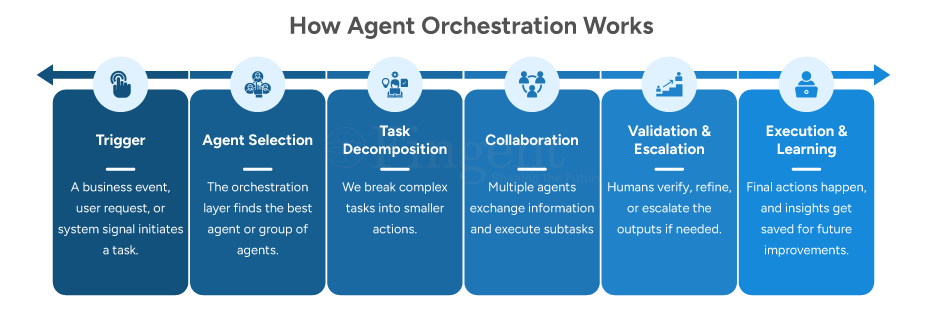
How Agent Orchestration Works
How Enterprises Benefit from Agent Orchestration
Enterprises using agent orchestration scale better and achieve greater consistency, speed, and collaboration.
1. Scalability Without Chaos
AI agent orchestration helps businesses use agents effectively. This is especially beneficial in finance, customer service, HR, supply chain, and cybersecurity. It ensures that oversight remains strong.
In a financial services firm for instance, it is used to integrate customers, detect anomalies, issue fraud alerts, and approve loans. Telecom giants are helped in billing, fraud detection, network monitoring, and customer service. Resources are adjusted during busy times.
2. Consistent Decision-Making
A central governance layer ensures all agents are applying the same rules. It applies to business rules, compliance rules, and ethical rules. It eliminates data silos for full analytics and swift, coordinated action.
Retail banks for instance, keep complete conversation histories for loan apps, account support, and investment advice. This leads to a boost in customer retention. Fingent’s tools help the healthcare and finance sectors by using context abstraction, long-term memory, and policy-based agents. This ensures HIPAA and SOX compliance, which helps reduce audit discrepancies.
3. Faster Time to Value
Reusable orchestration templates and pre-built integrations accelerate development. This has sliced the time to market from months to weeks. This allows for quick prototyping of multi-agent workflows. Multi-agent systems solve problems faster than single agents or manual methods. This increases efficiency and significantly cuts admin time.
4. Improved Human-AI Collaboration
Orchestration patterns include:
- Supervisor agents for breaking down tasks.
- Handoff protocols for escalating issues.
- Progress monitoring to choose when agents act alone or involve humans.
In SOCs, agents tackle threats faster and escalate only high-risk cases. This lets analysts concentrate on strategy.
5. Enterprise-Grade Trust
Built-in monitoring dashboards and zero-trust security provide full audit trails. They also offer explainable AI for GDPR, EU AI Act, and SOC 2 compliance. Platforms provide end-to-end tracking of interactions with real-time anomaly detection, enabling you to detect issues sooner.
Use Cases of Agent Orchestration
Use Case 1. Customer Support Automation
Agent orchestration coordinates specialized AI agents end-to-end. A lead intent-detection agent checks messages. It then sends them to a knowledge-retrieval agent for FAQs or documents. Sentiment-analysis evaluates tone, triggering resolution agents for responses or escalations. Telecom customers tweet about billing errors. The orchestrator detects urgency, retrieves history, and assesses sentiment. It then auto-refunds, resolving 80% of cases in under 2 minutes. This boosts satisfaction by 30% and cuts costs.
Use Case 2. Business Process Automation
Orchestration chains agents for invoice processing, approvals, fraud detection, and exceptions. The central orchestrator does the following:
- OCR extracts data.
- Validation checks the ledgers.
- Fraud flags any anomalies.
- Approval routes or auto-approves.
Example: Accounts payable handles 1,000 invoices each day with 99% accuracy. OCR reads the invoices. Then, validation checks POs and fraud scans look for duplicates. Approval notifications follow, cutting processing time from days to just hours. AI-driven document processing and workflow automation can completely eliminate manual data handling and help achieve 99.9% scalable operational accuracy.
Use Case 3. IT Operations and DevOps
Agents monitor in real-time. They scan logs and metrics, check diagnostics, and find root causes through correlation. If needed, they apply remediation fixes, like scaling pods, and send escalation alerts.
Example: When there’s a CPU spike during peak traffic, monitoring catches it. Diagnostics find a memory leak, then remediation patches or rollbacks. This logs the fix, cutting MTTR from hours to minutes.
Use Case 4. Data Analytics and Insights
Agents automate pipelines in the following ways:
- Ingestion collects data.
- Cleaning handles outliers.
- Analysis runs models, like regressions and clustering.
- Insights visualize and narrate findings.
Example: Retail sales involve data from DBs/APIs. We clean, standardize, and analyze this data. Then, we create insights reports on underperformers. This approach boosts revenue by 15% each quarter through smart inventory adjustments.
Use Case 5. Enterprise Search and Knowledge Management
Query understanding clarifies what you mean. Retrieval finds what you need. Summarization makes it brief. Contextualization tailors it for each role or history.
Example: An executive asks about the “Q4 sales strategy.” The orchestrator quickly adds memos and grabs over 50 regional documents. It delivers a summary in seconds.
Enterprise agent orchestration uses a central controller. This controller handles handoffs. It also ensures governance with privacy and audits. Plus, it boosts reliability and supports scalable AI.
What Are the Challenges of Agent Orchestration?
Agent Orchestration has some challenges that need to be dealt with. There is an element of complexity and issues with governance among a few. Here’s a transparent look:
- Complexity of Design – Defining roles, workflows, and dependencies requires deep domain understanding.
- Integration Overhead – Interfacing agents with legacy systems and contemporary platforms is notoriously difficult.
- Governance Gaps – Agents can produce variable or noncompliant results if there are no controls in place.
- Performance and Cost Control – Inadequate orchestration results in duplicate activities and wasteful consumption of compute.
- Skills and Expertise – Agentic AI orchestration requires knowledge of AI, architecture, security, and business processes.
What You Need to Know Before Deploying Agent Orchestration
Before deploying agent orchestration, enterprises should test:
- If your business processes are sufficiently defined and stable to be automated
- If you have a technology stack that can support the required tools and multi-agent workflows
- Whether your security and compliance regulations are strong enough for a regulated environment
- Whether you want small pilot projects or an enterprise-wide, long-term deployment
- Whether you have the right partner expertise to support your efforts
- Are you ready for partner expertise? Do you have the right support for implementation?
Early architectural choices can save you from expensive rework later.
Still Doubtful About AI Agents? Let Us Help You Take The Right Steps
How Fingent Can Help
Agentic AI has great potential, but that potential remains unexplored. Agent orchestration is what takes proximity to autonomous agents and scales it, bringing them into cohesive enterprise-grade systems. It adds structure, governance, scalability, and trust to AI-driven workflows. AI needs to line up with real business results, and not just test success.
But orchestration is not a technical challenge. It requires the right strategy, architecture, and execution partner.
Enterprises need partners who understand both agentic AI and complex enterprise ecosystems. From system integration to governance design, experience matters.
Fingent helps organizations design, build, and scale enterprise-ready agent orchestration solutions. Fingent is an expert in AI and system integration. They help businesses go from separate AI projects to working together. This makes a real difference. Ready to prep your business for success? Connect with our experts now!
Stay up to date on what's new

About the Author

Recommended Posts

01 Apr 2026 B2B
The Ultimate Guide to Agentic AI Platforms in 2026
Gartner predicts that Agentic AI will autonomously resolve 80% of standard customer service issues by 2029, without human intervention. For market leaders, mastering Agentic AI is no longer optional—it is……
30 Jan 2026 B2B
Getting Started with Agentic AI Development for Your Enterprise
Traditional automation excels at repetition. RPA follows scripts. GenAI generates insights. But when conditions change mid-process, suppliers miss dates, forecasts shift, or approvals stall - these tools stop short. They……

26 Dec 2025 B2B
Building Custom AI Agents to Up Your Marketing Game
It’s Friday evening. A new lead hits your website—someone who could change your numbers in a big way. In the old days? They’d wait until Monday. Maybe Tuesday if your……

11 Sep 2025 Financial Services B2B
Agentic AI in Financial Services: The Shift from Automation to Autonomy
Banks have been using AI for a while now—flagging fraud, crunching credit scores, and personalizing offers. But Agentic AI in Financial Services? That’s a whole new game. It doesn’t just……
Featured Blogs








Stay up to date on
what's new