Getting Started with Agentic AI Development for Your Enterprise
Traditional automation excels at repetition. RPA follows scripts. GenAI generates insights.
But when conditions change mid-process, suppliers miss dates, forecasts shift, or approvals stall – these tools stop short. They alert. They suggest. Then they wait.
Enterprises don’t need more notifications. They need systems that take ownership of outcomes. That’s where agentic AI development enters the picture.
Why Agentic AI, Why Now?
When systems detect problems but cannot resolve them, teams become the glue.
In finance, forecasts trigger alerts but require manual adjustment. In IT ops, cloud overspend is flagged after the bill arrives. In sales ops, leads are scored but still sit untouched. The pattern is the same: insight without execution.
Agentic AI development closes that gap. It identifies issues, evaluates options, executes decisions within policy, and learns from outcomes. All without waiting on handoffs.
We’re seeing enterprises drive meaningful operational costs this way. With the agentic AI market projected to grow to USD 154.84 billion by 2033, the question is no longer if enterprises adopt, but who gains the lead.
Integrate AI Into Your Existing Systems The Smart Way. Reduce Friction. Maximize Results.
What Agentic AI Means for Your Operations
Agentic AI development builds systems that act independently. They sense issues, plan responses, execute fixes, and learn over time, all with minimal supervision. Forget rigid scripts. These systems handle surprises the way experienced operators do.
Picture your invoice disputes. An agent pulls contract data, cross-checks deliveries, flags errors, issues credits, and updates ledgers automatically. No more weekend escalations.
We mix perception (spotting anomalies), reasoning (weighing options), tools (accessing ERP systems), memory (past deals), and decisions (approving changes under limits). That’s agentic AI development in action, transforming chaos into smooth flows.
Expand this to tail-spend. Those 3,000+ low-value purchases eating your time? The agent aggregates them, benchmarks prices, bundles into bulk deals, and executes, freeing your team for strategic sourcing.
Why It’s Not Like Chatbots or Basic Bots
Generative AI spits out reports on supplier risks but stops there; now, you act. Virtual assistants book a meeting but can’t renegotiate contracts.
Agentic AI development goes further. It is platform agnostic, integrating with your existing enterprise systems, executing actions, tracking outcomes, and adapting over time.
In IT operations, this means more than dashboards. An agent detects abnormal cloud usage, reallocates resources, enforces budgets, and documents actions automatically. No ticket queues. No late surprises.
Key Benefits of Agentic AI for Enterprises
Agentic AI drives cost reduction and speed through autonomous, end-to-end execution. Let’s dig deeper:
1. Cut Costs and Speed Wins in Procurement
Procurement slows down when decisions wait on people, and systems don’t talk to each other. Agentic AI fixes this by orchestrating sourcing workflows end to end. Autonomous agents monitor pricing, flag cost gaps, recommend renegotiation paths, and route sourcing actions without manual handoffs. Teams stay focused on exceptions, while routine work moves faster with tighter control.
2. Faster, Smarter Decisions Daily
Markets shift fast—agentic AI processes signals instantly, beating human speed. In finance, it flags risky loans early; in procurement, it predicts shortages.
Finance teams love this for cash flow: The agent forecasts spend patterns from invoices and POs, flags variances, auto-adjusts forecasts, and suggests accruals, keeping your books tight.
Procurement leaders report improved supplier quality, too. Agents evaluate risks like financial stability or ESG compliance continuously, dropping underperformers proactively.
3. Personalize at Enterprise Scale
Personalization breaks when scale increases. Agentic AI fixes that by adapting actions, not just messages. AI agent development companies craft agents that adapt emails, terms, and follow-ups based on your data.
A B2B firm scored leads, personalized outreach, timed calls, and tweaked pricing. Result: more conversions, shorter cycles, bigger deals. Apply this to RFPs, you win more bids.
For enterprise architects, think spend categorization: Agents parse unstructured invoices, classify by GL codes, and flag maverick spend, ensuring compliance without manual reviews.
Enterprise Use Cases
Agentic AI automates enterprise workflows end to end, reducing risk, controlling spend, and keeping operations on track. Here’s how this shows up across enterprise functions:
1. Procurement and Supply Chain Wins
Disruptions keep you up at night. Multi-agent systems monitor everything: performance, forecasts, compliance.
One retailer used autonomous agent solutions to track inventory. When delays hit, agents negotiated premiums, sourced alternates, and adjusted forecasts, avoiding stockouts.
Dive deeper: Autonomous supplier discovery. Agents scan markets 24/7 for vendors matching your criteria, be it cost, location, or certifications. They score them, run background checks, and suggest switches, cutting cycle times 70%.
Dynamic contract negotiation takes it further. The agent drafts terms, simulates counteroffers, identifies risks (e.g., penalty clauses), and finalizes compliant deals, reducing review time.
2. Finance and Risk Scenarios
Banks run agentic AI development for portfolios. It scans borrowers, adjusts terms, ensures regs, all proactive.
During downturns, it flags risks and retains clients. Stable times? It optimizes profits.
In procurement, predictive spend analytics shines. Agents blend historical data, market trends, and real-time signals to forecast category spends, spot savings, and execute optimizations.
3. Infrastructure and Ops Examples
Cloud teams use agentic AI to predict demand and adjust resources automatically, improving cost efficiency and maintaining high availability without constant manual intervention. Procurement intake is simplified, without adding friction for IT teams
4. Sales and Threat Protection
Sales agents qualify leads, nurture them, and hand off hots. Cybersecurity agents spot insider threats, isolate systems, and log evidence. This stops breaches.
For finance, threat detection means spotting unusual PO patterns like duplicate invoices or off-contract buys and blocking fraud instantly.
Rollout Steps That Work
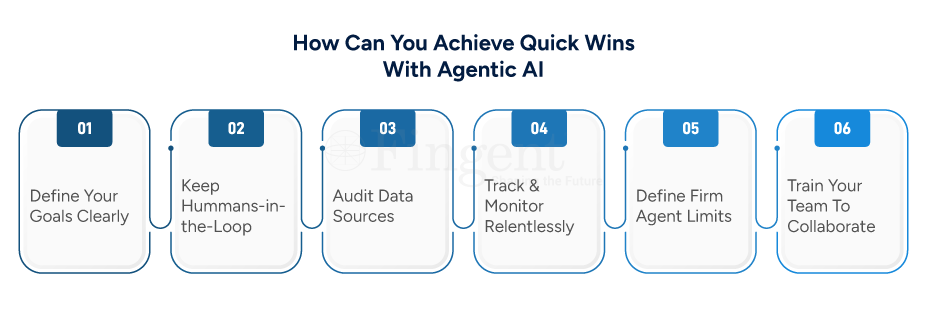
Agentic AI succeeds when enterprises start small, secure data early, keep humans in control, and track ROI rigorously. These steps show how to deploy autonomous AI agents safely, scale fast, and avoid costly missteps.
1. Define Goals First
Pick one pain point. Invoice matching or supplier onboarding. Define what “fixed” means and start where the risk is low.
Start narrow: Prove agentic workflows on routine tasks, then grow.
2. Keep Humans in Key Spots
Max autonomy tempts, but loop in people for big spends or contracts. It builds trust, catches drifts.
Two patterns work well in practice:
- Centralized for control (simple approvals)
- Hierarchical scale in multi-agent systems (complex chains)
3. Fix Data Upfront
Audit data sources early because bad data will derail agents. Set standards, loop feedback for better decisions.
In procurement, unify S2P data: Centralize spend, contracts, and suppliers for accurate agent reasoning.
4. Track Relentlessly
Monitor resolutions, accuracy, costs, and compliance. Refine based on real runs. Track ROI: Did negotiations yield expected savings?
5. Security from Jump
Apply zero-trust access, audits, and RBAC. Define firm agent limits and require review for high-value contracts.
6. Build Team Skills
Train on collaborating with agents. Learn from wins/losses together. Procurement teams need sessions on overriding agents safely.
Pitfalls We’ve Seen
Vague goals derail projects. Spell out success criteria, limits, and escalations. Define risky suppliers clearly.
Fix data gaps before agentic AI development. Start with clean vendor master data. Build security in from day one. Add explainability for audits. Avoid black-box agents. Add alerts and rollback controls.
Vendor lock? Pick open APIs. Accountability? Map chains now, like “agent proposes, human approves.”
Your 4-Phase Start
Phase 1: Target repetitive procurement task with data access, like invoice automation. Test with AI agent development company—learn feasibility.
Phase 2: Quantify: Autonomy rate? Cost drop? Tweak for 70% auto-handle. Add features like risk scoring.
Phase 3: Add cases (e.g., contracts), boost autonomy. Train teams, set governance. Roll to adjacent: Spend analytics next.
Phase 4: Deploy widely, monitor drifts. Key: Sponsorship, cross-teams (IT/procure/finance), change prep. Aim for 50% task automation by year-end.
Drive AI Success Faster! Start Small with the Right Expertise. Gain Quick Wins.
Fingent as Your Partner
Need help with agentic AI development? As one of the best agentic AI development companies for enterprise procurement, we tailor our solutions to your stack. We pilot fast, integrate seamlessly, govern safely, and train your team. No lock-in: We build your skills.
From multi-agent designs (one for discovery, one for negotiation) to monitoring (drift alerts), we shorten your path and reduce both cost and risk. We’ve delivered significantly better ROI in tail spend for manufacturers. Now it’s your turn.
Act Now
Agentic AI development is already reshaping enterprise workflows. The advantage goes to teams that start small and learn fast.
Pick one workflow. Run one pilot. Measure outcomes.
Invoice disputes. Forecast adjustments. RFP evaluation.
Start there. We’ll help you map it.
Stay up to date on what's new

About the Author

Recommended Posts

27 Mar 2026 B2B
AI Integration for Legacy Systems Without Rewriting Everything
Legacy systems do not just support the enterprise. They run it. They move money, manage care, track inventory, and process millions of transactions with precision. The issue is not reliability.……

26 Mar 2026 B2B
What Is Intelligent Integration? What Does It Mean for Enterprises in 2026?
Most AI initiatives do not fail because they never reach the core of the business. They might stay in pilots, generate insights, and impress in presentations. But they do not……

16 Mar 2026 B2B
Agent Orchestration: Turning Agentic AI into Enterprise-Grade Intelligence
Picture this: you give every department in your company a smart new tool. This tool can think, act, and learn. Sounds like a dream, right? But, what happens when those……

12 Mar 2026 B2B
How AI Reduces Cost and Time in Software Development
Software development has a well-documented cost problem. McKinsey reports that large-scale IT projects run an average of 45% over budget and 7% behind schedule, and that's when they survive at……
Featured Blogs








Stay up to date on
what's new