Transforming Call Center Quality Assurance with AI-Powered Automation

Challenges:

  • Quality Assurance evaluated only 3% of 9400 daily calls across 350 agents.
  • Lack of visibility into widespread performance trends and compliance risks. Inability to identify customer satisfaction drivers.
  • The manual QA process consumed 2,550 hours monthly.
  • QA operational cost estimated at $0.7 million annually.

Industry

Media/Nonprofit

Solutions:

AI-Powered Call Center Agent Scoring Application

Results:

Evaluation coverage from 3% to 100% of all calls. Complete visibility of agent performance across all interaction types, times, and customer segments. Quick identification of performance gaps and training needs. Reduced manual efforts and operational costs.

Location:

US

About the Client

The client is a diversified media organization with an annual revenue of approximately $700 million and a workforce of over 1,500 employees. Operating across content production, broadcasting, digital media distribution, and publishing, the company serves millions of customers worldwide. With a strong focus on innovation, it continuously adapts to emerging technologies to stay competitive in the dynamic media landscape.

The organization's call center handles an average of 9400 calls daily, through 350 customer service agents. However, their quality assurance program faced significant limitations. With only 12 dedicated QA agents, they could evaluate approximately 280 calls per day, which was just 3% of total call volume. This sampling bias prevented an accurate assessment of agent performance. Critical compliance issues or customer experience problems went undetected in the remaining 97% of calls. Coaching interventions were delayed by weeks due to insufficient data coverage.

Case Overview

The manual QA process consumed approximately 2,550 hours monthly, costing an estimated $0.7 million annually in QA labor alone. More critically, the organization lacked visibility into widespread performance trends, compliance risks, and customer satisfaction drivers. This limited their ability to proactively improve service quality and agent performance.

The organization's leadership evaluated several alternatives, including hiring additional QA staff, implementing traditional call monitoring software, and using off-the-shelf solutions. However, these approaches would scale costs linearly due to the fundamental limitation of sampling-based evaluation. Moreover, off-the-shelf software could not provide the quality and specificity of evaluation. The decision to pursue AI-powered automation was driven by the technology's unique capability to evaluate 100% of interactions while maintaining consistent scoring standards.

CHALLENGES

Roadblocks Faced In The Existing Systems

Inability to accurately assess agent performance

Limited QA coverage –only 3% calls were reviewed

Major compliance and customer experience issues went undetected

High manual QA efforts and costs –2,550 hours monthly, costing an estimated $0.7 million annually

Limitations to proactively improve service quality and agent performance

SOLUTION

Fingent’s Approach - AI-Powered Call Center Agent Scoring Application

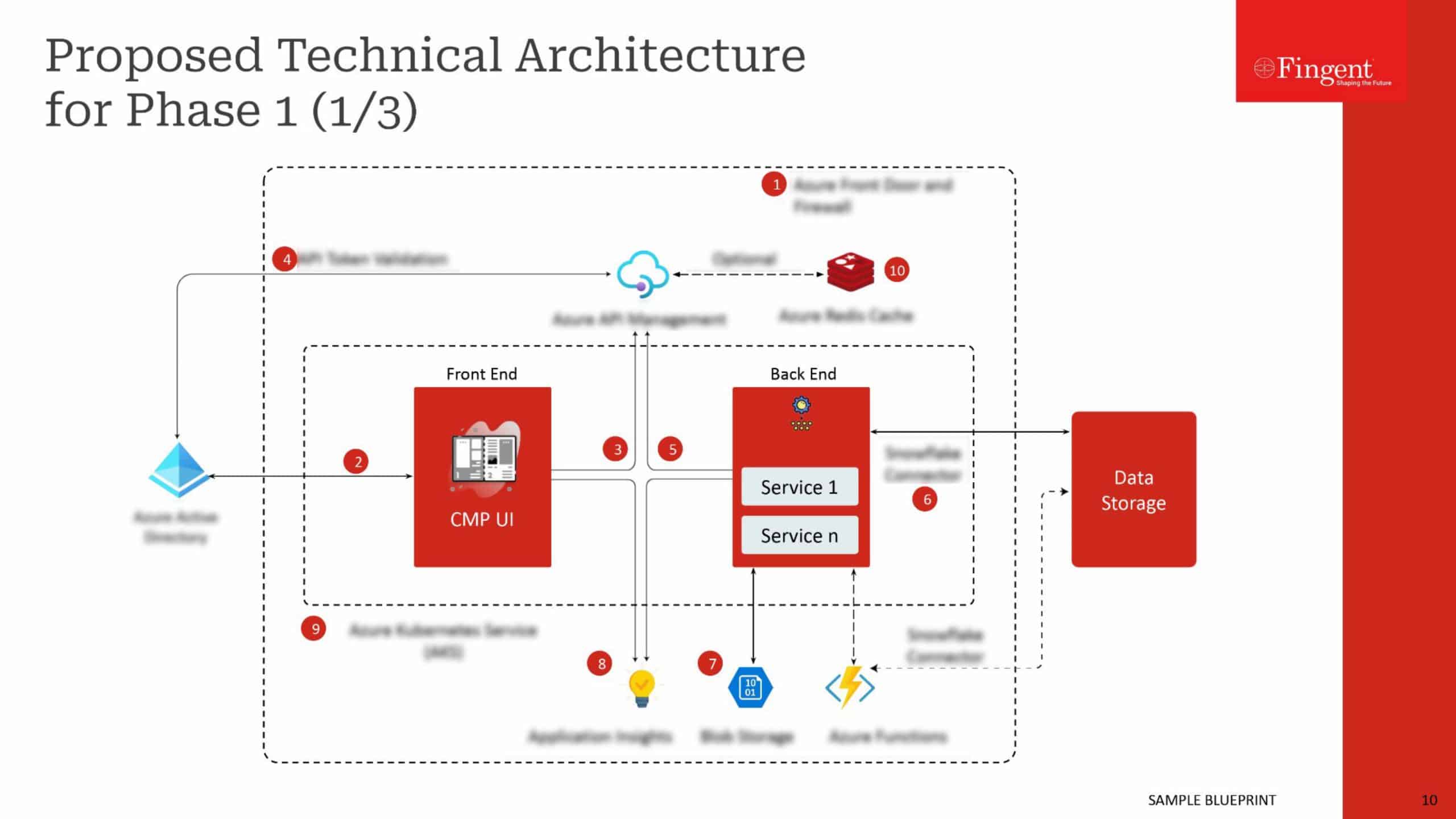
Fingent implemented a comprehensive AI-based Call Center Agent Scoring Application built on Microsoft Azure's cloud-native serverless architecture. The solution utilizes Azure Functions and Azure OpenAI Service with multiple GPT models for intelligent cost-optimized processing. The system processes call transcripts through a sophisticated pipeline featuring pre-processing modules for text normalization and PII removal.

Advanced model-specific prompt engineering utilizing few-shot in-context learning with domain-specific knowledge injection is used to transform the organization's 10-criterion scorecard into structured evaluation instructions. Call ingestion occurs via REST API integration with the existing contact center platform. This triggers workflows that orchestrate evaluation through configurable sampling strategies—from targeted call types to full 100% coverage— for cost optimization.

The platform integrates bidirectionally with existing systems and business intelligence tools.

Comprehensive audit trails, data protection, and retention policies ensure compliance.

The system maintains enterprise-grade security with role-based access control and integration with Azure Active Directory.

Enable a smooth and effortless AI transition journey with Fingent

IMPLEMENTATION JOURNEY

Ensuring a Successful and Smooth AI Transition

The implementation began with a comprehensive feasibility study involving detailed analysis of the organization's existing QA criteria, call types, and evaluation processes. The team conducted extensive testing of different evaluation strategies and LLM models to identify optimal performance and cost. The development phase focused on building the core Azure-based application backend, the PostgreSQL, and the CosmosDB. This was done by establishing secure API connections with their existing contact center platform for automated transcript ingestion.

The rollout phase began with a pilot program covering specific call types and agent groups, gradually expanding to full deployment across all 350 agents. This phase involved fine-tuning based on real-world performance data, optimizing cost efficiency and processing strategies, and training managers and QA staff on the new system capabilities. Throughout the implementation, Fingent maintained a strong stakeholder engagement with regular progress updates, addressed technical challenges through iterative problem-solving, and ensured seamless integration with existing workflows to minimize operational disruption.

Developed a React-based user interface for QA supervisors and managers to review and modify AI evaluations.

Extensive testing across different call types, agent performance levels, and edge cases ensured reliable operation before deployment.

Implemented comprehensive audit trails and integration with Power BI for reporting.

Explore how our experts can turn your innovative ideas into reality

BENEFITS

Making An Impact On Client Success

The AI-powered QA solution delivered improvements across multiple dimensions of the organization's call center operations. The most significant achievement was expanding evaluation coverage from 3% to 100% of all calls—a massive increase in visibility. This comprehensive coverage eliminated sampling bias and provided the first complete picture of agent performance across all interaction types, times, and customer segments. The automation generated substantial cost savings by reducing manual QA labor requirements significantly. QA staff can now focus on strategic coaching, trend analysis, and complex cases requiring human judgment.

Coaches and managers gain access to comprehensive, objective performance data enabling fair and accurate agent assessments.

Data-driven decisions can be made about training programs, coaching priorities, and performance management.

The system provides the base to identify performance patterns, compliance risks, and improvement opportunities at scale

Real-time alerts for compliance violations and quality issues enable immediate intervention.

Quick identification of issues

Strategic, data-driven training approaches

Reduced QA operational costs

Improved service quality & agent performance

Have a similar challenge or an idea to discuss?

Stay up to date on what's new

    About the Author

    ...
    Author

    Talk To Our Experts

      Unlocking Marketing Intelligence with a Conversational AI Agent

      Challenges:

      The marketing team lacked access to actionable intelligence from 9,400 daily call center interactions. This limited their understanding of their customer behavior and changing trends.

      Industry

      Media/Nonprofit

      Solutions:

      Custom Conversational AI Agent to unlock marketing intelligence

      Results:

      Accelerated campaign development by 3 weeks. Faster intelligence gathering process. Enhanced clarity on customer needs and behavior. Data-driven and targeted marketing campaigns. Improved user engagement and brand trust.

      Location:

      US

      About the Client

      The client is a diversified media organization with an annual revenue of approximately $700 million and a workforce of over 1,500 employees. The company operates across multiple verticals, including content production, broadcasting, digital media distribution, and publishing, serving millions of customers worldwide. The company focuses on evolving with emerging technologies to stay competitive in a rapidly changing media landscape.

      The company handles approximately 9,400 call center interactions daily. It's equivalent to 3.4 million annual conversations' worth of untapped user feedback. However, the marketing team had no scalable method to analyze these conversations. This left them unable to identify trends, measure sentiment, or understand the specific needs and motivations of their users, despite having an excellent data source at hand.

      Case Overview

      The lack of insight was a significant opportunity cost. Marketing campaigns were designed with incomplete information, limiting their effectiveness and ROI. Product development was reactive, relying on delayed or indirect feedback rather than real-time data. Crucially, the organization was missing the ability to proactively understand its users, which is essential for building loyalty and driving engagement in a competitive media landscape.

      The leadership evaluated expanding customer surveys and manual call analysis teams. But surveys yielded low response rates, while manual analysis was unscalable and too expensive. Fingent recognized that an AI Agent-based solution can analyze 100% of call data in real-time while leveraging existing infrastructure from a parallel call center agent evaluation project. The initial concerns about AI accuracy and implementation complexity were addressed through a phased PoC and MVP approach, which demonstrated quick wins during the design phase.

      CHALLENGES

      Roadblocks Faced In The Existing Systems

      Inability to convert 3.4 million annual customer interactions into insightful data

      Manual and weeks-long intelligence gathering process

      Inability to proactively understand customer needs and behavior

      Lack of data-driven campaign development

      Inability to build brand loyalty and drive customer engagement

      SOLUTION

      Fingent’s Approach - Custom Conversational AI Agent

      The conversational agentic AI system was built on a cloud-native serverless architecture using Azure Functions. The solution features a React-based conversational chat interface embedded into the client's internal applications for easy access. Marketing users query the data using natural language, which is then routed to AI agents equipped with specialized tools.

      The stack is designed for modularity and scalability, leveraging Python’s async capabilities for low-latency API interactions, paired with a responsive React-based front end. The serverless architecture using Azure Functions ensures efficient resource utilization. The system leverages PostgreSQL with pgvector to store embeddings for RAG ( Retrieval Augmented Generation), and a NoSQL store for unstructured data. The system includes a data pre-processing pipeline that embeds relevant data, stores metadata, and generates additional contextual information. The agentic AI system is powered by Azure OpenAI for planning and execution.

      The system uses both REST APIs and MCP (Model Context Protocol) to access data and tools.

      The architecture prioritizes scalability, fault tolerance, and extensibility.

      Azure AD, RBAC, and additional security measures ensure enterprise-grade compliance.

      Enable a smooth and effortless AI transition journey with Fingent

      IMPLEMENTATION JOURNEY

      Ensuring a Successful and Smooth AI Transition

      Implementation began after validating the concept and identifying strategies to overcome key bottlenecks via multiple PoCs. The three-month project was structured across three distinct phases to ensure an agile and effective rollout.

      Throughout the project, the team successfully navigated key challenges related to performance and data accuracy. To ensure fast response times when querying large volumes of data, the system's architecture was optimized for efficient data processing and caching. The reliability of the AI-generated insights was ensured by a validation process that combined automated confidence scores and source citations. This practical approach ensured the final tool was fast and reliable.

      Phase 1 - Scope & Design: This initial phase of one month focused on identifying the core set of business questions, designing the agentic AI architecture, creating the data processing pipelines, and creating UI mocks.

      Phase 3 - Pilot Rollout & Iteration: Early wins included successfully answering 78% of initial queries and reducing typical research tasks from hours to minutes.

      Phase 2 - Development & Integration: The core development phase included building the React-based chat interface, developing the AI agent and its backend tools on Azure, establishing the data integration with their contact center platform, and finishing with a week of testing with various sample scenarios.

      Explore how our experts can turn your innovative ideas into reality

      BENEFITS

      Making An Impact On Client Success

      The solution transformed the marketing team’s intelligence gathering from a manual, weeks-long process to instant query resolution, accelerating campaign development time by 3 weeks. Estimated time savings averaged 85%, with some tasks that previously required over 4 hours of manual research now completed in under 15 minutes. This new capability led to several measurable improvements in marketing and product development operations.

      Data-Driven Campaign Development: The team could now design campaigns based on a real-time understanding of user needs, concerns, and sentiment.

      Efficient Content Generation: The ability to query the entire call database allowed for the rapid identification of powerful user testimonials and stories for use in content.

      Accelerated Product Improvement Cycles: Direct, unfiltered feedback on products and services could be analyzed at scale to identify and prioritize enhancements.

      Enhanced Regional Analysis: The marketing team could now perform demographic and regional analysis to create more user-specific strategies.

      Improved customer engagement

      Customer-specific marketing campaigns

      Agile decisions in product strategy

      Enhanced brand trust & loyalty

      Have a similar challenge or an idea to discuss?

      Stay up to date on what's new

        About the Author

        ...
        Author

        Talk To Our Experts

          Augmented Reality Powered Facial Recognition App

          Challenges:

          Ability to identify people and access their basic data with facial recognition

          Industry

          Education

          Solutions:

          A unique mixed reality application enabling quick identification of people through facial recognition

          Results:

          The application can enhance security checks and protocols with easy identification of people. Real-time access to databases and image comparison and recognition abilities make the app a groundbreaking innovation.

          Locations:

          US

          About the Client

          The client is a renowned university in the US, known for its innovative researches, teaching methods, and public services. As a part of their research, the organization wanted to explore on the opportunities of enhanced security and communications through facial recognition.

          Fingent, being their global technology partner for years, collaborated to establish a solution with mixed reality. Fingent had previously assisted the university in developing projects involving upcoming technologies such as AR, VR, and AI.

          Case Overview

          The client sought a groundbreaking solution, and Fingent ensured they got it! Using Microsoft Hololens, Fingent developed a mixed reality, first-of-its-kind application that enables users to identify people using facial recognition.

          The application can further link the facial recognition to the biodata of a person for more relevancy. The app will further have the capability to capture images and compute similarities between the captured images and compute similarities with images in secured database.

          CHALLENGES

          Roadblocks Faced in the Existing System

          Lack of high recognition accuracy

          Enhance security and privacy

          Dependency_on_siloed_applications_&_Excel_Sheets

          Secure management of student/staff database

          Maintaining visibility and keeping track of data was tedious

          Inability to quickly scan biodata and student details

          Complexities of leveraging new-age technology

          SOLUTION

          Fingent’s Approach - AR-powered Facial Recognition App

          Fingent delivered a first‑of‑its‑kind mixed reality solution on Microsoft HoloLens, combining on‑device facial recognition with secure cloud‑based data retrieval to instantly overlay validated biodata in real-time, enabling:

          3D bubble hologram to display biodata using UNITY 3D Engine

          Uses Microsoft Face API to verify and identify the correct match

          Capture a facial image and compare it with the existing database

          Hololense-benefits

          Explore how our experts can turn your innovative
          ideas into reality

          Hololense-solutions

          BENEFITS

          Making an Impact on Client Success

          The app streamlines identity checks and accelerates security workflows. The intuitive HoloLens interface and optimized edge‑cloud processing ensure rapid, reliable performance and seamless campus integration.

          Instant on‑the‑spot identification

          Real‑time biodata overlays

          Enhanced privacy and security

          Intuitive MR interface for quick adoption

          Enhanced Security

          Easy Scanning of Biodata

          Improved Management of Databases

          Quick Identification of People

          Have a similar challenge or an idea to discuss?

          Stay up to date on what's new

            About the Author

            ...
            Isac

            Talk To Our Experts
              ×