Tag: AI
Imagine being able to describe an app out loud and watching it come to life—no syntax, no setup, no stress. That’s the essence of vibe coding. It’s not just a new coding style; it’s a new interface between humans and software development, one that’s reshaping who can build, how fast they can do it, and what the future holds.
In this article, we’ll take a grounded, practical look at vibe coding—what it is, how it works, its current limitations, and where it’s headed.
Vibe Coding: Explained Simply
Andrej Karpathy popularized the term “vibe coding,” which he summed up as “see stuff, say stuff, run stuff.” Vibe coding is the process of explaining your project to an AI system, usually in natural language, and having it produce functional code for you.
AI tools that power this workflow include:
- GitHub Copilot – Offers relevant code completions based on project context
- ChatGPT – Can generate full functions, explain code, and handle debugging
- Replit Ghostwriter – Helps solo developers build full-stack apps quickly
- Cursor – A VS Code-based editor with deep AI integration
These tools run on large language models. Like the kind trained on billions (yes, billions) of lines of open-source code.
They don’t just guess what you’re trying to build — they’ve practically read the manual for every major language out there. From Python and JavaScript to TypeScript, Go, and beyond, they understand how real-world developers write code.
They’ve studied common patterns. They know the popular libraries. And they get the frameworks most teams use. It’s like having a super well-read coding buddy — minus the coffee breaks.
Have a Software Development Idea? Let Us Help You Strategize a Streamlined Development Cycle
How Does Vibe Coding Work?
The vibe coding approach aims to reduce coding efforts to almost zero. The process is heavily reliant on AI, where users can generate code by just explaining how they want the software to function. Developers can simply apply prompts in natural language, and the AI assistant writes the code, including backend logic, frontend UI, and even APIs. Codes can be generated, debugged, and also refined. Here’s more on what a basic vibe coding flow might look like:
Choose Your Platform
Start by selecting an AI coding assistant. When you do that, ensure it complements your tech stack and budget. Replit, Cursor, Copilot, Lovable— they all help you write code. But the way they interact? Totally different. Some feel like a chatty co-pilot, finishing your thoughts before you do. Others are quiet powerhouses—minimal, fast, and out of your way.
Choosing one isn’t just about features. It’s about discovering the one that matches. Once you’ve picked your tool, the magic begins. These AI assistants don’t just suggest syntax—they generate actual, working code. Backend logic? Check. Frontend UI? Covered. API hooks? Already there.
Tell the AI Your Dream
A prompt is your design brief.
Example prompt (front-end):
“Create a React component that animates dots in rhythm with an audio track. Needs start/stop buttons, dark-mode friendly colours, and a prop for BPM so I can tweak tempo later.”
Tips that pay off
- Context first: Mention the tech stack up front (React 18, Tailwind, Supabase).
- Goal over detail: Focus on the ‘why’—the vibe you want—then layer specifics.
- Constraints save time: Screen size, performance targets, or API versions narrow the search space for the model.
Sculpt the First Draft
The AI responds with a “rough cut”: working code plus comments. It’s functional, not flawless. Here’s where you channel your inner film editor:
- Run it immediately. See what breaks.
- Copy-paste any error back into the prompt
- terate conversationally. Treat the model like a junior dev—ask why it chose a library or pattern.
Pro tip: Keep iterations short. If you haven’t improved the build after two tweaks, rewrite the prompt instead of patching spaghetti.
Review, Secure, Ship
AI can compose a melody, but you still master the track:
- Static analysis & linting (ESLint, Flake8) catch style drift and obvious bugs.
- Security scans (Semgrep, Snyk) look for SQL injection, weak auth, exposed secrets.
- Unit & integration tests anchor behaviour before refactors.
- Peer review stays non-negotiable—formal and informal inspections catch around 60–65% of latent bugs before code is merged.
Let’s Put It All Together
- Platform gives you the stage.
- Prompt sets the script.
- Iteration directs the scene.
- Review keeps the critics quiet.
Repeat this loop and you’ll notice a rhythm: shorter feedback cycles, fewer context switches, and more time spent on what the software should do—not how to spell it in code. That’s the real vibe.
Why Vibe Coding Is Gaining Real Traction
Simply because it’s faster and more accessible. Most of all, it’s enabling even non-developers to turn ideas into working software quickly. No doubt, vibe coding is promising a new future for software development, opening doors to faster and seamless development cycles.
Speed to Value
Time is money—especially in tech. AI-assisted development shortens time-to-market. Did you know that the research shows that developers using GitHub Copilot were able to complete programming tasks 55–56% faster. AI didn’t just speed things up. It hit fast-forward.
Availability
With the right prompt, product managers, analysts—even founders—can spin up MVPs in no time. No code bootcamp. No sleepless nights. Just clear ideas, well-worded.
Focus on High-Value Assignments
Let boilerplate be handled by AI. Developers can concentrate on tasks like building scalable architectures and so on. These are areas where human insight still holds sway.
Expedited Feedback Loops
Faster iteration = better products. AI allows for quick testing, immediate revisions, and more user-centric development.
Democratization of Software Building
Non-engineers can now participate meaningfully in development. This creates cross-functional innovation and faster internal tooling.
Who’s Using Vibe Coding?
Anyone from startups, enterprises, indie developers, and even boot camps is adopting vibe coding to speed up delivery and lower technical barriers. The 2025 report from SnapLogic is noteworthy. It said that 50% of enterprises are already deploying AI agents in production. Another 32% planning to do so within the next year.
A whitepaper by IBM, 2024, provided an interesting forecast. It claimed that 40% of the global workforce will need reskilling over the next three years due to AI and automation efforts.
There’s circumstantial (but growing) indication that vibe coding is being used in:
- Startups: Founders are building MVPs using AI tools with minimal traditional coding.
- Enterprise Prototypes: AI is used by businesses like Visa and SnapLogic to speed up internal tools.
- Education: To improve learning, coding schools and boot camps are incorporating AI tools into their curricula.
- Indie developers: One-person SaaS teams are shipping apps faster using Replit and ChatGPT.
2025 report from SnapLogic is noteworthy. It said that 50% of enterprises are already deploying AI agents in production. And another 32% planning to do so within the next year. A whitepaper by IBM, 2024 provided an interesting forecast. It claimed that 40% of the global workforce will need reskilling over the next three years due to AI and automation efforts.
The Limitations: What Vibe Coding Can’t Do (Yet)
The fact is that AI is what it is – artificial and not human. While that plays out well in many scenarios, it does fail the litmus test when it comes to some. One of the main glitches in the Vibe Coding system is the ability to include real-world context – the “why”s of the task. And the fact that its context window is comparably short. Which means the need for repetitive and highly specific prompts. Additionally, it can’t be expected to design systems from scratch, or guarantee secure code—it still needs human oversight and engineering discipline.
Despite the hype, vibe coding is not a silver bullet. Here are its current shortcomings:
- Prompt clarity matters: Vague prompts = vague output. Clear thinking is still required.
- Architecture isn’t automatic: AI can build features. However, it doesn’t design maintainable systems.
- Debugging can be opaque: You may get working code, but understanding and fixing bugs is still human territory.
- Security issues: AI doesn’t use auth flows, automatically clean inputs, or adhere to OWASP standards.
- Tooling fragmentation: is a growing pain. AI-generated code often breaks. Especially when it meets your tests, linters, or CI/CD pipeline. Speed is great—but without precision, it’s chaos.
Winning teams strike the balance: fast code, clean handoffs, solid engineering.
How Can Enterprises Use Vibe Coding Strategically?
Enterprises can use Vibe Coding strategically by playing to its strengths and propping up its weaknesses. Use it in low-risk areas like prototyping, which is one of its superpowers. Train your teams in prompt writing – specific and detailed prompts that leave no room for ambiguity. Review AI-generated code like you would a junior dev’s work and get micro with security measures.
Here’s how enterprises can experiment with vibe coding without taking on unnecessary risk:
- Leverage it for prototypes and other internal tools
These could prove to be high-reward. Plus, low-risk settings for experimentation. - Train your developers in prompt writing
Prompt engineering is the need of the hour. It is turning into a real skill set. - Establish human-in-the-loop code reviews
Treat AI code like a junior developer’s work—it needs checking. - Build reusable prompt templates
Standardize how teams ask for common patterns like login flows, dashboards, or API scaffolds. - Measure outcomes rigorously
Track time saved, bugs introduced, and deployment cycles to ensure real value.
Discover How Fingent Is Accelerating Software Development Process with AI
Final Thoughts: Is Vibe Coding the Future?
Vibe coding is not about eliminating developers—it’s about augmenting them. It reframes coding as a combination of design thinking, communication, and quick iteration rather than just a technical task.
The main trend is true: AI is significantly speeding up software development, even though some of the statistics that are circulating—such as 95% AI-generated codebases—are unverified.
We at Fingent trust that the most prosperous businesses will be those that carefully incorporate AI rather than those that heedlessly pursue automation.
Are you curious about the potential applications of AI-assisted development in your company?
Stay up to date on what's new

About the Author

Featured Blogs








Stay up to date on
what's new



Talk To Our Experts

AI was once limited to internal pilots—impressive in demos, but rarely tied to measurable business outcomes. That’s changed. Today, AI systems are being integrated into workflows that impact decisions, operations, and outcomes.
That’s where the Model Context Protocol (MCP) and Agent-to-Agent (A2A) communication come in. MCP provides a minimal interface for tool access and execution context. When paired with agent logic and A2A communication, it enables agents to reason and coordinate actions collaboratively.
This article explains what an MCP server is, why it matters for enterprise AI, and which capabilities to prioritize for scalable automation.
Why MCP & A2A Matter for AI Deployment
To scale AI agents across an organization, enterprises need more than smart models—they need standards.
What is MCP?
Model Context Protocol (MCP) is an open interface specification that allows AI agents to interact consistently with enterprise tools, data sources, and other agents—without custom code or proprietary integrations.
While MCP facilitates the access to resources that might be used in multi-agent workflows, the direct communication and coordination between agents is typically handled by Agent-to-Agent (A2A) protocols. MCP uses a JSON-RPC communication to:
- Allow clients (like AI agents) to connect to servers.
- Standardize how requests, responses, and errors are handled between these components.
- Enable modularity—A single tool setup can serve multiple agents, streamlining development.
The goal of MCP is to create a minimal, interpretable interface that lets intelligent agents work across systems without custom APIs or hardcoded integrations.
What is A2A?
Agent-to-Agent (A2A) allows AI agents to delegate tasks, share partial context, and coordinate across functions—using structured, programmatic protocols rather than hardcoded instructions.
Why This Matters
Without common standards, AI agents become fragmented across teams and workflows. MCP and A2A enable composable architecture, traceability, and shared tooling—key to scaling automation without increasing operational risk.
By adopting MCP:
- Tools and resources become composable: Build once, connect many agents.
- Traceable agent decisions: Every interaction is logged and inspectable.
- Cross-functional orchestration made possible: Agent orchestration enables cross-functional coordination and task delegation.
The result is lower engineering overhead during deployment and a consistent architecture. Scaling from isolated use cases to organization-wide AI agents requires shared protocols—not just APIs or refined models. Without standards, enterprise AI becomes hard to audit and expensive to maintain.
Open-source ecosystems, including LangChain, Autogen, and Semantic Kernel, converge on MCP as a shared layer for tool access and context passing. For enterprises, this eases integration and future-proofs internal AI infrastructure.
Why Should Businesses Consider MCP and A2A?
While CEOs don’t need to master the technical details of AI architectures, they do need to assess whether their systems are:
- Modular enough to evolve.
- Transparent enough to audit.
- Scalable enough to grow.
Studies show that more than 80% of AI initiatives underperform or stall—making them significantly riskier than typical IT projects. Success in this domain demands more than automation. It requires agents that can understand, collaborate, and adapt—across platforms, tools, teams, and geographies. This is precisely what Model Context Protocol (MCP) and Agent-to-Agent (A2A) communication enable.
MCP and A2A should be seen as part of the infrastructure that makes scalable AI possible. They’re not solutions in themselves—but they make robust, reusable, and collaborative AI systems possible. Without shared standards, AI rollouts become expensive one-offs. MCP establishes the connections; A2A provides management. Together, they move you to resilient intelligence.
While specific outcomes may vary, AI implementations in IT support have demonstrated up to 40% cost savings and up to 50% time savings.
AI Is Revolutionizing the Way Businesses Function Are You Ready to Leverage the Best of AI?
Inside the Architecture: How MCP & A2A Work
MCP defines a standardized, modular structure where clients request operations and Servers expose tools and data. JSON-RPC ensures standardized, traceable communication—so models, tools, and policies plug in seamlessly.
MCP servers define available tools, data access layers, and interaction templates. Clients act as execution interfaces. The JSON-RPC format ensures every call and response is standardized and traceable. A compatible format across environments ensures enterprises can plug in new models, tools, or policies easily.
A Modular System for Enterprise-Grade AI
Let’s break down the key MCP elements:
- Tools are executable functions—made accessible via the server, invoked by the client. Think of them as APIs that models can call to perform enterprise-level operations—like querying a CRM or triggering a workflow. These aren’t static scripts—they’re dynamic, callable operations the model can reason over.
- Resources are structured data assets—files, database entries, or API payloads. They remain under enterprise control. The model can read them but doesn’t own them. This safeguards integrity and enforces a clean boundary between AI reasoning and enterprise data.
- Prompts serve as organised models. These use variables and predefined instructions to shape model interactions. Prompts convert model behaviour into repeatable, auditable logic. That is when you answer customer enquiries, convert JSON payloads, or summarise legal contracts. Together, these elements form the foundation for AI systems that are modular, auditable, and safe to scale.
MCP Client: A Lightweight Interface for Model Execution
The MCP Client issues calls based on pre-defined prompts and tools—but orchestration logic (like when to call what) sits outside, typically in the agent runtime. It’s worth noting that agents—built on top of MCP, can use Clients to drive intelligent behaviors. For example, a pricing agent could receive a prompt based on real-time supply chain data and invoke a pricing tool to automatically adjust product costs—without human intervention. It’s not guessing. It’s acting within boundaries you’ve set.
Agent-to-Agent (A2A): Real-Time AI Coordination
While MCP standardizes how a single agent operates, Agent-to-Agent (A2A) takes it a step further. It defines how multiple agents communicate. It offers a structured, encrypted, and completely interoperable communication substrate required for independent cooperation.
With A2A:
- Agents can securely share updates about what they’re doing, what they know, and what they need.
- Agents delegate responsibilities dynamically.
- Agents coordinate actions based on shared objectives.
A2A is still an evolving design pattern. While promising, it lacks a unified protocol spec. Today, teams implement A2A through frameworks like AutoGen or custom coordination logic.
Strategic Upside: Why CEOs Should Care
Key outcomes that matter to enterprise leadership:
- Interoperability: With MCP, switching models or vendors doesn’t require rewriting business logic. You get abstraction without lock-in.
- Security & Governance: Fine-grained control over agent access—down to tools, tasks, and data. MCP makes agent behavior predictable and explainable. It also ensures that all actions are fully auditable.
- Compliance: Because MCP standardizes communication formats, it supports detailed logging and traceability—critical for compliance audits and responsible AI governance.
- Adaptability: When priorities change, your architecture doesn’t break. MCP supports plug-and-play upgrades—whether it’s a new language model or a compliance shift.
Assess your existing AI infrastructure based on these criteria:
- Can AI modules integrate without rearchitecting systems?
- Are agent actions traceable and compliant?
- Is collaboration autonomous or human-assisted?
- Can components be swapped without vendor lock-in?
Bottom Line
For CEOs serious about scaling AI—not just experimenting with it—this is the architecture that moves you from pilot to production, from automation to transformation.
MCP Implementation: Best Practices
Integrating the Model Context Protocol (MCP) into your AI infrastructure doesn’t require a complete architectural overhaul. When implemented thoughtfully, MCP enhances how autonomous agents reason, interact, and collaborate across enterprise systems. For CEOs, this means adopting a systems-thinking approach: How do you enable scalable, modular intelligence across functions without compromising control or security?
Start with a Pilot
Start small. Look for areas where agent-to-agent (A2A) communication can reduce latency or manual intervention. For instance, if your support agents operate without real-time CRM context, MCP can provide the interface to access that data. It will enable better coordination within a broader agent orchestration system.
Choose Open Standards
Avoid proprietary lock-in by selecting an open-standard MCP architecture. Your enterprise should remain flexible—able to integrate new LLMs, APIs, or microservices without rewriting communication protocols.
The MCP server should expose standardized components:
- Tools: Model-invoked operations like database queries or file generation.
- Resources: Application-managed data including APIs, storage, or documents.
- Prompts: Predefined templates for tasks such as summarization or Q&A.
Map Your Context Layers
In AI systems, “context” isn’t just raw data—it includes temporal signals, task relevance, and user intent. MCP enables agents to act not in isolation, but with awareness of their operational environment.
A robust implementation includes a context repository—a shared data layer that maintains evolving state information, enabling agents to coordinate actions with continuity and relevance.
Choose Partners Who Specialize in Agent Orchestration
Work together with engineering teams that have practical MCP framework deployment experience. This will reduce integration risks and accelerate time to value.
For instance, Fingent prioritises security, modularity, and long-term scalability when working with businesses to implement agent-based systems. With tried-and-true design patterns, Fingent customizes design patterns to fit business ecosystems.
Define Success Metrics Early
MCP implementation must translate into measurable business outcomes. Whether you’re targeting a 15% improvement in model accuracy or automating repetitive decision trees, define these metrics early.
When paired with orchestration frameworks, MCP enables real-time visibility into agent workflows—helping your team align AI interactions with measurable KPIs. Engineering efforts should begin only after your success criteria are clearly articulated.
Embrace Incremental Rollout
Deploy MCP incrementally. Begin with isolated, low-risk workflows where output can be quickly validated. Once performance is confirmed, expand to more complex, interdependent functions. This phased approach reduces exposure and allows for faster iteration based on feedback and learning.
Stress-Test A2A Communications
Agent-to-agent communication is the foundation of distributed reasoning. But what happens when an agent disconnects mid-task or misinterprets a shared context?
Design for failure. Run chaos tests that simulate outages, data corruption, and conflicting agent behavior. Your architecture should support retry logic, fallback protocols, and human intervention pathways. Resilience—not just speed—should be the benchmark.
Build in Human Override Mechanisms
As systems scale, autonomous agents must still operate within defined ethical and operational boundaries. Implement policy engines that enforce constraints and human override controls that allow for intervention in edge cases.
These guardrails ensure your AI infrastructure stays compliant, auditable, and aligned with enterprise values.
Treat Your Agents Like Employees
Autonomous agents require structured governance, defined roles, access permissions, audit logs, and performance metrics, similar to how enterprises manage human teams.
Prepare for Disagreement
In modular agent architectures, conflicting outputs are inevitable. One agent may override another; two may interpret context differently. Without conflict resolution protocols, such disagreements can derail workflows.
Implement arbitration logic—whether through rule hierarchies, ensemble models, or escalation to human reviewers. MCP must support not just agent communication, but also reconciliation and collaborative reasoning.
The Challenges
MCP and A2A are powerful—but there are challenges to be aware of so you can deal with them..
Skill Gaps
Most enterprise tech teams are not yet fluent in agent-based coordination. Expect a learning curve in architecture, not just code.
Tooling Immaturity
While libraries like AutoGen and LangGraph are maturing fast, many are still under rapid development. Stability can vary. Documentation often lags.
Standards Fragmentation
Not all “MCP” implementations follow the same conventions. Choose vendors and tools that are interoperable—and be ready to enforce internal standards.
Change Management
Shifting from pipeline automation to agent collaboration requires a mindset change. Some teams may resist. Others may over-engineer. Without constraints, autonomy becomes chaos.
A smart strategy is to treat MCP like an internal protocol—not a one-off project. Invest in internal documentation. Train key leads. And review each rollout with the same rigor as you would a security audit.
Looking Ahead: Future of MCP and A2A Standards
MCP and A2A are still emerging—but the momentum is clear.
Anthropic’s original announcement of MCP provides further context on its origins and intended impact across multi-agent systems.
Open standards are forming. Early implementations are converging around core design principles: JSON-RPC for message passing, shared state objects for coordination, and permissioned tool definitions.
Like Kubernetes standardized containers, MCP is emerging as the control plane for AI agents. Protocols are stabilizing. Tooling is catching up. And early adopters are defining what “good” looks like.
One emerging direction is cross-agent collaboration across platforms—potentially leading to “agent marketplaces,” where enterprises can exchange modular agents that adhere to shared protocols like MCP.
It’s early—but the stakes are high.
Enterprises that adopt MCP now don’t just prepare for the future. They help shape it.
Discover Unique Opportunities With Fingent’s Custom AI Solutions
Turning Strategy into Execution—with Fingent
At Fingent, we build custom AI solutions designed to scale and perform—now and in the future. From MCP-compliant architectures to secure A2A pipelines, we turn complexity into clear, measurable results.
At Fingent, we don’t just build—we partner. From architecture to rollout, we make AI reliable, scalable, and aligned with your business goals. Whether you’re launching your first AI agents or managing enterprise-wide intelligent ecosystems, we make sure your AI speaks one language, works seamlessly, and delivers real outcomes.
In the age of autonomous intelligence, being smart isn’t enough. You need smart that works together.
Keep in mind that disjointed AI hinders business progress. Team up with Fingent to power unified, unstoppable intelligence—and lead your industry forward.
Stay up to date on what's new
About the Author
Featured Blogs
Stay up to date on
what's new
Talk To Our Experts
“It’s becoming increasingly clear that AI is the future, and almost everything else is a sideshow.” – World-renowned computer scientist Geoff Hinton
AI has taken over almost every aspect of society. It provides a wide range of benefits that have accelerated its traction in the modern era and caused it to sink its roots deeper into society. Document processing is one of the sectors in management that has stood to benefit the most from artificial intelligence. This article will explain how to make the most of this fortuitous union.
The Use of AI In Document Processing
For years, documents have been manually created on paper or Excel sheets. Data and valuable insights from these documents have also been manually retrieved. Thus, the data approval processes require the physical circulation of files and documents. Dissemination relies on printing or electronic means, making processes more lengthy and strenuous.
Revision and editing are also conducted manually, with adherence to storage protocols for archiving purposes. Compliance and auditing necessitate the completion of reports and paperwork by hand. While these conventional procedures have been the standard practice for some time, they are prone to inefficiencies, lengthy labor hours, and data insecurity.
The use of AI in document processing has completely changed how businesses manage paperwork by providing automation, increased accuracy, and efficiency. AI technologies allow for automatic information extraction, analysis, and classification from documents. Examples of these technologies include machine learning, optical character recognition (OCR), and natural language processing (NLP). These systems help with intelligent decision-making, extract important insights from documents, and classify them.
AI-driven document processing systems minimize mistakes and eliminate the need for human data entry by automatically identifying, extracting, and validating data. AI also improves text comprehension and accessibility by enabling advanced capabilities like sentiment analysis, summarization, and language translation. All things considered, AI in document processing improves productivity, accelerates procedures, and simplifies workflows, all of which significantly benefit businesses in various sectors.
Simplify Business Processes with AI Automation.
Common Challenges in Document Processing
1. Manual Data Entry and Its Limitations
With manual data entry, there is inevitably an element of wasted time and effort. It is a mundane task that can leave employees with a deep sense of stagnation that can directly affect their quality of work. Listed below are some of the major limitations of manual data entry:
- Accuracy: Prone to human mistakes and dependent on the state of the individual inputting.
- Speed and efficiency: Slow and inefficient due to human limitations and the necessity for breaks.
- Costs: Lower start-up expenses but greater long-term employment costs.
- Workflow integration: Additional procedures may be required for integration with digital operations.
2. Error Rates and Data Inconsistencies
Errors frequently occur when manual customs entries are processed. In commerce, much time and money is spent moving data from one document to another, yet mistakes are common. Up to 4% of errors occur during data entry without verification layer processes.
3. Scalability Issues
The root cause of scalability problems in document processing is the inefficiency of human approaches to processing huge amounts of data. Some of the difficulties are processing data slowly, using a lot of resources, being prone to errors, having little flexibility, having compliance issues, and having complicated integration.
4. Compliance And Security Concerns
Manual processing raises the possibility of human error, resulting in data breaches and compliance infractions. Because physical storage doesn’t have strong access restrictions, unauthorized parties might access private data. Furthermore, audit trails suffer from manual operations, which makes it difficult to monitor document handling and guarantee regulatory compliance.
The Transformation With AI: Top Benefits
Artificial intelligence has emerged as a savior that rescues organizations from the clutches of manual document processing. Listed below are some areas that benefit greatly from AI.
1. Efficiency And Cost Savings
AI simplifies many document-processing tasks. It lightens the workload for staff members across many departments, freeing up time for other duties. By automating repetitive tasks, organizations can greatly cut unnecessary costs and enhance their overall efficiency.
Reducing processing time and operational costs is another major benefit of AI in document processing. Automation lowers labor expenses related to hand-processing documents, resulting in considerable cost savings. By reducing human labor, intelligent document processing also reduces the time required for processing. AI technologies save expenses, particularly for organizations that must recruit temporary staff during their busiest seasons.
2. Enhanced Accuracy
Machine learning increases the accuracy of document processing by using OCR (Optical Character Recognition) for adaptive recognition, automating data extraction, and comprehending document context. Errors are found and fixed, and accuracy is continually increased with feedback. By decreasing manual involvement and boosting the effectiveness of collecting insights from documents, machine learning (ML) enables customization for specific demands.
Furthermore, AI reduces human error in document processing by using continuous learning, contextual understanding, automated data extraction, advanced OCR for accurate text recognition, and error detection and repair.
3. Intelligent Decision-Making
IDP provides important insights, analyzes retrieved data, and automates repetitive procedures. As a result, company managers can base their judgments on factual and impartial facts. By acquiring structured data from unstructured documents, finding patterns and correlations, and using natural language processing (NLP) to comprehend the context and sentiment of text, artificial intelligence (AI) in document processing offers data-driven insights and analytics. It promotes rapid comprehension and decision-making by arranging and simplifying documents.
Predictive modeling is another use of AI in document processing. AI models may help with strategic planning by predicting outcomes based on past data. Machine learning algorithms study past document data to find trends and patterns that allow for predicting future events. Thanks to this predictive information, businesses can proactively adjust plans, efficiently manage resources, and take advantage of new opportunities.
4. Customer Satisfaction
Using AI for document processing can help you increase client loyalty. It reduces paperwork mistakes and the average response time. A fast response helps establish solid, reliable connections with consumers. To improve the overall customer experience, AI-powered document processing systems may evaluate consumer data to customize interactions and tailor replies to specific requirements and preferences. Artificial intelligence improves clarity and transparency in client relationships by automatically creating and distributing bespoke documents, such as contracts or invoices, facilitating seamless communication.
AI Document Processing in Action: Use Cases Across Industries
AI has proved to be a game-changer in many industries as it smooths out document processing and achieves time and cost efficiencies.
1. Banking and Financial Services
AI document processing simplifies processes, boosts productivity, and enhances customer experiences—all critical banking and financial services functions. This is how the industry gains from it:
- Loan Processing: AI speeds up loan approvals and cuts down on processing times by automating procedures for document verification, credit scoring, and risk assessment.
- Fraud Detection: Artificial intelligence (AI) systems examine transaction records and patterns to quickly identify fraudulent activity, allowing for early intervention and reducing financial risks.
- Risk management: AI assists in the decision-making processes related to risk management and wealth management services by analyzing financial documents and market data. This helps evaluate risks, forecast market trends, and optimize investment portfolios.
According to a recent survey by the Cambridge Centre for Alternative Finance and the World Economic Forum, 85% of prosperous financial services companies currently use artificial intelligence in some capacity in document processing.
2. Insurance
Insurance operations are revolutionized by AI document processing, which reduces risks, streamlines procedures, and improves customer experiences.
- Claims Processing: AI simplifies claim settlements and shortens processing times by extracting and analyzing important information from documents.
- AI in Policy Underwriting: This process enhances the precision and efficiency of underwriting by analyzing policy papers and client data to identify risks, personalize coverage, and maximize price.
- Risk Assessment: AI examines a variety of documents, including property assessments and medical records, to precisely determine risk factors. This allows insurers to provide specialized coverage and pricing options.
3. Legal Sector
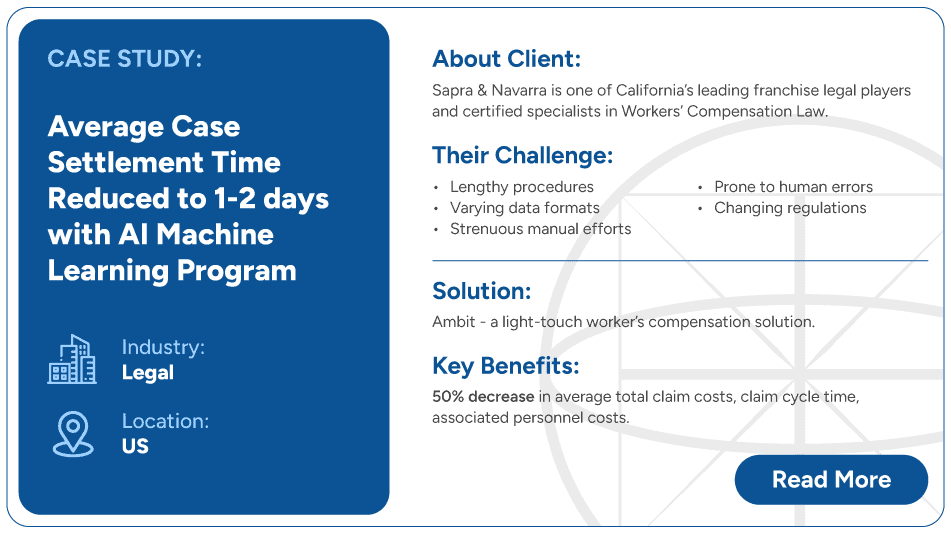
Legal services are changing because AI document processing improves efficiency, streamlines processes, and facilitates better decision-making. According to a Deloitte report, 30% of legal professionals believe AI will transform the delivery of legal services.
- Legal Research: Artificial intelligence (AI)-driven technologies can examine lengthy legal documents, court cases, and precedents to give attorneys relevant information and suggestions, speeding and enhancing the quality of legal research.
- Document Review: Artificial intelligence (AI) reduces the time and effort needed for manual review by automating the extraction of important information, spotting possible risks, and highlighting errors in legal documents, contracts, and agreements.
- Contract Management: AI streamlines and lowers contract administration errors by automating drafting contracts, reviewing, and management processes. It also extracts clauses, tracks obligations, and keeps track of deadlines.
4. Information Technology
AI document processing in information technology is the application of artificial intelligence algorithms to automate the management, analysis, and extraction of data from various types of documents. This technology uses machine learning algorithms, natural language processing (NLP), computer vision, and other artificial intelligence (AI) approaches to comprehend, categorize, and extract useful data from text files, photos, PDFs, spreadsheets, and more.
- Automated code documentation and AI-powered augmented development optimize programmers’ workflows in IT service management augmentation.
- Automated documentation saves effort and assures consistency by creating code explanations automatically. This improves accessibility and knowledge transmission among teams.
- Augmented development uses artificial intelligence for code analysis, optimization, and problem discovery, which speeds up development cycles and improves code quality.
5. Telecommunications
AI document processing in telecoms involves applying artificial intelligence technology to automate numerous document-related operations and boost operational efficiency in the telecom business.
- Chatbots: In telecoms, AI document processing improves customer service chatbots by giving them instant access to information for individualized replies, lowering wait times and increasing efficiency.
- Network Optimization: It also optimizes networks by evaluating performance data to foresee problems, distribute resources efficiently, and plan maintenance, increasing dependability and minimizing downtime.
These applications improve operational efficiency, boost customer happiness, and allow telecom firms to make data-driven decisions for better service delivery.
6. Healthcare
AI document processing in healthcare transforms administrative duties and improves patient care.
- Automated Records Management: AI quickly organizes and pulls data from medical records, improving administrative procedures and lowering human error.
- Diagnostic report analysis: AI examines massive quantities of medical literature and research articles to extract insights that help with medical research, medication discovery, and therapy development.
Custom AI Software Has The Power To Solve Your Unique Problems And Elevate Your Business To New Heights.
How Fingent Can Elevate Your Business with AI
Fingent is one of the biggest IT solution suppliers worldwide, with clients across four continents.
We provide custom AI solutions uniquely tailored to our clients’ needs across all major industries. By creating a custom AI solution, you will own the program forever. You may even sell the technology to third parties. Custom AI software development is the best option for integrating with current software. Under the supervision of our excellent team, integrating your business with existing systems will be a seamless operation. Our AI-powered chatbots employ machine learning algorithms and natural language processing to understand consumer demands and provide the best responses.
From doing software testing and providing excellent customer service to giving product suggestions, we will assist you at every stage of the procedure. To guarantee the finest results for you, we use cutting-edge technologies such as artificial intelligence, natural language processing, and machine learning.
Give us a call, and let’s discuss your needs.
Stay up to date on what's new
About the Author

Tony Joseph

Tony believes in building technology around processes, rather than building processes around technology. At Fingent, he specializes in custom software development, especially in analyzing processes, refining them, and then building technology around it. He works with clients on a daily basis to understand and analyze their operational structure, discover (and not invent) key improvement areas, and come up with technology solutions to deliver an efficient process. You can reach him at [email protected], Skype: tony_fingent
Featured Blogs
Stay up to date on
what's new
Talk To Our Experts
In the dynamic realm of modern business, the profound impact of artificial intelligence (AI) continues to unfold, reshaping industries and redefining conventional practices. As we step into 2025, the transformative force of AI is set to intensify, bringing forth new trends that promise to revolutionize the way organizations operate.
This blog offers a comprehensive exploration of the top AI trends anticipated for 2025, shedding light on their potential implications across diverse sectors. Join us as we look into how AI is shaping the future of modern businesses in 2025.
How AI is Redefining Competitiveness in 2025
As we approach 2025, AI’s impact on the business landscape transcends mere trendiness; it stands as a pivotal force shaping competition. Let us begin by considering the unparalleled competitive advantages that AI implementation brings.
1. Streamlined Operational Efficiency:
Integrating AI into business operations offers a significant boost in efficiency by automating routine tasks, data analysis, and decision-making processes. This approach enables businesses to streamline workflows, minimize manual errors, and strategically allocate resources. In 2025, an upswing in businesses leveraging AI for operational optimization is anticipated, providing a crucial edge in efficiency over competitors.
2. Exceptional Data Insights:
AI possesses the remarkable ability to sift through massive datasets, extracting valuable insights impractical for human analysis. This year, businesses will increasingly capitalize on AI’s data analytics capabilities to make informed decisions. Whether understanding customer preferences, market trends, or internal performance metrics, harnessing actionable insights from data gives AI-driven businesses a considerable advantage in staying ahead.
Discover How AI Can Benefit Your Business.
3. Tailored Customer Experiences:
Meeting soaring customer expectations involves providing personalized experiences, a key differentiator in the market. AI in business enables companies to create tailored interactions at scale. In 2025, an upsurge in AI-powered customer engagement is expected, where virtual assistants, chatbots, and recommendation systems enhance customer satisfaction and foster brand loyalty. Effectively implementing AI for personalized customer experiences will make businesses stand out in a crowded marketplace.
4. Proactive Risk Management:
Effectively managing risks can be a game-changer in the business realm. AI’s predictive capabilities empower businesses to identify potential risks and challenges before escalation. Whether forecasting market trends, predicting equipment failures, or assessing cybersecurity threats, AI-equipped businesses can take proactive measures to mitigate risks, providing a crucial competitive advantage in an unpredictable business environment.
5. Agility in Decision-Making:
The speed of decision-making often determines business success. AI facilitates real-time data processing and analysis, enabling faster and more informed decisions. In 2025, the agility offered by AI-driven decision-making will be a critical advantage in adapting to dynamic market conditions, outpacing slower competitors.
6. Enhanced Productivity through Automation:
AI-powered automation is set to reach new heights in 2025, allowing businesses to streamline processes across various departments. From routine administrative tasks to complex data analysis, AI-driven automation enables employees to focus on high-value, creative, and strategic aspects of their roles. This heightened productivity not only accelerates business operations but also fosters a more innovative and dynamic work environment.
7. Cost Savings and Resource Optimization:
AI in business development enables businesses to optimize resource allocation, minimize waste, and reduce operational costs. Whether through predictive maintenance in manufacturing, smart energy management systems, or intelligent supply chain optimization, AI-driven solutions enable businesses to operate leaner and more sustainably, contributing to long-term financial resilience.
Watch now: How AI is revolutionizing customer experience.
Futureproofing Business with AI’s Game-Changing Trends for 2025
In 2025, businesses are on a quest to futureproof their operations through the strategic adoption of AI. These game-changing trends showcase how organizations can not only stay relevant but also thrive amidst evolving technological landscapes.
1. Hyper-Personalization Takes the Spotlight
In 2025, businesses are set to enhance customer experiences through hyper-personalization. AI algorithms, powered by vast datasets, empower companies to customize products, services, and interactions on an individual level. From tailored recommendations to personalized marketing messages, the era of hyper-personalization is here, promising heightened customer satisfaction and loyalty.
2. The Surge of AI-Enhanced Cybersecurity
The significance of robust cybersecurity cannot be overstated. AI emerges as a sentinel, fortifying organizations against the ever-evolving landscape of cyber threats. Machine learning algorithms, backed by real-time data analysis, enable swift detection and proactive responses to potential breaches. In 2025, the integration of AI in cybersecurity becomes not just a necessity but a strategic imperative for maintaining the trust of clients and stakeholders.
Read more: A Guide for AI-Enhancing Your Existing Business Application
3. AI-Driven Operational Resilience
The business landscape is inherently unpredictable, with disruptions ranging from supply chain challenges to market fluctuations. In response, organizations turn to AI as a beacon of operational resilience. Predictive analytics, a key facet of AI, allows businesses to anticipate and navigate these uncertainties effectively. From forecasting supply chain disruptions to identifying market trends, AI becomes the compass guiding businesses through dynamic environments, ensuring not just survival but sustained growth.
4. AI-Powered Automation Reaches New Heights
Automation, infused with the power of AI, will undergo a metamorphosis in 2025. It transcends routine tasks, extending its reach to intricate processes across various departments. Businesses leverage AI-powered automation to enhance efficiency, reduce manual intervention, and accelerate operations. As mundane tasks are delegated to machines, human capital is liberated to focus on creativity, strategy, and high-impact decision-making, fostering a workplace culture that thrives on innovation.
5. Ethical AI Governance in the Limelight
In 2025, businesses actively embrace ethical AI governance, emphasizing transparency, fairness, and accountability in the development and deployment of AI algorithms. This commitment not only aligns organizations with societal expectations but also builds trust among consumers who are increasingly discerning about the ethical practices of the brands they engage with.
6. AI-Infused Talent Management
The traditional paradigms of talent recruitment and management undergo a revolutionary shift in 2025, driven by the integration of AI. Advanced analytics aid in identifying ideal candidates by considering qualifications and delving into a nuanced understanding of their potential and cultural fit. Beyond recruitment, AI-driven insights enhance employee engagement, providing tailored development opportunities and fostering a workplace culture that recognizes and amplifies individual strengths.
Read more: AI Recruitment: The New Norm In Hiring & Recruiting Industry
7. AI-Generated Content Gains Momentum
Content creation, a cornerstone of modern marketing and communication, evolves with the integration of AI-generated content. Natural language processing and generative models come together to produce compelling, contextually relevant content. In 2025, businesses harness AI as both a tool and a creative partner in crafting marketing materials, reports, and social media posts. This streamlines content creation processes, ensuring consistency and relevance that resonate effectively with the target audience.
Read more: Finding Success in Aviation Business with AI.
Fingent – Your Gateway to AI Excellence in 2025 and Beyond
In this era of unprecedented technological evolution, Fingent stands at the forefront, offering businesses a gateway to AI excellence. As your ally in navigating the complexities of 2025, Fingent is committed to transforming these trends into tangible advantages for your organization. Whether you seek to enhance cybersecurity, implement ethical AI practices, or revolutionize your talent management, Fingent’s tailored AI solutions are poised to be the driving force behind your business’s ascent.
Contact us today and embark on a transformative journey where AI propels your business to new heights of success.
Stay up to date on what's new
About the Author
Tony Joseph
Tony believes in building technology around processes, rather than building processes around technology. At Fingent, he specializes in custom software development, especially in analyzing processes, refining them, and then building technology around it. He works with clients on a daily basis to understand and analyze their operational structure, discover (and not invent) key improvement areas, and come up with technology solutions to deliver an efficient process. You can reach him at [email protected], Skype: tony_fingent
Featured Blogs
Stay up to date on
what's new
Talk To Our Experts
“Aviation is the branch of engineering that is least forgiving of mistakes.” – Freeman Dyson, British-American theoretical physicist and mathematician.
The truth in that statement is sobering indeed. The precision and skill needed to perfect a safe flight plan involves an army of brilliant minds. The process flows onto the nitty gritty of running the day-to-day tasks of the industry as well. That is where AI comes in.
“Artificial intelligence is not a substitute for human intelligence; it is a tool to amplify human creativity and ingenuity.” – Fei-Fei Li, co-director of the Stanford Institute for Human-Centered Artificial Intelligence.
Let us look into how AI is transforming the Aviation industry.
An Introduction to Aviation and Artificial Intelligence
The aviation industry includes nearly every facet of air travel as well as the operations that support it. By extension, this covers the entire airline sector, as well as the production of aircraft, research firms, military aviation, and much more. Aviation management includes a wide range of tasks like managing airport safety and security, air traffic control, airport operations, aircraft maintenance, and airline operations. The ideal pricing strategy for an airline will always vary depending on its unique business objectives, route network, and market competition. The use of strategic communications to market an aviation or aerospace company to decision-makers is known as aviation and aerospace marketing.
Where AI meets Aviation:
Artificial intelligence has revolutionized modern aviation, especially in connection with the modern airport. Recent reports by Radix state that “the artificial intelligence (AI) market, currently valued at $328.34 billion, is anticipated to expand by at least 120% annually”.
AI is already improving the efficiency and convenience of air travel by automating mundane procedures in airports. In the future, artificial intelligence (AI) in aviation will primarily focus on digital transformation projects to enhance customer experience, speed up procedures, lower costs, and explore many more benefits of such cutting-edge technologies. According to research, approximately 38% of airports plan to use AI for tailored marketing in the near future.
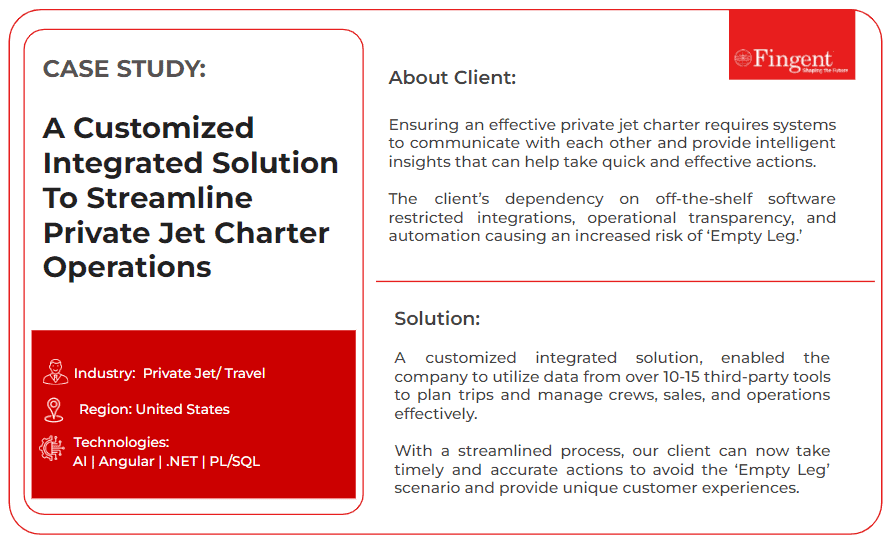
Read Case Study: How Fingent’s Customized Integrated Solution helped a Private Jet company streamline their operations.
Specific Areas AI Can Indent An Aviation Company
Artificial intelligence (AI) has already enabled autopilot technology to go from basic instruments for maintaining aircraft altitude to completely autonomous flight control systems that can operate gate-to-gate without requiring human intervention.
Furthermore, it can also be used by airlines and other operators for ground operations, flight planning, and fleet optimization. AI tools can help engineers designing airplanes create and certify goods more quickly and easily before they are even put on the market. Pricing strategy and marketing modules are two of the most critical areas that AI is impacting.
Pricing Strategies
Airlines are transforming passenger engagement and revenue optimization by utilizing Artificial Intelligence (AI) to harness the possibilities of personalization and dynamic pricing. We’ll explore three of these key artificial intelligence-driven tactics.
1. Dynamic Pricing For Tickets: Conventional pricing models frequently find it difficult to adjust in real time to changes in the market. However, this is where AI excels.
- Customer Division: AI divides travelers into categories according to their willingness to pay and purchase patterns. Different consumer segments might have their pricing methods customized to ensure that the price is appealing to them.
- Competitor Observation: Artificial Intelligence (AI) solutions enable airlines to promptly respond to shifts in the competitive landscape by monitoring the pricing and strategies of their rivals.
- Supplementary Services: AI maximizes the cost of both tickets and add-ons like checked baggage, in-flight Wi-Fi, and seat preference. Airlines can optimize their ancillary revenue by determining pricing that appeals to travelers.
2. Personalization Pricing Modules: Airlines are now able to customize services, offers, and experiences to each passenger’s specific interests and behaviors thanks to machine learning algorithms. This degree of personalization is available from the reservation procedure all the way through the in-flight encounter, leading to a flawless travel experience.
- Customer Segmentation and Profiling: To generate thorough client profiles, AI algorithms can examine a wide range of data sources, such as previous booking histories, travel trends, and even social media activity.
- Customized Deals and Services: Airlines can create customized offers once they have unique profiles in place. These customized deals increase passenger satisfaction and foster client loyalty.
3. Real-Time Demand Analysis: Real-time analysis and demand fostering generally fall under dynamic pricing, but they are also similar to personalized models.
- Analyzing Data in Real Time: AI systems monitor the market, demand patterns, and pricing strategies of rivals in real time to modify ticket prices. This guarantees airlines’ continued competitiveness and revenue maximization.
- Demand Forecasting: Artificial Intelligence is able to forecast changes in demand for particular flights and schedules. Then, airlines can modify their pricing to maximize income during busy periods or fill unfilled seats.
Marketing Model
AI is capable of analyzing enormous volumes of data to spot possible safety hazards, forecast equipment malfunctions, and support preventative maintenance, all of which increase overall aviation safety. As per reports, AI in aviation was estimated to be worth USD 686.4 million in 2022, and between 2023 and 2032, it is expected to grow at a compound annual growth rate of more than 20%. In order to manage air traffic and optimize flight routes, airlines and aviation corporations look for AI software solutions. Two key ways that AI influences marketing struggles in the aviation industry are:
1. Targeted advertising: Many neighboring industries utilize AI to optimize their advertising procedures and make them more attractive to the right audience. With passenger services like chatbots and tailored suggestions, AI can bring in more customers and revenue to airlines while simultaneously boosting customer satisfaction levels.
2. Monitor emails: The majority of requests for private flights are made via email, which means that operators must perform the tiresome chore of reviewing emails once an hour. With the help of AI, team members can react to travel requests more quickly and arrange flight schedules more easily by sifting through emails and selecting those that best fit what the business has to offer.

The Future Of AI In Aviation
By now, it must be evident how useful AI is to the Aviation industry. Furthermore, according to research, it is predicted to grow at a 37% annual rate of growth between 2023 and 2030, reaching US$ 12.1 billion by the end of 2031. Some emerging trends and advancements to look out for are:
Autonomous Aircraft: By decreasing human error, boosting productivity, and possibly even enhancing environmental sustainability, the development of autonomous aircraft might completely transform air travel.
- Data security: As AI systems are used more frequently, there is a greater need than ever for strong cyber security defenses against online threats.
- Workers Adaptation: As AI technologies are integrated, the aviation sector will need to upskill its workers and create new positions that reflect the shifting job market.
- UAVs (unmanned aerial vehicles): These drones with AI algorithms installed can effectively scan large areas, giving security operations useful data.
- Predictive maintenance: AI systems that can precisely forecast the need for maintenance by evaluating data from sensors integrated into aircraft components by reducing downtime and enhancing overall safety; this proactive strategy assists airlines and maintenance teams in identifying any problems before they become more serious.
- Customer assistance: Customers may soon be able to utilize AI-powered devices like Amazon Alexa, which can be connected to an airline’s mobile app. After that, Alexa may be used to respond to queries, deal with typical issues, track flight statuses using their numbers, manage check-in requests, and find out if amenities like Wi-Fi are available while flying.
- Passenger identification Kiosks: It is anticipated that AI will be used soon to provide self-service flight check-in. Consumers will utilize this technology in facial recognition kiosks. It is anticipated to enhance customer satisfaction and enable quicker check-ins and client flow at the airport.
How Can Fingent Help Aviation Companies Explore Capabilities with AI Better?
Here at Fingent, we believe using emerging technology can help industries reimagine processes and find possibilities in impossible challenges. We enable organizations to look beyond digitalization and create innovations that change lives by providing them with easy-to-use and quickly implemented software solutions.
Fingent combines the full force of its expertise in many facets of technology to bring you a solution that will fit your needs. This includes the power of augmented, virtual, and mixed realty, data analytics, network, and infrastructure security, and more.
We use an agile process to create dependable, high-quality, reasonably priced solutions that have an impact. In addition to our well-known post-installation care, we provide excellent customer service and knowledgeable support from the beginning to the end of the implementation. Give us a call, and lets create a custom solution that will help your aviation business reach new heights.
Stay up to date on what's new
About the Author
Tony Joseph
Tony believes in building technology around processes, rather than building processes around technology. At Fingent, he specializes in custom software development, especially in analyzing processes, refining them, and then building technology around it. He works with clients on a daily basis to understand and analyze their operational structure, discover (and not invent) key improvement areas, and come up with technology solutions to deliver an efficient process. You can reach him at [email protected], Skype: tony_fingent
Featured Blogs
Stay up to date on
what's new
Talk To Our Experts
Are you sick and tired of performing the same monotonous task every day? Well, if your answer is yes, then Generative AI can benefit you.
Technology is evolving at a rapid rate, with new inventions and software being built on an almost daily basis. A significant increase in computer power, data storage, and algorithms has made it possible to create more proficient AI systems. With these advances in technology, AI is now increasingly available and useful in a variety of business sectors. Generative AI is one of the branches of AI that enables companies to develop, test, and improve solutions to challenging issues.
Let’s see how this amazing technology can boost your business processes.
What is Generative Artificial Intelligence?
As the name suggests, this is a form of Artificial Intelligence that has the ability to generate, create, or fabricate new content, including text, imagery, audio, and synthetic data. Artificial intelligence (AI) models produce new data by learning the patterns and structures of their training data.
The ease with which modern user interfaces can produce professional-level text, drawings, and films in just a few seconds has recently generated a lot of hype around Generative AI. Generative AI uses sophisticated neural networks to acquire information from huge datasets and generate outputs on its own. This is in contrast to typical AI systems that rely on set guidelines or explicit data patterns.
Custom Al software can boost your business to do more. Connect with our experts today to strategize your Al investments.
Types And Uses Of Generative AI
There are various Generative AI model types, and each has a distinct approach to creating content. The most prominent versions of generative AI models include:
1. Generative Adversarial Networks (GANs): This model includes two sub-models – the generator and the discriminator. The generator (trained to generate new examples) aims to create extremely realistic content to deceive the discriminator, which is thus trained to improve its ability to distinguish between real and fabricated data.
2. Autoregressive Models: This model is essentially known for its ability to create coherent and contextual content with appropriate text. A very common example of this model is GPT (Generative Pre-trained Transformers).
3. Recurrent Neural Networks (RNNs): RNNs are a form of neural network that analyzes sequential data, including time-series data or natural language sentences. By foreseeing the following elements in the sequence given prior elements, they can be employed for generative tasks.
Generative AI has found its use in almost all fields of life and business. It is essentially used in generating content, data augmentation, fabrication of synthetic data, graphic design, and code writing.
Don’t Stay Behind! Unlock Business Growth, Efficiency & Innovation With AI.
How Is Generative AI Impacting Modern Business?
47% of businesses utilizing AI, say sales and customer service, are where Generative AI is most frequently used.
Generative AI streamlines workflows by automating repeated processes that were previously time- and resource-consuming. Businesses can reach unmatched levels of productivity by utilizing Generative AI’s sophisticated language models, freeing up personnel to concentrate on jobs with a favorable return on investment that promotes growth and innovation.
AI helps businesses identify bottlenecks and inefficiencies to streamline operations. Additionally, the quality control procedures are automated by AI systems, which ensures product uniformity and lowers manufacturing flaws.
Compared to other apps, Chat GPT attracted 100 million users more quickly.
Benefits Of Using Generative AI
There are innumerable benefits to installing a Generative AI model into your business plan. Some of the major benefits experienced are:
- Amplification of creativity: Generative AI can foster more originality and innovation.
- Saving time and money: By automating and improving everyday mundane tasks and processes, generative AI can reduce both time and costs.
- Hyper-personalization: Using generative AI, personalization and customization of data can be boosted.
- Enhanced productivity and efficiency: When the need for repetition of mind-numbing and tedious tasks is removed, Generative AI can increase output quality and operational effectiveness.
- Data synthesis: Generative AI is capable of yielding original data quickly and effectively, supporting operations including data organization, processing, augmentation, and synthesis.
- Realistic simulations: Generative AI is capable of decoding complex algorithms, converting satellite photos to maps, producing images for medical applications in real time, and producing spontaneous marketing data.
- Adaptive learning: Generative AI’s data-driven insights and forecasting model can help in making sound decisions.
- Superior knowledge organization and discovery: Customer assistance, e-commerce interactions, and several other fields where effective communication is essential can be revolutionized by Generative AI.
How To Utilize The Best of Generative AI For Your Business?
If you want the best of generative AI, the first thing you should consider is your business requirements. Analyze what your weaknesses are, and then correlate them with the features this technology can provide. Once you are clear on where and how you want to use your artificially intelligent partner, you can explore the many possibilities it presents. Here are some ways in which you can use Generative AI:
1. Data Analytics
Data analytics solutions powered by generative AI make data analysis more intelligent, quick, scalable, and safe. For more safe and compliant data analysis and QA testing processes, you can utilize generative AI to produce synthetic data, depending on the model type and size you choose.
Examples: Dermio, Narrative BI, and Power BI Co-pilot
2. Customer service and user experience
There are now several Generative AI tools available to guide your current customer care representatives and, in some cases, replace them with chatbots, speech generation technology, and AI-powered search engines that are created with client inquiries and natural language requirements in mind.
Examples: Gridspace, IBM Watson Assistant, and Forethought SupportGPT.
3. Assistant Coding and Product Design
For the production of digital products, Generative AI can be used to support coding and quality control tests. Bug fixes, test code generation, and software documentation are all possible with models like ChatGPT.
Examples: ChatGPT, Google Bard, Code Snippets, and Tabnine
Read more: Custom AI Copilots: Unleashing New Opportunities
4. Document summarization
A lengthy contract, legal document, conversation transcript, or other long-form content type can be quickly and easily distilled down to its most crucial details using this method. Some generative AI systems are used for independent content summaries, while others are integrated into tools used for project management and routine business processes.
Examples: Cohere Summarize, PatentPal, and AI21 Studio.
Read more: Applied AI For Document Processing
5. Cyber Security Management
Cyber security applications of generative AI include improved threat detection and hunting, contextualized security environment suggestions, and attack simulations. While many of these new generative AI security technologies are either new features or add-on items for current cyber security systems, others are independent businesses.
Examples: Google Cloud Security AI Workbench, Microsoft Security Co-pilot, and Airgap Networks ThreatGPT.
Watch now: How Artificial Intelligence impacts customer experience!
How Can Fingent Help?
Fingent has been a pioneer in the Artificial Intelligence game and has built many custom AI-powered apps for clients worldwide. Our experts work on AI platforms such as Natural Language Processing, Computer Vision, Speech Recognition, and more. Having acquired expertise in robotic and business process automation, experts at Fingent can help you achieve cost and time efficiencies and yield a greater margin of profit for your business.
Fingent top custom software development company, is equipped to help businesses of all sizes, including start-ups, as well as well-established organizations. We will be with you through all your processes, from suggesting products to providing basic customer service to running software tests. Allow us to empower your business with the power of Generative AI. Give us a call today.
Stay up to date on what's new
About the Author
Tony Joseph
Tony believes in building technology around processes, rather than building processes around technology. At Fingent, he specializes in custom software development, especially in analyzing processes, refining them, and then building technology around it. He works with clients on a daily basis to understand and analyze their operational structure, discover (and not invent) key improvement areas, and come up with technology solutions to deliver an efficient process. You can reach him at [email protected], Skype: tony_fingent
Featured Blogs
Stay up to date on
what's new
Talk To Our Experts
Many of us interact with Artificial Intelligence (AI) on a daily basis without even realizing its presence. From email spam filters to face IDs used for unlocking our phones and from smart home devices to Amazon feed recommendations, AI has become a household name today.
The examples of AI we encounter every day are seemingly infinite! Now, imagine the myriad ways AI facilitates business development!
“87% of enterprises believe that AI and ML will help them achieve business goals centered around growing revenue, boosting operational efficiency, and improving customer experiences.”
With its capability to automate processes, enhance productivity, forecast trends, and personalize experiences, AI has become an invaluable asset for businesses of all sizes.
Key Areas Where AI Can Contribute to Business Development
1. Business Growth: Data-Driven Decision Making
Machine learning (ML) algorithms running behind AI analytics engines can process and analyze vast amounts of data quickly and accurately. By deploying AI-based analytics tools, you can extract contextualized and valuable insights from your data to make well-informed and timely business decisions.
Benefits of AI-driven business data analysis:
- Understand customer behavior and preferences, market trends, and sales performance
- Optimize business operations and resource allocation, identify new opportunities, refine marketing strategies, and improve your competitive positioning.
- Make proactive business development decisions powered by reliable data.
2. Customer Gratification: Personalized Experiences
By analyzing customer purchase history, behavior patterns, preferences, and interests, you can tailor your offerings to individual needs. In-depth personalization enhances customer satisfaction, boosts loyalty, and drives customer acquisition.
- Intelligent customer service solutions such as AI-powered chatbots and virtual assistants enhance customer experience by providing prompt and personalized support.
- Insights derived through AI can be used to personalize website experiences, optimize conversion rates, and improve customer engagement.
- AI helps deliver personalized customer recommendations and individualized experiences across multiple channels.
3. Marketing Automation: Tailored Content & Targeted Campaigns
AI-powered marketing automation helps streamline your entire marketing efforts. Thanks to data and algorithms, AI-based marketing automation makes sending personalized content to your customers easier.
Here are a few ways marketers can leverage AI to automate their processes:
- Personalization: Analyze customer data, predict consumer behavior, identify patterns and trends, and send personalized messages to your customers.
- Email Automation: Analyze the performance of your emails in real time and use the data to improve your next set of emails.
- Lead Scoring: AI can be used to analyze your data to determine which leads will likely become customers. This saves your time and money on lead scoring and improves the quality of your leads.
- Lead Nurturing: AI can also automate your lead nurturing process by effectively guiding leads through the sales funnel until they are ready to purchase. This will boost your conversion rates.
- Channel Optimization: With Al algorithms, your marketing team can easily identify which channels are the most effective in reaching your target audience. This allows you to allocate sufficient time and funds to channels with the best ROI.
- Customer Service & Communication: Using AI to respond to customers instantly will improve your customer’s experience and satisfaction while saving time and resources. For instance, AI-powered chatbots can answer frequently asked questions, recommend products, and process orders faster than a human service agent.
Discover How AI Can Benefit Your Business.
4. Sales Performance: Driving Conversion & ROI
AI-powered sales tools can help businesses identify the most promising leads, prioritize sales activities, and personalize sales pitches. By analyzing customer behavior and predicting their needs using AI, companies can provide more effective sales support and create compelling sales pitches.
Here’s how AI can transform your sales process:
- Data Enrichment & Analysis: Data enrichment refers to the process of deriving data from third-party sources and pulling it into an organization’s database, typically a CRM. Leveraging AI will allow you to bring all your customer context in one place. For instance, with a single source of customer information (in your CRM), you can easily understand lead sentiments and topics of interest. That way, you can score and prioritize your leads and personalize your selling strategies.
- Conversation Intelligence: AI-powered conversation intelligence tools allow you to analyze sales calls and pull key insights, recognize the context within a conversation, and uncover the why behind sales performance.
- Sales Enablement: Sales enablement, the process of equipping your salespeople with the right tools and resources to close more deals, can be automated and optimized with AI. For instance, AI helps build and manage dynamic content libraries that can surface relevant information when necessary and even automatically pull the data from these libraries into sales pitches and proposals.
- Pipeline Management & Forecasting: AI helps reduce the probability of inaccuracies in your sales team. With an AI-driven forecasting solution, you can analyze existing data and gain insights into deals and overall pipeline, build forecasts to draw valuable insights and make improved decisions.
- Sales Engagement: Sales engagement involves all the buyer-seller interactions within your sales process, right from initial outreach to customer onboarding. There are two ways AI can help you streamline this process. Firstly, AI helps analyze your data and insights to understand customer needs and pain points. Secondly, AI aids in personalizing and automating your customer interactions.
5. Process Automation: Automate Repetitive, Time-Consuming Tasks
AI helps automate your most time-consuming routine operations and free up your workforce for more critical tasks. Transferring large volumes of repetitive work from humans to automated systems increases your productivity, accuracy, and responsiveness while minimizing the error rate.
Here are a few examples of AI in business process automation:
- Inventory Management: AI-integrated inventory management software helps with accurate stock level maintenance, effective order management, improved demand forecasting, and better supplier management.
- Data Entry & Update: AI-based data entry involves using software systems that leverage ML, NLP, OCR, computer vision, or other AI techniques for extracting, validating, transforming, or entering data from various sources, such as PDFs, documents, images, audio, or web pages.
- Price Optimization: AI can help you set optimal prices for your products and services by analyzing your customer demographics and spending patterns, historical data, market trends, supply and demand changes, and competitors’ prices.
- Reporting: AI helps automate your report generation process by extracting data from different business systems and relevant documents. It also helps perform necessary data manipulations, assemble reports in designated formats, and send them to relevant stakeholders based on the content.
- Fraud Detection & Prevention: AI-based automation allows your financial professionals to reduce errors in transactions and prevent miscalculations and delayed payments.
6. Innovation: New Business Models Expansion
Artificial Intelligence is basically focused on business expansion and helps unlock new business models that were not possible before.
Here are some of the ways organizations today are making that shift and reaping the benefits of AI in a more practical way.
- Unlock New Opportunities: Predictive analytics solutions leverage AI to identify new revenue streams and opportunities, such as upselling and cross-selling products and services.
- Develop New Offerings: AI-based customer insights are used to develop new products and services that meet the needs of their customers, resulting in increased revenue and growth.
- Efficiency & Productivity Gains: AI-based analytics helps warehouses, shipping and transportation companies, fulfillment centers, and similar businesses with fuel optimization, predictive maintenance, and route optimization.
- Coding & Application Modernization: Companies are using AI for application modernization and enterprise IT operations by employing AI to automate coding, deploying, and scaling. IBM’s Project CodeNet, for example, is a large dataset developed for teaching AI to code.
- Convergence with Other Technologies: Converging AI with other technologies, such as IoT, helps create a new paradigm of business models. For example, real-time data collected by IoT sensors attached to equipment or vehicles can be used to rigorously train AI models, which will ultimately help businesses make fruitful decisions.
Download Our Free Case Study Report Now: How Combining AI with the client’s Litigation Strategy helped reduce the Average Case Settlement Time to 1-2 days at a settlement cost of $15000.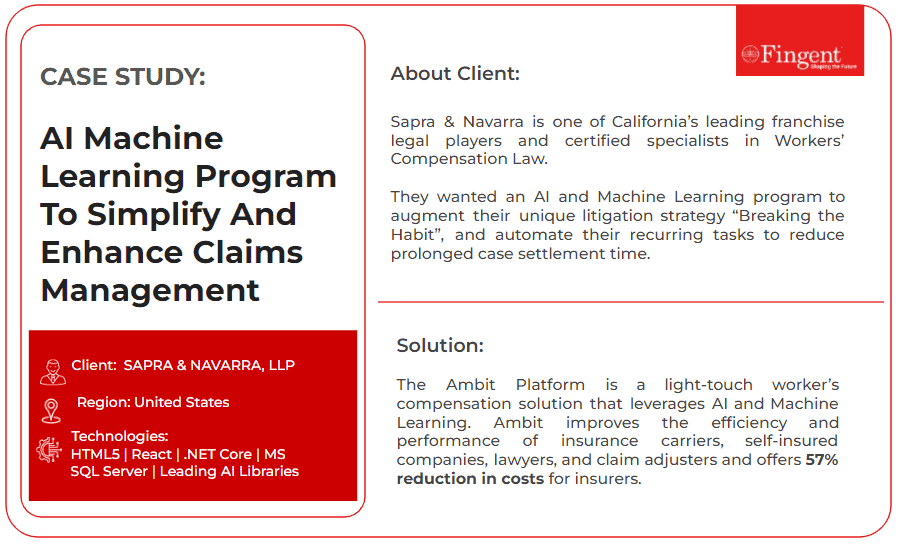
AI Use Cases in Business Development
Here are some significant AI use cases impacting major industries:
1. Healthcare
Healthcare organizations are using AI to improve the efficiency of all kinds of processes, from back-office tasks to patient care.
- AI computer-assisted documentation: This allows clinicians to efficiently maintain medical records.
- AI virtual nurse assistants: Automate patient question-answering, clinical appointment scheduling, and report-sharing with physicians or surgeons.
- Detect & Minimize Dosage Errors: Monitor and flag errors in how a patient self-administers medications in order to enhance patient health outcomes and reduce healthcare costs and hospitalizations.
2. HR & Talent Management
AI influences almost all of HR operations and service delivery, including recruiting, learning and development, and talent management.
- Recruiting: AI-based profile sourcing from recruitment websites, automated screening of candidates using facial recognition, and AI-based interviews.
- Employee Onboarding: AI-powered bots can accelerate employee onboarding processes by providing quicker access to knowledge, personalized results, real-time assistance, Q&A support, and enhanced collaboration.
- Payroll Processing: Automation of repetitive and error-prone payroll processing tasks such as recording overtime, keeping track of timesheets and leaves, and calculating incentives or commissions.
3. Banking & Financial Services
Custom AI banking solutions help reduce banking costs, mitigate financial risks and frauds, and improve the overall banking experience for customers.
- Reduce Manual Work: Automating routine processes such as KYC update, data extraction, validation, etc., will speed up processing times, reduce error rates, and improve regulatory compliance.
- Transaction Monitoring & Fraud Prevention: In digital banking, AI can be used to monitor user transactions, spot suspicious activities in real-time, and take quick measures to address the risks.
- Financial Planning: AI banking chatbots can interact with customers to assist them with financial planning tasks such as setting financial objectives, budgeting, identifying new investment opportunities, etc.
4. Education
AI in education focuses on developing new solutions for teaching and learning catering to different situations. The ultimate goal is to facilitate learners with flexible, personalized, and engaging learning experiences.
- Personalized Learning: AI helps educators understand the needs of every learner/ student so they can quickly come up with tailor-made learning plans for each student.
- Course Creation: Several online learning platforms use AI to generate smart content and courses that include immersive visualizations, simulations, bite-sized lessons, and other interactive forms of content.
- AI-Based Tutorials: AI-driven tutorials provide additional support to students in understanding their study materials. With these tutorials, students can learn complex concepts by breaking them down into simple learning modules.
Read more: Augmented Reality in Education: Use Cases and Benefits
5. Retail
The application of AI in the retail industry translates to better experiences, accurate forecasting, and automated inventory management.
- Demand Forecasting: AI can track and analyze customer data to improve demand forecasting, make pricing decisions, and optimize product placement.
- Inventory Management: AI-based inventory management software can automatically track out-of-stock items, missing inventory, pricing errors, expiring stocks, surplus inventory, etc.
- Returns Management: Intelligent bots can reduce the volume of manual work involved in managing and processing returns by collecting necessary information from customers, guiding them through the return process, sending notifications, and updating inventory databases.
How Fingent Helps Organizations Leverage AI for Business Development
“94% of global business leaders believe AI is critical to success over the next five years.”
Artificial intelligence has a unique and powerful role to play in addressing many of the challenges presented to us today. The question is no longer about adopting AI for basic process automation. It is now about unleashing the potential AI holds to drive new opportunities for our businesses, employees, and society at large.
Fingent offers custom AI software development services to accelerate your business’s growth and profitability. Our AI software development experience spans multiple industry segments, including education and corporate learning systems. It also covers litigation, human resources, and people management, as well as insurance. Additionally, we have experience in the retail and real estate sectors, and more.
If you are planning to build custom AI software for your business? Or want to know more about the scope of AI in business development, or upgrade from legacy software to a modern technology platform? Feel free to connect with our team.
Stay up to date on what's new
About the Author
Tony Joseph
Tony believes in building technology around processes, rather than building processes around technology. At Fingent, he specializes in custom software development, especially in analyzing processes, refining them, and then building technology around it. He works with clients on a daily basis to understand and analyze their operational structure, discover (and not invent) key improvement areas, and come up with technology solutions to deliver an efficient process. You can reach him at [email protected], Skype: tony_fingent
Featured Blogs
Stay up to date on
what's new
Talk To Our Experts
Today’s businesses aren’t content with revolving orbits; they’re reaching out for galaxies. Are you one of them? AI can get you there. By equipping your enterprise software with a powerhouse of resources, AI can help your business reach heights never explored before. This article will show you how.
Reaching Heights With AI
Imagine for a moment you’re standing at the launching pad with a rocket-fueled and ready. In this case, the rocket is your enterprise software – a powerhouse of technology, promise, and potential. But just having a rocket won’t send you hurtling toward the stars. There’s a cosmic force waiting to be harnessed – Artificial Intelligence (AI).
Think of AI as the navigation system that charts a course beyond the atmosphere of conventional operations, taking your enterprise to breathtaking heights. While software handles routine tasks, AI extends your reach, guiding your decisions with insights. Just as astronauts trust their instruments in uncharted space, your business relies on AI to navigate complexities, foresee trends, and make informed choices.
AI isn’t merely a tool; it’s a decoder that reveals patterns, predicts possibilities, and equips your organization to make strategic leaps forward. Just as a rocket maneuvers through space, AI-enhanced software propels your enterprise through a dynamic market, automating complexities and boosting growth.
Read more: How AI-based Code Generation Tools are Revolutionizing Industries.
Elevating Business Excellence Beyond Software Implementation
Building a thriving business is not merely assembling a puzzle; you need to build a dynamic masterpiece that can adapt, grow, and stay ahead of the game. That’s why thinking beyond simply implementing software is like adding a dash of genius to your strategy.
Your customers deserve a seamless and delightful experience. AI will help you go beyond implementation. You’re not just giving them a product; you’re crafting an adventure they’ll want to return to with updates and features that improve their journey.
When implementing AI, you are not just wielding a single power but exploring new abilities. By watching for the latest tech trends, you’re adding new tools to your utility belt, ensuring you can face any challenge head-on. And turn your challenges into triumphs.
So, let’s blast off into a future by considering specific realms where thinking beyond software is the norm, and AI is the rocket fuel of progress.
AI Empowers Enterprise Efficiency: Elevating Operations Across Diverse Realms
Incorporating AI intelligence into enterprise software can transform various aspects of business operations, boosting functional efficiency across different realms. Just as a rocket reaches new heights with precision and power, AI-infused enterprise software takes your efficiency to unparalleled realms across diverse domains.
Let’s break down how AI can enhance efficiency in the following scenarios:
1. Flawless Dispatch and Scheduling: The AI Thrust
Visualize AI as your mission control center, ensuring dispatches and schedules operate with pinpoint accuracy. AI can optimize dispatching and scheduling by analyzing real-time data, such as traffic conditions, weather, and job priorities.
Like a mission planner, AI optimizes routes and timing, minimizing downtimes and maximizing resource utility. Your operations glide seamlessly, guaranteeing on-time arrivals and delighted customers. It can automatically assign tasks to the right resources, minimizing travel time and maximizing productivity. This results in faster response times, reduced operational costs, and improved customer satisfaction.
2. HR Onboarding, Rocketed by AI Prowess
AI can be compared to a co-pilot for HR, navigating through onboarding with finesse. With AI’s assistance, paperwork is streamlined, training needs are anticipated, and personalized experiences await your new crew members. Your team steps into their roles with confidence, accelerating productivity.
AI-powered tools can streamline onboarding by automating administrative tasks, providing personalized training plans, and offering interactive modules for new hires. This accelerates the time it takes for new employees to become productive and minimizes manual intervention by HR staff.
3. Claims Management: AI’s Turbo Boost
Consider AI your claims turbocharger, rocketing through paperwork at lightning speed. Just as a turbocharger enhances engine performance, AI can quickly review and process claims documents, extracting relevant information and identifying patterns to detect fraudulent claims. This speeds up the claims management process, reduces errors, and improves claims processing accuracy.
4. Supplier Audits: AI’s Navigator
Think of AI as your supplier audit navigator, equipped with advanced radar for data scrutiny. With AI’s precision, audits become comprehensive and insightful. AI can analyze supplier data, performance metrics, and historical trends to prioritize supplier audits based on risk and importance. It can provide actionable insights and recommendations to auditors, enabling them to focus on critical areas and make informed decisions efficiently.
5. Instant Work Instructions: AI’s Inflight Guidance
Like a co-pilot giving live directions, AI ensures your team has immediate, accurate guidance. AI-powered systems can provide real-time, context-aware work instructions to employees on the shop floor. Since it can deliver step-by-step guidance and troubleshooting assistance, efficiency soars as your workforce executes tasks precisely.
6. Revolutionizing Asset Trading: AI-Driven Trajectory
With AI’s guidance, asset trading becomes strategic and informed. Your decisions are empowered by AI’s data-driven analytics, allowing you to navigate market fluctuations with confidence. AI can analyze market trends, historical data, and customer preferences to provide valuable insights for asset trading decisions. This helps businesses make informed choices, optimize pricing strategies, and seize trading opportunities, improving profitability.
7. AI’s Galactic Odyssey: Efficiency Beyond Boundaries
Today’s enterprises are embarking on an AI-powered odyssey, rewriting efficiency. By infusing AI intelligence into your enterprise software, you’re not merely embracing technology but launching your efficiency into the stratosphere of possibility. AI becomes the booster rocket that propels your operations into a new era.
As the architect of this transformative mission, AI ensures that each operational phase is executed with precision, guiding your enterprise to excel in once unimaginable ways.
Read more: Boosting customer experience with AI.
Fingent Can Help You Unleash AI-driven Brilliance in Your Software
In a world where business success hinges on innovation, Fingent emerges as the guiding light, igniting a transformative spark in your enterprise. Imagine if your software could perform tasks, think, learn, and evolve. That’s the power of infusing artificial intelligence, and Fingent, as an esteemed enterprise software development company, is your key to unlocking this potential.
At Fingent, we don’t just develop software; we cultivate digital minds that enhance your business’s cognitive capabilities. We’re not just developers; we’re architects of intelligence. Our experts at Fingent wield the brush of advanced algorithms, crafting solutions that empower your software to analyze data, make informed decisions, and continuously enhance its own performance.
Reach out to us and allow us to transform your software.
Stay up to date on what's new
About the Author
Tony Joseph
Tony believes in building technology around processes, rather than building processes around technology. At Fingent, he specializes in custom software development, especially in analyzing processes, refining them, and then building technology around it. He works with clients on a daily basis to understand and analyze their operational structure, discover (and not invent) key improvement areas, and come up with technology solutions to deliver an efficient process. You can reach him at [email protected], Skype: tony_fingent
Featured Blogs
Stay up to date on
what's new
Talk To Our Experts
“A simple rule: always give people more than they expect.” – Nelson Boswell
The cycle of business starts and ends with customers. Keeping them satisfied and happy is the number one rule of any business that dreams of being successful. Customer needs and expectations never cease, so businesses should always be prepared to meet and exceed their needs. Artificial Intelligence has been a substantial help in this area since the late 19th century, and it consistently finds new innovative ways to amplify its presence in modern businesses.
Meeting Customer Needs and Exceeding Expectations
Recent research reported that a good number of executives have already planned to invest more in rising technology to gain a competitive advantage. Due to the Covid-19 pandemic, almost all businesses were forced to move to an online platform to survive, further underscoring the need to adopt AI technology.
It is extremely imperative to recognize and address the needs, desires, and emotions of people which change from moment to moment. Businesses have to provide their customers and clients with care beyond purchases and respond to the intricacies in their lives. In a world that moves forward so fast, it’s best not to fall behind.
Read more: Realizing Self- Service in Modern Customer Experiences

What Is Artificial Intelligence and How Does It Impact Customer Experience?
The textbook definition of Artificial Intelligence is – a semblance of human-like intelligence processed by machines, especially computer systems. AI is used by developers to:
- efficiently perform mundane tasks that humans otherwise do.
- connect with customers.
- recognize patterns.
- solve problems.
AI Customer experience is when artificial intelligence tools are used to learn about customers and improve their business experience. The AI technologies that are famously emerging include machine learning, natural language processing, automation, chatbots, virtual assistants, and even enhanced customer experience platforms.
There are three major ways in which AI impacts Customer Experience –
1. Better Understanding Of Customer
Artificial Intelligence combined with machine learning enhances the gathering and analyzing of social and factual data of customers, which then facilitates businesses to gain an accurate understanding of their customers. AI is known for continuously learning and improving from the data it surveys. This enables it to predict customer behavior perfectly.
2. Real-time Decision Making
Making decisions in real-time is the ability of AI to collect fresh data from current interaction with a customer and make a decision with near-zero delay. It is a very effective marketing strategy and often leads to predictive analysis, which is the process of analyzing statistics, data mining, and modeling to make accurate predictions.
3. Hyper-Personalization
Artificial Intelligence, along with all its advanced technologies, proffers content that is specifically relevant to the customer. This eradicates the need to search for services the customer requires manually and adds a layer of comfort to the business and its customization techniques.
Top Ways Businesses Use AI To Tweak Customer Experience
Following are the top 8 utilities that Artificial Intelligence provides to boost customer experience –
1. Personalization
Businesses can easily gain a clear picture of their customer preferences and requirements by using AI and ML technologies which acquire and analyzes social, factual, and behavioral data. AI is built to predict client behavior by regularly surveying and improving the data it collects. This facilitates companies to analyze customer demographics and personal preferences. This, in turn, highlights the relevant products and resources during the browsing process.
2. Chatbots
A chatbot is a conversational AI using machine learning and natural language processing. It is automated and programmed to pretend to be human and carry out programming tasks based on specific triggers. Its unique ability is to conveniently and efficiently generate conversations between two people.
The most commonly found type of chatbot is a “question-answer bot” —this form of chatbot refrains from using advanced artificial intelligence but instead accesses a smaller knowledge base and utilizes pattern recognition.
Artificial Intelligence powered Chatbots make a business’s presence accomplished by allowing customers to find what they are looking for while simultaneously delivering a seamless experience.
Did You Know: 35% of customers want to see chatbots being used more often to improve communication and offer a better experience overall.
The best examples of Chatbots are – Apple’s Siri, Amazon’s Alexa, and Google Assistant.
Using simple rules and past interactions, bots provide insightful replies to any query, making their responses accurate, short, and creative.
3. Predictive Analysis
Predictive analytics, by definition, is to use data collected to predict a business’s future. It utilizes statistical algorithms blended with internal and external data to foresee future trends, ultimately enabling businesses to optimize inventory, enhance delivery times, boost sales, and reduce operational costs. A more accurate and punctual prediction occurs when Artificial Intelligence is added to the mix. Predictive analytics can be used by advanced analytics tools and machine learning models across any industry or business function.
4. Voice Recognition
The voice recognition model functions purely with the aid of AI to
- analyze the user’s voice and language,
- learn the words spoken,
- and then bring forth outputs with transcription accuracy as text data on a screen or model content.
With the help of this technology, devices can interact and respond to human questions in uncannily natural language.
With the ability to understand and converse with human language, Voice AI has opened up great opportunities for businesses to serve their customers better. It efficiently speeds up processes, increases productivity, and scales operations.
Approximately 55% of virtual assistant users prefer speech recognition apps be they proffer a complete hands-off operation of devices.
Examples of businesses that integrated AI for voice recognition and have successfully replaced touch-screen devices are – Amazon Echo, Siri, Google Assistant, Google Home, Amazon Alexa, and a few others.
5. Sentiment Analysis
A sentiment analysis system collects specific customer feedback and uses it to improve company products and services. When AI technologies are fused with this system, it can identify objects or situations that customers feel any negative emotions towards as expressed in text. AI understands the undertone of a statement rather than simply noting a negative or positive connotation.
Sentiment Analysis is majorly utilized by marketers to better understand their consumers’ sentiments, beliefs, and motives perfectly to make advertising to specific groups effective. It has a wide array of benefits ranging from patient insights and online reputation management to competitor analysis and product development.
Almost all social media platforms use Sentiment Analytics powered by AI. This way brands and companies can keep track of the content being shared and censor or filter content that could evoke negative emotions and cause problems.
6. Customer Journey Mapping
A customer journey map as the name suggests, is essentially the visual representation of the customer’s journey from brand discovery to purchase and post-purchase. It enables businesses to retrace a customer’s footsteps and see where their services might need any improvements or upgrades.
All through this journey, AI and Machine Learning play a vital role in ensuring a headache-free shopping experience. There are three essential stages to customer shopping: the Pre-Purchase, purchase, and post-purchase. With the assistance of AI and ML, customers thread these maps and help brands analyze and prioritize activities that impact customers, boosting internal collaboration and coordination.
The benefits of creating a customer journey map are that it helps:
- streamline the customer experience,
- optimize customer service costs,
- accelerate proactive sales solutions to customer problems, and lastly, boost customer retention rate.
Examples of businesses using customer journey mapping are – Home Depot, JPMorgan Chase, Starbucks, and Nike.
7. Fraud Detection
Fraud detection is another surprising area that AI has a distinguished hold over. AI can work with internal security to help organizations improve and protect corporate activities. Businesses can use AI to examine large quantities of exchanges and unravel misrepresentation patterns.
In the case of online fraud detection and prevention, machine learning consists of a collection of AI algorithms that are specially trained with the company’s data to suggest risk rules. The business owner can then enforce the rules to block or allow certain user actions, such as suspicious logins, identity theft, or sketchy transactions.
When fraud detection is handed over to AI and Machine Learning, businesses reap great benefits like – faster and more effective detection, reduced manual review time, faster predictions with bigger databases, and cost-effective solutions.
8. Personal Data Protection
AI and Data Protection are like two sides of the same coin; both are very important, and one cannot progress without the other. We all see and know that AI technology is advancing rapidly; it raises important questions about the use of personal data and the protection and storage of said data in AI systems.
AI is frequently used to minimize the risk of privacy breaches by encrypting personal data and detecting potential cybercrime incidents. It is, therefore, pivotal for businesses to maintain a balance between technological advancements and artificial intelligence with respect for data protection rules and guidelines.
The main benefit of Data Protection Artificial Intelligence is the elimination of human errors and its keen sense for spotting new trends and patterns.
Amazon, Apple, Facebook, IBM, Microsoft, and many other grandiose organizations have implemented this system, and many more are predicted to follow.
Read more: How AI and ML are reshaping customer experience.
AI In Action – Use Cases
AI has been implemented in virtually every facet of our lives and in every industry imaginable. Here are 3 Use Cases that will give you a gist of how they can be applied successfully.
1. Chatbots Creating Engaging Learning Experiences
Learning experiences become unique and personalized when the right assistance is provided at each stage of learning. That’s where leading educational institutions are now deploying Automated Intelligence-driven ecosystems to facilitate students to interact with AI-enabled Teaching Assistants (AiTA). The system, when tightly integrated with other Teaching Assistant Bots, enables improved interaction, easy instructor-led training, and enhnaces student-instructor relationship.
2. Simplifying Claims Management for Legal Firms
A typical compensation claims processing takes up to three years for case settlement costing an average of $85000. It’s often challenging for legal firms to balance time, money, and the cases in hand. That’s why they are now implementing AI and machine learning to improve performance efficiency. Utilizing AI and machine learning to settle claims can help legal firms reduce costs up to 57%.
3. Netflix Gets You!
Netflix is the largest streaming platform, with more than 200 million customers globally. It gained a majority of its popularity due to its personalization feature. This streaming service uses AI to create a personalized home screen interface for individual subscribers and accounts. When viewers create a new account, they are directed to pick a few of their favorite TV series and movies. The AI at the crux of Netflix analyzes the data fed to it and provides recommendations similar to the favorites picked by the user. It continues to customize the suggestions displayed based on what the user watches.
4. Rolls-Royce Rolls Out Smart, Responsible Manufacturing
To exemplify the impact of AI on Predictive Analytics, we can look at Rolls-Royce, one of the world’s largest manufacturers of aircraft engines. It deployed predictive analytics to help drastically reduce the amount of carbon produced in its engine’s product while simultaneously optimizing maintenance to assist clients and keep their planes flying longer.
5. Ask Julie!
“Ask Julie” is Amtrak’s virtual assistant. Amtrak, the national passenger railroad company of the United States has implemented this chatbot to the best advantage. Ask Julie has successfully helped provide Amtrak provide a seamless customer experience to “over 375,000 customers on their website each day and over 30 million passengers on over 300 trains each year.” The result – an 8X return on investment, more effective customer services. and reduced email costs.
Finding The Right AI Partner – A Few Tips
Digitalizing a business can be very daunting, especially when you want to integrate Artificial Intelligence into its core. Finding a partner who understands you and can communicate well with you is quite hard to find, but you must not give up hope! Keep looking because it is better to spend a little more at the start and have a quality setup rather than spend less and have a wobbly foundation that could jeopardize your whole AI implementation. Here are a few tips to keep in mind while looking for a capable AI partner –
1. Priorities
When looking for your potential AI partners, choose someone who can help the business and its employees prioritize and manage workloads.
2. Comprehend The Difference Between Machine Learning And Artificial Intelligence
Although the two may sound like they perform the same functions, do not be fooled. They each have their own region of expertise so look for someone who acknowledges that.
3. Invest In The Right Tools
In the current economy, businesses can not afford to splurge money on luxuries. Pick a partner who understands your company’s budget and can plan a perfect setup for you.
How Fingent Can Help Seamlessly Leverage AI For Customer Experience
Artificial Intelligence is a wide ocean of opportunities, if you have the right swimming gear, you can glide on its surface. Making the right decisions and trusting the right people with your projects should not be taken lightly. Fingent is committed to providing impactful software solutions to meet business goals seamlessly. Our certified experts focus on client-centered transparency and offer complete services with a wide range of Artificial Intelligence capabilities. Our team can boost your business to be more efficient and robust through intelligent technology. We have nearly two decades of experience and completely understand our client’s needs and requirements. Give us a call and let us know how we can help you.
Stay up to date on what's new
About the Author
Tony Joseph
Tony believes in building technology around processes, rather than building processes around technology. At Fingent, he specializes in custom software development, especially in analyzing processes, refining them, and then building technology around it. He works with clients on a daily basis to understand and analyze their operational structure, discover (and not invent) key improvement areas, and come up with technology solutions to deliver an efficient process. You can reach him at [email protected], Skype: tony_fingent
Featured Blogs
Stay up to date on
what's new
Talk To Our Experts
How the insurance industry delivers service has evolved significantly in the last decade.
Regardless of what form of insurance sales or policy management your organization is engaged in, you can attest that face-to-face interactions are no longer routine and are, in fact, an oddity.
As the insurance industry’s new normal, more and more interactions between customers, industry experts, other organizations, and adjustments claims occur digitally. Though phone-based communications will continue to be a part of the customer service process for the foreseeable future, customers, care providers, other insurers, and virtually anyone else with whom an insurance company interacts have come to expect a largely digitized experience.
For any organization to thrive in the insurance industry of tomorrow, it must take steps to evolve its processes today. That means creating a cohesive modernization strategy and investing in leading-edge technology solutions.
Read more: Answering the Burning Questions of Business Leaders on Digital Transformation!

Top Challenges Facing the Insurance Industry
To understand what a modernized strategy looks like in the insurance industry, it’s vital to examine some of the top challenges businesses will face in the coming years.
1. Staffing Shortages
Historically, the insurance sector has contended with turnover rates somewhere in the range of 8-9%, according to Insurance Business America, but that span climbed to 12-15% by September 2022.
That additional turnover significantly impacts business continuity and diminishes the customer experience. It can also negatively influence insurers’ ability to replace members of leadership that are retiring or stepping away from the industry.
2. Skyrocketing Costs
Inflation and numerous other factors have contributed to rising costs of everything from healthcare to vehicles higher than ever before. Naturally, some of these cost increases are passed onto insurers and their customers, so insurance companies must find ways to absorb some of these expenses while mitigating rate increases for their clients.
Insurers should also explore ways to reduce their operating costs to keep coverage prices lower. Otherwise, businesses may find it challenging to retain customer accounts, particularly in sectors like automotive insurance, where consumers can freely shop around and change policies in six-month intervals.
3. Antiquated Legacy Systems
Some legacy systems hinder the ability of many businesses to embrace digital transformation. These aging platforms can make it challenging to comply with relevant regulatory requirements and increase an organization’s overall operating costs.
The longer that insurance companies cling to antiquated systems, the harder it will be for them to streamline traditionally tedious practices, such as claim management. Therefore, insurance companies must replace these inefficient, disjointed platforms with modern, unified alternatives.
The Role of Digital Transformation in Solving These Challenges
Digital transformation can bring modern technologies to any business process to improve its operation. Fast-growing digital transformation technologies include machine learning, artificial intelligence (like ChatGPT), customer relationship management platforms, and intelligent document processing software.
Digital transformation holds the key to solving the insurance industry’s most significant problems, and it appears that many in the industry realize this, as recent projections estimate that insurance technology spending will increase by 25% between 2022 and 2026 in the US and UK.
A cohesive digital transformation strategy will lay out a roadmap for replacing aging technologies with modern alternatives, and once these technologies have been replaced, the cost savings are almost immediate.
In one example of how a digital transformation strategy led to practical innovation, Fingent joined forces with the California law firm of Sapra & Navarra, LLP to develop Ambit, an AI and ML program that simplifies and enhances the management of workers’ compensation claims. Claims may include hundreds of pages consisting of a variety of letters, affidavits, forms, and other documents from claimants, doctors, lawyers, investigators, employers, and witnesses, among others. Utilizing both artificial intelligence and machine learning, the Ambit system streamlines the claims management process, reducing claim costs, and helps break the old practices of:
- Taking too long to assess claims
- Treating similar claims inconsistently
- Not equipping claim adjusters with modern tools
Instead, Ambit improves the efficiency of all parties — insurance carriers, self-insured companies, lawyers, and claim adjusters — while reducing costs for insurers by 57%.
The Ambit solution was designed to:
- Easily ingest the many documents in the claims process
- Quickly identify missing, processed & corrupted pages
- Review structured and unstructured documents automatically
- Identify areas of concern
- Suggest potential legal defenses
- Automate calculations and reminders for important legal deadlines
- Generate case summaries, with action plans
These automation capabilities not only make life easier for claims managers but enable organizational leaders to offset productivity issues created by ongoing labor shortages by reducing onboarding time for new hires. These capabilities result in more uniform handling of the claims while speeding their resolution and lowering their overall costs.
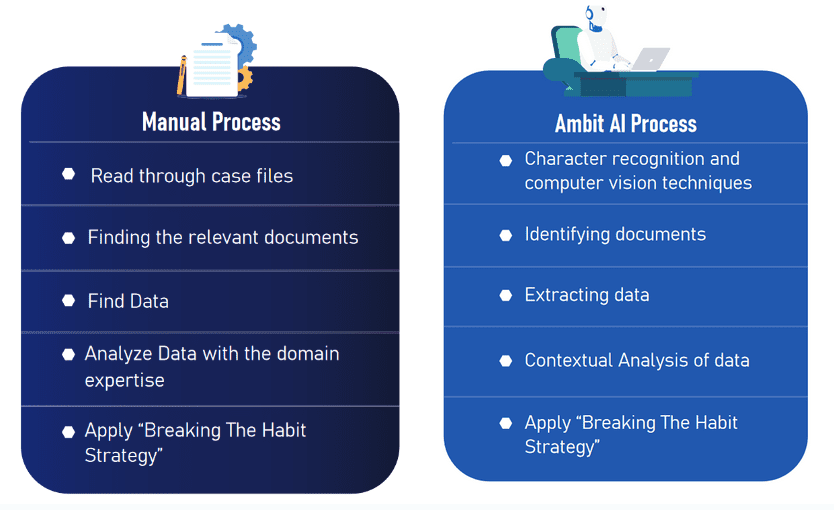
In general, automation technologies, such as those implemented during a digital transformation initiative, will also decrease operating costs, enabling insurance companies to increase their profitability and offer their customers more competitive premiums.
Read more: How AI Drives Digital Transformation In The Insurance Industry
The Essential Components of Digital Transformation
The technology trend in insurance is clearly moving from the strictly paper-based methods of the past to the digital. Beyond static websites to mobile apps. Beyond email to text and chat. Beyond processes driven by people to more and more intelligent automation that speeds up and uniformly handles all kinds of processes from marketing, and operations, to customer service.
Every organization’s digital transformation roadmap should be as unique as the business itself, but every digital transformation strategy must include a few core elements:
- Clear objectives
- An integrated plan
- A leadership-driven approach
- Investments in the right technology
When creating your organization’s digital transformation strategy, you should start by defining your “why.” In other words, you must identify the reasons you are undertaking this initiative in the first place.
From there, work with a digital transformation partner who can help you create an integrated plan that includes everyone from executive members to line-level employees.
Digital transformation efforts — even small ones — require the active support of top management. Change is the hardest thing to achieve in the organization and without the sponsorship of the corporate leaders, the effort is unlikely to succeed.
Finally, you will need to replace outdated, inefficient technology with modern, robust solutions. When appropriate,
partner with a custom software development firm that can provide you with a purpose-built solution you need for your business. They are equipped with the personnel and experience to generate a solution in the minimum timeframe and without the need to increase in-house headcounts.
If your organization has been exploring ways to improve the customer service experience, increase productivity, improve profitability, and streamline its operations, it is more than ready to embrace digital transformation.
Successfully facilitating digital transformation requires a cohesive strategy, some cutting-edge technologies, a commitment to doing things better, and the right development approach.
Read more: Digital Twin Improving Predictability and Risk Management in Insurance!

How Fingent Can Accelerate Your Process
Naturally, the cornerstone of any digital transformation initiative is technology choices. These may be an off-the-shelf system for standard processes, the integration of existing systems or, your transformation may demand a custom solution that can accommodate your business needs unlike systems available to anyone else.
At Fingent, we specialize in creating resilient custom software solutions that are able to change and adapt according to your requirements. We work with insurance industry clients to help them streamline mission-critical business processes, and – as in all our projects – we accomplish this by providing dynamic, unique software that incorporates the most appropriate technology, such as the latest in machine learning and artificial intelligence technologies.
Connect with Fingent today to accelerate your digital transformation with the help of an experienced software development partner.
Stay up to date on what's new
About the Author
Tony Joseph
Tony believes in building technology around processes, rather than building processes around technology. At Fingent, he specializes in custom software development, especially in analyzing processes, refining them, and then building technology around it. He works with clients on a daily basis to understand and analyze their operational structure, discover (and not invent) key improvement areas, and come up with technology solutions to deliver an efficient process. You can reach him at [email protected], Skype: tony_fingent
Featured Blogs
Stay up to date on
what's new
Talk To Our Experts