Tag: digital transformation
Technology has literally touched every single aspect of our lives now. Any industry you take, you will find a significant technological revolution, that has completely changed the entire industry. Be it retail, healthcare or education, technology has played its role and left the results for all of us to see and experience.
One of the less talked about industries when it comes to technological influence is Agriculture – the world’s oldest industry. It might seem like a far-fetched idea to at least some of us, incorporating technology into agriculture. But then, weren’t all technology ideas far fetched for any industry, initially?
Jim Swanson, CIO of Monsanto, leads a digital revolution in the world of agriculture, through his organization. He has been the CIO of Monsanto for almost two and a half years now and has been dealing with all the IT systems and data that extend across Monsanto, who have their presence over 67 countries worldwide. His focus, throughout the digital transformation, has been on 5 basic pillars that define digital opportunity: operational efficiency, customer centricity, business productivity, revenue enablement and disruptive innovation.
So, how did Jim Swanson go about leading the technological revolution, focused on these areas?
The Slow Shift From Analog To Digital And Working With Growers
As the agriculture industry is pretty huge and old, moving from analog to digital was quite exciting for Monsanto.
Jim Swanson, says, “You think about the seven and a half billion people on the planet, growing to nine billion in a relatively short period, and growing the amount of food we need, and doing it sustainably is an important mission that Monsanto has.”
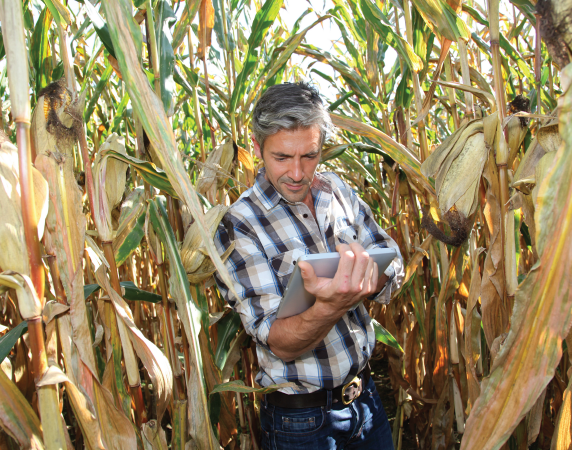
What Jim’s team did on the fields was a kind of extraction of useful data and information insights, which they utilized to come up with new and better ways to do agriculture, than what was done in the past. For that, they needed information, science and technology, and used every single resource that they had. They set up the connectivity in their fields that enabled them to collect real-time information, so that they could asses the performance of their combines. They also used data analytics to generate better insights on their products as well as their sustainable business practices.
They digitized their internal processes so as to connect more easily and freely across the agriculture ecosystem, with the help of sensor technology, data, and insights that have literally changed the way farming is done. The impact was also quite big, in terms of yield, reduced inputs and bringing about sustainable agriculture.
The farmers or the growers, being the scientists that they are, are always curious about ways to increase their output, and hence assess and test everything to see if it works for them.
Monsanto made the effort to work with them, understand and grow their thinking around how technology can be applied. They were able to learn with the growers, and analyze what works and what doesn’t. They did more of what worked, and evolved what didn’t, to make them better. This way, they developed a great partnership with the growers, which went a long way in digitization.
Achieving Operational Efficiency Through Simple Techniques
From a holistic perspective, they came up with a simple solution as one of the means to improve operational efficiency. They fixed sensors on their semi-trucks which transported products from their farms into their manufacturing plants, which enabled them to track the products wherever they were in the process. This allowed them to understand if certain semi-trucks were getting hot. They could provide real-time information through dashboards and information analytics to their plant, to move a hot semi-truck forward in the queue, and get it unloaded, thereby avoiding a possible loss of product or yield. This basically shows the value of digitizing the supply chain and its impact on business.
 Such technologies and ideas can be used on the research or commercial side as well. It allows agriculture companies to analyze and make important decisions well in advance, while providing growers with real-time information as and when they need it. This facilitates sustainable improvements in business.Every organization has a mission and a strategy to achieve the mission.
Every organization has a mission and a strategy to achieve the mission. Monsanto is a yield based company, and hence, for them, digital yield is at the top of their mission and strategy. It is under this mission, that the rest of the company’s processes to unlock the digital yield take place. For example, IT to provide the digital platform to facilitate the processes and their work with customers and growers, come underneath. To assess the value of that digitization, as mentioned before, they also created five value pillars – operational excellence, centricity, business productivity, revenue enablement and disruptive innovation.
Jim Swanson is a role model for all those CIOs working in the agriculture industry. I’m sure we could never think of ideas to automate agricultural activities in the past. Now, we have the capabilities to develop custom software applications for almost everything in agriculture. This is just a start to what could be a worldwide revolution in agriculture.
Source: Forbes
Stay up to date on what's new

About the Author

Featured Blogs







Stay up to date on
what's new



Talk To Our Experts
There are components in business that ride the wave of time to have halo’s associated with it, when space, time and the event coincide, the companies that wear the halo accelerates its reach and hits the bull’s-eye. The resulting amalgamation of people, processes and ideas have time and time again celebrated success. This has been etched in stone, but what’s more contrasting and less surprising is that the components that create the halo is never the same and are subjected to disruption from around. There were innovations that elevated organizations and disruptions that have catapulted few others to the top. Particularly, the digital forces that once was touted as a disruption, which is now increasingly becoming the norm for the future.
The Whole Picture
Digital Transformation is not about islands of digitization like digital marketing, digital customer behavior or transformation from paper to digital media within an organization, rather it is a demanding process that requires considerable time, holistic thought and skilled people to guide the transformation process. The change has to be ideally driven from top-down, where the business leaders can put together the pieces of the digital puzzle thus enabling a rapid transformation in the business processes, activities and work models to move faster and efficiently to meet customer and business needs. This transformation of business by leveraging technology ultimately rests on the people who can drive the change into all layers of the organization.
Common Frontiers, Different Approach
Digital as the way forward is being experimented at varying degrees and varying pace by organizations. Some become more successful than the other to make this change a holistic one that touches the entire organization. The successful organizations show traits of digital maturity that touch different areas within an enterprise like Marketing, Operations, HR and Customer service; business models that unite these areas, and processes that embed efficiency through business automation, optimization, and management.
The foundation of successful transformation into the digital realm lies in organizational change, this change needs to address some key areas:
- For existing business, there is a need to take stock and understand why to transform, what to transform and how to transform. Once the reflection is carried out and you have figured out the answers to these questions, you should ideally start your mission to a digitally modified business. Improving on digital lines can help to have improved decision making by the use of big data, analytics, creating an effective corporate control, Risk optimization by automating manual labor, improved targeting with insights from customers, augmentation of traditional channels into digital and whenever wherever service propositions as well. Granted your journey would require much change from the status quo, and even you may not be as digital as a “Born Digital” company, but effective action can leverage the existing business, giving better reach to help multinational companies to truly have global operations.
- For an organization, Digital transformation process is multifaceted. Right from the beginning, it is essential that the organization has leaders with the potential to drive this change. The company has to make changes in their best practices in business architecture, BPM, continuous improvement, continuous innovation, crowd computing etc. Latest tools for robotics and sensors that can automate much of the mundane, so that the organization can focus on building lasting relationships with the customer. A mix of digital technologies, tools, and best practices can set the stage for Digital Transformation.
- The end part of the digital transformation is the customer experience. The models, the processes and the coherence of the activities carried out within an organization should ideally drive the customer journey with an emphasis on the physical and digital touch points. With Digital it is possible to effectively map this journey by understanding the way the customer interacts with business and brands, this invariably helps to find the best-fit solution for the customers. This is made possible through the combination of software, IoT, Big data, Mobile, CRM, Augments reality etc. In reality, a company may not be able to perform all these alone, it would have to seek partners that can run part of the show for them so that the companies can, in turn, focus on building their main offering.
The final touch points, like the interface, should invariably help the customer feel at ease and add touches of modernity. Looks aren’t everything, but when you and your competitor have the same product, looks, and a streamlined interface would come in handy
The Digital Wave doesn’t mean to throw away the method in which the business is being currently being conducted, rather it should dovetail and leverage the current best practices. When this is executed in the right way, the businesses can cater to a wider array of customers, speed to hit break even in shorter time, improve workflow employee efficiency within the organization. All companies irrespective of the segments they cater must invest proportionally so that risks can be mitigated and key opportunities are addressed in the most prudent way.
Stay up to date on what's new
About the Author
Featured Blogs
Stay up to date on
what's new