Tag: Customer Experience
Digital Transformation in 2025: A Strategized Guide
Digital transformation refers to employing digital technologies to manage the business processes, company culture, and customer experience, which will help meet the changing industry requirements. It is applied to create new strategies as well as modify the existing approaches to different business roles, such as sales, marketing, and customer service. The digital transformation strategy directly reflects upon how a business engages with its customers in this digitally-advancing era.
Incorporating a digital transformation strategy in a startup or small business is very simple. They can easily future-proof the business by applying a digitally agile method of operation, which will help them grow productively. For an established business though, it may take some reimagining for integrating the right tools and technologies for the best digital strategy and transformation.
Related Reading: What considerations should be part of a company’s digital transformation strategy?
What are the 4 main areas of digital transformation?
A digital transformation roadmap to success should include four key areas – customer engagement, empowering employees, optimizing operations, and transforming business models. Digital transformation is not just about adopting new technology or investing in digital tools, you need to be prepared for the changes, anticipate them, and drive innovation to remain competitive in the market.
1. Customer Engagement
Cultivating good customer relationships is the backbone of every thriving business. Maintaining a healthy connection with customers can be very easy by using digital tools. From addressing grievances quickly to promoting seasonal sales and offers, digital transformation can help improve the brand image through enhanced customer engagement, which will, in turn, lead to superior business results.
2. Empowering Employees
Building a dynamic company culture with digital technologies can lead to high performance and enhanced productivity. Digital collaboration and networking tools, for instance, can allow employees to work easily with different business departments and teams. This helps accelerate delivery, boost quality and efficiency, and drive greater employee satisfaction.
3. Optimizing Operations
A robust operations digitalization strategy can reform the business from inside out. Adopting digital tools for managing human resources, sales, marketing, manufacturing, finance, or any other business operation can give a comprehensive outlook of the current processes. With proper analytics and insights, businesses can easily manage the operations as well as fix the flaws for a better outcome.
4. Transforming Business Models
Digital business transformation strategy cannot be complete without changing how the business functions work. Leveraging technology to find innovative ways to introduce digital products can perfectly complement traditional offerings. In fact, marketing the brand and promoting the products and services digitally is the key to emerge as a flourishing business today.
Related Reading: 4 Questions to Ask When Your Business Goes Digital
How do you develop a digital transformation strategy?
Rapid digital development and evolution can be seen in every industry in the present day. If you want to keep up, you will need to have the right plan to make the best of the digital landscape. A digital transformation strategy framework allows you to understand your current state, identify your goals, and adopt the best measures to achieve those objectives.
Here is a three-step process to create your digital transformation strategy roadmap:
1. Analyze your requirements and align your business objectives
Developing a robust digital transformation strategy roadmap requires you to analyze the market properly. At the same time, you should also focus on your goals and evaluate how it will affect your current business model. Determine your vision for implementing digital transformation and think about how it will improve customer experience and company culture.
2. Plan your budget
You should also secure funding for your digital transformation. It is an ongoing process and usually involves technology-intensive investments. Therefore, you should have an idea of how much resources you can allocate for the initiative. However, the budget should be calculated keeping in mind all the business areas that would benefit from digital transformation. This way, you can structure the best IT transformation strategy by identifying priorities and establishing the scope of the process.
3. Evaluate the present to plan the future
It is also important to recognize your current business state. Simply trying to migrate to digital infrastructure will not work. You need to understand the current organizational structure, culture, business processes, operations, and employee skill sets. This will help you to categorize the pain points or opportunities that should be addressed at the earliest. It will also let you track the achievements in your digital transformation strategy roadmap promptly.
What are some of the best digital transformation examples?
Digital transformation has practical benefits for every business unit or department. Here are a few examples:
In marketing, it can help to find more customers for less capital investment. Digital marketing approaches can generate more leads and connect with potential customers, which results in greater brand awareness.
In sales, digital transformation can allow automation with analytics tracking and data-driven insights. By using the stats, businesses can promote the products/services that a consumer is likely to buy. Besides, the data and analytics can also help understand the effectiveness of current sales techniques and strategies.
As for customer support, digital transformation allows consumers to contact businesses quickly for any grievances related to the product/service. Customer support personnel can share information promptly across digital modes and find the best solution for the customer. When the company addresses their problems in time, it strengthens their relationship with the customer, which in turn leads to better customer retention.
Related Reading: Digital Transformation in Manufacturing
Implementing digital tools also facilitates improved collaboration between different teams within the organization. This is a must for streamlined business growth in today’s highly competitive industry. That is why you should employ a reliable digital transformation strategy for your business. It will definitely help you discover new opportunities and make the most of powerful sales channels to increase business revenue.
Fingent top software development company empowers businesses to build a strong foundation for smooth and cost-effective digital transformation that helps them discover new opportunities and revenue streams. Get in touch with our experts to learn more.
Stay up to date on what's new

About the Author

Featured Blogs








Stay up to date on
what's new



Talk To Our Experts
Top 10 Algorithms to Create Functional Machine Learning Projects
From simple day-to-day functions to making computers smarter, Machine Learning algorithms help automate manual tasks for making our lives simpler. The significance of Machine Learning has grown even further, which is why enthusiastic data scientists and engineers look forward to learning different techniques to hone their skills.
Below are the top 10 Machine Learning algorithms that you should know. These will help you to create practical projects, no matter whether you choose Supervised, Unsupervised, or Reinforcement Machine Learning model.
Read our Infographic: What Machine Learning is and why it is important in business
1. Apriori Algorithm
Apriori algorithm is a type of machine learning algorithm, which creates association rules based on a pre-defined dataset. The rules are in the IF_THEN format, which means that if action A happens, then action B will likely occur as well. The algorithm derives such conclusions by analyzing the ratio of action B to action A.
One of the most common examples of the Apriori algorithm can be seen in Google auto-complete. When you type a word, the algorithm automatically suggests associated words that are mostly typed with that.
2. Naive Bayes Classifier Algorithm
Naive Bayes Classifier algorithm works by presuming that any specific property in a category is not related to the other properties of the group. This helps the algorithm to consider all the features independently as it calculates the outcome. It is very easy to create a Naive Bayes model for huge datasets, and can even do better than many of the complex classification methods.
The best example of the Naive Bayes Classifier algorithm will be email spam filtering. The function automatically classifies different emails as spam or not spam.
3. Linear Regression Algorithm
Linear Regression algorithm determines the correlation between a dependent variable and an independent variable. It helps understand the effect that the independent variable will cause on the dependent variable if the former’s value is changed. The independent variable is also referred to as the explanatory variable, while the dependent variable is termed as the factor of interest.
Generally, the Linear Regression algorithm is used in risk assessment processes, especially in the insurance industry. The model can help to figure out the number of claims as per different age groups and then calculate the risk as per the age of the customer.
Related Reading: Can Machine Learning Predict And Prevent Fraudsters?
4. K-Means Algorithm
K-Means algorithm is commonly used for solving clustering problems. It takes datasets into a specific number of clusters, which is referred to as “K”. The data is categorized in such a way that all the data points in the cluster remain homogenous. At the same time, the data points in one cluster will be different from the data grouped in other clusters.
For instance, when you look for, say, “date”, on the search engine, it could mean a fruit, a particular day, or a romantic night out. The K-Means algorithm groups all the web pages that mention each of the different meanings to give you the best results.
5. Decision Tree Algorithm
Decision Tree algorithm is the most popular Machine Learning algorithms out there today. The model works by classifying problems for both categorical as well as continuous dependent variables. Here, all the possible outcomes are divided into different standardized sets with the most significant independent variables using a tree-branching methodology.
The most common example of the Decision Tree algorithm can be seen in the banking industry. The system helps financial institutions to categorize loan applicants as well as determine the probability of a customer defaulting on his/her loan payments.
Related Reading: How Predictive Algorithms and AI Will Rule Financial Services
6. Support Vector Machine Algorithm
Support Vector Machine algorithm is used to classify data as points in a vast n-dimensional plane. Here, “n” refers to the number of properties in hand, each of which is linked to a specific subset to categorize the data. A common use of the Support Vector Machine algorithm can be seen in the regression of problems. It works by categorizing data into different levels using a particular line or hyper-plane.
For instance, stockbrokers use the Support Vector Machine algorithm to compare the performance of different stocks and listings. This helps them to device the best decisions for investing in the most lucrative stocks and options.
7. Logistic Regression Algorithm
Logistic Regression algorithm helps calculate separate binary values from a cluster of independent variables. It then helps to forecast the likelihood of an outcome by analyzing the data against a logit function. Including interaction terms, eliminating properties, standardizing techniques, and using a non-linear model can also be used to create better logistic regression models.
The probability of the outcome of a specific event in the Logistic Regression algorithm is calculated as per the included variables. It is commonly seen in politics to predict if a candidate will win or lose in the election.
8. K- Nearest Neighbors Algorithm
K Nearest Neighbors or KNN algorithm is used for both the classification as well as regression of different problems. The model saves the data available from several cases, which is referred to as K, and classifies new cases as per the data from the K neighbors based on distance function. The new case is then included in the identified dataset.
K Nearest Neighbors needs a lot of storage space to save all the data from different variables. However, it only functions when needed and can be very reliable in predicting the outcome of an event.
9. Random Forest Algorithm
Random Forest algorithm works by grouping different decision trees based on their attributes. This model can deal with some of the common limitations of the Decision Tree algorithm. It can also be more accurate to predict the outcome when the number of decisions goes higher. The decision trees are mapped here based on the CART or Classification and Regression Trees model.
A common example of the Random Forest algorithm can be seen in the automobile industry. It is seen to be very productive in forecasting the breakdown of a specific automobile part.
10. Gradient Boosting and Adaptive Boosting
Gradient Boosting and Adaptive Boosting (AdaBoost) algorithms can be used when you need to handle a huge amount of data and predict the outcome with the highest accuracy possible. Boosting algorithms combine the power of different basic learning algorithms to improve the results. It can also merge weak or average predictors to get a strong estimator model.
Gradient boosting is generally used with decision trees, while AdaBoost is typically used to improve binary classification problems. Boosting can also correct the misclassifications found in different base algorithms.
The above-listed Machine Learning algorithms will help you get started with your desired projects right away. These will equip you for understanding the scope of Machine Learning as well as work out complex problems more easily.
Related Reading: How Machine Learning Boosts Customer Experience
Want to develop machine learning applications that deliver better experiences for your users? Connect with us.
Stay up to date on what's new
About the Author

Featured Blogs
Stay up to date on
what's new
Talk To Our Experts
CX Solution to Improve Retail Growth
Nurturing communities and building loyalties is now more critical than ever for all retail brands. With instant access to the latest trends and technologies, customers demand better experiences in their interactions with retail brands across all touchpoints. Hence, Customer experience (CX) has become the most important facet of the retail marketing strategy. Retailers, therefore, have to focus on improving CX through every channel.
Importance of CX solutions
Companies can leverage authentic data and modern technology to transform customer experiences and positively impact their business’ future. While most organizations do have systems in place to track the performances of their CX strategies, few track the end-to-end customer journey. Using appropriate CX solutions, organizations can bridge the gap between expected and actual experiences. CX solutions help companies measure and understand the impact of their CX management strategies.
By employing CX solutions, you can manage the interactions that current and potential customers can have with your brand, thus enabling you to meet or exceed their expectations. CX solutions leverage customer interactions to align the brand image according to the customer’s perceptions. This helps you foster strong and long term customer relationships.
Related Reading: 5 Ways to Enrich Customer Experience at Your Retail Store
Top Trends in CX
Staying abreast of the latest technologies and trends in Customer Experience will help you stay ahead of the competition. It’s time to hone your CX strategies by following these latest trends that rule the CX market.
- Omni-channel CX: Customer journeys have become more dynamic than ever. Based on convenience, customers constantly switch mediums. Since the line between physical and digital channels are blurring, customers expect seamless experiences in their interactions across all channels. It’s important for retailers to strike a proper balance between the “traditional” and “online” business models based on their customers’ preferences. Adopting omnichannel customer care strategies will help resolve complex issues quickly.
- Artificial Intelligence: CX enhancement requires comprehending vast amounts of chaotic and complex data in real-time at high speeds. This scenario is most suitable for AI-powered solutions. Using AI, you can replicate human-like engagements (chatbots for example), track customer-behavior and roll out customized campaigns on their preferred channel of operation. Thus you turn your data into valuable customer insights.
- Hyper personalization: Customers expect high levels of personalization and prefer to buy from brands that offer services/products that are fine-tuned according to their requirements. With a hyper-personalized approach, retailers can identify subtle customer traits and deliver highly targeted and relevant services. To develop this level of hyper-personalization, your data and analytics have to be aligned to paint a clear picture of your customers’ choices.
- AR/VR: Augmented Reality (AR) and Virtual Reality (VR) technologies are touted as the “technologies of the future” since they provide highly immersive and engaging customer experiences. AR and VR provide customers with a hands-on experience which helps them make better choices. Many retailers are already reaping the benefits of implementing these futuristic technologies. For instance, Ikea allows customers to check how the furniture would look in their homes before buying using AR. Famous clothing brand Marks and Spencer uses virtual try-on mirrors to boost their store experiences.
- Virtual assistants and chatbots: Virtual assistants and chatbots enable companies to deliver faster and more efficient services at low costs. Some may argue that chatbots lack empathy and hence cannot replace human customer service representatives. However, you should not overlook the fact that advances in AI have given bots the ability to decipher human emotions. By combining the technologies of a virtual assistant and chatbots, you can provide your customers with personalized and empathetic experiences.
Related Reading: Capitalizing on AI Chatbots Will Redefine Your Business: Here’s How
Future of CX
Customer Experience will continue to be crucial for brands to survive in a disruptive business environment. Retailers need to adopt agile models to retain customers and attract new ones. Going forward, CX will also depend on employee experiences. If your employees are empowered, they will in turn care for your customers. Your interactions, both with your customers as well as your employees across all channels need to be more meaningful and effective.
https://www.fingent.com/insights/portfolio/smart-product-ordering-system/
Gartner states that 64% of consumers give more importance to their experiences with a brand than to the price of a product or service. Fingent helps you implement the latest technological advancements to make your CX strategies fruitful. Contact us to know more.
Stay up to date on what's new
About the Author

Tony Joseph

Tony believes in building technology around processes, rather than building processes around technology. At Fingent, he specializes in custom software development, especially in analyzing processes, refining them, and then building technology around it. He works with clients on a daily basis to understand and analyze their operational structure, discover (and not invent) key improvement areas, and come up with technology solutions to deliver an efficient process. You can reach him at [email protected], Skype: tony_fingent
Featured Blogs
Stay up to date on
what's new
Talk To Our Experts
How Extended Reality Is Transforming Business Environments?
Picture yourself diving into crystal-clear Grecian waters or taking a walk on the moon, all the while sitting in the comfort of your home. As fantastical as this may seem now, Extended Reality is making this possible as we speak. What is Extended reality and what are its powerful real-world applications? Let’s check.
Understanding What Extended Reality Is
Extended Reality is a blanket term that encompasses all virtual and real environments generated by computer technology. This includes components such as Virtual Reality, Augmented Reality, and Mixed Reality. Extended Reality is poised to completely revamp the way businesses interact with the media and has the potential to allow seamless interaction between the real and virtual worlds allowing its users to have a completely immersive experience.
Three Remarkable Components of Extended Reality
These components fall under the category of immersive technologies that can affect our perceptions. Here is a little bit about them:
Virtual reality: Virtual reality transposes its users to a different setting through a simulated digital experience. It makes use of a head-mounted display (HMD) to create an immersive experience by simulating as many experiences as possible. Virtual reality app development has witnessed significant adoption in industries like healthcare and real estate.
Augmented reality: Augmented reality services have emerged as a powerful tool in various industries, including healthcare and real estate. With the development of augmented reality apps, businesses can enhance user experiences by overlaying digital elements onto the real world. This technology offers exciting opportunities for immersive and interactive interactions, transforming the way we perceive and interact with our surroundings.
Mixed reality: Being the most recent advancement among reality technologies, mixed reality is experienced through mixed reality glasses or headsets where you can interact with physical and digital objects in real-time.
Related Reading: Augmented Reality Vs. Virtual Reality – The Future Technology
The implementation of these technologies through extended reality is enabling businesses to create innovative solutions and increase customer engagement, reduce human error and improve time efficiency.
5 Powerful Real-World Applications of Extended Reality
“The market for Extended Reality is expected to have a compound annual growth rate of more than 65% during the forecast period of 2019-2024,” says Mordor Intelligence.
Check out these five real-world applications of extended reality:
1. Entertainment and Gaming
The entertainment and video games industries are the foremost users of Extended Reality. Camera tracking and real-time rendering are combined to create an immersive virtual environment, allowing actors to get the real feel of the scene, thereby improving their performance. The extended reality also allows for multipurpose studio environments, thus reducing the cost of an elaborate movie set.
Video gaming is enhanced by the ability of Extended Reality to create a comprehensive participation effect. This allows users to dive into a completely different reality. Other entertainment events such as exhibitions and live music can also be enhanced by the capabilities of Extended Reality.
2. Employees and Consumers
- Training: Extended Reality allows employees to be trained and educated in low-risk, virtual environments. Medical students, surgeons, firefighters, pilots, and chemists can closely simulate risky scenarios with minimal risk and less expense. The experience they gain will prove invaluable when they handle real-life situations.
- Information: Replacing physical manuals, Extended Reality can enable technicians to focus on the task without having to flip the pages of a manual. It can even connect an expert remotely to the real-time issue for his expert advice. This would save organizations a whole lot of money, and more importantly save them valuable downtime as they wouldn’t need to wait for experts.
- Improve customer perspective: Simulating virtual experience brought on by specific diseases and impairments can help doctors and caregivers receive empathy training.
Related Reading: How Top Brands Embrace Augmented Reality for Immersive Customer Experiences
3. Healthcare
Extended Reality is improving healthcare by streamlining medical procedures while enhancing patient care. Allowing surgeons to visualize the complexities of the organs in 3D, it is enabling them to plan each step of a complicated surgery well in advance. Essentially, it is ensuring that surgeons can perform surgeries in a more safe, effective and precise way.
4. Real Estate
Extended Reality makes it easier for real estate agents and managers to close a deal by enabling prospective homebuyers to get a real feel of the property. The layout scenarios that are enabled by Extended Reality enhance customer experience while providing strong business opportunities.
Related Reading: AR and VR- Game Changers of Real Estate Industry
5. Marketing
Extended Reality enables marketers to give their consumers a ‘try before you buy’ experience. It allows consumers to be transported to a place, immerses them in that world and motivates them to explore it. As an example, Cathay Pacific used a 360◦ video with hotspots to help potential customers experience the brand firsthand. That increased customer awareness by 29% and brand favorability by 25%.
Face the Future with Extended Reality
There are many more advancements and applications to be discovered with Extended Reality, and it is soon going to be imperative to competitive advantage. Don’t let your business fall behind. Consult with Fingent, a top custom software development company, today and ensure you stay ahead of the curve.
Stay up to date on what's new
About the Author

Featured Blogs
Stay up to date on
what's new
Talk To Our Experts
How to Attain More Business Value with AI Implementation
The potential of Artificial Intelligence (AI) is being harnessed by businesses to implement automation across several industries and to augment their efforts to provide stellar customer experiences. The incomparable precision, speed, and accuracy of AI-enabled solutions are driving an AI revolution and this blog will discuss five specific ways you can attain business value with AI adoption.
AI: A new approach to customer experience
IBM, one of the leading universal AI champions reveals that 74% of customer experience executives feel that AI will change how customers view their brand. AI provides customers with an experience that appears very similar to human-like interaction. AI-powered apps are highly efficient in enhancing customer interactions.
Automation of “the customer experience journey” through AI enables your business to personalize your marketing campaigns, which will boost the email opening rate. Among other things, AI provides improved customer insights and better customer satisfaction which results in increased conversion and strengthens brand loyalty.
Related Reading: How AI is Redefining the Future of Customer Service
Discover How AI Can Benefit Your Business.
Steps to Gain Business Value with AI Adoption
A study from Market Research Engine estimates that the Artificial Intelligence Market is expected to exceed more than US$ 191 Billion by 2024. The vast growth of information in huge quantities, growth in the adoption of cloud-based applications and services, and an increase in the demand for intelligent virtual/ personal assistants are the major driving factors behind the booming AI market.
Unfortunately, many are still unsure of how to adopt AI, and how it can be used to yield maximum results. We present you these 5 steps to adopt AI which will help you gain the maximum business advantage.
1. Map out a clear customer-centric strategy
The best way to do this is to analyze recent customer journeys with your brands such as discovery, presales, sales, and customer service. Such analysis will help you understand the experience your customers are having with your brand. Research director at Gartner, Olive Huang said, “Your business results depend on your brand’s ability to retain and add customers.” Hence it’s important to deliver a highly personalized experience to every one of your customers. Once that strategy is crafted, it can be delivered through AI.
Related Reading: 6 Ways Artificial Intelligence Is Driving Decision Making
2. Diagnose the problem
Just as the prudent diagnosis of a disease is crucial to helping a patient improve their health, finding out your specific business problems will help you use AI to improve business value. Organizations need to be clear about what AI can help them accomplish. Once the problem is identified, aligning AI to business priorities becomes easier. The beauty of AI algorithms is that once algorithms are enabled to solve one aspect of the business successfully, it can easily be adapted for use in other aspects of the business too.
3. Establish a governance program for customer experience
Before you begin your journey with customer experience, make sure to establish a governance program. The benefit of having a central team working on the AI project is that you can integrate program oversight with a complete comprehension of AI-related initiatives. This is true even when your customer experience teams are just in the learning process. Build a program to supervise development activities and business implications and set brand guidelines for AI technologies such as NLP. Also, establish standards to gauge the impact of customer experience initiatives and its correlation with ROI.
4. Bring the best onboard
Creating a custom AI solution is recommended over buying it readymade. It is important however that you bring in the best talent. Bringing in a team of dynamic people who can create exciting ways to engage with the customers sends a powerful message to your competitors. It will also put your organization on the radar as a tech-savvy innovator.
Read our latest white paper: How Could Your Business Use AI to Achieve Higher Profits & Growth
5. Prepare to store
A business that fails to look into the future fails to grow. Gathering relevant data allows organizations to derive greater benefits far into the future. Meaningful data help AI systems in achieving your organization’s objectives. Insufficient data could compromise the accuracy of AI applications, so get your team to build relevant data including cases and codes.
Drive Business Value With AI
Organizations are adopting AI faster than anticipated. To gain long-term and sustainable business value from Artificial Intelligence, you need to develop a robust implementation approach that takes into its fold, even the minute aspects of your enterprise. Contact us to adopt the power of AI into your business.
Stay up to date on what's new
About the Author

Featured Blogs
Stay up to date on
what's new
Talk To Our Experts
Can Augmented Reality Improve Conversion Rates For Businesses?
Augmented Reality (AR) is a powerful tool that brands are using to bridge the gap between their products and their digitally empowered customers. With the power of AR, customers can see and experience their products without actually trying them on, helping them make purchase decisions instantly. AR is being widely used by many brands as the most cost-effective way to convert strangers into customers and promoters.
Let’s consider why and how top brands are embracing Augmented Reality for immersive customer experience.
Top Brands Embracing AR
When AR technology was pioneered by Ivan Sutherland in 1968, he described his concept of the Ultimate Display as: “The ultimate display would, of course, be a room within which the computer can control the existence of matter. A chair displayed in such a room would be good enough to sit in. Handcuffs displayed in such a room would be confining, and a bullet displayed in such a room would be fatal. With appropriate programming, such a display could literally be the Wonderland into which Alice walked.”
Today we are witnessing the massive affect AR is having on immersive customer experience. Wonderland looks close!
Here are a few examples of top brands that are using AR effectively to achieve this.
LEGO Wear’s AR Shop
LEGO Wear’s first limited-edition clothing line for adults was featured on Snapchat with a uniquely designed Snapcode. This virtual cloth store had no clothes on display but allowed customers to shop virtually on a Snap-triggered portal. Studies reveal that Snachatters engage with Augmented Reality naturally on a large basis.
Around 70% of them play with an AR lens every day. So with the combination of AR and e-commerce leading to exciting customer experience, the company was able to drive sales rapidly.
Watch how AR simplify equipment maintainance
This video is made using InVideo.io
Patron Tequila’ s Immersive Distillery Experience
Patron’s AR app is designed for its tech-savvy customer persona. Understanding the mindset of today’s socially connected generation to know more about the products they consume, the Patron AR app allows its customers to take a virtual tour of their distillery in Mexico giving them a glimpse of the history and origins of the distillery.
Speaking about the success story, the app-enabled more than a million consumers to have a memory of visiting Hacienda without even physically going to the place. Also, thousands of people have interacted with a virtual Patrón bartender, who is actually not a real person at all, but a robust data processing tool to simulate a real-world interaction.
Nike Snaps Up Customers
The Air Jordan Brand in collaboration with Snapchat and Darkstore, out together a virtual experience that brought in record sales last year. Using a special 3-D AR world lens of Michael Jordan circa 1988, taking off from the free-throw line in the slam dunk contest, Nike was able to target Snapchat users around the Staples Center where an NBA All-Star Game was taking place.
Users could walk around the lens and see Jordan changing into the All-Star uniform and the new AJ III Tinkers. In the following event, Snapchat brought out a QR code that users could use to buy the shoes from the Snap Store. The shoes would be delivered within 2 hours. The shoes sold out in 23 minutes!
MAC Cosmetic’s AR-enabled Video Tutorial
In June of this year, MAC cosmetics launched AR-enabled shoppable video tutorials on YouTube in partnership with the beauty influencer, Roxette Arisa. As the tutorial is playing, a ‘try on’ button appears below the video, allowing viewers to try on different shades of lipstick as they continue to watch the tutorial.
Once they have made a choice, they can order the lipstick without leaving the app. MAC sees a huge potential in this as beauty-related content generated more than 169 billion views on YouTube last year.
Speedo’s Customers Try It On Virtually
Early this September, leading swim gear company Speedo launched a mobile app that lets their customers try out their goggles before they buy it. This app is compatible with both Android and iOS phones. Commenting on this feature, Pentland Brand’s head of innovation Ben Hardman said, “This technology will undoubtedly enhance our customers’ shopping experiences by allowing them to interact with the product before they make a purchase. In this instance, it helps them address a well-documented human pain point: leaky goggles.”
AR Is the Future – Are You Ready?
AR technology is working wonders for the sales and productivity of many brands. It is improving its business operations while giving their customers a more immersive and fun experience. Brands are able to market their products in fresh and interesting ways and are seeing great returns.
Fingent works with brands to achieve this for their business. By using AR technology like Microsoft HoloLens and more, we are making AR possible for our clients.
Reach out to us and know how Augmented Reality technology can be used to improve your customers’ experience and scale your business.
Stay up to date on what's new
About the Author
Featured Blogs
Stay up to date on
what's new
Talk To Our Experts
Top Five Barriers To Growth and Adoption Of Virtual Customers
“There is only one boss. The customer. And he can fire everybody in the company from the chairman on down, simply by spending his money somewhere else.”
Wise words from Sam Walton, the founder of Walmart. Yes, customers can either make or break an organization. The key then is to know how to treat them the way they want to be treated. In this blog, we will discuss a particular segment of these customers – virtual customers. We will also consider some of the challenges for growth and adoption of these customers.
The Customer Is The Only Boss
Every day, we see significant developments in technology. The rate at which consumers and companies are adopting such technology is astonishing. For example, the adoption rate for computer technology grew from 0% to 50% in just a five year period, and the use of tablets grew from 3% in 2010 to 64% in 2017.
Customers create customers, and so will virtual customers. Virtual customers will be able to communicate with each other and encourage knowledge creation and knowledge sharing, thus aiding the growth of the business. In this regard, innovation and new ideas are rising at an exponential rate. Here is where dealing with virtual customers become extremely important. Many large firms have integrated virtual customer assistants (VCA) or chatbots as part of their strategy.
Emphasizing the support operations, which integrate VCA, the managing vice-president at Gartner, Gene Alvarez says: “As more customers engage with digital channels, VCAs are being implemented for handling customer requests on websites, mobile apps, consumer messaging apps and social networks.” He adds that “this is underpinned by improvements in natural-language processing, machine learning, and intent-matching capabilities.”
According to Gartner research, companies report a reduction of up to 70% in calls, emails and/or chat inquiries after implementing a VCA. They also reported greater customer satisfaction and a 33% savings per voice engagement. Yet, we may have to wait for several years before we can create autonomous virtual customers that can function without human intervention. Meanwhile, certain hurdles need to be acknowledged and overcome by live customer support and services. Consider a few of them.
Related Reading: Check out how AI is redefining the future of customer experience.
Barrier 1: Brand Strategy
Without the benefit of face-to-face interaction, businesses will need to work out how to maintain their relationship with the customer. A business might design a VCA and forget it. Instead, they should continue to check if their design is functioning as they would like it to function.
Brands should continue to collect data from their customers and ensure that they treat them not just as a number. In this regard, algorithms play a major role. Engaging aspects of humanism provide the best virtual customer support.
Barrier 2: Capability and Capacity
One of the advantages of having a virtual customer is the ability to record and process data quicker and more efficiently than humans. For it to be fully automated there are two things to consider. The first is the capacity to understand a customer’s preference and the second is the capability to influence the actions of the customer. Both of these are equally important to balance business transactions.
In machine-to-machine communication, compatibility issues may run the risk of slowing down the pace of acceptance and deployment with virtual customers. Employing VCAs that can learn from each interaction, detecting preferences, and making recommendations based on past requests is the solution to this challenge.
Related Reading: Read more on how Machine Learning is boosting customer experiences.
Barrier 3: Legal Impact
Legal liability can become a major issue if the virtual customer assistant goes ‘rogue,’ and offers wrong information or misguides a customer. Internal policies will have to be put in place and disclaimers should be considered for failed transactions and adjudications which could follow.
Barrier 4: Data Privacy
According to Gartner, 80% of all internally developed software are now cloud-native or cloud-enabled. In the course of interaction with the virtual customer, VCA may be exposed to and may collect a vast amount of personal data and other commercial information. Therefore, it is very important to be careful about security and privacy. Companies should ensure that their data controller registrations and privacy policies are up to date. It must be clear where the data is collected and if it is protected under constitutional law. Data protection measures must be put in place to safeguard data.
Appropriate measures must be taken to safeguard copyright-protected data. Companies should ensure that the virtual customer is real and that they can understand and use the equipment. Also, they should decide if they want to provide virtual customer support to devices which may affect their sales and service channels.
Related Reading: Is Big Data evolving retail customer experience? Read on to know more!
Barrier 5: Human Acceptance
No technology can ever replace or replicate human empathy. Though VCA can eliminate the awkwardness of technology, it cannot really emulate the human element. Ultimately, humans will make the decisions. When customer service is on the spectrum of high-emotion and high-urgency, getting people to trust technology will undoubtedly be a challenge.
Virtual customer communities affect the relationship between absorptive capacity and organizational innovation. Many firms are investing in virtual customer communities as they are capable of reducing communication barriers between firms and costumers.
Get On the Virtual Path Now
Companies would do well to consider these five challenges and use them to advance their virtual customer services. While this is an aspect of technology that is sure to grow by leaps and bounds, organizations would need to act wisely to stay on the cutting edge, or they risk being thrown off the bus, or losing out on the possible benefits, at great loss to themselves. Give us a call if you need help with getting this started for your business.
Stay up to date on what's new
About the Author
Tony Joseph
Tony believes in building technology around processes, rather than building processes around technology. At Fingent, he specializes in custom software development, especially in analyzing processes, refining them, and then building technology around it. He works with clients on a daily basis to understand and analyze their operational structure, discover (and not invent) key improvement areas, and come up with technology solutions to deliver an efficient process. You can reach him at [email protected], Skype: tony_fingent
Featured Blogs
Stay up to date on
what's new
Talk To Our Experts
Before I give a definite yes or no to this question, let’s understand the concept of User Interface or UI.
Remember back in the days when owning a Gameboy was as good as an Xbox now, when 30 minutes of Super Mario Land was as intense as a game of graphically dense Far Cry 5 today? Or how uber cool it was to hit your favorite music on a Sony Walkman while you browsed through your myspace account?
Fast forward to 2019, where software is more intelligent and much better looking, even the older millennials cannot ditch their Xboxes to go back to the Nintendo DS nor can they return to myspace from Instagram. Did they love their Nintendos? Yes. Did they enjoy using it even though it wasn’t as graphically demanding? Yes. Then what changed?

All thanks to better UI designers.
Related Read: The Power of UX and UI in Delivering Successful Digital Assets
What Is UI?
UI or User Interface is simply the link between your customer and your product. Whatever elements your customer can see, touch or feel to navigate through your product can contribute to the User Interface. Be it the mobile phone we use, the smartwatch we wear, the car we ride or the websites we use. Everything has a User Interface.
Talking about software, do customers really care what your software looks like or do they just want any platform to get their work done quickly?
The answer is Yes. Customers do care about the interface you provide. Are they aware of it? Probably not.
Psychologically, most users aren’t consciously aware of the interface they use to navigate through the software. It is through their experience on your website that they decide whether to stay or leave. This is where the importance of User Experience or UX comes to play. A well thought of User Interface can subsequently lead to good user experience and can undoubtedly help you retain your users.

Here are a few points that you need to keep in mind when you design your next product to help you retain your customers/users.
1. Take Time to Research
This is one of the most underrated steps in the software design process. Many product teams focus on having the requirements in place and getting work started without “wasting” time. Little do we realize that spending those extra hours in user research and understanding the end user, can do wonders for your product.
Nowadays companies even consult with independent UX research companies that conduct user interviews, focus groups, personas, etc. for them. According to Forrester Research, a good user-centric design has proven to boost ROI and bring up conversion rates by up to 400%.
Moreover, in a study by the Design Management Institute, “design-centric” companies outperformed the S&P 500 by 211%.
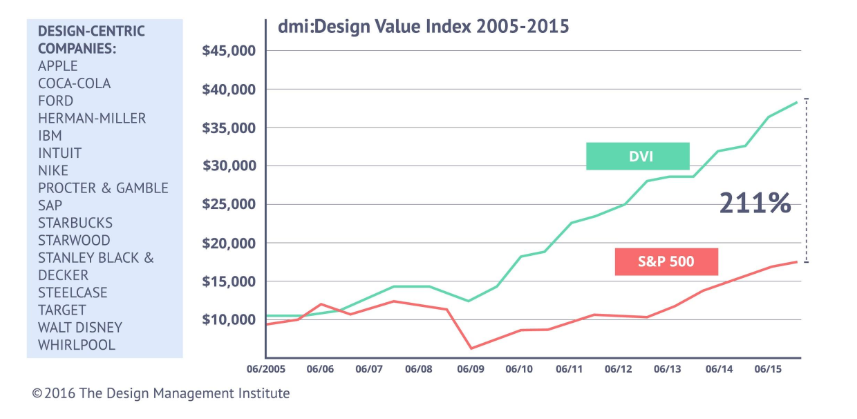
Source – The Design Management Institute
It is imperative that the product that is being delivered to users cater to their needs, accommodate their goals and reflect their behavior in order to make them use your product. A design that does not take into account what the customer wants will only prompt them to move away from your product.
2. Make Educated Decisions
Needless to say, it is absolutely crucial that design teams are aware of the latest trends in software design and are up to date with the current design principles. As a designer, you simply cannot afford to offer a dated solution to your user. So make sure your product team takes that extra step to study what solution your competitors are offering for the same problem and try to come up with a better solution.
This does not mean you need to go over the top with new ideas and designs. For example, a trash can icon is synonymous to “Delete” in the digital world and replacing that with any other fancy icon would only confuse your user.
Some very well thought UI creations that come to my mind are
- Charlie AI
- Samsung SDS Flow
- Airbnb
- Bellroy
- ESPN Sports Programming
3. Use a Style of Communication that Suits Your Audience
Understand your user base and use a communication style that best suits their age and interests. Say for a children’s website or a fashion e-commerce application, a dull downbeat communication style might not sit well with your younger audience and could force your customers to move on to an application they can relate to emotionally.
On the other hand, a professional network like LinkedIn will require a precise and formal tone as the larger audience on it are strictly there for professional reasons.
Using a tone that makes sense to your audience is very important to capture their attention and build trust with them. Users like to know the “people” behind the software and the tone of your website does just that.
4. Consistency is Key
Like we talked about setting a communication style for your website, it is just as important that this style is maintained throughout the website. The importance of being consistent cannot be stressed enough when it comes to optimal user experience. Users tend to use applications that are consistent in their elements, color scheme, typefaces, and interactions.
Say, if your application displays notifications on a side panel, maintain all notifications on the side panel throughout the site. Believe it or not “Your users don’t like surprises”.
5. Include a Knowledge Base
Let’s explain this with an example. Patrick wants to use your application. He loves the concept and the UI design. He can’t wait to start using your app as he has heard it is perfect for his needs. But Patrick has no idea HOW to use your product. He searches for a guide to help him, but found none. Disappointed, he had to move to another application that had a detailed manual.
Now, losing a customer like Patrick is such a shame. Had you spent that extra effort to create a beautifully crafted knowledge base that explains every functionality and feature of your app, you would have retained millions of users like Patrick.
Understand what your users are looking for. If you don’t want to maintain a separate knowledge pile for this, you can add all the information you want to show the user in the UI, by making it seem less like a knowledge base but more like an intuitive design. You could even integrate an AI bot to answer popular queries for you instantly.

When customers are able to find answers to their questions easily and without having to Google/Quora for answers, the overall customer satisfaction increases and also increases user engagement on your website.
Related Read: CTOs Guide – How Robotics and AI Can Improve Customer Experience
6. Less is More Vs More is More
Minimalism isn’t just a fancy word for lazy design. A minimalist design is a visual concept that seeks to embrace simplicity in design, in order to rope in users only towards what is most important.
When catering to a mature target audience, minimalism can be more attractive than a page full of creative design elements, sliding panels, glittering headlines, and modish popups. If your aim is to urge your customers to focus on a particular set of products, minimalist design is the path to choose.
However, it is crucial to understand your customers here. A minimalist design may not work as well for software designed for children, like an educational game. Younger audiences probably would not understand the aesthetic that you are trying to create and may move away to a more attractive website.
7. Improvise and Adapt – The Secret Sauce of Software Design
This is probably THE most important point that businesses need to keep in mind in order to retain their user base for years.
According to a survey by Skype, Adobe, Norton, and TomTom, less than half of the technology users do not like to upgrade software when they should. The simple reason is that people are comfortable with the way things work and do not want to risk getting an update until it’s proven to work for someone else.
On the contrary, users are attracted to new features and functionality as well.
So how do we ensure our software stays on top of its game to an audience that are hesitant to upgrade but wants new stuff too?
Let’s look at the case study of a simple messaging software.
Starting with a messaging platform to simply connect with friends and family via text messages, the team introduced push notifications on mobiles to ensure messages are received even when the application is not running in the foreground. Once the application garnered a few users, more features like photo and video sharing were added and while they were at it, some edit and filter features were included too. Once the application turned out to be an indispensable communication tool for its users, they added voice and video call features.
At this point, users were receptive to all these subtle changes because they hadn’t realized that the application as it was in the beginning, had completely transformed into something much bigger. As far as the customers knew, their experience on the application was flawless. Once the users were comfortable with the current working, the team added group conferencing and even payment integration. Finally, what started as a simple one-on-one messaging app had the potential to replace at least 4-5 apps that were needed every day.
This is the story of how the messaging giant “WhatsApp” increased its user base from a humble 250,000 users to more than 1.5 billion active users standing right next to Facebook and YouTube.
Takeaway – Start by building trust with your customers. Be attentive to your customer’s needs and incorporate improvements without overwhelming the users.
Some popular applications that have evolved into tech giants over time are
- Google Suite
- Adobe Photoshop
- Amazon
- Windows
- Android
- SAP
- iOS
Knowing how to improvise and adapt is the reason these intelligent businesses remain relevant in the market for years.
Related Read: How AI is Redefining the Future of Customer Service
Summing Up
Coming back to the beginning of this article, we asked you why millennials are unable to switch back to older technologies even though they enjoyed the UI at that time. Gameboys for one, were well researched, were consistent, came with a detailed manual and had a great design given the technological limitations of that age. Where they failed to deliver was improvisation. Users are always looking for the next big technological breakthrough.
To stay on top of your game, you must be open to enhance your product for improvements and cater to the continuous cycle of changing customer demands. Product teams should focus on providing users with a flawless experience, be it through the user interface, functionality or customer service. A user-friendly UI is a catalyst for building good relationships with your customers. Retaining your users become easy when you have earned their trust by consistently meeting your customer’s expectations.
By building sustainable software that sees well into the future, we at Fingent top custom software development company, believe our partners deserve the best that technology can offer. Feel free to contact our consultants to get an insight into how we work to deliver your dreams.
Stay up to date on what's new
About the Author

Featured Blogs
Stay up to date on
what's new
Talk To Our Experts
Today’s consumers are tech-savvy, demand consistency and know they can switch brands at any time. Therefore, Customer Experience (CX) is extremely important now more than ever. Customers aren’t just buying a product. They are looking to gain a good experience throughout the customer journey – before, during and after their purchase.
Imagine the pressure of not slipping up in any instance! If it wasn’t for AI and robotics, this could be a daunting affair. Thankfully though, the application of robotics and AI has streamlined the entire customer journey. As a CTO, leading the company towards this technological transformation is a great responsibility. This blog will take you through 4 ways in which robotics and AI can improve customer experience.
1. Personalization
Hyperconnected customers of this digital age highly value personalization. This personalization is expected at all touch points and marketers are employing various strategies to achieve this. In the basic sense, this includes presenting personalized recommendations using algorithms and predictive analytics. Algorithms mine transaction data, browsing patterns and purchasing behaviors to gain customer insight. This information then enables to design personalized offers and create cross-sell opportunities.
Machine Learning is going one step further with AI-Augmented Contextual Analytics. Contextual Awareness is made available through machine learning and human curation. This awareness is implemented across the entire data and analytics workflow of the company. Thus, personalization is made possible throughout the operations and can be implemented at any touch point.
Sentiment Analysis is the next big thing that companies are implementing in order to improve customer experience. Voice, text and visual engagement can be analyzed by technologies to gauge sentiment and emotion. Voice biometrics over phone calls, parsing of facial expressions during video chats, and texts through chatbots can be used to understand emotion and intent. This insight helps companies measure and deliver customer satisfaction more effectively.
Read More: Predictive Analytics: The Key to Effective Marketing and Personalization
2. Improving Internal Processes
As we have discussed, customers expect a satisfactory experience in all touch points. This includes the way the company is run, the backend and the corporate image. Efficient processes and effective decision-making filters down to a profitable company and happy customers. AI and robotics can be used to achieve this.
Mark Robinson, co-founder of the world leading SaaS solution Kimble talks about how augmented intelligence helps businesses grow. “Using augmented intelligence to make suggestions to staff, and to record their response, means that humans and the machines can work together to come up with the best solutions,” he says. “There is less need to worry that people are going to miss important actions or take wrong decisions because of the visibility of what’s going on.”
It is believed that AI has the power to increase productivity by 40% or more by 2035. By automating processes and supporting innovation, AI can improve manufacturing and business processes. One example is smart product ordering systems, which use the power of AI to streamline order fulfillment. Our recent blog brought out the opportunities in this: “From ensuring that the product is personalized and available where the customer wants it, to streamlining the order shipment and delivery process, the customer experience is enhanced by the intelligent product ordering system.”
3. Effective Pricing
“What I ‘charge’ today has nothing to do with yesterday or tomorrow. It has to do with ‘now’!”
– David Wayne Wilson
This has profound significance today, where pricing drops or increases by the second. However great your marketing, your technology and other systems are, it all comes down to pricing. If a consumer gets the same benefits and quality at a lesser cost, he will opt for a cheaper option. Pricing is therefore a vital component in competitive advantage. This means that businesses must keep a close eye on competitors’ pricing behavior.
That is where Dynamic Pricing Science holds significance. With the power of Artificial Intelligence, cognitive algorithms, big data and machine learning, businesses can now effectively adjust their pricing strategies in real-time. Dynamic Pricing Science enables tailor-made pricing solutions to customers at the right time and consistent across channels. It helps understand buying patterns, identify effective correlations, compare competitor prices, match it across channels and create a customized offer – all in real time.
4. Improving Response Time
Response time is crucial in business. This is true in leads conversion as well as customer service. The importance of response time in lead conversion was brought out by Dave Elkington, the CEO and founder of InsideSales.com. Quoting a study he was involved in he says: “The study revealed that the odds of making contact with a new lead are extremely high if you call within the first 5 minutes of submission … a rep is 100x less likely to make contact if the first call is made 30 minutes after submission. The odds of making contact drop by 3000x if the first call is made 5 hours after lead submission.” Converting a lead into a customer is the first customer touch point and it is vital to get it right.
This is important in customer service as well. The State of Multichannel Customer Service report found that:
- 68% of people stop doing business with a brand due to a poor customer service experience.
- 34% of people feel that quick resolution of their problems was the most important feature of customer service.
- 61% of people on social media expect a response from a brand in less than 24 hours.
A bad response time could break a business as the numbers show. However, AI and machine learning have helped immensely in this regard. Chatbots are proving to be a great boon, especially when it comes to swift response on first-level queries. This ensures that there is an immediate response and minimizes time spent by personnel on repetitive queries. Agents can then handle deeper conversations and conversions with the assistance of AI.
China Merchants Bank is an excellent case study on the effectiveness of real-time chatbot interaction. Interactions through these bots had reached a record of 41 million by the end of 2015, with the chatbot handling 99.5% of the questions with an accuracy of 99.8%!
Power Your Customer Service With AI
As you can see, the power of AI and robotics in customer service cannot be overemphasized. Fingent works with clients across industries all over the globe. We would be happy to help you with any questions you might have. Drop us a message and let’s get this rolling.
Stay up to date on what's new
About the Author
Featured Blogs
Stay up to date on
what's new
Talk To Our Experts
Improving the customer experience is the mantra for survival in today’s highly competitive business environment. More and more businesses have identified machine learning as a reliable tool towards this end.
Machine learning is in essence software coded differently to traditional software. Rather than a long list of if-then-else statements typical of traditional software, machine learning predicts what humans would do given a specific set of inputs.
Currently, marketers and others leverage machine learning to further customer experience through improved personalization, enhancing the computer vision, improving natural language, greater decision support, through analytics optimization, and augmented analytics.
1. Machine Learning Aids Personalisation
Today’s highly pampered customers prefer and even demand personalized engagement and experiences. Machine Learning facilitates it to the hilt. Data and analytics allow marketers to understand customer preferences. Using machine learning in combination with new data sources from the Internet of Things (IoT,) telematics, geolocation beacons, and social data improve the insights.
Several marketers now apply machine learning based algorithms to understand the nuances of their customer’s preferences and engage them on their terms. Marketers use such algorithms to develop highly relevant marketing campaigns, such as a matching audience profile with highly targeted video content. These steps improve the call-to-action.
Customers receive tailored offers rather than irrelevant non-contextual offers. Such non-contextualized offers have a very low probability of conversion.
Segmentation gets better. For instance, insurance companies do not have to go by general assumptions or time-honored conventions to offer the highest automobile insurance premiums to a 16-to-25-year-old male. They can factor in everything specifically related to the customer, and tailor the premium based on individual rather than class factors.
The creation of such relevant content is the godsend at a time when over 90% of online users in the U.S. and Europe feels advertising is more intrusive today compared to two years ago.
Related Infographic: Machine Learning- Deciphering the most Disruptive Innovation
2. Machine Learning Facilitates Computer Vision
Machine Learning technology detects everything and anything, from objects and people to complex scenes within the images and videos. Applying the technology to enhance the quality of digital assets is a sure-shot way to win the customer’s heart.
One big success story is Twitter’s Magic Pony, which leverages machine learning technology to make pixelated images sharper, and enhances the quality of video captured on mobile phones in poor lighting conditions. Apart from delighting the customer, the spin-off benefit of Twitter is lower data usage, and by extension improved streaming abilities.

3. Machine Learning Aids Natural Language Processing
The next big thing revolutionizing human interactions with computers is speech recognition technology. The ability of computers to recognize human speech and act on it not only spares the hassles of keyboard typing but also unlocks a host of new possibilities. While speech recognition technology has been around for a while, the application of advanced machine learning technologies has made the system highly accurate, with error rates far lower than humans. Google’s Cloud Speech API now recognizes over 80 languages and variants, with a high level of accuracy.
Marketers can, and are leveraging advanced linguistic data and cognitive technologies spawned by speech recognition capabilities to create highly engaging content, targeted at the customer. In a sense, it furthers the cause of personalization in a big way.
Marketers benefit from natural language capabilities in myriad other ways also. A case in point is the intuitive new tool launched by Relative Insight, a UK based start-up. The tool converts natural language into data, offering marketers a wealth of information to connect with specific audiences instantly and deeply.
4. Machine Learning Improves Decision Support
Machine learning allows the marketers to predict the future. The “machine” becomes capable enough to predict the customer’s likely course of action, based on the data at his disposal, and his present behavior. The market is now flooded with several digital tools and services which provide advanced recommendations on this front.
On the anvil is “copyless paste,” where machine learning will save users time by proactively offering to share information between apps. Marketers will leverage the concept further to offer proactive product suggestions. Integration with other systems also offers the scope for proactive and automatic delivery.

5. Machine Learning Facilitates Analytical Optimization
Businesses leverage the immense analytics opportunities offered by machine data to fine-tune their operations, deliver new business models, and offer new products and services in tune with customer demand. The insights gained, predict not just how a customer may behave or act, but also how the competition may move in the future.
One sector where machine learning algorithms are already in widespread use is the financial sector. Financial services companies use various machine learning algorithms such as random forest and gradient boosted models for a host of applications, from predicting the probability of being ranked at the top of aggregator portals to predict midterm cancellation rates on policies, and more. These applications have a direct bearing on customer satisfaction. For example, banks and financial institutions predict volumes for credit card lines, to adjust rates and terms, and thereby attract the right type and volume of customers for the specific product.
Related Reading: Top Artificial Intelligence Trends to Watch Out for In 2019
6. Machine Learning Facilitates Augmented Analytics
The scope of machine learning improves with the development of technology. Neural networks support better classification and forecasting, decision trees support more complex rule and relationship-based customer experience programs. All these improve the organization’s ability to support complex decisions, forecasts, and optimizations.
Augmented analytics, which co-opts these latest and emerging technologies, combines various elements of the ecosystem, such as data preparation, business intelligence, predictive analytics and machine learning capabilities into a single, automatic and seamless process. Enterprises would be able to cleanse their data easily, to uncover latent insights and patterns.
Today’s huge data create millions of variable combinations impossible to process manually or even with traditional tools. Augmented analytics, powered by machine learning, deliver quicker insights, reducing customer frustration.
What exists now is just the tip of the iceberg. The future holds a world of possibilities. A case in point is the fragmented nature of the machine learning ecosystem being all set for a big churn. Increased competition, the hyper-fast paced changes in technology, and the proliferation of big data at an alarming frequency force many open source machine learning libraries, algorithms and frameworks to join forces and deliver a better deal to their customers. The lower-level personalization commonplace today will make way for a more robust collaborative filtering, delivering a much higher degree of personalization and contextualization than present levels.
Side-by-side, the machine learning ecosystem is becoming increasingly easier to use, and more affordable. Hitherto, only enterprises with large analytics teams could really afford to play around with machine learning. The advent of various solutions delivered in a cloud-based subscription model makes the power of machine learning available to the masses, including start-ups, freelancers, and even individuals.
Marketers and brands can leverage the improved ecosystem to generate a better picture of their customers’ true context, and serve them better. Simply put, customers will get better food, movie, music, travel, product and purchase recommendations.
Related Reading: AI To Solve Today’s Retail Profit Problems
Stay up to date on what's new
About the Author
Featured Blogs
Stay up to date on
what's new