Category: Enterprise Software
Artificial Intelligence is revolutionizing our lives. What used to conjure up images of robots taking over the world, is now a household word. Recommendation engines are reading our minds, virtual assistants are listening to our voices, and AI insights are transforming our businesses. AI is definitely here, and this blog will show you how.
Artificial Intelligence and Its Impact on Today’s World
Artificial Intelligence in its basic sense is defined as intelligence demonstrated by machines. In application, we can say that Artificial Intelligence is the ability of a machine to assimilate information and use it to make intelligent decisions. The attributes of problem-solving, decision making and other cognitive abilities that are associated with humans becomes artificial intelligence when applied to a machine.
The lifeblood of AI is data and its pulse run by an algorithm. Algorithms assimilate data and make sense of it through analysis. The resulting insight is what drives the decision making and problem-solving capabilities of Artificial Intelligence. Learning is by far the greatest attribute of Artificial Intelligence. The ability to learn and emulate human thinking and behavior is what makes AI nearly unstoppable. Its application in business is unmatched and is predicted to offer $15.7 trillion to the global economy by 2030!
Read more: AI Implementation For Businesses
Advanced Benefits of AI
The benefits of AI extend to much more than recommendation engines and chatbots. The ability of AI to make sense of data collected through the Internet of Things (IoT) will be a game changer in every aspect of our lives. Gartner predicts that 20.4 billion “things” will be connected by 2020. Artificial Intelligence can analyze the data collected by IoT technology and enable it in ways that we cannot even imagine.
A classic example of this is Idemandu, one of the most talked about topic in the AI world since the 2018 Consumer Electronics Show. In the words of its founder Pooya Abka, Idemandu is the first AI agent “that can understand customers’ service needs over voice, connect them to vetted service providers instantly, and learn about their personal preferences with time.”
Demonstrating what is possible with Idemandu, a Forbes article quotes this conversation:
You: “Hey Idemandu, could you ask my massage therapist to come to my place tonight preferably after 8? I’m feeling an annoying pain in my neck.”
Idemandu: “Sure, but your therapist is not available tonight. I found another very similar therapist who is available, would you like to see him at 8 pm tonight? If not, I can book your own therapist for tomorrow at 8:30 pm.”
You: “Okay, tell him to come tonight.”
Idemandu: “Okay, he’ll be there. I already briefed him about your pain.”
Imagine the possibilities with such an AI empowered assistant in every home and business. Google Duplex is another technology that is focused on helping us make hotel reservations. The Assistant will call your chosen restaurant, converse with the concierge, make a reservation for you, confirm with you if the reservation was successful or recommend another restaurant if it wasn’t!
The ability of AI and robotics to use concepts like AI-Augmented Contextual Analytics and Sentiment Analysis to better predict and direct customer experience was brought out in one of our recent blogs. You can read it here: https://www.fingent.com/blog/how-robotics-and-ai-can-improve-customer-experience-ctos-guide
How AI Is Transforming Various Business Sectors
The biggest impact of AI in business development. A survey conducted at the EmTech Digital conference revealed that respondents saw AI affecting these top three business outcomes:
- improve and/or develop new products and services
- achieve cost efficiencies and streamline business operations
- accelerate decision-making
We can see this impact in nearly every sector in business. Here are three sectors where the impact of AI has been seen the most:
Healthcare
86% of healthcare provider organizations, life science companies, and health technology vendors are using AI technology, says a 2016 report from CB Insights. These organizations are projected to spend an average of $54 million on AI projects by 2020. Few areas where AI is being used in healthcare are:
1) Data management – Medical records and other patient data can be accurately analyzed, stored and used to provide healthcare businesses with the right information at the right time. Time-intensive report analyses can be automated, diagnosis can be fast-tracked, and treatment can be better administered.
2) Virtual Consultation and Care – Healthcare apps using AI allow doctors, patients and, caregivers to communicate and coordinate effectively. Speech recognition, machine perception, and other AI enabled technologies, help to monitor the patient’s condition and administer effective treatment.
3) Precision Medicine and Drug Discovery – By screening complex compounds and existing medicines for specific attributes, drug candidates for pre-clinical drug discovery and development can be rapidly identified. AI can also help detect diseases and predict hereditary health issues more accurately and help design precision medicines for specific genetic make-ups.
For more applications of AI in the healthcare industry: https://www.fingent.com/blog/5-ways-big-data-is-changing-the-healthcare-industry
Finance
The assimilation and analysis of financial data is where AI shows its true potential, but there is much more that AI can do in the financial sector. AI in the Finance industry reduces costs, saves time and improves accuracy and efficiency in all areas of Finance. Here are a few applications:
- Security from Fraud – Security is the number one concern in the financial sector. AI helps in this by simulating fraud and cybercrime scenarios and coming up with preemptive security measures to combat security breaches. AI also helps in monitoring whether all security measures and regulations are being followed in the design of financial technology.
- Wealth Management – AI engines help analyze data associated with wealth management and provide insights on how to provide optimal benefits to clients. Creating personalized and tax-optimized investment offerings for clients becomes much simpler and accurate with the help of AI. AI also helps mitigate the unpredictability of the stock market, by incorporating features like blockchains and distributed ledgers.
- Digital Assistants – AI now assists with banking transactions and finance in nearly every household. AI assistants like Alexa, Siri and others are used to make financial transactions. Voice assisted banking is being made possible with banks like Barclays coming up with technology to enable money transfer through voice assistance software.
Read more about how predictive algorithms and AI will rule financial services: https://www.fingent.com/blog/how-predictive-algorithms-and-ai-will-rule-financial-services
Transportation
AI is being used widely in the transportation sector and these are a few areas where it is making an impact:
- Automation – While driverless cars are what comes to mind when we talk about AI and automation, the role of AI in automobile manufacturing is of equal import. Tesla’s automated manufacturing systems in its factories is an excellent example of the capabilities of AI in automobile manufacturing.
- Cloud based conveniences – With the help of AI and cloud computing, automobiles are being packed with features like suggestions for gas stations when the fuel is low, favorite restaurants on the route and shopping reminders when approaching stores.
- Intelligent Maintenance – Features like predictive maintenance, repair scheduling, and even sensors to detect medical emergencies for drivers can be enabled with AI.
Read more about how connected transportation will disrupt the world: https://www.fingent.com/blog/how-connected-transportation-will-disrupt-the-world
Keeping up with AI
As you can see, the implications for AI in business is tremendous. It is important that businesses capitalize on AI-based technologies to keep up with the competition. Fingent has helped businesses from every sector to implement AI and drive revenue. Drop us a message if you have any questions!
Stay up to date on what's new

About the Author

Featured Blogs








Stay up to date on
what's new



Talk To Our Experts
Custom Software Development Vs Packaged Software – Tips to select the right solution for your business
Custom software and off-the-shelf solutions come with their own pros and cons. Organizations should assess their requirements closely and opt for one that suits their workflows and processes.
In this video, Dileep Jacob, Head of Operations at Fingent shares his insights on helping businesses choose between off-the-shelf and custom software offerings. He elucidates on how custom software and off-the-shelf solutions bring efficiency improvements within an organization. The benefits and limitations of the two platforms are dealt with to help pick the best choice for your business.
Conclusion
Businesses find it difficult to choose between off-the-shelf or custom software solutions. This video presents a clear picture of the key differences between the two together with their pros and cons to help businesses like yours pick the right choice. Fingent’s decade-long expertise in custom software development can assist you to make an informed decision by piecing together the best solution and guide in your decision making.
Questions? Comments? Concerns? Contact us today to learn more about how we can help drive your business success with custom software solutions. We will quickly get back to you with the information you need.
Stay up to date on what's new
About the Author

Featured Blogs
Stay up to date on
what's new
Talk To Our Experts
 INFINCE was showcased at the NY Business Expo held on October 30, 2018, at the Jacob K. Javits Convention Center in New York. The New York Business Expo is an annual B2B trade show for small and mid-sized businesses. The expo brings together business owners and executives of small companies who converge on this day-long event with conferences, sessions, and networking.
As a part of the exhibition, Stephen Cummings, the Senior Vice President at Fingent, took to the stage to deliver a session on running profitable small businesses in the age of digital technologies. He elaborated on how small-scale businesses can be empowered with technology to become competitive and highly productive to thrive in today’s market.
“Every company today, one way or another, depends on information. Successful companies are resilient and adopt the right mix of technology and processes as their appetite for information technology grows. We’ll present ways a small business can take advantage of recent advances in technology to compete more effectively, even against much larger companies.”
– Stephen Cummings, SVP, Fingent
Small Businesses and Technology
Technology should remain accessible to businesses of all kinds, whether big or small. Stephen highlighted on this very aspect in his 45-minute presentation. Technology comes with its own jargons that prevent smaller businesses from taking advantage. However, the onus is on bringing technology to businesses with smaller investments and workforce, so that they can thrive competitively.
There is a perceivable gap in adopting technology among small businesses. He attributes it to the increasing costs and lack of adequate tech support, Besides, on-premise IT infrastructure was dissuaded in favor of alternatives like the cloud, where small companies can get computing resources at reasonable costs. This is where Stephen put forth INFINCE, Fingent’s own enterprise cloud platform to the spotlight.








About INFINCE
INFINCE is cloud technology optimized for small businesses and a platform to run IT without any hassles. Stephen highlighted on some of the key traits of INFINCE that makes it different from other cloud platforms. Quick deployment is one such, where a company can set up and run INFINCE within minutes. INFINCE is also economical as it integrates optimal cloud configurations that cut down cost without sacrificing on performance.
INFINCE’s concierge IT services together with 24/7 support help small companies deploy the right technology. With it, small businesses get the advantage of a true enterprise cloud with all the functionalities at half the cost. In addition, the huge array of productivity tools and utility apps integrated with INFINCE helps automate marketing, improve customer engagement, open up collaboration across all levels and monitor workforce productivity through its streamlined dashboards.
About Fingent
Fingent is a global IT company specializing in developing custom software solutions that help businesses succeed. Starting operations in 2003, Fingent has grown over the years with more development centers spread across three countries. By building sustainable business practices across different industries, Fingent has become the preferred partner for leading enterprises like Sony, Johnson & Johnson, PwC etc. The industry expertise combined with a robust workforce have enabled us to consistently deliver strategic solutions for a global clientele.
Find out more about the NY Business Expo here
Stay up to date on what's new
About the Author
Featured Blogs
Stay up to date on
what's new
Talk To Our Experts
AI continues to positively disrupt businesses around the world by empowering them with automation and data-driven insights.
In this video, Deepu Prakash, Head of Process and Technology Innovation at Fingent shares his expertise on deploying AI within the context of the modern business environment. He puts forth five crucial steps that you can begin right now to shift your company into an AI-driven model systematically.
Stay up to date on what's new
About the Author
Featured Blogs
Stay up to date on
what's new
Talk To Our Experts
This month we are covering how creating and fostering mobile-driven digital ecosystem help grow your customer base and provide services effectively. We will also be discussing how zero code platforms ease the pain of mobile app development. Lastly, we cover what happens when Machine Learning meets the business world.
Zero-Code Platforms Ease the Pain of Mobile App Development | Business.com
Enterprises find themselves plagued with issues like apps not performing as expected, apps scoring low on user experience and more. But with the benefits of zero-code being obvious to more and more businesses, more platforms are on its way to becoming mainstream.
Where Do You Fit in the Mobile-Core Digital Ecosystem?| Clutch
With the global proliferation of mobile users, enterprises must now focus on mobile-centric solutions. Such a rapid increase in global mobile usage points to a paradigm shift in the future of digital communications.
Mobile devices now act as the medium for facilitating all kinds of communications and services within an ecosystem. In addition, their improved connectivity options and versatility makes them ideal for all kinds of digital ecosystems.
When Machine Learning Meets the Business World| DZone
Let’s discover what happens when Machine Learning meets the business world. Take a look at how it will transform businesses as well as how it will minimize risks.
Stay up to date on what's new
About the Author

Featured Blogs
Stay up to date on
what's new
Talk To Our Experts
iOS App Development: Grow Your Business With An iOS App
With smartphones and tablets emerging as the device of choice for most people, apps are in a boom phase. Businesses are joining the bandwagon in a big way, rolling out apps that offer a world of convenience to their customers and employees alike. However, while doing so, they need to be wary of losing focus.
Apps are not just another channel to execute the entire gamut of organizational functions. The most effective apps serve specific purposes, and in the process empower the business.
Businesses also need to take a serious look at iOS application development, considering iOS apps have proven to be very engaging. An average iPhone user spends about 75% of her time on apps, probably owing to iOS applications being able to leverage the advanced features and functionality of Apple devices.

Here are some ways in which you can empower your business, using iOS application.
Roll Out Customer-Facing Apps
Customer facing iOS app is a good idea, considering Apple devices, such as the iPhone, has more than a 15% share of the total smartphone market. Such apps not only promote sales but help in engaging with customer better. Marketers may send out push notifications on key milestones, keep track of customer behavior, issue special offers when a customer is in the vicinity of a store, and do more. Customers may be given several self-service options, from keeping track of loyalty points to access of neutral product reviews, and more.
Empower Internal Teams
Imagine the world of convenience when the salesperson, on meeting with a potential or existing customer, pulls out the iPhone, opens an app that draws on data from the CRM, and gather all details about the customer, right from his purchase history to open inquiries, his preferred channels of communication, and so on. The salesperson also gets highly customized tools and relevant insights, such as market surveys, reports, and more. iOS apps facilitate similar empowerment across all functional area, be it accounts, HR, logistics, and other teams.
Forge Deep Relationship with the Ecosystem
More and more businesses seek to develop apps that help the company forge deeper relationships with their ecosystem partners, such as suppliers, contractors, and others. An app that makes explicit real-time stock levels and issue alerts would prompt suppliers to make timely deliveries, and improve the efficiency of their business as well. Contractors could log into another intuitive iOS application to get a list of open projects, deadlines, billing, and more. Channel partners could also gain from first-hand access to a ton of resources, and all the information they require, without having to make follow-ups, or spend time seeking information.
Facilitate the “Internal” Customer
An iOS app could likewise benefit the “internal customer” of the enterprise. Employees could, for instance, use an internal employee app to make leave requests, access their payroll details, stay updated on everything from upcoming team meetings to office parties, and more. Such apps eliminate complicated and time-consuming paperwork, be it filing trip sheets, expense reports, or appraisal forms. With the bulk of information readily available at their fingertips, employees can focus wholeheartedly on their core tasks, improving their productivity manifold.

Streamline Internal Processes
Many enterprise apps streamline internal workings and deliver big productivity gains. Employees starting a task could hook up to an iOS application that guides them through the specific process flow, helping them complete the task without being bogged down by doing things the wrong way, or seeking instructions. The app could also facilitate electronic submissions of documents and bills associated with the task, and make sure the next in line gets a notification to process the same. The benefits are multifold and include reduced paperwork, better productivity, faster turnaround time, and cost-cutting. Still better, employees are empowered to do the task from anywhere, at any time.
Promote “Smart” Work
Apps can help employees work smarter instead of harder. A case in point: the average employee attends 62 meetings a month, wasting a whopping 31 hours in the process. A collaborative app that enables managers to set targets, notify team members of their targets and deadlines, allow team members to submit their results, and do more can eliminate a good chunk of such meetings, and save considerable time. Such app based internal communications is also a good way to overcome silos, a big stumbling block for the free flow of information.

Transform Organizational Processes
Rolling out iOS applications could even eliminate certain traditional functions altogether. For instance, a training app that delivers instructional videos, handbooks, and other resources to the employee’s iPhone could completely eliminate the need for training sessions. The cost saved in terms of arranging training resources and the trainer’s time alone would repay the investment in the app many times over. Employees could also leverage such apps to unlock training and development opportunities not available before. The impact on employee performance and commitment are worth its weight in gold.
All the possibilities come to pass only when the app development is done right. iOS developers would do well to customize enterprise apps by giving it a distinct look and feel that resonate the brand image, offer appropriate options such as choice of languages, flexibility to enable or disable certain features, location mapping and more. The ability to customize the app and the presence of value-added features make the employee feel more connected and enhance the worth of the app.
Development of iOS apps is a far more straightforward process, compared to developing Android apps, as Apple provides standardized SDKs, APIs, and IDE needed for the application development. However, Apple’s app store discards apps that do not meet its guidelines, and as such iOS app development requires a much more concentrated and focused effort. A partnership with a reputable company to develop the iOS application helps pass the iTunes test and ensure the effort invested in the app development process does not go waste.
Stay up to date on what's new
About the Author

Featured Blogs
Stay up to date on
what's new
Talk To Our Experts
MEAN Stack – Performance Optimizations
In the past few years, MEAN stack went from ‘yet another shiny JS thingy’ to being a viable alternative to build high-performance web applications. We have quite a few medium to large apps running, that are MEAN.
One of our recent MEAN projects saw rapid growth in the user base (hundreds of thousands of users within the first few weeks), resulting in the system hitting the initially designed max-loads much earlier than anticipated. Hence we had to review the architecture and performance parameters to identify and fix the bottlenecks.
This blog is a quick rundown of the whats and hows in our initial performance tuning. Since the system was hosted in AWS, we used Amazon services wherever possible.
We implemented the following to improve the MEAN Stack project performance.
-
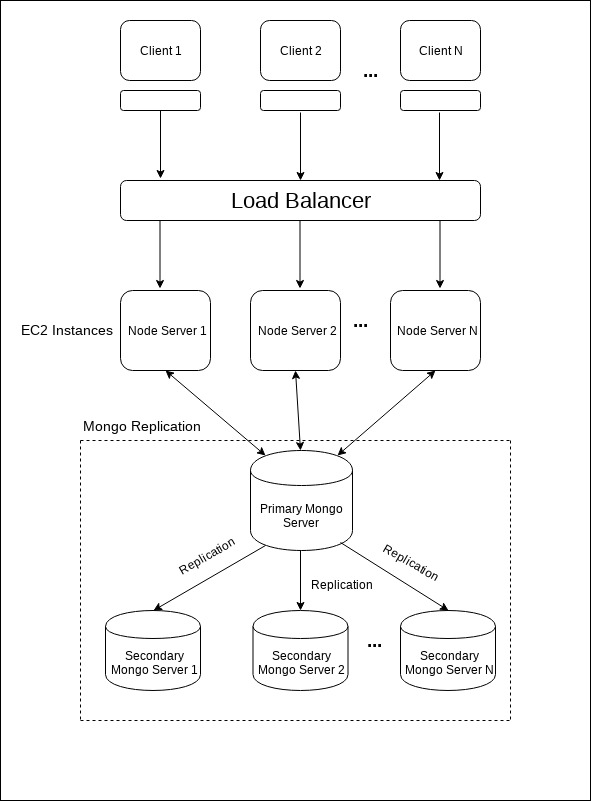
Introduction of Load balancing
-
NodeJS Clustering
-
Amazon S3 as CDN
-
Mongo replication
-
Microservice implementation
Load Balancing
When it comes to increasing the performance of websites and web services, there are a couple of options:
- Improve the efficiency of the code.
- Throw more hardware at it.
Option two (throwing in more hardware) is the fastest and easiest solution to mitigate the performance woes.
Let us discuss how we can scale the Node.js server infrastructure using ELB, which stands for Elastic Load Balancing. ELB automatically distributes the incoming application traffic across a group of backend servers. The load balancer routes the incoming requests to the second server when the first server is busy processing other requests so that the end user does not experience any delay in getting the response.
There are three types of load balancers:
-
Application Load Balancer
-
Network Load Balancer
-
Classic Load Balancer
Application Load Balancer is best suited for load balancing of HTTP and HTTPS traffic and provides advanced request routing targeted at the delivery of modern application architectures, including microservices and containers. Operating at the individual request level (Layer 7), Application Load Balancer routes traffic to targets within Amazon Virtual Private Cloud (Amazon VPC) based on the content of the request. The socket forwarding is supported only in the application load balancer. So we have used the Amazon AWS application load balancer to scale the server architecture.
The decision on how many servers to be used in the load balancer depends upon the traffic expected in the server and the number of concurrent requests the server needs to handle. Moreover, it also depends upon the system configurations in which the server is hosted such as the number of cores, memory, etc. We also need to change some web server(ex: nginx or apache) configurations as described here.
To discover the availability of your EC2 instances, a load balancer periodically sends pings, attempts connections, or sends requests to test the EC2 instances. These tests are called health checks. The status of the instances that are healthy at the time of the health check is InService. The status of any instances that are unhealthy at the time of the health check is OutOfService. The load balancer performs health checks on all registered instances, whether the instance is in a healthy or unhealthy state.
The load balancer routes request only to the healthy instances. When the load balancer determines that an instance is unhealthy, it stops routing requests to that instance. The load balancer resumes routing requests to the specific instance when it has been restored to a healthy state.
The load balancer checks the health of the registered instances using either the default health check configuration provided by Elastic Load Balancing or a health check configuration that the developer configures. In the second case, the developer has to give one health checking URL ({main domain}/health) to the IT team (who are doing the ELB implementation), which serves as the health status of the instance.
The health URL should be an API configured in Node.js program, which connects to the database and fetches some lightweight data to make sure that the instance is properly working i.e, it ensures the health of web server (Nginx), server (Node.js instance) and the database server (MongoDB). If this API could respond with the HTTP status 200 within a particular time (Say 2 seconds, which we can set in the load balancer configuration), the instance is marked as healthy, otherwise, it’s marked as unhealthy.
The load balancer periodically (Say 10 sec, which we can set) checks the health status of each instance (If we scaled to 2 servers – checks these 2 instances) through the corresponding health URL, to mark it healthy or unhealthy. So, when the next request comes, the load balancer routes the request to a healthy server instance which is available.
We are using the LoopbackJs – a Node.js framework, and we can put the following code in the folder called server/boot (In loopback framework folder structure) to create the health checking API URL. You can use your own API path if needed.
module.exports = function(server) {

 var router = server.loopback.Router(); // router module

  router.get('/health', function(req, res) {

       server.models.ServerHealthStatus.findOne({where: {status: 1}, fields: "status"}, function(err, healthStatus) {

           var response = "";

           if (err) { //failure

               res.status(400).send(response).end();

           } else {

               if (healthStatus) { // success

                   response += "Health: OK";

                   res.send(response); // http status: 200

               } else { //failure

                   res.status(400).send(response).end();

               }
           }
       });

 });

};
In this code, ServerHealthStatus is a model which is mapped to the mongo database collection (Similar to a table in MySQL) – ServerHealthStatus, which is having the following one document (Similar to row in MySQL):
{

     "_id" : ObjectId("5b2b7u5d1726126da11b1f98"),

     "status" : "1"

}
The model query tries to fetch this document, and sends the response – either 200 or 400 depending upon the query result. If the Node.js service is busy with processing other requests, it may fail to retrieve data or it may take more time to respond, which may exceed the time that we have configured in the load balancer timeout.
Since our server is distributed over multiple instances, firstly, we need to make sure that, the resources like images or files (user profile images, documents) are located in a place, which is accessible to all instances. Earlier, we may have been using the local file system for resource storage. Since the load balancer is implemented, there are multiple instances which need these contents to be accessible. So in order to solve this problem, it must be saved in a common place like Amazon S3.
After hosting the server, we need to do the load testing with some automated tools to make sure that the server can handle the specified number of concurrent requests and handle the traffic. If it fails, we need to increase the server configurations or the number of server instances until it meets the required standards. We need to periodically track the server for the CPU and memory usage while doing the load testing. After implementing the load balancer, we need to do the failover test as well.
Besides, we need to manually down one instance and check whether other instances serve the client request without any delay. Also, we must carry out the load testing by putting the load specified in the project requirement (say, 10K concurrent requests).
Node.js Clustering
A single instance of Node.js runs in a single thread. To take advantage of multi-core systems, the user will sometimes want to launch a cluster of Node.js processes to handle the load. The cluster module allows easy creation of child processes that all share server ports.
const cluster = require('cluster');

const http = require('http');

const numCPUs = require('os').cpus().length;

if (cluster.isMaster) {

 console.log(`Master ${process.pid} is running`);

 // Fork workers.

 for (let i = 0; i < numCPUs; i++) {

   cluster.fork();

 }

 cluster.on('exit', (worker, code, signal) => {

   console.log(`worker ${worker.process.pid} died`);

 });

} else {

 // Workers can share any TCP connection

 // In this case it is an HTTP server

 http.createServer((req, res) => {

   res.writeHead(200);

   res.end('hello world\n');

 }).listen(8000);

 console.log(`Worker ${process.pid} started`);
}
Amazon S3 as CDN
We were using the local file system for storing static resources (images, JSON files etc.). Since the load balancer is implemented, there are multiple instances which need these contents to be accessible, so, it must be saved in a common place. Amazon S3 was the automatic choice since we were already on AWS.
Mongo replication
A replica set is a cluster of MongoDB database servers that implements master-slave (primary-secondary) replication. Replica sets also failover automatically, so, if one of the members becomes unavailable, a new primary host is elected and your data is still accessible. We have used 3 mongo servers. The entire process is clearly described here:
https://linode.com/docs/databases/mongodb/create-a-mongodb-replica-set
We will specify the server domain names or IPs of the mongo servers in the database connection URL like this:
mongodb://userName:password@mongo1,mongo2,mongo3/databaseName?replicaSet=rs0&connectTimeoutMS=180000&socketTimeoutMS=180000
Where mongo1, mongo2 & mongo3 are the mongo server names(which uses internal domain names, since all server exists inside one AWS account, admins can give user defined names mapped to IP address, which can be used instead of IP addresses in the mongo connection URL) which is pointing to different IP addresses.
In the loopback structure, need to change the connection URL in the datasources.json (it will change to datasources.prod.json when we are in the production environment) file in the folder called server like this:
{
"db": {

   "name": "db",

   "connector": "mongodb",

   "url": "mongodb://userName:password@mongo1,mongo2,mongo3/databaseName?replicaSet=rs0&connectTimeoutMS=180000&socketTimeoutMS=180000"

 }
}
Microservices FTW
Splitting up independent functionality to a stand-alone service can help with the system performance a lot. Node, with its asynchronous, event-driven architecture, is well suited for this.
If there are complex operations that require lots of system resources (CPU, RAM) for a considerable amount of time, check whether these can be moved out as a microservice. So the load is not reflected in the main server(s). We can implement this functionality in an independent server which can be accessed via an API URL. The main server will trigger this API URL for getting this task done.
For example: Sending push notification functionality to mobile apps
Our app has an alert functionality, where notification gets sent to hundreds of thousands of devices at once. Sending notifications involves selecting the device token IDs from the database to those users who have to be alerted, which proved to be an involved task with the non-relational nature of Mongo.
Since the push notification sending functionality is a time-consuming process, the server load will be high during this process which may result in queueing other incoming requests. In order to solve this, we have separated the push notification functionality to an independent server as a microservice.
After implementing all these, we can monitor the resource usage of all the servers while performing the functionalities especially the complex functionalities.
In conclusion, optimizing the performance of a MEAN stack project requires efficient database querying, caching implementation, and resource management. For expert assistance, it is advisable to partner with a custom software development company to optimize the performance of your MEAN stack project.
Please note that this is in no way a complete list. Optimizations vary based on a number of factors from architecture and functionality to client preferences.
Stay up to date on what's new
About the Author

Featured Blogs
Stay up to date on
what's new
Talk To Our Experts
Write once, run anywhere – the alluring catchphrase of Java still seems relevant. Since Sun Microsystems unveiled Java, it has remained the most popular programming language in use. Object-oriented and class-based, Java stood its ground even when the development space became saturated with a plethora of new languages. However, with time, programming languages do get phased out once newer and better platforms take over.
And then came Kotlin. The search for a tenable Java alternative reached fruition with Kotlin, a statically-typed programming language running on the Java Virtual Machine (JVM). Essentially, Kotlin stripped Java of its complexities and came up with a refined alternative that is as versatile as its predecessor.
The Czech software company JetBrains unveiled Project Kotlin in 2011 with the objective of coming up with a better alternative to Java. They looked to Scala, another Java alternative with support for functional programming, but were taken aback by its slow compilation times.
Kotlin Goes Public
In 2016, JetBrains launched Kotlin v1.0, its official stable release to the public. Kotlin immediately gained traction among the Android development community. They lauded its refined framework and faster compilation times, complete with added tool support, as a significant advantage over Java. Things gained momentum when Google announced Kotlin as a first class language for developing Android apps at the I/O 2017.
What followed was an outburst of mainstream apps all written fully or partially with Kotlin. Kotlin had everything that developers couldn’t find in Java or any of its alternatives like, JRuby or Groovy. It is concise and 100 percent interoperable with Java. Added to that, Kotlin came with extensive compatibility with Android Studio in which IntelliJ IDEA, JetBrains’ own Java IDE serve as the backbone.
With interest in Kotlin skyrocketing, global adoption rates point to a widespread disruption. From freelance developers to software development houses, the adoption of Kotlin has increased manyfold. In the Stack Overflow Developer Survey Results of 2018, Kotlin is just behind Rust as the most loved programming languages. In the near future, Kotlin could become the de facto standard in Android development.
Kotlin’s Development Philosophy Strikes a Balance
Andrey Breslav, Kotlin’s lead language designer at JetBrains highlighted that the goal of Kotlin is to serve as a general-purpose language, which is concise, adaptable and fully interoperable with Java. By giving these extended set of functionalities, JetBrains intends to push the developer to migrate into Kotlin. Plain old Java has numerous flaws and the developers at JetBrains couldn’t conceive things as they wanted. For them, greater interoperability and productivity in the language is the need of the hour to quickly compile and execute code.
When working with Kotlin, we could easily pinpoint its structural similarities with its parent language, Java. The brains behind Kotlin did not just want to create a new language, but one which is in all ways a “better language” than Java. Platforms like Scala, although they offered extensive feature list and functionality, failed when it comes to build times and tool support. Kotlin managed to tick all the right boxes and struck a balance on how an ideal Java alternative should be.
Kotlin borrows some elements from Scala to bring out a more upgraded version. In fact, one could find that Kotlin does contain certain instances from other programming languages as well. Pascal, an early procedural and imperative programming language remained fairly influential in the development of Kotlin. Certain elements of it, like parameter lists and variable declarations with the data type following the name of the variable could be found in Kotlin too.
Bringing Full-Scale Interoperability with Java
What distinguishes Kotlin from other languages is its full interoperability with Java and the Android runtime. It is easier to call existing Java codes from Kotlin and Kotlin codes from Java. Developers could use all the Java frameworks to build highly responsive and feature-rich apps. Both the platforms, Kotlin and Java, identify each of their classes as their own, which enables seamless interchange and compatibility. This interoperability with Java could be demonstrated with a few lines of Java code as listed below:
MainActivity.kt
class MainActivity : AppCompatActivity() {

override fun onCreate(savedInstanceState: Bundle?) {

    super.onCreate(savedInstanceState)

    setContentView(R.layout.activity_main)

    // accessing "getSum"  method from a java class

    val result = SumHelper.getSum(1, 2)

}

}
SumHelper.java
public class SumHelper
{

public static int getSum(int val1, int val2){
       return val1+val2;
}
}
Fig 1. Kotlin – Java Interoperability
This extensive interoperability of Kotlin with Java owes it to the fact that JetBrains worked on all the limitations of Java and sought to bring out something more refined. Together, the team worked on a new version that is different but still has Java as its backbone. Besides, Kotlin fully supports Java 6 and 7, the current versions used by Android developers.
Java Lacks Key Elements that Current Developers Need
Java has been around for more than two decades. Developers still continue to build great apps using its highly versatile and robust framework. Like every language, Java too has its limitations chiefly because it is old. Even though numerous updates were released over the years, they failed to address some essential problems associated with coding using Java.
When it comes to Android development, Java lacks support for key elements like lambdas, streams, method references, etc. Null Pointer Exception continues to be a fundamental flaw of Java, particularly in the way it handles them. Null references in code often referred as the Billion Dollar Mistake is the key reason why several apps written in Java still undergo occasional crashes.
Moreover, Java is verbose and takes a lot of code to get even a simple program up and running. The APIs involved in Java get rather complicated as the developer is forced to go through multiple steps, which take more time. Kotlin, on the other hand, requires lesser coding than Java by reducing both redundant and boilerplate code, making development a whole lot faster.
A Class Declaration in Java
public final class PersonJava {

private final String name;

private final int age;

private final String email;

private final long phone;

public PersonJava(String name, int age, String email, long phone) {

this.name = name;

this.age = age;

this.email = email;

this.phone = phone;

}

public String getName() {
return name;

}

public int getAge() {
return age;

}

public String getEmail() {
return email;

}

public long getPhone() {
return phone;

}

}
In Kotlin
data class PersonJava(val name: String, val age: Int, val email: String, val phone: Long)
Fig 2. Side by Side Comparison of Kotlin and Java Code
Lesser code means developers can write a program in lesser time and the code has greater readability combined with fewer chances of bugs or manual coding errors. Memory leaks are also a frequent problem with Java due to the way it implements anonymous inner classes and nested classes.
Kotlin Edges out over Java in Conciseness
With Google’s official endorsement, Kotlin has become the most commonly used language for Android development. The simplicity and robustness of Kotlin means both proficient and novice developers can write and debug applications with ease. Generally, Kotlin requires fewer steps or ceremonies when writing code, which simplifies the process altogether. Compared to Java, Kotlin has:
- More concise class declarations because of primary constructors and properties
- Robust type interface eliminates the need for repeating the same types again
- Function parameters with default values mostly do away with delegating overloads
- Availability of top-level functions substitute static utility classes
Being more concise than Java, Kotlin edges it out when it comes to ease of coding. It takes a redefined approach to programming to untangle several complicated workflows that developers face when using Java.
Meanwhile, Kotlin’s less verbose coding decreases the time taken to code and enhances the readability while also reducing the chances for any errors or bugs. Writing lesser code means developers can reduce the number of boilerplate codes while improving their productivity and avoiding tediousness.
Kotlin is Nothing but an Improvised Version of Java
A notable benefit of Kotlin over Java is that it does not sway from being completely independent of the latter. In fact, Kotlin is an improvised form of Java, with all its limitations sorted out. Kotlin still relies on Java libraries but refines them all together to improve their functionality.
In the existing Java ecosystem, Kotlin manages to integrate each of its elements like the Java libraries, APIs and frameworks. In fact, Kotlin incorporates Java’s procedural and functional programming aspect at the right balance. Besides, its lightweight framework combined with modern features make it a refined version of Java that is in every way better than the original.
Android Development Gets Swift and Efficient with Kotlin
Kotlin aims at being pragmatic and productive at the same time all the while serving itself as a general purpose language fully compatible with Java. Owing to its compactness, Kotlin has proved itself a workhorse among the Android development community. It steers clear of all the limitations of Java with its full interoperability with the existing ecosystems of libraries and code. Here are a few reasons why Kotlin remains the ideal platform for Android development currently.
Developer Friendly:
Novice developers can easily learn and adapt Kotlin owing to its simplicity. It takes less time to learn to code with Kotlin due to its uncomplicated learning curve. Developers already proficient in Java would appreciate the familiarity of its coding process and streamlined approach to programming. Meanwhile, the availability of existing Java libraries, frameworks and lesser coding, amps up the speed of coding, allowing developers to conceive applications faster than before.
Excellent IDE Support:
IntelliJ IDEA, JetBrains’ own platform serves as the base for Android Studio and thus offers extensive IDE support to Kotlin allowing developers to seamlessly build apps. This ready integration with the IntelliJ IDEA framework enables access to its wide range of productivity tools. Configuring Kotlin plugin could be undertaken within minutes in Android Studio. Besides, every single process of coding in Kotlin from writing, navigation, debugging and unit testing happens effortlessly with the improved support offered through the IDE.
Enhanced Versatility:
Kotlin was designed to address some of the fundamental flaws in Java and it did well. Integrated into its framework is a built-in null checking feature that helps avoid frequent errors. Kotlin’s compiler also includes a feature that automatically corrects mistakes in the code simultaneously while it is being written in the console. These rich features negate several issues in Android development giving developers a clean and versatile platform to work with. Besides, it allows developers to streamline the production process through its features like search and auto-completion of code.
Open source:
JetBrains announced open source status under Apache 2 for Kotlin in 2012. The Java to Kotlin converter tool can seamlessly convert an existing Java project into Kotlin to save on time and work. Besides, it is completely free to use for any developer wishing to expand their skill set or get acquainted with its refined framework.
Summing Up
Every new language introduced into programming has the potential to disrupt it. Developers, when faced with limitations while working on their existing language readily adopt a new language that mitigates these issues. And Kotlin proved to be just that with Java. Its swiftness and concise nature proved instrumental in its widespread adoption among the Android development community.
For them, Kotlin seemed a better Java and its great interoperable support combined with expressive nature meant they could code just like they did with Java but in a fast and efficient manner. That does not mean that it will completely phase out the former. Java will still be around as a versatile language for years.
In times to come, newer versions of Kotlin gets released, which would be more developer friendly and complete with added features and support. More apps will utilize Kotlin to develop Android apps and there will come a point where it will ultimately substitute Java. Moreover, the steep adoption rates signal an increasing prominence of Kotlin for Android development in the near future.
Stay up to date on what's new
About the Author
Featured Blogs
Stay up to date on
what's new
Talk To Our Experts
As a company grows and faces new challenges, a continuous evaluation must be done on the current work processes and IT solutions so as to analyze whether they can address these challenges. Performing a periodic gap analysis in ERP implementation helps assess the direction in which a company is headed. Moreover, it can also determine whether the company is equipped with the right kind of tools to get there.
Some of the common issues that companies normally need to look into are:
- Streamlining day to day operations so as to improve productivity and profitability
- Recognize the need for collaborating with business partners
- Generate more insights for decision making
- Meeting regulatory requirements
- Adapting and scaling the business
Most companies rely on a combination of manual and automated workflows, legacy applications, and databases to run their business. These systems may serve their purpose for quite some time, but will eventually run out of options for scalability leading to productivity gaps. In today’s highly competitive markets, inefficient systems can seriously affect the productivity, profitability, and growth of a business.
Dealing with separate systems can become a hindrance to growth and profitability. At the same time, companies can benefit from ERP systems to help define best practices, optimize workflows and achieve a better view over the various business processes.
By automating business processes, companies benefit from the increased accuracy, accelerated data flow and streamlining of day to day activities. This, in turn, gives the staff more time to focus on areas that require personalized attention.
The Need for GAP Analysis in ERP Implementation
Considering the rapidly evolving ERP market and ever-changing needs of companies, it is very essential that gap analysis is done on a frequent basis. This can assess the relevance of legacy systems and ascertain whether the organization’s demands have outrun the capabilities of these systems. GAP analysis helps in providing precise analytical data to compare the costs involved in an upgrade versus the value addition that the upgrade brings in.

Performing the GAP Analysis
GAP analysis is the technique of listing out the steps to be taken for a company to move from its current state of operations to a desired future state. The analysis begins with highlighting the company’s current situation, listing factors to achieve the objectives, and also planning out the key steps to put into effect for bridging the gap between the current situation and the desired future state.
Besides, undertaking an ERP implementation also imply conforming to common market forces and regulatory requirements. The following checklist will help analyze whether the existing system meets your unique business requirements. In addition, this will also guide you determine whether to enlist the services of a consulting organization to perform a detailed evaluation for accurately assessing the value that a state of the art ERP system would bring about.
Does your organization need to comply with government regulations?
Many companies in various industries must comply with various regulations constituted by the government. Some of these regulations include:
- Sarbanes-Oxley Act for all public companies
- OSHA Hazard Communication Standard
- ANSI
- European Union REACH (Registration, Evaluation, Authorisation, and Restriction of Chemicals) legislation for chemical companies
- The Bioterrorism Act
- HACCP (Hazard Analysis and Critical Control Points) for food and beverage producers
Most companies find that managing these government regulations are burdensome and costly. The higher costs are attributed to the fact that many of these are managed manually. Moreover, manual compliance processes not only increase the cost but also leads to inaccuracies and time delays.
Do you need to streamline your operations to improve productivity and profitability?
In today’s competitive world, organizations need to continuously improve their processes and streamline their operations to reduce costs and increase productivity. Manual systems can be time-consuming and slow down the business processes due to rekey of information into multiple systems. Furthermore, to add to the trouble, there are a lot of inaccuracies as well.
Do you need to enhance your decision-making capabilities?
With the increasingly competitive market, it is essential that your company has all the required info to guide you in making the right strategic decisions. When data is spread across various systems and spreadsheets, it becomes increasingly difficult and time-consuming to create reports that are needed to support key decisions.
Do you need to collaborate with partners?
As your company grows and the market conditions fluctuate, it may become unavoidable to not team with partners in various industries across different geographical locations. During such collaborations, effective and hassle-free communication becomes vital to meet customer expectations, maintain loyalty and remain profitable at the same time.
Does your processes and systems scale with your business?
Scalable systems are an absolute necessity considering the competitive markets that thrive today. You will need technology solutions that not only cover your present needs but also accommodate the growth of your business in the future.

Are you planning to grow your business globally?
If the answer is yes, then you will definitely need systems that address the following:
- Global currencies
- Multiple Languages
- Global regulatory specifications
The Output of GAP Analysis
- The GAP analysis will give a complete overview of the system
- It will inform the organization or business, how much value the ERP system will precisely bring into the various business processes
- At times, it may also lead to the conclusion that the implementation of an ERP isn’t needed for the organization when analyzing the value being added
Conclusion
Modern day companies face adverse competition due to rapid market shifts. In the midst of new technological innovations, the adoption of an ERP system is a big step for the growth of a company and its productivity as well. GAP analysis remains an indispensable part of this entire process and companies should focus on it more and give the importance that it deserves. The value adds by giving you a detailed retrospective of your business processes and the current systems are much more than the costs involved in the same.
Stay up to date on what's new
About the Author

Featured Blogs
Stay up to date on
what's new
Talk To Our Experts
What kind of business software works for your business?
Business software marketed by developers for enterprises are available in two categories: tools and solutions. So, which one is compatible with your business and why should you rely on that instead of the other?
Finding a solution to this question will give you a clear picture of the kind of software that you need for your business. Picking a business software tool or solution has its differences. Both aids in managing and optimizing the workflows so that the business processes run as you envision.
The end results are usually the same but what differs is how the two functions and what features you have at your disposal. Knowing about this will guide you in preferring a business software for managing your operations. This article details some useful tips to help you choose between a business software tool and solution.
Why do you need a Business Software?
In managing your business, what are the criteria or standard rules that you normally carry out? Extensive paperwork, registers, accounts books or any novel ways that you have invented. They were reliable once upon a time as the scale of business operations were much confined, then.
But, in this ever-connected world, such methods have become rather unconventional. Today the entire world is shifting digitally and enterprises have been at the forefront of this rapid revolution. Digital tools and software have become the standard for carrying out almost all kinds of business operations.
It transformed all the vital processes in the domain of business and management. For instance, a direct example would be the software and tools used in a supermarket to generate bills and invoices as well as track their warehouse status real-time.
Business software steers clear of conventional approaches to managing a business in favor of digital tools. They combine powerful processing with quick and feasible results, enabling businesses to do more in less time.
If you look at the overall spending for migrating to such new and innovative approaches, it will give you a rough idea of the growing prevalence of enterprise software.
The total spending that enterprises have accumulated for specialized business software have ratcheted in 2018 alone. The coming years and the end of this decade will witness an explosive growth and demand for enterprise software by information technology and related companies worldwide.
Simply stated, depending on a business software will give your businesses the following plus points:
- Simplify operations to manage any of your business projects
- Easy scalability that grows with your business
- Rich features that integrate all key functions
- Anywhere, anytime access via any digital device
- Robust and swift data processing
- Integrates work and enhance focus
Business Software – Tools and Solutions
When approaching a business software, you will stumble across two categories such as tools or solutions. You cannot just go and opt for one without a clear idea about the differences between the two. They are essentially software but have their own differences in the features, functionality and user experience.

Basically, a tool is just one application specialized for managing your enterprise operations. A tool is a bundle of features and services that let you manage all operations within its confines. So, you will limit connectivity, for when, if the processes do not move as expected.
Software solutions are made for enterprises with large-scale operations and have preloaded features and guidance that will let you navigate your business processes with ease. Solutions usually come as a contract where you sign up for the services of a solutions provider.
You are allowing an external agency to give solutions for all your key managerial operations. This takes the workload off your shoulders and the people, which gives you more time and energy to focus on important matters related to your business.
Addressing the Pros and Cons of Tools and Solutions
Tools
Pros – A business software tool has the major advantage of affordability. Developers can customize the software so that it suits the business while incurring only lesser costs. Therefore, software tools are particularly apt for small businesses which have only a limited range of operations. They come with an intuitively designed interface and are easier to use.
Cons – Software tools are just an application designed to do a specific task but limited in its functionality. How you gain positive results rests entirely on how well you use the tool and its key features. There is no external support that will help you trudge through difficult processes and operations. Besides, there is no guarantee that a software tool works for your business to earn the desired result.
Solutions
Pros – Solutions are the perfect means to tackle the large-scale management processes of big enterprises. Packed in software solutions are some leading and highly dependable features like expert guidance and coverage across the entire aspects of management. Solutions can make a ready change in how the operations are managed, which has the immediate effect of driving growth and innovation.
Cons – Software solutions are typically costlier compared to tools. Businesses relying on a solutions provider need to pay exorbitant charges to keep their management processes up and running constantly. It is not within the reach of smaller businesses and is only meant for large enterprises and corporations.
What Business Software Should You Choose – Tools or Solutions?
So, when deciding between the two, which one will you opt for in assisting your business? Firstly, the needs are to be clearly addressed. Failing to do so will result in ending up with a business software that does not correspond to the business you are doing.
Selecting among both business software – tool or solution will give you the results that you are looking for. But to truly help in dealing with your daily business management processes, it is vital to choose the right one.

Tool
Opting for a software tool is an excellent option if you run a small or medium scale business. If you run a new startup or are already figuring out the ways to manage your small business, then a tool would best suit your requirements. When picking a tool for your business, you need to consider the following questions.
- What use will it have on my business and who uses it?
- Has it got any integration features with other business systems?
- What are the needs of employees and does it serve their needs?
Request a demo of the software from the vendor before you move forward with the purchase. This gives you an overall idea of the software, which helps you understand whether it has the features and functionality that you are looking for.
Meanwhile, a demo could also give your employees a hands-on experience with the software to find out whether it goes smoothly integrated into their work practices as well. Moreover, considering the pricing of the software by comparing across different vendors will help you choose one that fits in with your budget.

Solution
A solution encompasses a much broader range and extends beyond the limitations offered in a tool. It is particularly for business process change and has a service provider that takes over the managerial functions of the enterprise. If you run a large-scale enterprise, then a software solution will benefit your business more than any other.
Basically, the reliance on solutions helps in driving better management and relieves the workload on your employees. A typical example of software solutions is ReachOut Suite, a field services management software for managing work orders. Technicians can easily carry out field works with efficiency due to the centralized cloud-based system of ReachOut, which are accessible via mobile devices.
When choosing a software solution for your business, you should address all your requirements with the vendor. This is the preferred option than opting for a trial or demo of the product. In this way, the vendor or a software development company can work out with your estimate and give you solutions tailored for tackling all your management problems.
Summing Up
It all gets down to your need because that essentially determines everything. A tool can serve you well and help deal with issues related to managing your crucial business operations. It can aid in your business functions for making it easier within its stand-alone solution. Besides, they are affordable too, helping you decrease expenditure along with a boost in performance.
Solutions, however, are a complete offering specially designed for solving management problems of large enterprises. And so, the pricing is larger, but you get what you need, which is expert guidance and overall efficiency in the process. This unifies and liberates work in your business, helping you solve issues, maintain operational efficiency and opt for business process change.
Stay up to date on what's new
About the Author
Featured Blogs
Stay up to date on
what's new