Tag: IoT
Supercharge Your Business with These 11 Hot Tech Trends
Technology is having an ever-greater impact on our personal lives and most importantly on the way we do business. The business world has transformed rapidly in the past few years and it will evidently continue to change the pace of business in the years to come. Whether it is the production of goods or the computing devices used at the office, new technologies have helped businesses run smoother and more effectively. As information travels more quickly and reliably, businesses are realizing how easy it is to grow globally and across multiple sectors. To gain benefits, however, businesses must keep up with technology and adopt new trends. This article discusses 11 tech trends to look forward to in the next couple of years. First, let us understand what drives these tech trends, and then we will consider their impact on businesses.
What Will Drive the Evolution of Tech Trends?
Two major reasons for the evolution of all kinds of tech trends are our day-to-day business challenges and the passion for innovation. As an intelligent being, it is normal for human beings to innovate to live better. However, from a business standpoint, it is about optimizing all that humans are capable of accomplishing and that includes making profits.
1. Greater predictive levels and programmability will reshape cybersecurity
Cybersecurity will be one of the prominent IT functions to mature. New technologies will bring about a fundamental shift in cybersecurity as they enable greater predictive capabilities and programmability. It will become more predictive with the use of large-scale data along with AI, analytics, and machine learning. As a general rule, the more we have, the more difficult it becomes to protect it from thieves. That is not the case with immense data accumulation. Even as data increases it will become easier to determine and match patterns to both predict and shut down any attack vectors.
As every element of infrastructure becomes programmable, you can put a firewall inside the software of all virtual machines in your architecture, thus limiting the flow of data within the software. This will eliminate the need of storing data on a network from where the data can easily be hacked or stolen. Businesses will continue to see this capability emerge as programmability improves.
Read more: Safeguarding IT Infrastructure From Cyber Attacks – Best Practices
2. Promise of serverless computing
According to IDC’s prediction, “from 2018 to 2023 — with new tools/platforms, more developers, agile methods, and lots of code reuse — 500 million new logical apps will be created, equal to the number built over the past 40 years.” Currently, we are witnessing a distinct change in the application infrastructure with most businesses moving to cloud-native applications.
There are four distinct computing models that are evolving simultaneously such as virtual servers, physical servers, container-based computing, and serverless computing. Virtual servers and container-based computing make it easy to move applications. Whereas the promise of serverless computing offers greater agility and cost savings as the applications do not need to be deployed on a server. Alternatively, functions can be run from a cloud provider platform. It can return outputs and instantly release the associated resources. As businesses see a change in the infrastructure, they will have to make choices about how they approach development.
Read more: 5 Trends That Will Transform Cloud Computing in 2020
Accelerated in part by the long-term shutdown due to COVID-19, industries that design and manufacture products will quickly adopt cloud-based technology trends to aggregate and intelligently transform. In a couple of years, these intelligent algorithms will allow manufacturing assembly lines to optimize towards increased levels of output and enhanced product quality thereby reducing the overall waste in manufacturing by half.
3. IoT and Edge
IoT and Edge can rightly be termed as superpowers of the tech world. The developing, managing, and running of widespread IoT and Edge applications will grow in complexity with numerous endpoints. For example, audiovisual technologies are being used to achieve the same input as you would get when you connect numerous IoT sensors. When compared to individual sensors, these tech trends provide reasonable mass coverage at a minimum cost. This is only possible when AI and ML are integrated into the IoT platform. Powering and maintaining thousands of sensors is a daunting prospect. Audiovisual solutions can thus make this a significant growth area. As a result, these changes will have a profound impact on how the businesses get value out of new data that they are able to collect and process.
Read more: Gearing up for IoT in 2020
4. Everything will revolve around data
Enormous amounts of data collected from IoT devices and digital platforms can now be made available through application programming interfaces for business insights, analysis and to develop other applications. Collecting information from a sufficient amount of data-points enables you to model behavior and understand patterns and come to more accurate conclusions quickly with minimum cost. With abundant data from multiple touchpoints and new analytic tools, businesses are able to customize products and services by creating ever-finer consumer microsegments. Businesses that do not build around data will find themselves swamped by its enormity.
5. Voice control is the next evolution of human-machine interaction
The advent of voice technology such as Apple’s Siri, Google’s Assistant, and Amazon’s Alexa is disrupting businesses as it creates a three-way interaction between devices, services, and people. It has completely changed the way consumers interact with smart devices.
According to recent research, by 2024, the global voice-based smart speaker market could be worth $30 billion. This technology trend has a huge impact on how online searches will happen. Businesses will have to adapt their way of promoting their products and services. It will also affect the way companies are organized as internal knowledge can be shared more easily which improves the possibility of multitasking. This will result in increased productivity.
In the next couple of years, we will see a transformation of voice technology from being an information tool to a transaction tool. It offers the possibility to directly order from brands and perhaps even pay.
Read more: 6 Key Predictions for AI-Driven Voice Computing in 2020
6. Blockchain platform market
Blockchain started as an offshoot of the cryptocurrency movement. Now, it is evolving to find use cases beyond just the international settlement areas. According to Gartner, Blockchain will grow to slightly more than $176 billion by 2025 and continue to exceed $3.1 trillion by 2030. The marriage of Blockchain and Artificial Intelligence can significantly change the nature of transactional businesses. This is possible as Blockchain is a decentralized unchangeable space for encrypted data and AI will assist you in analyzing and interpreting that data quickly and reliably to drive actionable insights. There is great potential for this technology to have an immense impact on cybersecurity.
Read more: How Blockchain Enables the Insurance Industry to Tackle Data Challenges
7. Seamless blend of the digital twin
Applied technology will intersect between the physical and digital worlds, the digital twin. For example, the digital twin will have a perfect digital copy of the physical world. Applied technology will allow you to blend these two worlds seamlessly. The resulting immersive environments will have a pervasive impact on the industry. This twin will allow you to collaborate virtually, simulate conditions quickly, understand what-if scenarios clearly, predict results more accurately, and more. Most businesses are already aware of the benefits of applying the digital world to enhance the physical world. They are digitizing physical processes to reduce inconsistencies, redundancies, and human error.
Explore: Learn more about Digital Twin Technology
This pandemic has shown us that communication is not just for work but is required to form real emotional connections. In the next couple of years, AI technology will be used to connect people at a human level and drive them closer to each other. There has been a lot of concern over the security of video conferencing companies. However, these concerns will move companies to ensure that they provide secure digital connectivity for their consumers.
Being a secure video conferencing software, InfinCE has been a game-changer for enterprises of all sizes. Click here to explore
8. 5G will be the game-changer
5G has innumerable use cases beginning from healthcare to more reliable security. With 5G, the audio-video experience will be faster and clearer than it has ever been. On the flip side, 5G will enable businesses to provide remote opportunities for their employees with work experience that would be similar to that inside the office. It will bolster recruitment and retention efforts for top talent.
As more businesses move their critical tasks to the cloud, employees will become increasingly productive from wherever they work and with whatever device they use. Though currently, 5G coverage is limited, according to Ericson’s Mobility report, 5G subscriptions could cover up to 65% of the world’s population by 2025. Businesses that anticipate and embrace these emerging technology trends will see a positive impact in the years to come. Low latency 5G networks can help resolve the challenges caused by the absence of reliable networks and can facilitate more high-capacity services. Private 5G networks can offset the high cost of mobility with economy-boosting activities.
Read more: From Remote Work to Virtual Work, 5G is Reinventing the Way We Work
9. Data lakes enable new analytic models
Data lakes are storage repositories that contain quantitative and qualitative data. Data lakes enable new models of predictive analytics and help unlock the potential of digital twins. Since they can hold enormous amounts of data, organizations can leverage the insights, including discrete data points to create a ‘digital twin’ of each customer. You can gain access to customer details such as demographic data, browsing behavior, purchasing patterns, and payment preferences. The ability to gauge qualitative data will increase the demand for robust ERP systems and AI-driven automation. This would mean that businesses should acquire the skills to set up, manage, and secure their data lakes and build data models that will help extract the insights they require for ongoing innovation.
Read more: 7 Key Differences Between Data Lake and Data Warehouse
10. Sophisticated sentiment analysis for real-time insights
Sentiment analysis uses techniques to interpret and classify the ‘mood’ of your customers. Sophisticated sentiment analytical tools allow businesses to recognize the customers’ sentiment towards a product, a service, or a brand. It can also be used by the businesses to respond to the feedback with a proactive approach. It allows businesses to understand how people are feeling in real-time and proactively position products, services, and visual merchandise. In the future, this technology will be used in addition to tools such as conversation intelligence, text analysis, and natural language processing. It can enable innovation on demand. Businesses will find it advantageous to incorporate sentimental analysis into their data analysis in the areas of customer feedback, marketing, CRM, and e-commerce.
Read more: CTOs Guide – How Robotics and AI Can Improve Customer Experience
11. Micro-fulfillment for e-commerce fulfillment
Robotics has turned around numerous industries except for a few sectors such as grocery retail. With the new robotic application termed micro-fulfillment, grocery retailing will no longer remain the same. Micro fulfillment allows you to convert personal garages into storage spaces and can operate 5-10% more economically than a brick and mortar store. This rising trend is captured in tiny, urban warehouses that leverage high-end automated systems to complete online orders with greater efficiency. These centers are used to deliver goods rapidly, in as fast as an hour. Robotic arms can be used to pick up items. The application of robotics downstream at a ‘hyper-local’ level will disrupt the grocery retail industry. This technology trend will unlock wider access to food and a better customer proposition such as product availability, speed, and cost.
Read more: 5 Transformative Trends Ushered by B2B E-commerce in Healthcare and Life Sciences
How Technology will Continue to Disrupt Businesses?
The transformative potential of innovative technology trends is exciting businesses today. It will change the way businesses plan, start, manage, operate, market, and make a profit. The next couple of years will see profound improvements in addressing most business challenges as organizations develop and deploy solutions that will deliver tangible results. Driverless cars, 3d printing, artificial and business intelligence tools, robotics, and IoT are just a few examples of how technology has transformed or disrupted the business world and has the potential to continue to disrupt.
The COVID-19 pandemic has necessitated worldwide collaboration, transparency of data, and speed at the highest levels to navigate the human and business impacts. Now is the time to recognize and support the opportunities for technology trends that can best and most rapidly address business challenges. Partner with us to capitalize on these trends and scale your business quickly.
Stay up to date on what's new

About the Author

Featured Blogs






Stay up to date on
what's new



Talk To Our Experts

How Can Your Business Benefit from Fog Computing?
How much data do we create every day? The World Economic Forum reports that the entire digital world is expected to reach 44 zettabytes by 2020. So, each day, we witness the colossal growth of data and this pace is only increasing with the growth of IoT. The agility and flexibility of big data applications are the foundation of the Internet of Things (IoT). The escalation of IoT has resulted in an increased volume of digitally generated data and managing that data has become a major challenge. This has led to the emergence of fog computing – an answer to the new challenges of computing technologies.
Read more: Gearing up for IoT in 2020
Defogging The Term Fog Computing
Let us start by defining it.
What is fog computing?
Fog computing is a decentralized computing infrastructure in which computing resources such as data, computers, storage, and applications are located between the data source and the cloud. This term refers to a new breed of applications and services related to data management and analysis.
According to Mung Chiang, Dean of the Purdue University, “fog provides the missing link for what data needs to be pushed to the cloud, and what can be analyzed locally, at the edge.” In simple terms, fog computing is a distributed network fabric that stretches from the outer edges of data creation to the point of storage.
Are fog computing and edge computing the same?
Edge computing is a subset or a component of fog computing. For example, if fog computing is compared to a basket of various fruits, edge computing would be one fruit from a single variety.
Edge computing refers to data being analyzed locally, at the point of creation. Fog computing encapsulates edge processing as well as the network connections required to bring that data from the edge (point of creation) to its endpoint.
Evidently, fog computing and edge computing are complementary.
Difference between fog computing and cloud computing
Just as the literal fog is a cloud closer to the ground, fog computing is stationed as a layer to reduce the latency in hybrid cloud scenarios. Cloud computing forms a comprehensive platform that helps businesses with the power to process important data and generate insights. Fog computing is like the express highway that supplies computing power to IoT devices which are not capable of doing it on their own.
Read more: Hybrid Cloud Infrastructure: How It Benefits Your Business
How Does Fog Computing Work?
Fog computing uses the concept of ‘fog nodes.’ These fog nodes are located closer to the data source and have higher processing and storage capabilities. Fog nodes can process the data far quicker than sending the request to the cloud for centralized processing.
The cloud is getting cluttered due to the enormous number of devices connecting to the internet. Since cloud computing is not viable in some cases, it has become necessary to use fog computing for IoT devices. It can handle the enormous data generated by these devices.
When implemented, fog-empowered devices locally analyze time-critical data that includes alarm status, device status, fault warnings, and so on. This minimizes latency and prevents major damage. Fog computing can effectively reduce the amount of bandwidth required, which in turn speeds up the communication with the cloud and various sensors.
Fog computing example:
If a user with a hand-held device wants to review the latest CCTV footage from a locally positioned IoT security camera, he would need to request the stream from the cloud since the camera does not have storage. This could take a bit of time, which can be eliminated with fog computing, where a local fog node can be accessed for video streaming which is far quicker.
Step-by-step Fog Computing Process:
- Signals are wired from IoT devices to an automation controller which executes a control system program to automate those devices.
- A control system program wires data through a protocol gateway.
- Data is converted into a protocol such as HTTP so that it can be understood easily by internet-based services.
- A fog node collects the data for further analysis.
- It filters the data and saves it for later use.
Read More: Fog Computing: The Catalyst For Efficient Data Processing
Key Takeaways for Your Business
- Increased business agility: It is evident that fog computing is cost-effective because it makes the production of revenue-generating products and services more efficient. It accelerates rollout cycles, broadens revenue bases, and reduces costs.
This revenue stream creates value for IoT fostering highly functioning internal business services. Fog computing also provides a common framework for seamless collaboration and communication helping OT and IT teams to work together to bring cloud capabilities closer.
- Privacy control: Fog computing facilitates better control of privacy because you can process and analyze sensitive data locally instead of sending it to a centralized cloud for analysis. It also enables the IT team to track, monitor, and control any device that collects or stores data.
- Data security: Since fog computing allows you to connect multiple devices to a network, it helps identify threats such as potential hacks, or malware. Additionally, such identified threats can be curbed at the device level without risking the entire network.
The Future is Fog Computing
Fog computing has several advantages over cloud computing. Fog computing can boost usability and accessibility in various computing environments. Soon, cloud computing for IoT may fade away but fog computing will take over. IoT is seeing an impressive growth rate and so it needs a special infrastructure base that can handle all its requirements. Fog computing is the key to accomplish this critical work. Reach out to Fingent, the leading custom software development company, and embark on a transformative journey for your business today.
Stay up to date on what's new
About the Author

Featured Blogs
Stay up to date on
what's new
Talk To Our Experts
How to prepare for IoT in 2025?
In coming years the Internet of Things (IoT) is here to stay. We’re at the cusp of a new era wherein intelligent digital connectivity is a part of our day-to-day lives. Gartner predicts that there will be 25 billion connected devices by 2021. Thus, IoT has made its presence felt across various industries.
Upcoming IoT trends that can shape the business landscape
1. Industrial IoT and Digital Twin technology:
IoT has made manufacturing smart, efficient and less risky. Using digital twin technology, organizations can access the context, structure, and behavior of an asset. Thus, you have the information regarding the past and present state of an asset with an ability to look into the future. Organizations are therefore receiving warning alerts and predictions faster than ever before. Investing in a digital twin can be a part of your IIoT strategy so that after implementing sensors into your machines, you can document their operations and fine-tune them.
2. Computing would be balanced between the cloud and the edge:
While those new to IoT consider cloud as inevitable, high data transmission costs for remote business environments have moved computing to the edge. In many industrial sectors, shifting some analytics intelligence to the edge may prove cost-effective. With edge devices becoming more affordable and centralized infrastructure becoming more stressed, there would be a balance between cloud and edge.
3. Sustainability will become important:
Sustainability efforts have become a key business priority across the globe. The World Economic Forum reports that IoT projects can help to accomplish the UN’s 2030 Agenda for sustainable development. IoT can have a large impact on global sustainability as it connects people and things. IoT can be used to reduce e-waste, promote agricultural sustainability, save energy, protect species, reduce emissions and so on.
How to gear up for the IoT boom in 2024?
While IoT promises attractive growth potential, many companies lack the technical capabilities and know-how to make their IoT projects work. A recent survey found that almost 75% of IoT projects end up as failures. Following are some of the ways in which you can prepare for the IoT surge:
Related Reading: IoT Implementation: Common Mistakes And Strategies To Tackle Them
- Plan Ahead: The major challenges that cause IoT projects to fail are budget overruns, limited internal expertise, long completion times, lack of proper data. All of this boils down to planning. You need to organize your projects, asses your budget needs, calculate the time requirements and assess whether your team has the expertise to handle the project. If you lag on any of these points, it is better to postpone the project rather than not finishing it at all.
- Establish partnerships: Implementing IoT products can be very taxing due to the complex technology involved. The task can become almost unmanageable without a network of partners. You can establish partnerships for technological expertise or data and content delivery. Pioneers like Facebook, Amazon or Google have built entire ecosystems by establishing partnerships with hundreds of thousands of specialized developers.
- Integration: Successful IoT implementation requires robust connectivity, infrastructure, and seamless integration of your enterprise application/ systems with proper third-party wares. Challenges such as integration of the IoT platforms to enterprise applications and integration of edge/ cloud computing devices to the IoT platforms are most prevalent. By forming a strong IoT solution team with IoT architects and other subject matter experts, you can solve challenges across the IoT solution landscape.
- Ramp up the security: Cybersecurity is going to be one of the biggest risks in an increasingly connected world. Since everything that can be connected to the internet is exposed to a security risk, it is critical to secure every connected device. You need to be prepared with a game plan to tackle such types of data breaches. If you find that your business is ill-equipped to meet the security needs of your IoT network, don’t worry; you can always outsource.
Related Reading: The Pros and Cons of Outsourcing Mobile App Development
- Data storage: IoT is all about data. Cisco estimates that IoT devices would generate about 847 zettabytes of data per year by 2021. You can invest in your own local data storage system (which would be expensive) or you can find a cloud storage provider. Edge computing is another possible solution that is preferable over the aforementioned ones. In this system, the data is pushed to the ‘edge’ for quick access and to prevent data overload.
- Be ready to transform: Partnerships are important. But you’ll also have to set up your own software and big data capabilities which are far beyond the existing levels. The team should focus on transforming itself into a technology company that understands the capabilities of IoT. Be responsive and address all concerns that rise up during the course of the project.
- Innovate dynamically: A dynamic operating model requires cooperation. Innovative approaches like hackathons can be used to advance new ideas that meet the market demands of the digital world. Having the courage to take risks is an important part of dynamic product development. Even if ideas fail, it is important to keep trying and be consistent.
The Internet of Things (IoT) is set to bring about lasting changes across various industrial sectors. Business leaders who stay agile can rest assured that they won’t be left behind.
Need any tips on how to harness the power of IoT in your business? Contact us now!
Stay up to date on what's new
About the Author
Featured Blogs
Stay up to date on
what's new
Talk To Our Experts
Evolution Of The Digital Twin Technology
What is a digital twin? Digital Twins can be best defined as digital copies or virtual replicas of physical assets. Data scientists can make use of digital twins to try and run simulations before they build and deploy actual devices. Digital Twin technology transforms the way in which the Internet of Things, Artificial Intelligence, as well as, Data Analytics is optimized.
The concept of ‘digital twin’ rewinds back to the year 1970 with the launch of Apollo 13. NASA’s digital twin model of Apollo 13 was a famous rescue mission to assess space monitoring conditions. The concept of Digital Twins later gained recognition in 2002 at the onset of a presentation by Challenge Advisory at the University of Michigan. According to Gartner, the digital twin is one of the top 10 strategic technology trends since 2017. Gartner estimates 21 billion connected sensors and endpoints by the end of the year 2020!
Related Reading: Checkout in detail, where and why should you invest in IoT.
Digital Twins: Enhancing IoT Enabled Industries
Data scientists build digital twins that can receive input from sensors that collect data from its real-world counterpart. The twin is then allowed to simulate in real-time. This process provides critical insights and feedback that helps in analyzing the actual system’s performance. For instance, a twin car can be built digitally by validating various inputs to check on factors such as safety, mileage, etc.
Digital Twins impact various IoT-enabled environments such as manufacturing, automotive, healthcare, financial services, urban planning and many more. The major IoT-enabled industries that can leverage the benefits of digital twin technology and how they benefit from it are as follows:
- Manufacturing Industry: The Digital Twin concept with the IIoT (Industrial Internet of Things) is implemented in the manufacturing domain. It can be designed and deployed in numerous ways such as in tracking and monitoring systems, evaluating production, troubleshooting equipment used, etc. As digital twins can predict failure chances, it helps in saving costs, time and in improving customer loyalty.
- Automotive Industry: The future of autonomous vehicles lies on well-connected road systems and vehicles. Critical data gathered from this network. The digital twins then act as simulated models that help engineers analyze the behavior of vehicles before they are used on roads.
- Healthcare: Medical monitoring technology is used to gather critical data such as heart rate, oxygen levels, etc. This data is used in the creation of digital simulations. Digital twins help the healthcare ecosystem in disease diagnosis, remote monitoring of patients, etc.
- Urban Planning Sectors: Vital data such as maps, blueprints of buildings, real-time data from sensors, etc are used to create digital twin models to improve urban planning services. These services include waste disposal, mobility services, providing resources like electricity and water, etc.
- Asset Management: Both worksite and remote industrial operations can be managed via digital twins with the help of remote asset monitoring services. Predictive maintenance of assets like machinery improves operational efficiencies and decreases disruption of business operations. Digital twins can also be converged with augmented and virtual reality techniques for better visualization of industrial workflows.
- Financial Services: Customer behavior can be easily monitored with digital twin technology. It helps in creating personalized profiles for individuals via data analysis of their previous behavior in buying decisions etc. It can also simulate cash flows and balance sheets. Client needs can be analyzed better by insurance firms and asset managers and can thus provide personalized experiences for their customers.
Digital Twin Technology: Fostering Innovation In IoT-Enabled Environments
According to Gartner digital twin will be used by 50 percent of the industries in 2021. This will result in a 10% improvement in operational efficiency in these IoT-enabled organizations. The digital twin technology is the most important Industry 4.0 technology that is available today.
It helps in automating decision-making processes, providing critical insights into dynamic recalibration of products and other equipment in the industries, monitoring the manufacturing processes and production lines, etc.
The digital twin technology helps in monitoring manufacturing components, assets, and critical processes in real-time. Also, it helps in improving OEE (Overall Equipment Effectiveness), increasing product quality, enhancing traceability, reducing wastage and boosting overall efficiency.
Main Data Elements in Digital Twin Technology: Key Benefits For Improved Innovation
There are three main elements in digital twins such as Past, Present and Future Data that improve efficiency in IoT-enabled industries. The past data is the data from the previous performance of individual machines etc. Present data is the real-time data from sensors, whereas the future data is the data received from machine learning algorithms and various inputs from engineers.
The key benefits of Digital Twin IoT enabled industries are as follows:
-
Automated Insights
It is important for an IoT-enabled environment to understand the relationship between different types of data within its network. This IoT data can be extracted and enhanced in the form of knowledge graphs. This helps in automating processes and improving decision-making.
-
Increased ROI Generation
A decline in revenue is mainly due to the downtime of machines. The digital twin technology can reduce downtimes, prevent failures, and increase the life-span of machines. This not only improves productivity but also brings down the operational costs significantly and improves revenue generation.
-
Predicting Failures
Digital twins provide a platform that enables IoT-enabled industries to be prompted constantly about production, operation and management activities. The virtual testing platform that it provides, simulate the real-world data into critical and meaningful insights. In addition to being a scalable solution, it also self-diagnoses problems. This makes it easy for industries to make human-machine interaction efficient and productive.
-
Digitizing The Whole Industry Ecosystem
There is a rapid adoption rate of digitizing operations by industries day-to-day in order to achieve positive business outcomes. This is made possible with the steady data flow from the environmental and operational sectors of the IoT-enabled industries.
This up-to-date and personalized data maximize profitability and productivity. In addition to being a high revenue opportunity, the digital twin technology also digitizes the working assets and processes in its entirety.
In a nutshell, the benefits that can be leveraged from digital twin technology for IoT-enabled industries are as follows:
- Reliable operations and management of equipment and production lines
- Increased Overall Equipment Effectiveness or OEE achieved via reduced downtime.
- Increased ability of customers to remotely configure products.
- Significantly reduced maintenance costs due to preventive measures taken that aid in finding out chances of failures or machine breakdown, etc.
- Improved production cycles leading to reduced downtimes.
- Better productivity
- Considerably reduced risks in areas of product availability, product failures, services, maintenance, etc.
- Provides critical insights of past, present and future data in real-time environments.
The globe is yet to witness over 50 billion connected devices by the time period of 2020-2030 and over 7 billion customers using the web worldwide.
For an immersive experience on how to transform your IoT-enabled industry or business with the Digital Twin technology, call us right away. We will help you gather brilliant strategies on fostering innovation with specific digital twin models!
Stay up to date on what's new
About the Author
Featured Blogs
Stay up to date on
what's new
Talk To Our Experts
5 Technology Trends Every Travel and Tourism Business Needs To Invest In 2019
If we look at the sheer number of customers involved, the travel and tourism sector is one of the world’s largest industries. Back in 2017, it was a USD 1.6 trillion industry worldwide and over 1.32 billion international tourist arrivals were recorded worldwide according to emigration agencies. With such a phenomenal target audience base, businesses that want to flourish in this sector from hotels to travel companies to flight and cruise operators are continuously seeking new differentiators to win customer loyalty and survive profitably in the face of intense competition. And the competition is not just from peers in the industry.
Today, there are thousands of technology companies that have transformed the conventional travel and accommodation experiences for the common man by shifting the power of choice to the consumer from the hands of the service provider. To remain viable, traditional players in this industry have also shifted their investment priorities to technology that helps them provide better services with lower costs.
There has been a paradigm shift in how the travel and tourism industry works. What was once a monopoly of travel agents, today an end customer has the freedom to chart their own travel itinerary, arrange every necessary and ancillary service throughout their journey and ensure hassle-free travel experiences anywhere in the world.
The best part is, they can accomplish all this from the comfort of their homes using just their mobile phones. The proliferation of smartphones and a large digital savvy guest base necessitates players in this industry to continually invest in technology platforms that help them connect with potential customers across all channels, be it booking offices or online portals.
Today, we shed light on the top 5 emerging technology trends that travel and tourism-related businesses need to keep a close watch and invest wisely if they want to remain successful. Here are our picks:
1. Mobile Friendly
Did you know that over 47.96 percent of global web page views have been from mobile devices alone? This implies, that irrespective of which travel or tourism service you offer, you need to ensure that every presence you have for your business on the internet needs to be mobile friendly. Additionally, businesses need to ensure that they offer customers access to critical services on their premises through smartphones. An example would be a hotel offering customers to book ancillary services like spa, cabs, recreational activities, restaurant, and in-room dining services, etc., through a mobile app rather than having to call up the reception to do so.
Check out the video to learn more about how hotels are embracing technology to provide better customer service.
This video is made using InVideo.io
Some of the world’s most premier hotel chains have gone one step further by creating smart room keys that help guests unlock their rooms with just their mobile phones or a wearable device like a smartwatch. Even more, if such services can be offered by integrating the hotel’s technology back-end with popular services that users already use will ensure greater customer satisfaction as they need not download another app on their mobile phones to use the new feature.
Related Reading: Find how realtors are winning tenants with innovative mobile apps.
2. Artificial Intelligence
Gartner predicts that by 2020, consumers worldwide will handle 85% of their interactions with a business without the need of a human agent. For the travel and tourism sector, customer engagement and the subsequent experiences are critical for continued success. AI can be a game changer in this regard. By serving multiple roles ranging from a virtual assistant or chatbot, AI enabled platforms to help businesses keep their businesses open to customer queries 24 X 7 without dedicated human staff.
Considering the fact that the travel and tourism industry is a global sector with business opportunities available without time zone restrictions, AI becomes even more special. By using machine learning, AI systems can study user behavior and offer automated recommendations and services during interactions for booking a cab or tickets to a nearby destination and so on.
AI can also help businesses automate much of their intense manual data management jobs like generating reports for management, staying compliant with local and regional laws, facilitating verification of guest background and biometrics and much more. The list is endless and in the coming years, AI will turn into a significant contributor to profits for key players in the travel and tourism industry.
Related Reading: Read on to know the top artificial intelligence trends of 2019.
3. Immersive Visual Experiences
What if you could offer a virtual tour of your hotel or resort or a popular tourist destination where your business operates, to a potential customer in another country? Well, this is possible today, thanks to the advancements in immersive visual technology like augmented reality (AR), virtual reality (VR) and mixed reality (MR). It can be used for virtual simulations of travel destinations and accommodation facilities and even for interactive content marketing campaigns. With hardware costs going south every year, more users would buy devices that facilitate such experiences.
The popular Oculus Rift that had a hefty price tag of $799 when it launched in 2016 now sells for just $199 and this is an indication that hardware hindrances will not deprive AR, VR and MR technologies of their worth in the coming years. Businesses can offer interactive opportunities for other ancillary service providers to market their services in their properties like for example, a hotel chain, allowing AR-enabled shopping from popular brands for their guests or running promotional campaigns of nearby attractions that guests can explore virtually before making a decision. The possibilities are limitless.
Related Reading: Check out which technology has a better future: AR or VR
4. Internet of Things
Today, technology is moving from the bounds of computers and smartphones and integrating into almost every physical environment surrounding us. The Internet of Things (IoT) paradigm has opened new possibilities for improving customer experiences considerably. The travel and tourism sector too can leverage the potential of IoT to serve their customers more efficiently. From hotels offering a smart room environment controls to guests and airlines facilitating smooth check-in and boarding through beacons within airports, the number of offerings in this segment is numerous.
With the advancement made in hardware sensors, it is possible to gather a large volume of data from a customer or potential customer’s physical surroundings and businesses can use this data to offer personalized services. With an increased focus on data security, today’s IoT platforms will assure end users of personalized services without the risk of unauthorized access by imposters. From an operational standpoint, businesses such as airlines and hotels can use IoT platforms to automate several key operational tasks such as maintenance activities to improve their efficiency, save costs and reduce manual labor risks in the long run.
Related Reading: Read along to know where and why should you invest in IoT.
5. Big Data Analytics
From the huge gamut of data generated by guests and travelers, businesses in the travel and tourism sector can derive insights that help them make the best decisions for growth. This is facilitated by powerful big data analytics platforms that are today available even on a subscription basis. This makes the proposition sweeter for even smaller businesses as they can now compete with the giants in their respective business community by gaining vital knowledge about customer behavior, their spending habits, and their interests.
By analyzing data on past travel experiences, hotels and travel companies can provide personalized recommendations to customers and aid their decision-making process considerably. These systems allow travel companies to suggest the most profitable itineraries for both them as well as the customer making it a win-win situation for everyone. It also allows them to segregate travelers, according to several criteria such as cost preferences, location preferences, interests and much more. This allows them to create personalized marketing and promotional campaigns for each segment and gain more business opportunities.
Related Reading: Check out how big companies are using Big Data to boost business
The travel and tourism sector will undoubtedly rank among the largest in the world when it comes to investment potential. However, the future of this industry will largely be decided by who makes the wisest technology investment decisions among competitors. By converging human interactions and technology, businesses in this sector can serve their customers better and run their infrastructure smarter.
For travel and tourism companies, there are countless technology options available, and it can be challenging to fully leverage these investments without expert guidance. That’s where a software development company like ours comes in as a strategic partner. Our experienced consultants can provide the expertise needed to help your business thrive and survive in today’s era of digital disruption. Let us guide you in making intelligent technology investments that will make the most impact for your business. Contact us today to learn more.
Stay up to date on what's new
About the Author

Tony Joseph

Tony believes in building technology around processes, rather than building processes around technology. At Fingent, he specializes in custom software development, especially in analyzing processes, refining them, and then building technology around it. He works with clients on a daily basis to understand and analyze their operational structure, discover (and not invent) key improvement areas, and come up with technology solutions to deliver an efficient process. You can reach him at [email protected], Skype: tony_fingent
Featured Blogs
Stay up to date on
what's new
Talk To Our Experts
Most of us, technology geeks or not, are eager to stay first in line to catch up with the latest game-changing technology trends. Here we are to know which technologies will thrive in future!
The Potential Technology Trends You Need To Explore In 2025
Have you ever looked up at the sky and clapped your eyelids on a bat? This is commonplace. But what if it was a drone. Or would it be a flying fleet? Since we don’t belong to the Jetsons family, the latter is not expected but we are close to it! This year is definitely a transformative year for technological innovation!
According to Gartner, the Top 10 Strategic Technology Trends for coming years are Block chain, Artificial Intelligence, Empowered Edge, Privacy and Digital Ethics, Quantum Computing, Immersive Experiences, Augmented Analytics, Autonomous Things, and Digital Twins!
This is just the tip of the iceberg. Following are the emerging technology trends and catalyzing technical innovation that we can expect to see more of in future!!
Related Reading: Find how digital innovation is transforming today’s business world.
1. Blockchain Technology – The ‘New Internet’
Some call Blockchain technology the ‘New Internet’. The blockchain is the brainchild of a person or group of people known by the pseudonym, Satoshi Nakamoto. It permits digital information to be distributed but not duplicated.
It was first devised for the digital currency, Bitcoin. It is also called the “digital gold”. To this day, the total value of the currency is nearly $112 billion US!
“Blockchain solves the manipulation problem”, says Vitalik Buterin, inventor of Ethereum.
2. Artificial Intelligence (AI)
Apart from AI-powered chatbots, This year will witness chip manufacturers such as Intel, NVIDIA, AMD, ARM, and Qualcomm shipping specialized chips that speed up the execution of AI-enabled applications.
This year will also be the year for hyperscale infrastructure companies like Amazon, Microsoft, Google, and Facebook.
Related Reading: Check out the top AI trends
3. Cloud-independent edge computing
The study from IDC illustrates that 45 percent of the entire data created by IoT devices will be stored, processed, analyzed and acted upon close to or at the edge of a network by 2024! Edge computing is a mesh network of data centers that process and store data locally before being sent to a centralized storage center or cloud.
4. Privacy and Digital Ethics
Facebook, recently witnessed the biggest security breach in which 50 million accounts were compromised. Facebook, later clarified that data of 30 million accounts were stolen.
People are becoming more nervous about how organizations and third-parties are using their personal data.
5. Quantum Computing
The world is behind building the first fully-functional quantum computer. Also called the supercomputer, this is expected to be a cloud service rather than an on-prem service. IBM is already offering cloud-based quantum computing services. For instance, the automotive, financial, insurance, pharmaceuticals, military, and research industries have the most to gain from the advancements in Quantum Computing.
6. Immersive Experiences
Conversational platforms are changing the way in which people communicate with the digital world. Virtual reality (VR), augmented reality (AR) and mixed reality (MR) are changing their approaches to know more about people’s perception.
7. Augmented Analytics
Augmented analytics relies on augmented intelligence. This uses machine learning (ML) to transform how analytics content can be developed, consumed and shared.
“Through 2020, the number of data scientists will grow five times faster than the number of experts”, says David Cearley!
8. Autonomous Things
Autonomous things, such as robots, drones, and autonomous fleet, use Artificial Intelligence techniques to automate their functions that were previously performed by humans.
9. Digital Twins
A digital twin is a digital representation of real-world items that are interlinked. Cearley states that there can be digital twins of people, processes, and things!
A DTO is an aspect of the Digital Twin evolution that is a dynamic software model that relies on operational or other data. DTOs help drive efficiencies in business processes.
Apart from these, there are other key technology trends that organizations need to explore in future. These include:
10. Cybersecurity and Risk Management
According to the estimates from the firm Gemalto, the data breaches were 4.5 billion in the first half of 2018! The University of Maryland study found that hackers attack computers every 39 seconds.
In coming years we will be facing a more sophisticated array of physical security and cybersecurity challenges.
Cybersecurity is thus the digital glue that has held IoT, Smart Cities, and the world of converged machines, sensors, applications, and algorithms operational throughout!
11. Smart Spaces
A smart space is a physical or digital environment in which humans and technology-enabled systems interact in an increasingly open, connected, coordinated and intelligent ecosystems, according to Gartner! The world of technology is to enter accelerated delivery of smart spaces in 2019.
12. Self-powered data centers
Data centers grow every minute with the implementation of virtual servers and storage, energy-efficient buildings. In coming years, the data centers are expected to run on its own self-contained power plants!
13. IoT integration
This year will witness more IoT implementation. An International Forrester IT survey that said among a recent group study, 82% of respondents were unable to identify all of the devices connected to their networks. Of this lot, 54% were nervous about device security, and 55% were concerned about integration!
Related Reading: Find the role of Data Analytics in Internet of Things (IoT)
14. More self-service IT kiosks for business users
This year will be a year of IT innovation designed to build better communication between IT and end users. The self-service IT kiosks to be set up would enable users to log on and choose what they want for the apps that they build.
15. The Internet of Things and Smart Cities
50 billion equipment, including smartphones, and others are expected by the IoT to be wirelessly connected via a network of sensors to the internetin future.
The term “Smart City” means creating a public/private infrastructure to conduct activities that protect and secure citizens. It integrates communications (5-G), transportation, energy, water resources, waste collections, smart-building technologies, and security technologies and services!
To upgrade your business with the latest technology trends on the table, contact the experts at Fingent today! Also, read through our latest blogs to learn more about accelerated technological development!!
Stay up to date on what's new
About the Author

Featured Blogs
Stay up to date on
what's new
Talk To Our Experts
The past decade has been a game-changer for the way businesses operate in the realm of retail. The advent of e-commerce and its subsequent boom has compelled brick and mortar outlets to undertake a paradigm shift from a profits-first to a consumer-centric approach. Failure in conforming to new consumer demands fueled the retail apocalypse that toppled the brick and mortar landscape. Thus, we see retail giants like Bon-Ton Stores Inc., Sears and Macy’s filing for bankruptcy and liquidate their holdings.
Implementation of targeted mobile promotions, loyalty benefits, e-payment gateways is just some of the strategies adopted by retail outlets to maintain a competitive advantage in the face of fierce technological overhauls. With disruptive innovation gaining a strong footing now more than ever, the need to constantly reinvent and augment is more pressing than before. Here are five key disruptive technology trends that you need to sync your business model with, to offer consumers retail experience par excellence:
Related Reading: 5 Ways to Enrich Customer Experience at Your Retail Store
1. The advent of Artificial Intelligence

Robots and AI bots capable of not just learning but also executing real smartness are the new focus in tech innovations. Retail giants are already experimenting with ways to implement these AI bots in their business operations. A strong case in point would be Amazon’s no-checkout cashier-less convenience stores, Amazon Go being tested across different states in North America.
Then there are self-driving grocery stores and automated trucks making home deliveries that are still undergoing trials. Of course, that is not to say that AI dominating retail operations will become the new normal tomorrow, but it is in the offing. Businesses that are in the retail sector for the long haul will stand to gain from their preparedness to embrace this change.
2. The Internet of Things
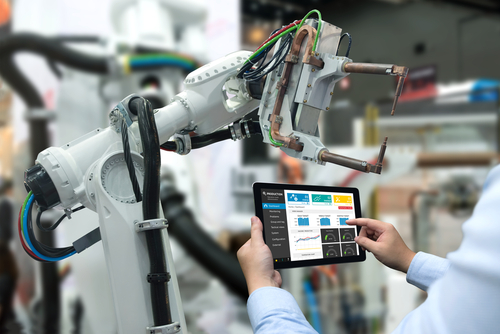
The ability of devices to interact with humans, understand commands and execute them is passé. The Internet of Things (IoT) puts the limelight on the ability of machines to interact with one another. The slow but consistent development of IoT is shaping up a new ecosystem where our gadgets will be able to operate without human intervention. Besides, the global market size for IoT in retail is expected to grow around 94.44 billion by 2025.
The emergence of IoT will inevitably alter the dynamics of the way consumers interact with retail business and the way businesses interact with distribution networks and supply chain partners. More importantly, it will usher in a connected customer model by relying on smart-store applications like smart shelves, beacons, and customer service robots. Making room for these swift connections powered by the internet will help you build a business model that is future ready.
3. Striking the Online-Offline Balance

It is the age of digital customers where the lines between online and offline existences are forever blurring. Brick and mortar businesses need an online extension to sustain themselves. Now, the spotlight is on understanding the dynamics of virtual and augmented reality and creating a marketing strategy that caters to the customers’ dual persona – considering their social media image and real identity – to encourage continued interactions and conversions.
The result – a complete overhaul of the shopping experience by bringing in a consistent omnichannel approach built around a convenient digital backend. For instance, Oasis, the UK-based fashion retailer is closing the gap between in-store and online purchasing by merging shopping experiences across its mobile app, website, and brick-and-mortar stores.
4. Personalized Shopping Experience

Take a look at how e-commerce websites function – bringing customers exactly what they need, every time, on every device, without fail. This carefully curated shopping experience eliminates the need for buyers to browse through the inventory of online stores to find what they need. Over time, this approach toward shopping has been normalized to an extent that customers expect the same out of their retail shopping experience too. Installing smart screens, tablets etc. is one way of using technology to recreate the same sense of personalization in your retail business.
5. Banking on Data
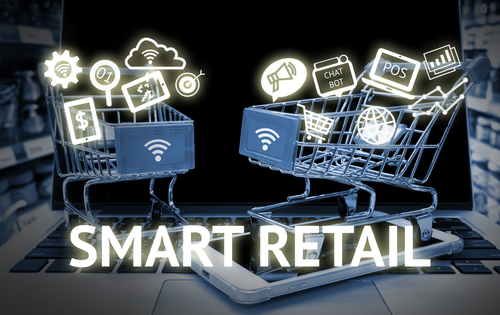
Big data is the next big thing in terms of business operations. Multinational corporations are pumping in billions of dollars to assimilate and organize this seamless information to create the right kind of marketing strategies. While big data may be out of your reach as a standalone business entity, you can create your own pool of data and use it to offer improved retail experiences for your customers.
Fun quizzes, for instances, are a great way to gather insights into your customers’ buying preferences, which can then be used to offer personalized product recommendations. You can take it a step further by tracking these recommendations to know if they are appealing to your customers and tweak them accordingly.
Related Reading: How Big Data and Analytics are Evolving Customer Experience in Retail
[Courtesy : European Bank for Reconstruction and Development]
Meanwhile, other technologies like virtual and augmented reality will continue to grow in popularity and efficiency. As a retailer, the onus of using these disruptive innovations to offer a seamless customer experience falls on you. Pairing with the right technology partner is the first step. Get in touch with our experts today to uplift your retail experience with cutting-edge software solutions.
Stay up to date on what's new
About the Author
Featured Blogs
Stay up to date on
what's new
Talk To Our Experts
The Internet of Things (IoT) is the next big thing in the world of Internet and has the potential to change life in a big way. Much have been written about how IoT will disrupt enterprises, but enterprises are still clueless as to how exactly they would invest in IoT. The confusion is largely owing to the actual implementation still being limited. IoT is yet to attain critical mass and become a normal phenomenon, like what a smartphone is now. However, it is only a matter of time before it becomes so, and enterprises who have a clear-cut idea of where exactly to invest, and how, can reap the early mover advantage.
The IoT Infrastructure Backbone
IoT essentially entails assigning an IP address to any “thing,” and making it thing a part of a wider ecosystem. Research major, Gartner estimates the number of physical “things” connected to the Internet to exceed 25 million by 2020, a big jump from the approximately five billion “things” connected to the Internet today.
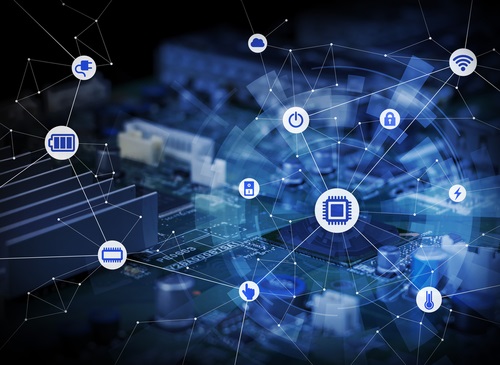
The most obvious IoT investments are sensors, processor chips, and wi-networks, besides supporting equipment such as routers and modems. Hardware firms such as Qualcomm offer IoT chips, and networking companies such as Aruba Network, Ruckus Wireless, and a host of others, offer IoT solutions. However, not all enterprises would need to, or even have the capability to set up custom IoT implementations. They would rather deploy ready-to-go IoT solutions available in the market.
Ready to Consume Products
There is already a huge untapped market for smart devices, from smart cars that navigate automatically to smart lighting that manages energy automatically, and from smart shirts that capture body information to smart thermostats and many other things. Enterprises would obviously need to invest in “things” relevant to their business, or “things” which add value. However, even here the options are not yet clear cut, as IoT ecosystems are still its nascent stage, and yet to mature.
Usually, companies that market smart devices grab the headlines when in actuality such “marketing” companies rely on third-party firms who develop and support the products they sell.
A barometer of which IoT product or project is likely to succeed is the interest shown by investors to the device or project. For example, Google’s Nest Learning Thermostat is widely popular among investors, and backed by Google, is a safe bet for enterprises to control air conditioning and other devices and achieve optimal energy efficiency.
However, it is still early days for IoT products. For instance, Fitbit’s ubiquitous wearable fitness-tracking devices is already a household name, and to the unintended, is synonymous with IoT in the same way Xerox was once to photocopiers. But competitors are snapping at its heels, as evident from Microsoft’s recent launch of its own health-oriented wearable in direct competition with Fitbit.
Other companies, such as GE, are making big investments in innovation for the “industrial internet,” launching a slew of new products that would leverage IoT to enable new possibilities. GE has already pumped $1.5 billion into smart product research since 2012, and the results are starting to bear fruit. Side-by-side, major manufacturers such as Samsung are releasing new “smart” and IoT compatible models of their existing equipment and device ranges. Agri-giant Monsanto has taken over a technology firm that helps farmers better predict the weather, to signify its foray into the IoT space. Devices from such established majors gain the advantage of an established market and client base.
IoT is still an extremely fluid space, and investing in it is a hands-on endeavor. Enterprises need to indulge in a lot of research matching the available solutions to their specific business processes and models.
Early Benchmarks
Several leading companies are already making big investments in IoT, and reaping rich rewards in the form of improved process efficiency, and unlocking new business. Here are some high-profile success stories:
UPS uses sensors to monitor mileage, speed, and engine health of its fleet, thereby bringing in operational efficiency and considerable savings in fuel and associated costs.
Farmers Insurance uses IoT in its core business models, to automate automobile claims resolutions. For instance, the company has deployed a system where a sensor equipped car that gets hit by a shopping trolley in the car park could trigger an automatic notification alert to the car owner, through a smartphone, and file an insurance claim automatically.
Disney World’s Magic Band makes guest management at its resorts seamless. Guests can take fast pass rides, order food, park cars and do more with these bands, in a seamless way, and the company gets greater insights to fine-tune its operations accordingly, creating a win-win situation.

Soon a customer may be able to simply walk into a store, pick up what she like, and leave. IoT sensors would capture all the required information, and collect payment automatically.
Enterprises need to take a close look at their business models to see how IoT will fit in, to improve processes, deliver better services to the customer, and expand the scope of doing business. Investment in IoT needs to focus on this direction.
Invest in the Analytics
Setting up the IoT infrastructure is one thing, and benefiting from it is another thing altogether. Many enterprises investing in IoT make the mistake of focusing their energies on setting up the infrastructure. Success requires giving equal focus on the analytical tools that aggregate data from sensors, integrate it with information already available in the company database, subject the data to analytics, and present the results to the stakeholders, in the form of actionable information.
Several organizations and vendors offer solutions to help enterprises analyze and make sense of the vast amount of data the sensors collect. Since actionable information that benefits depends on the nature of the business, there is scope for considerable customization here. Enterprises would do well to rope in a competent strategic partner who is strong in delivering cutting-edge apps and other software solutions that can leverage IoT.
Stay up to date on what's new
About the Author
Featured Blogs
Stay up to date on
what's new
Talk To Our Experts
The service model is the in-thing in enterprise IT. Just about anything the enterprise requires, from storage to security, and from applications to hosting, is now available on the cloud, as a service. Such services offer enterprises the unprecedented convenience of paying for such resources as neatly packed line items on a monthly statement, a big jump from the often messy derivation of costs from various inputs and sources.
In tune with the trend, moves are afoot to deliver IoT in a service model. It matters little that IoT is yet to be entrenched, and the dust has hardly settled on IoT standardization. When even highly architecturally complex applications can be delivered in a simple service based model, why should the Internet of Things (IoT) be any different?
Commoditized Hardware
The latest trend in hardware is the increasing preference of open, modular hardware over custom or application-specific hardware design. Specialized custom-built hardware is fast being relegated to the fringes. A case in point is the success of the bare-bones Raspberry PI, designed as a bare-bones board, on which the required functionality may be added as required. For instance, wi-fi connectivity, analog sensors, and other capabilities each would require adding additional modules.
One of the earliest innovations that could set the trend for IoT as a service (IoTaaS) is the line of wi-fi sensors developed by the Naperville-based ConnectSense. The range of Wi-Fi sensors for home and building automation are for various purposes, such as temperature, humidity, motion, light, dry contacts, and more. The company organizes the portfolio around a base platform, allowing deployment of multiple sensors quickly, with only minimal modifications required to the common platform. The software is delivered through a proprietary cloud platform, sparing the need for additional hardware resources on the physical sensors. In the present business model, users may install the required hardware module at $150 a piece, and the cloud-based software subscription comes at no extra cost. However, there is nothing preventing a new model wherein users subscribe to the cloud-based software on a need basis and get the associated hardware free of cost! ConnectSense’s system is already in use in several applications, such as agricultural observation and data center monitoring.
Sensor based Services
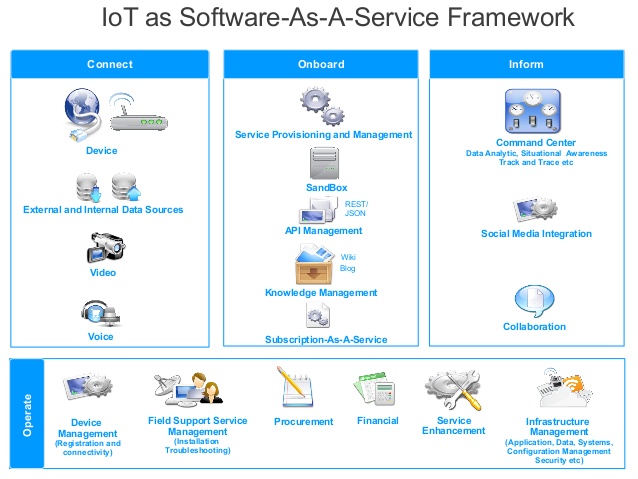
IoT as a Service (IoTaaS) would help enterprise implement IoT technologies without having to deploy complicated software stacks in-house, leave alone go through the arduous task of integrating such software with existing enterprise architecture. The technology is already in place.
Nokia’s recently launched worldwide IoT network grid (WING) is an IoT managed service for the enterprise market, offering connectivity and management services to businesses, and designed for use in connected cars, connected freight containers, and other similar applications. Nokia offers multi-tenanted connectivity, through M2M Core, which supports IoT communications and smartphone traffic, and Cloud Packet Core, which gives each enterprise exclusive access to a discrete segment of the core network. The system incorporates device connectivity via the e-SIM subscription model, and also the company’s Impact IoT platform, allowing them to maintain connectivity to local provider networks. In addition to this connectivity, Nokia’s IMPACT IoT platform offers device management, security, and analytics.
Canada’s Rogers Communications offers a suite of services that simplifies deployment and support of devices, services, and connectivity. It is already in use in several key services, such as “Farm and Food Monitoring” and “Level Monitoring,” to oversee sensors and other endpoints in refrigerators, field machinery, waste disposal machinery, and everywhere else, enabling organizations to offload day-to-day operations effectively.
Igor Leprince, Head of Global Services at Nokia, opines:
“IoT connectivity as a managed service is an answer for enterprises to the current IoT deployments that are hampered by the patchwork of business agreements to connect devices around the world. These services allow enterprises to get enterprise-class services at lower cost, with greater scalability and functionality, compared to what enterprises can reasonably conjure up in-house, and be spared to the hassles of doing so as well.”
Pure IoTaaS
Managing sensors and edge devices is only one piece of the overall IoT chain. When advanced analytics and automation that powers IoT functionality comes into the mix, the picture becomes complex.
Pure IoTaaS, which is leveraging the “things” itself for revenue in a service based model remains a tricky proposition. The underlying stumbling block is the limitation of using the “thing” for more than one purpose. For instance, it is hard to offer the dongle in the car on a service offering, but if the same dongle can be used for a multitude of service, there is a strong case for it. However, it is only a matter of time before technology advances to offer solutions that remove such underlying limitations. Just as the smartphone today has replaced the need for stand-alone wrist-watches, flashlights, alarm clock, camera, and music player, IoT “things” could in future be used for different things, leveraging the same hardware.
Cisco’s recent $1.4 billion acquisition of Jasper is a big step in pushing IoT as a service. Many many millions of “things” are already connected to Jasper’s network, allowing ecosystem partners to bring their service-based products to market and run it at scale.
The true benefit of IoT comes not by the efficiencies on offer by connecting everything, but by using such connected ‘things’ to overhaul the business model from static products to dynamic services. In such a model, products become dynamic, and businesses may add new services and revenue streams. A business could, for instance, derive for itself more value by selling printing-as-a-service than selling a few printers. GE is already selling power-by-the-hour jet engines, wherein the user of the engine pays the amount of power consumed by the engine by the hour, rather than an upfront capital cost.
The basic underpinnings of these systems still under development, but it is only a matter of time before the complexities are resolved, and IoT embrace service-level operations in line with other areas of the enterprise data stack. IoTaaS is most likely the next major development in business technology.
As competition mounts. IoTaaS is one-way companies can innovate and gain one-upmanship over the competition. Make sure you have all your bases covered, and tie-up with a strategic partner to have your systems in place, to leverage the coming IoT wave.
Stay up to date on what's new
About the Author
Featured Blogs
Stay up to date on
what's new
Talk To Our Experts
The noted English poet A L Tennyson’s words “Let the great world spin forever down the ringing grooves of change” captures the impact railways and locomotives brought about in the 19th Century, transforming the world from a grouping of feudal villages to an interconnected urban and industrialized world. Today, the world is in the throes of yet another mobility induced revolution, propelled by artificial intelligence, IoT and a myriad of other technologies that promote convergence and connectivity. This new disruption will be just profound, and likely to change lives forever.
A portent of things to come is Venture investors placing $5.7 billion into transportation businesses in 2016, twice the level of investment in the previous two years combined. The big thing in transportation that happened during the period, Uber and its cousins such as Lyft and GrabTaxi would seem rudimentary compared to the technologies on the anvil.
Autonomous Vehicles
Think artificial intelligence, and the first thing that pops up into most minds is the driverless car. Autonomous vehicles, which facilitate hands-free and feet-free driving are soon set to go mainstream. What works in favor of such vehicles is the ever decreasing cost of production. LiDAR laser sensors that Google uses on its autonomous vehicles cost $70,000 three years ago, it now costs just 10% of this amount now. New technologies now cost even less.

The opportunities that arise from autonomous vehicles are endless. Improved fuel efficiency and greater safety owing to the elimination of “human error” from the equation are the direct benefits, but the indirect benefits are much more. Autonomous cars can plot the best route to the destination, saving time and money, and deliver freedom from traffic jams. Cities can reclaim public spaces devoted to parking. The smaller mass and weight of the autonomous cars enable propulsion by compact, efficient, and environmentally friendly powertrains, reducing energy consumption considerably.
Collaborative Consumption
Collaborative consumption brings most of the benefits of the cloud to the mobility space. Instead of investing in owning and maintaining a vehicle, technology makes it increasingly viable to rent a vehicle on demand, hassle-free, and reliable.
The fleet of autonomous, shared vehicles, fully integrated to the road infrastructure and connected to the internet will create incredible value.
At a macro level, the automobile market is worth $20 trillion, but the utilization rate of this asset class is just 4% to 5%. Uber-inspired on-demand mobility technology would increase efficiency to a potential 10% utilization and at the same time considerable capital which can be diverted to other productive uses.
At the individual level, users are free of the hassles of maintaining the vehicle, navigating traffic, speeding tickets, finding parking space, charging or fuelling up the vehicle, and several other non-productive tasks, time which they can put to better use realizing their core competency.
From a business perspective, the simultaneous rise of fully autonomous networks of long-haul trucks can operate for extended time periods, covering longer distances, with lower costs. The direct benefits are quicker deliveries and decreased costs.
There would be direct cost savings as well. As collaborative consumption gain traction, average costs per passenger mile is expected to dip from around $1 per mile today to about 30¢ per mile.
Revamped Public Transportation
The rise of autonomous vehicles and connected vehicles would also revamp and revolutionize public transportation as we know it today. The sci-fi take “Beam me up, Scotty” may just become closer to reality as individuals can access a reliable, fast and transportation at just a few swipes of their smartphones and get to their destination in the most comfortable, fast, and cost-effective way possible.

Uber-like solutions for public transportation, combined with autonomous vehicles, would mean public transport vehicles becoming flexible enough to cater to real-time demands of mobility, rather than individuals being forced to adapt to timings of public transportation.
Fully autonomous cars, accessible on demand, anytime, anyplace, would make last-mile connectivity hassles a thing of the past, and would in many cases deliver seamless end-to-end transportation in a single vehicle, putting an end to public busses and trains.
As seamless multimodal transportation becomes the new norm, commuters would achieve seamless interoperability, enabling them to reach their destination using multiple, connected modes of transportation, on a single fixed price charged on a single payment system, with minimal walking and wait times. The integration of robotics to the mix may also allow them to travel hands-free, as their luggage, be it files or handbag reaches the same destination at the same time, through its own route.
Efficient Multimodal Network Solutions
Several start-ups are already working to improve transparency and reduce friction in public transportation. Some of the methods already popular include crowdsourcing transit data, moving ticketing to the smartphone, and calculating prices for multiple trip options. Infusing artificial intelligence to make predictive analysis, linking IoT data to automatically calculate the demand for routes, and more are rich possibilities for the future.

A case in point is the Caltrain, the fastest and most cost-efficient way to travel between San Francisco to San Jose. The trip, however, involves long wait times and cumbersome schedules. Effective integration of data from users’ calendars, user’s geo-location, and travel preferences would allow smart apps to plan highly efficient trips, using real-time data. Integrating such data with sharing services extending from cabs to e-bikes offers an effective solution to “last mile” challenges as well.
At the backend, technology would be put to increasing use to develop and manage the vehicle-operating and traffic network information system that helps direct and control the movement of autonomous vehicles and shared mobility fleets.
In the new scheme of things, enterprises that can capture aggregate, and analyze mobility-related data in real time can aspire to gain a foothold in the “virtual” value chain. Enterprises would do well to forge a strategic partnership with tech solution provider companies who have the talent and the expertise to deliver cutting-edge solutions that allow businesses to stamp their digital competency so essential for success. We have the right talent and wealth of experience to serve your needs well.
Stay up to date on what's new
About the Author
Featured Blogs
Stay up to date on
what's new
Talk To Our Experts